FiiO Warmer R2R
Retro charm, modern convenience, and provides the sound options that many audiophiles want
Some products arrive with a very specific promise. The FiiO Warmer R2R sets out its stall right on the faceplate with mechanical VU meters and a proudly retro aesthetic, and under the hood it doubles down with a discrete R2R DAC and a tube output stage. This is not a measurement chasing DAC so much as a deliberate choice to create a retro sounding DAC with some character. I absolutely love how it looks in my setup, it is now probably my favourite DAC but not directly for how it sounds, more because it is not a typical boring ‘DAC’ box, yet has options to sound both transparent if I want it that way, but also options that provides that warmth and engaging sound so many people crave.
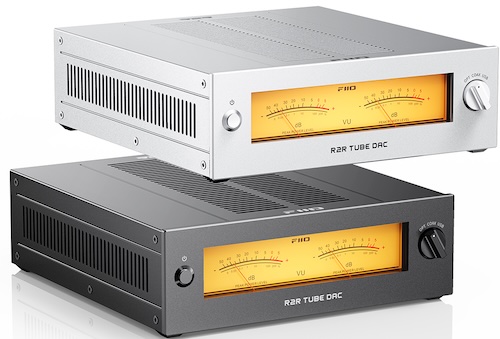
I would like to thank FiiO for providing the Warmer R2R for this review.
If you are interested in finding more information about this product, you can find it at product page link
At around $329, the Warmer R2R enters a space where many listeners are curious about R2R and tube gear, but are not keen to jump straight to cost-no-object components. Earlier this year I walked around Munich High End and did not anything nearly as impressive looking as the Warmer at anything like this price. Overall, I feel the Warmer R2R is almost perfect at “giving people what they want”: the retro vibe and feel of an R2R DAC with a slight tube glow and that unmistakable stylish build. Basically, a ‘high-end’ experience without the high-end cost.
FiiO has basically created a perfect retro DAC, and you have to respect the engineering, especially at this price point. But does it sound good? Or maybe the important question is does it sound ‘retro’ enough. So, as you will hopefully see in this review it offers something unique, so paired with the right amplifier and using OS mode you get a perfectly respectable ’transparent’ output, but paired with some other FIIO products, and switching to NOS mode you definitely get a warm, more organic sound, a sound that some people will cherish as ’natural’.
So does this sound ‘better’? In Ireland, we often call this an ’ecumenical matter’, i.e. your religion decides how you feel about it. I will try and provide as much information as possible in this review.
But before I get into the details, I thought it might be interesting to have a small intro section on R2R technology and some analogies, feel free to skip this section if you are more interested in the specifics of the Warmer R2R:
R2R Analogies
The recent resurgence of R2R DACs—driven in part by FiiO’s impressively priced K11 R2R and K13 R2R has prompted a renewed interest in how they differ from modern Delta-Sigma designs. To frame these differences clearly, I think it helps to use some subjective and objective analogies for the comparison.
Subjectively, many listeners who favour R2R DACs describe Delta-Sigma DACs as too precise, in the same way that some art enthusiasts eventually drift away from hyperrealism toward something more organic or textured. Impressionism, for example, emerged as a reaction to strict Realism, and the popularity of Instagram filters reflects a similar desire for a curated, coloured presentation rather than clinical accuracy.
Objectively, a very different but also useful analogy is with the shift in automotive engineering from carburetors to electronic fuel injection (EFI) systems. Carburetors are older, mechanically elegant but limited in precision and consistency, whereas EFI delivers more accurate, stable, and efficient performance through digital control. Some enthusiasts still swear by carburetors for subjective reasons, but most drivers prefer the measurable benefits of modern fuel injection. I feel the situation with R2R versus Delta-Sigma DACs mirrors this dynamic.
R2R OS versus NOS Modes
FiiO recent R2R DACs allow you to switch to either Oversampling (OS) or Non-Oversampling (NOS) mode, and these settings have as you will see both measurable and subjective differences. NOS mode bypasses digital interpolation filters and relies directly on the ladder’s stepped output. This introduces high-frequency imaging artefacts above the Nyquist limit, some of which can fold back into the audible band through analog stages or driver nonlinearities. The result is a gentle high-frequency roll-off, typically around –3 dB at 20 kHz with 44.1 kHz PCM, along with the potential for additional HF distortion.
OS mode, by contrast, performs digital interpolation that pushes imaging well beyond the audible band. Reconstruction becomes cleaner and linearity improves, with remaining differences depending on the filter implementation. With the Warmer R2R the OS mode provides an accurate reconstruction of the analog signal, while objectively not as ‘accurate’ as DS DACs it is still beyond the tresholds where you might hear a difference, in otherwords, it is a good enough DACs for most users.
Subjective Differences between OS and NOS
These technical distinctions translate into distinct listening impressions. NOS usually sounds softer or slightly blurred in the upper treble due to its HF droop, which can make cymbals less sharp and transients a little rounder. Some listeners perceive an increase in depth because the reduced high-frequency energy shifts focus toward the midrange. NOS can also sound denser or warmer through the mids, especially in R2R designs that incorporate tube-based output stages, which may introduce subtle sub-bass roll-off. Vocals may seem closer, and the transition from bass to midrange takes on a gently thickened character.
OS playback tends to sound cleaner and more solid in imaging. With imaging artefacts suppressed and phase behaviour better controlled, spatial cues lock into place more precisely. Transients sharpen, stereo separation improves, and the overall presentation feels more stable and well-defined. Basically, like a good delta-sigma DAC.
Anyway, let’s look at the unboxing experience:
Unboxing and Build Quality
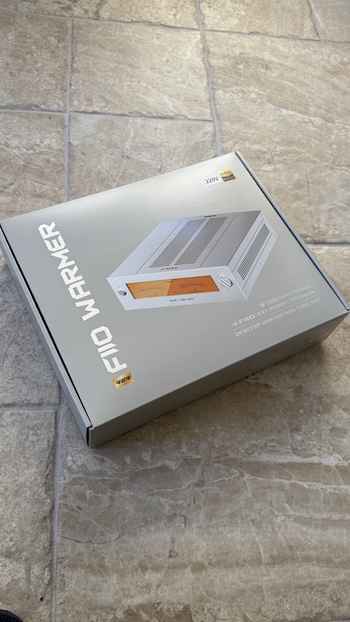
The unboxing is typical of recent FiiO products and high quality:
Turning to the back of the packaging, there is minimal information:
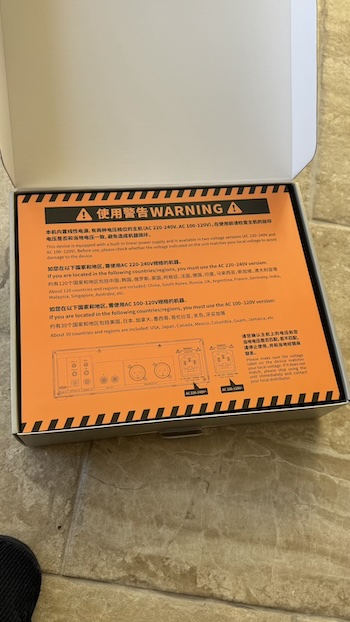
Lifting the lid, you are initially presented with a warming about the voltage to use with your power supply:
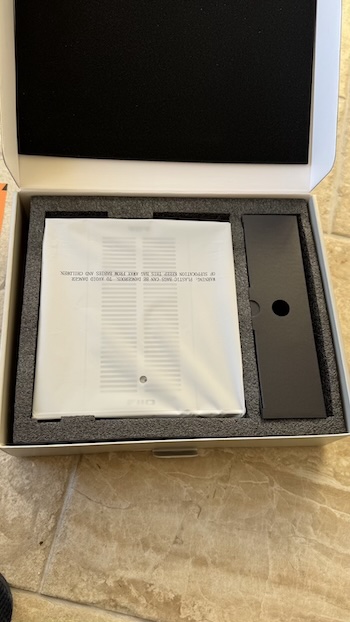
Inside, the Warmer is protected next to a box with the accessories:
The quick start guide is concise and clear:
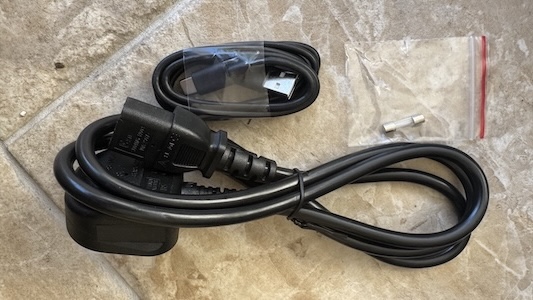
There are minimal accessories in the box with the power lead, a usb-c cable, and a spare fuse:
The chassis feels dense and solid in hand, with a finish that catches the light
nicely, but the VU meters are the star visually:
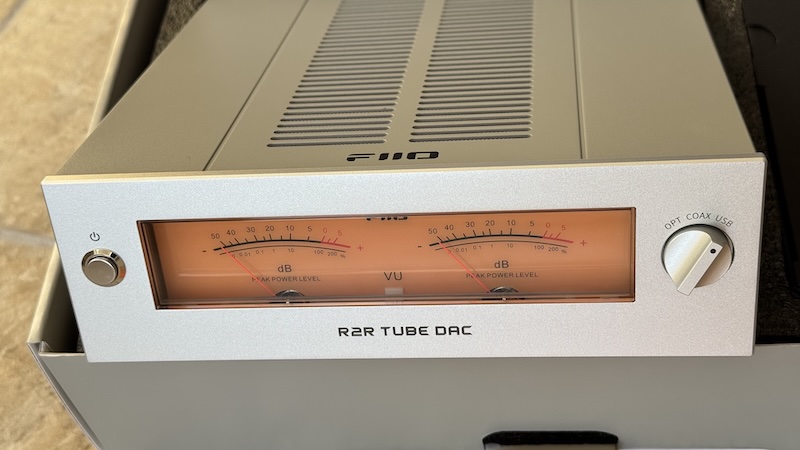
But I actually also appreciate the minimalist look of the front of the Warmer. FiiO could have added lots more switches, but in a classy move, most of the switches are on the back
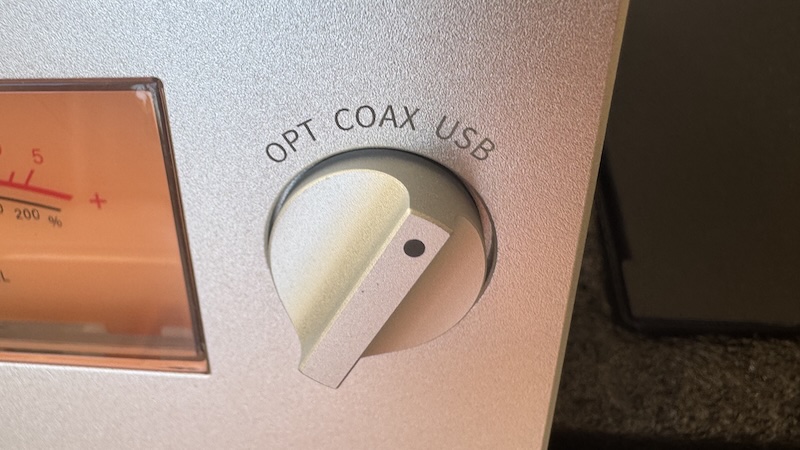
Turning the input selection knob has a pleasing feel:
The input selector and OS/NOS toggle are simple and nicely out of the way on the back:
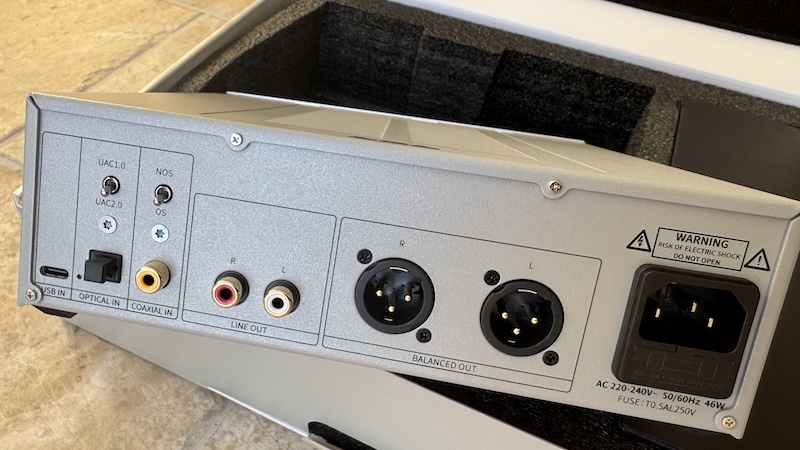
Note: I would love a future Warmer model that offered a third way here with a DeltaSigma (DS) switch. I feel with that option, the Warmer R2R would be a DAC that appeals to all ‘religions’, both the subjectivists and the objectivists, especially if the Tube Buffer output stage could also be made optional with a different switch.
Also on the back, there is also a switch for usb uac-1 or 2 (mainly so the Warmer can act as a DAC for legacy systems like gaming systems). So, this is possible, welcome by some, but I doubt most people will need to use this option.
Then there are the typical 3 DAC inputs of usb-c, coaxial, and optical digital inputs, and you get both RCA and XLR line outputs for easy integration into balanced or single‑ended chains. There is no switching between RCA and XLR outputs so both are always available.
Overall, I like the minimal look of both the front and back of the Warmer.
That first power‑on glow hints at what the Warmer R2R is about:
The gentle illumination at the back if from the tubes:
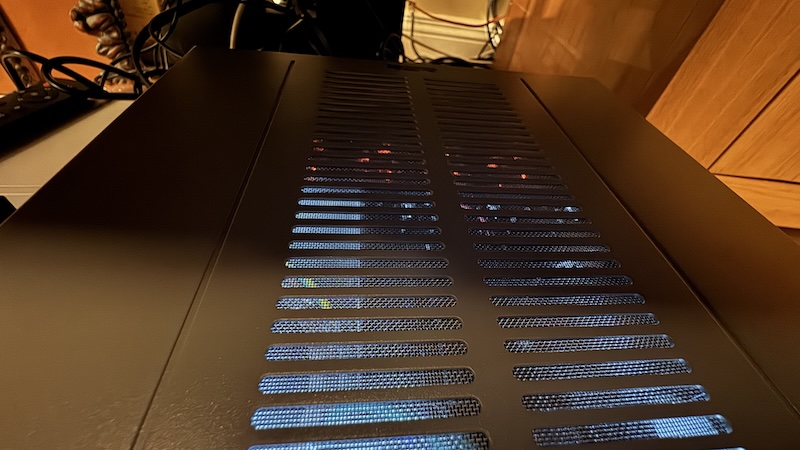
While I appreciate the subtle glow of the tubes, I feel FiiO are probably missing a trick not having the tubes ‘on-display’ like many audio devices using Tubes.
Desktop Use and Chain Integration
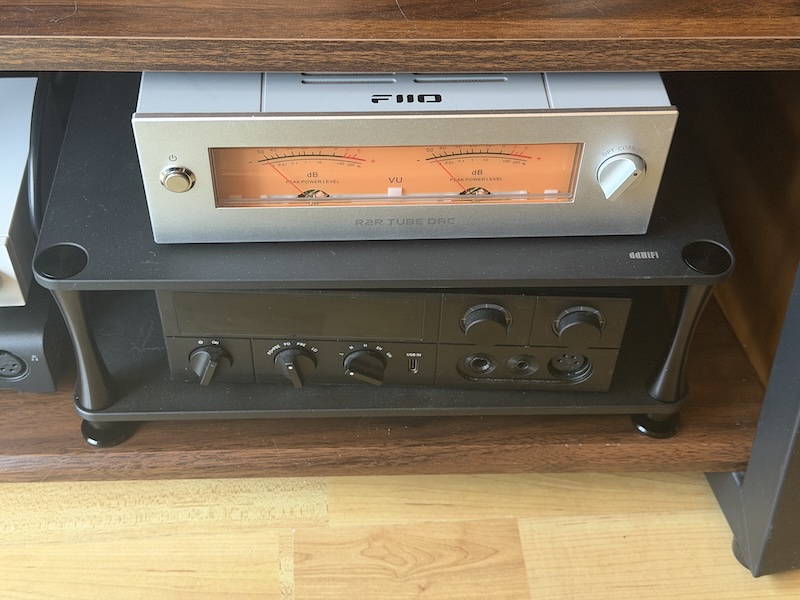
I have been listening the Warmer R2R integrated in my home listening setup:
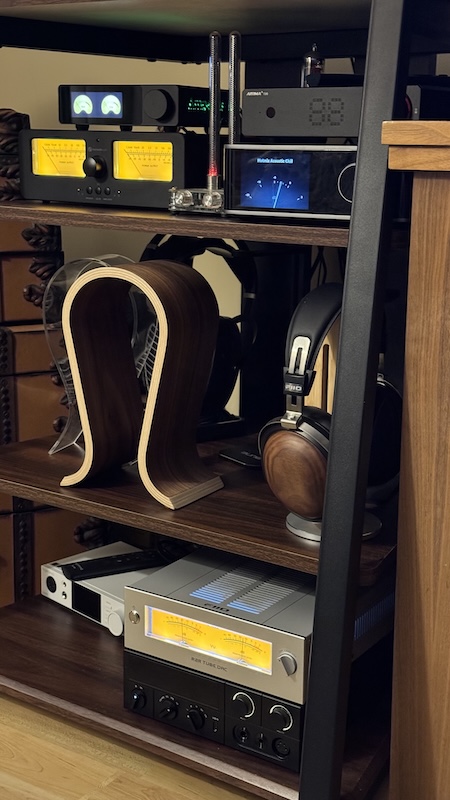
As you can see I like VU Meters :grinning:
Keeping the Warmer Cool: ddHifi Stands
I initially had the Warmer sitting on top of the K17:
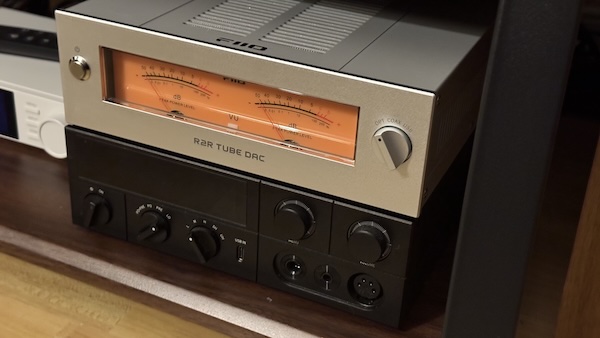
I found the Warmer was literally getting too warm for my comfort, so I had spotted some ddHifi stands that worked well for me. I got these via ddHifi AliExpress store.
With this stand you get nice vents underneath to help your device keep cool:
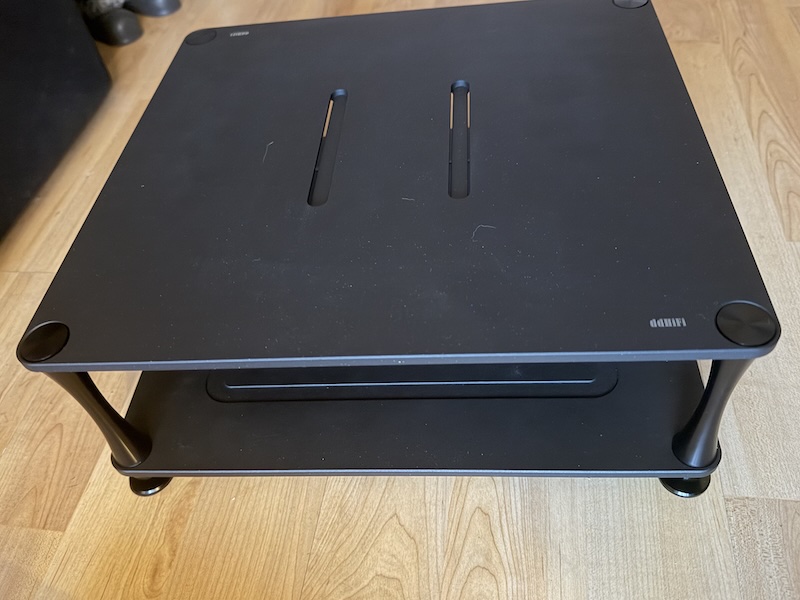
These stands are very nicely machined and modular by design you can stack them to achieve different heights depending on your needs.
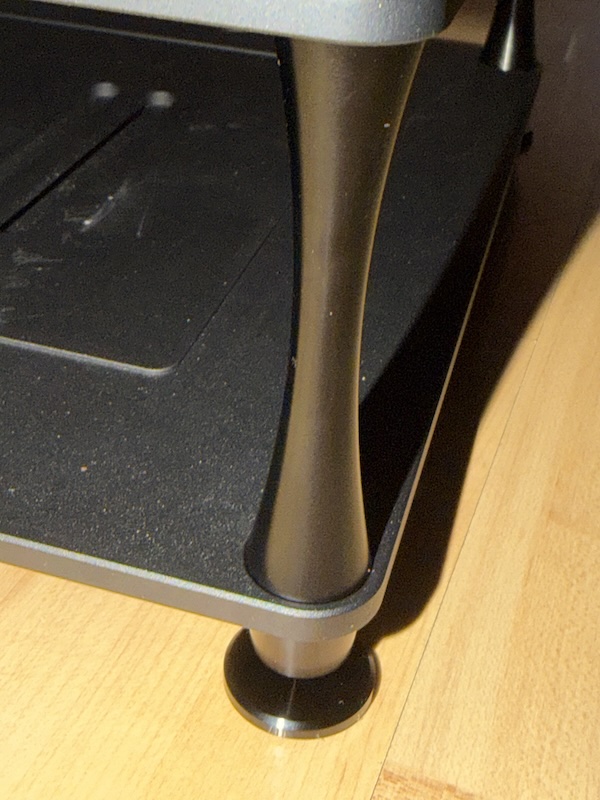 |
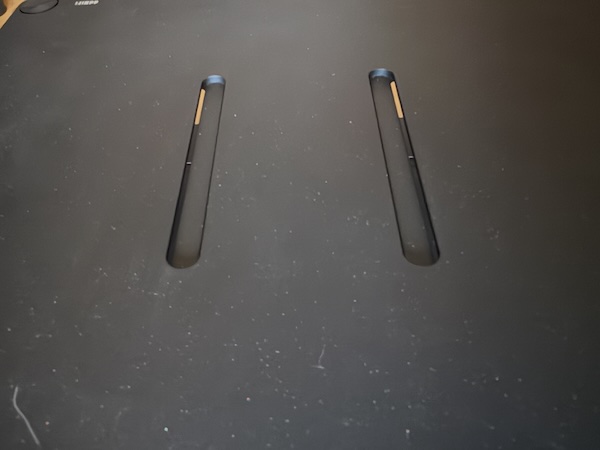 |
And maintaining a visually cohesive look with the K17 even though my K17 and Warmer are different colors:
Features and Performance
The FiiO marketing information highlights the four replacable E88CC tubes:
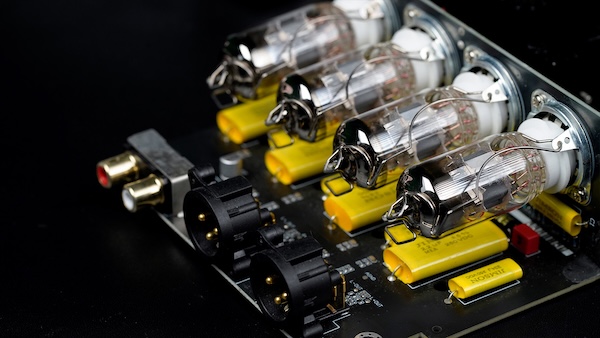
I believe some people are already experimenting with replacing the tubes but I don’t feel that would add any sonic benefits and given the tubes are mostly hidden it doesn’t add any visual benefits either.
As a software architect, I do love to see audio architecture diagrams and this is what FiiO provided for the
Warmer R2R:
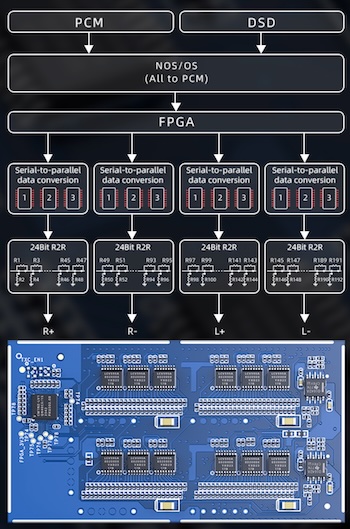
Though compared to the K17, the internals of an R2R DAC are much simpler as I feel that is the point, a return to simpler technology.
Sound Impressions
Overall, I felt the sonic differences were subtle, but I imagine other reviews will talk about massive sonic differences. But here are my thoughts:
Via the NOS mode, Warmer R2R adds body and a slightly more intimate focus, bring forward the midrange. Bass has a touch more bloom and weight, not in a way that obscures the rhythm but in a way that fills out notes and makes kick drums and bass guitars feel a little more rounded. Midrange takes on a pleasing density, with vocals becoming a shade more present and textured. Treble is smooth and relaxed rather than surgical, and cymbals trail with a sweetness that keeps long sessions comfortable.
The combination of the tube stage and the discrete R2R DAC create a gently dimensional image where instruments occupy a tangible space, not pushed unnaturally wide, but layered in a way that feels convincing. It is not a microscope; it is more like moving a row or two closer in a small venue. If you crave clinical separation at all times, a DS DAC like the ones inside the K17 is the tool for that job. If you want to lean into a warmer, more enveloping presentation on certain recordings, the Warmer R2R delivers the experience that many listeners actively seek.
Via OS mode, and when paired with a dedicated powerful headphone amplifier like the Schiit Midgard or the Aune N7 I feel you are getting a transparent / neutral presentation which makes a nice contrast to the OS mode. It is this reason I feel the Warmer R2R is a great addition to any home audio setup.
Specifications and Measurements
FiiO provides lot of detail specifications for the Warmer R2R here but the following are the key technical details I feel:
| Item | Spec |
|---|---|
| Name/Model | WARMER R2R |
| Hardware solution | Overall control: GD32F303RET6 |
| DAC: FiiO proprietary R2R DAC | |
| USB decoding: SA9312L | |
| AMP: OPA1642AIDR×2 + E88CC×4 | |
| Maximum supported sampling rate | USB decoding: 384 kHz/32‑bit; DSD256 |
| Coaxial decoding | 192 kHz/24‑bit |
| Optical decoding | 96 kHz/24‑bit |
| Volume control type | No volume control |
| USB port | Type‑C USB ×1 (data transmission) |
| Digital coaxial input port | RCA port |
| Digital optical input port | Optical port |
| Single‑ended line output port | RCA port ×2 |
| Balanced line output port | XLR3 balanced port ×2 |
| Audio Parameters (RCA out, OS mode) | Spec |
|---|---|
| THD+N | About 0.052% (1 kHz/−7 dB @ 10 kΩ) |
| SNR | ≥112 dB (A‑weighted) |
| Crosstalk | ≥96 dB |
| Noise floor | <4.5 µV (A‑weighted) |
| Frequency response | 20 Hz–20 kHz: attenuation <0.6 dB; 20 Hz–45 kHz: attenuation <2.4 dB |
| Line output level | 1.8 Vrms (1 kHz @ 10 kΩ) |
| Audio Parameters (XLR out, OS mode) | Spec |
|---|---|
| THD+N | About 0.053% (1 kHz/−7 dB @ 10 kΩ) |
| SNR | ≥114 dB (A‑weighted) |
| Crosstalk | ≥104 dB |
| Noise floor | <7 µV (A‑weighted) |
| Frequency response | 20 Hz–20 kHz: attenuation <1.5 dB; 20 Hz–45 kHz: attenuation <2.4 dB |
| Line output level | 3.3 Vrms (1 kHz @ 10 kΩ) |
So, a THD+N of 0.053% is roughly a SINAD of 65 which is poor by ‘Delta Sigma’ terms but what you should expect from most R2R DACS with tube buffers. In NOS mode you should expect additional harmonics and, consequently, a lower SINAD, which I feel is entirely in line with the intended design goals.
If you come to this product seeking the lowest possible distortion numbers, you are missing what it is trying to achieve.
FiiO’s Official Measurements
Here are FiiO’s own published measurements showing the Warmer R2R’s performance characteristics:
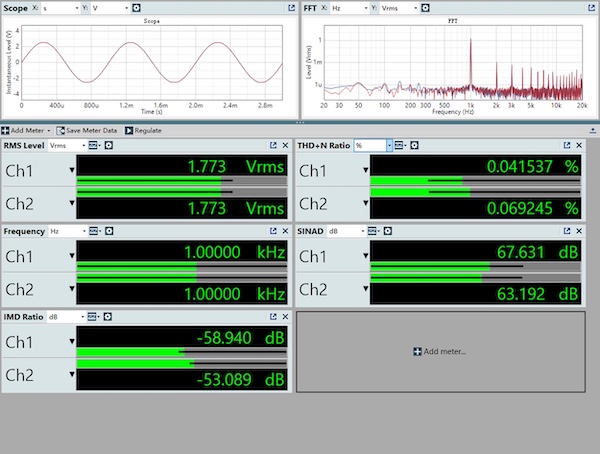
The SINAD chart illustrates what you would expect from a tube‑equipped R2R: modest aggregate distortion figures with a harmonic profile many listeners find euphonic. In OS mode the results are cleaner; in NOS, harmonic content rises in a way that corresponds with the slightly warmer, more “filled‑in” presentation.
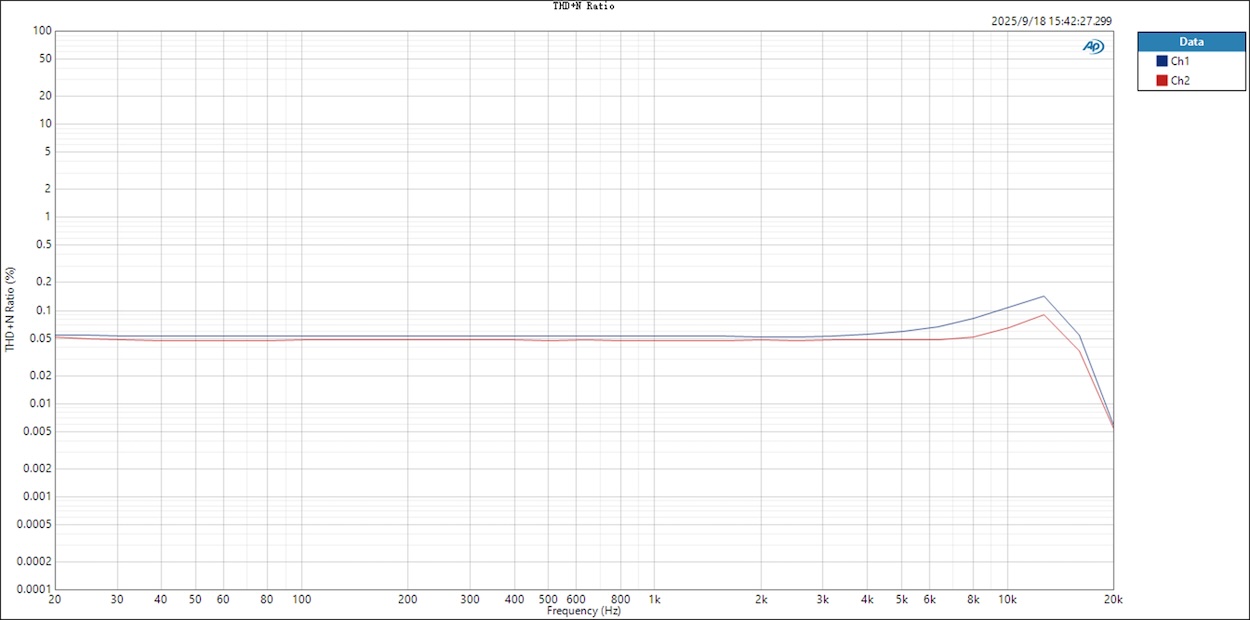
A complementary view of THD+N over frequency shows how those harmonics manifest across the band, with the upper treble revealing more activity in NOS. None of this is intended to chase state‑of‑the‑art numbers; it is about delivering a sound that many prefer in real listening.
Practical Measurements: Real-World FR Impact with FiiO FT13
To understand how the Warmer R2R affects the final frequency response at the ear, I initially conducted a series of practical measurements using the FiiO FT13 headphones measured on my standard headphone measurement rig. I was already measuring the FT13 for its review, so I thought I would have some fun doing some measurement of the Warmer at the same time.
These measurements compare the direct K17 output (DS reference) against the signal routed through the Warmer R2R into the RCA inputs of the K17 both OS and NOS modes. I shared these results on AudioScienceReview, which I think sparked some interesting technical discussion as it does show the Warmer R2R is measurable different than other DACs. The idea was the headphone was not moved for the measurements only the volume was aligned and the usb was routed initially through the K17 directly but then via the Warmer R2R usb-c input for the OS and NOS measurements.
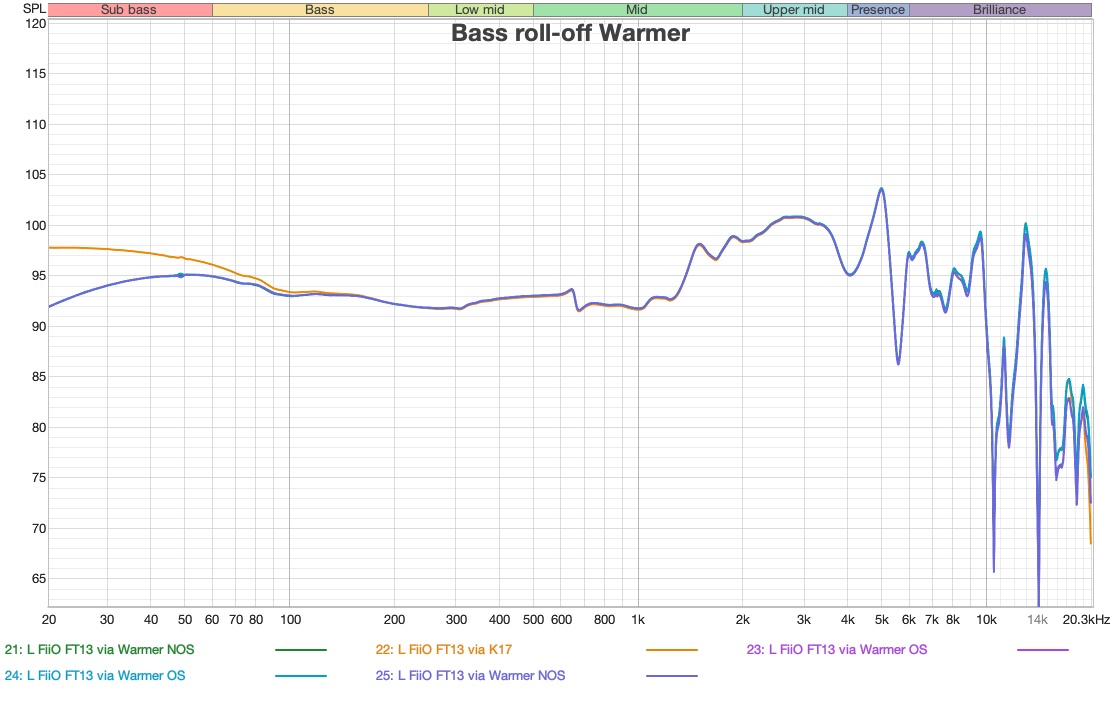
The first measurement shows the complete frequency response comparison. Two key differences are immediately visible, a treble reduction in NOS mode and the most obvious was a bass roll-off when using the Warmer R2R with the K17.
The bass roll-off was the thing that sparked some discussions on ASR, but I will get to those in a minute but first lets discuss the treble differences:
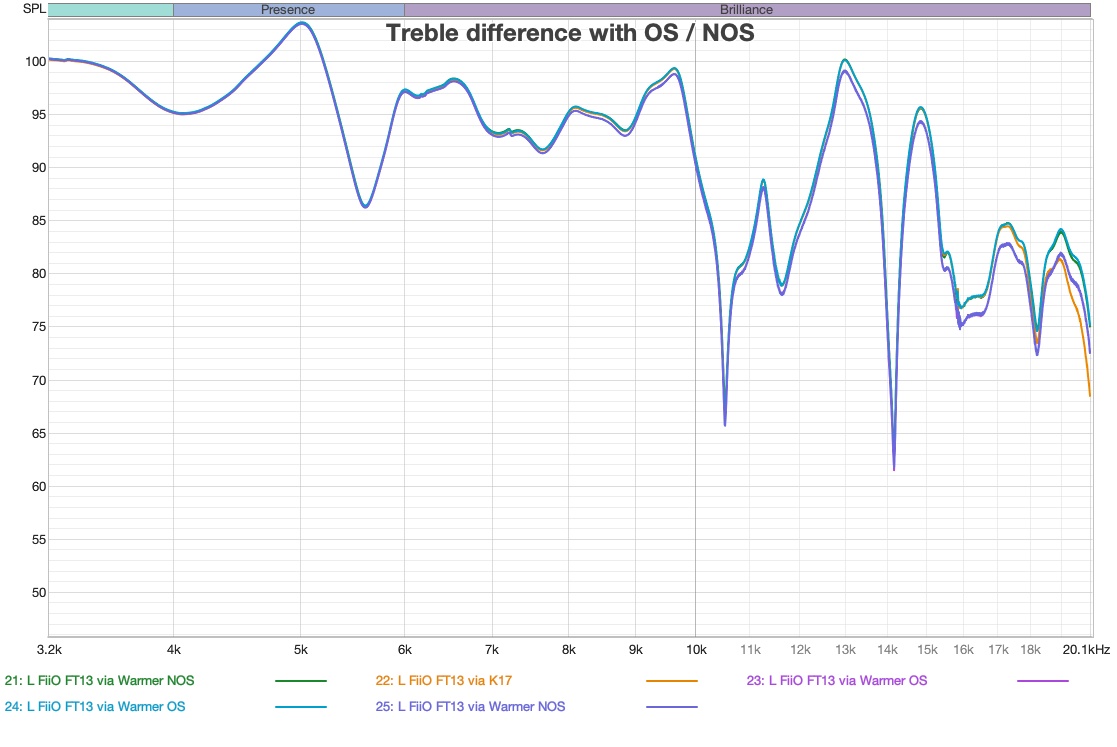
Treble differences: OS vs NOS modes
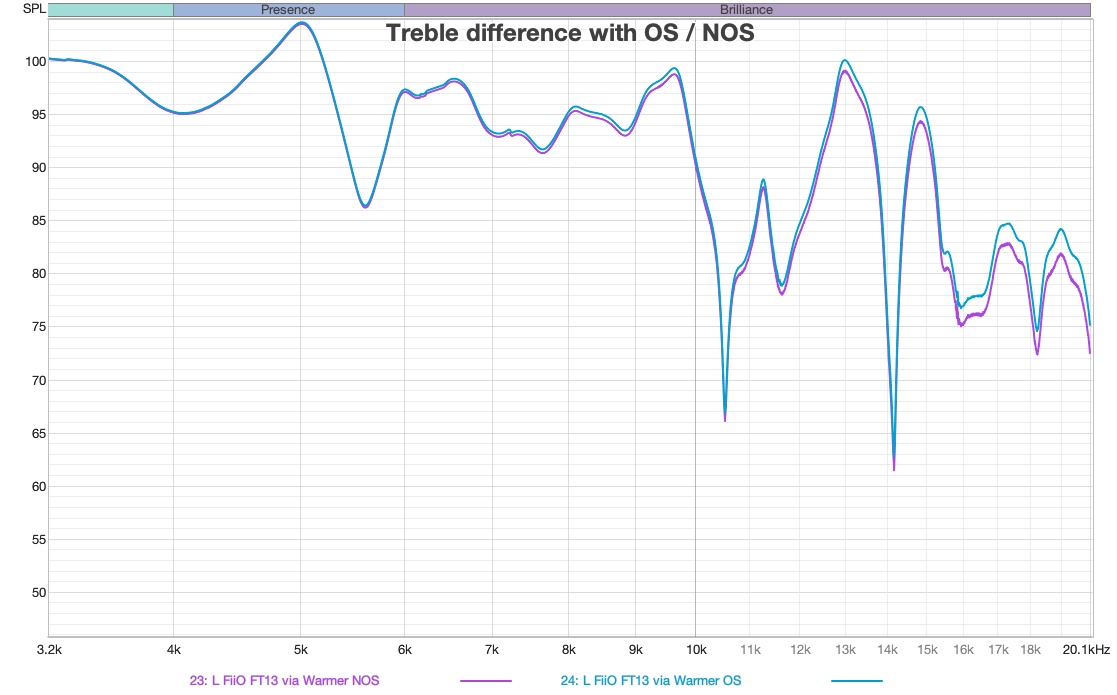
NOS mode introduces what amounts to a gentle high-shelf filter starting at 5Khz-6Khz, lowering the average treble response. This is a well-known characteristic of non-oversampling DACs, the lack of digital reconstruction filtering results in a natural roll-off at higher frequencies. Importantly, this does not mean NOS is inherently superior to OS with parametric EQ applied; both approaches can achieve similar end results, but NOS delivers this character as an integral part of its design and will carry some potential side effects into the FR response.
Treble differences: OS vs Delta Sigma
While the majority of the signal was exactly the same between OS mode via the Warmer R2R and signal directly from
the K17 (without being routed through the Warmer R2R), there was a small difference in the way the reconstruction
filter handles the upper treble region, so as you can see below in the 19Khz-20Khz region was some difference with
the K17 rolling off the upper treble:
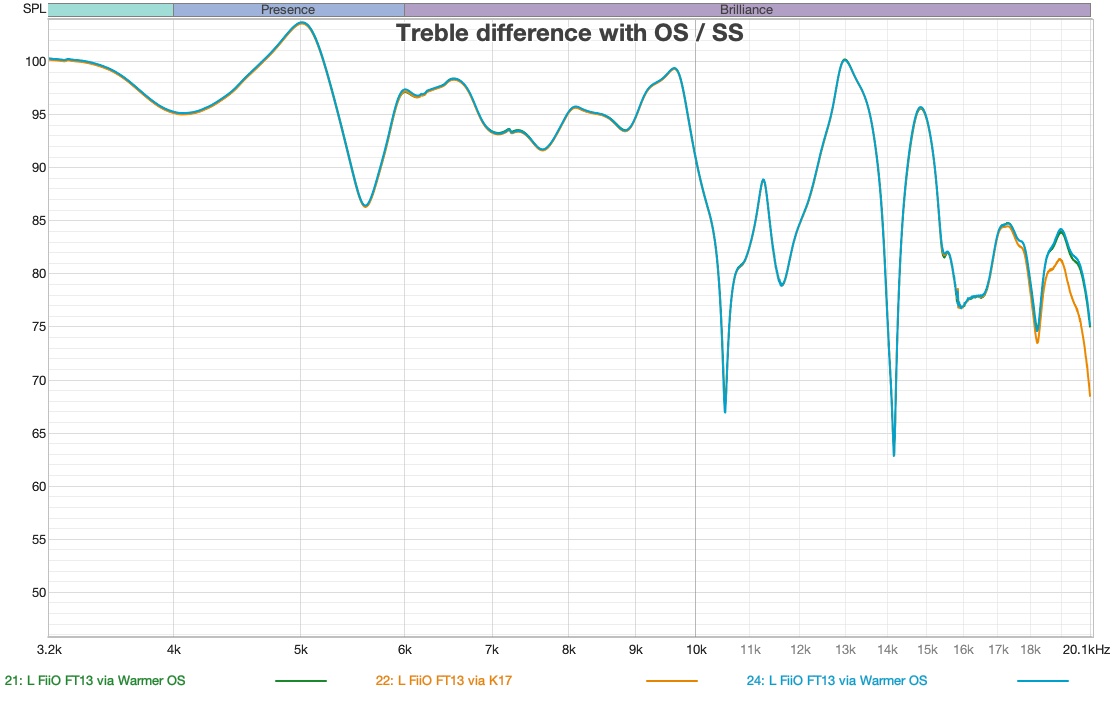
Note: I could have switched the digital filter implementations on the K17.
Bass Roll-Off and Output Impedance Discussion
The bass roll-off visible in these measurements initially puzzled me, but thanks to detailed feedback from @solderdude ( of DIY-Audio-Heaven) over on ASR, the technical explanation became clear. The Warmer R2R uses relatively small output coupling capacitors (2.2 µF for RCA, 1.1 µF per XLR phase). These capacitors form a first-order high-pass filter in combination with the input impedance of the downstream device.
When connected to the K17’s line input (which has a typical 10–22 kΩ input impedance), the resulting high-pass corner frequency sits in the upper single-digit hertz range. This produces measurable bass attenuation and phase rotation in the deep bass, which is what we’re seeing in these measurements.
Crucially, this is not an engineering limitation or cost-cutting measure. The decision to use 2.2 µF is an intentional tuning choice, adding a subtle bass character that aligns with the “warmer” sonic profile many listeners seek from tube gear, but dependent on the downstream amplfiiers’s input impedance.
So, I thought it might be interesting to use my Cosmos ADC to vary the input impedance of the ADC and measure the outputs:
Cosmos ADC Measurements: Quantifying the Bass Roll-Off
To isolate and quantify the bass behavior more precisely, I measured the Warmer R2R directly into my Cosmos ADC iso, which allows configurable input impedance. This removes the headphone and measurement rig from the equation, giving us a pure electrical measurement of the DAC’s output.
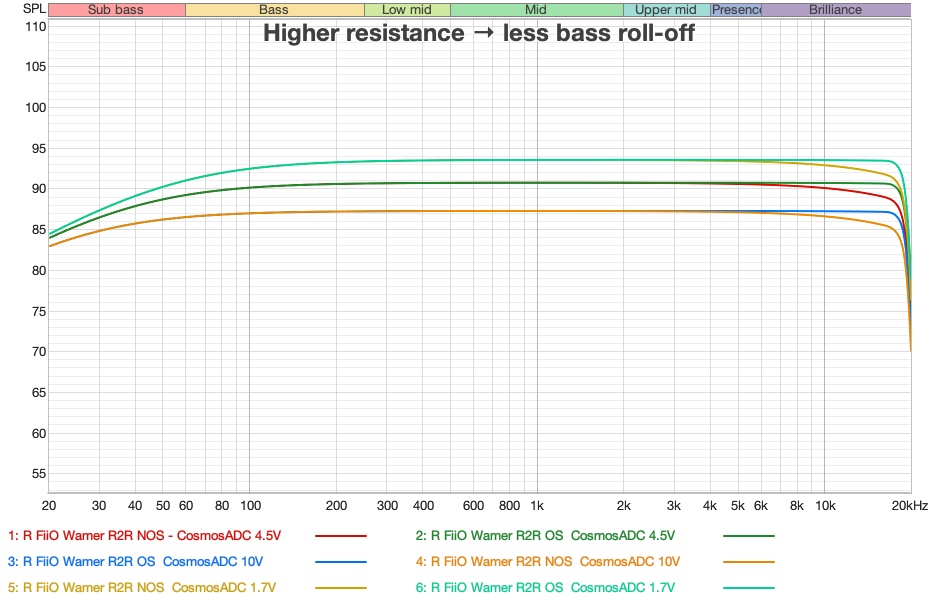
This chart shows frequency response with different Cosmos input impedances. As expected, higher input impedance (closer to the Warmer’s rated 10 kΩ test load) results in flatter bass response, while lower impedances exacerbate the high-pass filtering effect.
The key takeaway: when paired with a downstream device that has high input impedance (≥50 kΩ), the Warmer R2R’s bass response will be essentially linear down to 20 Hz. With more typical input impedances (10–22 kΩ), you’ll experience a gentle bass roll-off that, combined with the NOS treble reduction, contributes to the “warm” tonal balance.
I also decided to measure the THD+N (and SINAD) values from the Warmer R2R’s output in XLR mode:
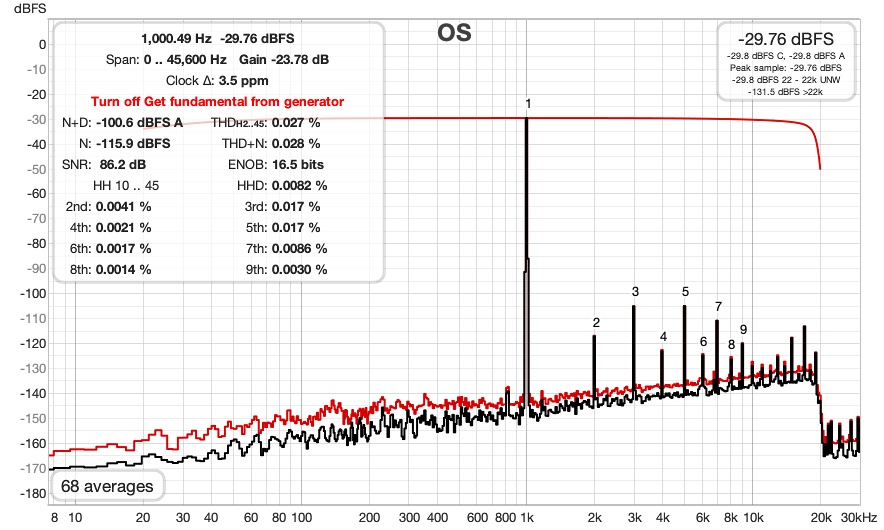
These results were slightly better than FiiO published measurements but should not be taken as lab published values as my setup for these measurements was not ideal.
More Practical Measurements with different amplifier pairings
To better understand how the Warmer R2R performs with different downstream amplifiers, I conducted a series of measurements comparing frequency response an many different headphone amplifiers with varying input impedances:
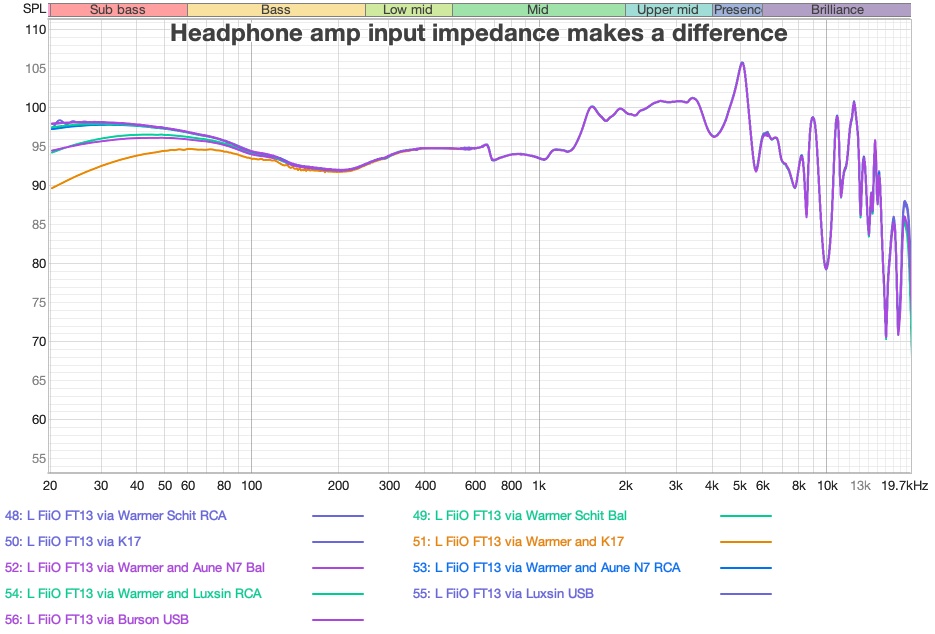
These measurements revealed some important insights about optimal pairing and the Warmer R2R’s versatility.
- Schiit Midgard (≥50 kΩ input impedance)
- Aune N7 (high input impedance)
- Luxsin X9 in OS mode (high input impedance)
- FiiO K17 RCA input (~10-22 kΩ typical line input impedance)
So, these measurements include some direct measurements (via the K17, Luxsin X9 and the Burson Playmate 3), those 3 measurements are identical (so appear as a single line on the graph) as they should being good transparent amplifiers. But you will also see that the RCA output of the Warmer when routed through the Schiit Midgard, Aune N7, and the Luxsin X9 were also linear and effectively transparent.
The XLR outputs of the Warmer into the Schiit Midgard and the Aune N7 show a slight roll off but the worst roll off was via RCA output into the FiiO K17.
The Schiit Midgard, for example, is an excellent pairing:
- 50 kΩ line-level input impedance: Ensures the −3 dB corner is pushed to 1–3 Hz, achieving flat bass response
- Fully solid-state, DC-stable input: No additional AC coupling after the Warmer R2R
- <0.1 Ω SE headphone output impedance: Load-invariant frequency response
- High-current, wideband output stage: No low-frequency compression or limiting
Harmonic differences
I thought it might also be interesting to see what the Warmer R2R’s harmonic distortion profile was like:
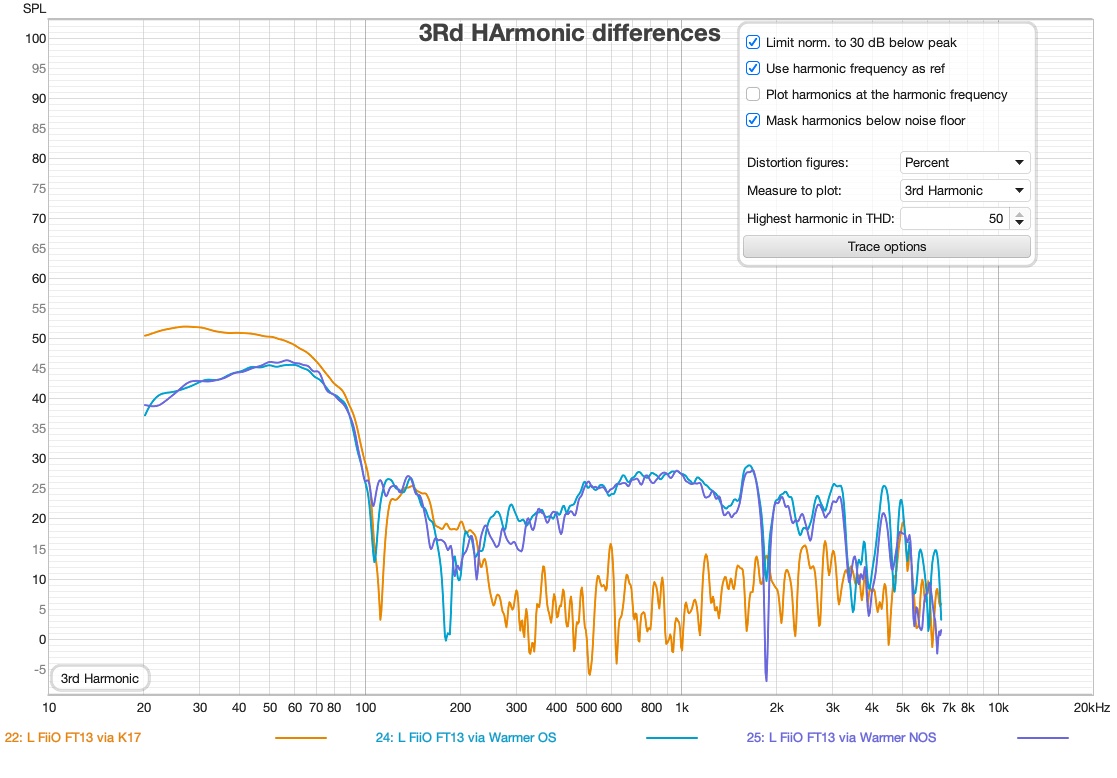
So, compared to the 3rd harmonic taken directly via K17, the R2R DAC adds some distortion to the midrange, but still below audible levels.
The third-harmonic content is visibly higher with the Warmer R2R compared to the solid-state K17 path.
This is expected behavior from a tube output stage and contributes to the “warmth” and “density” many listeners describe.
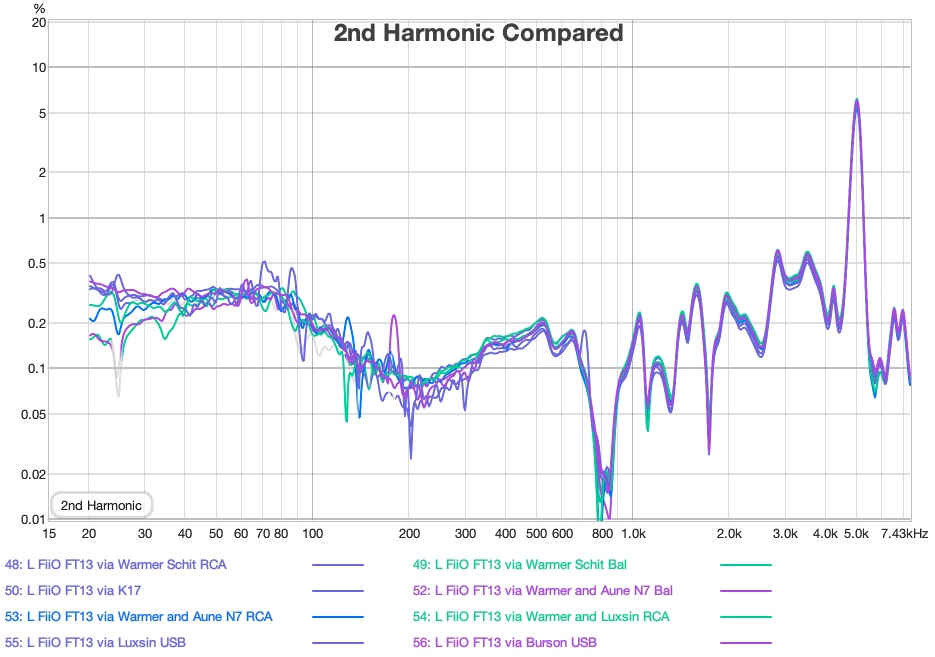
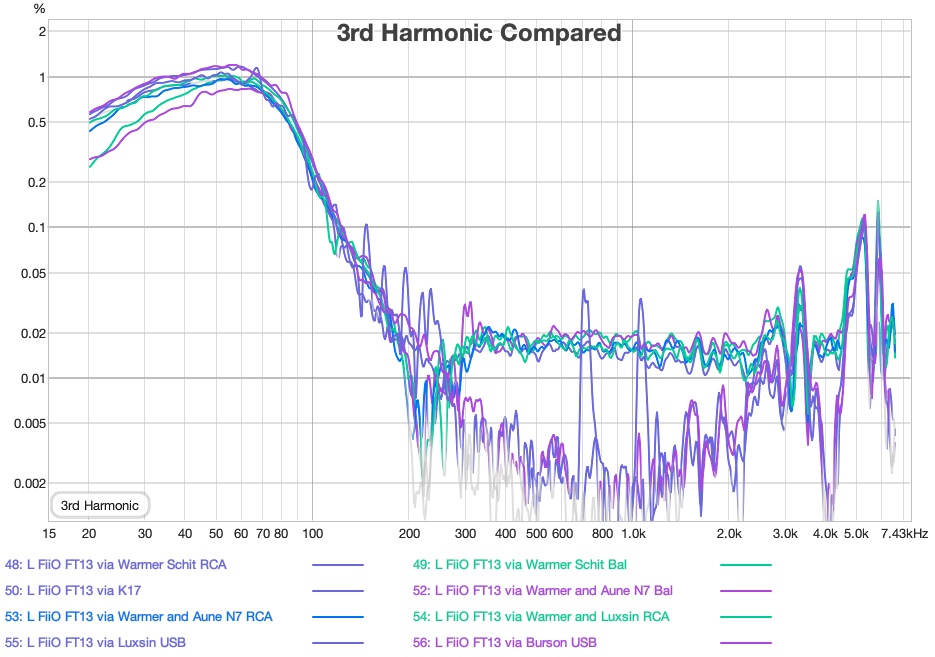
Finally with these measurements, I thought it might be good to do a comparison of different harmonics with the various Amplifiers measured
2nd harmonic
3rd harmonic
5th harmonic
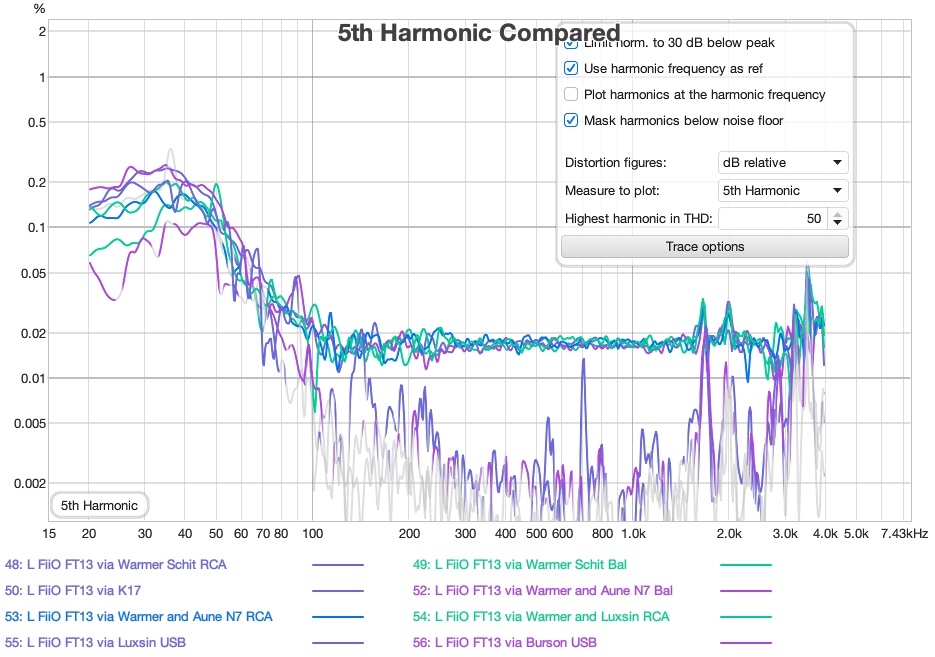
What this shows is 2nd Harmonic distortion was similar with all these setups (via the Warmer R2R or directly with the different amplifiers), but the 3rd and 5th harmonic content was much higher when the Warmer R2R was involved in the audio path.
Transparent DAC Performance: The Right Pairing Matters
With the Schiit Midgard, Aune N7, and Luxsin X9 in OS mode, the Warmer R2R delivers decent transparent performance in OS mode. All three amplifiers have high input impedances (≥50 kΩ for the Midgard, similarly high for the others), which minimizes the bass roll-off caused by the Warmer’s output coupling capacitors. In this configuration:
- Bass response is essentially linear down to 20 Hz
- Frequency response deviates minimally from neutral
- The tube stage adds subtle harmonic character without significant tonal coloration
- This would be my normal listening preference with the Warmer R2R
This is what I believe most people should want from a DAC: a transparent reproduction of the original analog signal without added “color.” The Warmer R2R, when properly paired, delivers exactly this in OS mode while still providing the option to embrace warmth when desired.
Rating
I am giving the Warmer R2R a 4 out of 5 pragmatic rating. At roughly $329, the build quality alone feels worth the asking price, the feature set covers the essential inputs and outputs, and the OS/NOS options let you choose between cleaner and warmer presentations. Measurements are not the headline here, and that is by design. What matters is that it integrates smoothly into a modern desk system and delivers the sound a certain segment of listeners actively prefers.
Why 4 and not 5, well for me personally I think transparency is more important than retro warmth and harmonics added to the sound, but as someone who loves to experience music in different flavours and because I love how the VU Meter looks, this will have a permanent place in my audio chain.
I even gave it my ‘Retro product of the year’ Pragmatic award as it was exactly the retro product I was looking for in my setup.
So for me the genius of the Warmer R2R is its versatility:
- Transparent reference path: OS mode + high-impedance amplifier = neutral, clean DAC performance
- Vintage warmth on demand: NOS mode + any amplifier = classic tube/R2R character
- Maximum warmth: NOS mode + lower-impedance input (like K17 RCA) = pronounced warm signature
- Gorgeous aesthetics: Retro VU meters and premium build quality regardless of mode
Conclusion
For those curious about the appeal of R2R and tubes without diving into extreme pricing, the Warmer R2R is a fantastic gateway. It is not about sounding better in an absolute, one‑size‑fits‑all sense, it is about sounding better to the many audiophiles who want to experience this particular flavor. The retro styling with real VU meters, the option to run OS or NOS, and the easy way it slots into a loop with a K17 or other DAC make it a fun and rewarding addition.
After living with it in my chain for the past month, I keep coming back to the same thought: this is a beautiful device built to give people what they want. If that resonates with you, it is hard to argue with the result.