Status Pro X
Audiophile Tuning Meets True Wireless Convenience
Status Audio is a New York–based audio brand that has a long history in creating some excellent TWS sets. But, I’ll admit I was initially reluctant to review the Status Pro X. My hesitation stemmed from concerns that it might fall into the typical “consumer ANC” category, the kind with boomy bass and over-processed sound that prioritises ’lifestyle sound’ over audio fidelity. However, I’m genuinely glad I gave the Pro X a go, as it has become one of my favorite TWS earbuds, especially for audio quality.
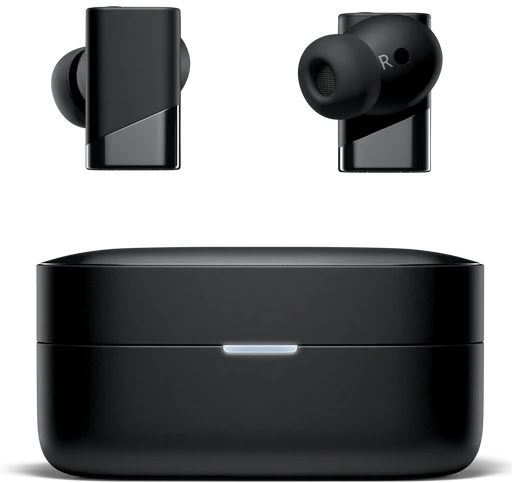
What immediately impressed me were the stock sound profiles available in the Status Hub app. As you’ll see in the measurements section, the EQ implementation offers exceptional range, allowing very decent adjustments across frequency bands when needed (though sadly no PEQ). But more importantly, the default tuning profiles are thoughtfully crafted with proper audiophile target curves so you will get an excellent out-of-the-box sound profile.
I would like to thank Status Audio for providing the Pro X for this review.
If you are interested in finding more information about this product, you can find it at the official product page.
The current retail price is $249 USD / €299 EUR.
But while I really enjoyed the Pro X, I do have some quibbles about certain aspects, which I will get to later in the review.
So, before I get into the details, let’s look at the unboxing and build quality.
Unboxing and Build Quality
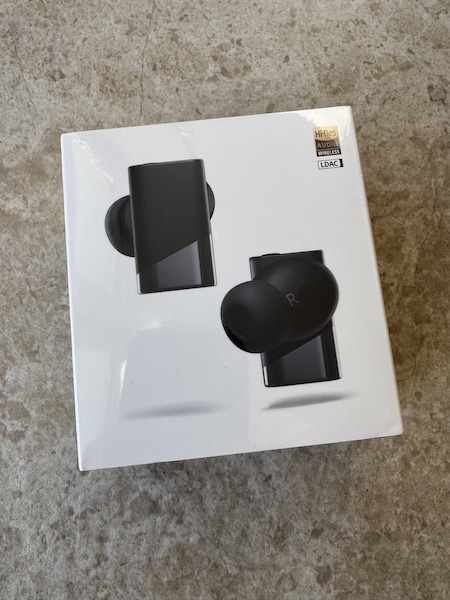
The Status Pro X arrives in premium packaging that reflects its positioning as a high-end TWS offering:
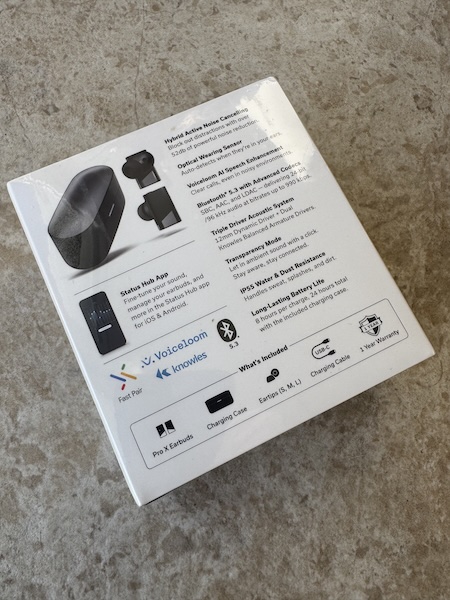
The back of the box features clean branding and key specifications:
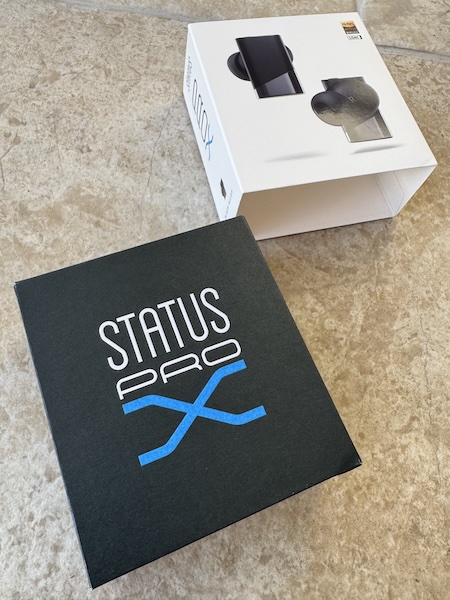
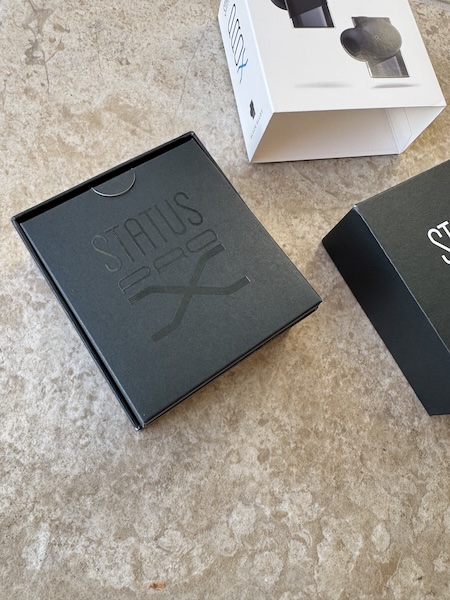
Opening the outer sleeve reveals a sturdy inner box:
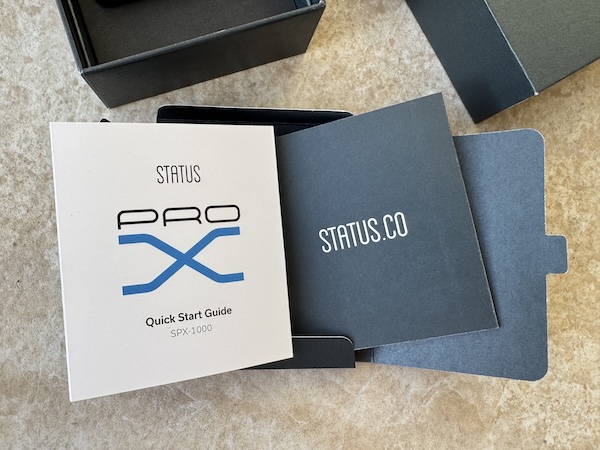
| Opening up the inner box | The documentation is in the outer sleeve: |
|---|---|
 |
 |
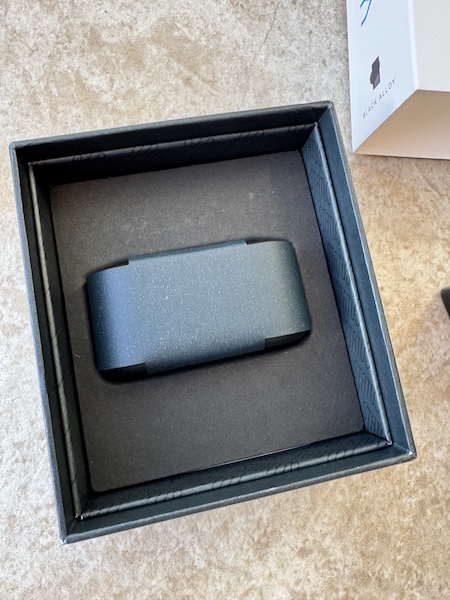
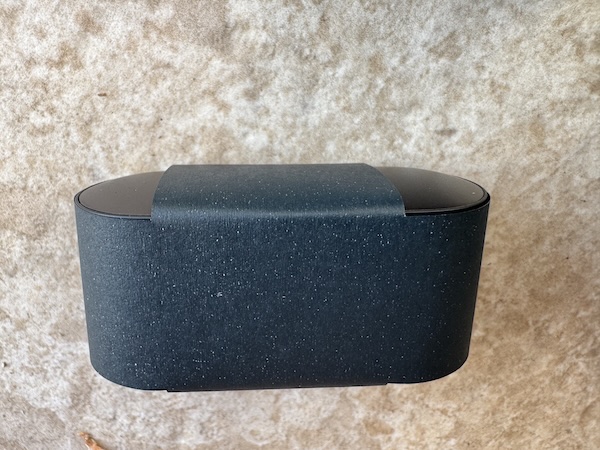
Inside, you’ll find the charging case prominently displayed in a protective cover:
The complete package includes:
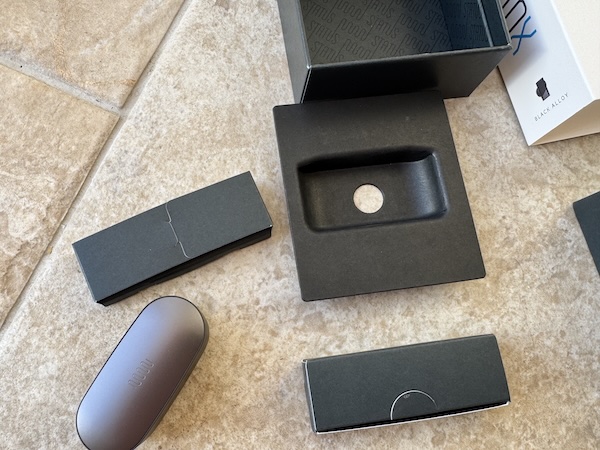
- Status Pro X earbuds with pre-installed medium eartips
- Compact charging case (with wireless charging support)
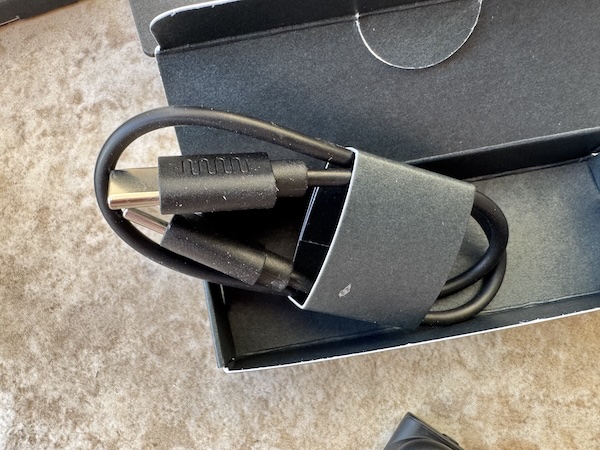
- USB-C charging cable
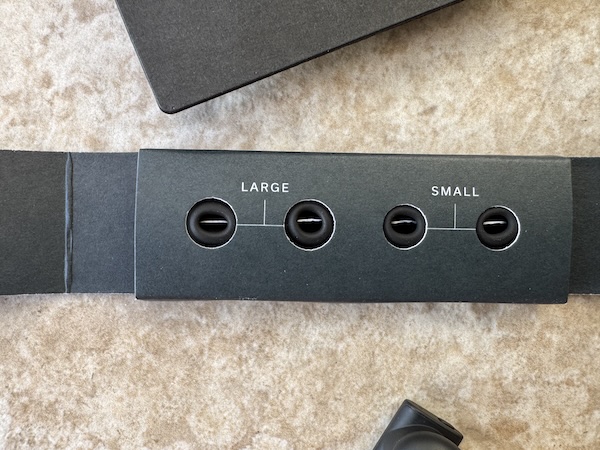
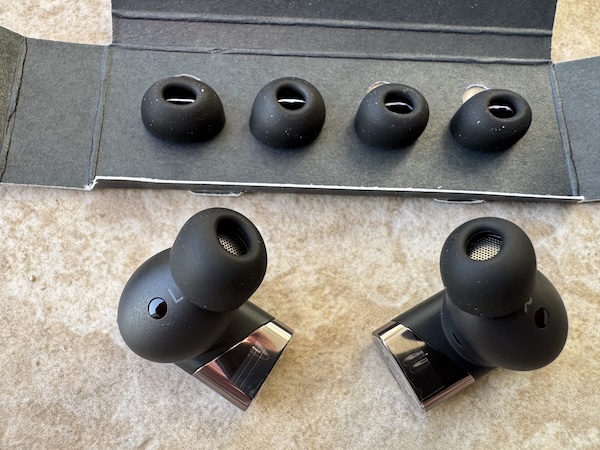
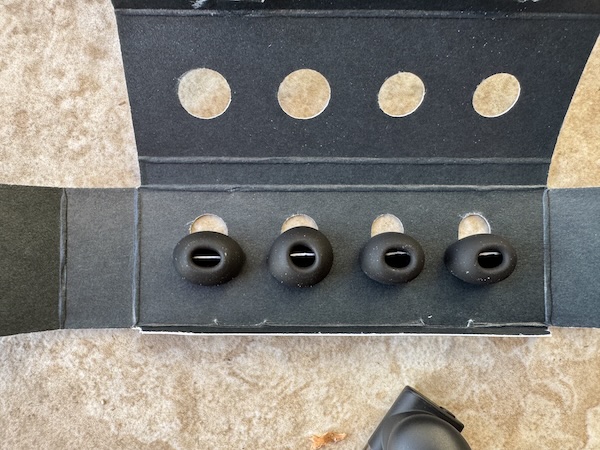
- Three sizes of silicone eartips (S/M/L)
- User manual and documentation
Taking the case out of the box:
The usb-c cable is standard:
The eartip selection is good but not great:
 |
 |
But the ability to easily use stock large or even XL third party eartips is a real plus for me especially.
Design and Build Quality
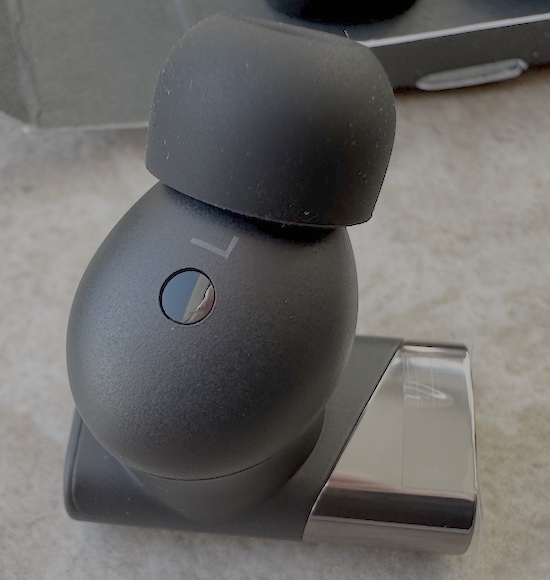
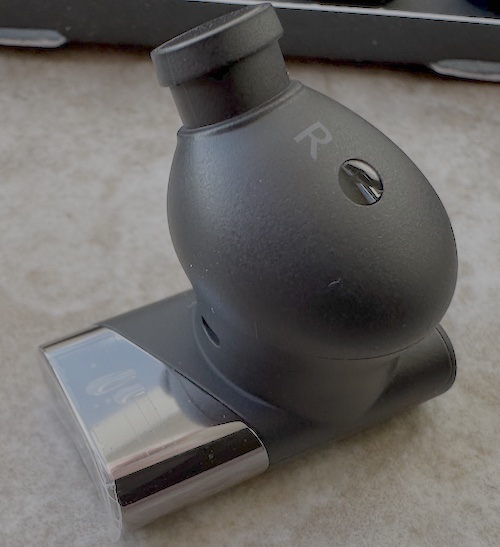
One of the most features of the newer design is a 21% size reduction compared to the previous model the “Between Pro”, while maintaining the same triple-driver architecture.
 |
 |
Each earbud features a capacitive touch panel on the outer face for playback controls, while a physical button on top toggles ANC modes.
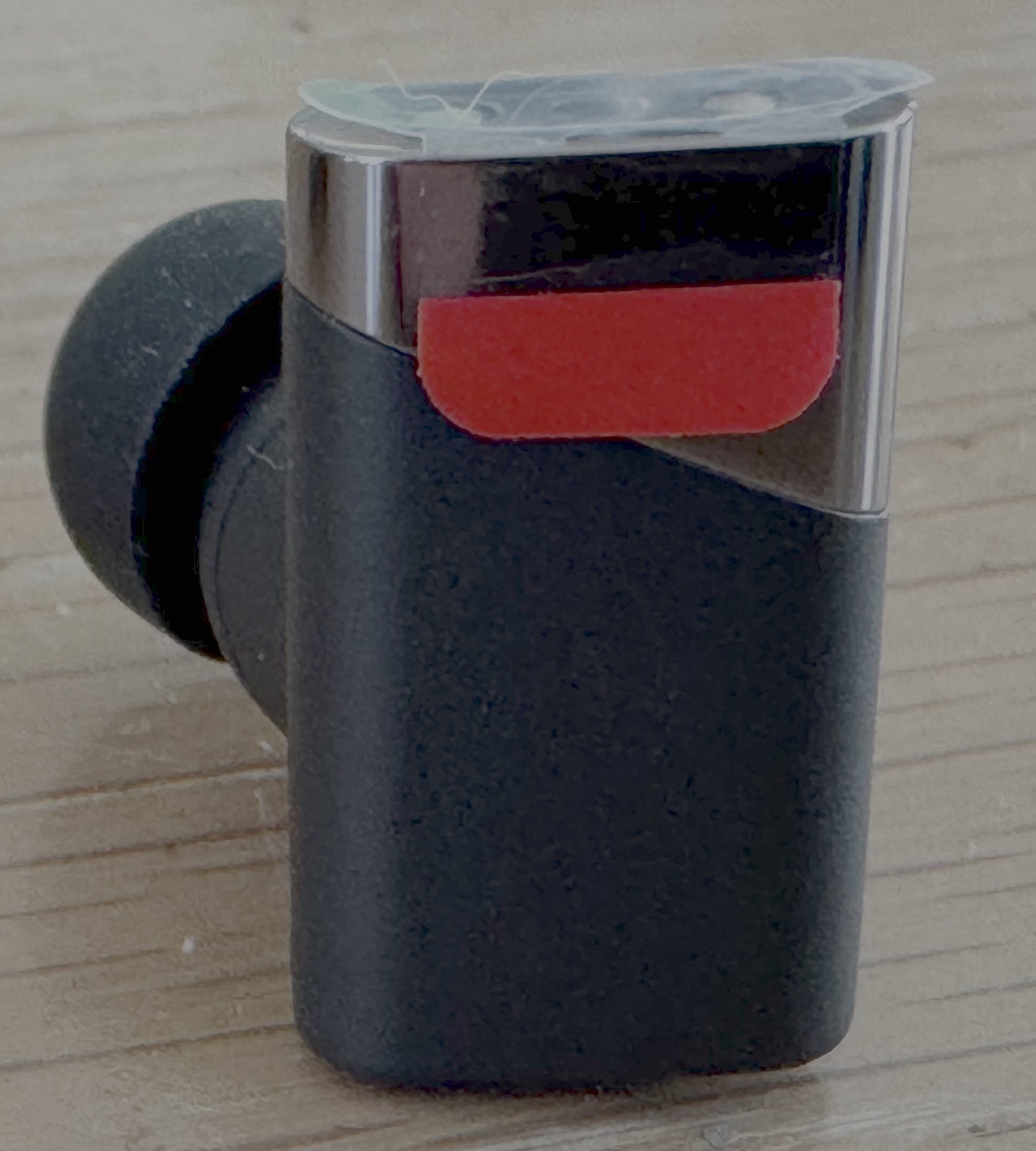
This hybrid control scheme works well in practice, though I did occasionally trigger the touch controls when adjusting the fit. The physical ANC button, however, is perfectly positioned and provides tactile feedback.
The Pro X carries an IP55 rating for water and dust resistance, making them suitable for workouts and outdoor use in light rain. I’ve used them extensively during rainy walks and gym sessions without any concerns. The earbuds feel solid and well-constructed, with no creaking or flex in the shells.
Charging Case: Smaller, Smarter Design
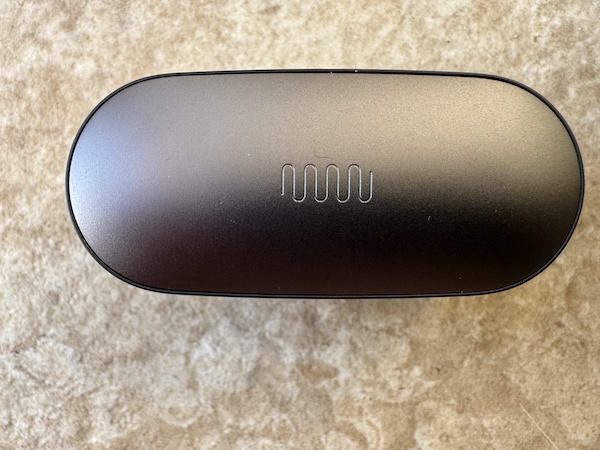
The charging case is 11% smaller than the previous generation, yet this reduction doesn’t compromise functionality. In fact, it’s one of my favorite aspects of the Pro X design.
 |
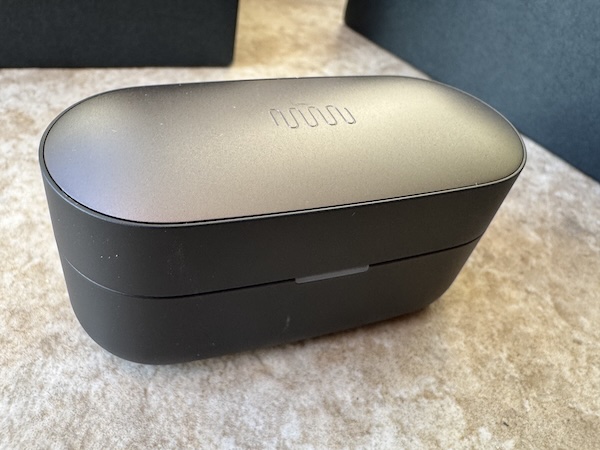 |
The case features a plastic bottom with a metal-topped lid—a premium materials combination that feels substantial without being heavy. Status Audio made a clever design choice with the edges: the top edge is sharp while the bottom is rounded, making it easy to orient the case correctly when pulling it from your pocket. It’s a small quality-of-life improvement that I’ve come to appreciate after weeks of daily use.
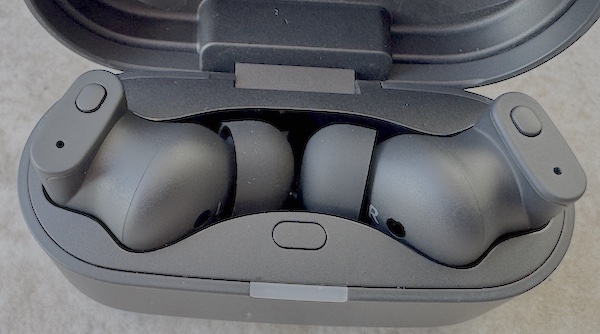
The case opens smoothly and closes with a satisfying magnetic snap. Wireless Qi charging is supported, though I primarily used the USB-C port for faster charging.
The Underrated Feature: Eartip Flexibility
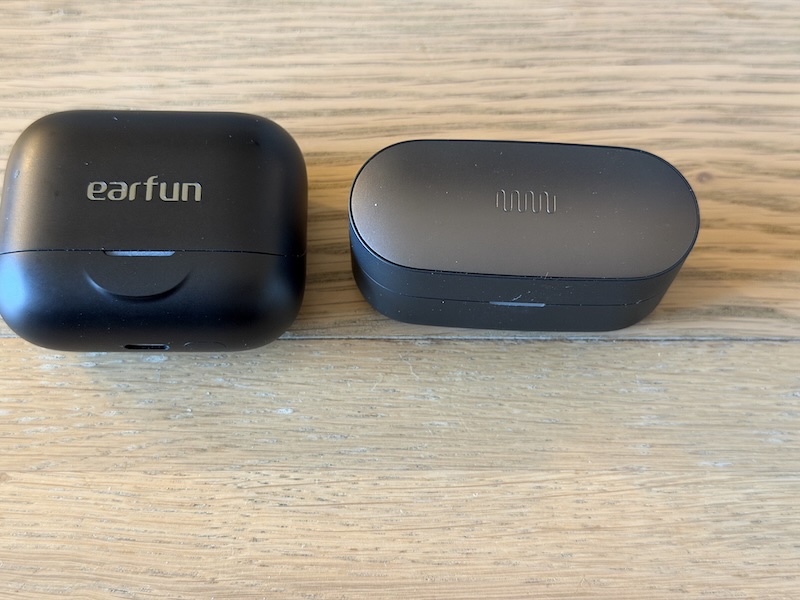
Here’s something that doesn’t get enough attention in TWS reviews: despite the smaller case size, the Pro X accommodates much larger aftermarket eartips. This might seem trivial, but it’s actually transformative for sound quality and ANC effectiveness. So, I got larger eartips into a much smaller case than for example the Earfun Air Pro 4 Plus:
 |
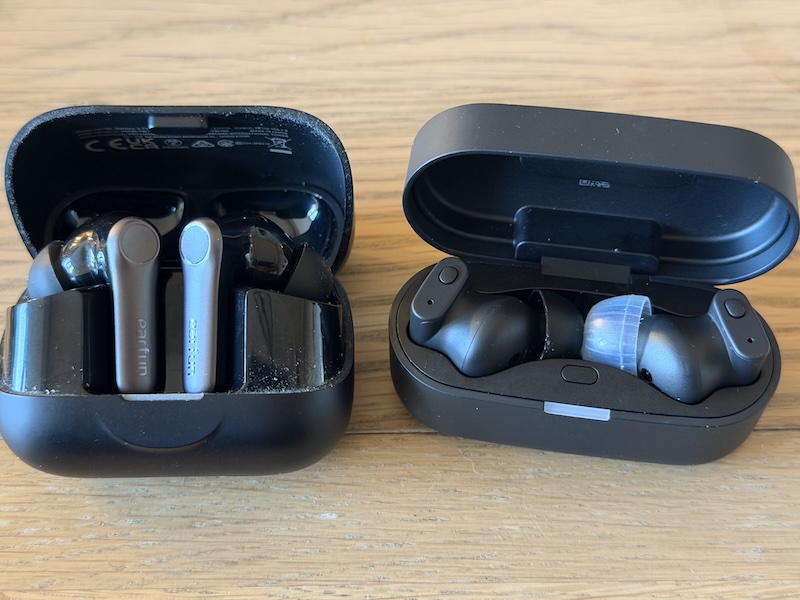 |
I experimented with several larger eartip options, and the improvement was substantial. Larger tips provided a better seal should you need it, which enhanced both bass response and ANC performance. The fact that these fit comfortably in the charging case without forcing the lid or creating pressure points speaks to thoughtful internal engineering.
Fit and Comfort
I was initially concerned that the protruding rectangular housings would create pressure points during extended wear. Those concerns proved unfounded. I’ve worn the Pro X for 4+ hour sessions without discomfort or fatigue. The ergonomic optimization that Status Audio achieved with the size reduction really shows during extended listening.
The earbuds stay secure during movement, including jogging and gym workouts. The weight distribution feels balanced, with no sense that one side is pulling more than the other. The IP55 rating makes them suitable for workouts and outdoor use in light rain I’ve been using them during the rainy Irish winter weather without any concerns.
The nozzle design features a relatively large bore, which worked well for me (as I like larger earbuds) but possibly if you have a tiny ear canal this larger size might not be ideal:
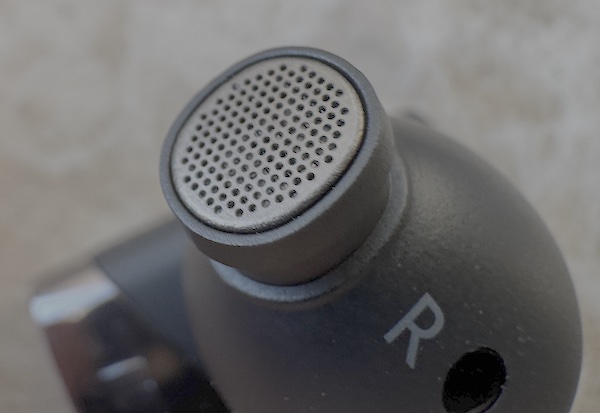
For those who listen with one earbud while still engaging with the environment, it works well.
Features and Performance
What It’s Like to Use the Status Pro X
The Status Pro X features optical wearing detection, which automatically pauses audio when you remove an earbud. In theory, this is convenient. In practice, the purely optical nature of the sensor creates some quirks. The sensor measures distance rather than differentiating between skin and other objects, which means placing the earbuds tip-down on a surface can trigger playback.
More problematically, if you’re listening with one earbud in (something I do occasionally in work when I need to hear my surroundings naturally rather than through ambient mode), storing the other earbud in your pocket can cause intermittent play/pause behavior.
Status Hub App: Comprehensive but with a Learning Curve
The Status Hub app (available for iOS and Android) is where the Pro X truly shines.
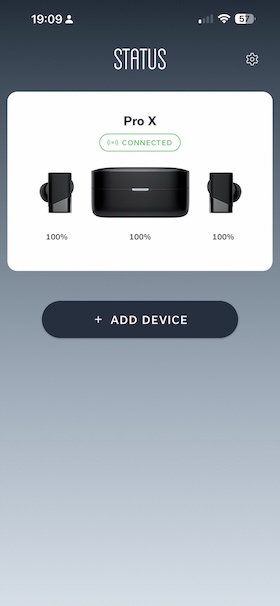
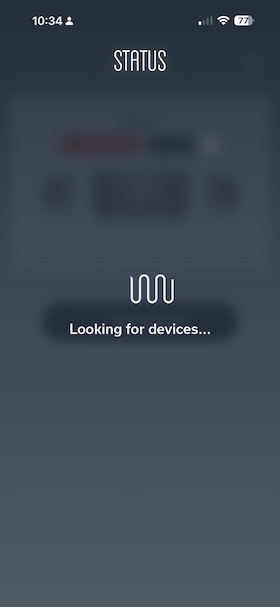
Searching and adding your Pro X is super easy:
 |
 |
It’s feature-rich and offers excellent customization options, though first-time users will need to spend some time exploring to unlock its full potential. Once connected, the main screen displays battery levels for both earbuds and the charging case, along with quick access to ANC modes and EQ presets and you will get a notification if there is some new firmware available:
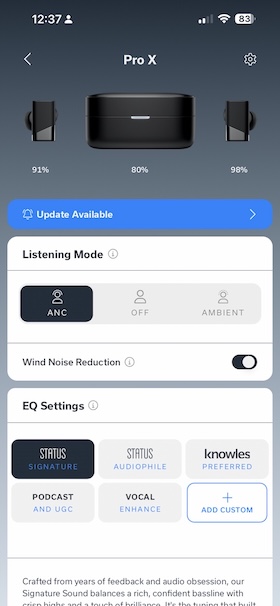
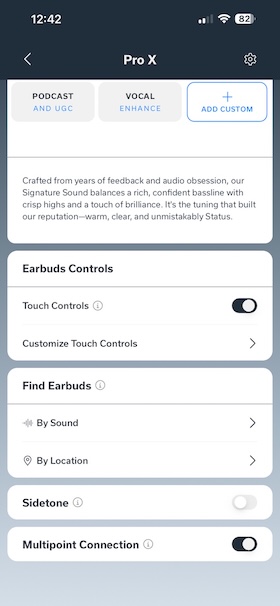
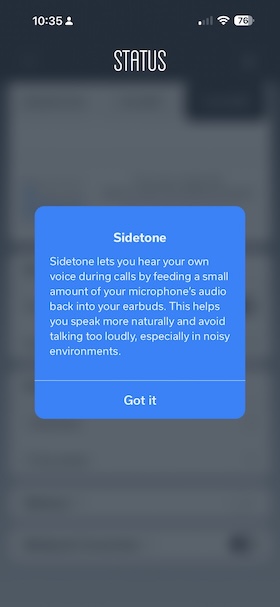
Scrolling down, there are a few more options, including some nice features like Sidetone (which greatly helps when
using the microphone during calls):
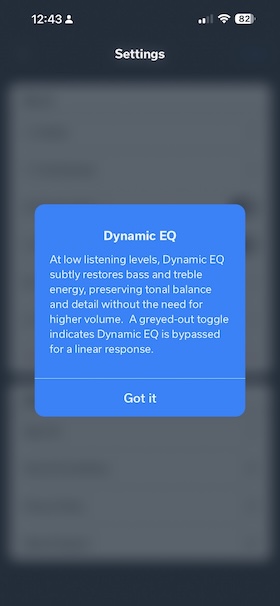
I did like how each feature has a detailed explanation:
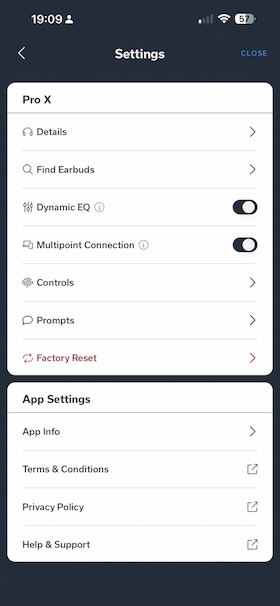
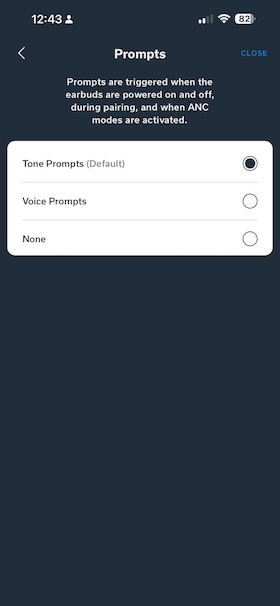
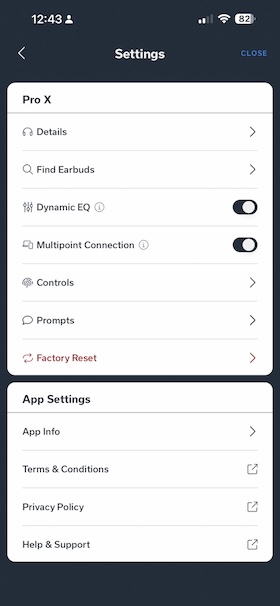
There is also a separate settings screen with some extra configuration options like prompts:
Firmware Updates
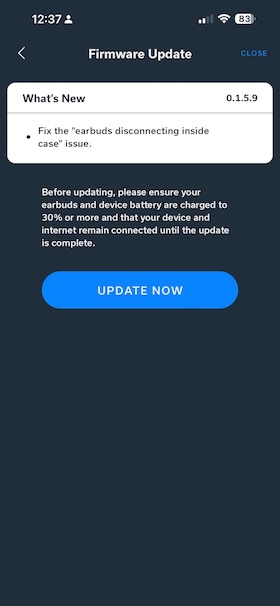
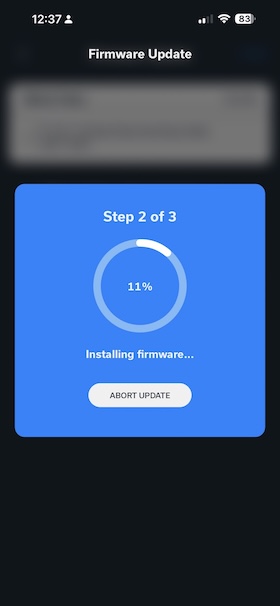
Status Audio actively supports the Pro X with firmware updates:
 |
 |
EQ Profiles: Audiophile Targets Done Right
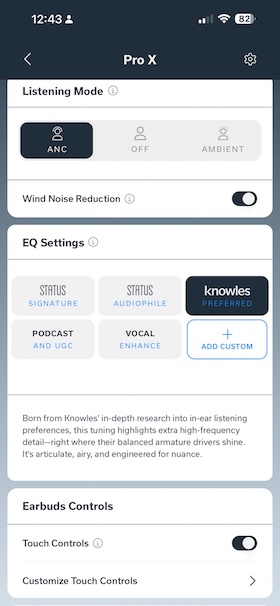
But this is where the Pro X distinguishes itself from typical consumer TWS. The Status Hub app includes several sound signature presets, and unlike the generic “Bass Boost” or “Treble Enhance” options found on most TWS companion app, these profiles are based on proper audiophile target curves:
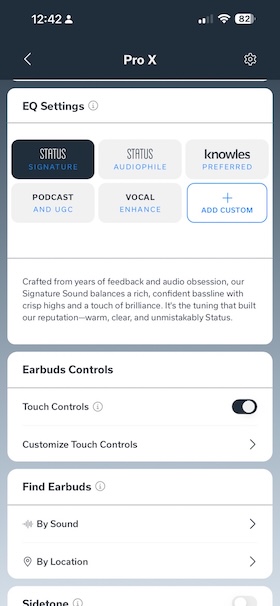
The available presets include:
- Signature: The default tuning, with balanced presentation and slight warmth
- Knowles Preferred: Brighter, more detailed presentation leveraging the Knowles BA drivers
- Audiophile: Neutral reference tuning
- Podcast/Vocal: Enhanced clarity for spoken content
Each preset is thoughtfully crafted rather than being an extreme caricature. The “Knowles Preferred” profile, for instance, adds treble energy and detail retrieval without becoming harsh or fatiguing.
Custom EQ: Eight-Band with Advanced Options
For those who want to fine-tune their sound, the Pro X offers an 8-band EQ:
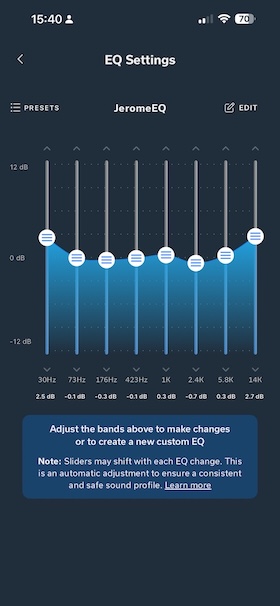
If you want more bass (which I did for commuting where I typically listen much louder to my music) is easy:
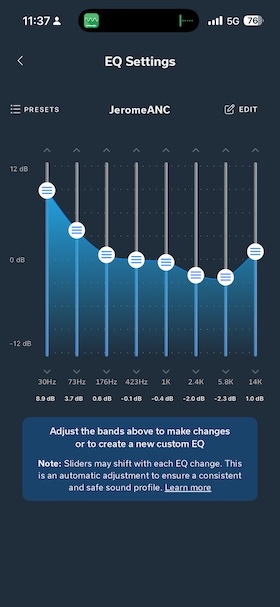
Though as you will see in the measurements section later, it is a pity that the Pro X has 2 slightly different Frequency responses when ANC is active and when it is not as it mostly means 2 different EQ profiles. This is a minor quibble.
ANC, Ambient Modes and some quibbles
The Pro X offers multiple ANC modes accessible through the app:
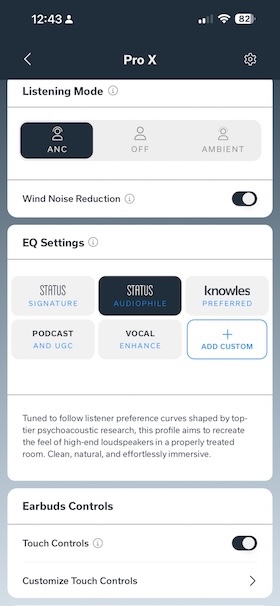
- ANC: Full active noise cancellation
- Transparency (with four levels: Low, Medium, High, Super)
- Normal: ANC disabled
The transparency mode has four intensity levels which is sort of interesting, with “Low” sounding most natural due to a less prominent noise floor.
However, even at the low setting, quiet sounds are amplified more than I’d prefer. Unlike some higher-end competitors, there’s an audible electronic hiss in transparency mode, particularly at the higher settings, though again this is a minor quibble as I only switch on the ambient / transparency mode for a few seconds at a time.
Another little issue is the “Wind Noise Reduction” toggle when enabled, the wind noise reduction only moderately reduces the harshness of wind buffeting. Additionally, each time you use the Pro X this setting to disable, requiring you to re-enable via the App. This feels like an oversight that should be addressed in firmware.
Control Customization
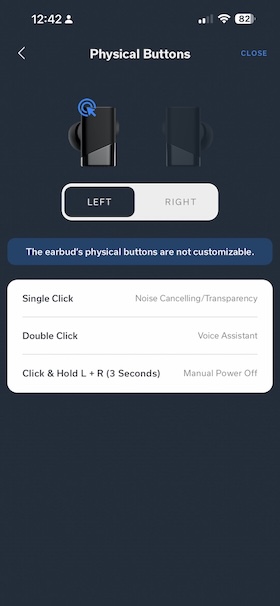
The Status Hub app allows remapping of touch controls:
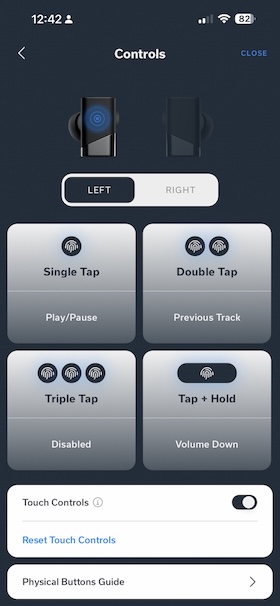
Though, strangely, the physical ANC button cannot be reconfigured as I would have like different controls on the left
and right earbud:
You can also choose between tone notifications or voice prompts for various events.
Additional Features
The app includes several other useful features:
Sidetone: During phone calls, external microphones amplify your own voice in the earbuds, allowing you to speak naturally without shouting. This is a genuinely useful feature that more TWS should implement.
Find My Earbuds: Plays a loud tone to help locate lost earbuds, with GPS tracking of the last known connection location.
Settings: Additional configuration options for power management and connectivity.
Triple-Driver Acoustic System: The Hardware Advantage
The Pro X’s standout feature is its hybrid triple-driver configuration:
- 1× 12mm Dynamic Driver: Upgraded from the 10mm driver in previous models, delivering deeper bass extension and more power
- 2× Knowles Balanced Armature Drivers: Custom-tuned for midrange clarity and treble detail
This isn’t just a spec sheet bullet point—you can hear the benefit of having dedicated drivers for different frequency ranges. The dynamic driver handles bass duties with authority, while the dual Knowles BAs provide crystalline midrange and treble without the harshness or sibilance that plagues many single-driver TWS.
Knowles is a leading manufacturer of precision balanced armature drivers, with decades of experience in the hearing aid and professional audio industries. Their BA drivers are renowned for detail retrieval and consistency, and Status Audio has leveraged this expertise effectively in the Pro X tuning.
Connectivity and Codecs
The Status Pro X connects via Bluetooth 5.3 and supports a decent (though not class leading) list of codecs:
- SBC/AAC: Universal compatibility
- LDAC: Sony’s high-resolution codec, supporting 24-bit/96kHz audio at bitrates up to 990 kbps
- LC3: Part of Bluetooth LE Audio, offering improved efficiency
In practice, LDAC is a definite upgrade over SBC or AAC when streaming high-quality source material from services like Apple Music Lossless or local FLAC files. The increased bandwidth reduces compression artifacts and provides better dynamic range.
Status Audio also Bluetooth LE Audio support, enabling the LC3 codec and Auracast protocol. While Auracast adoption is still in its infancy, it’s good to see Status Audio preparing for next-generation Bluetooth features.
Multipoint Connectivity: The Pro X supports simultaneous connection to two devices, allowing seamless switching between, say, your laptop and smartphone. This worked flawlessly during testing.
Fast Pairing: Android Fast Pair and Microsoft Swift Pair are supported for quick connection on supported devices.
Latency
As with most Bluetooth earbuds, there’s perceptible latency—around 100-150ms by my estimation. This is noticeable when watching content closely or playing games, but it’s comparable to other TWS in this price range. For music listening, it’s a non-issue. I would therefore pick a wired IEM for gaming if low Latency is requirement.
Active Noise Cancellation: Strong Performance with Caveats
The Pro X features hybrid ANC with six beam-forming microphones across both earbuds
In real-world testing, the ANC performance was impressive but not class-leading. But Low-frequency rumble airplane cabin noise, train engines, HVAC hum are attenuated effectively. Mid-frequency chatter is reduced but not eliminated. High-frequency sounds (keyboard typing, dishes clattering) bleed through, as physics dictates.
Here is a measurement of the ANC performance from the SoundGuys review:
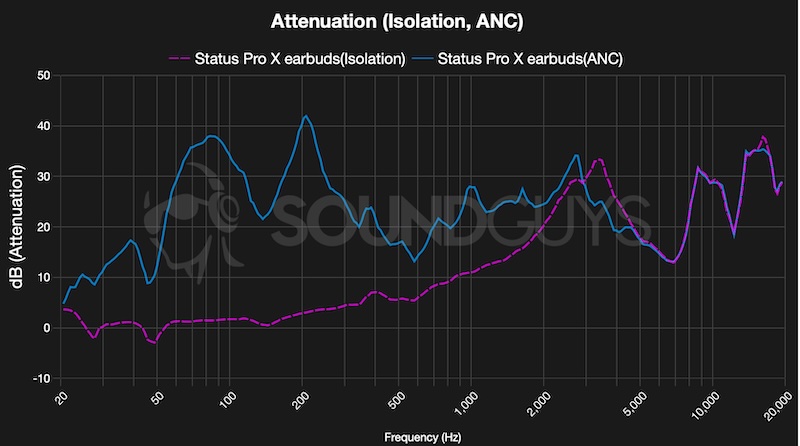
You can get more information here from SoundGuys, Overall, they measured 80% noise reduction which is good, but a little behind Apple AirPods Pro 3 with over 90%.
For the $249 / €299 price point, I’d expect the Pro X to compete directly with Bose QuietComfort Earbuds II and Apple AirPods Pro 2 in terms of ANC effectiveness. The Pro X gets close but doesn’t quite match those flagships in challenging conditions—specifically wind noise handling and ambient mode naturalness. The Bose and Apple offerings have more sophisticated wind detection and adaptive ANC algorithms that adjust more quickly to environmental changes.
However, where the Pro X distinguishes itself is sound quality while ANC is active. Many consumer ANC earbuds sacrifice audio fidelity for noise cancellation, resulting in compressed, colored sound when ANC is enabled. The Pro X maintains its tonal balance and detail retrieval even with ANC maxed out—a testament to the quality of its tuning and driver implementation.
Battery Life
Status Audio claims up to 8 hours of playback per charge. The included charging case provides an additional 16 hours, for a total of 24 hours (36 hours ANC off), this is pretty good considering how small the case is. Though, in real-world use, I achieved approximately 6 hours, which is good for TWS with high-resolution codec support and active ANC but not class leading. I do know some people who wear TWS to bed at night, and a minimal of 8-hour battery life is what they typically need, so if you have that requirement maybe have a look at the battery.
The charging case itself recharges the earbuds quickly about 90 minutes for a full charge via USB-C, or slightly longer via wireless Qi charging.
Call Quality: Voiceloom AI Enhancement
The six beam-forming microphones work together to achieve directional pickup, focusing on your mouth while attenuating environmental sound. In testing, call quality was good—certainly better than average for TWS earbuds. My voice came through clearly even in moderately noisy environments like coffee shops and busy streets.
In calm indoor environments, it’s excellent. In challenging conditions with wind or crowd noise, it’s merely good rather than exceptional.
The sidetone feature helps significantly during calls, as it allows you to hear your own voice naturally and modulate your speaking volume appropriately. This is particularly useful when taking calls in quiet spaces where you might otherwise speak too loudly and appear to be shouting on the call.
Sound Impressions
This is where the Status Pro X truly shines. The combination of the 12mm dynamic driver and dual Knowles BA drivers delivers sound quality that punches well above its price point—and in some respects, rivals dedicated audiophile IEMs.
I primarily used the Signature profile during my listening sessions, which provides a balanced presentation with just a touch of warmth. It’s musical and engaging without being colored or exaggerated. For more analytical listening or when I wanted extra treble detail, I switched to the Knowles Preferred profile, which showcases the BA drivers' clarity and extension. Not everyone will appreciate the extra treble energy though in the Knowles Preferred tuning—it can verge on bright with poorly-recorded material but for well-produced tracks, it is nice to hear that detail.
When listening outdoors in noisy environments, I created a custom EQ with boosted bass and enhanced treble. This compensates for the masking effect of background noise and accounts for the Fletcher-Munson equal-loudness curves (the psychoacoustic phenomenon where our perception of bass and treble decreases relative to midrange as listening levels decrease—or conversely, when ambient noise raises the effective noise floor). With ANC active and this EQ applied, the Pro X delivers engaging, full-range sound even on busy streets or public transit.
Bass: Powerful Yet Controlled
The enlarged 12mm dynamic driver delivers bass that’s both powerful and remarkably controlled. There’s genuine sub-bass extension—you can feel kick drums and bass synths, not just hear them. Unlike many consumer TWS that emphasize mid-bass bloat for “impact,” the Pro X provides linear bass response that extends deep without bleeding into the midrange.
“Why So Serious?” - Hans Zimmer (The Dark Knight soundtrack): The opening moments of this track feature subsonic rumble that tests bass extension. The Pro X renders this with weight and authority, maintaining composure even at elevated volume levels. The layered bass notes remain distinct rather than collapsing into muddy boom.
“Limit to Your Love” - James Blake: The notorious bass drop around the 50-second mark is a torture test for bass quality and extension. The Pro X handles it remarkably well for a TWS, with the dynamic driver maintaining control through the deepest notes. There’s no distortion or loss of composure—just clean, extended bass response.
This is smooth, non-boomy bass that serves the music rather than overwhelming it. Whether it’s the subtle bass line in jazz recordings or the synthetic low-end in electronic music, the Pro X delivers with both authority and finesse.
Midrange: Clear and Uncolored
The midrange is where the Knowles BA drivers begin to shine. Vocals and instruments occupy a natural position in the mix, neither recessed nor overly forward. There’s excellent clarity and detail retrieval, with subtle textures and nuances coming through that are often lost in single-driver implementations.
“Heartbeats” - José González: This sparse, intimate recording showcases acoustic guitar and vocals with minimal production. The Pro X renders González’s voice with natural timbre and texture, while the guitar strings have palpable presence and resonance. The sense of space and air around the instruments is impressive for TWS earbuds.
“Teardrop” - Massive Attack: The complex layering of this production—dubbed-out bass, ethereal vocals, intricate percussion—requires good midrange resolution to sound coherent rather than congested. The Pro X delivers excellent separation, with each element occupying its own space in the mix.
Treble: Knowles BA Excellence
The dual Knowles balanced armature drivers handle treble duties with exceptional finesse. There’s extension, air, and sparkle without harshness or sibilance. High-frequency detail retrieval is genuinely impressive—cymbal crashes have shimmer and decay, hi-hats have realistic texture, and string instruments have natural brightness without edge.
“Lux Aeterna” - Clint Mansell (Requiem for a Dream soundtrack): The string crescendos in this piece can sound harsh and fatiguing on poorly-tuned earphones. The Pro X maintains composure, delivering intensity without pain. The aggressive string arrangement retains its emotional impact while remaining listenable even at elevated volumes.
“Three Little Birds” - Bob Marley & The Wailers: The hi-hat and cymbal work in this reggae classic provides a good test for treble texture and decay. The Pro X renders these percussive elements with realistic tonality and natural sustain. There’s no artificial emphasis or “digital” sheen—just clean, accurate treble reproduction.
The Knowles BA drivers truly distinguish the Pro X from single-driver TWS. While many earbuds achieve decent midrange and bass through clever tuning and DSP, genuine treble extension and detail require quality hardware. The Pro X has it.
Soundstage and Imaging
This is where expectations need to be calibrated. No IEM or TWS will match the spaciousness of open-back over-ear headphones—that’s simply the reality of the form factor. However, within the constraints of sealed in-ear designs, the Pro X delivers impressive imaging and separation.
The soundstage extends slightly outside the head, with good width and a sense of layering. Individual instruments and vocal lines occupy distinct positions in the stereo field. Complex orchestral pieces don’t collapse into a wall of sound—there’s genuine depth and dimensionality.
“Dante’s Prayer” - Loreena McKennitt: This richly-layered production features vocals, accordion, strings, percussion, and atmospheric effects spread across the stereo field. The Pro X renders this complexity with admirable coherence, allowing you to follow individual elements while appreciating the whole.
For TWS earbuds, the Pro X’s soundstage is genuinely good. While it won’t satisfy headphone enthusiasts accustomed to HD 800 S or Arya Stealth, it’s more than sufficient for on-the-go listening and represents one of the better implementations I’ve heard in the TWS category.
Specifications and Measurements
| Specification | Value |
|---|---|
| Drivers | Triple hybrid (1× 12mm dynamic + 2× Knowles BA) |
| Bluetooth | 5.3 |
| Codecs | SBC, AAC, LDAC (up to 990 kbps), LC3 |
| ANC | Hybrid ANC with 6 microphones (52dB+ reduction) |
| Water resistance | IP55 |
| Battery (earbuds) | Up to 8 hours |
| Battery (with case) | Up to 24 hours |
| Charging | USB-C, Qi wireless charging |
| Additional features | Multipoint, Android Fast Pair, Microsoft Swift Pair, Auracast, optical wearing detection, sidetone, Find My Earbuds |
Frequency Response and Measurements
All measurements were taken using a calibrated IEC 60318-4 711 coupler with REW (Room EQ Wizard) software. There are available here
Audiophile Sound Signatures: Default Tuning Excellence
The Pro X’s Signature profile demonstrates what TWS earbuds can achieve with proper tuning and quality drivers. The overall balance is neutral-warm, with slight emphasis in the upper bass that provides body and warmth without bloat.
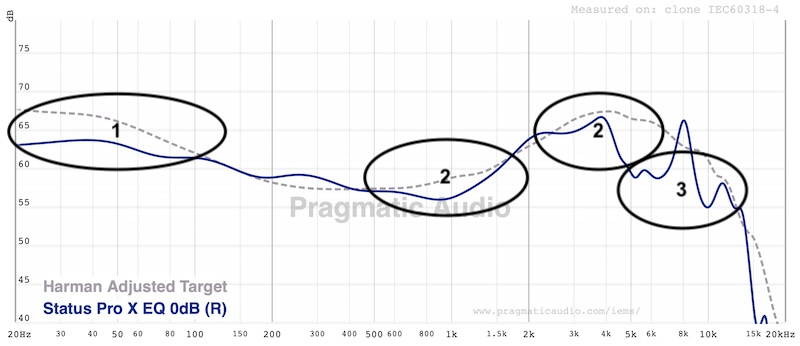
The bass response extends mostly linearly down to 20Hz (1), with controlled roll-off below that. Mid-bass (80-200Hz) is slightly elevated relative to neutral, providing a sense of warmth and fullness that most listeners will find pleasing. Importantly, there’s no excessive mid-bass hump that would lead to boominess or congestion.
The midrange (200Hz-2kHz) (2) is relaxed in that typical ‘soundstage’ area with a matching lower treble boost (2). Vocal intelligibility is excellent but never too forward, with both male and female voices rendered with natural timbre and presence.
Treble response shows the benefit of the dual Knowles BA drivers. There’s excellent extension beyond 10kHz (3), with controlled peaks that provide sparkle and air without sibilance. The slight dip around 8kHz helps tame potential harshness, while the recovery above 10kHz provides “air” and openness.
Knowles Preferred: Showcasing BA Driver Treble Quality
The Knowles Preferred profile increases treble energy, particularly in the 4-8kHz region where detail and clarity live. This brings out micro-details and subtle textures, showcasing the resolving power of the BA drivers.
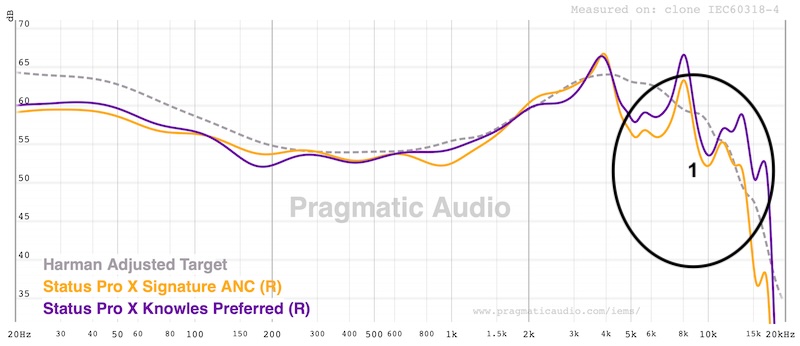
This tuning is more analytical and suited for well-recorded material where you want maximum detail retrieval. With poorer recordings or overly bright source material, the Knowles Preferred profile can verge on fatiguing. But for audiophile-quality recordings—particularly acoustic music, jazz, and classical—it’s exceptional.
Audiophile Profile Variations: Lower Midrange and Treble Differences
The various audiophile-oriented profiles show thoughtful variation in lower midrange and treble tuning to suit different preferences and genres.
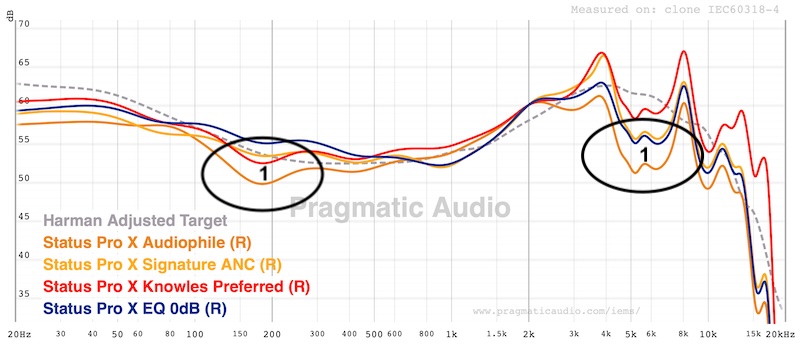
The lower midrange adjustments (200-500Hz) affect warmth and body, while the treble variations (4-10kHz) influence clarity, detail, and brightness. The fact that Status Audio offers multiple valid approaches rather than declaring one " correct" tuning shows maturity in their acoustic design philosophy.
Podcast and Vocal Profile: Meaningful EQ Application
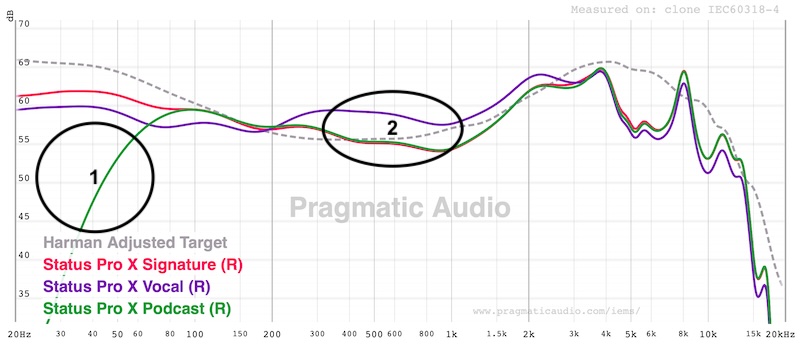
The Podcast/Vocal setting incorporates sophisticated Digital Signal Processing to lessen low frequencies and improve the clarity of the midrange, with the specific goal of making speech easier to understand. This effect is particularly noticeable in the Podcast setting, which eliminates sub-bass frequencies. Both the vocal and podcast settings amplify the midrange frequencies of the voice compared to the ‘audio settings,’ which are designed for music.
EQ Range Testing: Bass and Lower Midrange
The Pro X’s 8-band EQ offers exceptional range, as demonstrated by these frequency sweeps showing the maximum and minimum adjustments at each band.
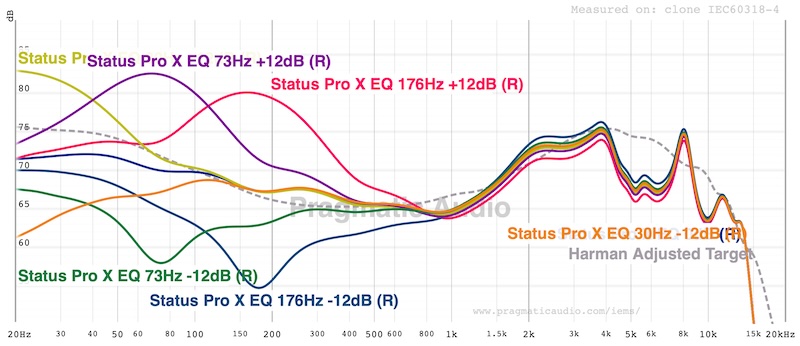
The bass and lower midrange bands provide approximately ±10dB of adjustment, which is more than sufficient for dramatic tonal shaping. You can transform the Pro X from bass-light reference tuning to basshead-friendly warm signature simply by adjusting the lower bands.
EQ Range Testing: Midrange
The midrange bands offer similar range and precision, allowing fine-tuning of vocal presence and instrument fundamentals.
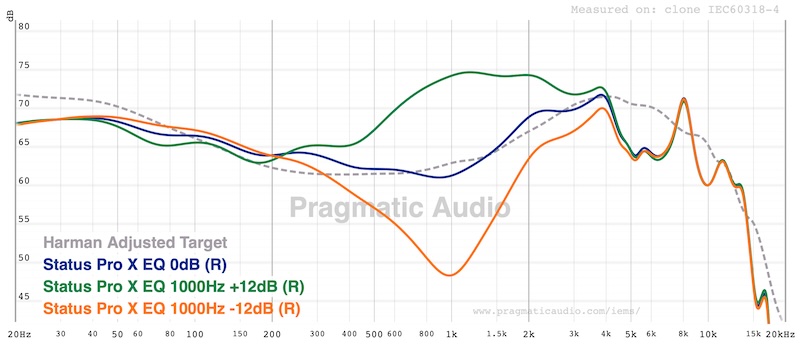
The ability to independently adjust multiple midrange bands enables nuanced tuning that goes beyond simple “more” or " less" midrange. You can, for instance, add warmth without affecting vocal clarity, or enhance presence without introducing nasality.
EQ Range Testing: Midrange and Treble
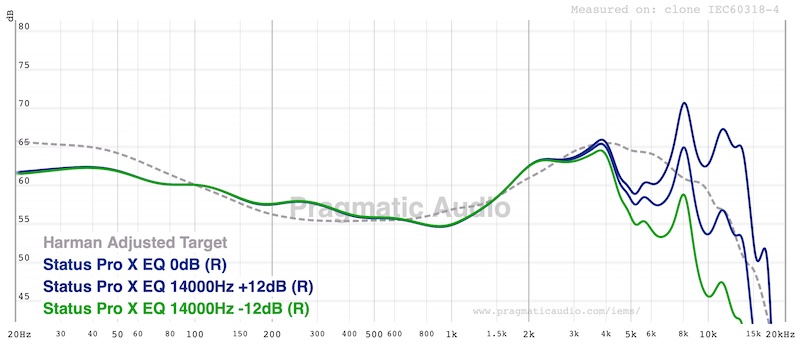
I change the scale on the treble to more clearly show the +/- 12dB range you still get adjusting the treble with the EQ:
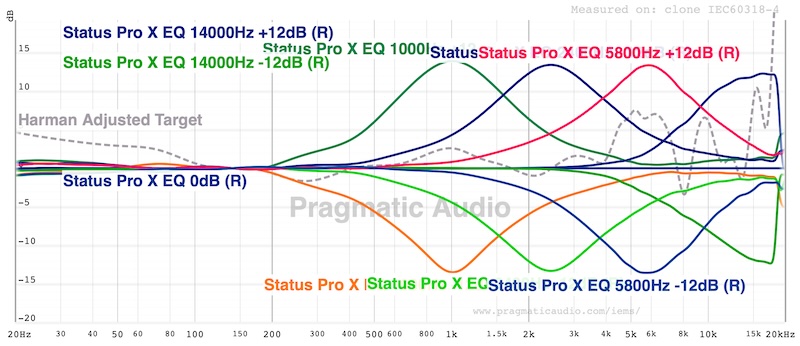
This is where you can fine-tune the Pro X for your hearing characteristics and preferences. If you find the upper treble slightly hot, you can tame it without losing air and extension. Conversely, if you want more “sparkle,” you can boost the upper bands without creating harshness.
EQ Range Testing: Upper Treble
The highest frequency bands control air and brilliance, with adjustments that can add openness or reduce potential sibilance.
ANC Mode Frequency Response Differences
As mentioned earlier, the Pro X exhibits noticeable frequency response changes when switching between ANC modes. This graph illustrates the variation between Normal, ANC, and Transparency modes.
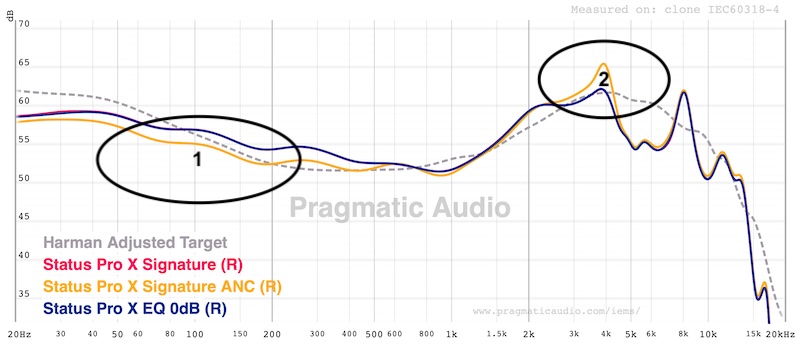
The differences are most pronounced in the bass and lower midrange, with ANC mode showing slightly elevated low frequencies compared to Normal mode. The treble response remains relatively consistent across modes, which is good—vocal clarity and detail retrieval don’t suffer significantly.
For users who primarily stick to one ANC mode, this isn’t a significant issue you simply optimize your EQ for that mode. But for those who frequently toggle between modes, the shifting tonal balance can be frustrating. Ideally, Status Audio would implement frequency response compensation to maintain consistent tonality regardless of ANC state.
Comparison with HiFiMAN Svanar Wireless and EarFun AirPro4 Plus
How does the Pro X stack up against other audiophile-oriented TWS? Here’s a comparison with the HiFiMAN Svanar Wireless LE (which is a similar price to the Pro X) and with the more modestly priced EarFun AirPro4 Plus.
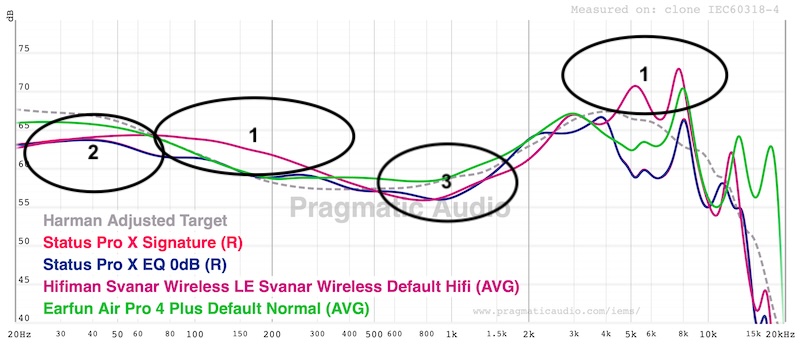
The Svanar Wireless LE has a much more colour sound signature with some midbass bloat and aggressive treble, while the Earfun AirPro4 Plus while similarly balanced in the midrange does go for a more U shaped sound with more sub-bass and upper treble.
The Pro X therefore strikes a middle ground that will appeal to listeners who want both bass authority and midrange neutrality.
Comparison with Tanchjim Fission: More Bass Emphasis
I thought I would add an IEM measurement comparison, and one IEM that has a slightly similar frequency response is the excellent Tanchjim Fission that I reviewed last year:
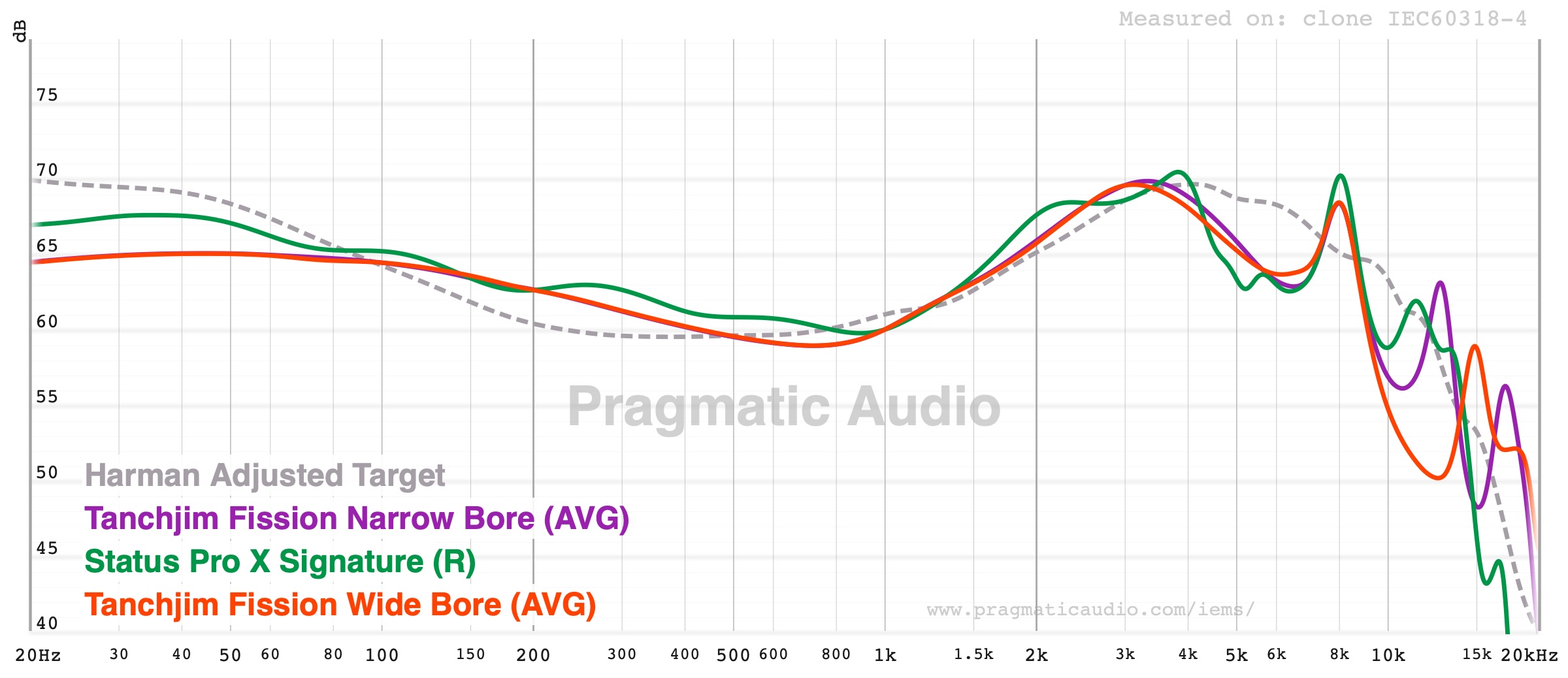
The Fission has noticeably more bass quantity by default, but the Pro X is more neutral in comparison, which some listeners will prefer for accuracy while others might find slightly lean. The beauty of the Pro X’s comprehensive EQ is that you can easily add a little sub-bass to taste, effectively transforming it into a Fission-like tuning if desired.
Distortion Performance
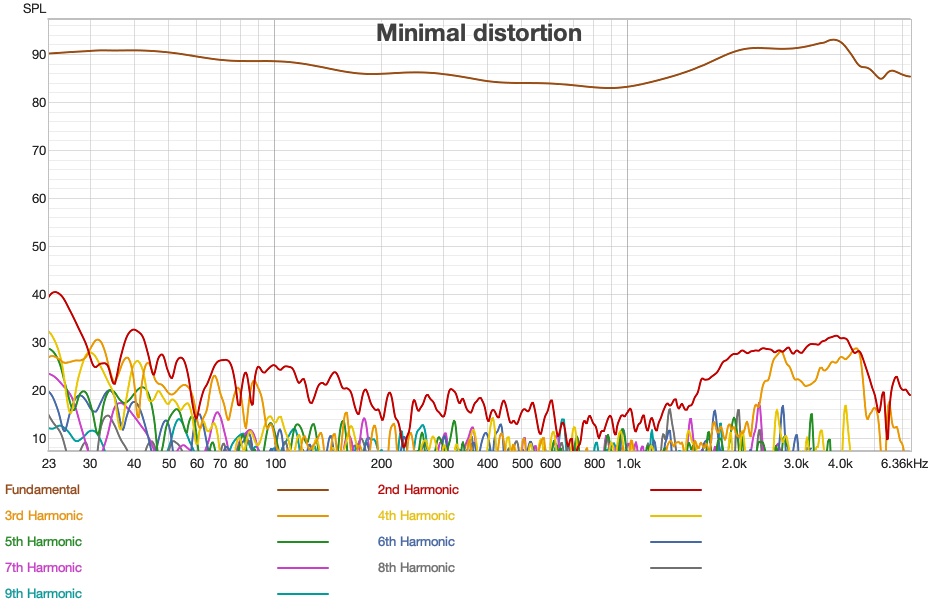
Harmonic distortion remains low across the frequency spectrum, even at elevated playback levels (90dB SPL at the coupler, representing quite loud listening):
And as a percentage:
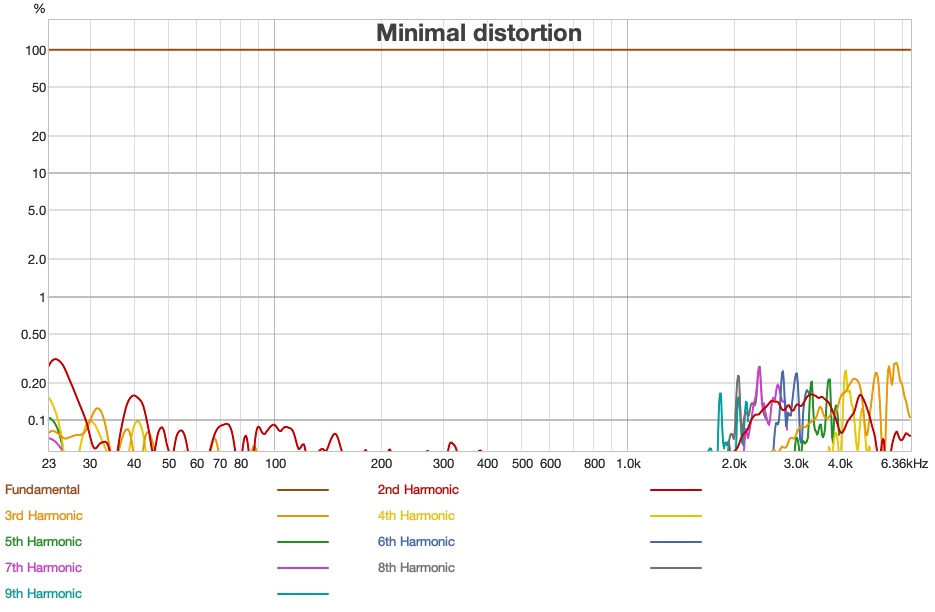
The dynamic driver maintains composure in the bass region, with distortion staying below 1% through most of the bass range. The BA drivers exhibit characteristically low distortion in the midrange and treble, contributing to the Pro X’s clean, detailed sound.
These are excellent distortion figures for TWS earbuds. Many consumer TWS show elevated distortion in the bass due to small drivers being asked to move large excursions in sealed enclosures. The Pro X’s 12mm driver has sufficient surface area and excursion capability to deliver bass cleanly.
Rating
I have given the Status Pro X a pragmatic rating of 4-stars. This is a TWS that prioritises audiophile sound quality while still delivering strong ANC and feature performance, making it an exceptional all-rounder for discerning listeners. My only complaint is that for the price I would expect the ANC and Ambient modes to be slightly better to compete with the flagship models from Apple, Sony, and Bose.
But the combination of triple-driver architecture, thoughtful tuning profiles, decent EQ capabilities, and that nice small case that still allows me to use much larger XL-sized ear tips makes it a winner for me, and why it has been in my bag for my commutes for the past month or so.
Who is it for:
- Audiophiles who want TWS convenience without compromising sound quality
- Listeners who appreciate neutral-warm tuning with the flexibility to customize via comprehensive EQ
- Users who prioritize sound quality over absolute best-in-class ANC in challenging wind conditions
- Those who value the ability to use larger aftermarket eartips for improved seal and bass response
- Anyone wanting LDAC, LC3, and future-proofed connectivity features
Conclusion
The Status Pro X represents a fantastic audiophile-centric entry into the TWS category. The Pro X demonstrates that true wireless doesn’t have to mean compromised sound quality.
The Status Hub app’s audiophile-oriented EQ presets show that Status Audio understands their audience. The Signature profile especially provides balanced, musical sound. The Knowles Preferred showcases the BA drivers’ resolving power.
Yes, there are areas for improvement. The ANC, while strong, doesn’t quite reach the adaptive sophistication of Bose or Apple’s flagships. Wind noise handling needs some work, Battery life is adequate but not class-leading but these are mostly minor issues, especially if you prioritise sound quality.
This is a TWS earbud that competes with dedicated wired audiophile IEMs in terms of sound quality, while also providing ANC, wireless convenience, LDAC support, and comprehensive features. That’s the highest compliment I can give.