SVS Ultra Evolution Bookshelf
SVS Ultra Evolution Bookshelf: Diamond Tweeter, Time-Aligned Cabinet, and Bass Extension That Belongs in a Subwoofer Conversation
SVS built their reputation on subwoofers — the PB and SB series that dominate recommendation threads in every home theatre forum now with the Ultra Evolution Series is their bid to be taken equally seriously as a speaker company. The Bookshelf and the smaller Nano are at the most accessible / pragmatic end of the range, but all share some of the same technology and lovely design cues, namely a curved time-aligned cabinet, a diamond-coated tweeter, and a bass extension that looked implausibly deep for speakers at their size.
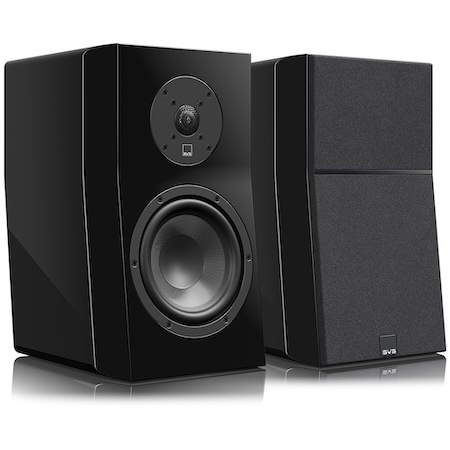
I would like to thank both SVS and Karma for providing the Ultra Evolution Bookshelf for the purposes of this review.
If you are interested in finding more information about this product, you can find it at the official SVS product page or on the Product page on Karma.
The SVS Ultra Evolution Bookshelf retails for $599 per speaker / $1,199 per pair. Available in Piano Gloss Black, Piano Gloss White, and Real Black Oak Veneer. The pair reviewed here is the Piano Gloss Black finish.
I have been living with the Ultra Evolution Bookshelves for about six weeks across three distinct listening environments — a large living room, a games room, and a near-field den — driven variously by a WiiM Amp, an Ampapa D1, a Denon AVR with room correction, and my Schiit Aegir 2 in stereo. The defining characteristic of this speaker, and the one worth understanding before you read further, is a measured in-room bass extension that reaches down towards 30Hz — a figure that typically belongs in a conversation about subwoofers rather than bookshelves.
But first, let’s take a look at what’s in the box.
Unboxing and Packaging
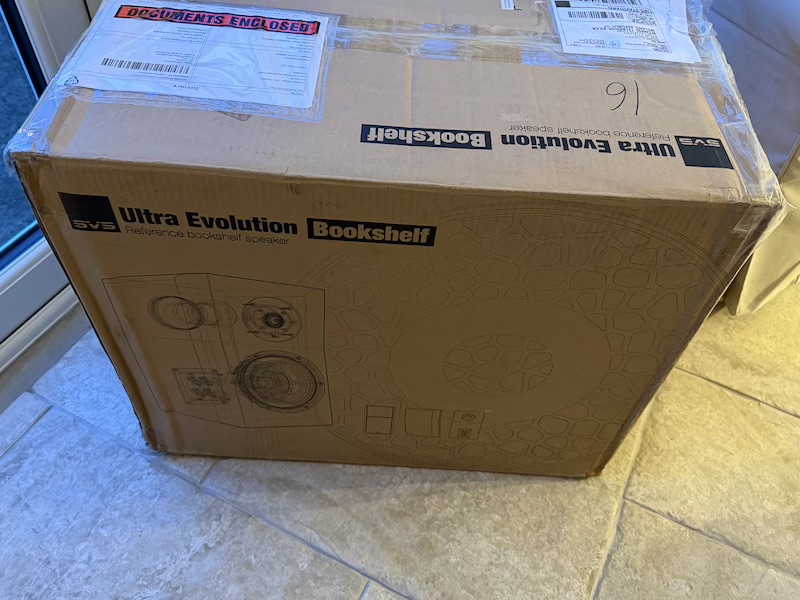
SVS ships the Ultra Evolution Bookshelves in serious packaging that reflects the weight of the product inside — 18.8 pounds per speaker unboxed, nearly 41 pounds shipped per pair.
 |
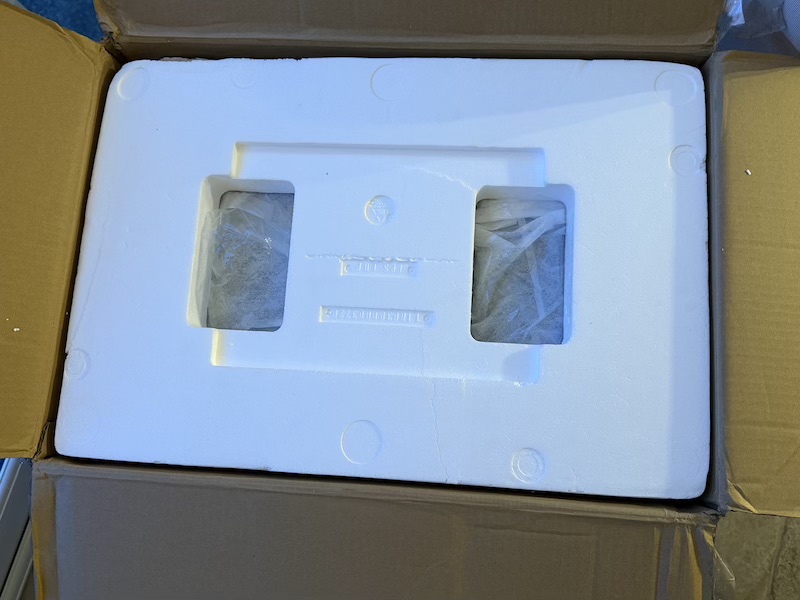 |
The box construction is substantial, and the approach to protective packaging is immediately noteworthy.
The offset arrangement of the two speakers within the shared packaging is interesting rather than stacking them
symmetrically:

The speakers out of the box:

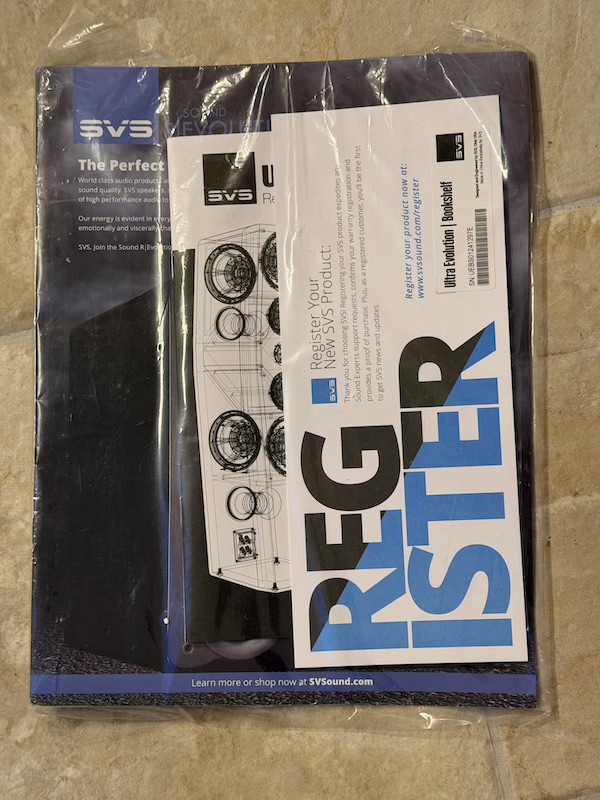
The manual and the feet:
Note: Despite the “Bookshelf” name, these are fairly large speakers that will not fit on most actual bookshelves.
At 378mm tall, 220mm wide, and 295mm deep — and weighing 8.6kg each — the Ultra Evolution Bookshelf is a proper standmount that requires dedicated speaker stands.
Stands of around 24 inches place the tweeter at a sensible listening height for most seated positions, but I also placed the speaker on a sideboard in one of my rooms. If you genuinely need a speaker that fits on a shelf, SVS makes the smaller Ultra Evolution Nano for that purpose. The Bookshelf is designed for open placement with space to breathe around it, and it performs accordingly.
Build Quality and Design
The Piano Gloss Black finish commands the room in the way that only a genuine high-gloss lacquer can. It is worth noting that the gloss surface reflects everything in front of it, and in a home theatre context where a television sits in the same visual field, you will see the screen reflected in the speakers.
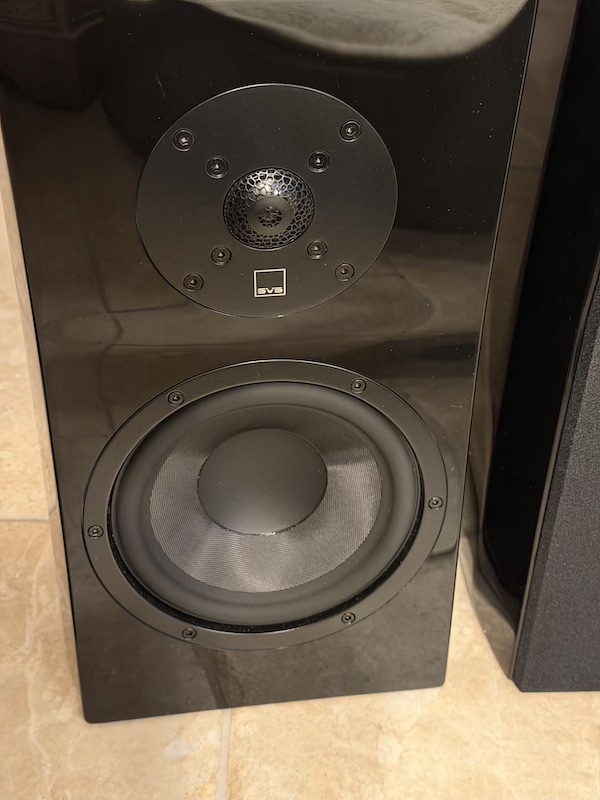
Obviously, this does not affect the listening experience, but if your room layout places the speakers directly alongside a TV, the reflection may be distracting — and it is worth considering the Real Black Oak Veneer finish as an alternative for that use case.
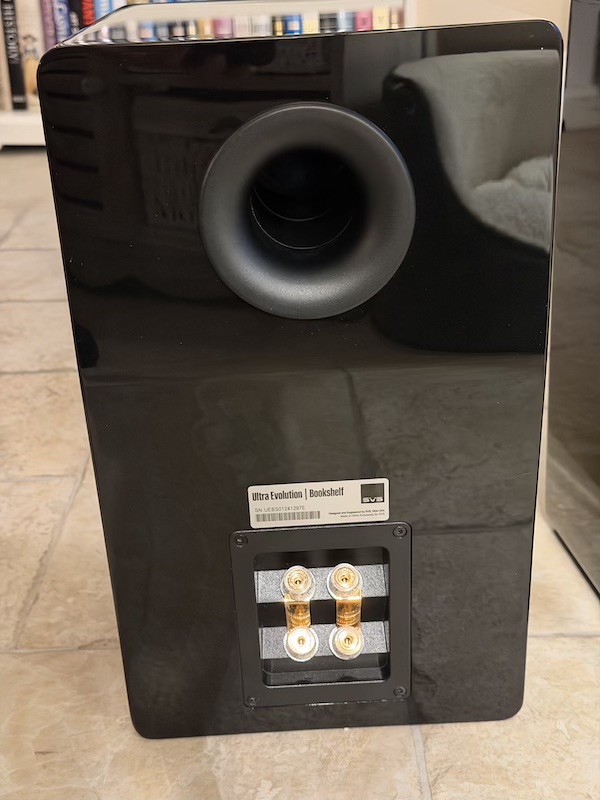
The rear panel is tidy and functional. The 2-inch wide-flared rear-firing port is tuned as part of the acoustic enclosure design rather than added as an afterthought, and its generous diameter reduces port noise at high drive levels.
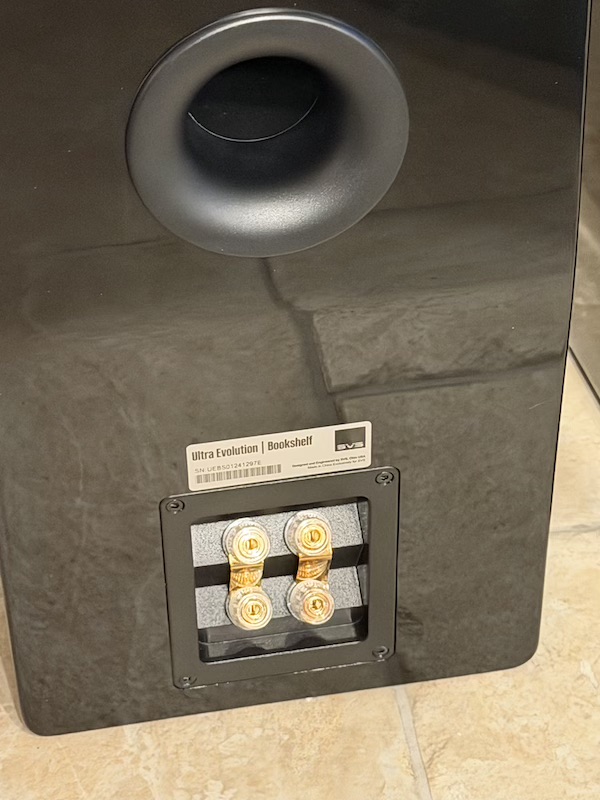
Binding post jumpers are pre-installed for single-wire connection:
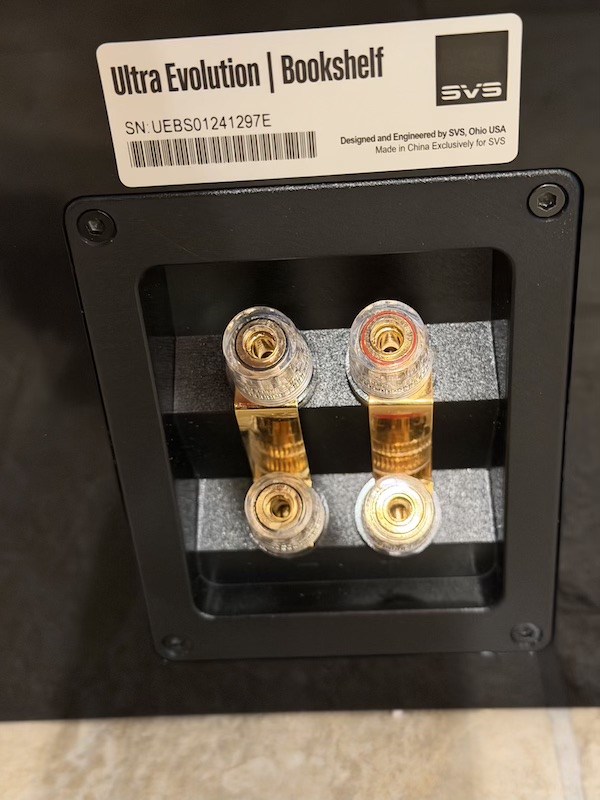
For the listener who eventually wants to explore biwiring, the Ultra Evolution is already prepared for it. The quality of the post hardware itself is excellent: firm engagement, no wobble, and gold plating that signals both corrosion resistance and a proper contact interface.
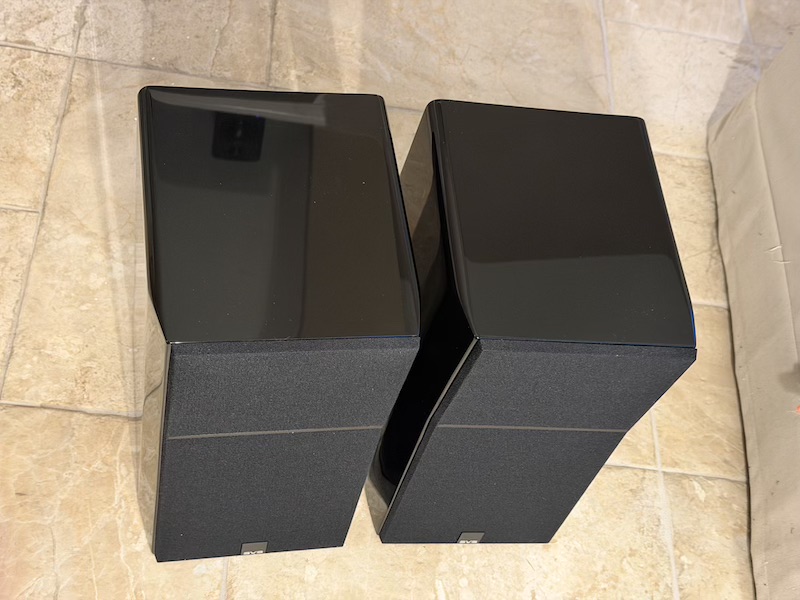
Note: the magnetic attachment system on the Ultra Evolution connects to the driver frames rather than to dedicated metal inserts embedded in the front baffle. Most magnetic grille designs use fixed baffle-mounted attachment points that guarantee consistent alignment every time the grille is replaced. The Ultra Evolution’s approach means the grille can sit slightly off-centre if not placed carefully, requiring a brief visual check when reattaching.
The woofer’s composite glass-fiber cone is worth examining closely — the material choice reflects a specific engineering trade-off. Glass fiber provides an excellent stiffness-to-mass ratio: stiff enough to behave as a piston well beyond its passband (at a 1.8kHz crossover point), light enough to preserve sensitivity, and rigid enough to resist the cone breakup modes that degrade upper-bass clarity in cheaper paper or polypropylene cones.
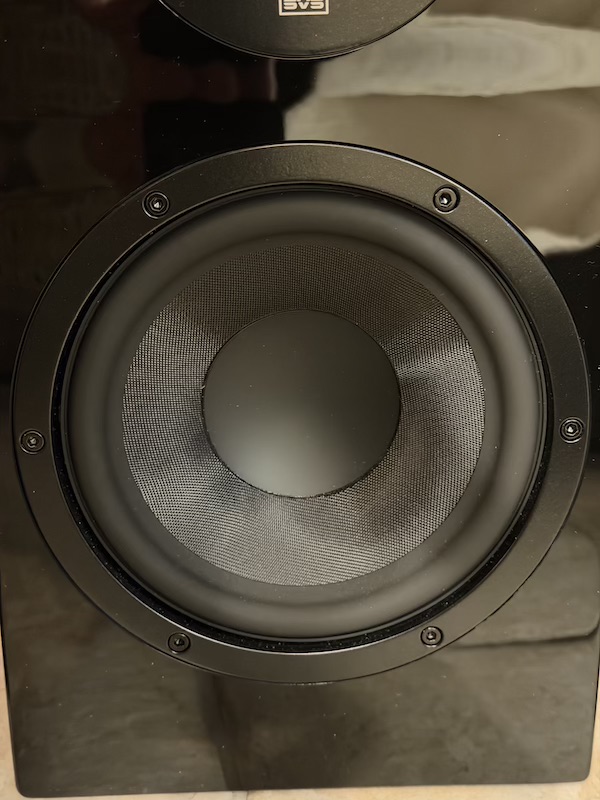
The precision-cast aluminium alloy basket ensures the voice coil alignment is maintained under thermal stress at high drive levels — SVS’s subwoofer engineering heritage is visible in these choices.
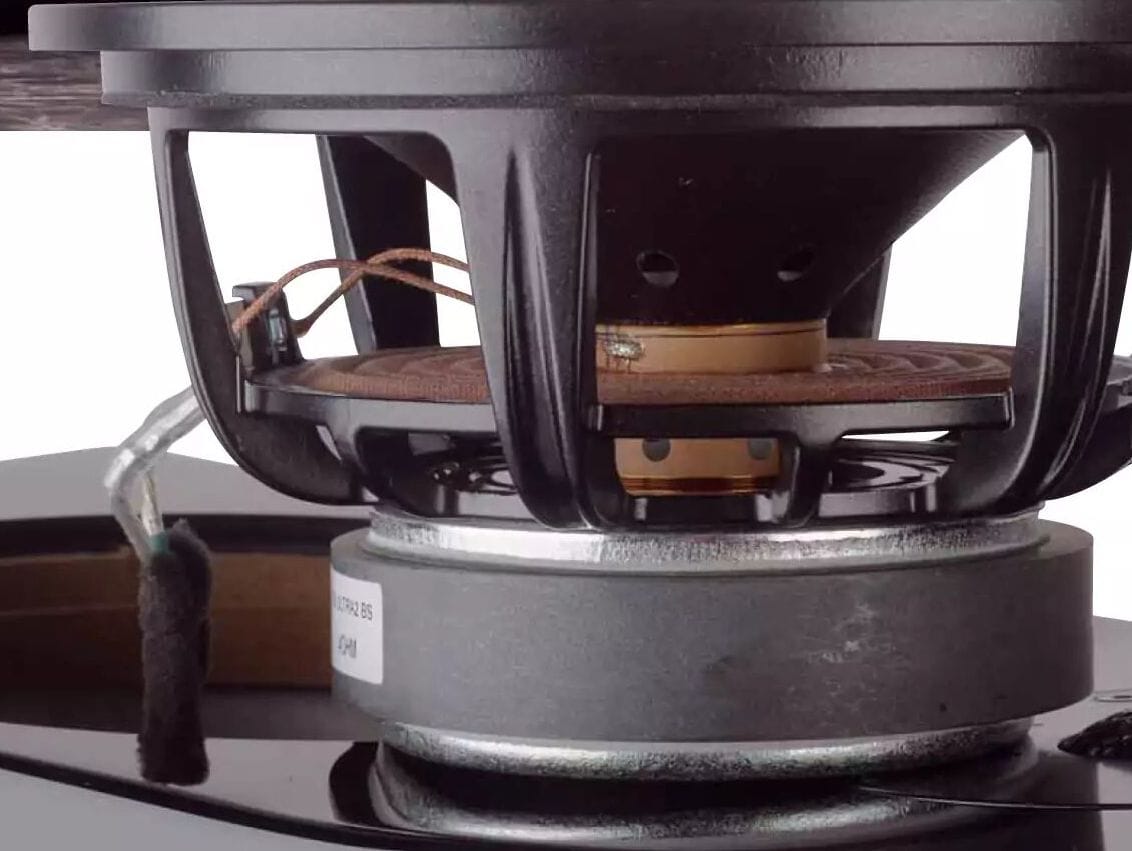
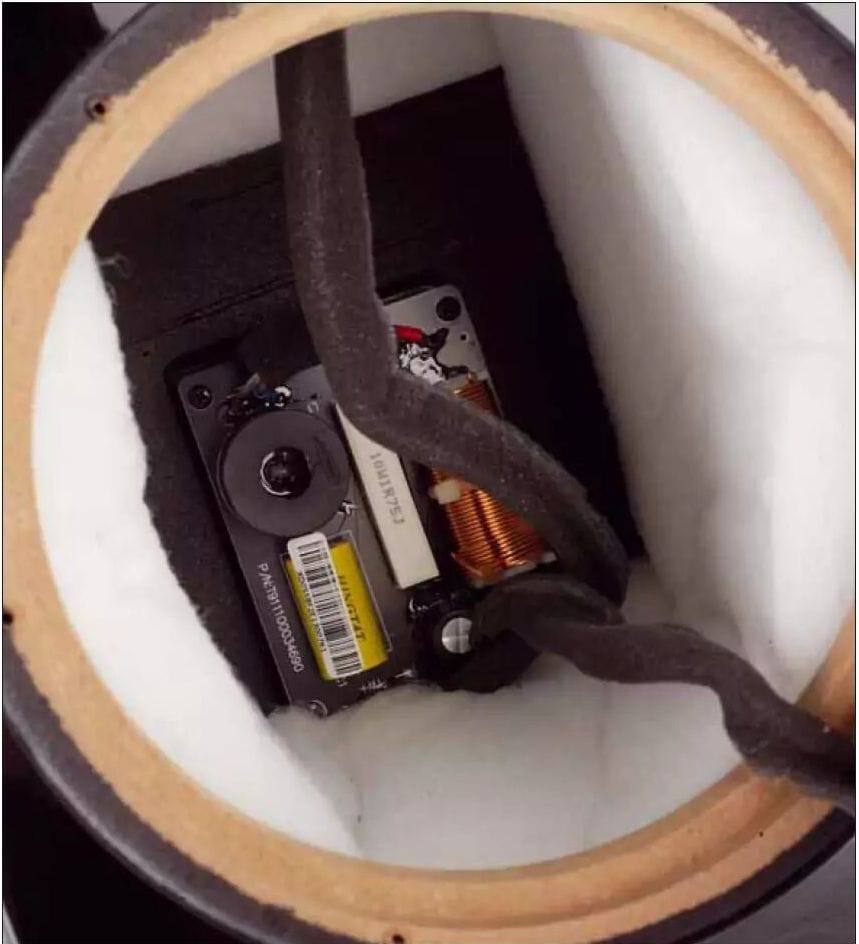
The bracing is also excellent:
The diamond-coated tweeter is SVS’s most significant driver technology claim, and it has genuine engineering substance behind it.
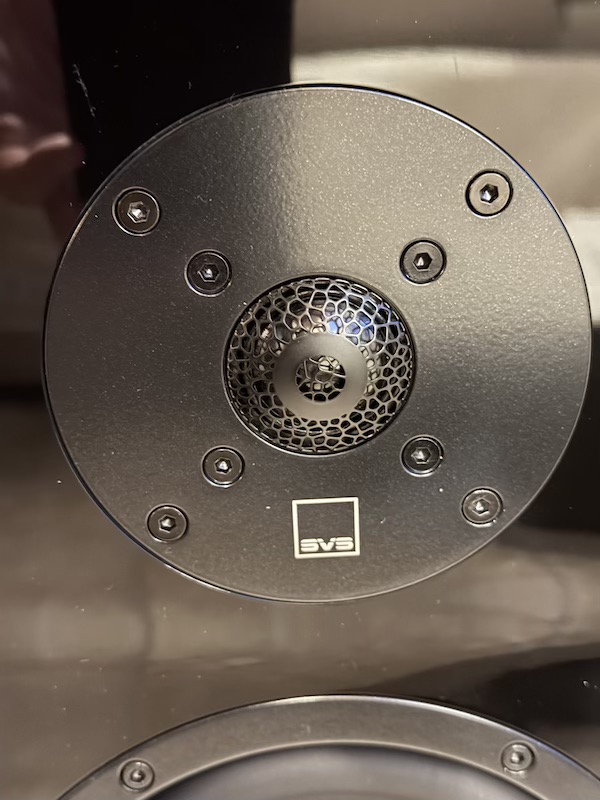
Through a process called vapour deposition, a hyper-rigid diamond-like carbon layer is grown on the aircraft-grade aluminium dome — not applied as a coating in the conventional sense, but formed as a crystalline structure that according to SVS fundamentally changes the mechanical properties of the dome.
The result is measurably higher rigidity, which pushes resonance modes well beyond the audible range and allows the tweeter to maintain linear, distortion-free behaviour well past 40kHz. The practical consequence in listening is a treble that extends without the glassiness or HF resonance that plagues softer dome materials under stress.
The curved front baffle is the third piece of engineering that deserves specific discussion. I thought this diagram from SVS was useful to understand the time alignment of the cabint design:
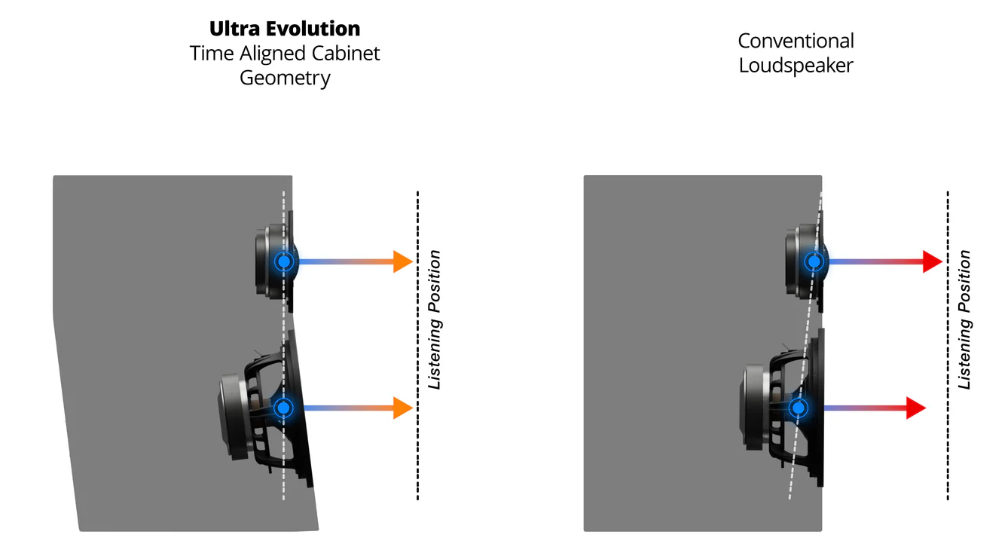
Time alignment between drivers — ensuring the acoustic emanation points of the tweeter and woofer arrive at the listener’s ear simultaneously — typically requires either electronic delay, physical offset in the driver plane, or a curved baffle that introduces the necessary geometric path length difference.
Setup and Amplification
The Ultra Evolution Bookshelf has a nominal impedance of 6Ω and a sensitivity of 87dB — figures that look demanding on paper but behaved considerably more forgivingly in practice than the specification might suggest. Across six weeks and three rooms, the speakers performed well with every amplifier in the chain and scaled appropriately as I swapped amplifiers, from the modest WiiM Amp to the Class A purity of the Schiit Aegir 2.
For the living room and games room environments, the WiiM Amp and Denon AVR’s room correction capabilities proved their value. The Ultra Evolution’s bass extension reaches deep enough that room modes become a meaningful factor in a typical domestic space, the WiiM’s room optimisation routinely addressed low-frequency peaks and room-specific coloration that the speaker’s inherent capability was otherwise revealing. The combination of genuine deep bass in the speaker and intelligent room correction in the amplifier/streamer is, in practice, the ideal way to deploy the Ultra Evolution in a non-acoustically treated room where you do not have space for a subwoofer.
Setup in different rooms
In my large living room, the Ultra Evolution Bookshelves were paired with the Aegir 2 and positioned
at a
conventional listening distance:
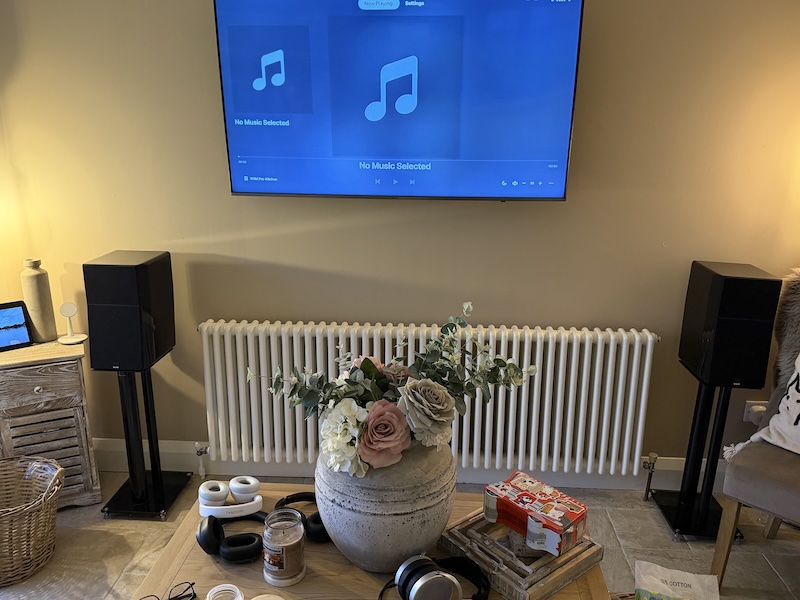
The scale of the speaker’s performance in this environment was immediately apparent. The bass filled the room with an authority that most standmounts cannot achieve without a dedicated subwoofer alongside them, and the soundstage projection reached beyond the speaker boundaries in a way that typically requires floorstanders.
My games room setup revealed a different facet of the Ultra Evolution: its composure under less rigorous listening conditions, where it doesn’t have a lot of space around the speaker but where I employed some room correction:
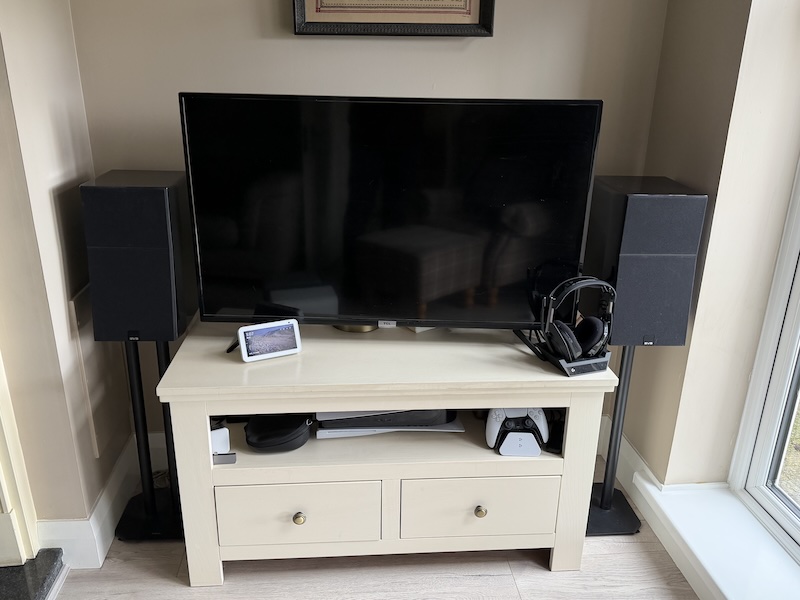
Running casually from the WiiM Amp at decent volume, the speakers maintained the tonal balance and detail retrieval, a sign of a speaker that does not depend on a specific acoustic environment to perform well. Basically, it can provide a decent tonal balance even when using room correction rather than needing acoustic panels.
The near-field den setup was where the Ultra Evolution’s midrange and imaging resolved most clearly:
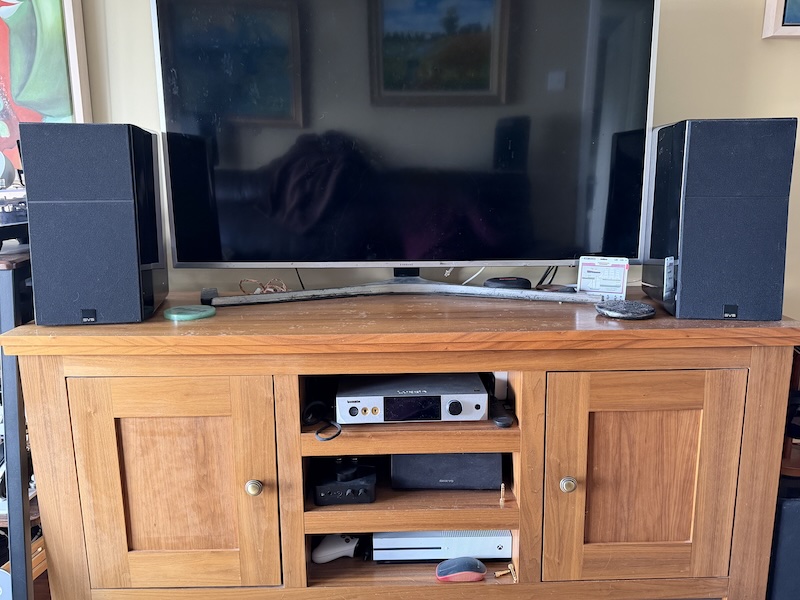
At close listening distances with the Denon AVR, the level of fine detail in vocals and acoustic instruments was immediately apparent — this is a speaker that rewards close, attentive listening as generously as it rewards casual use across a larger room.
I typically use a Kef LS50 Meta paired with a KEF Subwoofer in this space while that it vital for the KEF, but I did not need the Subwoofer when I listened to the Ultra Evolution.
Some Speaker Comparisons
 |
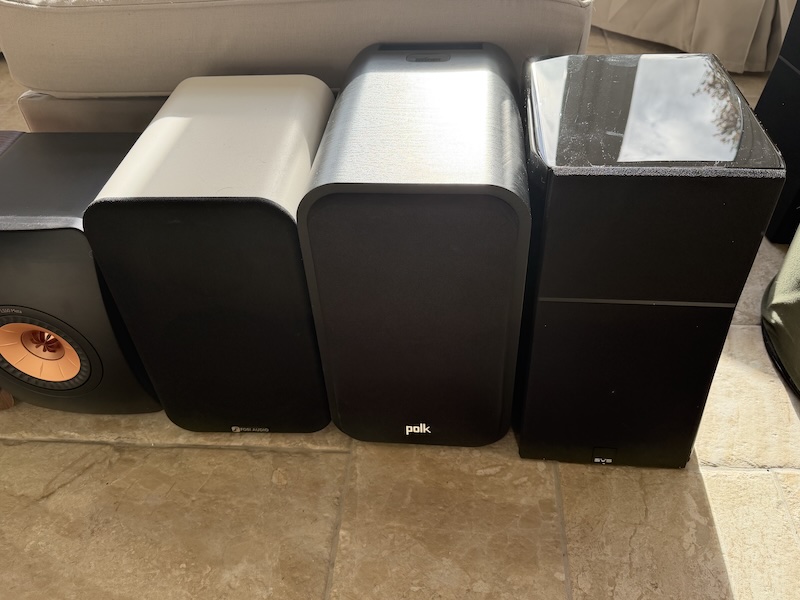 |
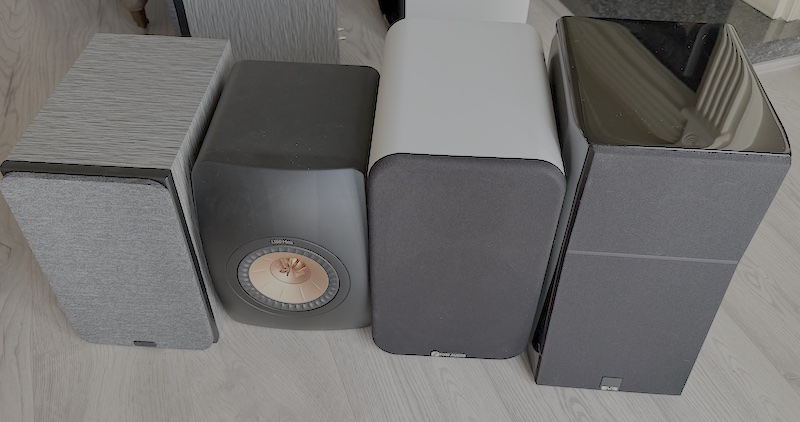
The comparison with the Fosi Audio SP601 and Polk ES20 is because both speakers share a broadly similar driver size footprint on paper. In practice, the Ultra Evolution operates in a different performance tier entirely: the bass extension, authority, and control of the SVS is not a marginal improvement over the alternatives but a categorical one. Mid-bass articulation on the Polk and Fosi is competent, but the Ultra Evolution’s long-stroke motor and composite glass-fiber cone produce a fundamentally more resolving and controlled low-end presentation — one where the difference between a bass guitar’s body and its attack is rendered distinctly rather than fused together.
SVS Ultra Evolution Bookshelf vs KEF LS50 Meta
The KEF LS50 Meta is the more interesting comparison. The LS50 Meta’s Uni-Q coincident driver delivers pin-point imaging that the Ultra Evolution does not fully match — the KEF’s concentric tweeter-in-woofer geometry places the acoustic centre of both drivers at a single point, producing a spatial coherence that the Ultra Evolution approaches but does not quite equal. What the Ultra Evolution offers in return is bass extension that the LS50 Meta cannot match without a dedicated subwoofer. In a typical domestic room without bass management, the Ultra Evolution sounds substantially more complete — fuller, richer, more convincing as a full-range system. Whether you prioritise the KEF’s imaging precision or the SVS’s low-frequency authority depends on your listening priorities, but the Ultra Evolution makes the trade-off considerably less painful than most alternatives in its price bracket.
Sound Impressions
My primary listening was conducted with the Schiit Aegir 2 in the open-plan living room, and with the Denon AVR in my nearfield DEN room for extended casual listening. Source material was a mix of Apple Music Hi-Res streaming and local FLAC files. All impressions below are formed with room correction engaged unless otherwise stated, as the Ultra Evolution’s bass extension makes room correction an active and beneficial tool rather than a compensatory one.
Bass
The bass is the definitive characteristic of the Ultra Evolution Bookshelf, and it is the area where SVS’s engineering heritage — and their reputation — are most legibly expressed. Sub-bass extension reaches into territory that no speaker of this cabinet volume should be able to access: the in-room measurement confirms usable output approaching 30Hz, which is a figure associated with subwoofers rather than two-way bookshelves. The character of this bass is not merely deep but also articulate and controlled — the long-stroke woofer motor maintains composure at high excursion, and the mid-bass avoids the bloom and softness that often accompany deep extension in ported designs at this price.
James Blake’s “Limit to Your Love” is the reference track I kept returning to: the synthesised bass frequencies that give that recording its physical weight and emotional character were reproduced with a completeness and authority that I have not heard from any bookshelf in my collection without a paired subwoofer, the first time that particular piece of music sounded as it should in my listening environment.
Midrange
The midrange of the Ultra Evolution is strikingly neutral — perhaps the most surprising characteristic of a speaker whose bass commands immediate attention. Vocal timbre is natural and unforced, with none of the upper-midrange push that can make voices sound artificially present on speakers tuned for consumer listening environments. Instrumental separation across complex passages is clear and unhurried, with note weight and body that give acoustic recordings a convincing physical reality. The 1.8kHz crossover point — managed by the premium-grade crossover components — maintains seamless handoff between woofer and tweeter with no audible discontinuity through the critical presence region.
Dire Straits’ Brothers in Arms is the reference I rely on for midrange evaluation — Knopfler’s voice and guitar carry genuine intimacy and tonal density through the Ultra Evolution, with enough harmonic richness to make a familiar recording feel newly present.
Treble
The diamond-coated tweeter delivers on its technical promise in listening. The high-frequency presentation is refined, airy, and extended — the vapour-deposition diamond coating’s rigidity advantage translates directly into a treble that extends effortlessly without the grain or etch that aluminium dome tweeters sometimes exhibit at the limits of their excursion. Cymbal shimmer has natural decay rather than a mechanical quality; hi-hat texture is resolved with transient speed that tracks rapid rhythmic detail accurately.
Patricia Barber’s “Use Me” is the test I trust for treble evaluation: snare snap and cymbal decay both resolve cleanly through the Ultra Evolution, with air and shimmer that feel correct rather than elevated.
Soundstage and Imaging
The time-aligned curved cabinet’s contribution to soundstage coherence is one of the Ultra Evolution’s most consistent strengths. Instrument placement is precise and stable, with a well-defined centre image and convincing left-right separation that extends confidently beyond the speaker boundaries in the listening rooms where I tested it. Depth layering is more convincing than the two-way topology might suggest — front-to-back distance between instruments on well-recorded material is rendered with sufficient resolution to convey a sense of the recording space rather than a flattened stereo field.
The one area where the LS50 Meta holds a genuine advantage is in pin-point imaging: the Uni-Q geometry’s single acoustic point of origin produces a more holographic, positionally precise result than the Ultra Evolution’s conventional driver geometry can fully replicate. That said, the Ultra Evolution’s soundstage is more than competitive at its price, and the overall spatial coherence that the time-aligned cabinet delivers is audible and meaningful — instruments sit in consistent, believable positions across the frequency range through the crossover region rather than smearing as the handoff occurs.
Supertramp’s Crime of the Century rewards this quality well — the spatial layering and reverb tails that make that recording a standard imaging reference are rendered with a breadth and depth that makes the listening space feel genuinely extended.
Specifications and Measurements
| Specification | Detail |
|---|---|
| Driver complement | 1-inch diamond-coated aluminium dome tweeter / 6.5-inch composite glass-fiber woofer |
| Tweeter coating | Vapour deposition diamond-like carbon |
| Tweeter diffuser | FEA-optimised organic cell lattice |
| Crossover | 2-way at 1.8kHz; premium-grade components, heavy-trace PCB |
| Frequency response | 40Hz – 40kHz (±3dB) |
| Nominal impedance | 6Ω |
| Sensitivity | 87dB (2.83V @ 1 metre, 300Hz – 3kHz) |
| Recommended amplifier power | 20 – 150W |
| Cabinet construction | FEA-optimised ¾-inch (18mm) walls; 1-inch (25mm) driver baffle; curved time-aligned front |
| Port | 2-inch wide-flared rear-firing |
| Binding posts | Dual gold-plated 5-way (biwire capable) |
| Grille attachment | Neodymium magnetic |
| Cabinet dimensions (H×W×D) | 382 × 220 × 296mm (15.04" × 8.66" × 11.64") |
| Weight (each) | 8.6kg / 18.8 lbs |
| Finishes | Piano Gloss Black / Piano Gloss White / Real Black Oak Veneer |
| Price | $599 each / $1,199 pair |
As i mentioned earlier the important specification is probably the Sensitivity value as you do need some power to drive this speaker but as I have hopefully demonstrated both Class A and some of my favourite recent Class D amplifiers like the Ampapa D1 and the WiiM App are more than capable of driving this speaker.
Measurements
The following anechoic frequency response and distortion measurements are courtesy of 7review.com, whose independent lab testing of the Ultra Evolution Bookshelf provides a useful counterpart to the in-room measurements I will present below:
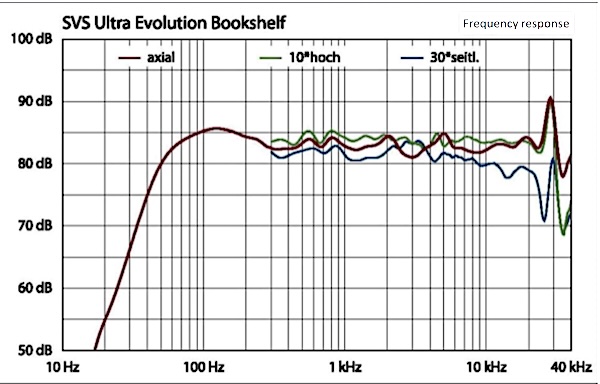
The 7review anechoic measurement isolates the speaker’s native frequency response from room influence, confirming the broad shape of what the in-room measurement showed: a well-controlled bass rolloff, a composed and broadly linear midrange, and a treble that extends cleanly without the elevated peaks or early rolloff that would indicate driver or crossover stress.
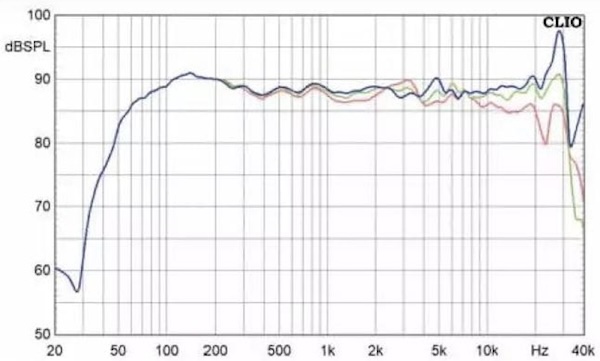
The anechoic environment removes the low-frequency room mode contributions visible in my in-room trace, making the speaker’s own engineering more legible — and the result is a speaker that measures as neutrally as it sounds in careful listening.
The distortion measurements are reassuring across the operating range. Distortion rises in the low-frequency region as the driver works at higher excursion — expected and unavoidable physics at this cabinet volume — but remains well-controlled through the midrange and treble.
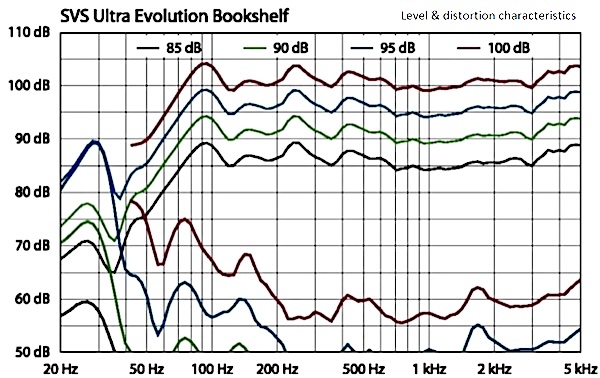
These figures confirm that the Ultra Evolution’s low-distortion character in listening is measurably real rather than a subjective impression.
John Atkinson’s laboratory review of the SVS Ultra Evolution Pinnacle — a larger floorstander from the same Ultra Evolution family — as published in Stereophile. The Bookshelf’s low-frequency behaviour is naturally its own, but the diamond-coated tweeter is shared across the Ultra Evolution range, making the high-frequency portion of Atkinson’s measurement directly relevant here:
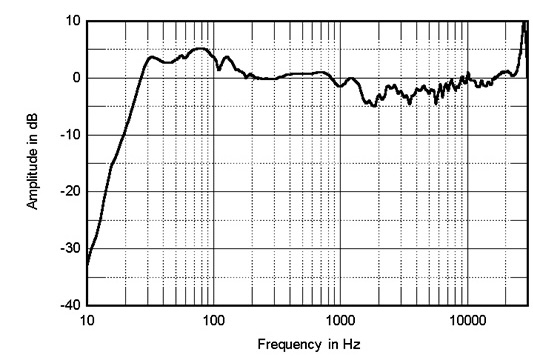
I think two findings are worth drawing out here even for the Bookshelf. First, the tweeter’s resonance peak appears at approximately 29kHz — well above the audible range, confirming that the diamond coating’s rigidity advantage keeps the dome behaving as a clean piston throughout the entire audible bandwidth and well beyond it. This is the measurable explanation for the absence of grain or HF stress in extended listening. Second, Atkinson notes a slight lack of energy in the presence region on-axis, which tends to fill in as you move off-axis to the sides of the speaker.
The practical implication is that toe-in angle is worth experimenting with during setup: toeing the speakers more directly toward the listening position adds a touch of presence-region energy, while toeing out slightly produces the warmer, more laid-back presentation that the Ultra Evolution’s character naturally lends itself to. The broader sweet spot afforded by the organic cell lattice diffuser means this adjustment has a relatively gentle effect, but it is a useful tuning tool that the Stereophile measurements make legible.
In Room Measurements
So the following is a simple in room measurement I did after I applied some room correction and as you can see with some tuning you can get the bass down to incredible low levels and relatively smooth response accross the complete frequency response:
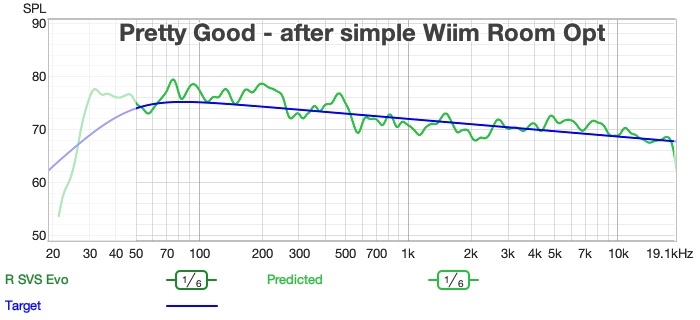
The curve through the midrange is well-behaved and reasonably linear, consistent with the neutral midrange character noted in listening. The high-frequency extension tracks cleanly to the top of the measurement range, without the premature rolloff or resonant peaks that would indicate the tweeter working beyond its comfortable operating range.
One worry sometimes when you do use room correction PEQ is does it introduce any distortion but again as shown earlier the Bookshelf handles these room correction EQ incredible well with no worrying distortion even when pushing 30hz:
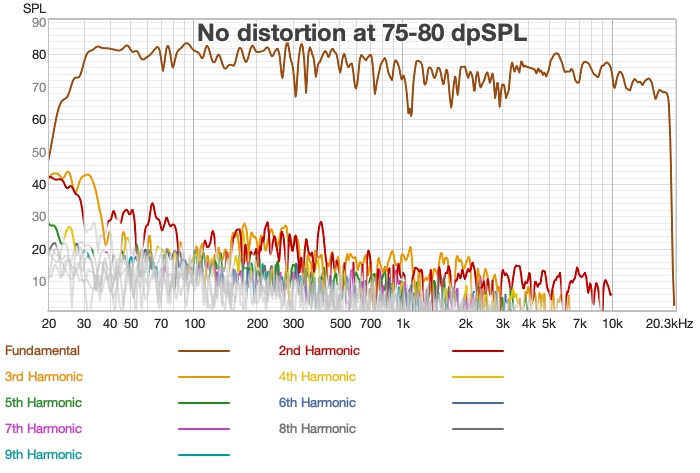
In my opinion, this is the measurement that matters most for everyday use — it confirms that the Ultra Evolution Bookshelf’s low-distortion character is not a controlled laboratory result that disappears in a domestic environment, but a real and consistent property of the speaker in typical use. The room correction contribution here is worth noting: by taming the low-frequency room modes that would otherwise push the woofer into harder excursion, room correction actively reduces the conditions that produce distortion, and the measurement reflects that benefit.
Rating Explanation
The Ultra Evolution Bookshelf earns a pragmatic rating of five because it delivers on its central engineering promise without qualification: this is a bookshelf speaker that extends deep enough, images precisely enough, and resolves midrange detail clearly enough to function as a genuinely complete two-channel listening system in most domestic environments without a subwoofer alongside it.
The combination of the diamond-coated tweeter, the time-aligned curved cabinet, the long-stroke glass-fiber woofer, and the biwire-capable binding posts represents a specification that belongs in a speaker costing considerably more. The measurements support the listening impressions at every point, and the consistent performance across three different rooms and four different amplifiers suggests a speaker that is robust and reliable rather than environment-dependent.
The Ultra Evolution Bookshelf is the speaker for a listener with a medium to large room who wants a near-full-range two-channel system in standmount form — one that handles complex music, home theatre duty, and serious listening equally well, and that sounds noticeably better than its price suggests it should.
Conclusion
SVS built its reputation on bass, and the Ultra Evolution Bookshelf is the fullest expression of that heritage in a speaker that no longer needs a companion subwoofer to achieve it. Six weeks across three rooms confirmed what the measurements establish: this is a speaker with a bass performance that is genuinely unusual at the price, delivered alongside a neutral midrange and a refined, extended treble that the diamond tweeter technology earns through engineering rather than marketing.
At $1,199 a pair, the Ultra Evolution Bookshelf asks for a considered investment and returns a speaker that is thoughtfully engineered, distinctively styled, and capable of making you forget the subwoofer in the corner. Buy them if you want a bookshelf speaker that genuinely extends into the room, sounds neutral and detailed across the frequency range, and scales gracefully from casual listening to critical evaluation — all without the dedicated low-frequency reinforcement that most competing standmounts silently require.