Fosi Audio SW10
A compact powered subwoofer to partner the SP601
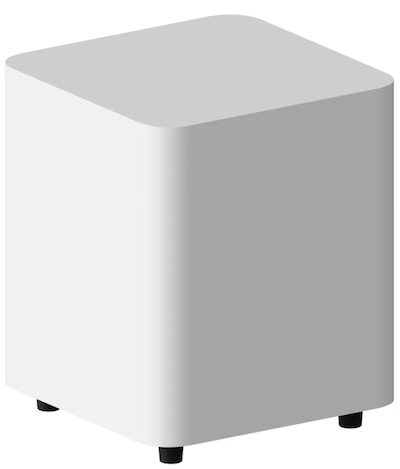
The Fosi Audio SW10 is a compact powered subwoofer built around a 10-inch down-firing woofer and a 200W Class-D amplifier rated for 500W peak. The driver fires toward the floor — using the floor as a natural reflector to spread bass more evenly — and the cabinet is ported by a pair of rear bass ports for greater airflow and deeper extension. The front face is left clean, with the driver hidden underneath and all the controls on the rear, giving it a Nordic-inspired minimalist look that disappears into a room.
Fosi pitch it as a do-everything subwoofer for movies, music and gaming, designed to partner their own amplifiers and speakers — and it slots in naturally beneath a system like the Fosi Audio SP601 speakers, which is exactly how I have been using it. A precision DSP adds DRC limiting and dual EQ voicings, and the rear panel carries a proper 40–180Hz crossover and 0–180° phase control for integrating it with the main speakers.
I purchased the SW10 myself for the purposes of this review. Fosi Audio have sent me a number of their amplifiers and other products in the past, but this subwoofer was not one of them.
If you are interested in finding more information about this product, you can find it at the official Fosi Audio product page.
The Fosi Audio SW10 retails for $379.99, though it can often be found a little cheaper during one of Fosi Audio’s regular sales events.
I bought this one myself, which is worth explaining. Fosi Audio have sent me a good number of amplifiers and other products over the years, but I had already bought the SP601 speakers with my own money because I was curious about how a company I knew for amplification would handle passive speakers — and having liked those enough to keep them in the system, I wanted to hear what they would do with a subwoofer as well. So the SW10 joined the SP601 pair in my TV and desktop system as a deliberate purchase rather than a review sample. The standout finding after living with it is the simplest one: this is a large woofer at a price where large woofers are rare, and the amount of bass it moves reflects that.
Unboxing and Packaging
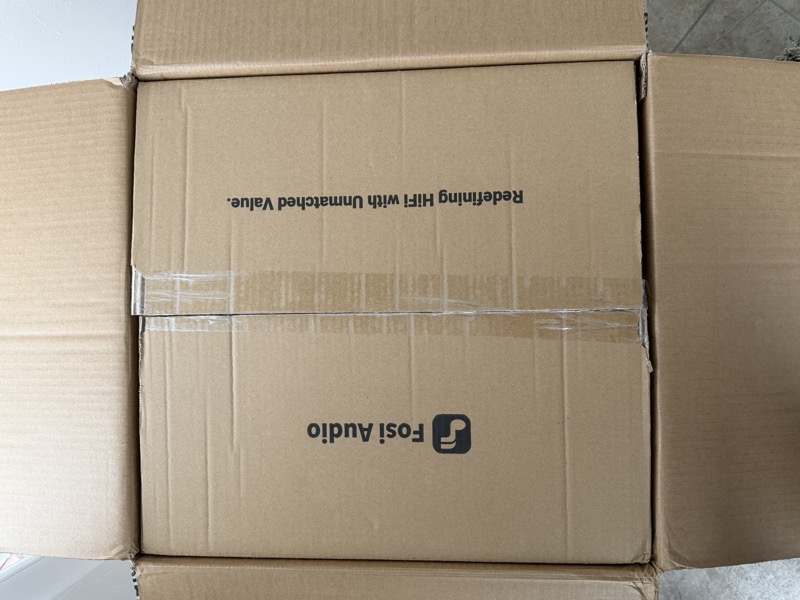
The SW10 arrives in a plain Fosi Audio shipping carton — “Redefining HiFi with Unmatched Value” printed on the side:
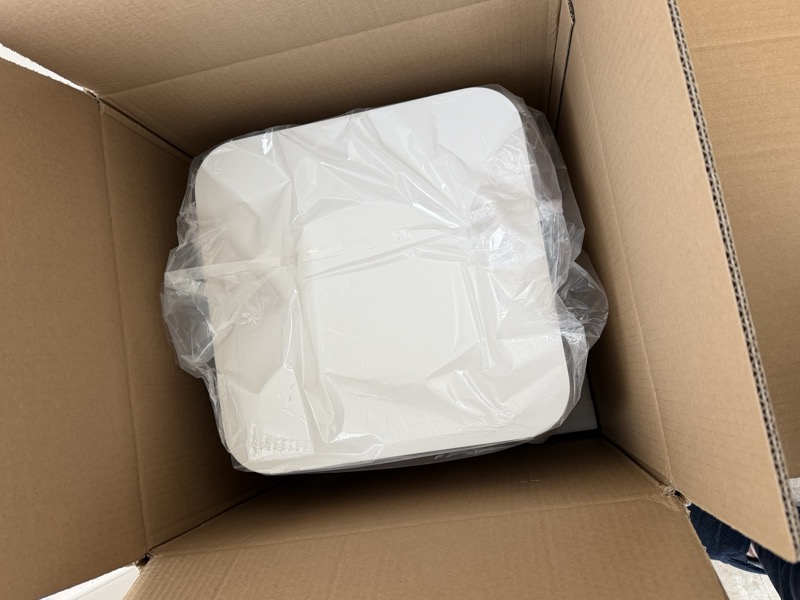
Inside, the subwoofer is bagged and wrapped in protective film:
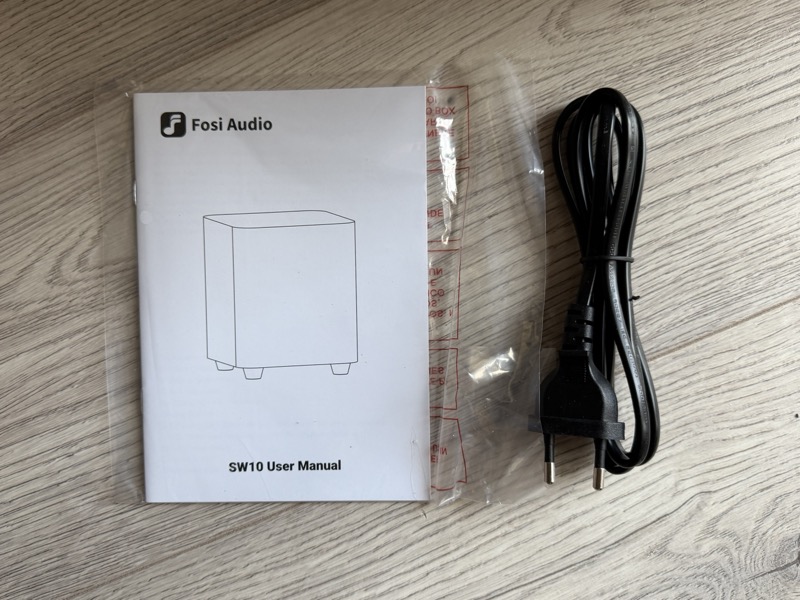
The accessories are minimal — a power cable and the SW10 user manual:
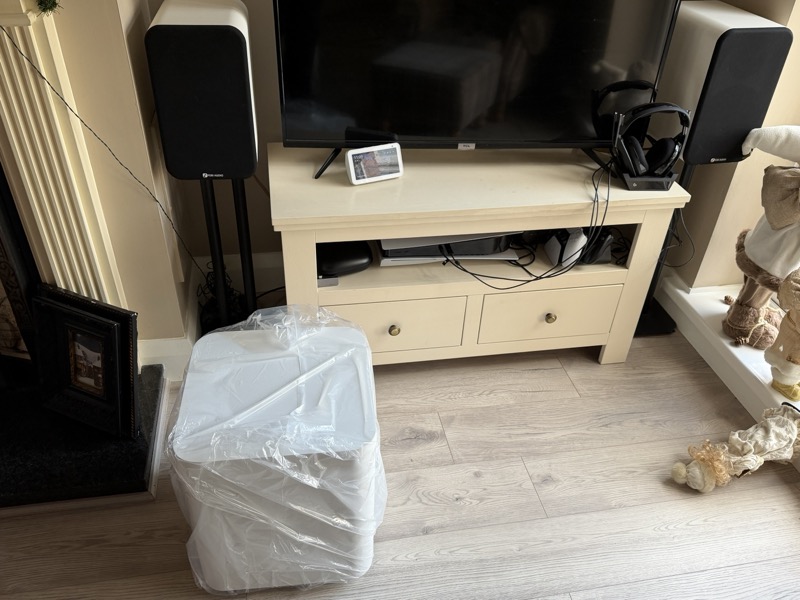
Freshly unboxed and wrapped, sitting in the room next to the SP601 system:
Design and Build Quality
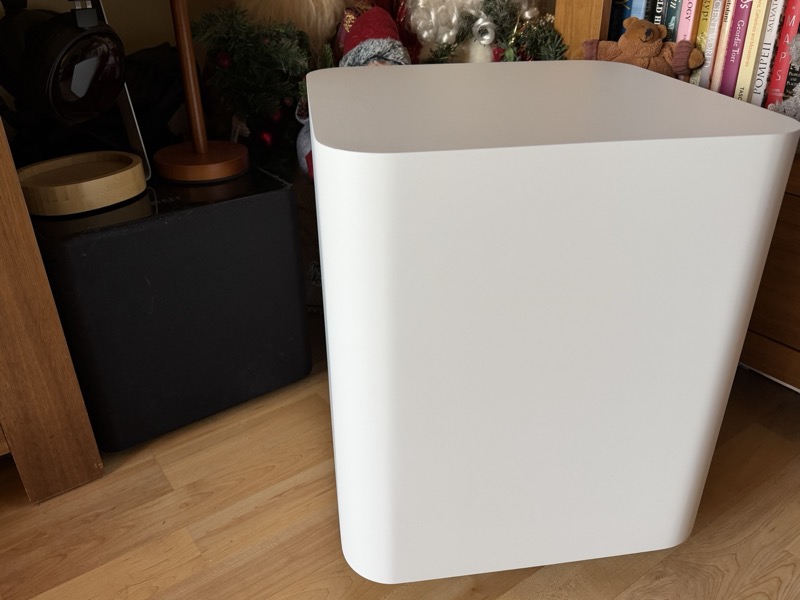
The SW10 is a clean, minimalist white cube with rounded edges and no visible driver on the front or sides — understated enough to sit unobtrusively in a living room. It is a substantial unit, with a 14kg MDF cabinet finished in PVC, and that mass is deliberate: it helps damp cabinet resonance and vibration for cleaner bass:
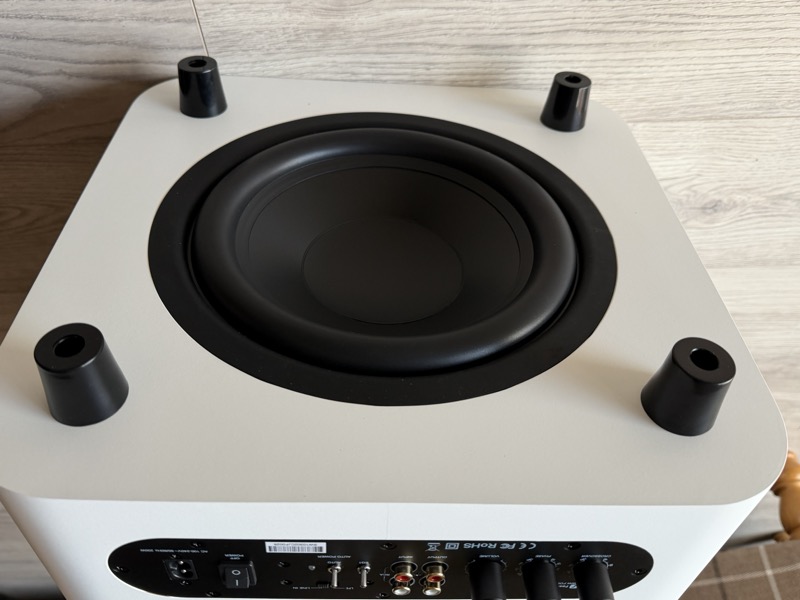
The 10-inch woofer is down-firing, mounted on the underside and lifted off the floor by four feet so it can fire toward the floor surface:
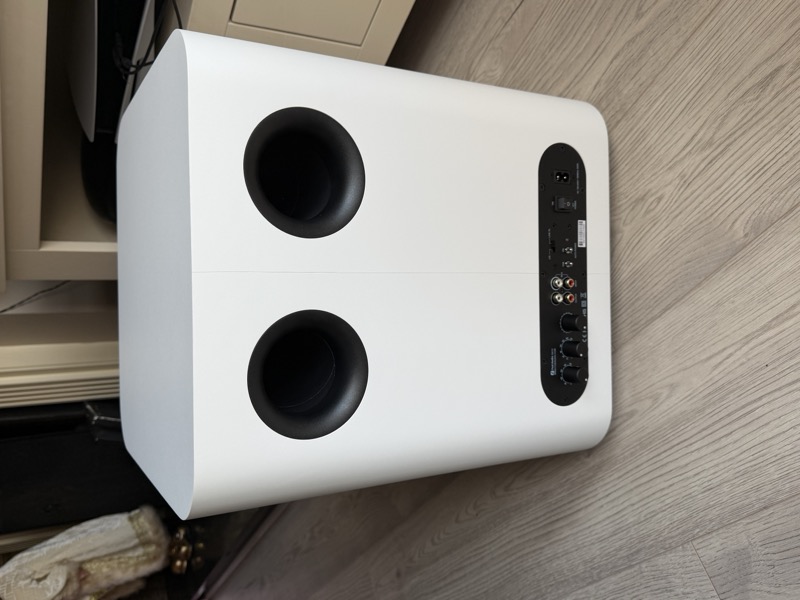
The rear carries the dual flared bass ports above the amplifier plate:
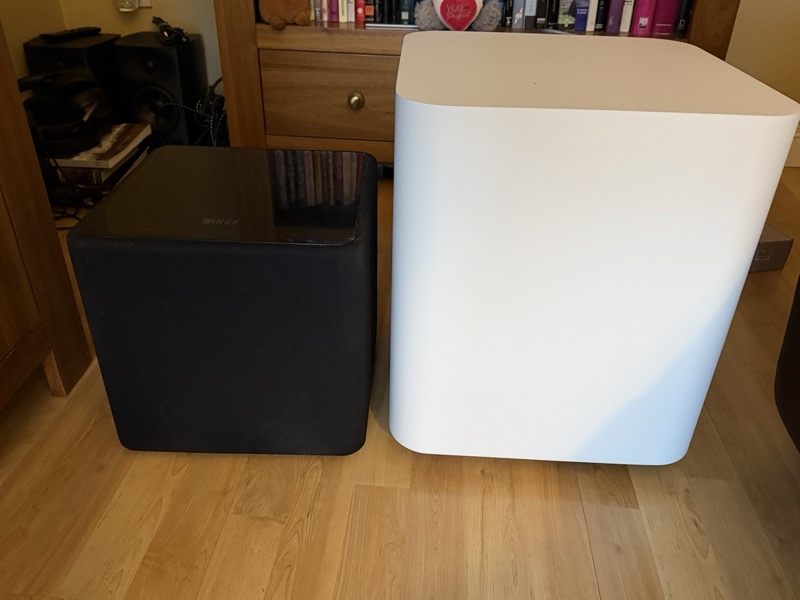
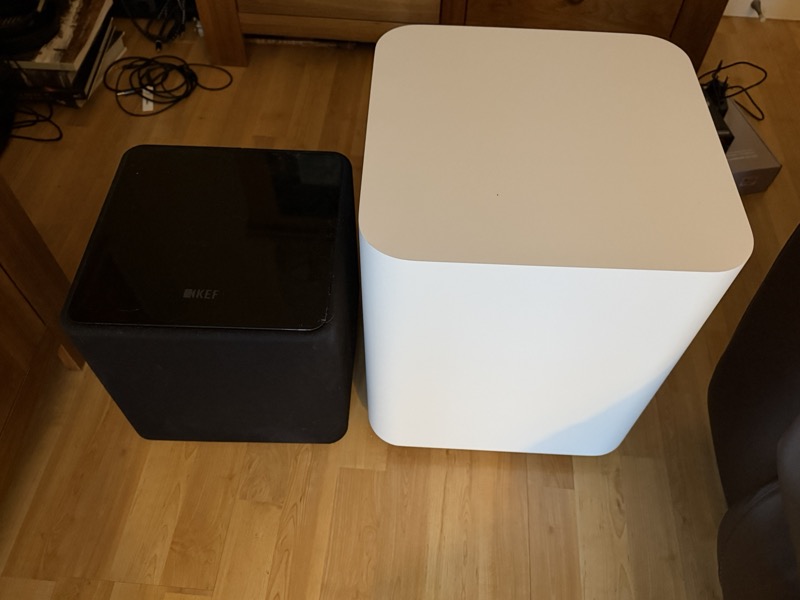
For a sense of scale, here it is next to a KEF subwoofer — the SW10 is the noticeably larger of the two:
 |
 |
Controls and Connections
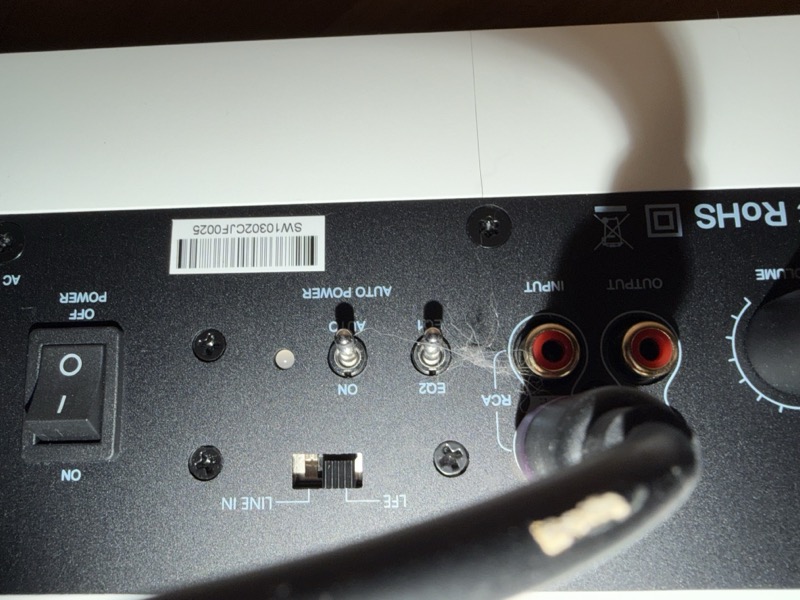
The amplifier plate on the rear is well equipped for a subwoofer at this level. There are rotary controls for crossover frequency, phase and volume, RCA input and output, an LFE / Line-in selector, an EQ1/EQ2 voicing toggle, and an auto-power (On/Auto) switch alongside the main power switch:
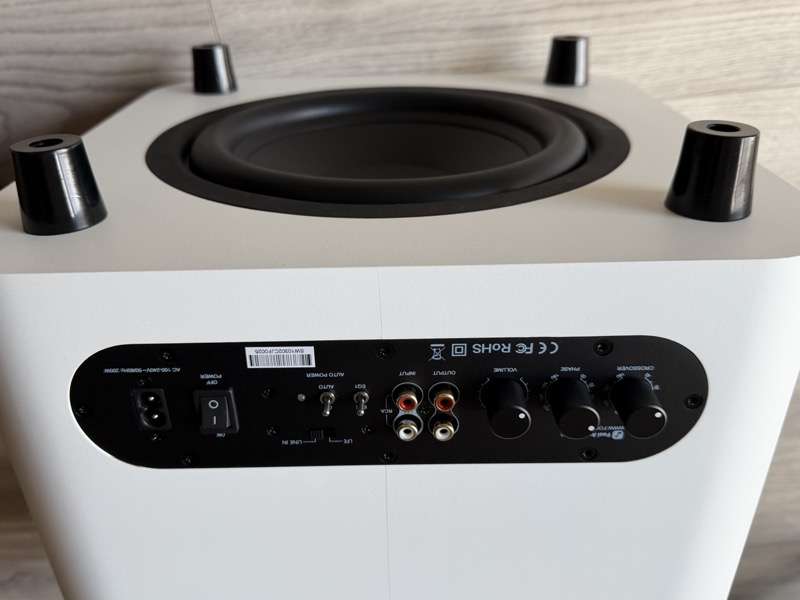
Seen at an angle, with the woofer below:
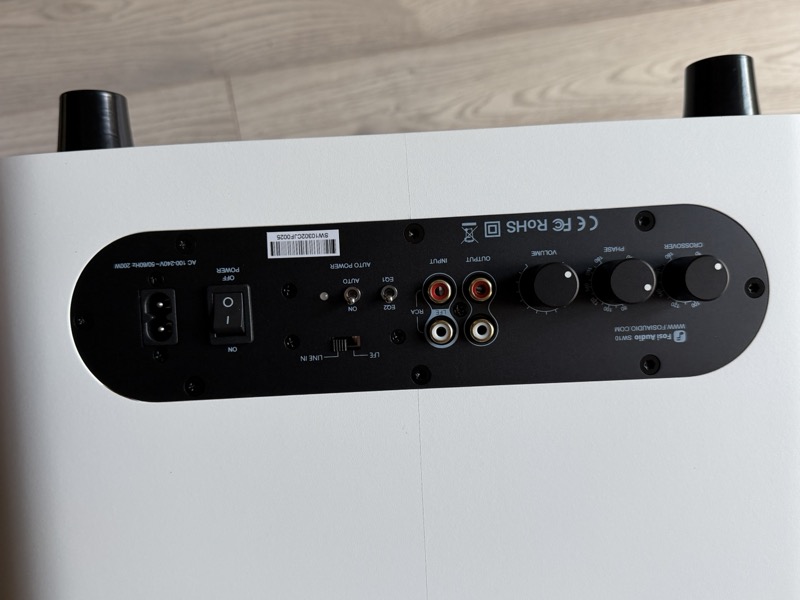
A closer look at the RCA input/output, the LFE/Line-in switch and the auto-power toggles:
 |
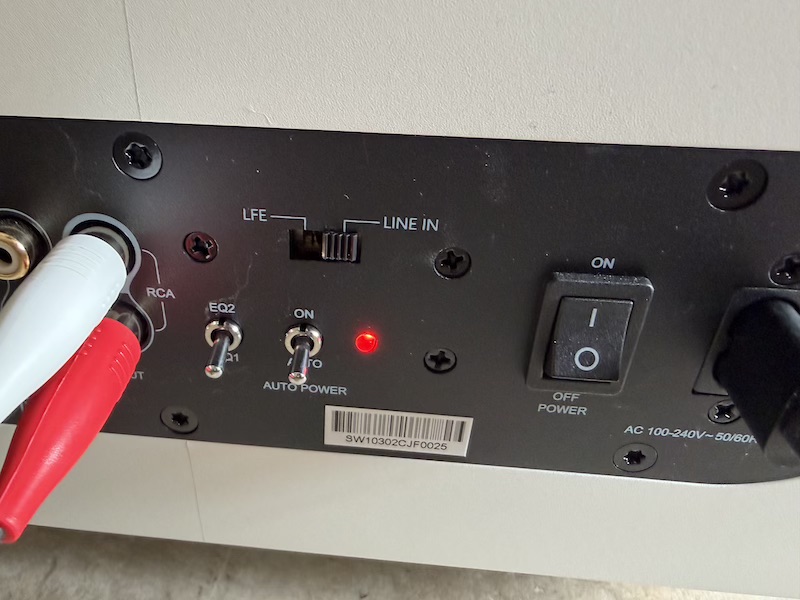 |
The controls are comprehensive for a sub at this price. The crossover is continuously adjustable from 40Hz to 180Hz, so you can dial in exactly where the SW10 hands over to your main speakers, and the phase control sweeps the full 0–180° for time-aligning it with them. The EQ1/EQ2 toggle switches between two DSP voicings, and behind the scenes the DSP also applies DRC limiting to keep the driver under control during dynamic peaks rather than letting it overload. Connection is by RCA line input or a dedicated LFE/subwoofer input for home-theatre use, with an RCA line output to daisy-chain a second sub or amplifier. The auto-power circuit senses an incoming signal and switches the sub on and off automatically, so it idles down when the system is quiet.
In the System
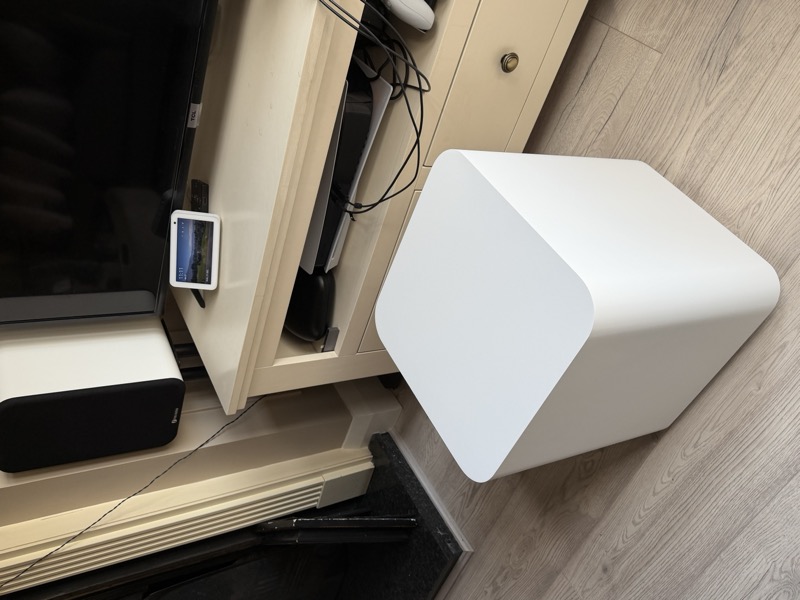
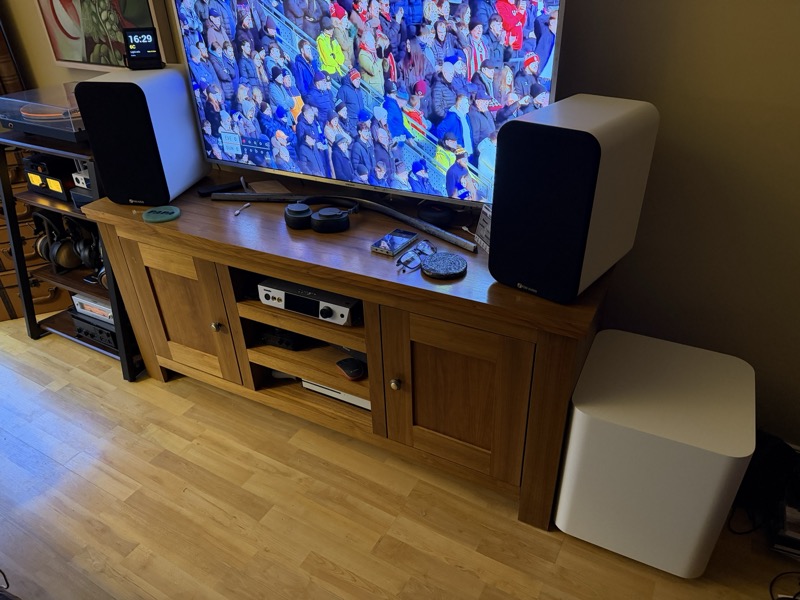
The SW10 slotted into my TV and desktop system alongside the SP601 speakers, adding low end beneath them:
 |
 |
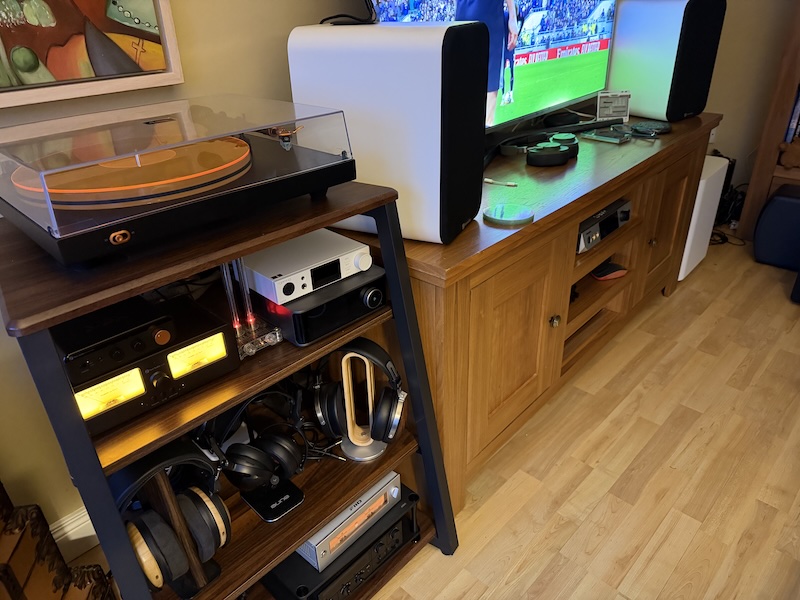
It also formed part of my larger hi-fi setup with the turntable and headphone gear:
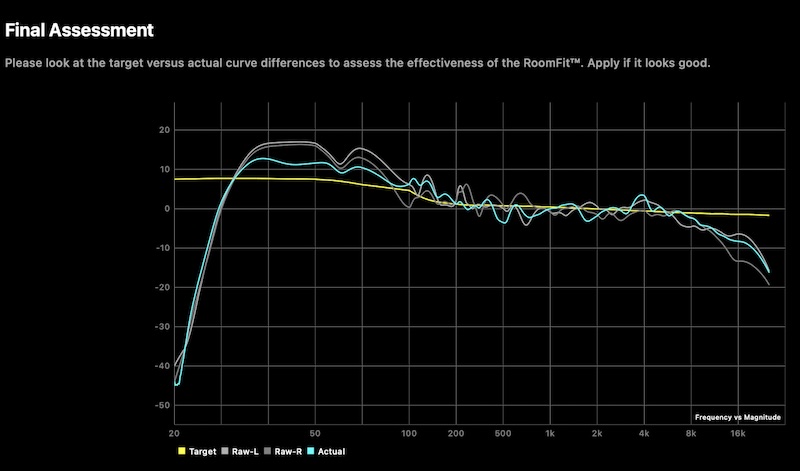
As with the rest of this setup, I used the WiiM’s RoomFit room correction (here with the KEF LS50 and the Fosi subwoofer) to integrate the sub cleanly into the room:
Sound Impressions
If you want room-filling bass on a budget, there is no getting around the physics: moving a large volume of air needs a large cone with room to travel, and a 10-inch woofer in a 14kg ported cabinet is a much cheaper route to that than any amount of DSP cleverness applied to a smaller driver. That is essentially what the SW10 gives you — big, obvious bass with plenty of SPL in hand, rather than a polite low-frequency top-up.
Paired with the right speakers, and — just as importantly — placed in the right spot in a room that suits it, I think the SW10 produces genuinely authoritative sub-bass. Those conditions matter more here than with a smaller sub: get the placement wrong and a woofer with this much output will simply excite whatever room modes you have, which is why I ran it with the WiiM’s RoomFit correction rather than by ear alone.
What that extra low end does best is act as a backbone. Bass-forward electronic music is the obvious beneficiary, but it also changed how guitar-led rock sat in the room — Radiohead was the case that struck me most, where the extra weight underneath gave the arrangements a foundation the SP601 pair could not produce on their own. The same applies to film, where the SW10’s output and extension are well matched to a cinema setup.
On value, the trade-off is straightforward and comes down to floor space. If space is tight, I would probably still reach for an SVS or a KEF sub, both of which get more done per litre of cabinet. But if you have the room to give up, the SW10 is where you can save the money without giving up the output.
Specifications
| Specification | Value |
|---|---|
| Type | Active powered subwoofer (down-firing, dual rear ports) |
| Driver | 10″ high-excursion polypropylene diaphragm woofer |
| Amplifier | 200W Class-D (500W peak) |
| Frequency response | 30Hz – 120Hz (adjustable via crossover) |
| Crossover | 40Hz – 180Hz, adjustable |
| Phase | 0° – 180°, adjustable |
| DSP | Precision DSP with DRC limiting; dual EQ modes |
| Inputs | RCA line-in; LFE / subwoofer in |
| Output | RCA line-out (daisy-chain a second sub/amp) |
| Auto power | Automatic on/off via signal detection |
| Cabinet | MDF with PVC finish |
| Dimensions | 14.17 × 14.17 × 15.75 in (≈360 × 360 × 400 mm) |
| Weight | 14 kg (30 lb) |
| Finish | White |
| Price | $379.99 |
Rating Explanation
The Pragmatic Rating of 4 reflects what the SW10 is: a remarkable first subwoofer from a company that has not built one before, held back by the one area where inexperience shows. The DSP is not quite at the level of the more established brands — the dual EQ voicings and DRC limiting do useful work, but they are not the kind of measurement-driven room and driver correction that the companies who have been doing this for decades apply. That is the gap between four stars and five here, and it is a software gap rather than a hardware one.
The Price Rating of 5 comes down to size. Cabinet volume and cone area are the expensive parts of building a subwoofer that can fill a room, and at this price you are getting a genuinely large one — that alone makes a substantial difference to what it can do, and it is difficult to find that much displacement for the money. The Features Rating of 5 covers the amount of adjustment on offer: a continuously variable 40–180Hz crossover, full 0–180° phase sweep, two DSP voicings, a dedicated LFE input, line output for daisy-chaining, and signal-sensing auto-power. That is a real set of tools for integrating a sub properly rather than a token level knob.
The Measurements Rating of 4 is the one I would most like to revisit. I have not measured the SW10 yet, so this rests on the specification sheet and listening. Nothing about it is bad, but the 30Hz figure is where a driver this size could reasonably have been asked to go lower — the extension is good rather than exceptional, and a sub with this much cone area had the physical means to reach further down than it does.
Conclusion
The SW10 is a good first attempt at an audiophile subwoofer, and the qualifier matters in both directions — it is a first attempt, and it is genuinely good. The hardware is the strong part: a large driver in a heavy ported cabinet, plenty of output on tap, and a control set comprehensive enough to integrate it properly. Where it trails the established names is in the DSP, and that is the part most likely to improve. My sense is that once Fosi Audio finish their mobile app with proper PEQ support, they will be able to do some genuinely interesting things across their range, this subwoofer included. For now, if you have the floor space and want large-woofer bass without paying large-woofer prices, the SW10 earns its place.