FiiO TT11
A fully-automatic belt-drive turntable with a pre-fitted Audio-Technica cartridge and Bluetooth for $179
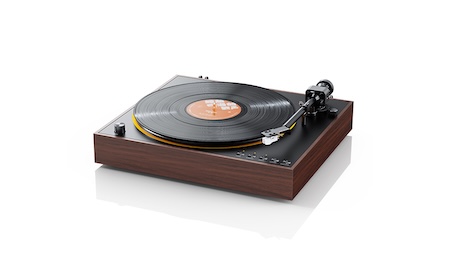
I have reviewed a lot of FiiO gear, and lately that has included their growing turntable line — most recently the TT13. The TT11 sits below it as FiiO’s new entry-level deck at $179 / €179, and it takes a different angle: it is fully automatic, it ships with an Audio-Technica AT3600L cartridge already fitted, it has Bluetooth, and — the part that caught my eye before I had even heard it — it comes in a wood-grain finish that looks like it belongs on a much more expensive turntable.
I spent a few days with the TT11 in the run-up to High End in Vienna, and the honest headline is that I came away genuinely impressed — with the sound, with the ease of use, and especially with how good that retro wooden finish looks in a real room.
I would like to thank FiiO for providing the TT11 for the purposes of this review.
If you are interested in finding more information about this product, you can find it at the official FiiO website.
The FiiO TT11 typically retails for $179 / €179 and is available in Black and Brown (wood-grain) finishes. The unit reviewed here is the Brown wood-grain finish.
A note before we start: this is based on a few days of listening rather than extended long-term use, and I do not have independent bench measurements for the TT11 — the figures in this review are FiiO’s own published specifications. But first, let’s take a look at what’s in the box.
Unboxing and Packaging
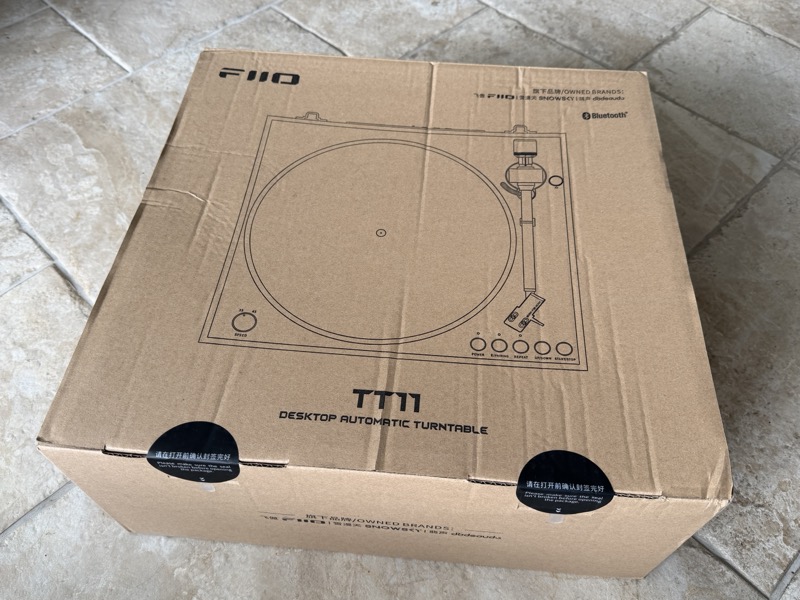
The TT11 arrives in a clean retail box that sets the tone for a product that wants to feel like a step up from a toy:
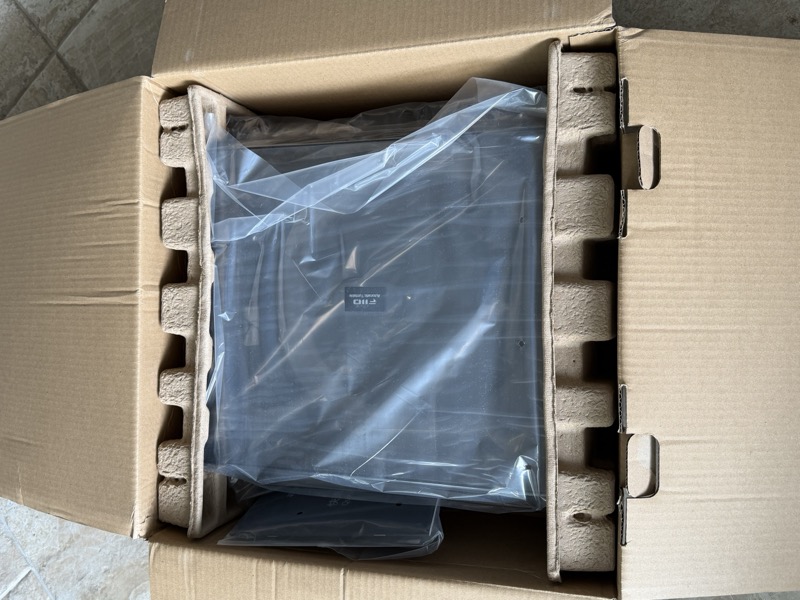
Inside, the deck is held in shaped cardboard with the plinth cradled securely, and everything is wrapped against transit:
 |
 |
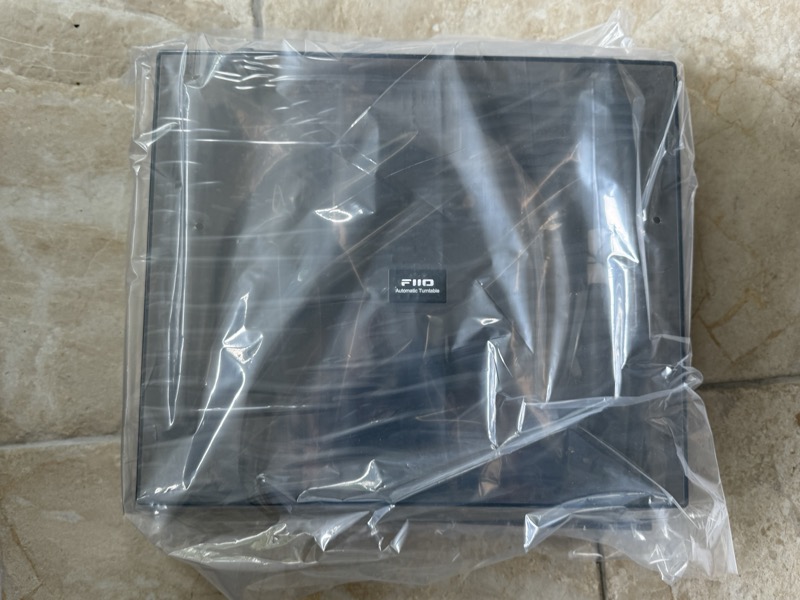
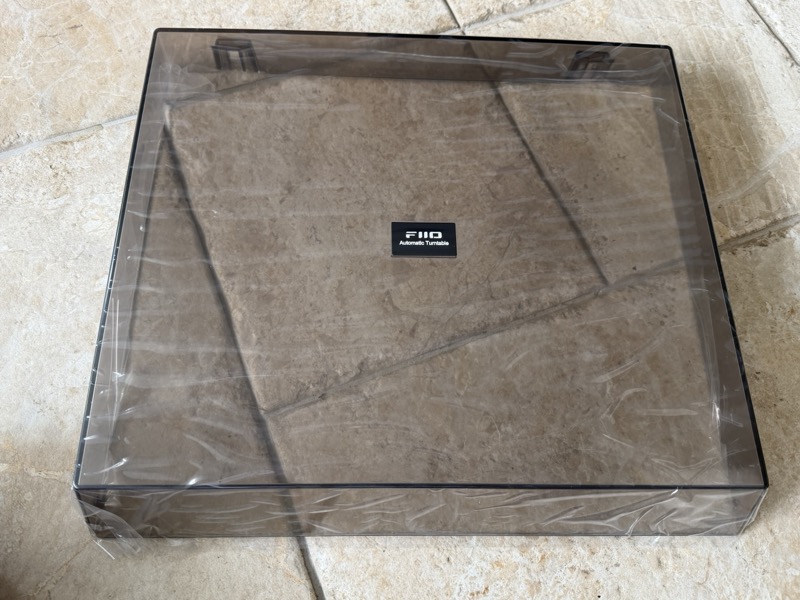
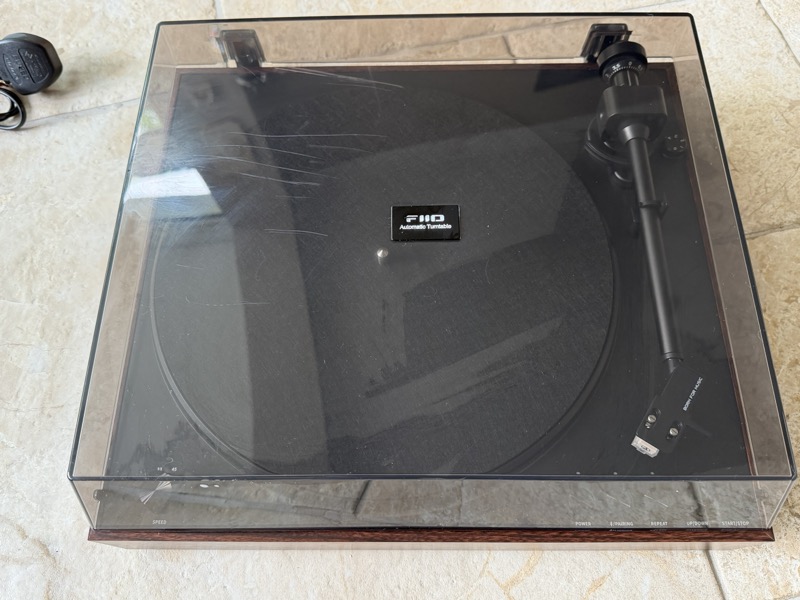
The turntable itself is bagged, with the transparent dust cover wrapped separately — the FiiO “Automatic Turntable” badge is visible through the plastic:
 |
 |
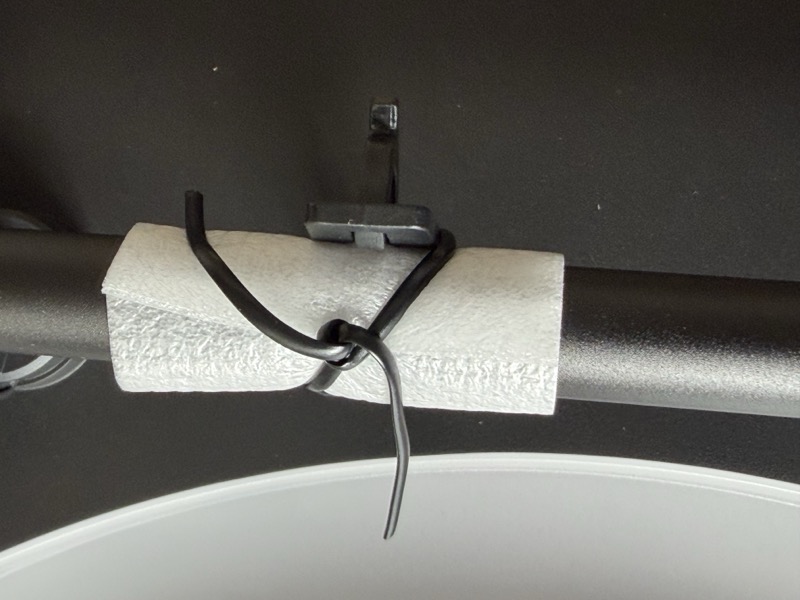
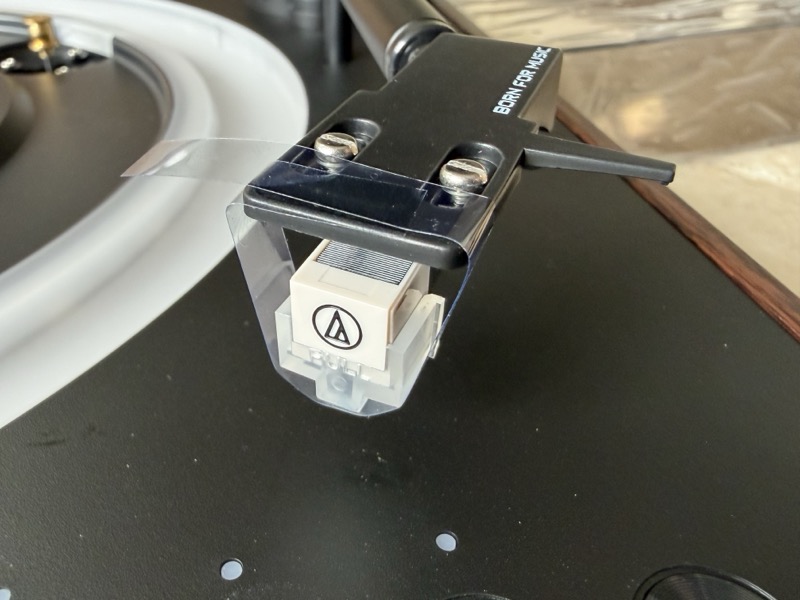
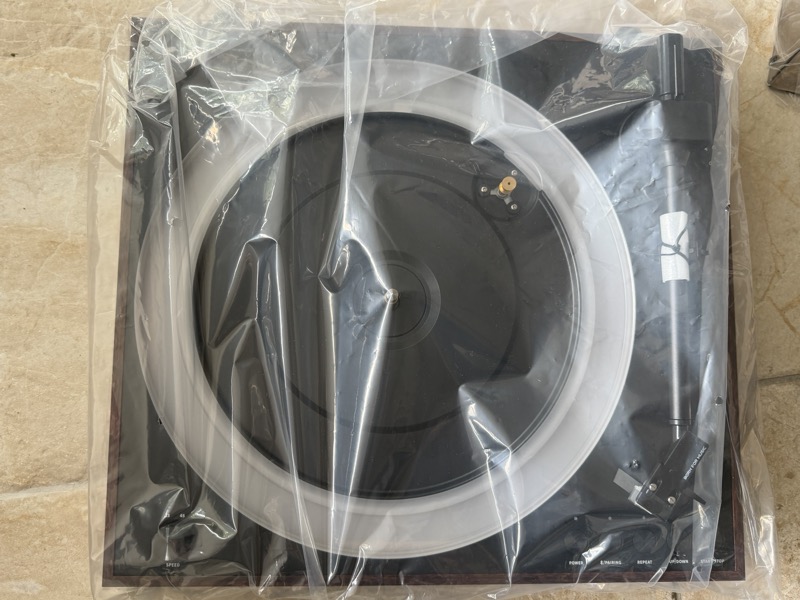
FiiO have taken care over protecting the moving parts for shipping. The tonearm is fixed down and wrapped in a protective film, and the whole plinth-and-tonearm assembly is held in protective packaging:
 |
 |
The accessories are simple and appropriate for a plug-and-play deck — the RCA lead with its ground wire, the connector clips and adapters, and the power supply:
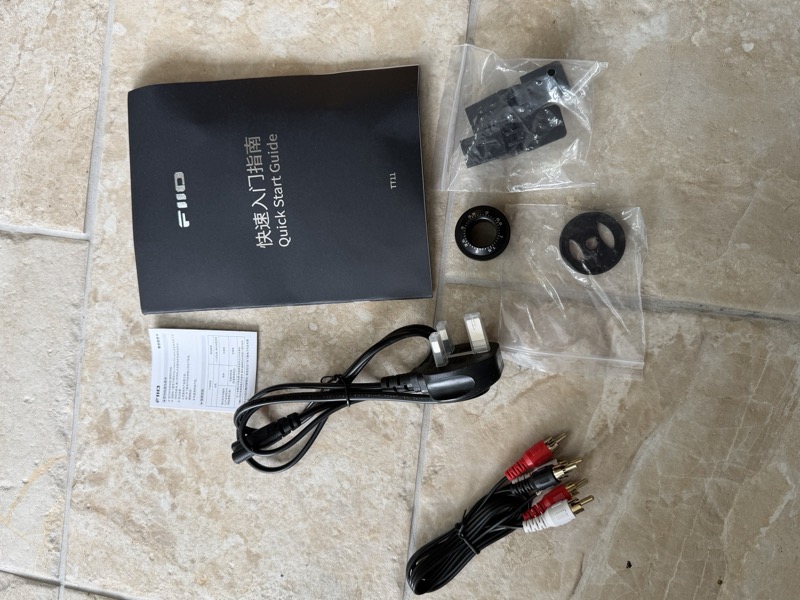
The RCA output cable is the standard red-and-white pair with a separate ground wire, and the small bag of connectors and clips covers what you need to get going:
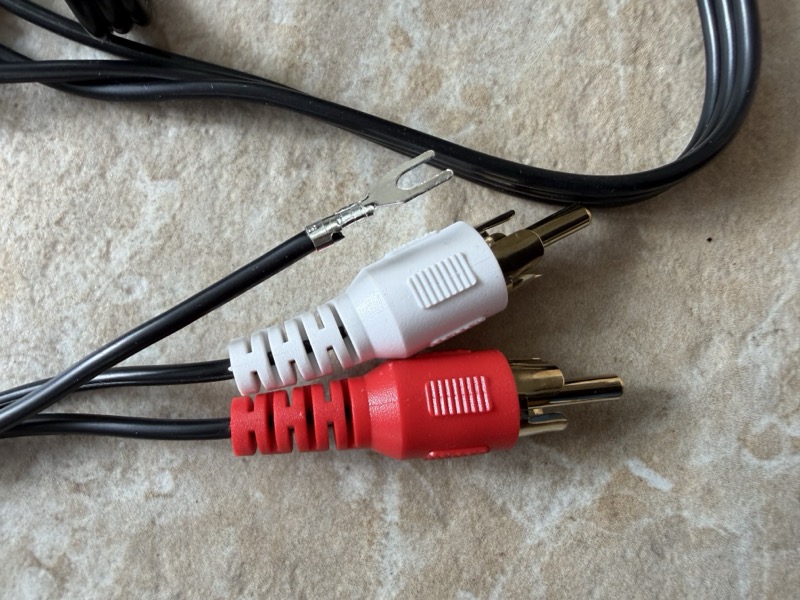 |
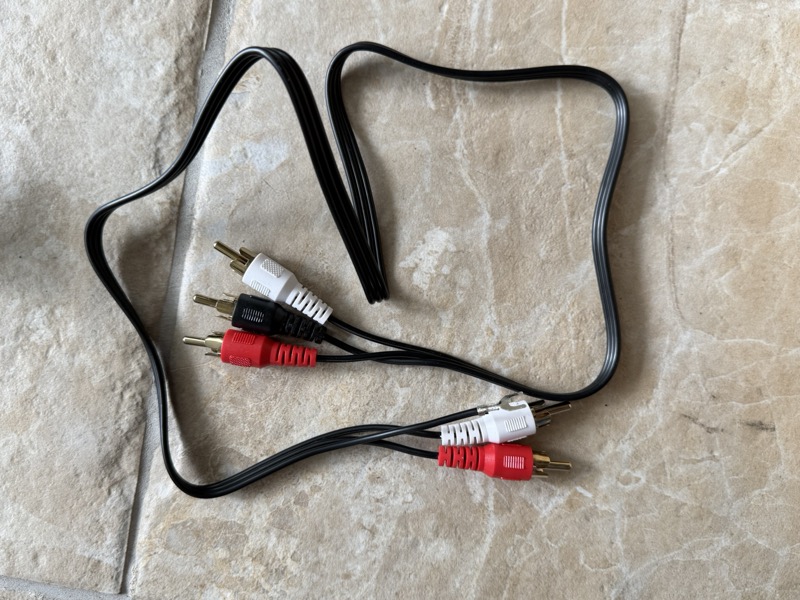 |
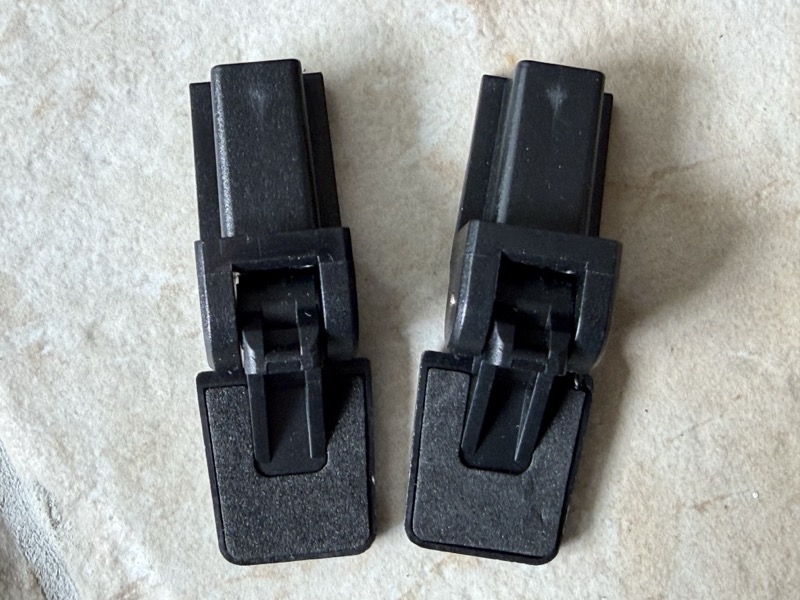
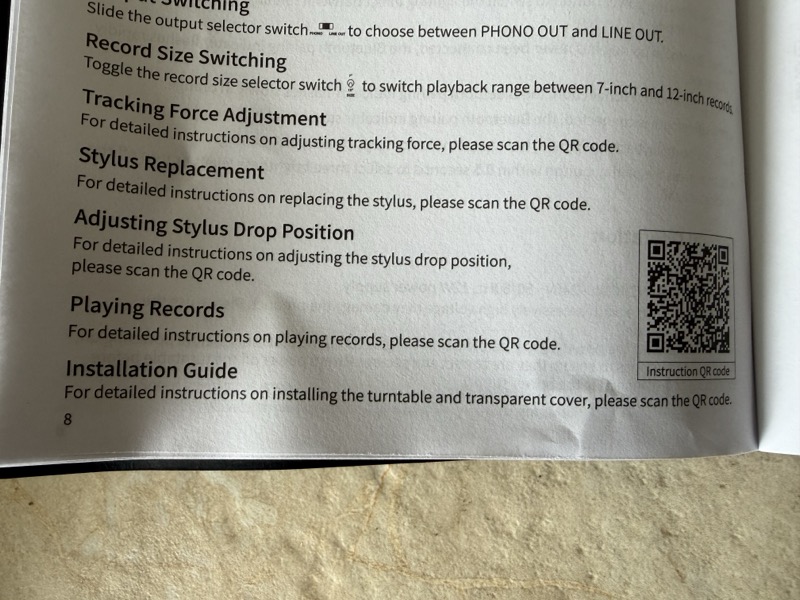
One small gripe at this stage: the printed setup guide is minimal, and the full manual is only really available by scanning a QR code rather than as a proper booklet in the box:
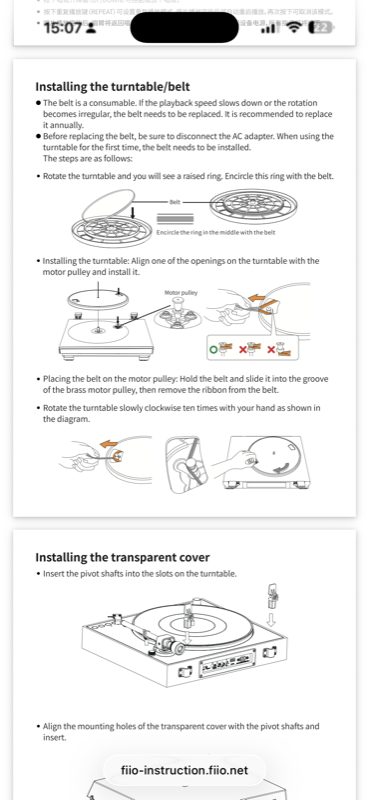
That QR code does at least take you to a clear, illustrated guide for installing the belt and the transparent cover:
Setup and Assembly
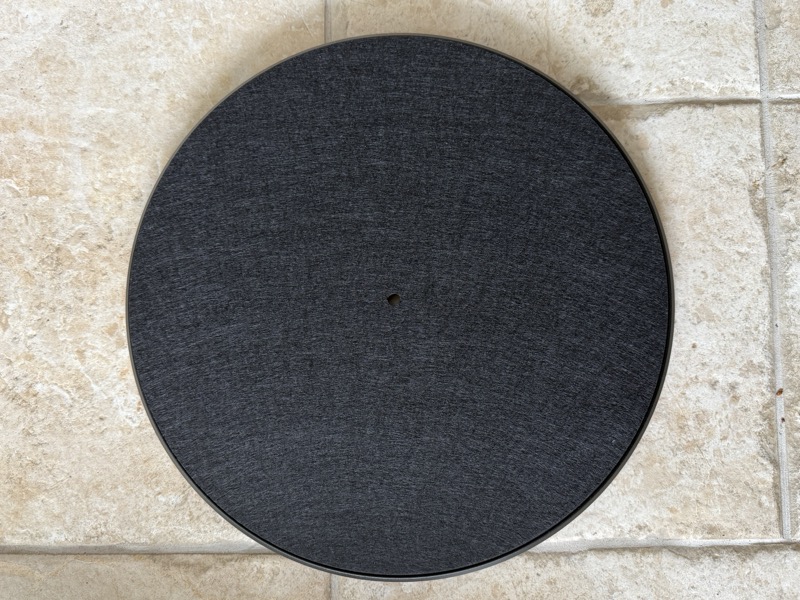
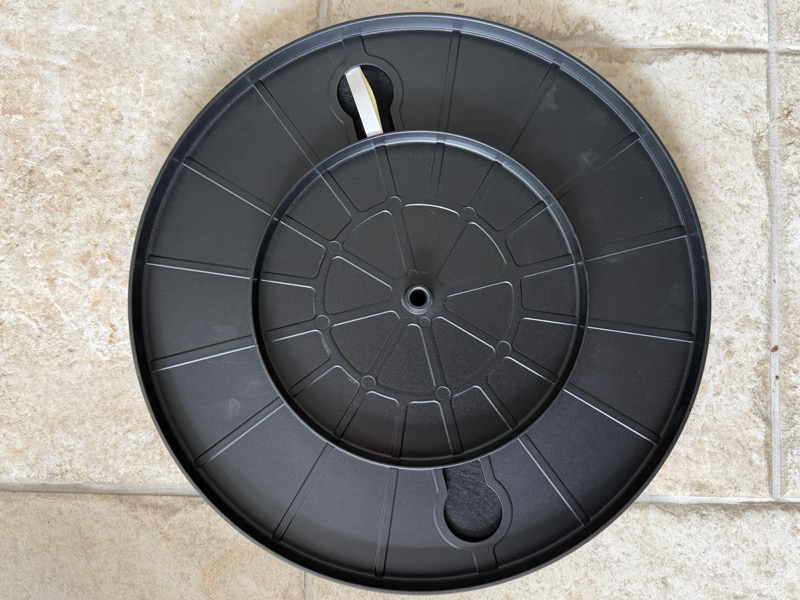
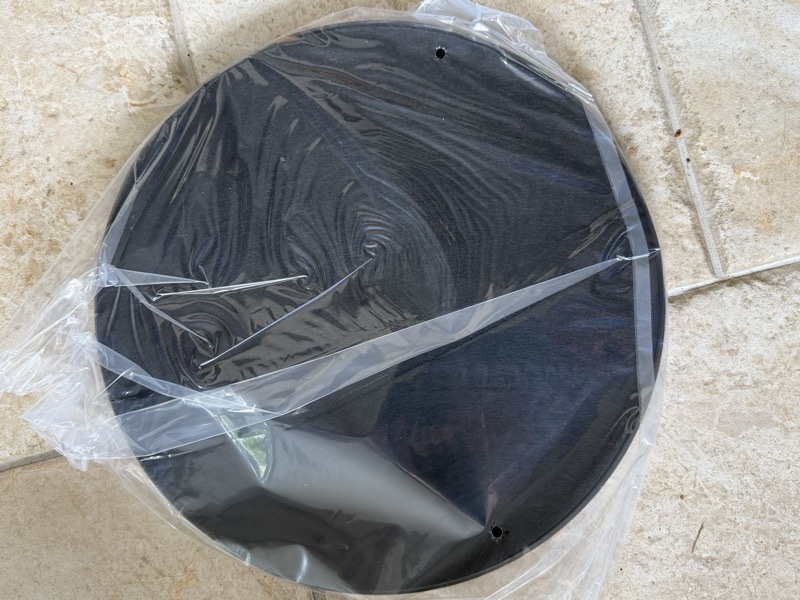
Even though the TT11 is “automatic”, you still do the usual first-time turntable assembly: fit the platter, route the belt, and attach the dust cover. The platter top carries a slip mat, and the underside is where you loop the belt around the motor pulley:
 |
 |
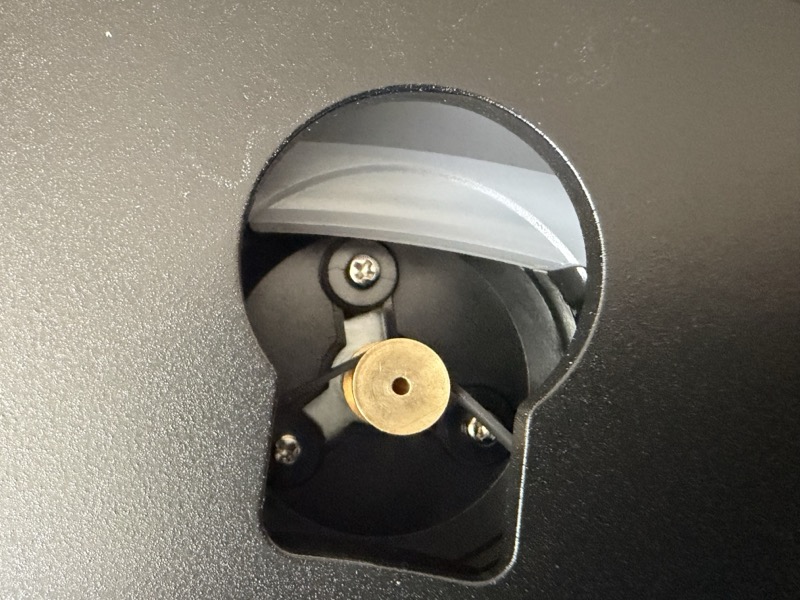
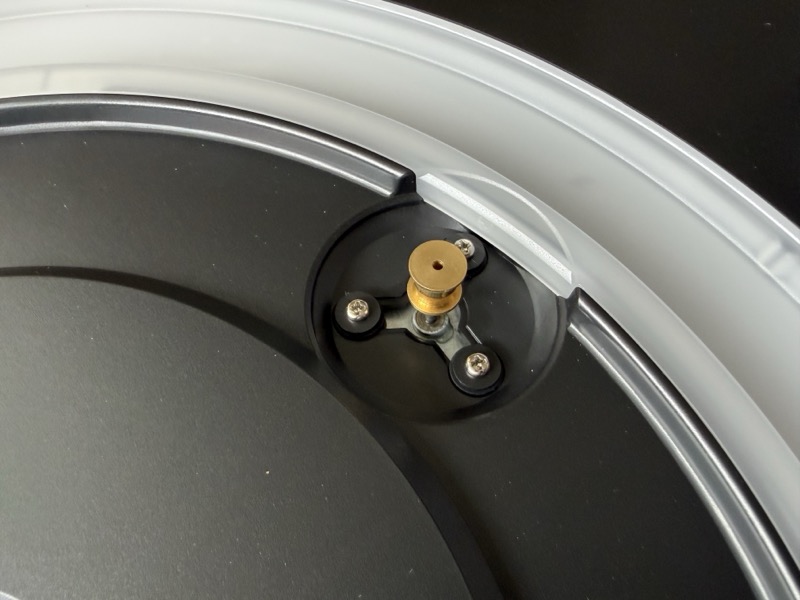
The motor pulley sits in a recess in the plinth, and you slip the belt over the brass pulley before lowering the platter into place:
 |
 |
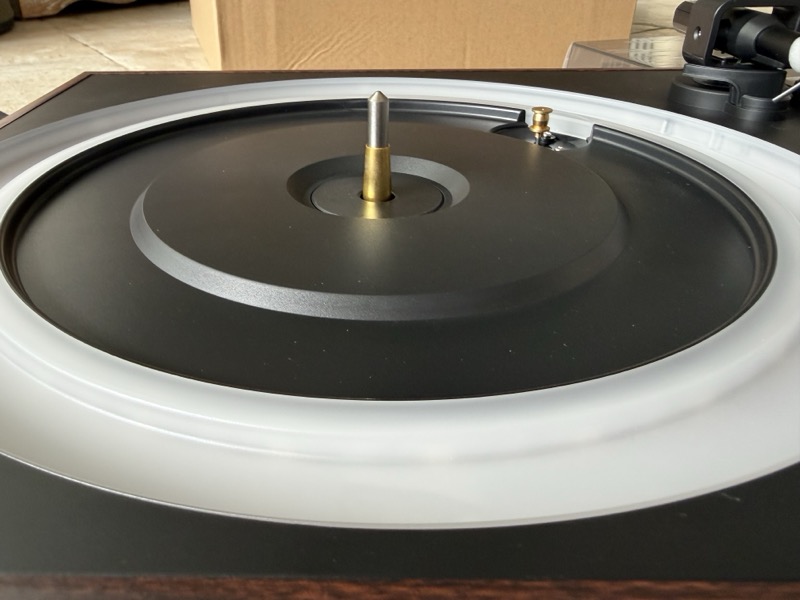
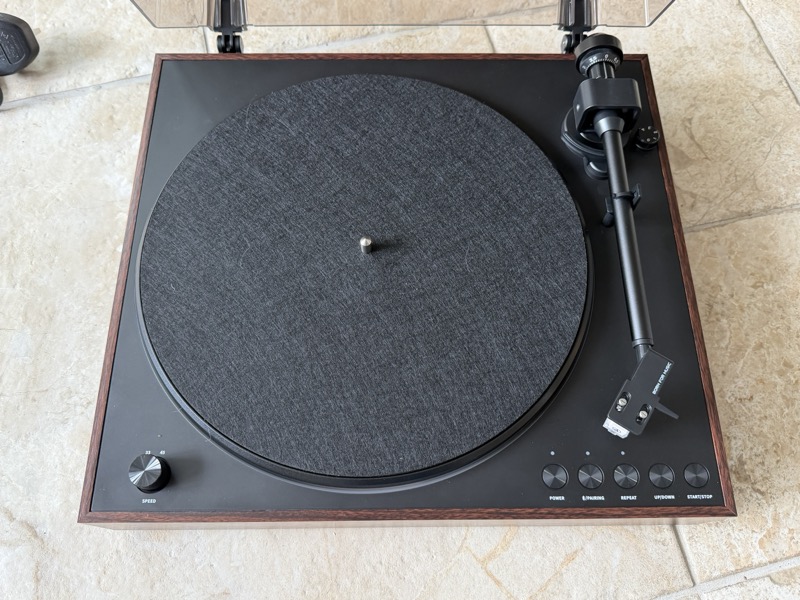
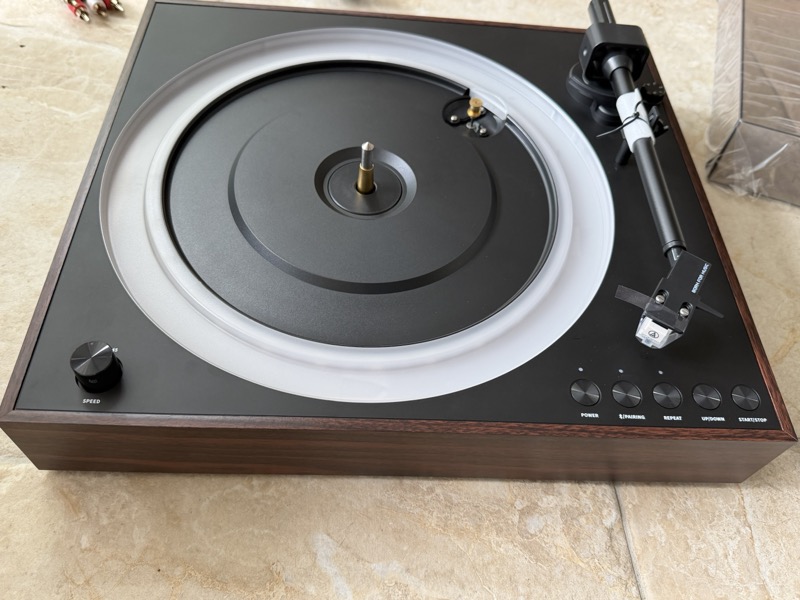
The platter base has an interesting recessed design — and it is also where the TT11’s ambient lighting lives, a ring that glows up from underneath the platter in any of seven selectable colours (purple, red, orange, blue, cyan, green or white), with adjustable brightness or off entirely. Once the platter is on and the tonearm is freed it comes together quickly:
 |
 |
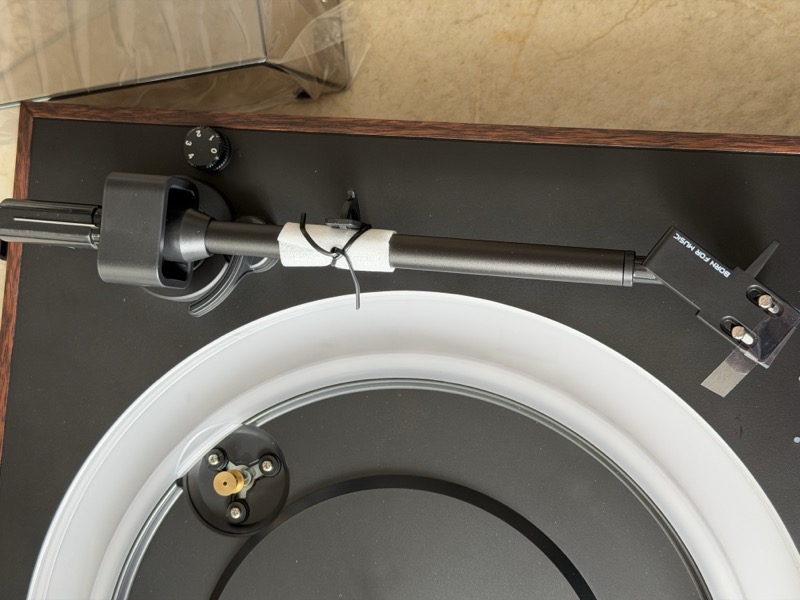
The transparent dust cover clips onto its hinges at the back. Worth flagging, the cover plastic marks easily so be careful, I managed to lightly scratch mine while fitting it during assembly, so handle it carefully, but all assembled, it looks the part:
 |
 |
Design and Build Quality
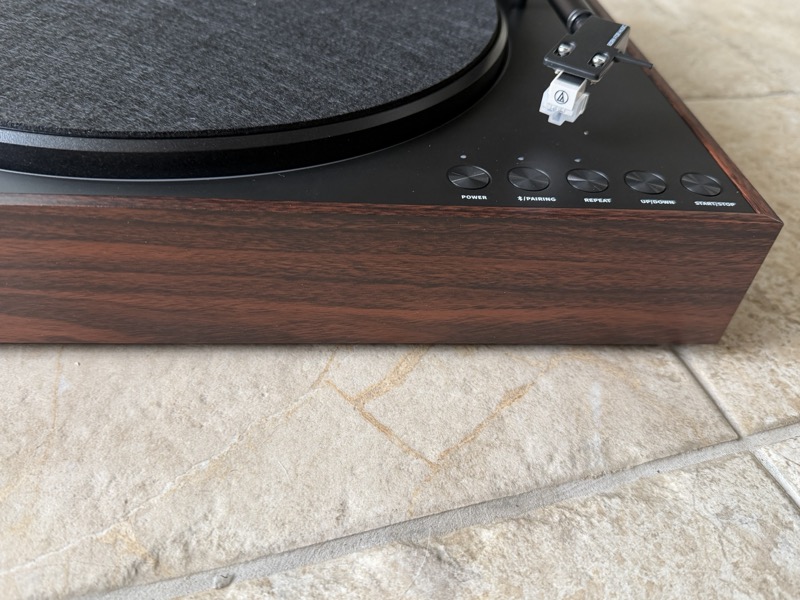
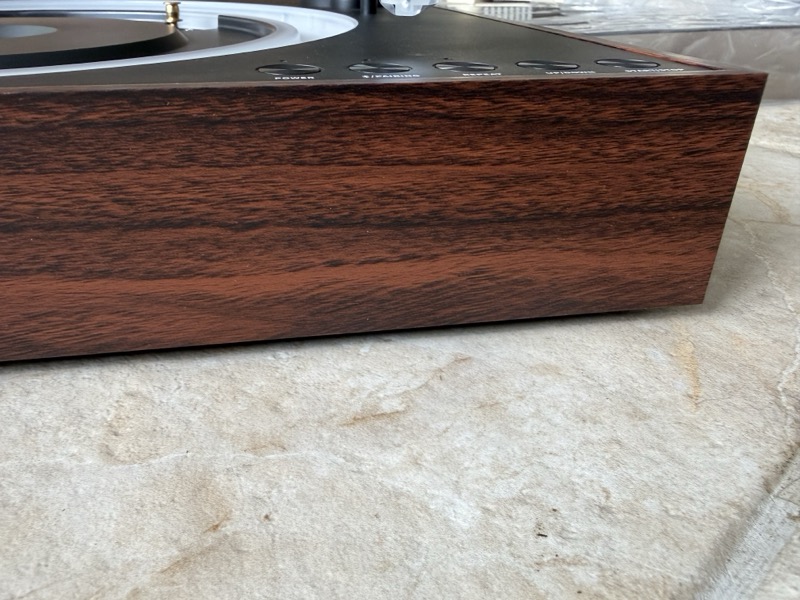
This is where the TT11 looks like far more than $179 buys. The wood-grain finish is the star, and from a normal viewing distance you would not guess the price:
 |
 |
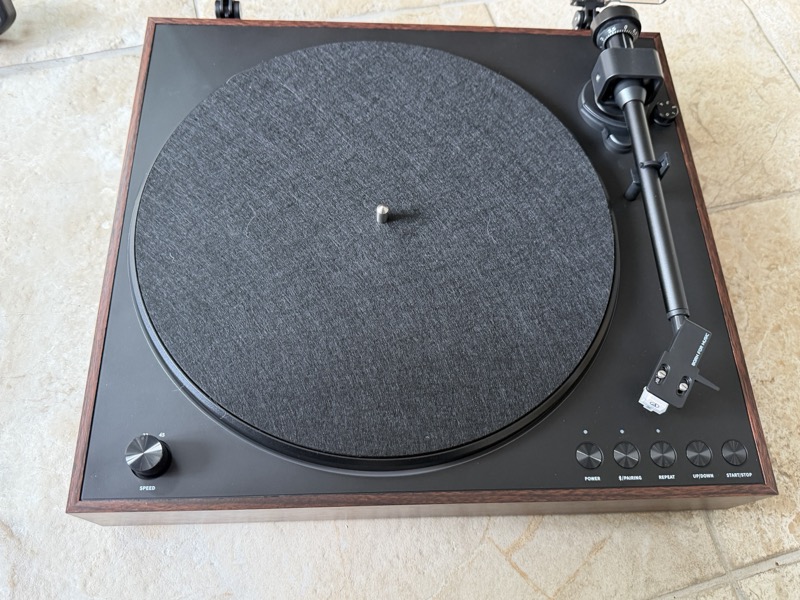
The front view shows the clean lines of the plinth and the transparent cover, and the control buttons sit along the front edge — power, speed, Bluetooth pairing, start/stop, repeat, and tonearm up/down:
 |
 |
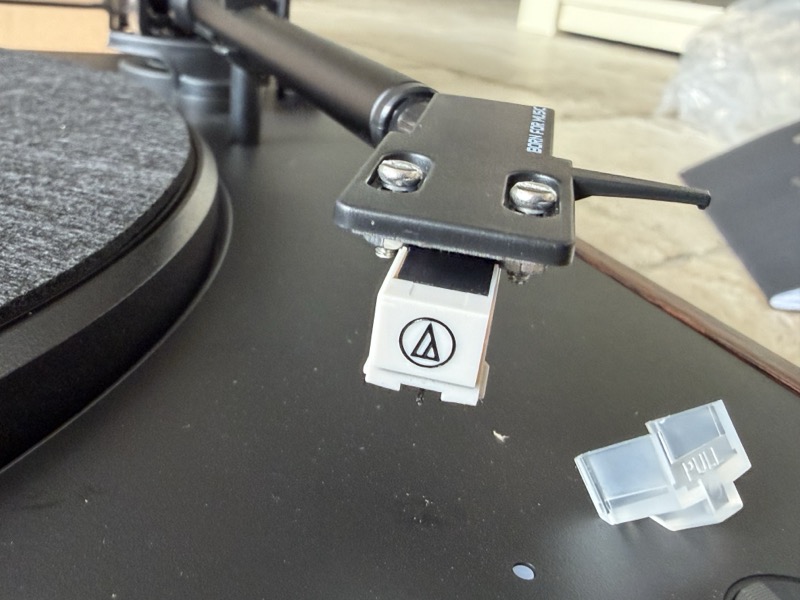
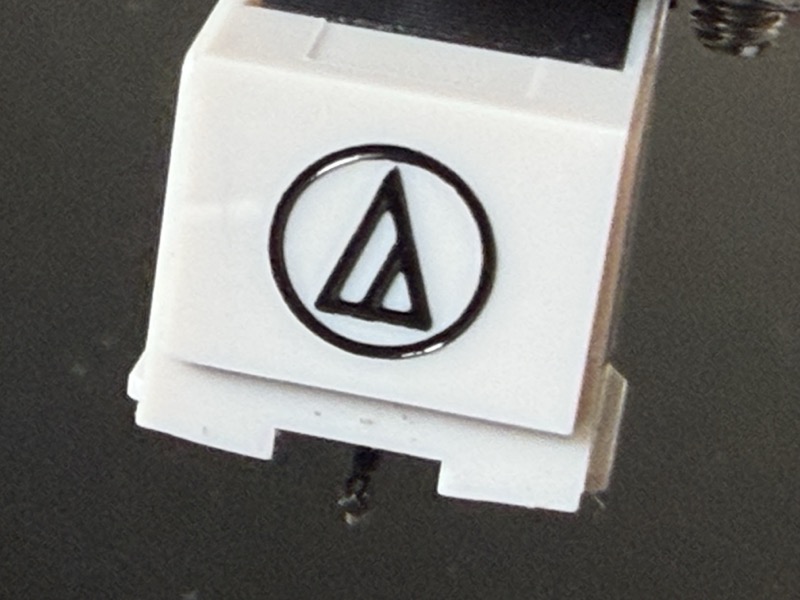
The pre-fitted cartridge is an Audio-Technica AT3600L, which you can see mounted at the end of the headshell. It is a familiar budget moving-magnet cartridge with a conical stylus, and having it fitted and aligned from the factory is a big part of what makes the TT11 genuinely plug-and-play:
 |
 |
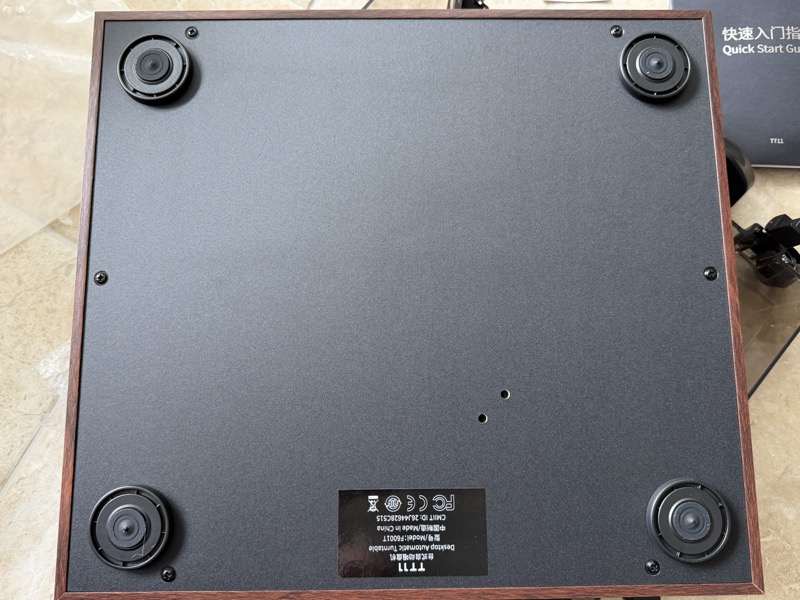
The underside carries the four feet and the model label (Desktop Automatic Turntable, model F600TT / TT11):
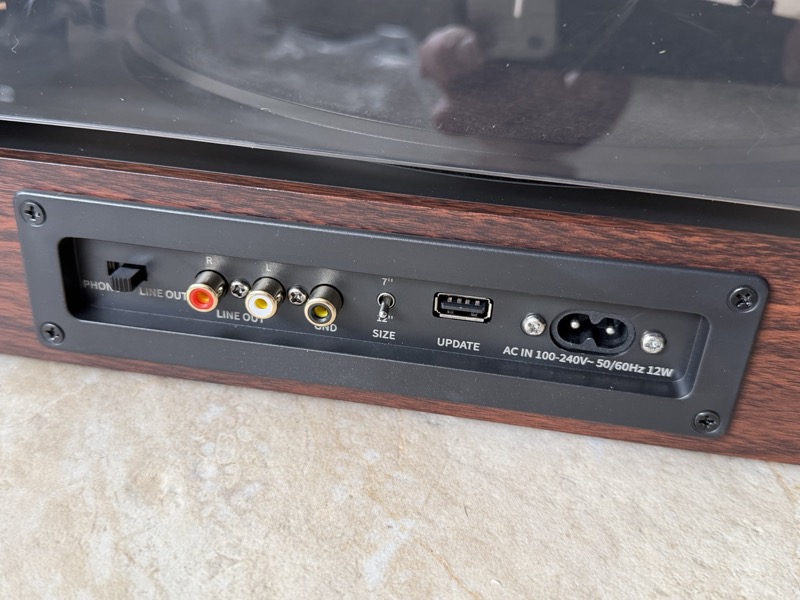
The rear panel has the RCA line/phono output with the PHONO/LINE OUT switch, the ground post, the record-size selector, a USB-A port for firmware updates, and the AC input. One real usability quibble here: the 7-inch / 12-inch size switch is on the back of the deck, which makes it awkward to reach — I would much rather it sat on the top or front where you actually need it:
In My Retro Setup
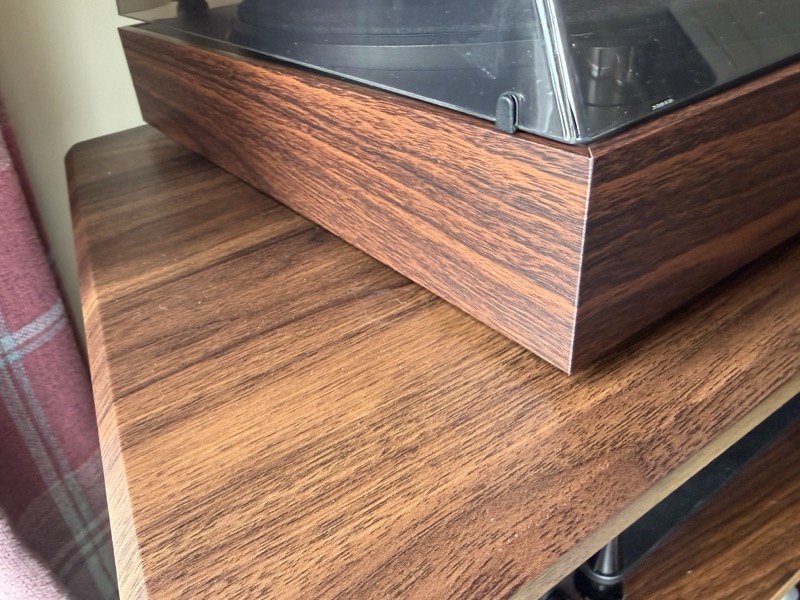
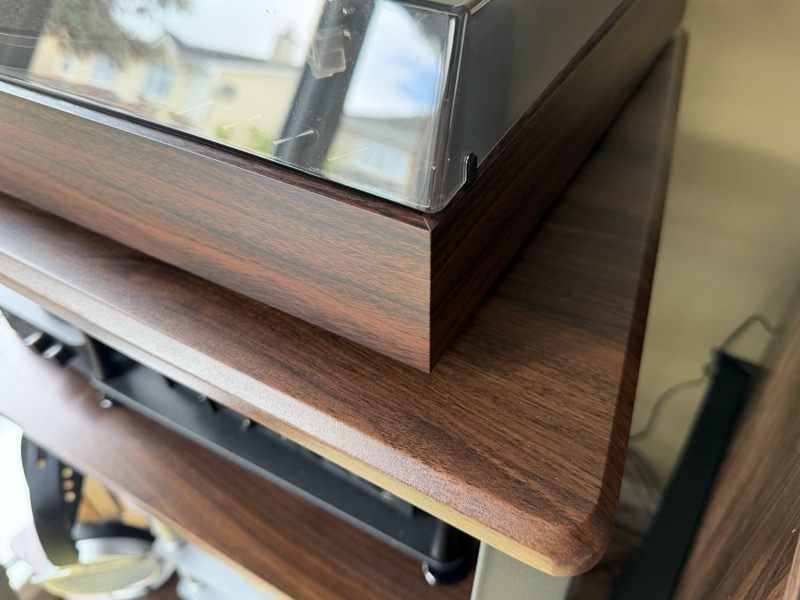
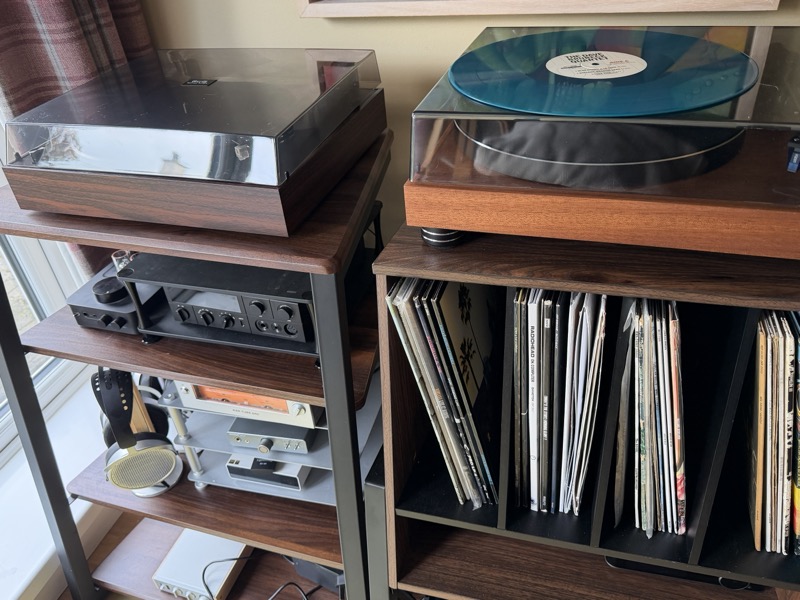
The reason the TT11 won me over so quickly is how well that wood-grain finish slots into a retro system with wooden cabinets. In my setup it is close to a perfect match for the surrounding wood, and it simply looks right:
 |
 |
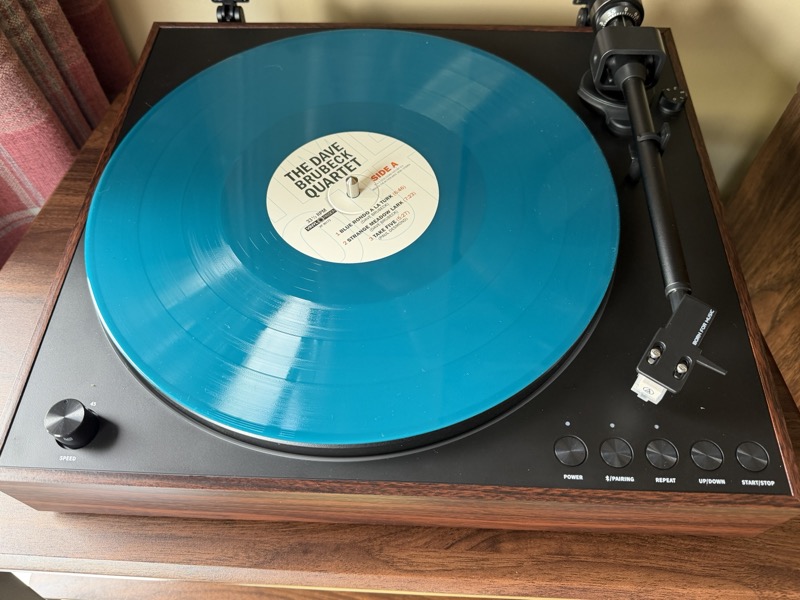
Playing a record on it in the wooden cabinet, it looks like a far more expensive deck than it is:
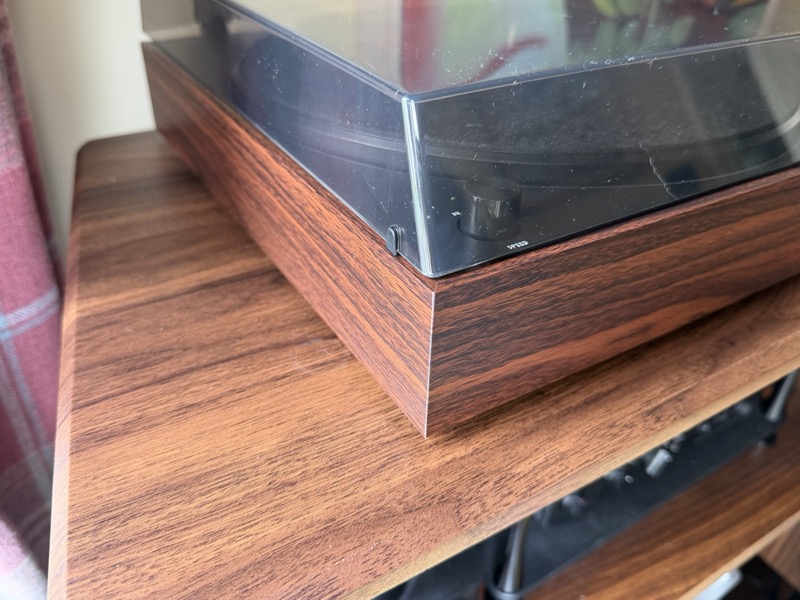
And here it is settled into the full retro setup, which is where it really makes sense:
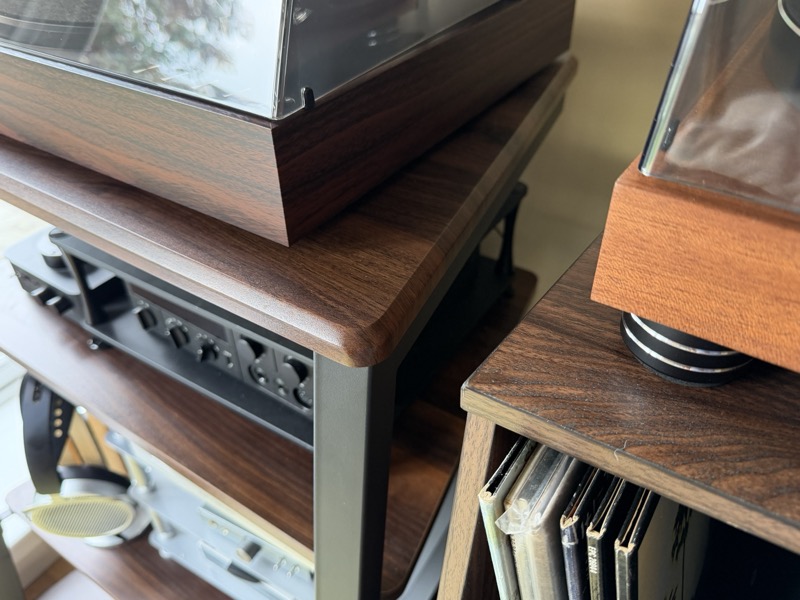
It is striking next to the Argon Audio TT-4 MK2 — which costs roughly four times as much — where to my eye the FiiO arguably looks the better of the two:
 |
 |
Features
For an entry-level deck the TT11 is generously specified. The headline feature is the fully automatic mechanism: a single press of start lifts the tonearm, moves it into position, and lowers it gently onto the lead-in groove, and at the end of the side it lifts and returns the arm on its own. There are also stop and repeat controls. This is exactly the right approach for the audience FiiO are aiming at — people who want to play records without worrying about a clumsy hand damaging a stylus or a disc.
On the analogue side, the phono stage uses dual Texas Instruments NE5532 op-amps, and the deck offers both a built-in switchable phono preamp (line out) for direct connection to active speakers or an amplifier’s line input, and a phono output for use with an external phono stage. It supports both 33⅓ and 45 RPM, has an adjustable counterweight (0–4 g) and anti-skate (0–4 g), and uses an aluminium-alloy platter and tonearm.
It also leans into being a modern, lifestyle-friendly product. There is Bluetooth (SBC) transmission for sending audio wirelessly to speakers or headphones via an AC6951C chip, and seven selectable ambient lighting modes — purple, red, orange, blue, cyan, green and white — with brightness control or the option to switch the lighting off entirely. The cartridge is interchangeable, so there is a clear upgrade path later. For $179, that is a lot of turntable.
Sound Impressions
These are preliminary impressions from a few days of listening — I will expand this section in an update. For the comparisons I used a classic I know well on vinyl, Time Out by The Dave Brubeck Quartet, and I bought a second copy so I could play the same record on two decks and switch quickly between them rather than relying on memory.
For an entry-level deck with a budget conical cartridge, the TT11 is genuinely enjoyable. On “Take Five” the walking bass line and that famous drum groove come through with a warm, easy character — there is real low-end presence, even if it is lighter and less authoritative than a more expensive deck and cartridge will give you. The midrange carries the piano and the alto sax with a natural, unforced tone, and “Blue Rondo à la Turk” keeps its drive and energy without the treble turning hard or splashy. It is a forgiving, musical presentation that suits the kind of listener this deck is made for. The one area where it shows its price is outright clarity and detail retrieval — it does not pull quite as much fine texture out of the groove as a step-up cartridge would — but for the money it is a thoroughly likeable sound.
Comparisons
I ran the TT11 alongside several decks I have here, switching between two copies of Time Out:
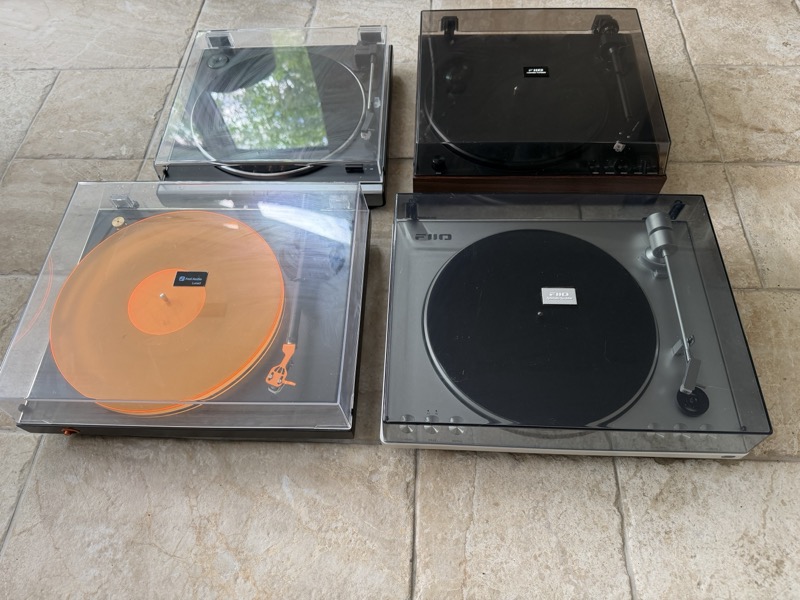
The closest sibling is FiiO’s own TT13. In my brief listening the TT11 did not quite match the TT13 for outright clarity — the TT13 sounds a touch cleaner and more resolved — but the gap is smaller than the price difference might suggest, and the TT11’s automatic operation and wood finish give it a different kind of appeal:
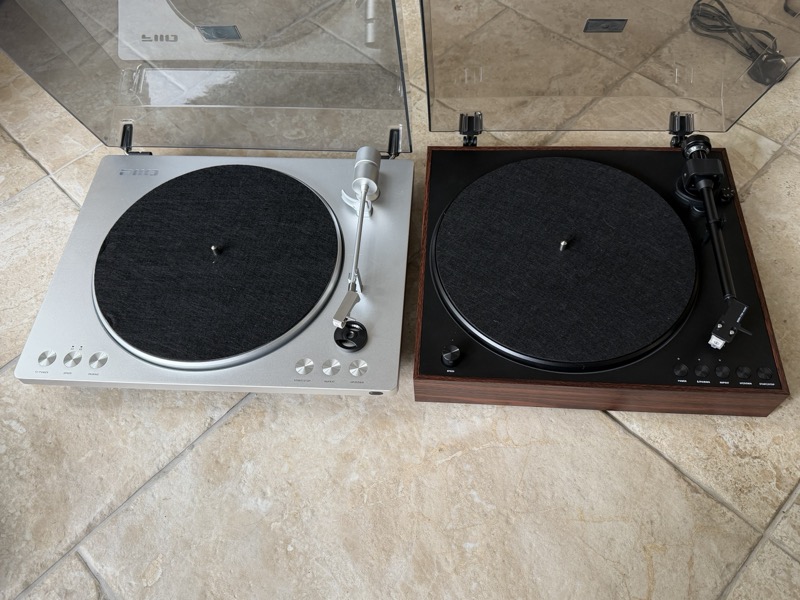
The Argon Audio TT-4 MK2 is in a completely different price bracket — around four times the cost — and it does have noticeably more bass weight and a lower noise floor. That is hardly a surprise, because the Ortofon 2M Blue fitted to the Argon costs more on its own than the entire TT11. What is striking is that, to my eye, the FiiO arguably looks the better of the two in a wood-finished room — and that counts for something when a turntable is also a piece of furniture.
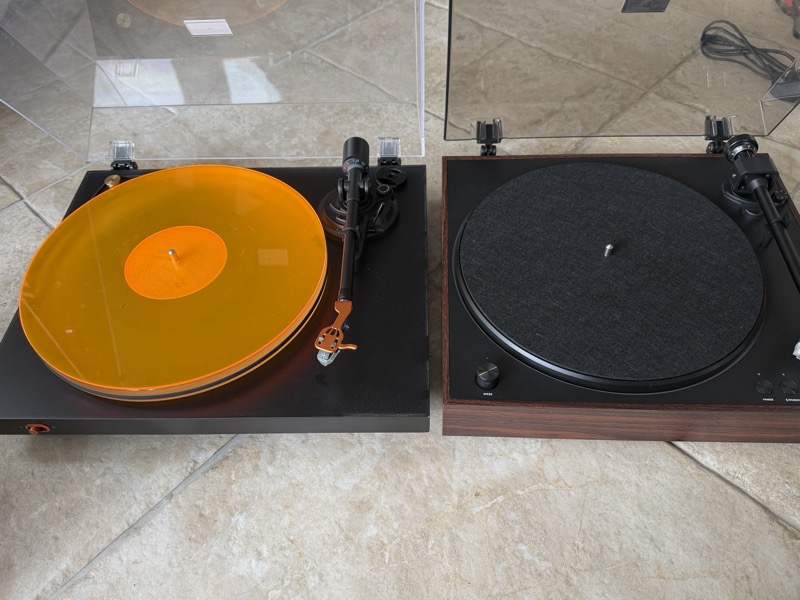
I also compared it against the Fosi Audio Luna3 and, importantly, the Audio-Technica LP60X — the deck that has long been my default budget recommendation:
 |
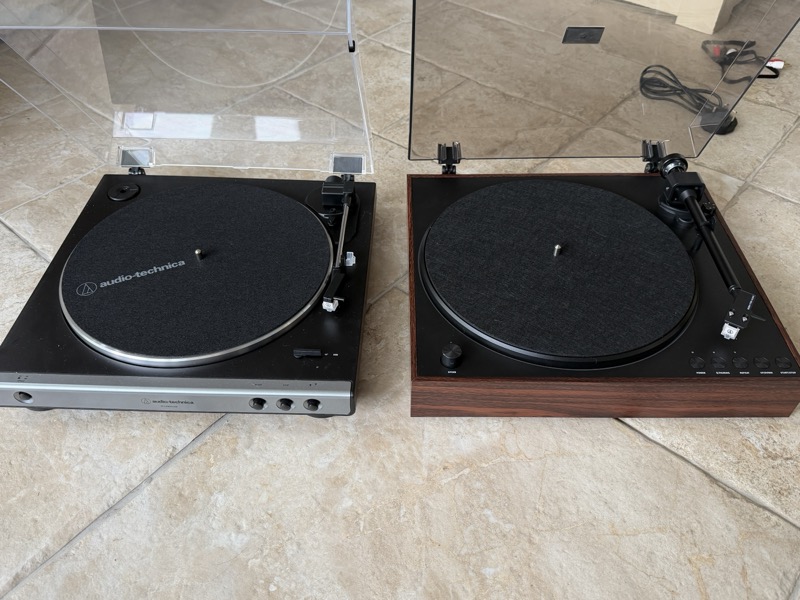 |
Against the similarly-priced Audio-Technica LP60X — long my default budget recommendation — the TT11 is a clear step up. Both are fully automatic belt-drive decks running essentially the same AT3600L-style cartridge, but the TT11 sounds fuller and more composed, its cartridge is user-replaceable where the LP60X’s is integral, it adds Bluetooth, and the build and finish are in another league. For someone choosing between the two at this price, the TT11 makes a strong case.
How they compare on paper
It is worth seeing how the TT11 lines up against the four decks I compared it with — on rough price, and on the things that actually shape the sound, the cartridge above all:
| FiiO TT11 | Audio-Technica LP60X | FiiO TT13 | Fosi Audio Luna3 | Argon TT-4 MK2 | |
|---|---|---|---|---|---|
| Price (approx.) | $179 | ~$149 | $239 | $300 | €799 |
| Operation | Belt, fully automatic | Belt, fully automatic | Belt, fully automatic | Belt, manual (auto-stop) | Belt, manual |
| Cartridge | Audio-Technica AT3600L (conical MM) | Audio-Technica AT3600L (conical MM) | Audio-Technica AT3600L (conical MM) | Audio-Technica VM95E (elliptical MM) | Ortofon 2M Blue (elliptical MM) |
| Cartridge replaceable | Yes (interchangeable) | No (integral headshell) | Yes | Yes | Yes |
| Tonearm | Aluminium alloy | Aluminium (straight) | Aluminium alloy | Static-balanced, anti-skate | Carbon-fibre hybrid, ATS |
| Platter | Aluminium alloy | Aluminium | Aluminium alloy | Heavy aluminium | Aluminium, 1.73 kg, damped |
| Speeds | 33⅓ / 45 | 33⅓ / 45 | 33⅓ / 45 | 33⅓ / 45 | 33⅓ / 45 |
| Built-in phono | Yes, switchable (dual NE5532) | Yes, switchable | Yes, switchable | Yes, switchable | Yes, switchable (bypassable) |
| Bluetooth | Yes (SBC out) | No | Yes (aptX HD / SBC out) | No | No |
| Wow & flutter | ≤0.2% | <0.25% (approx.) | n/s | n/s | ≤0.06% |
| SNR | ≥70 dB line / ≥57 dB phono | >50 dB (approx.) | 70 dB | n/s | 67 dB |
| Extras | 7 lighting modes | — | IR remote, 7 lighting modes | Trigger output | — |
LP60X figures are Audio-Technica’s published specifications and are approximate; “n/s” indicates a figure the maker does not specify. The single biggest differentiator in this table is the cartridge — the Argon’s pre-fitted Ortofon 2M Blue costs more on its own than the entire TT11, which is exactly why it pulls ahead on outright resolution and bass weight.
Zooming out from the table, this is roughly how I’d map out where the TT11 sits on the wider ladder. It’s the obvious alternative to the LP60X if you’re just vinyl-curious and want a sensible first deck. When you decide you’re in this properly and want to move up, there are two directions rather than one: the TT13 keeps everything you already like about the TT11 — the automation, the ease of it — while sounding better, so it’s the natural pick if convenience matters to you. The Luna3 goes the other way, trading some of that convenience for a proper cartridge and somewhere to go from there, which makes it the more “audiophile” step of the two. And if you’d rather skip the upgrade cycle altogether and buy the deck you won’t feel the need to replace, that’s where something like the Argon Audio TT-4 MK2 comes in — it’s a genuine step up in price, but it brings the cartridge, tonearm and phono stage quality that mean you likely won’t be shopping for another turntable for a long while.
Specifications
| Specification | Value |
|---|---|
| Type | Belt-drive turntable, fully automatic |
| Cartridge | Audio-Technica AT3600L (moving magnet) |
| Op-amps | 2 × Texas Instruments NE5532 |
| Bluetooth | Transmitter, SBC (AC6951C chip) |
| Speeds | 33⅓ and 45 RPM |
| Record size | Switchable 7-inch / 12-inch |
| Platter | Aluminium alloy |
| Tonearm | Aluminium alloy, electrophoretic black finish |
| Tracking force | Adjustable 0–4 g |
| Anti-skate | Adjustable 0–4 g |
| Wow & flutter | ≤0.2% WRMS (33 RPM, 3 kHz) |
| Line output level | L+R ≥ 530 mV + 530 mV |
| Line output THD+N | ≤3.5% |
| Line output SNR | ≥70 dB (A-weighted) |
| Phono output level | L+R ≥ 7 mV + 7 mV |
| Phono output SNR | ≥57 dB (A-weighted) |
| Outputs | RCA line/phono out + ground; USB-A (firmware) |
| Ambient lighting | 7 colours (purple/red/orange/blue/cyan/green/white) + off |
| Dimensions | 343 × 380 × 109 mm |
| Weight | About 3,330 g |
| Colours | Black, Brown (wood-grain) |
The published specifications above point to exactly what you would expect from an entry-level automatic deck with an AT3600L: a modest signal-to-noise ratio and a healthy output level, rather than the very low noise floor and fine resolution a more expensive cartridge would give you. I do not have independent bench measurements to confirm those figures against, so treat them as FiiO’s own numbers rather than an independently verified result.
Rating Explanation
The TT11 earns a pragmatic rating of five because it does the most important thing an entry-level turntable can do: it removes the barriers. The cartridge arrives fitted and aligned, the operation is fully automatic, and it sounds warm enough that a newcomer to vinyl will simply enjoy their records rather than worry about damaging them. On top of that it has a built-in phono stage, Bluetooth, an upgrade-friendly interchangeable cartridge, and a finish that looks far above its price. The price rating is also five: at $179 / €179, the combination of automatic operation, a real Audio-Technica cartridge, and this build quality is hard to argue with, and it is a clear step up from the Audio-Technica LP60X it competes with.
Features score five for the same reasons — automatic play, dual NE5532 phono stage, switchable line/phono output, Bluetooth, seven lighting modes, and adjustable tracking force and anti-skate is a lot at this price. The measurement rating sits at four based on FiiO’s own published figures rather than independent bench testing: this is a budget conical cartridge and the specified phono SNR is modest, so I would not expect class-leading numbers even if I could measure it directly. There are also two honest niggles — the 7-inch / 12-inch size switch is awkwardly placed on the back of the deck, and the transparent dust cover marks easily (I scratched mine slightly during assembly).
This one is for the listener taking their first proper step into vinyl, or anyone who wants an attractive, hassle-free second deck that looks the part in a wood-finished room, without spending more than the records deserve.
Conclusion
I came to the TT11 expecting a competent budget turntable, and it exceeded that on three fronts at once: how easy it is to live with, how good it sounds for the money, and above all how good it looks. That wood-grain finish is the kind of thing you normally pay a lot more for, and seeing it sit happily next to a turntable costing four times as much says a lot about where FiiO have put the effort.
It does not match a more expensive deck for clarity or bass weight, and it has a couple of small ergonomic quirks, but none of that undermines the core point: at $179 / €179 the TT11 is an easy, fully-automatic way into vinyl. This is based on a few days rather than months of ownership, but my early impression is that FiiO have made the entry-level turntable I would now hand to a friend who is finally ready to play their records.