Aiyima D07
A Tiny USB-C Powered Desktop DAC Built Around the AK4493SEQ and XMOS XU316
Aiyima have made a sensible set of decisions with the D07. Rather than trying to squeeze Bluetooth, a headphone amplifier, and a screen into one small box, the D07 concentrates on doing one job well: being a high-quality USB DAC and preamp. For a desktop speaker system, or for anyone feeding a dedicated power amp or a pair of active speakers, that narrow focus is exactly what I want.
The hardware backing that focus is genuinely impressive for the price. It’s built around the AKM AK4493SEQ DAC chip, an XMOS XU316 USB interface, and a socketed NE5532P op-amp that you can swap out if you enjoy experimenting. USB input supports up to 32-bit/768kHz PCM and DSD512, while the optical and coaxial inputs handle up to 24-bit/192kHz.
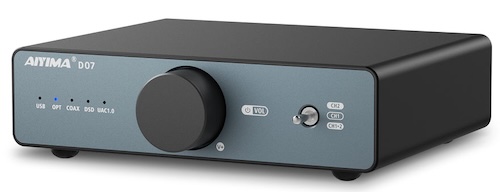
I purchased the D07 from Amazon.de for the purposes of this review.
If you are interested in finding more information about this product, you can find it at the official Aiyima product page, or at the Amazon.de listing where I bought mine.
The Aiyima D07 typically retails for around $110 / €109.99, though as with most Aiyima products you can often find a discount code or a small price reduction on Amazon.
Does a good DAC make music sound better? No — but a bad DAC will make it sound worse, and this is not a bad DAC. It’s an excellent DAC for the money, and the rest of this review explains why. But first, let’s take a look at what’s in the box.
Unboxing and Build Quality
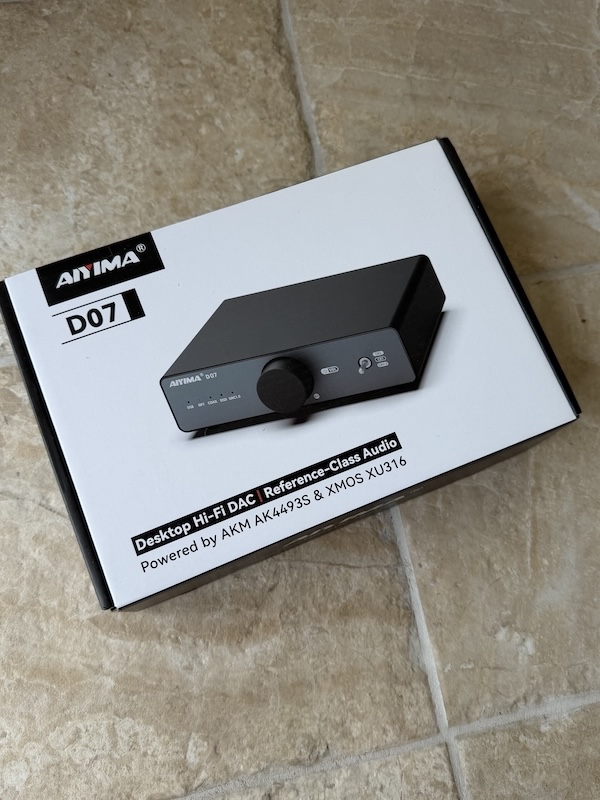
The D07 arrives in a compact black-and-white box, with the AK4493S and XU316 chipset called out right on the front:
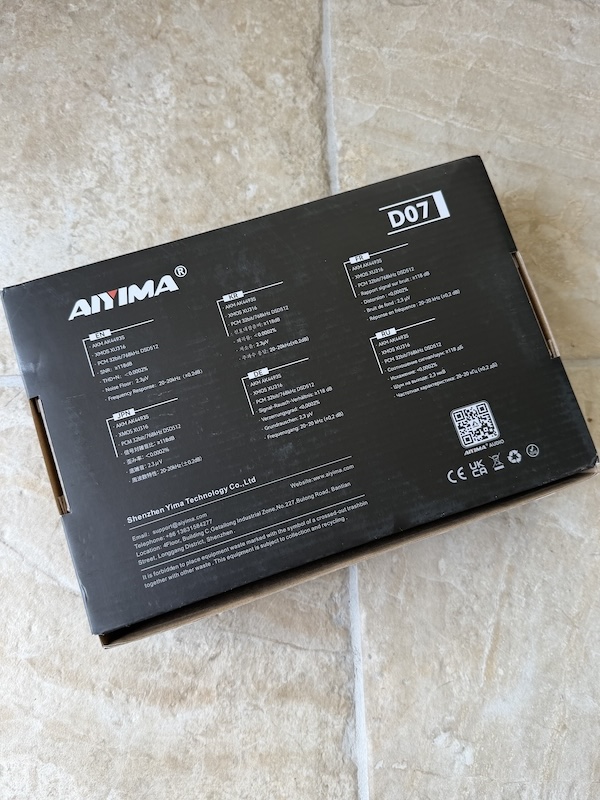
The back of the box prints the full specification trilingually, including noise floor, frequency response, distortion and signal-to-noise figures for each input:
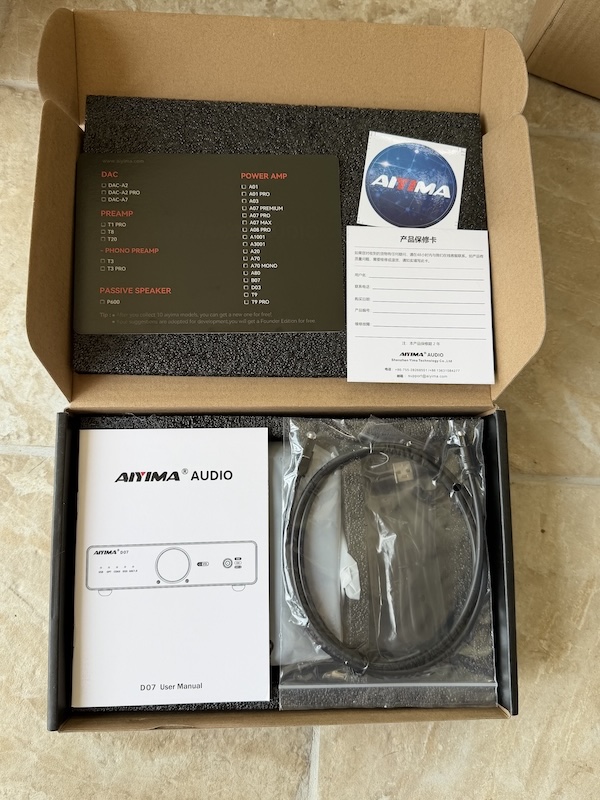
Opening the box, the manual, a warranty card, and a bagged 2-in-1 USB-A/USB-C to USB-C cable sit alongside the unit itself, with an Aiyima product-range checklist card also tucked inside:
Build quality is much better than the price suggests. The enclosure is solid, dark green-grey metal, with a clean front panel: a row of input LEDs (USB, OPT, COAX, DSD, UAC1.0), a smooth-turning volume knob, a combined power/volume button, and a small toggle switch for selecting between CH1, CH2, or both outputs together:
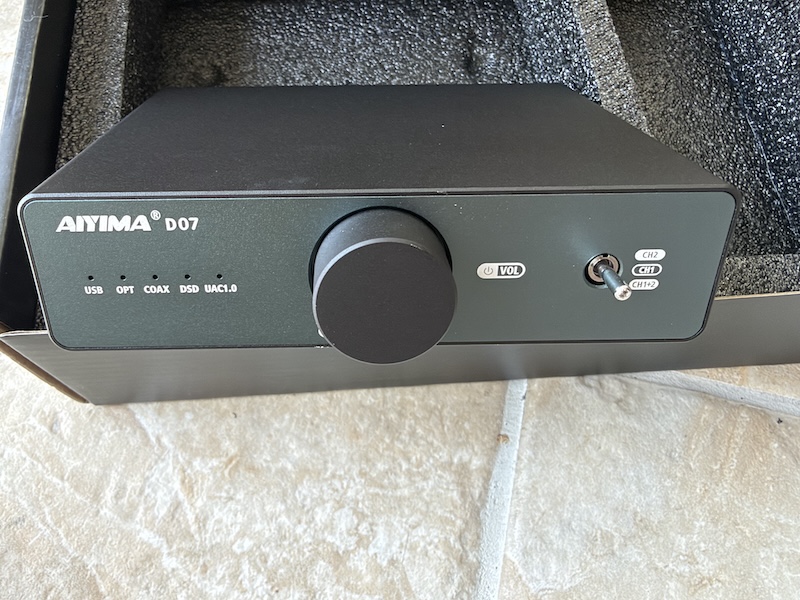
The whole unit occupies very little desk space, and the aluminium casing feels solid rather than hollow for something this size.
Connections and Features
Around the back, the D07 packs in a lot for such a small chassis: two independent stereo RCA output pairs (CH1 and CH2), a UAC mode button, a coaxial input, an optical input, and a USB-C input powered from DC 5V, plus a Bypass button:
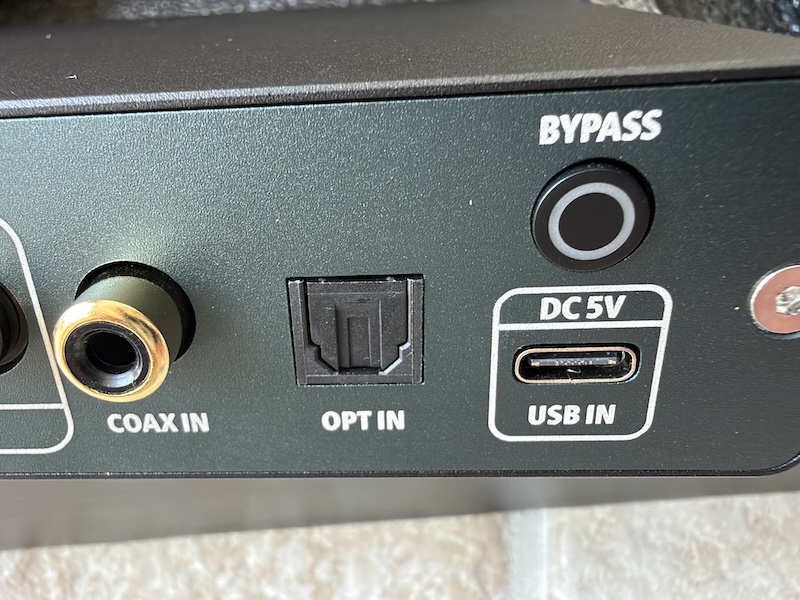
A closer look at the two RCA output pairs, clearly labelled CH1 and CH2 with colour-coded red/white terminals:
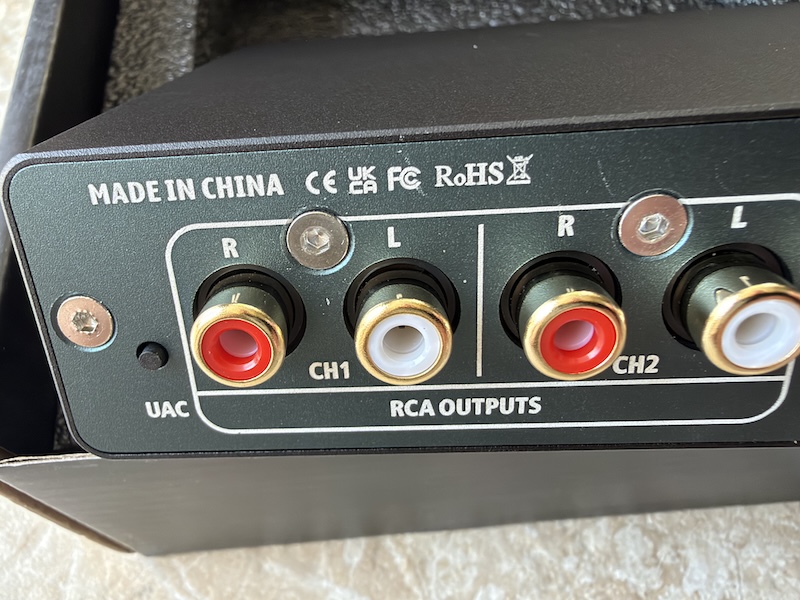
The two RCA outputs, combined with the front-panel CH1/CH2/CH1+2 switch, mean the D07 can feed two different destinations — say, a power amp and a pair of active speakers, or two separate amps — and let you pick which one is live without unplugging anything. Holding the rear Bypass button switches the D07 between a variable-output DAC/preamp and a fixed-level pure DAC mode, which matters if you’re feeding something with its own volume control rather than driving speakers or a power amp directly. I also appreciated the inclusion of both USB Audio Class 1.0 and 2.0 modes, which means it works without compatibility headaches on devices like a PS5 or a Nintendo Switch that don’t always play nicely with UAC 2.0-only DACs.
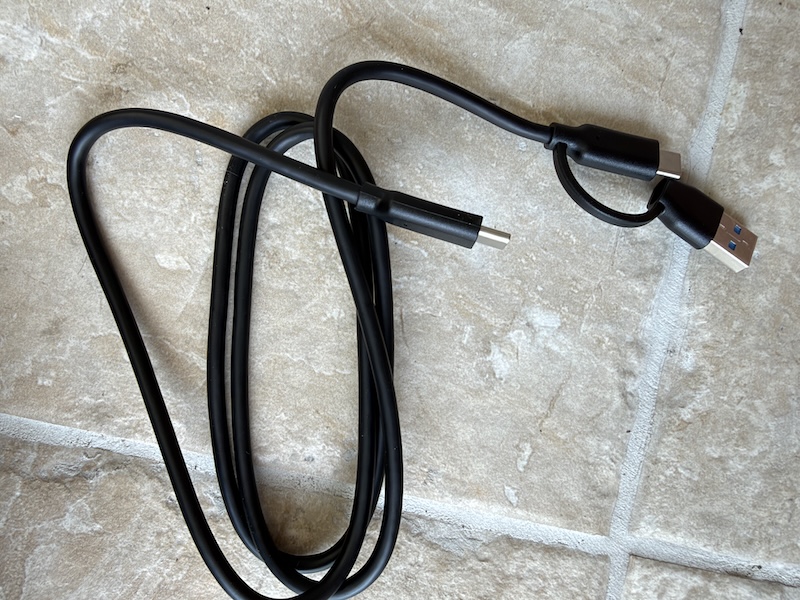
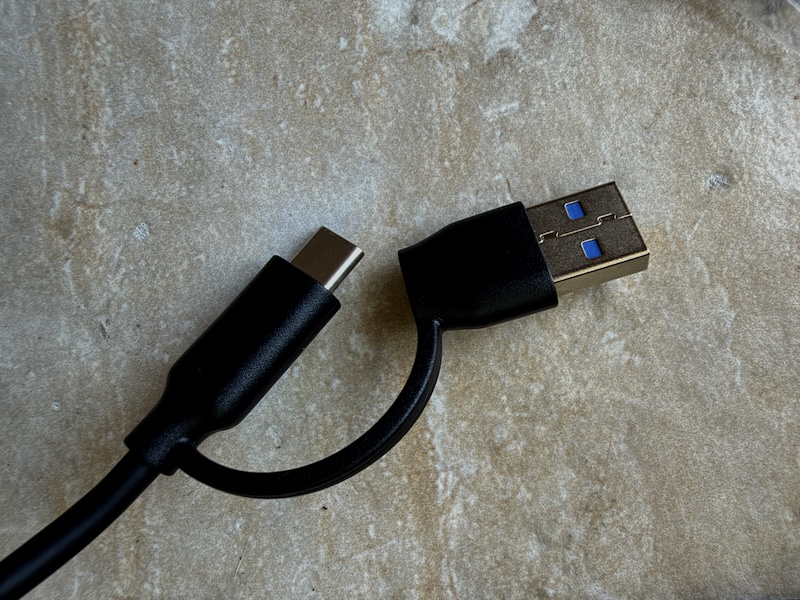
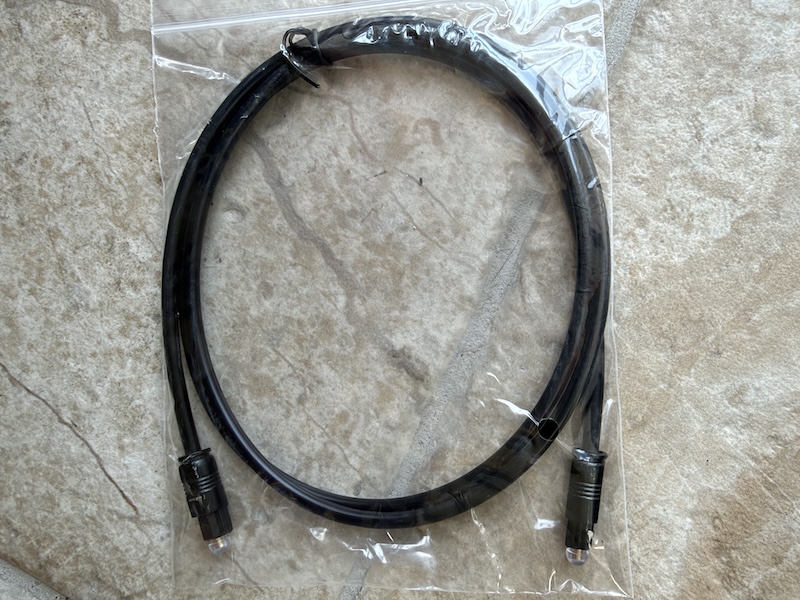
Aiyima include both a 2-in-1 USB-A/USB-C to USB-C cable and an optical cable in the box, so you can get started on either a USB or optical source immediately without buying anything extra:
 |
 |
One genuinely nice touch for anyone who likes to tinker is the socketed DIP-8 op-amp. Most buyers will be perfectly happy with the supplied NE5532P, but it’s a simple swap for alternatives like the OPA1612, MUSES02, LME49720, Sparkos SS3602 or OPA2604 if you want to experiment with a different flavour.
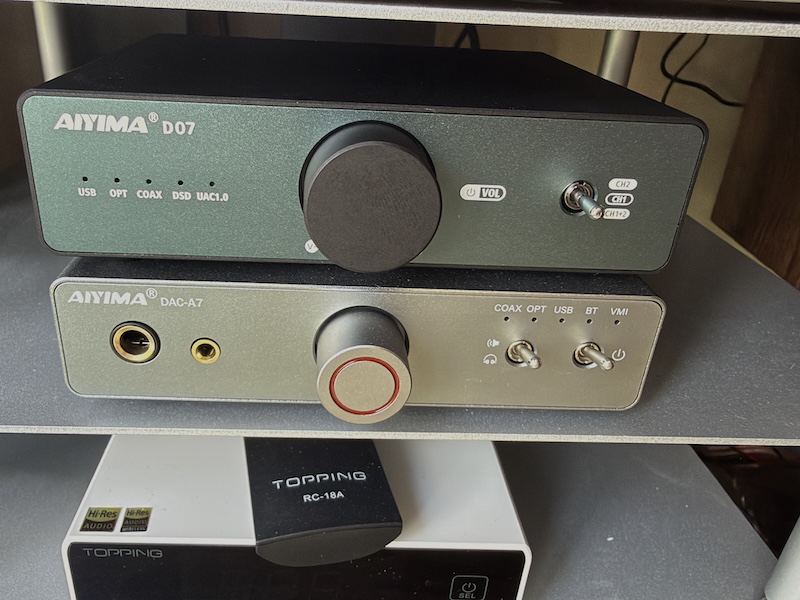
I’ve been using the D07 stacked on top of my Aiyima DAC-A7, which gives a good sense of scale — this is a genuinely tiny box next to full-size desktop gear:
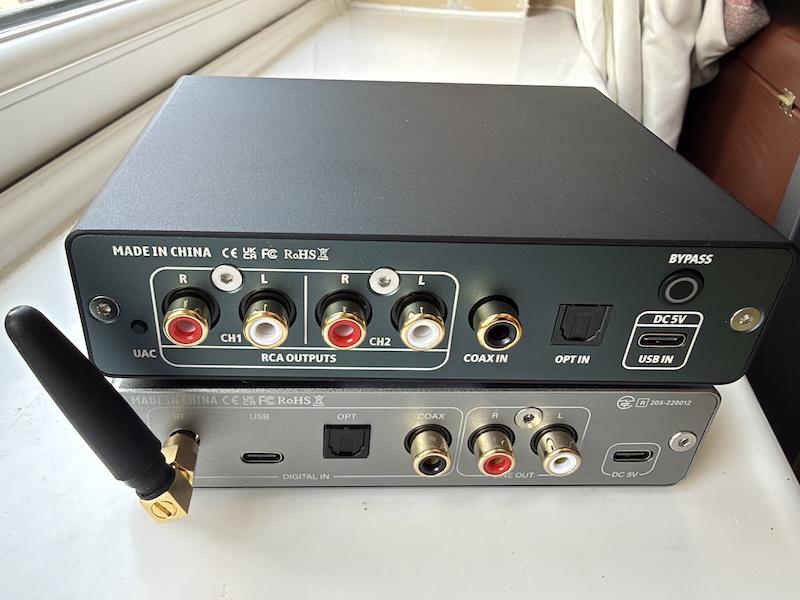
Seen from the back, the D07’s connections sit above the lower unit’s own digital inputs and RCA outputs:
If I had one criticism of the feature set, it’s the lack of any display. Input selection and operating mode rely entirely on the front-panel LEDs, which work fine but aren’t quite as immediately informative as a small screen showing the active input or the current volume level. That’s really my only complaint.
Sound Impressions
I’ve been running the D07 over USB from a desktop source, feeding both a power amp and a pair of active speakers via its two RCA outputs. What I’m listening for here is less a “sound signature” in the way I’d describe an IEM or a headphone, and more whether the D07 gets out of the way — because that is precisely what a clean, well-engineered DAC at this price should do.
Bass
Bass through the D07 is well controlled and free of any obvious looseness or bloat — there’s nothing added, and nothing taken away. On “Whole Lotta Love” by Led Zeppelin the bass line has good texture and stays tightly defined rather than smearing into the surrounding mix, which is exactly what you want from a transparent digital front end.
Midrange
The midrange is where the AK4493’s character shows through most clearly — a touch smooth and natural rather than clinical, without ever tipping into softness or a lack of detail. On “Fast Car” by Tracy Chapman the vocal comes through with good body and none of the analytical edge that some competing DAC chips can add.
Treble
Treble is clean and extended without being etched or fatiguing over a long listening session. On “Billie Jean” by Michael Jackson the hi-hats are clearly resolved without any added glare, which lines up with Aiyima’s own THD+N figures — there’s simply very little for the ear to object to up here.
Soundstage and Imaging
Instrument separation and placement are genuinely good for a DAC at this price, with a silent background that lets low-level detail come through cleanly. On “Private Investigations” by Dire Straits, the sparse arrangement gives plenty of room to hear individual elements placed distinctly rather than smeared together, which is as much a function of a quiet noise floor as it is any deliberate tonal shaping.
Specifications and Measurements
| Specification | Value |
|---|---|
| Chipset | AK4493SEQ + XMOS XU316 + NE5532P (socketed) |
| Maximum sample rate (USB) | PCM 768kHz/32-bit, DSD512 (DoP256) |
| Maximum sample rate (Optical/Coaxial) | PCM 192kHz/24-bit |
| Inputs | Coaxial, Optical, USB-C |
| Outputs | RCA × 2 (CH1, CH2, independently switchable) |
| Signal-to-noise ratio | ≥118dB |
| THD+N | 0.0002% |
| Dynamic range | ≥120dB |
| Frequency response | 20Hz – 20kHz (±0.2dB) |
| RCA output level | 2.0Vrms |
| USB mode | UAC 1.0 / 2.0 |
| Supported OS | Windows 10/11, macOS, Linux |
| Power supply | DC 5V via USB-C |
| Dimensions | 13 × 10 × 3cm |
| Weight | 400g |
| In the box | D07, 2-in-1 USB-A/C to USB-C cable, optical cable, user manual, warranty card |
| Price | $110 / €109.99 |
Aiyima’s own measurement sheet, supplied alongside the unit, shows THD+N split by channel at 0.000283% on Ch1 and 0.000270% on Ch2 — both rounding to the headline 0.0002% figure on the spec sheet:
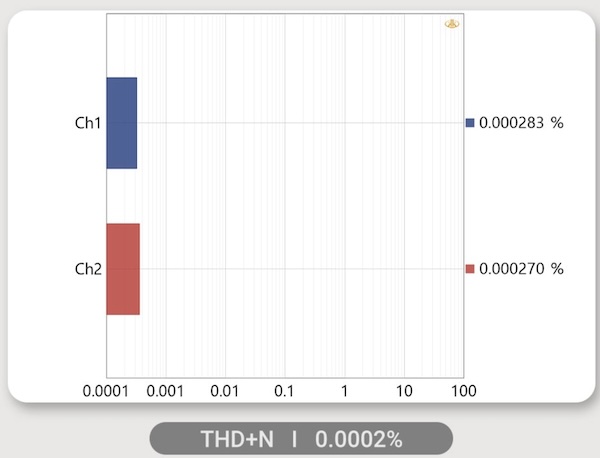
A THD+N figure of 0.0002% works out to a SINAD of roughly 114dB, which would land the D07 comfortably in the “excellent” section of ASR’s SINAD charts. For a $110 DAC with this much connectivity — coaxial, optical and USB in, dual switchable RCA outputs, UAC 1.0/2.0, DSD512, and a socketed op-amp — that’s a genuinely excellent result, not just a good one for the price.
Rating Explanation
The Pragmatic Rating of 5 reflects a DAC that focuses on exactly what most people actually need: a compact, well-built, USB-powered DAC that measures excellently, sounds clean, supports virtually every modern digital source, and simply gets out of the way of the music. The Price Rating of 5 follows directly from that — at $110 / €109.99, with the connectivity and measured performance on offer, this is very hard to beat.
The Features Rating of 4 reflects a feature set that’s excellent for what it sets out to do, held back only by the lack of any display — input and mode selection via LEDs works fine, but a small screen would be a genuine convenience. The Measurements Rating of 5 reflects Aiyima’s own THD+N figures, which work out to a SINAD around 114dB — comfortably into “excellent” territory regardless of price, and outstanding for a $110 DAC.
This one is for anyone who wants a no-nonsense USB DAC and preamp to sit between a digital source and a power amp or active speakers, who doesn’t need Bluetooth or a built-in headphone amp, and who appreciates the option to roll their own op-amp if the mood takes them.
Conclusion
The Aiyima D07 is exactly what a lot of people actually need: a small, well-built, USB-C powered DAC that measures excellently, sounds clean and unobtrusive, and covers coaxial, optical and USB inputs with dual switchable RCA outputs to match. Pair it with a good amplifier or a set of active speakers and you have a desktop system that performs well above its asking price.
One final practical note: power it from a decent 5V USB-C supply. A modern USB-C charger, a powered USB hub, or a MacBook Pro all provide more than enough power, and that’s all this little DAC needs to perform at its best.