VE Devastator Pro
Silver Braid, 4.4 mm Output
A USB-C to 4.4 mm DAC dongle from Venture Electronics, and in my use a significant step up from the original Devastator.
I reviewed the original VE Devastator last October. It was a small USB-C to 4.4 mm dongle with enough power for most of my balanced IEMs and headphones, and it became one of the adapters I reach for first. This new silver Devastator keeps the same idea: a short braided cable, a USB-C plug at one end and a 4.4 mm jack at the other, plus a USB-A adapter in the bag.
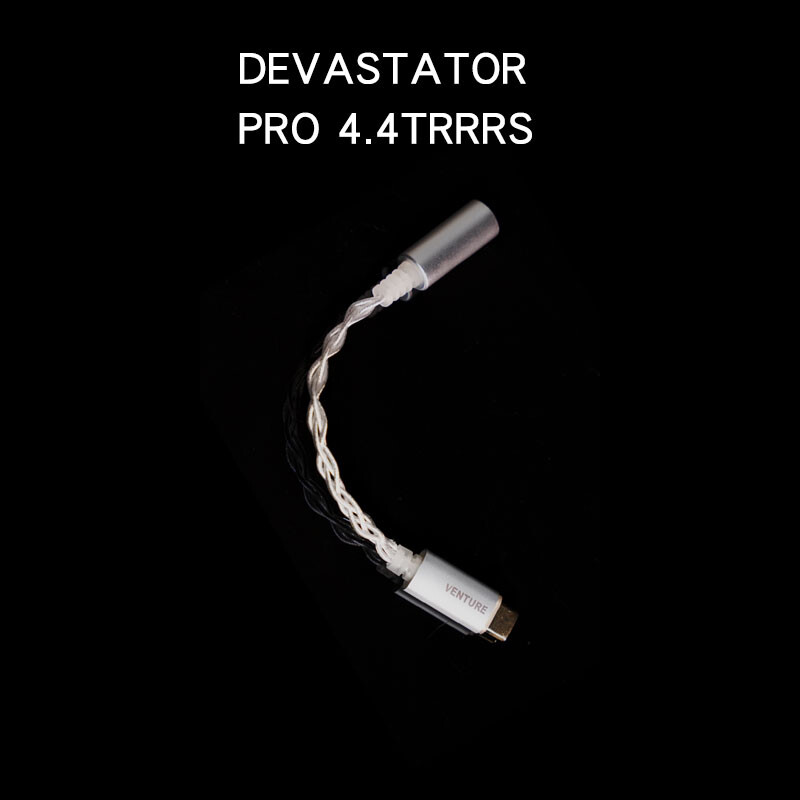
VE’s own product photo
I would like to thank VE (Venture Electronics) for providing the Devastator Pro for the purposes of this review.
VE’s own page is the Devastator Pro and Devastator Pro Max page, which lists a “Devastator Pro 4.4” edition, and that is the edition on the bag.
The Devastator Pro 4.4 costs $39.80.
The Devastator Pro is a single-purpose USB DAC dongle. You plug it into a phone, tablet or laptop and get a 4.4 mm headphone output without an app, battery or settings to manage. In my use it is a significant upgrade over the original Devastator.
VE describe the Devastator Pro as the benchmark for single-ended output quality, made for people who want a relaxed and detailed listening experience, with a 2 V RMS output, and I was interested to find out. (That description is for the 3.5 mm model on their page, and mine is the 4.4 edition.)
But first, let’s take a look at what’s in the box.
Unboxing and Build Quality
VE ships the Devastator Pro the same way it ships most of its small accessories: in a resealable foil bag with a clear window and the Venture Electronics “Sound to Belief” logo on the front. The dongle and its USB adapter are visible through the window:
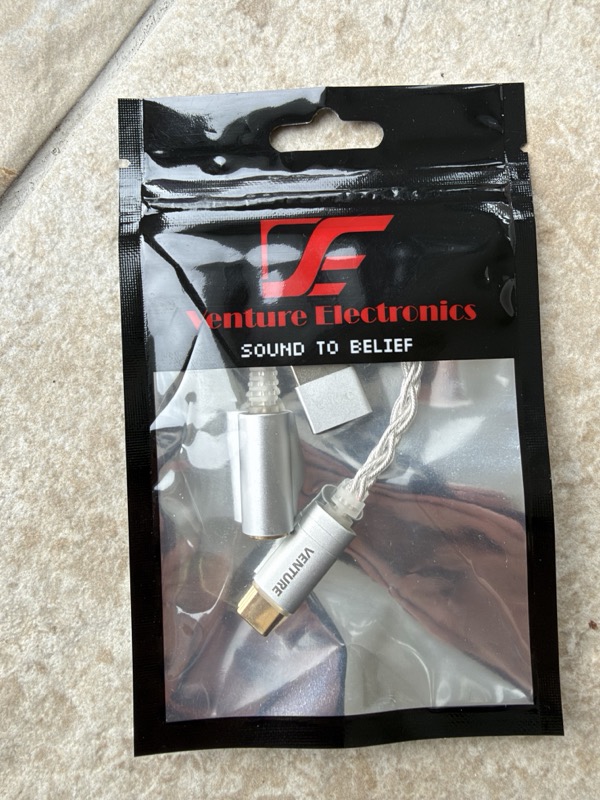
The contents are minimal:
- the Devastator Pro dongle (USB-C plug, fixed braided cable, 4.4 mm jack)
- a USB-C to USB-A adapter
Out of the bag, the dongle has a satin silver aluminium USB-C housing with “VENTURE” printed on it, a short four-strand braided silver cable with clear strain reliefs at both ends, and a plain cylindrical aluminium housing around the gold- coloured jack. The USB-A adapter uses the same finish. The bag’s label is in this shot too, and it reads “DEVASTATOR PRO / 4.4TRRRS”:
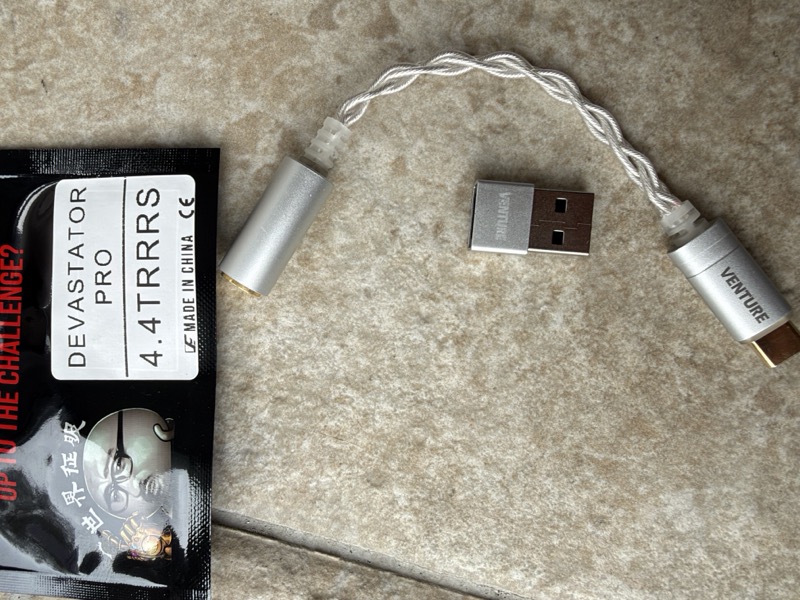
VE says the Devastator Pro has a silver-toned aluminium alloy shell, gold-plated connectors and “high-purity 6N silver-plated copper cables, internally constructed from 192 strands x 4” (manufacturer claim). I have not opened the cable to check.
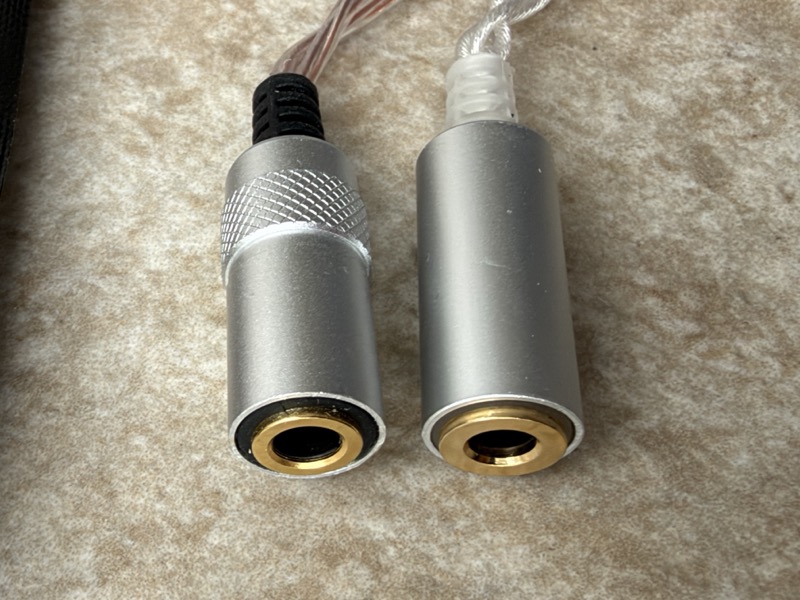
The original Devastator looks quite different. It has a copper-coloured twisted cable, black strain reliefs and a knurled jack housing:
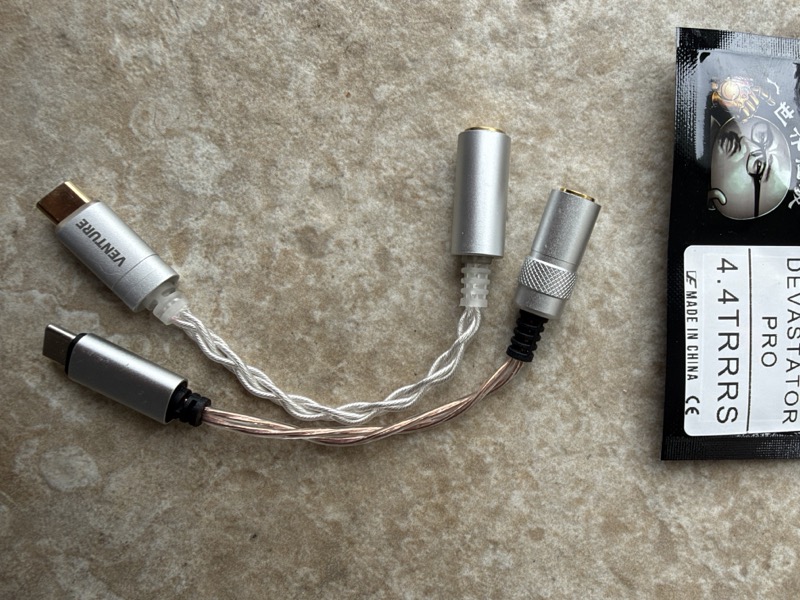
Looking at the two jacks end-on, both have the same gold-coloured 4.4 mm opening. The original has a knurled grip section and the new one is a smooth cylinder:
Features and Performance
A dongle like this has a short feature list, so the useful questions are practical ones: what it tells your phone or computer it can play, and what it does beyond playing music.
Product Name and USB Device Name
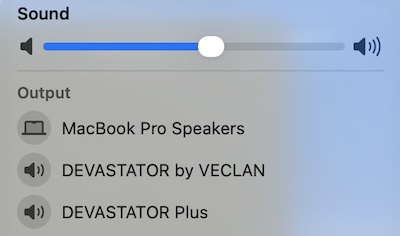
The bag label in the photo above reads “DEVASTATOR PRO / 4.4TRRRS”, so this is the Devastator Pro. The USB device name still reads “Plus” though: connected to a Mac, it shows up as “DEVASTATOR Plus”. Here is the macOS Sound menu with both Devastators plugged in, the original appearing as “DEVASTATOR by VECLAN”:
One more inconsistency on VE’s side: its Devastator Pro page describes the Pro as single-ended with “only a 3.5mm single-ended headphone jack”, while the same page sells a “Devastator Pro 4.4” edition, and that is what this bag says it contains.
Formats and USB Behaviour
macOS Audio MIDI Setup shows exactly what the dongle tells the computer it supports. The output device (“DEVASTATOR Plus 2”) offers 44.1, 48, 96, 176.4, 192, 352.8 and 384 kHz, each as 2-channel 24-bit or 32-bit integer:
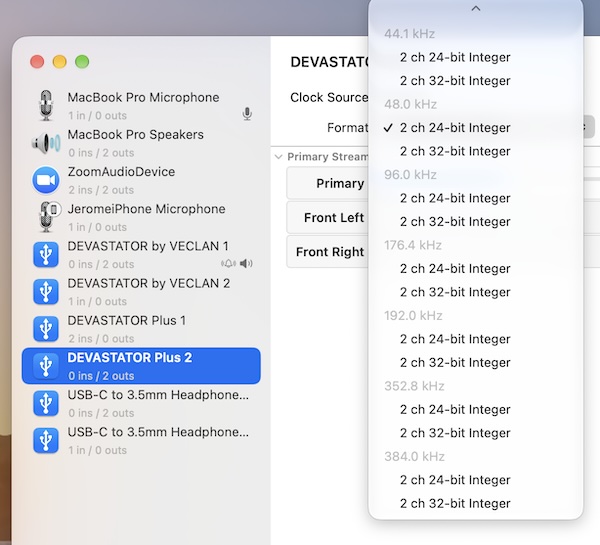
The same window shows one difference from the original. The Devastator Pro also exposes a separate 2-channel input device (“DEVASTATOR Plus 1”, 2 ins / 0 outs), where the original Devastator exposes a 1-channel input (“DEVASTATOR by VECLAN 1”, 1 in / 0 outs). VE does not say what the input is for, and I have not checked whether it carries a microphone signal.
VE does not publish the DAC chip used in the Devastator Pro, and neither does it publish DSD support.
Sound Impressions
This is a very transparent dongle. I do not hear it adding or removing anything, so what I hear is the recording and the earphones and not the gear. I would describe each part of the sound the same way, and I have picked a track for each from my usual list.
Bass
The bass is not reshaped by the Devastator Pro, so what you get is whatever is in the recording and in your earphones. Angel by Massive Attack is a good track to try this with.
Mids
The midrange is the same story, with no added warmth and no thinning out. Fast Car by Tracy Chapman is a good track to check that on, because you hear the recording and not the dongle.
Treble
The treble is also left alone, with nothing added and nothing rolled off. Roads by Portishead is a good track for this.
Soundstage and Imaging
The soundstage and imaging stay as they are on the recording and the earphones, because the dongle does not change the sound. Private Investigations by Dire Straits is a good track to hear that on.
That is the point of a transparent dongle. It lets you hear the recording and not the gear.
Comparisons
VE Devastator. The obvious comparison is the original VE Devastator. Both are small USB-C to 4.4 mm dongles from VE with fixed cables and no controls. The new one changes the cable to silver-plated copper, gives the jack a smooth housing and adds a 2-channel input device on the USB side. VE’s own figures put the two close on power. The Pro is rated at 1.98 V and 119.05 mW into 32 Ω, the original at 1.91 V and 110.2 mW into 33 Ω. On VE’s sheets the original actually has the lower distortion and higher dynamic range: 0.0051% THD+N and 102.9 dB DNR, against 0.0086% and 97 dB for the Pro. I still hear the new one as a significant upgrade, so the reasons come from listening rather than from VE’s table.
VE Megatron. The VE Megatron is VE’s bigger option. It uses an ESS ES9018K2M DAC and has 3.5 mm, 2.5 mm and 4.4 mm headphone outputs plus a line out. A second USB-C port takes extra power, and its published balanced rating is 300 mW into 32 Ω. It cost $50 when I reviewed it, and it is closer to a small desktop unit than something to leave on a phone. If you need a line out, more than one headphone jack or noticeably more power for harder loads, the Megatron makes more sense. If you want a 4.4 mm output that disappears into a pocket, the Devastator Pro is the one to carry.
JCally JM20Pro. The JCally JM20Pro is a similar size and also runs up to 32-bit/384 kHz. It uses a Cirrus Logic CS43131 rated at about 70 mW into 32 Ω, but it only has a 3.5 mm output, and it adds PEQ through the Walkplay app. It was €20 when I reviewed it. If you EQ your IEMs and only use 3.5 mm plugs, the JM20Pro’s PEQ is the bigger practical feature. If your cables end in 4.4 mm, the Devastator Pro avoids an adapter, and VE rates it for more output.
Specifications and Measurements
Specifications
The first table lists what I could confirm on the unit itself, plus what VE publishes. Items VE doesn’t publish are marked as such:
| Item | Devastator Pro (4.4 edition) |
|---|---|
| USB device name (macOS) | DEVASTATOR Plus |
| Retail bag label | DEVASTATOR PRO / 4.4TRRRS |
| Connector | USB-C plug on a fixed cable, USB-C to USB-A adapter included |
| Headphone output | 4.4 mm (per the bag label) |
| Output formats (macOS) | 44.1, 48, 96, 176.4, 192, 352.8, 384 kHz; 2-channel 24-bit or 32-bit integer |
| USB input device (macOS) | 2-channel (“DEVASTATOR Plus 1”), purpose not published |
| DAC chip | Not published |
| DSD support | Not published |
| Microphone support | Not published |
| Shell (manufacturer claim) | Silver-toned aluminium alloy |
| Connectors (manufacturer claim) | Gold-plated |
| Cable (manufacturer claim) | 6N silver-plated copper, 192 strands × 4 |
| Output voltage (manufacturer claim) | 2 V RMS |
| Price | $39.80 |
VE publishes a specification table for the Devastator Pro. The figures below are VE’s own figures, not results confirmed for this unit. The original Devastator’s published figures are included for comparison (VE measured the original at 33 Ω rather than 32 Ω):
| VE published figures | Devastator Pro, 32 Ω | Devastator Pro, 150 Ω | Original Devastator, 33 Ω | Original Devastator, 150 Ω |
|---|---|---|---|---|
| Output voltage (V, THD+N < 1%) | 1.9821 | 1.9857 | 1.9071 | 1.9565 |
| THD+N (%) | 0.0086 | 0.0047 | 0.0051 | 0.0032 |
| DNR (dB) | 97 | 97.5 | 102.9 | 101.5 |
| A-weighted noise (µV) | 11.52 | 11.31 | 11.62 | 11.21 |
| Intermodulation distortion (%) | 0.0026 | 0.0052 | 0.00094 | 0.00035 |
| Crosstalk @ 1 kHz (dB) | 61.7 | 68.7 | 66.22 | 78.85 |
| Output power (mW) | 119.05 | 26.29 | 110.2 | 24.8 |
About 2 V is enough voltage for nearly all IEMs and for easy-to-drive headphones. The roughly 11 µV of A-weighted noise is low, though very sensitive IEMs are where a noise floor shows up first. Crosstalk in the 60-70 dB range is well past the point where channel separation stops being audible. On VE’s own numbers the two generations are close, with the original slightly ahead on distortion and dynamic range.
Measurements
VE publishes the table above but no graphs: no frequency response, THD+N sweep or Audio Precision dashboard for the Devastator Pro.
Rating Explanation
I rate the Devastator Pro 5 overall and 5 for measurements. Price and features each get a 4, because the price and the lack of PEQ are the two minor things that make it less than perfect.
The features score is limited by design. There is no app, PEQ, gain switch, volume control or second output. That is the point of a dongle like this, but the lack of PEQ is the one I miss. VE’s page also lists more than one Devastator Pro edition, so buyers need to order the 4.4 one.
Conclusion
The silver Devastator Pro does the same job as the original: a USB-C to 4.4 mm dongle with no app, no battery and no settings to manage. My verdict is that it is a significant upgrade over the original Devastator. VE’s published figures put the two close on paper, so that verdict comes from using it, not from the spec sheet.
Its convenience has meant it has been a constant with many of my headphones, and even with the ZenCarb CIEM, which only came with a 4.4 mm connection.