FiiO SP5
A great all-round speaker for your desktop setup with pro-audio ambitions
The FiiO SP5 occupies an unusual and genuinely interesting position in the desktop speaker market: it is simultaneously a studio reference monitor with professional balanced connectivity, an audiophile near-field speaker with high-resolution USB audio, and a modern wireless speaker with Bluetooth 5.1 and aptX Adaptive, all wrapped in a die-cast aluminum cabinet that weighs over six kilograms per unit. At around $749 (approximately £800 in the UK), it is not an impulse purchase — but for that money, FiiO is offering something considerably more ambitious than the typical powered desktop speaker. The SP5 is the successor to the well-regarded SP3, and those who know that model will recognise immediately that the new design plays in an entirely different league in terms of bass extension, output power, and the breadth of its connectivity. What makes the SP5 particularly interesting is its dual-processing approach: analog EQ for XLR and RCA sources, and a full ten-band parametric EQ available via the FiiO Control app for digital inputs — two parallel signal paths serving two different kinds of listener with the same pair of speakers.
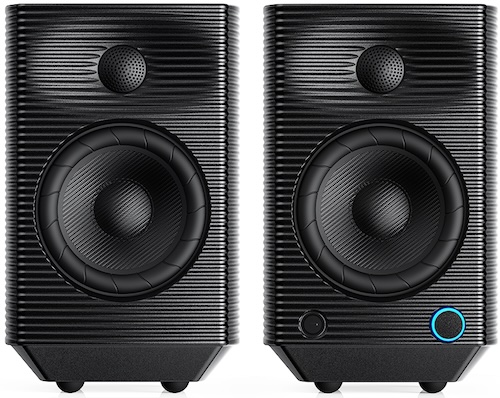
I would like to thank FiiO for providing the SP5 for the purposes of this review.
If you are interested in finding more information about this product, you can find it at the official product page.
The FiiO SP5 typically retails for approximately $749 / £800.
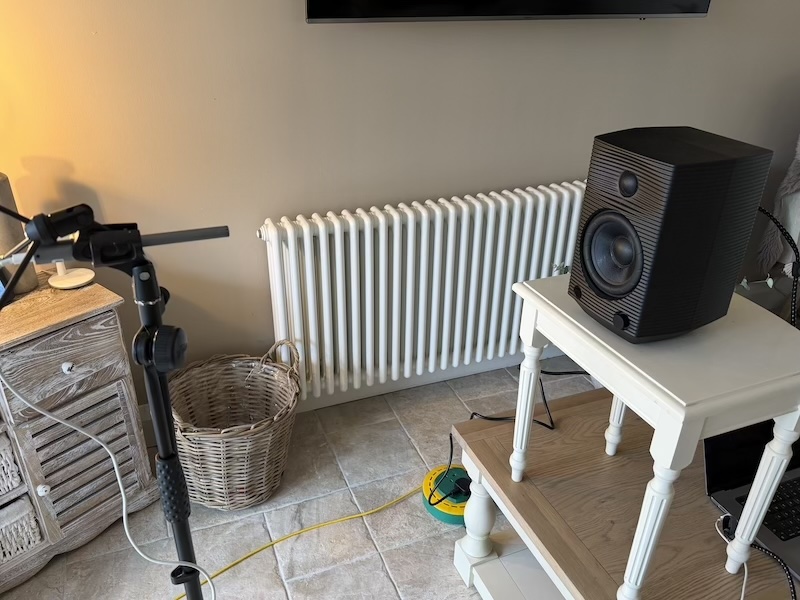
I spent about a month with the SP5 as my primary work-from-home desktop setup, paired most often with the FiiO K13 R2R DAC via XLR balanced connection. I also briefly substituted them into a position normally occupied by my KEF reference speakers, which gave me a useful point of reference for how the SP5 handles room-scale listening compared to the near-field desk environment where they clearly excel. The SP5 is the first of five speaker reviews I will be publishing over the coming weeks — a busy stretch on the desktop and nearfield speaker front covering a range of price points and form factors.
Unboxing and Build Quality
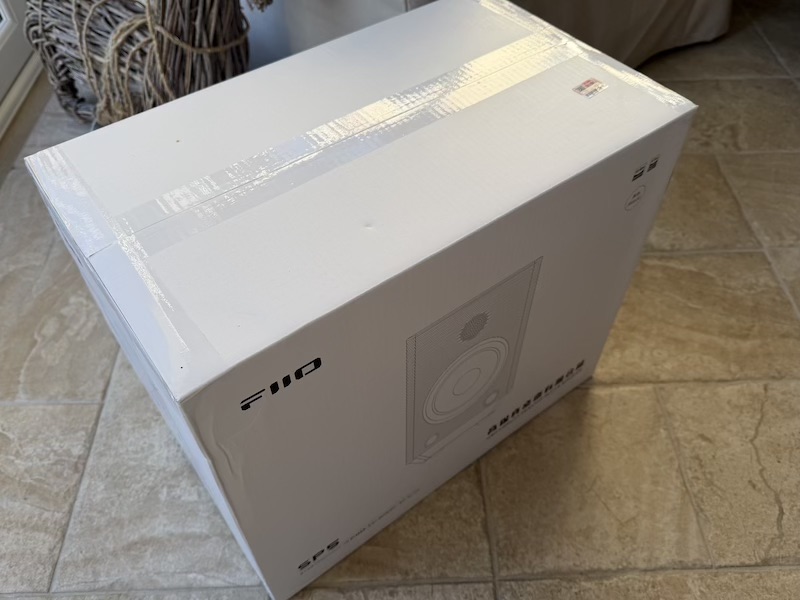
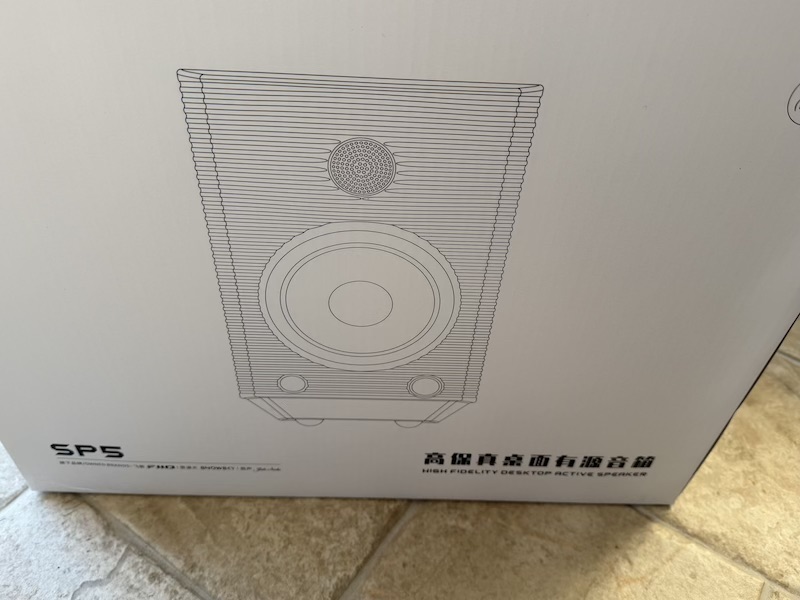
FiiO’s packaging has always been more considered than most, and the SP5 is no exception. The outer box is substantial — at roughly 15kg total with packaging this is a genuinely heavy shipment — and the presentation inside the lid makes an immediately premium first impression.
 |
 |
 |
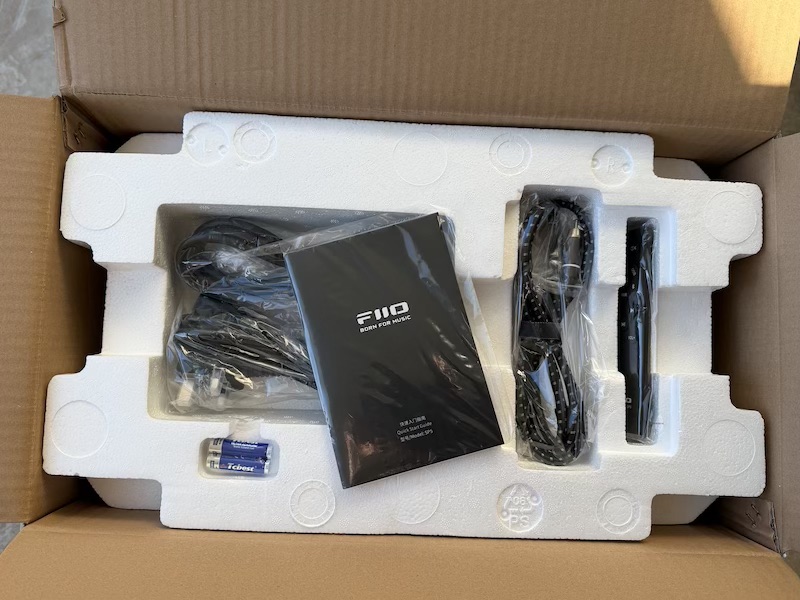 |
Once the lid comes off, the accessories are neatly arranged in a tray sitting above the speakers — cables, documentation, and a few extras — before you lift that layer to reveal the speakers themselves, each cosseted in thick protective plastic and high-density foam.
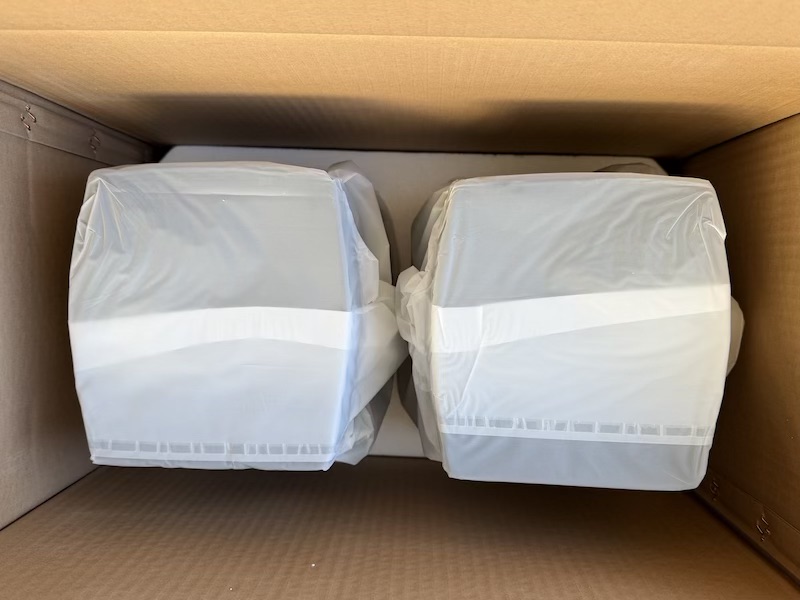
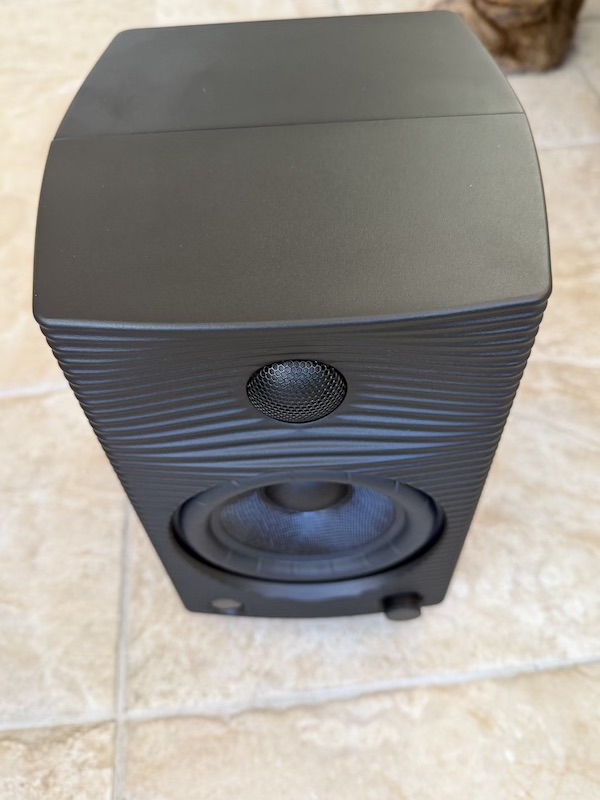
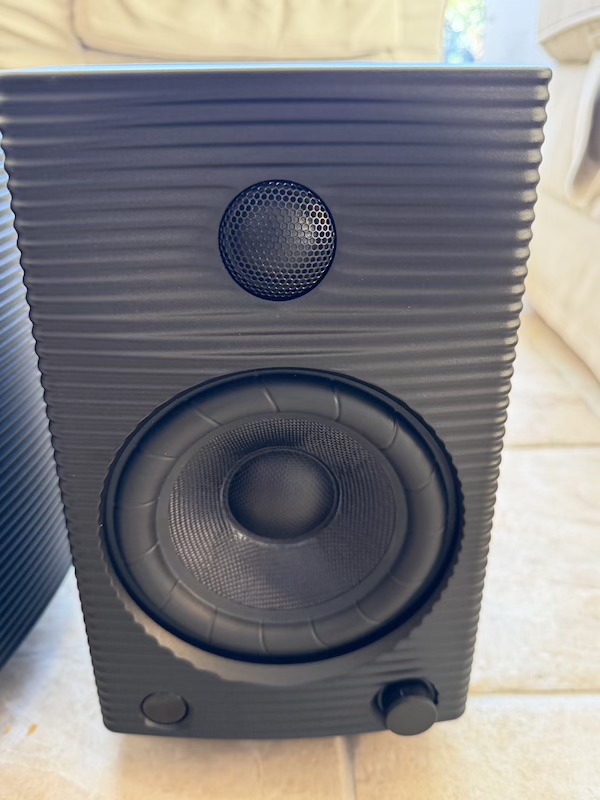
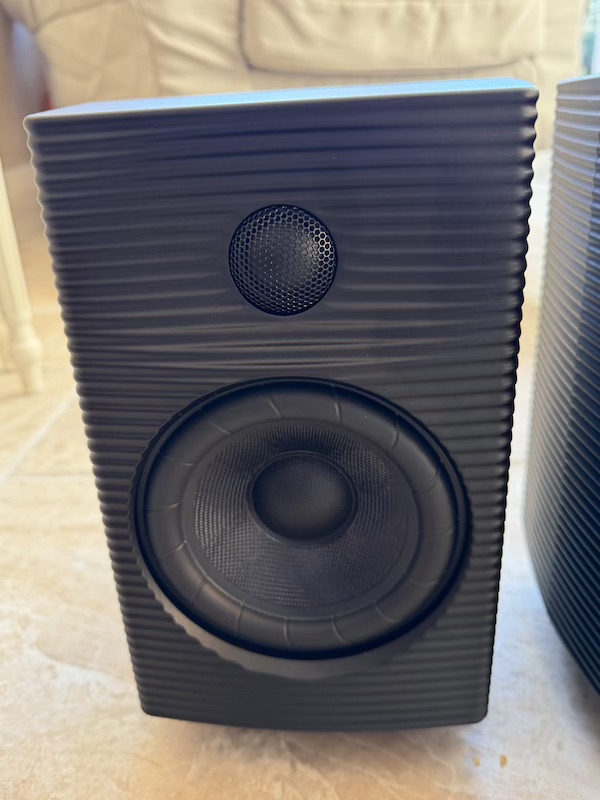
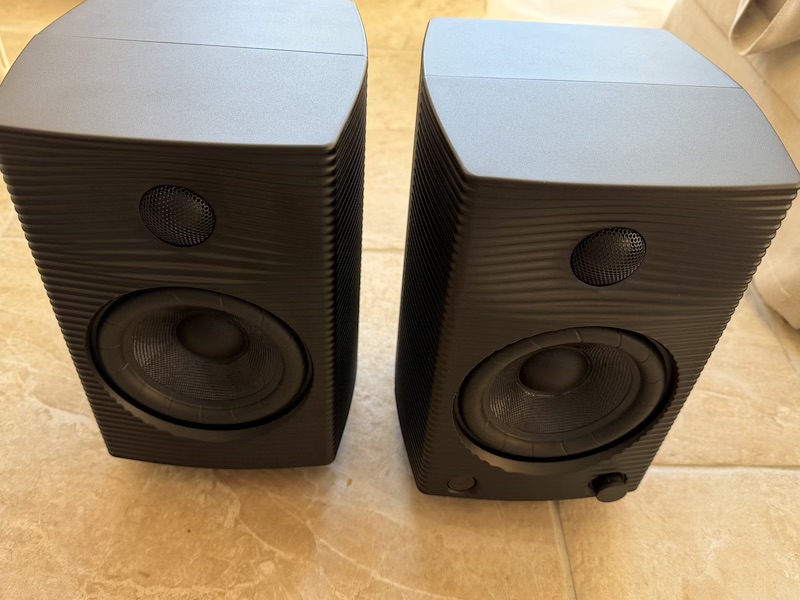
Lifting each speaker out is a genuine two-handed job. That weight is not a flaw; it is evidence of the die-cast liquid aluminum alloy construction that FiiO uses throughout. The cabinet is manufactured using a 650°C casting process and the result feels genuinely rigid, acoustically inert, and pleasingly cool to the touch. The curved profile is both aesthetically elegant and acoustically purposeful: the horizontal diffuser-stripe pattern on the baffle contributes to standing-wave suppression inside the cabinet, and every surface communicates intent rather than cost-cutting.
 |
 |
 |
 |
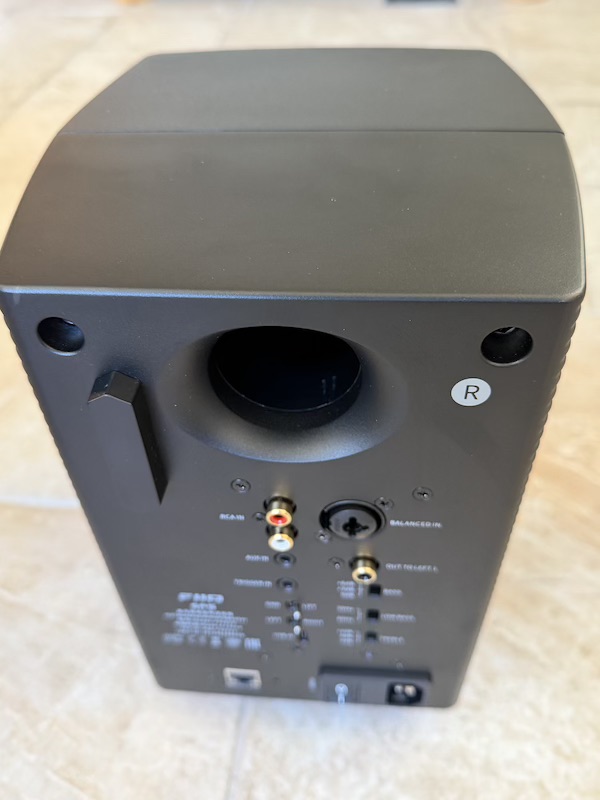
The horn-shaped rear-firing bass reflex port is a thoughtful design choice. Rear-firing ports demand some wall clearance — 20–30cm is the sensible minimum — but the horn profile manages port turbulence at high output levels, and in practice the bass behavior on the desk was well-controlled rather than bloated.
Connectivity
This is where the SP5 genuinely separates itself from the competition, and it is worth understanding the distinction between the right (main) speaker and the left (secondary) speaker.
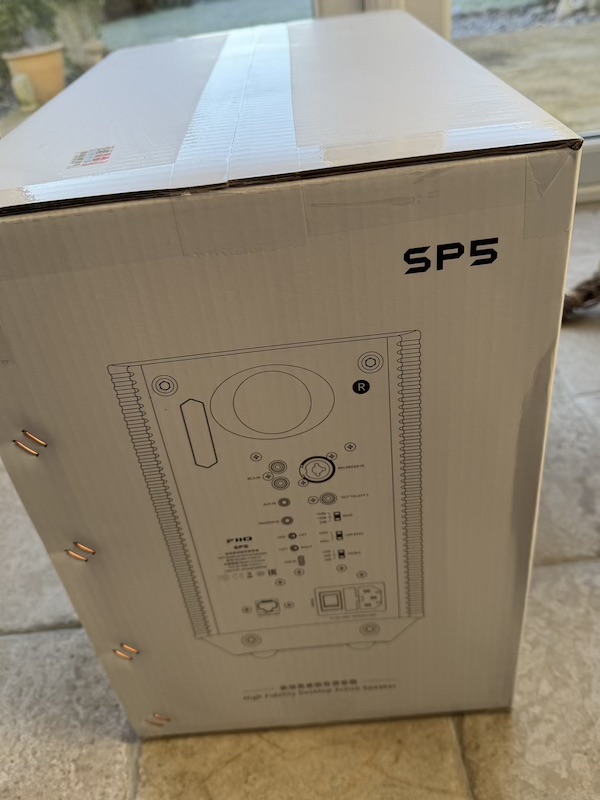
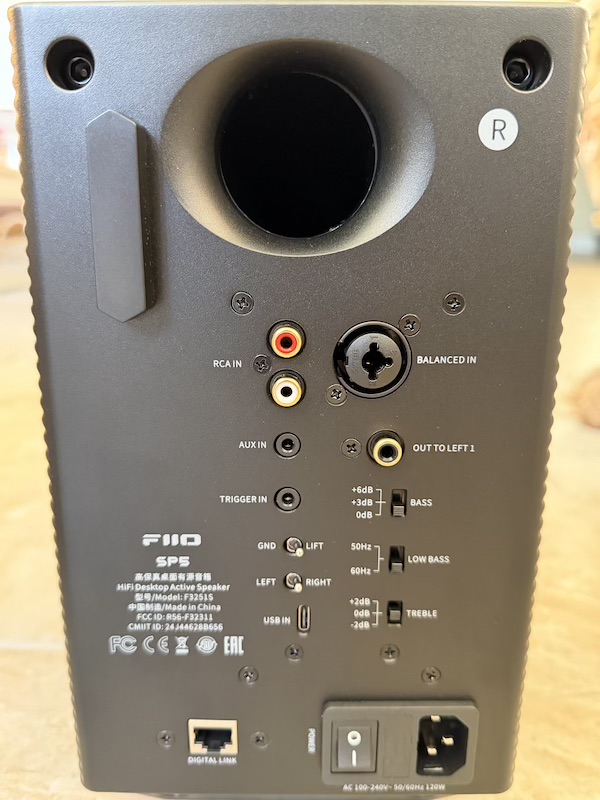
The right speaker is the system hub. Its rear panel hosts an XLR balanced input, RCA stereo input, 3.5mm AUX input, USB-B input (up to 96kHz/24-bit), a 12V trigger input for integrated system switching, a ground lift switch that is essential for studio use, and Bluetooth 5.1 with LED codec indicators — blue for SBC, cyan for AAC, purple for aptX/aptX LL, yellow for aptX HD, white for LDAC, and green for aptX Adaptive. The volume control on the right speaker synchronizes with the left unit so both speakers track together.
 |
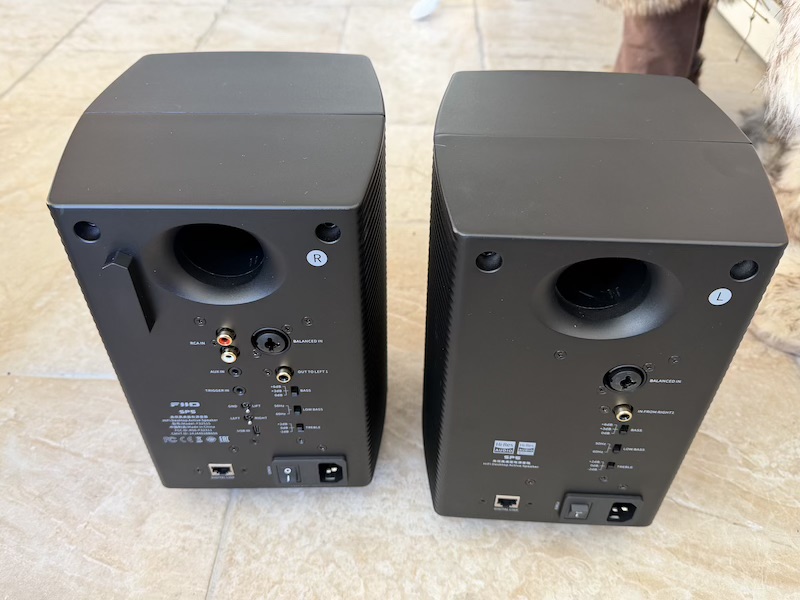 |
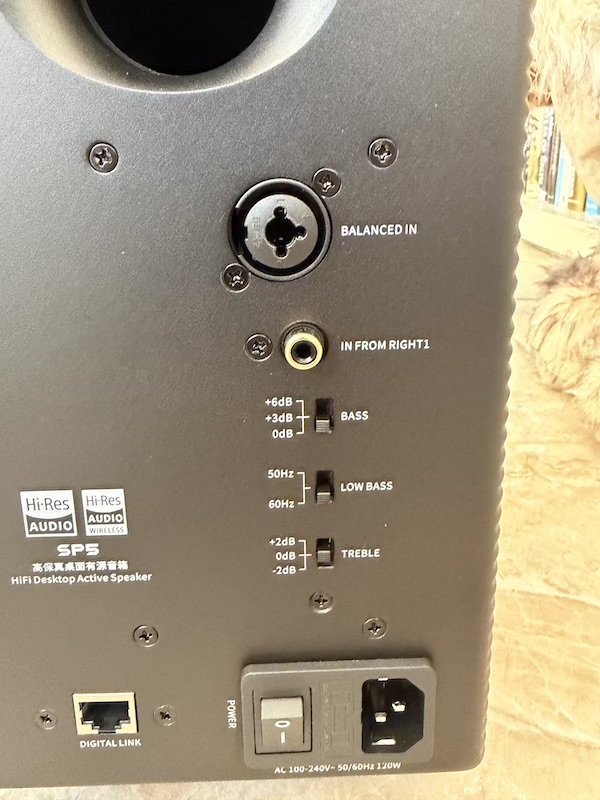
The left speaker’s rear panel serves a different purpose: it is where the analog EQ controls live. Three-position switches for bass (0/+3/+6dB), sub-bass extension (60Hz or 50Hz cutoff), and treble (−2/0/+2dB) provide hardware-level tonal shaping — no app required, no digital processing in the signal path for analog sources. Critically, each speaker’s EQ is set independently on its own rear panel, which is genuinely useful in asymmetric rooms where the left and right speakers face different reflective boundaries.
Features and Performance
The SP5’s dual-pathway approach to signal processing is its most distinctive and arguably most polarizing design decision. Analog sources — XLR, RCA, AUX — are processed entirely in the analog domain, with the physical EQ switches providing tonal adjustments. This is the path that appeals to studio engineers who prefer to keep the signal chain clean and predictable, and it is genuinely effective. For digital sources — USB and Bluetooth — the signal passes through the FiiO Control app ecosystem, unlocking a full ten-band parametric EQ that can be dialed in with the precision of a professional mastering tool. Crucially, the analog EQ switches still apply on top of any PEQ settings configured in the app, meaning you can use the hardware switches to set a broad tonal baseline and then refine the response further with surgical PEQ adjustments. That combination is powerful and not available on many desktop speakers at this price.
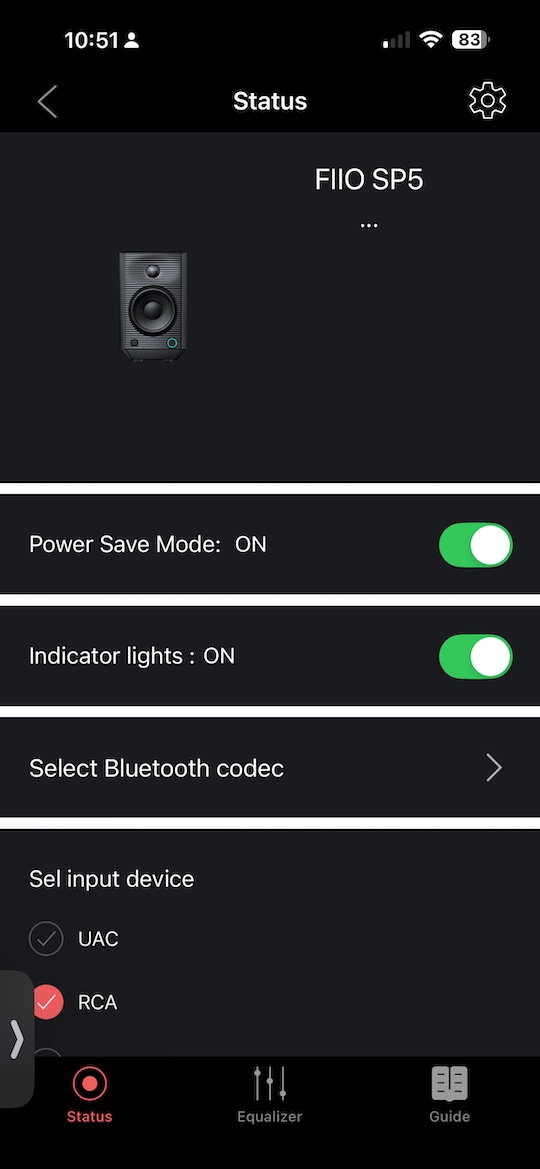
The FiiO Control app also provides input selection, Bluetooth codec management, RGB lighting control for the codec indicator LEDs, and power-saving configuration.
 |
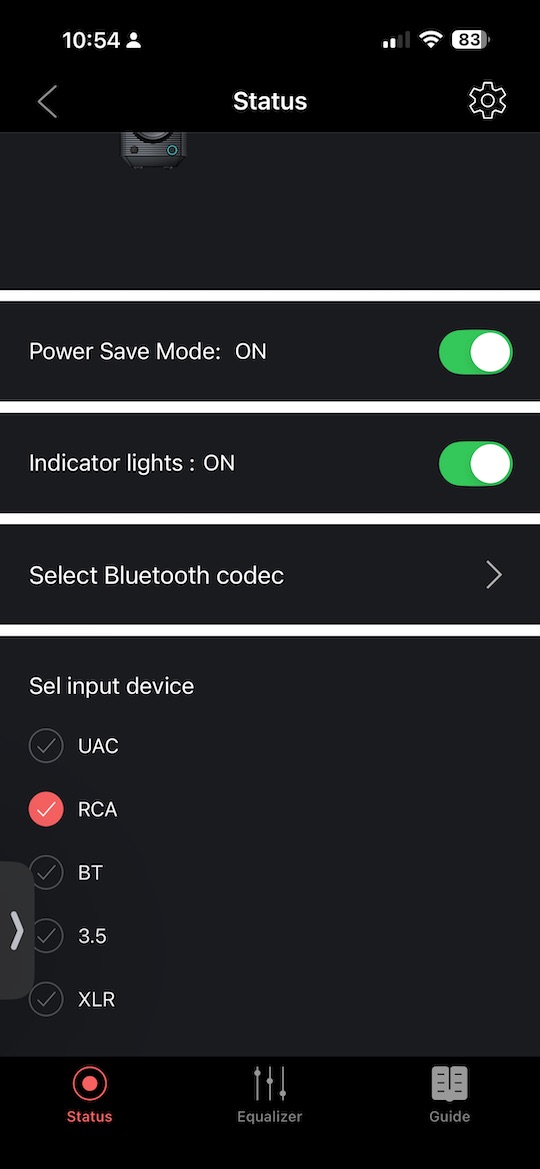 |
The Status tab is the app’s home base: it identifies the connected SP5, presents Power Save Mode and codec indicator LED toggles, and exposes the full input selector — UAC, RCA, BT, 3.5mm, and XLR — as a single tap rather than a rear-panel crawl. Being able to switch inputs from the phone while the speakers are on a desk below eye level is a small quality-of-life improvement that quickly becomes habitual.
 |
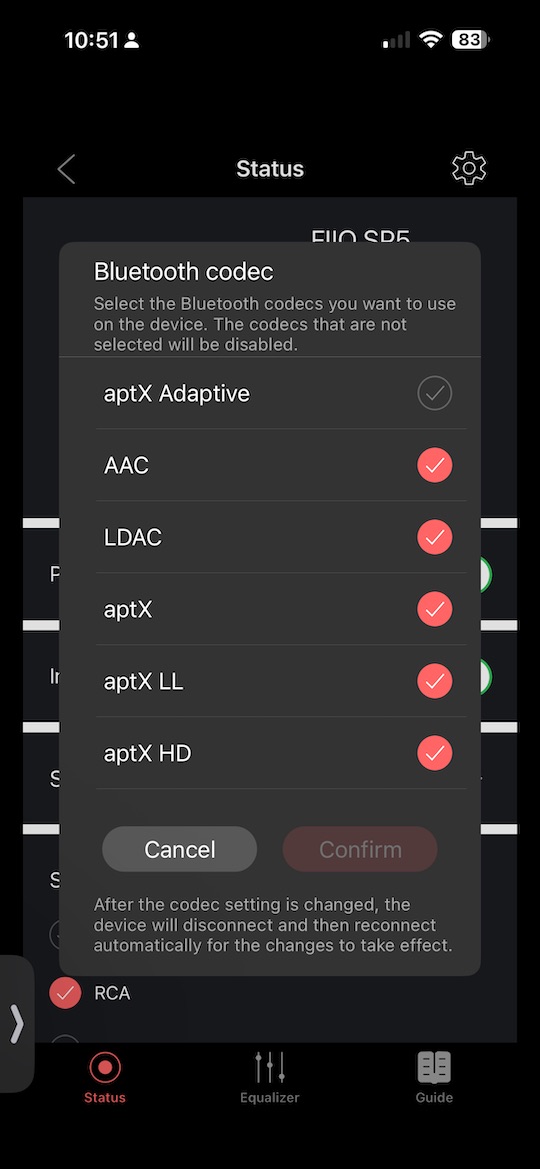 |
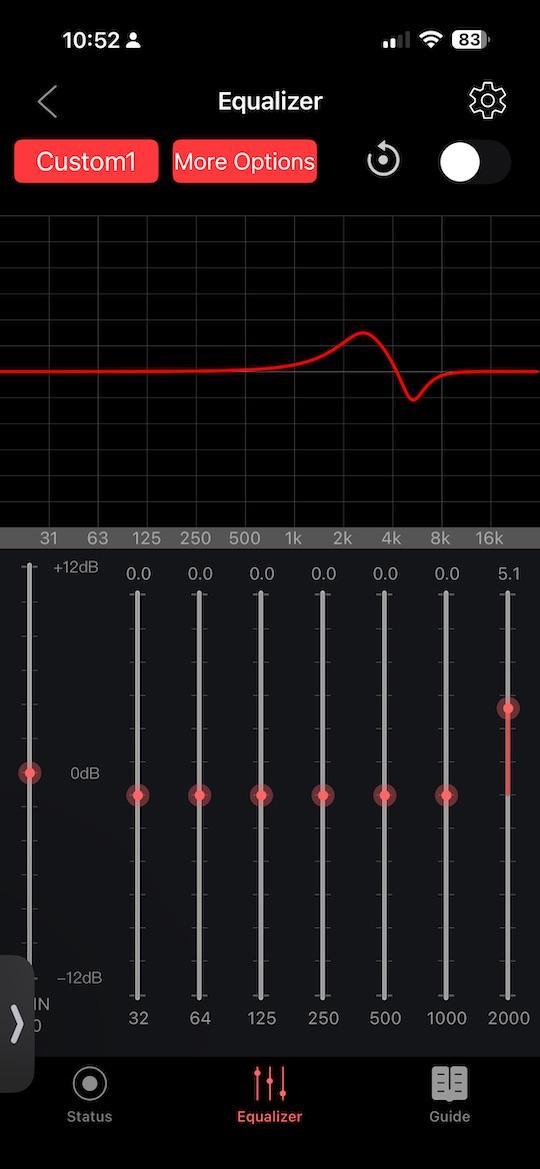
The Equalizer tab presents a ten-band graphic interface with ±12dB range per band and a live frequency-response curve rendered above the sliders — the screenshot shows a custom preset with a presence-region lift and a high-frequency roll-off, a typical in-room correction profile for a near-field desk setup. The Bluetooth codec selector appears as an overlay on the Status screen and lists every supported codec individually — aptX Adaptive, AAC, LDAC, aptX, aptX LL, and aptX HD — each with an independent enable/disable toggle. The ability to disable specific codecs is a useful provision for users who want to force a preferred codec and prevent automatic downgrade negotiation when switching sources.
 |
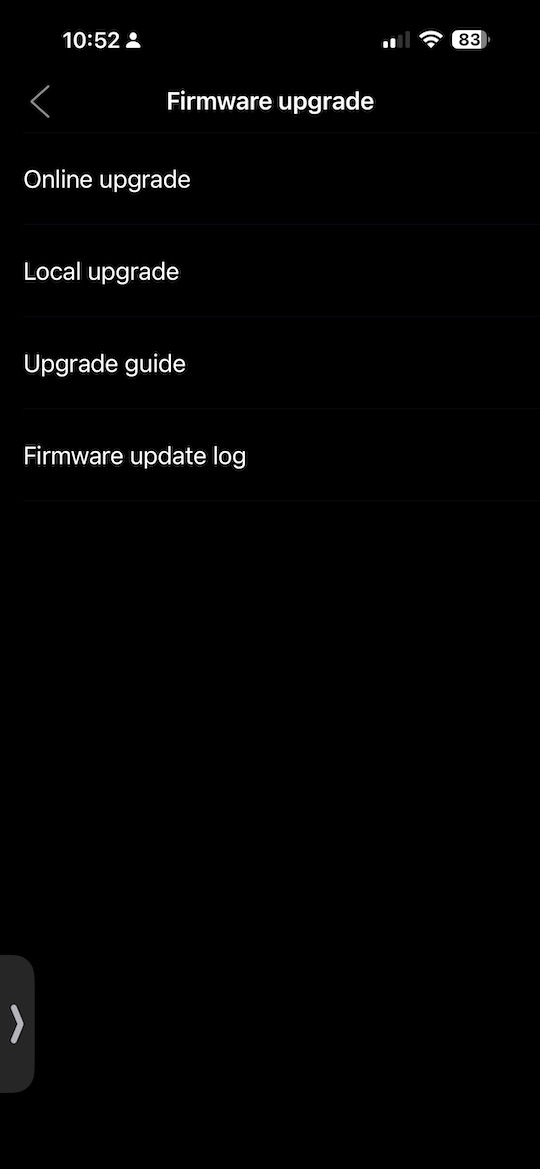 |
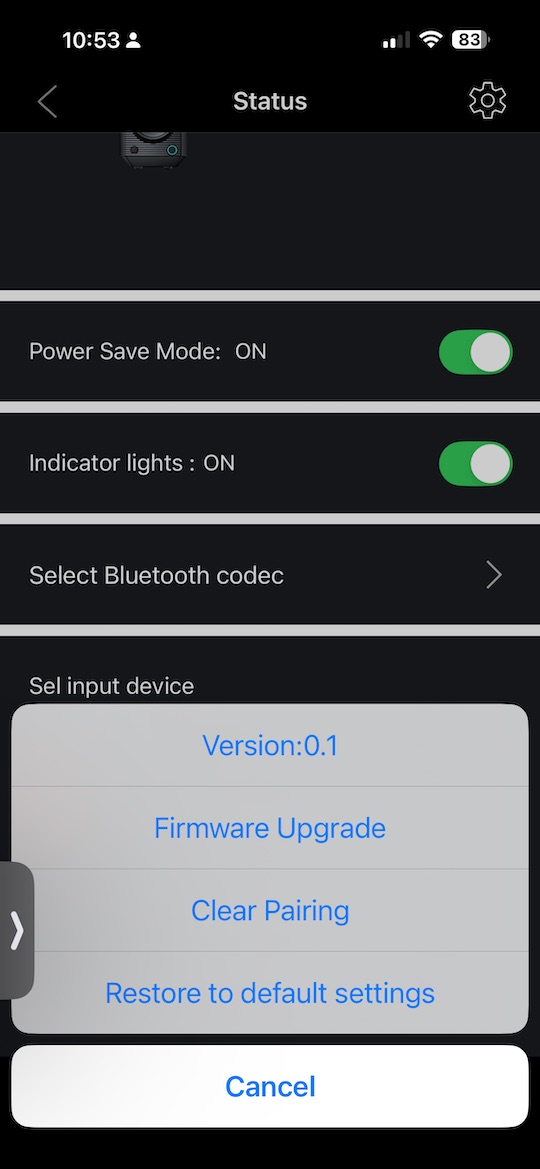
The gear-icon settings popup provides firmware management alongside the expected Clear Pairing and Restore to Default controls. Firmware upgrades can be performed either online or via a locally stored file, which is a practical option for users in regions with slow or metered data connections.
 |
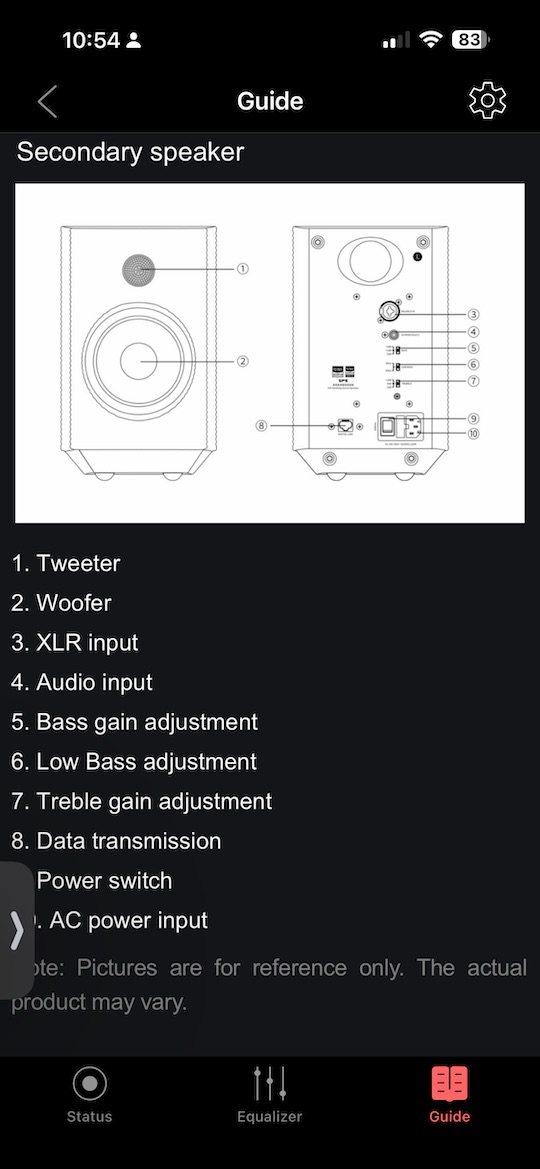 |
The Guide tab earns its place in the app: it contains fully labeled diagrams of both the primary and secondary speaker rear panels, making it straightforward to identify the analog EQ switches on the left cabinet without consulting the printed manual. At the time of review the firmware log showed version 1.0.1 — the SP5 is a relatively new product and the firmware ecosystem is still maturing, though no meaningful software issues were encountered during the review period.
The NJW1195A electronic volume control operates in 0.5dB steps and is rated for up to 100dB SNR and 0.0003% THD — specification numbers that confirm the volume circuitry is not a weak link in the chain. Power delivery to both speakers comes from independent switching power supplies, ensuring identical and interference-free energy to each cabinet. The active electronic two-way crossover sits at 3.1kHz, managing the handoff between the 5.25-inch composite carbon fiber woofer and the 1-inch composite silk soft-dome tweeter.
The woofer’s cone material is described as similar to the “Continuum” technology found in the Bowers & Wilkins 700 series — a serious design reference for a speaker at this price point. The tweeter’s hemispherical internal cavity is engineered to absorb unwanted harmonics rather than allow them to color the high-frequency response, and its contribution to the SP5’s refined top end is audible. One notable omission is a dedicated subwoofer output. At $749, there will be buyers who want to build a larger 2.1 system around the SP5, and the absence of a sub-out means those users will need to route the signal through a preamp or use an alternative chain. FiiO’s answer to this is the sub-bass extension mode and the +6dB bass boost, both of which handle a great deal of what you would use a subwoofer for in a near-field context, and the SP5 pairs elegantly with a source device like a WiiM Ultra as a streamer/preamp that can manage sub-bass routing upstream. For pure desktop and near-field studio use, however, the limitation is rarely felt.
Daily Usage
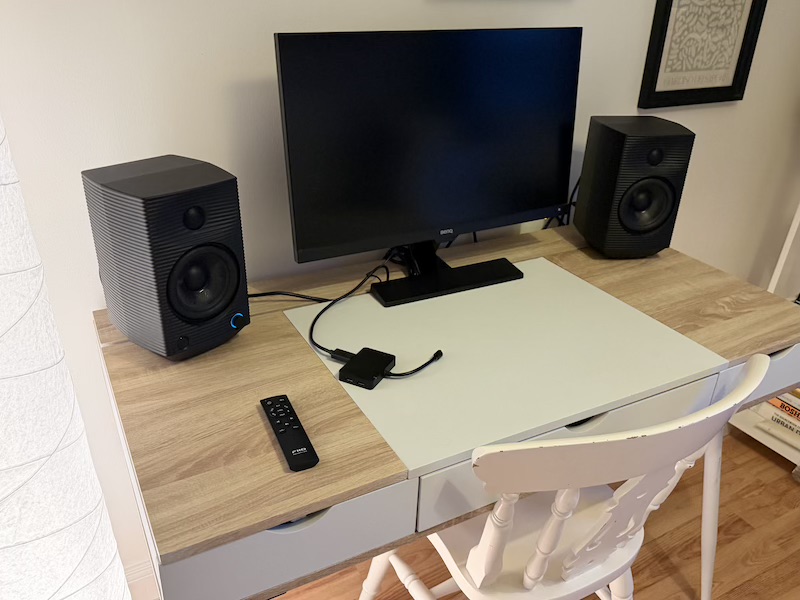
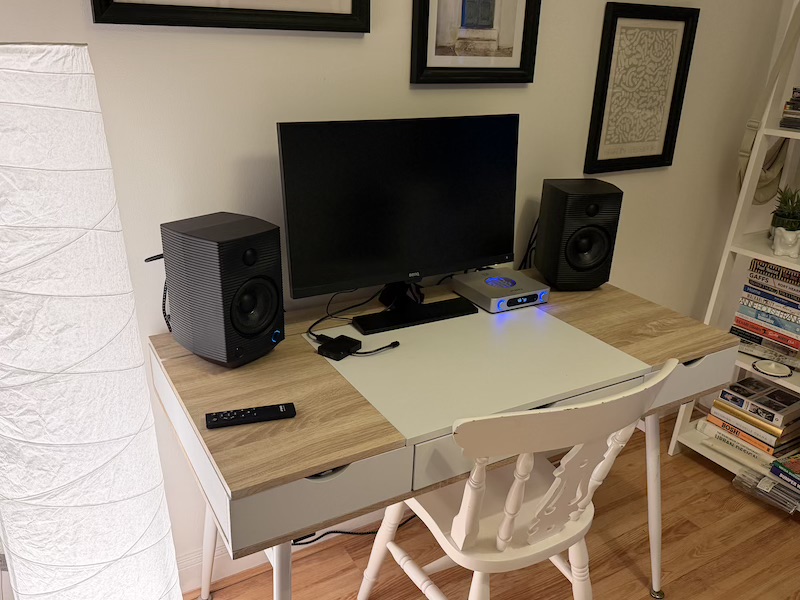
For the bulk of the review period the SP5 lived on my work-from-home desk, paired with the FiiO K13 R2R via XLR and serving as both background listening and focused critical-listening duty throughout the working day. That day-to-day experience is worth describing separately from the critical section that follows, because it tells a slightly different story: the SP5 is simply a joy to have on a desk. The nearfield bass — even in standard mode before touching the EQ — has genuine depth and warmth that makes long listening sessions feel effortless rather than fatiguing. There is enough low-end presence to give orchestral music body and pop music punch without the speaker ever feeling like it is straining.
After a modest PEQ session via the FiiO Control app on the USB input — a small sub-bass shelf lift and a gentle roll-off at the very top of the treble to account for the reflective desk surface — I found myself not thinking about subwoofers at all. The SP5 fills a nearfield workspace convincingly on its own. For a desktop setup used primarily for music listening and focus work, the absence of a sub-out is simply not felt day to day.
 |
 |
Sound Impressions
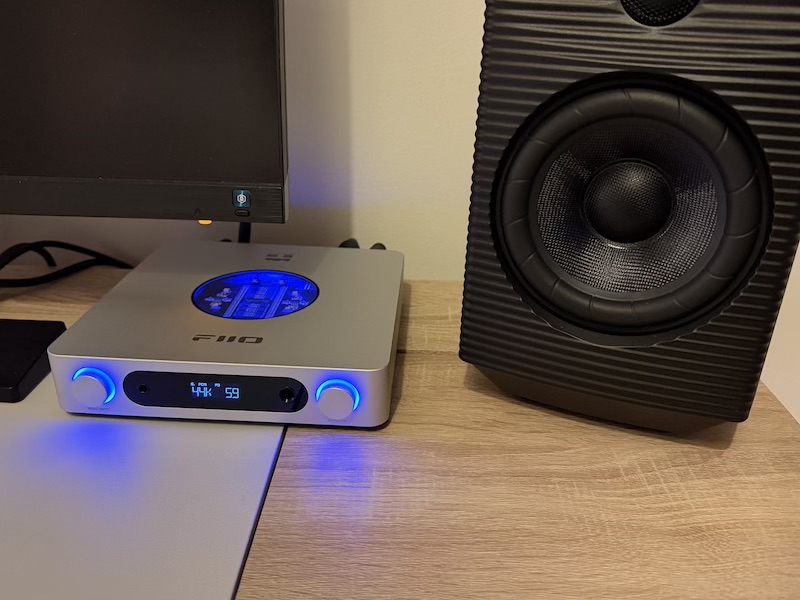
All critical listening was conducted with the SP5 on a desktop approximately 80cm from the listening position, toed in slightly. Primary source was the FiiO K13 R2R via XLR balanced connection, with the analog EQ set to 0dB bass boost, 60Hz sub-bass extension, and 0dB treble. Digital listening was conducted via USB with modest PEQ applied through the FiiO Control app — a gentle 1dB high-frequency shelf to account for near-field reflections, and a small +2dB sub-bass shelf at 60Hz to compensate for the inevitable desktop boundary interactions.
Bass
In standard mode with no EQ applied, the SP5’s bass is honest and controlled rather than generous. The 65Hz roll-off point means the lowest sub-bass registers are lean, and on nearfield desk placement that restraint is actually welcome — there is no boundary-induced boom, and mid-bass articulation is clean. Kick drums have convincing punch and texture, and bass guitar lines carry genuine definition. Engaging the 50Hz sub-bass extension mode adds meaningful weight without muddying the mid-bass, and the +3dB boost extends the perceived impact further still without inducing one-note bloom. At very high playback levels, some port loading becomes audible in the deepest registers, as you would expect from any rear-firing reflex design in close proximity to a desk surface, but at normal nearfield volumes it is a non-issue.
Donald Fagen’s The Nightfly is the ideal track to understand the SP5’s bass character. In standard mode the low end is taut and disciplined — the synth bass sits precisely in the mix rather than dominating it, and the kick drum texture is clearly resolved. Switch to the 50Hz extension mode and the recording opens up noticeably: the synth bass finds genuine weight, the kick gains authority, and the contrast between the two becomes more vivid. It is a good illustration of just how much range the analog EQ controls provide without touching a single software setting.
Midrange
The composite carbon fiber woofer handles the midrange with notable tonal density and body. Vocals sit naturally in the mix — neither recessed in the classic V-shape style nor pushed forward with artificial upper-mid emphasis. Instrumental timbre is a consistent strength: acoustic guitar and piano carry the kind of note weight and harmonic richness that suggests the driver and crossover are doing their jobs without adding coloration. The lower midrange has warmth without excess, and the transition into the upper midrange is smooth. That smoothness does mean the SP5’s upper mid is a touch relaxed compared to studio monitors deliberately tuned with a more assertive 2–5kHz presence rise — something to be aware of if your work depends on detecting harshness or sibilance in that region.
Dire Straits’ “Brothers in Arms” is the track that shows the SP5’s midrange at its best. Knopfler’s vocal sits at a natural distance — present and intimate without any artificial closeness — and the layered guitar parts separate cleanly behind it, each occupying its own depth in the mix. The lower-mid warmth of the SP5 preserves the recording’s characteristic moodiness rather than stripping it out in pursuit of a cleaner presentation, and the overall tonal balance on this track feels convincingly neutral.
Treble
The 1-inch silk soft-dome tweeter extends with considerable air and refinement, avoiding the glassiness or etch that occasionally surfaces with dome tweeters at this price. Cymbal shimmer is natural and unhurried, and the decay of reverb tails on well-recorded material is rendered gracefully rather than truncated at the edges. There is no sibilance to speak of in standard mode, and the −2dB treble reduction option is there for highly reflective rooms — though the neutral 0dB setting proved appropriate for my moderately treated desk environment without any adjustment.
Patricia Barber’s “Use Me” puts the treble under meaningful pressure: the snare snap is sharp and the cymbal decay trails long, and the SP5 handles both with composure, neither smearing the transient nor clipping the tail. For a second perspective on high-frequency resolution, Nils Lofgren’s “Keith Don’t Go” is revealing — the guitar harmonics and string overtones shimmer with genuine air rather than a vague diffuse brightness, which suggests the tweeter’s extension is genuinely there and not merely implied by a presence-region lift.
Soundstage and Imaging
Nearfield desktop listening is an inherently challenging environment for soundstage presentation — the speakers are close, the listening window is narrow, and early reflections from the desk surface work against depth perception. The SP5 manages these constraints well. Imaging is precise rather than diffuse: instruments lock into stable positions across the stereo field, the center image is solid, and the soundstage does not collapse as you move slightly off-axis. Depth layering is credible for the format, with a clear sense of foreground and background elements rather than everything arriving at the same apparent distance. Width is appropriately scaled to the nearfield environment — not artificially inflated, which keeps the imaging honest.
Miles Davis’ Kind of Blue in hi-res is a useful test: the intimate recording space is preserved convincingly, with the instruments placed at realistic distances from one another and the background blackness between notes contributing to a genuine sense of three-dimensionality. For a wider, more demanding test of ambient layering, Supertramp’s “Crime of the Century” demonstrates that the SP5 can handle a complex, spatially ambitious mix with confidence — reverb tails are preserved, the left-right spread is stable, and the sense of a large recorded space comes through without smearing into a single ambient wash.
Comparisons
Edifier M90 and the Broader Desktop Speaker Landscape
The Edifier M90 is a considerably more compact desktop speaker, and the comparison image tells most of the story from a size perspective — the SP5 is substantially larger in every dimension. The M90 is a capable and pleasant-sounding speaker at its price point, but it simply cannot match the SP5’s low-end extension, output power, or connectivity breadth. The SP5 goes meaningfully lower, plays meaningfully louder without strain, and offers professional-grade XLR balanced connectivity that the M90 does not. The aluminum construction of the SP5 is also a generation ahead in terms of cabinet rigidity and finish.
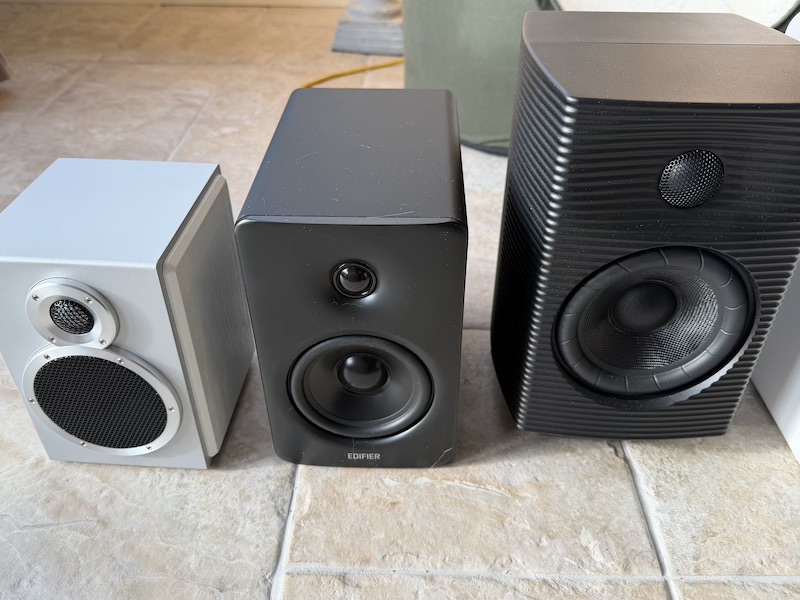
In the context of the broader desktop speaker landscape — including several larger and more expensive models that spent time on the same desk — the SP5 represents a genuinely compelling balance of features, size, and acoustic performance. Some of the comparison speakers are physically larger and more expensive; the SP5 holds its own in all respects except the very lowest bass extension, where physically larger cabinets will always have a natural advantage.
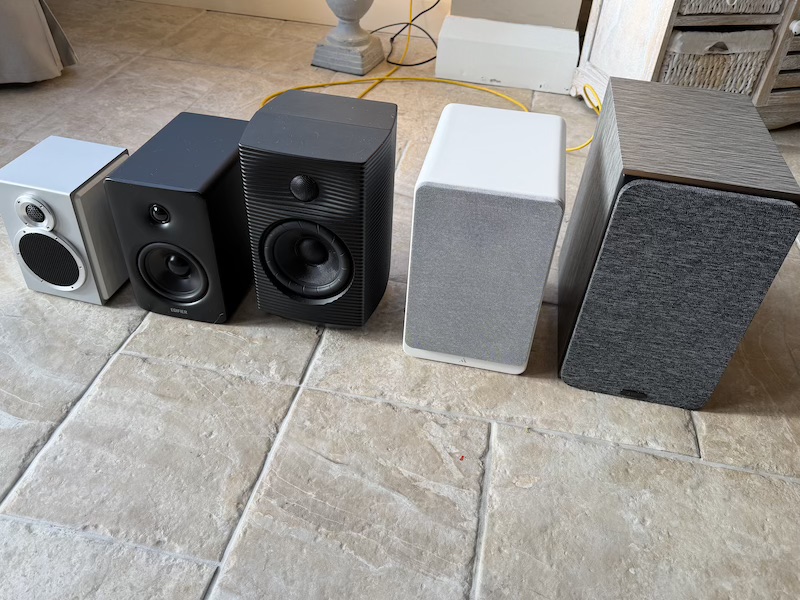
FiiO SP3 and FiiO SA1
The SP5’s most direct FiiO antecedent is the FiiO SP3, which I reviewed back in 2023 and found to be a likeable but limited desktop speaker — it earned a three-star pragmatic score, held back primarily by its measurement performance and modest low-end extension. The upgrade to the SP5 is substantial rather than incremental: the larger 5.25-inch driver and greater cabinet volume deliver meaningfully more sub-bass presence and dynamic headroom, the aluminum construction is a step-change in build quality, and the dual analog/digital processing architecture with proper XLR balanced connectivity makes the SP5 a categorically different proposition. If you own an SP3 and find yourself wanting more bass authority and professional connectivity, the SP5 is the natural upgrade path.
The FiiO SA1 occupies the opposite end of FiiO’s speaker range — a compact, budget-friendly near-field speaker that earned five pragmatic stars for what it achieves at its price. The SA1 is nimble, easy to place, and surprisingly capable, but it cannot compete with the SP5 in terms of bass extension, dynamic scale, or output power. What the SA1 does illustrate is how consistent FiiO’s design philosophy has become across the speaker range: app integration, PEQ on digital inputs, and thoughtful connectivity choices appear throughout the lineup. The SP5 is essentially the SA1’s philosophy executed at a higher level of ambition and without compromise on materials or driver quality.
Specifications and Measurements
| Specification | Detail |
|---|---|
| Model | SP5 |
| Product Type | Active desktop speakers |
| Driver — Woofer | 5.25-inch composite carbon fiber cone |
| Driver — Tweeter | 1-inch composite silk soft-dome |
| Output Power | Woofer 60W × 2, Tweeter 20W × 2 |
| Frequency Response | 65Hz–20kHz (standard); 50Hz–20kHz (extension enabled) |
| Max SPL | 104dB |
| Crossover | Active electronic two-way, 3.1kHz |
| Treble Adjustment | −2dB / 0dB / +2dB |
| Bass Adjustment | 0dB / +3dB / +6dB |
| Sub-bass Extension | 60Hz / 50Hz |
| Audio Inputs | XLR balanced, RCA, AUX, USB (up to 96kHz/24-bit), Bluetooth 5.1 |
| Bluetooth Codecs | SBC, AAC, aptX, aptX LL, aptX HD, LDAC, aptX Adaptive |
| Bluetooth Chip | QCC5125 |
| Cabinet | Die-cast liquid aluminum alloy |
| Acoustic Port | Horn-shaped, rear-firing bass reflex |
| Dimensions (each) | 170 × 185 × 280mm (W × D × H, including feet) |
| Weight (main speaker) | approx. 6.01kg |
| Color | Black / White |
For measurements I used a UMIK-1 calibrated microphone positioned to minimize early wall reflections and approximate the near-field desktop listening position as closely as practical.
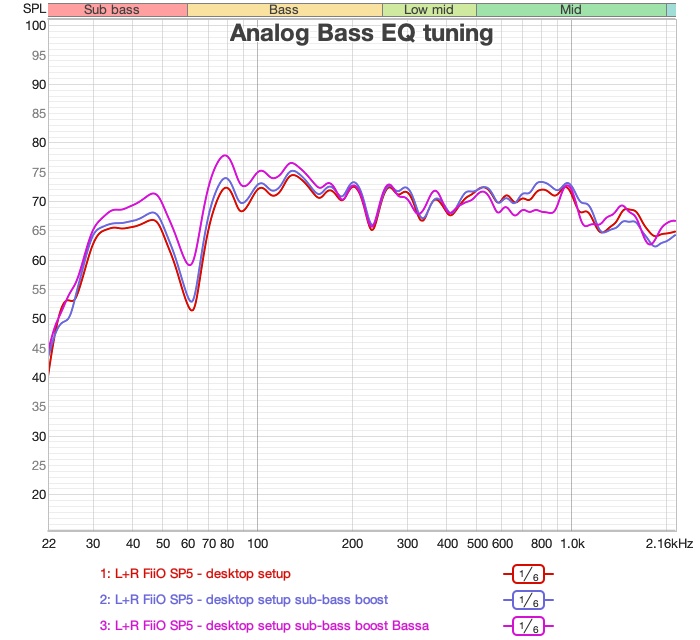
The baseline analog frequency response is clean and well-behaved across the midrange, with the expected roll-off beginning below 65Hz in standard mode.
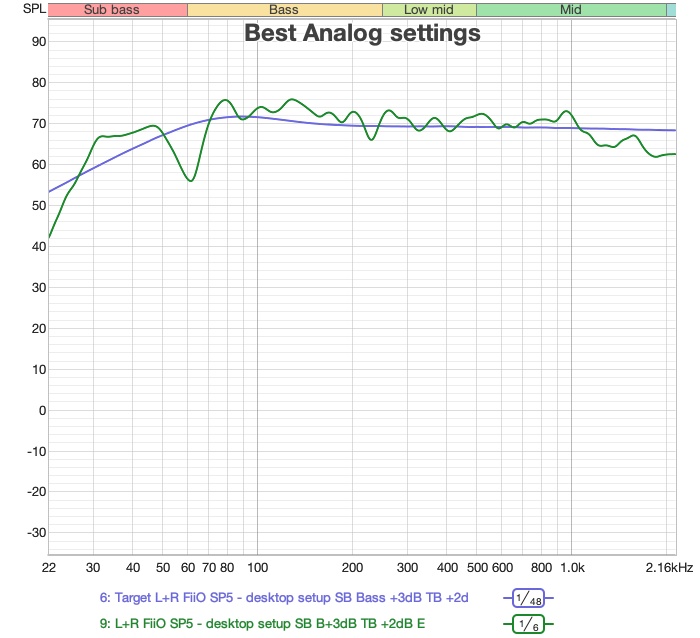
The analog treble adjustment works as advertised: the three-position switch moves the treble region by approximately 2dB in each direction without introducing narrowband resonances or phase artifacts, delivering a musically useful and measurement-clean adjustment.
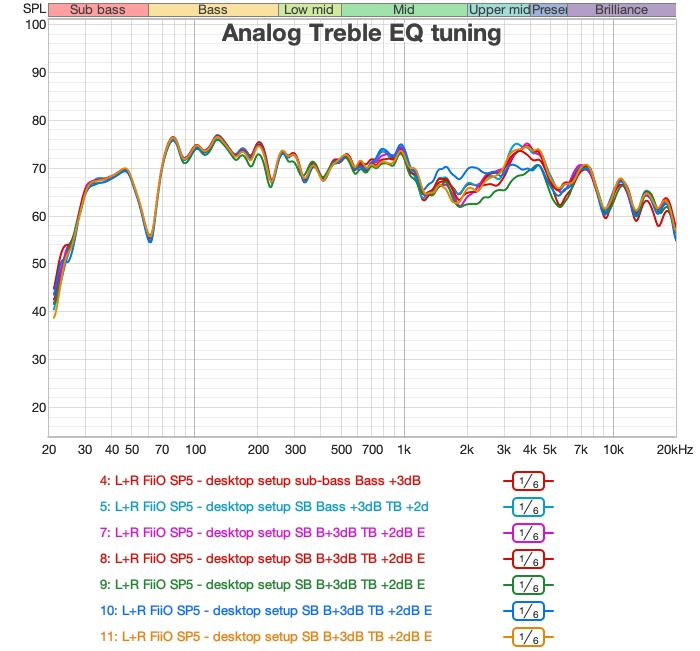
The bass adjustment is equally predictable. The +3dB and +6dB positions add a broad low-frequency shelf without inducing obvious port resonances within the measurement window. The 50Hz sub-bass extension mode adds worthwhile output below 60Hz at the cost of some port loading at very high playback levels.
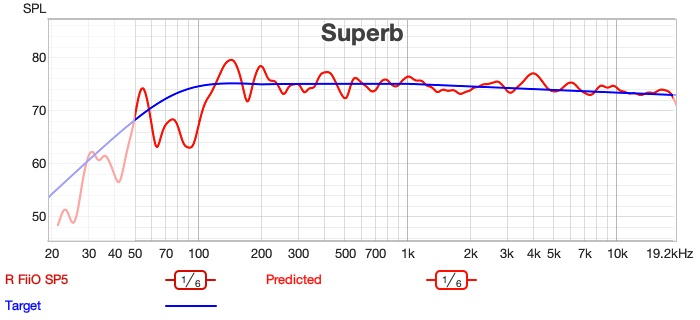
The in-room measurement confirms what the listening impressions suggest: the SP5’s response in a typical near-field desktop environment is already sufficiently well-balanced that aggressive EQ correction is not required. A gentle high-frequency shelf of around −1dB in the 10–15kHz region was all that was needed to hit the in-room target, and the PEQ on the digital inputs makes this a trivial adjustment.
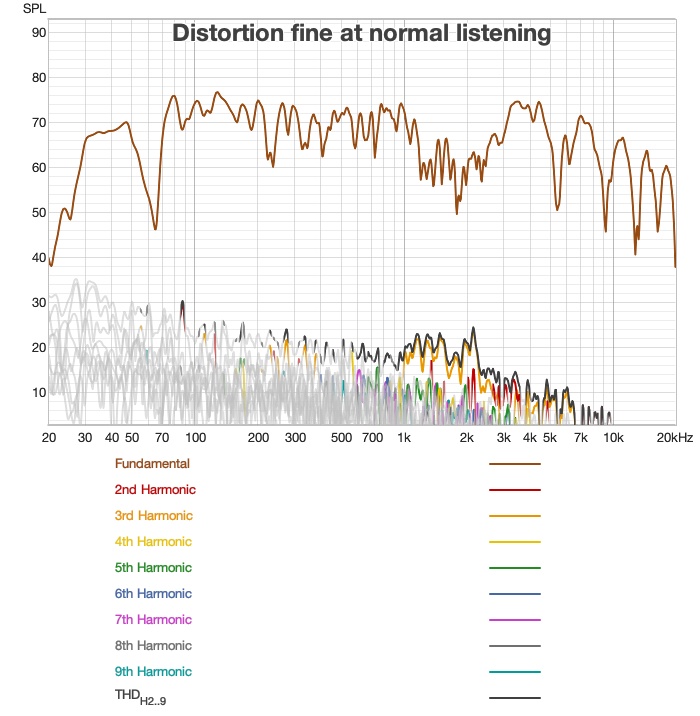
Distortion performance is reasonable and appropriate for a desktop speaker at this output capability and price.
Rating Explanation
The SP5 earns its four-star pragmatic rating by delivering on a genuinely ambitious design brief with very few obvious weaknesses. The aluminum cabinet construction is exceptional — you will not find this level of rigidity and finish in a powered desktop speaker anywhere near this price. The dual-processing architecture, combining hardware analog EQ for the studio and professional user with app-controlled parametric EQ for the digital listener, is a thoughtful solution to the challenge of serving two different audiences with a single product. The drivers perform beyond their price class, and the low-frequency extension — particularly with the 50Hz sub-bass mode engaged — is impressive for a 5.25-inch woofer in a cabinet of this volume. Measurements align closely with the listening experience: the response is honest, the distortion profile is appropriate, and the physical EQ controls operate without introducing measurement anomalies.
The deductions are equally clear. The absence of a subwoofer output is a genuine omission for a speaker at this price that will inevitably attract buyers who want to build a larger system around it. The dual-processing architecture, while powerful once understood, adds conceptual complexity to the setup process — recognising that XLR and RCA sources are handled differently from USB and Bluetooth sources, and that the analog EQ and the PEQ interact, requires careful reading of the manual before you can extract the best from the product. At $749 there is also meaningful competition from established studio monitor brands, though few of those competitors offer the same Bluetooth codec breadth or app-based PEQ integration alongside professional balanced connectivity.
The SP5 is for the near-field listener who wants the best possible result from a compact desktop footprint — whether that is an audio professional wanting XLR-connected studio reference monitoring, or an audiophile wanting Bluetooth LDAC streaming with parametric EQ precision. It is not the right choice if you need a dedicated subwoofer output or want a straightforward plug-and-play speaker without setup complexity.
Conclusion
A great all-round speaker for your desktop setup with pro-audio ambitions — that description turns out to be accurate. The SP5 resolves a genuine tension in the desktop speaker market: most products either target the studio professional with reference monitoring and professional connectivity but no consumer-friendly wireless, or target the consumer listener with Bluetooth and app control but no professional-grade analog inputs. The SP5 does both, and it does them with a build quality and driver performance that embarrasses much of the competition. The upgrade from the SP3 is substantial — this is a categorically different product, not a minor revision — and for near-field listening, whether at a work desk or in a small recording environment, the SP5 sets a high bar for what a $749 powered speaker pair can achieve. Buy it if you want the flexibility of a studio monitor and the convenience of a modern wireless desk speaker in a single, superbly built package.