Fosi Audio BT20A Max
Everything you should want in a modern desktop amplifier — with one compromise worth understanding
I have been following Fosi Audio’s progress through the Class D amplifier market for a few years now, and the BT20A Max is their most ambitious and feature-complete desktop amplifier to date.
You get Post-Filter Feedback (PFFB) for load-invariant linearity, a hardware High-Pass Filter (HPF) to protect bookshelf mains when crossing to a subwoofer, Bluetooth 6.0 with LDAC and aptX Lossless, a motorized volume potentiometer with remote control, dual RCA inputs, a 12V trigger, dedicated subwoofer output, better thermal management and tone controls with a bypass switch, so basically everything you can expect from a modern desktop class-D amplifier but, I guess the question is still does it sound good? Let’s find out.
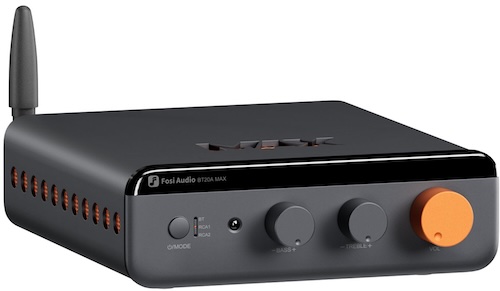
I would like to thank Fosi Audio for providing the BT20A Max for the purposes of this review.
If you are interested in finding more information about this product, you can find it at the official Fosi Audio product page, and on Amazon. There is often a discount voucher available on Amazon worth checking before you buy.
The BT20A Max typically retails for $279.99, or $299.99 with the bundled 48V 5A power supply.
After a month of listening across various different setups — a Fosi Audio SW10 subwoofer paired with Fosi Audio SP601 speakers, a SVS Ultra Evolution Bookshelf, and a KEF LS50 Meta with a KEF Kube 8 subwoofer — I feel I have a clear picture of whom this amplifier is for and, crucially, who might be better served elsewhere. In practical usage, almost all the features mentioned above hold up, though I feel there is one annoying ‘feature’ that might be a dealbreaker, that I will talk about later in the review.
But first let’s look at the unboxing experience.
Unboxing and Build Quality
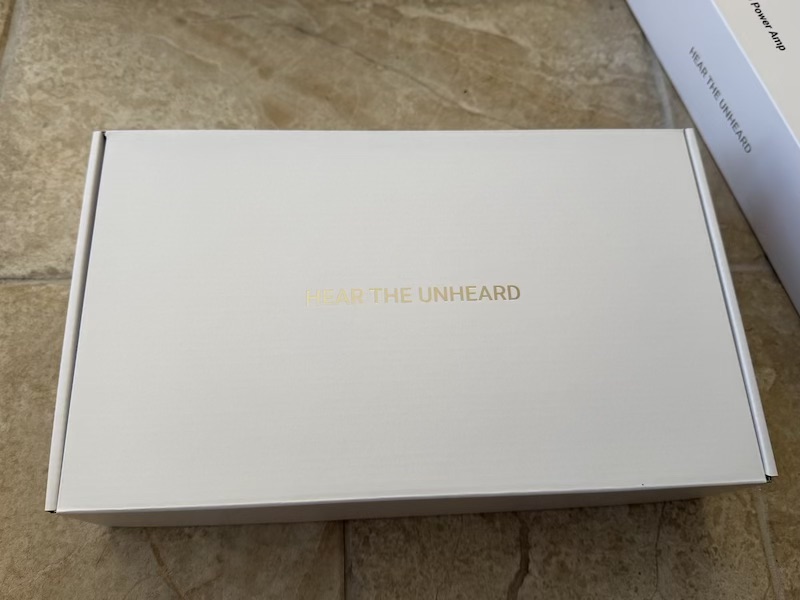
The BT20A Max arrives in solid, well-presented packaging that reflects Fosi Audio’s increasingly confident approach to product presentation.
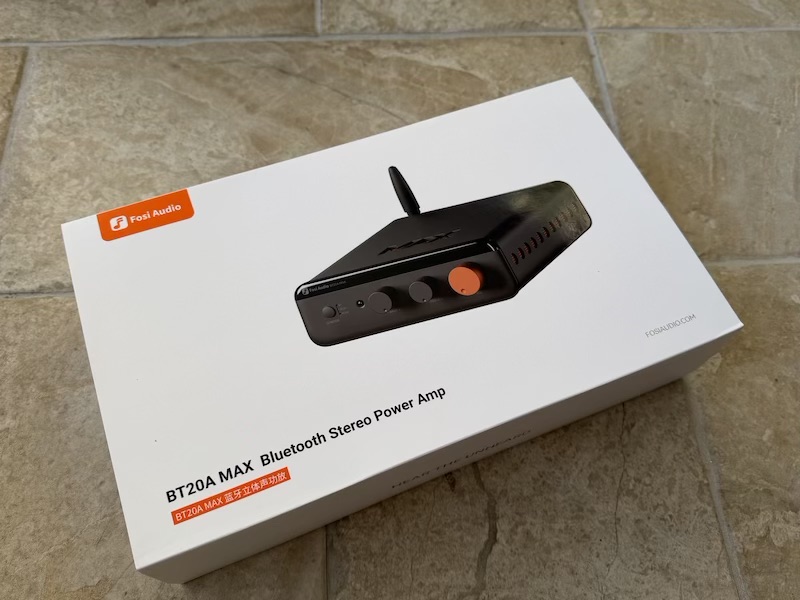
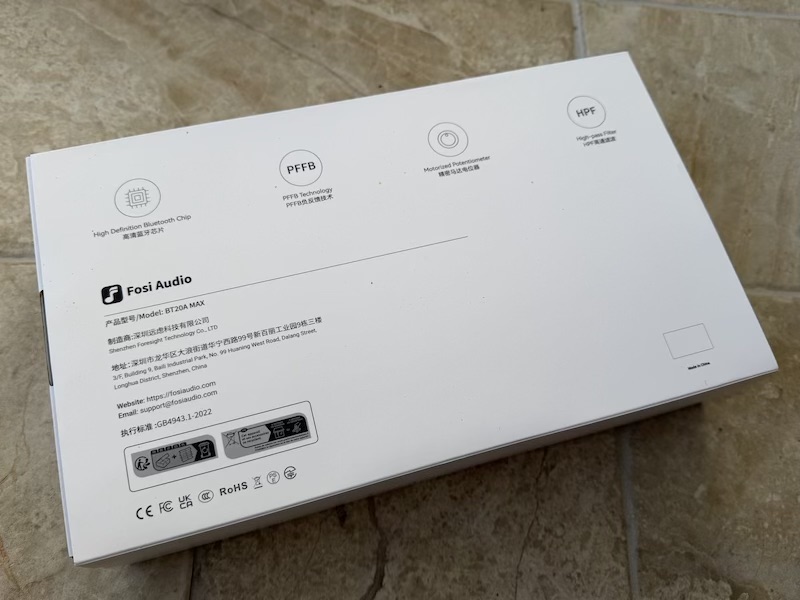
The rear of the box provides a useful overview of the key features and specifications:
Opening the box, the amplifier is presented cleanly and securely in form-fitted foam:
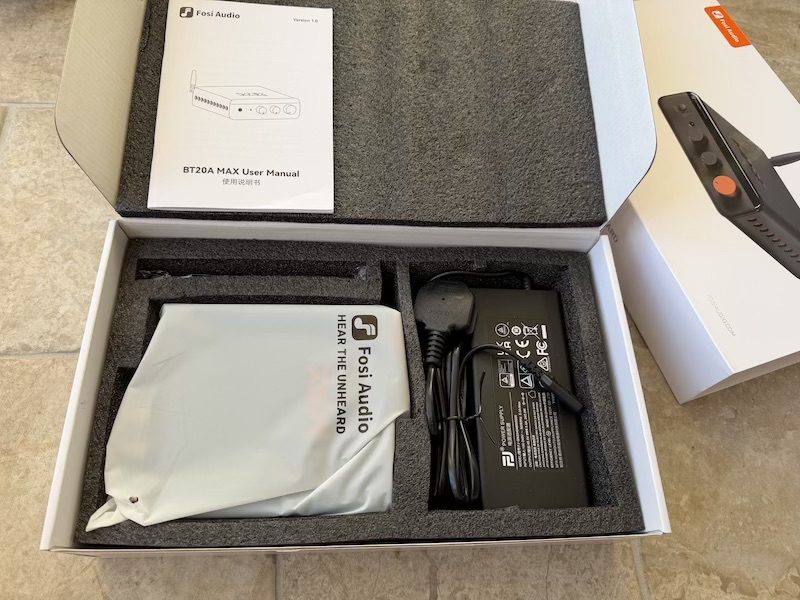
The inner packaging keeps everything organized and protected for shipping:
In the box you get the BT20A Max amplifier, Bluetooth antenna, remote control, power cable, and user manual. The 48V 5A power supply shown later in the review is included only with the $299.99 bundle, and I would strongly recommend opting for it — the headroom it provides makes a meaningful difference to output power at realistic listening levels.
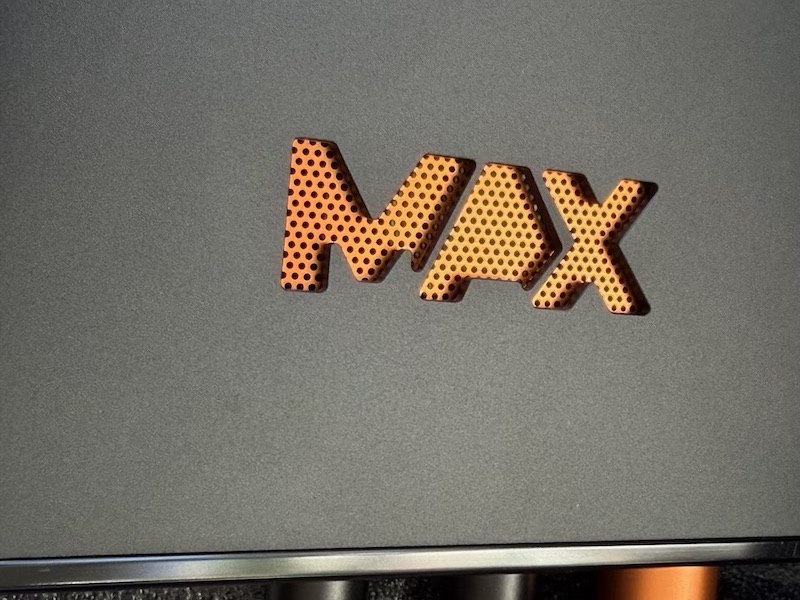
The chassis represents a notable improvement over Fosi Audio’s previous offerings, with satisfying heft and a more refined aesthetic approach. The unit has sufficient weight to resist being pulled around by heavy speaker cables — a practical consideration often overlooked in lighter amplifier designs. The finish is clean and purposeful, with attractive branding across the top:
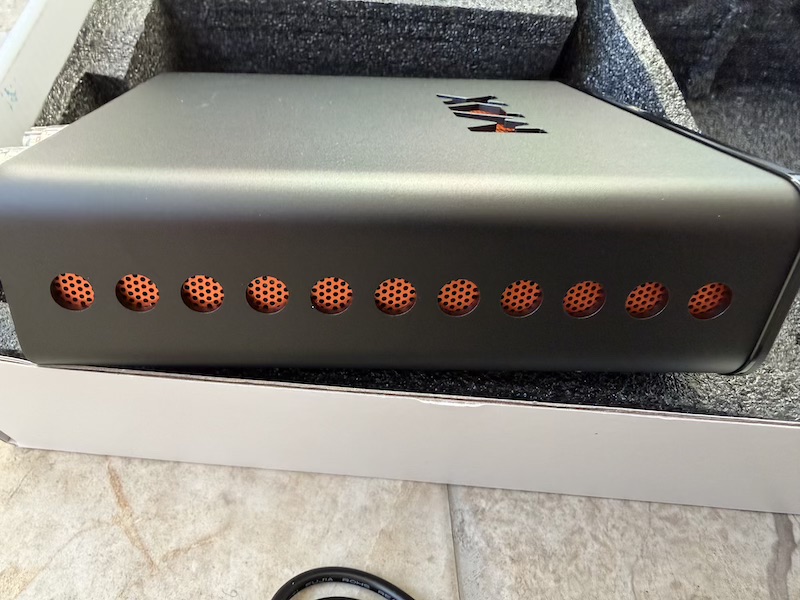
The speaker grilles carry Fosi Audio’s characteristic accent colours, and the overall build quality feels a clear step up from earlier Fosi amplifiers like the V3 Monos:
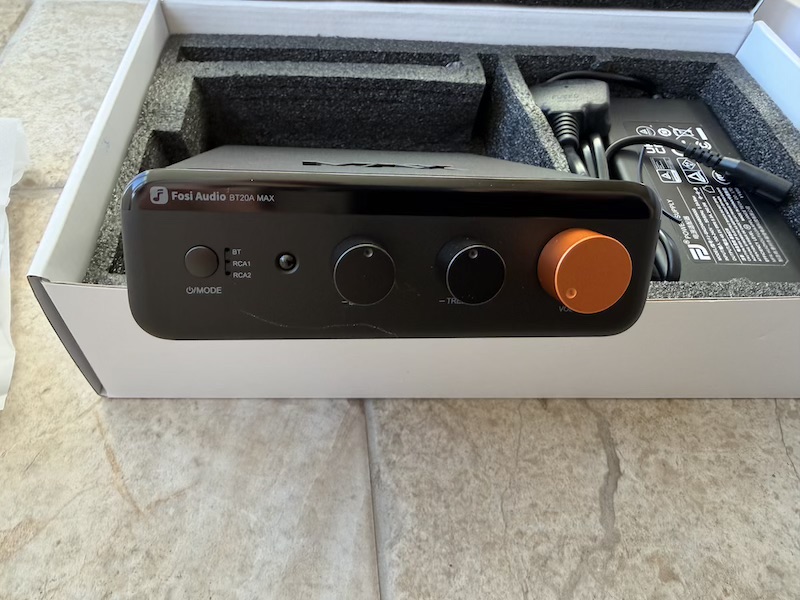
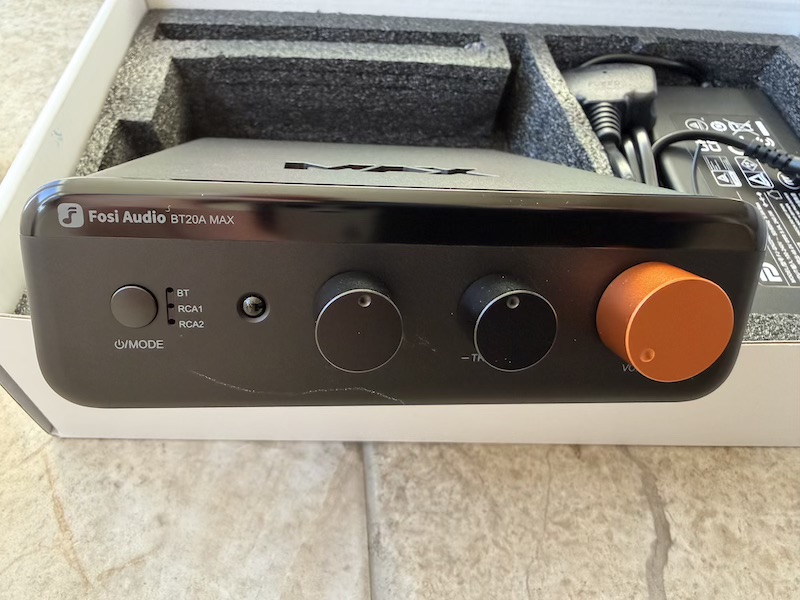
The front panel is clean and purposeful. The large motorized volume knob dominates the centre, flanked by input mode selection, the tone/bypass mode switch, and the bass and treble adjustment controls:
 |
 |
The rear panel is where the BT20A Max’s feature set becomes most apparent. Everything is clearly labelled and logically arranged:
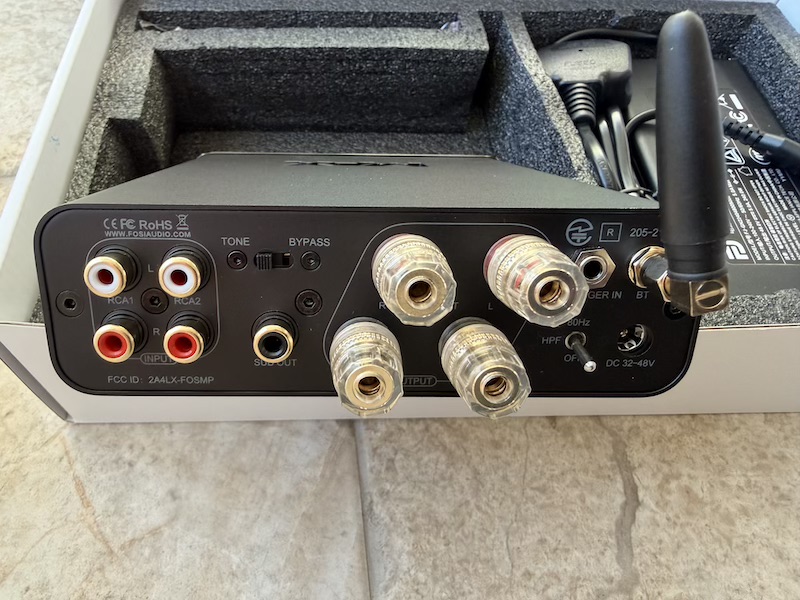
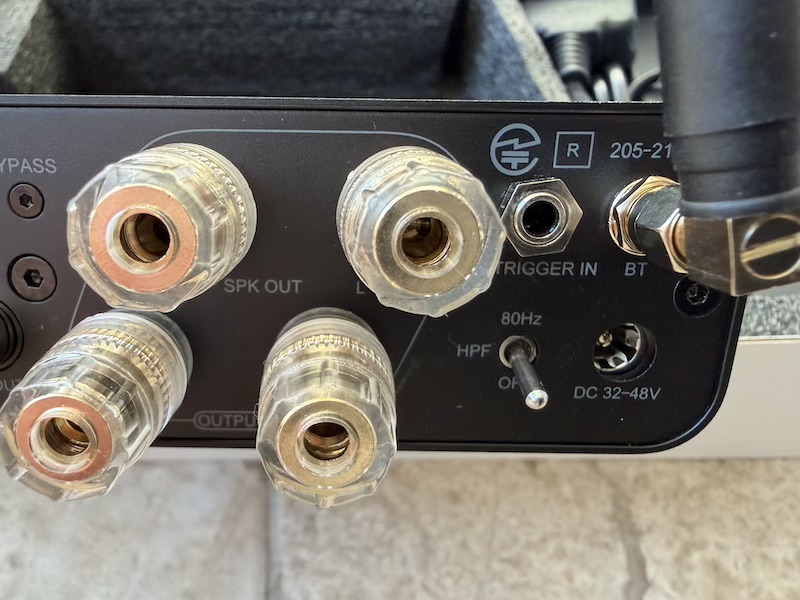
Looking at the upper half of the rear more closely, you will find the speaker binding posts (staggered for easier cable management — a practical detail I appreciate), the 12V trigger input, an 80Hz HPF switch, the Bluetooth antenna connector, and the power input:
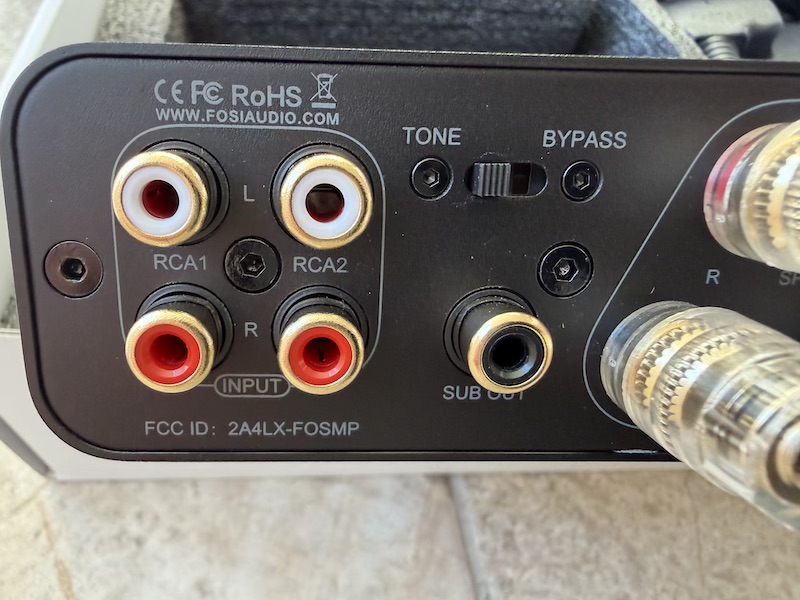
The lower section of the rear panel houses the dual RCA inputs, the tone bypass switch, and the dedicated subwoofer RCA output — making 2.1 integration genuinely straightforward:
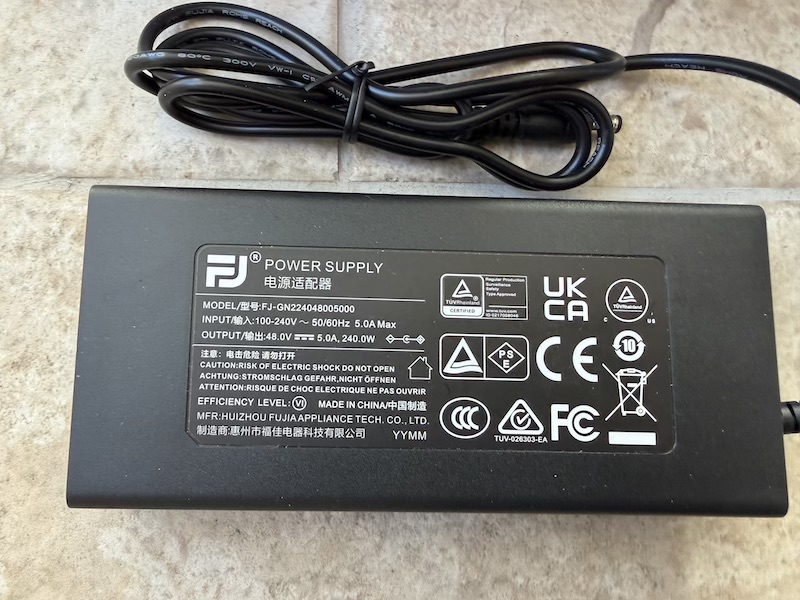
The 48V 5A power supply bundled with the top-tier version is a quality unit and I would recommend it over a generic supply for those serious about maximizing output power at this amplifier’s full rated capability:
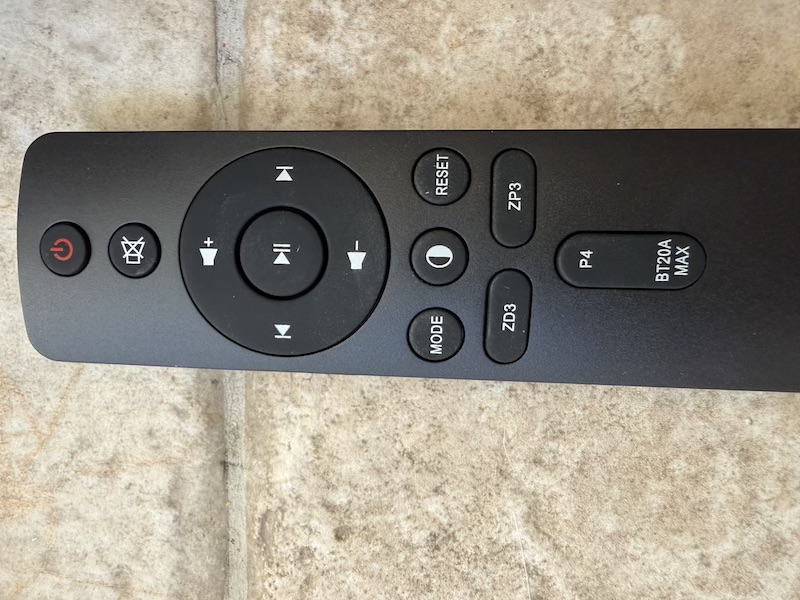
The remote control is fine in this price range, it is compact and well-organized, handling volume, input selection, and tone adjustments. The motorized volume knob on the front panel tracks the remote commands physically, which is satisfying in daily use and essential if the amplifier is hidden from sight:
Internal Architecture
One of the more interesting things Fosi Audio have done with the BT20A Max is their dual independent power supply design, which they illustrate in their own architecture diagram:
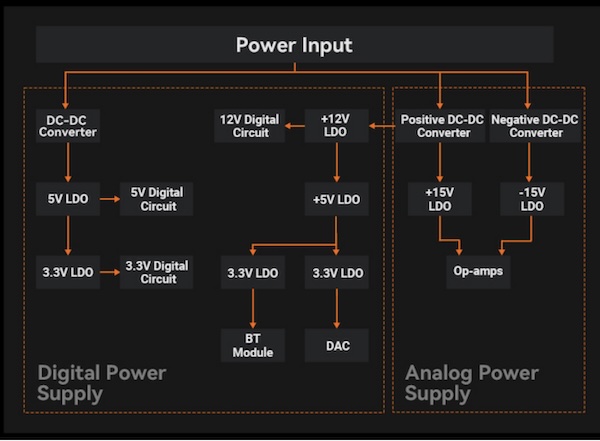
This diagram shows how the audio and control sections are fed by separate power rails — an approach that reduces crosstalk between the control circuitry and the audio path, and is one of the contributing factors to the BT20A Max’s strong measured performance. Beyond the dual supply, I appreciated the practical details: the staggered speaker binding posts, the hardware tone bypass switch that takes any DSP entirely out of the signal chain, and the dedicated subwoofer RCA output rather than a shared pre-out. These are small decisions that make the amplifier easier to live with day to day.
Features and Performance
I have reviewed a number of TPA3255 amplifiers over the past couple of years, and the pace of feature development has been rapid. The BT20A Max represents what I would call the current high-water mark for consumer-facing features in this category.
Post-Filter Feedback (PFFB) is now the expected baseline on a quality Class D amplifier, and the BT20A Max implements it correctly. By taking the feedback signal after the output filter, PFFB maintains a flat frequency response regardless of the speaker’s impedance curve — eliminating the treble rolloff that older Class D designs suffered with reactive loads. With my KEF LS50 Metas, which present a complex impedance to any amplifier, the BT20A Max delivered consistent, load-invariant tonality throughout testing.
The 80Hz High-Pass Filter is the feature I was most eager to use, particularly in the KEF LS50 Meta and KEF Kube 8 setup. Engaging the HPF removes low-frequency content from the main speaker output, letting the subwoofer handle bass duties and giving the LS50 Metas significantly more headroom and cleaner midbass presentation at higher volumes. Beyond the obvious headroom benefit, the 80Hz HPF also improves vocal and midrange clarity from the mains — with bass content removed from the signal path, the main speakers work less hard and the amplifier’s headroom for the midrange and treble increases noticeably. The 80Hz crossover point is a fixed selectable switch rather than a continuously adjustable dial — which contrasts with the Ampapa D1’s 30–200Hz adjustable range — but 80Hz is the right starting point for most bookshelf-plus-subwoofer pairings and will serve the majority of users without compromise. If you need fine-grained HPF control, the Ampapa D1 offers more flexibility; for most practical purposes, 80Hz is exactly where you want to be.
The dedicated subwoofer output is tied to the main volume control, allowing unified level adjustment across the entire system. The subwoofer signal begins rolling off around 80Hz, reaching full attenuation by approximately 150Hz — an appropriate low-pass characteristic for integrating with most powered subwoofers. One behavior worth noting: when the HPF switch is engaged, the subwoofer output exhibits a 4–5dB gain increase compared to when the HPF is disengaged, which may require recalibrating subwoofer level when toggling the HPF on or off.
Bluetooth 6.0 with LDAC, aptX Lossless, aptX Adaptive, aptX HD, and aptX via a Qualcomm QCC3095 chipset is the single largest feature leap over competitors at this price point. The Ampapa D1 offers Bluetooth 5.2 with aptX HD at best; the 3E Audio A7 has no Bluetooth at all. The QCC3095 supports streaming up to 24-bit/96kHz, meaning an LDAC-capable Android device or an aptX Lossless source can deliver genuinely high-resolution audio wirelessly — not merely “good enough for Bluetooth” but a legitimate hi-res path. Pairing was reliable and stable across both setups throughout testing.
The motorized volume potentiometer is one of those features that sounds like a gimmick until you live with it. The implementation is reliable and responsive — remote commands are tracked smoothly by the physical knob without lag or erratic behavior. Being able to adjust volume from across the room via the remote, and watching the knob physically track the adjustment, becomes part of the daily workflow quickly. Combined with the 12V trigger for synchronized power-on with a downstream source or streamer, the BT20A Max genuinely suits installations where the amplifier is tucked away in a cabinet and operated entirely by remote — which is precisely the use case Fosi Audio appear to have had in mind.
Tone controls with bypass round out the feature set. The ±10 dB bass and treble shelving controls offer a quick way to tune the system for room acoustics or personal preference. The tone knobs feature a center detent, making it straightforward to return them to the neutral position by feel alone — a thoughtful touch that matters when adjusting by hand. The dedicated bypass switch located on the rear panel takes the tone circuitry entirely out of the signal path when engaged, though it’s worth noting that the variable volume control remains active regardless of bypass state. I spent time in both modes: running tone controls in the SW10 and SP601 setup for some additional bass body, and bypassed with the KEF LS50 Metas where I wanted a transparent reference.
The Fan — the One Compromise
Fosi Audio describes the built-in fan as “silent,” and while it is quieter than you might expect, it sadly is audible if your room is otherwise silent even at a few feet distance. But for near-field desktop listening — which is how I spent a significant portion of my test time with the KEF LS50 Metas at arm’s length — I found the fan audible during quiet passages and between tracks. It is not a loud fan by any measure, but in a quiet room with speakers positioned close to the listening position, it is noticeable enough that I found myself preferring the passively cooled Ampapa D1 in that specific context.
But to be fair about this: the fan exists because managing heat in a 300W chassis is a genuine engineering challenge, and Fosi Audio are not hiding it. For a living room system, or an installation where the amplifier is in a cabinet at any meaningful distance from the listener, the fan will almost certainly be inaudible at the listening position. For near-field desktop listening in a quiet room, it is something to factor into your decision before purchase.
The single 12V trigger input does offer a practical solution to fan noise for users who commit to a single-source workflow. If you’re using a source device with trigger output — a WiiM Ultra being an ideal example — the trigger can power the amplifier on and off automatically, eliminating fan noise entirely when the system is idle. This works elegantly for single-input setups where the amplifier remains dedicated to one source. The limitation becomes apparent if you’re switching between multiple inputs regularly: with only one trigger input, you can’t achieve synchronized power control across different sources simultaneously, which reduces the trigger’s utility in multi-source configurations. For those who settle on a primary streaming device with trigger support, though, this feature effectively addresses the fan concern by keeping the amplifier powered down except when actively in use.
My Listening Setups
The BT20A Max found a home in two systems during my review period. The first paired it with a Fosi Audio SW10 subwoofer and Fosi Audio SP601 speakers — a natural ecosystem pairing that made good use of the dedicated subwoofer output and the 80Hz HPF. The second, and the more demanding of the two, was with my KEF LS50 Metas and KEF Kube 8 subwoofer, fed from a FiiO K17 via RCA and a WiiM Pro for streaming. I also evaluated it briefly with a pair of SVS Ultra Evolution bookshelf speakers, running both with and without subwoofer support. Across all three speaker pairings, the BT20A Max delivered confident, composed performance that scaled appropriately to the demands of each setup.
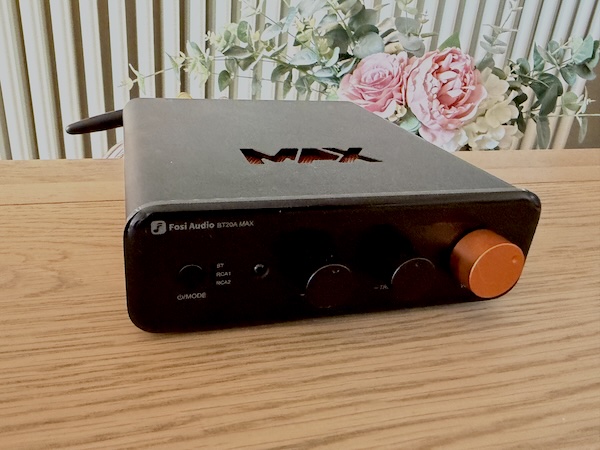
The BT20A Max looks handsome in either setup and a set up from the Ampapa D1 and even the 3E Audio A7. The build quality and the motorized knob give it a presence that feels appropriate alongside speakers at this level. For the cabinet installation use case that Fosi Audio clearly intend — where the amplifier is hidden and operated entirely by remote — this aesthetic polish still matters, because you know it is there even when no one else does.
Comparisons
Having spent time with the Ampapa D1 and the 3E Audio A7 in similar configurations, here is how the three amplifiers compare on features:
| Feature | Fosi Audio BT20A Max | Ampapa D1 | 3E Audio A7 |
|---|---|---|---|
| Chipset | TI TPA3255 + NE5532 | TI TPA3255 | 2× TI TPA3255 (PBTL) |
| PFFB | Yes | Yes | Yes |
| HPF | Yes (80Hz fixed switch) | Yes (30–200Hz adjustable) | No |
| Subwoofer output | Yes (dedicated RCA) | Yes (pre-out) | No |
| Balanced input | No | Yes (TRS) | Yes (XLR/TRS) |
| Inputs | Dual RCA + Bluetooth | RCA + TRS + Bluetooth | RCA + XLR/TRS |
| Bluetooth | BT 6.0 / LDAC / aptX Lossless | BT 5.2 / aptX HD | No |
| Tone controls | Yes (±10 dB, bypass switch) | Yes (±10 dB, bypass) | No |
| 12V Trigger | Yes | Yes | No |
| Remote / motorized pot | Yes (motorized pot) | Yes | No |
| Cooling | Fan-assisted | Passive | Passive (large heatsink) |
| Channels | 2.1 | 2.0 | 2.0 |
| SNR (rated) | ≥112 dB | ≥114 dB | ≥123 dB |
| THD+N (rated) | ≤0.003% | 0.002% | 0.0007% @ 4Ω |
| Max power @ 4Ω | 300W × 2 | 300W × 2 | 250W × 2 |
| Price | ~$280–$300 | ~$199 | ~€300 |
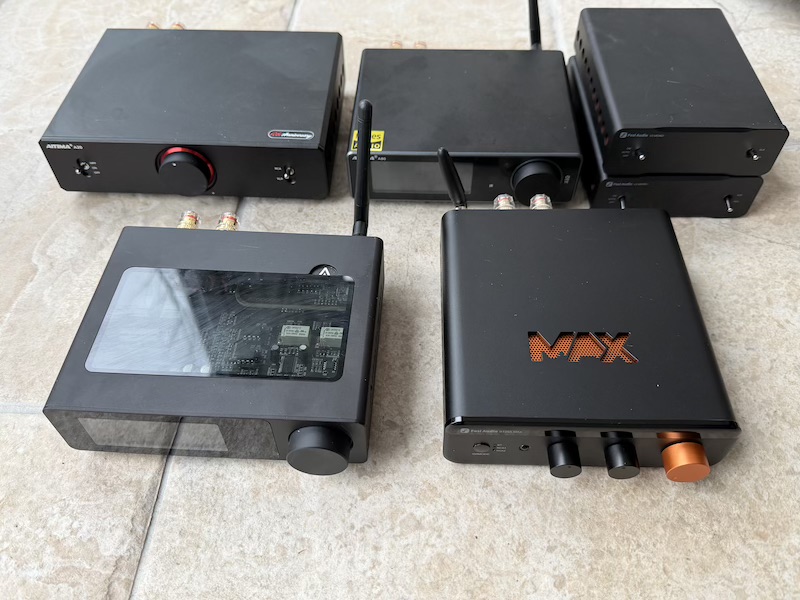
BT20A Max vs. Ampapa D1: These two amplifiers occupy similar feature territory but approach the 2.1 use case differently. The D1 offers a continuously adjustable HPF from 30–200Hz, a balanced TRS input, passive cooling that makes it the better choice for near-field desktop listening, and a lower entry price at around $199. The BT20A Max responds with Bluetooth 6.0 with LDAC and aptX Lossless (a substantial advantage over the D1’s aptX HD ceiling), a dedicated subwoofer RCA output, dual RCA inputs for two wired sources simultaneously, and the motorized potentiometer for remote volume operation. Build quality felt a step above the D1 to my hands. At roughly $ 80 more, the BT20A Max’s feature additions are real and meaningful — the decision comes down to how you intend to use the amplifier. Near-field, quiet-room desk listening with the amplifier in view? I preferred the D1. Living room system or hidden cabinet installation? The BT20A Max wins comfortably.
BT20A Max vs. 3E Audio A7: The A7 is the more technically accomplished amplifier by measured performance — SINAD 102dB versus 96dB, THD+N 0.0007% versus 0.001635% — achieved through a dual TPA3255 PBTL configuration with premium passive components including ELNA Silmic II capacitors and TDK film capacitors. But the A7 is a stripped-back, purist design: no Bluetooth, no remote, no HPF, no subwoofer output, no tone controls. For those prioritizing maximum measured transparency in a pure two-channel setup, the A7 is excellent and I did find it marginally more “technical” in character during A/B comparisons. For those building a 2.1 system, wanting high-resolution Bluetooth, or needing remote operation, the BT20A Max is the more practical and complete choice. With PFFB on both, the subjective sonic gap between them is very small in practice.
Sound Impressions
All of my critical listening was done with PFFB engaged and — depending on the setup — the 80Hz HPF active for the main speaker output. I fed the BT20A Max from a FiiO K17 via RCA for the KEF setup and from a WiiM Pro via RCA for the SP601 setup, with Bluetooth used for casual listening rather than critical evaluation. Both setups were run with the tone controls bypassed unless noted.
With tone controls defeated, the BT20A Max presents exactly what I have come to expect from a well-implemented PFFB Class D amplifier: a clean, flat, low-coloration presentation with good channel matching and a convincingly low noise floor at the listening position. It is a clear step up from the earlier Fosi Audio V3 Monos and incrementally ahead of Aiyima A20-class amplifiers, both of which show slightly less composure in the upper registers under reactive loads. Within the TPA3255 category with PFFB, though, I would describe the differences between the BT20A Max, the Ampapa D1, and the 3E Audio A7 as small — all three are genuinely good amplifiers, and the feature set matters more than residual sonic differences at this level.
Bass is controlled and authoritative, particularly with the HPF activated. Handing low-frequency content below 80Hz to the KEF Kube 8 freed the LS50 Metas noticeably — the BT20A Max’s bass-managed output sounded tight and well-timed, with no sense of the mains straining to reproduce content they were already relieved of. With the HPF off in the SP601 setup, sub-bass extension was adequate rather than exceptional for a large-room system, but appropriate for the desktop and small-room context this amplifier is designed for. Jennifer Warnes’ “Way Down Deep” is a reliable test of whether the low end has any bloom or one-note quality; through the BT20A Max with tone controls bypassed, it was clean and honest. Mid-bass articulation on Steely Dan’s “Aja” was satisfying — kick drum texture came through with the familiar bite of that recording intact.
Midrange is transparent and well-behaved with no obviously promoted frequencies. Vocals sit forward enough to feel engaged without crowding the mix. Elton John’s “Sweet Painted Lady” — a good test of piano weight and harmonic density — sounded full-bodied and natural through the LS50 Metas. On Dire Straits’ “Brothers in Arms,” Knopfler’s guitar had appropriate presence and the vocal settled naturally in the centre of the soundstage. Instrumental separation in complex arrangements was good; nothing felt masked or congested, and the note weight in the lower midrange was appropriate for acoustic instruments.
Treble is composed and extended without any of the old Class D glassiness that plagued earlier implementations. PFFB does the heavy lifting here, maintaining linearity regardless of speaker load. Eagles’ “Hotel California” in its acoustic version had fine-grain guitar pick attack and cymbal shimmer without edging into brightness. Sibilance was absent on recordings that did not already have it. On trickier material, the treble stayed out of the way and let the recording lead — exactly what you want from a component at this price.
Soundstage and imaging were solid and convincing, with the KEF LS50 Metas providing the spatial reference. Instrument placement was stable and predictable, with no channel imbalance issues across any listening session. Width felt accurate for a near-field setup, and depth cues on well-recorded material — Miles Davis’ “Kind of Blue” in hi-res — conveyed the intimate, close-miked character of that session faithfully. The BT20A Max did not add any artificial bloom or width to the presentation; what the recording contained, it reproduced.
Specifications and Measurements
| Specification | Value |
|---|---|
| Channels | 2.1 |
| Chipset | TI TPA3255, NE5532 |
| Max Output Power | 300W × 2 @ 4Ω |
| RMS Output Power | 180W × 2 @ 4Ω |
| Input | RCA1 / RCA2 / Bluetooth |
| Output | Speaker Out / Sub Out |
| SNR | ≥112 dB |
| THD+N | ≤0.003% |
| Terminal Impedance | 2–8Ω |
| Bluetooth SoC | Qualcomm QCC3095 |
| Bluetooth Version | 6.0 |
| Bluetooth Connection Range | ≤15 m (50 ft) |
| Bluetooth Audio Codecs | SBC / AAC / aptX / aptX HD / aptX Adaptive / aptX Lossless / LDAC |
| Frequency Response | 20 Hz–20 kHz (±0.5 dB) |
| Voltage Range | DC 32V–48V |
Measurements
Note: These are Fosi Audio’s Audio Precision THD+N and Sinad measurements:
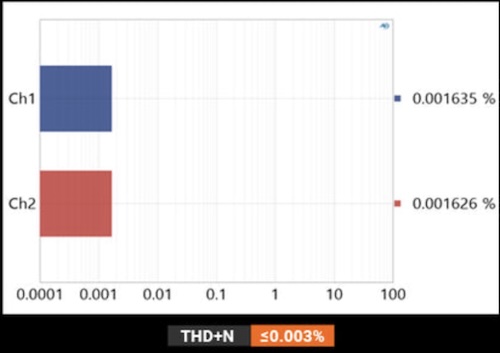 |
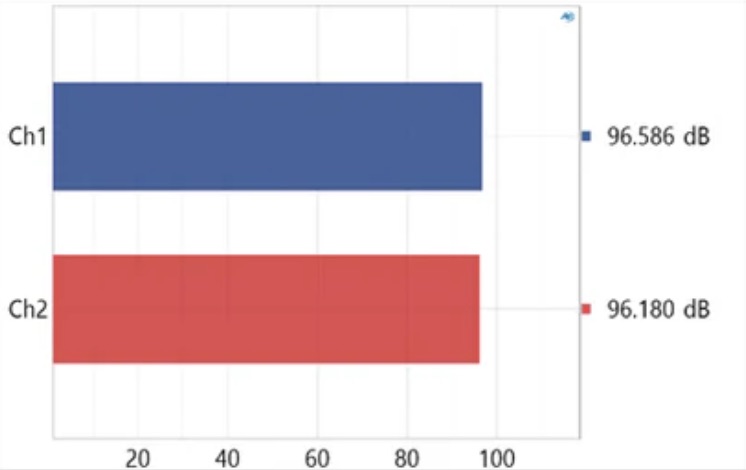 |
The corresponding SINAD of 96dB would place the BT20A Max firmly in the “Excellent” category on AudioScienceReview’s amplifier rankings — a result that reflects the dual independent power supply design and careful PFFB implementation. I look forward to seeing independent verification from AudioScienceReview when they review the BT20A Max — I will update this review when those measurements appear.
For now, the published figures are consistent with what I hear: an amplifier that measures cleanly and delivers on its technical promises. The 3E Audio A7 does measurably better at SINAD 102dB, but costs a similar amount and gives up most of the BT20A Max’s feature list to get there. For real-world listening, 96dB SINAD is well beyond what the rest of a typical signal chain or room acoustics will limit first.
Rating
The BT20A Max earns four stars because it delivers on nearly every promise in its spec sheet. The PFFB implementation is clean and effective. The Bluetooth 6.0 with LDAC and aptX Lossless support is genuinely the best wireless connectivity I have seen in a desktop amplifier at this price point. The HPF and dedicated subwoofer output make 2.1 integration straightforward. The motorized volume potentiometer and 12V trigger make it a natural fit for hidden or cabinet installations where the amplifier is controlled from a distance. The dual independent power supply contributes to strong measured performance. Build quality is the best I have seen from Fosi Audio to date. When you have PFFB, HPF, dual RCA inputs, and the full tone control and bypass infrastructure, you have every tool you need to achieve both a neutral reference sound and a room-tuned one.
The fourth star rather than fifth comes down entirely to the fan. For near-field desktop listening in a quiet room, the built-in cooling fan is audible, and that is a real limitation for a meaningful segment of users who will be sitting close to their speakers. Fosi Audio have made a rational engineering trade-off — managing heat in a 300W chassis is genuinely difficult without active cooling, and the fan does improve thermal performance by 30% over the previous BT20A Pro — and I understand why the decision was made, particularly given the BT20A Max’s clear positioning as a product suited for hidden installations. But for those intending to use it as an exposed desktop amplifier within a metre or so of the listening position, it is a factor worth weighing seriously before purchase.
Conclusion
The Fosi Audio BT20A Max is the company’s most accomplished amplifier to date. In a market where many TPA3255 amplifiers differ primarily in packaging and minor feature omissions, Fosi Audio have built something that genuinely stands apart: Bluetooth 6.0 with LDAC and aptX Lossless, a motorized potentiometer, dual RCA inputs, proper HPF with subwoofer output, PFFB, a dual independent power supply, 12V trigger, and a build quality step up from previous generations. It sounds excellent — better than the V3 Monos and the Aiyima A20-class alternatives, and competitive in every practical sense with the more technically pure 3E Audio A7.
If you want to hide your amplifier in a cabinet, drive it from a phone via LDAC Bluetooth, and integrate a subwoofer cleanly at 80Hz, the BT20A Max is the most complete solution in this price category right now. If you listen near-field at a desk in a quiet room and the amplifier will sit right next to you, the passively cooled Ampapa D1 at around $199 serves that use case more comfortably — and costs $80 less. Know your setup, and you will know which one is right for you.