WiiM Amp
A streaming integrated amplifier that turned the WiiM app into a whole system
The WiiM Amp takes everything the streamers do and adds a TPA3255 power amplifier, so a single compact box becomes a complete system — streaming, room correction, HDMI ARC for the TV, a subwoofer output, and enough power for most bookshelf and floorstanding speakers. Like the rest of the range, it is reviewed here as a long-term reference: the Amp I am writing about today has gained features since launch, and that trajectory is the point.
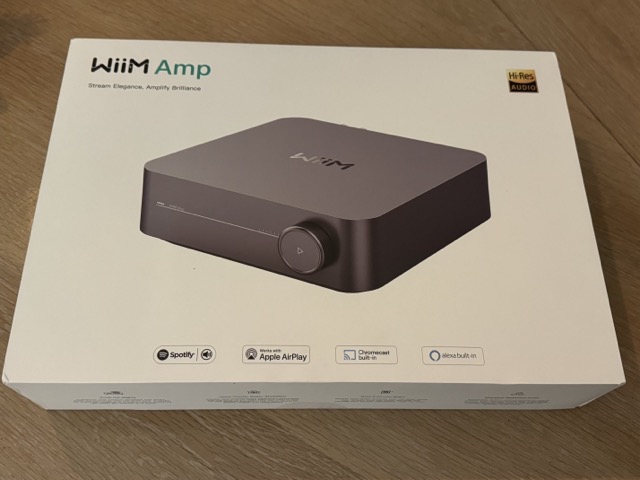
The unboxing alone signals intent — it is closer to opening an Apple product than a budget amplifier, with a classy box, a good remote and higher-quality cables included. But the real story is the same as every WiiM: the hardware is excellent for the money, and the software keeps making it better.
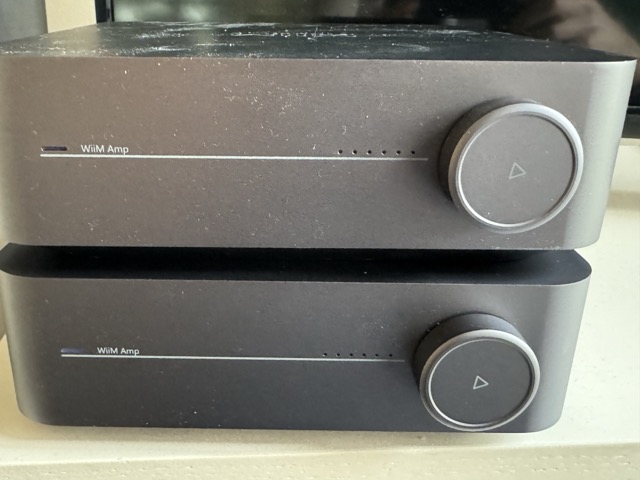
I would like to thank WiiM for providing the Amp for the purposes of this review.
If you are interested in finding more information about this product, you can find it at the official WiiM product page.
The WiiM Amp typically retails for around £299 / $299.
Software and the WiiM App — a story of constant improvement
As with the rest of the WiiM range covered on this site, this is a long-term usage review rather than a launch-day writeup, and the Amp has kept surprising me in the same way its siblings do — real, usage-changing features showing up long after I’d already formed an opinion of the device. As with every WiiM device, the hardware is only half the product. The WiiM Home app and the firmware are the other half, and both have improved continuously since launch — so a WiiM Amp bought a while ago does more today than it did on day one. That is exactly why this is framed as a living reference rather than a fixed snapshot.
On the Amp specifically, the app is what turns it from “an amplifier” into “a system”: multi-room, a deep set of streaming services, parametric EQ, room correction, and subwoofer/crossover management are all handled there, and they keep improving. The WiiM app is one of the most solid and feature-complete control apps in streaming audio, full stop.
The Amp launched in late 2023 as a streaming box with a power stage bolted on; the feature set today looks like a different product. Roon Ready certification landed in March 2024, turning it from an app-only device into a proper Roon endpoint. Through 2024 it picked up the 10-band Parametric EQ shared across the range, per-source EQ so HDMI ARC and network streaming can be tuned independently, and Room Correction with subwoofer bypass and full-range output options — genuinely useful given the Amp’s own sub output and crossover. By 2025 that room-correction flow had grown into RoomFit, with independent left/right channel tuning and support for multiple measurement passes.
None of the room correction, per-source EQ or Roon certification existed when the Amp shipped — it arrived because WiiM kept developing the software long after the sale.
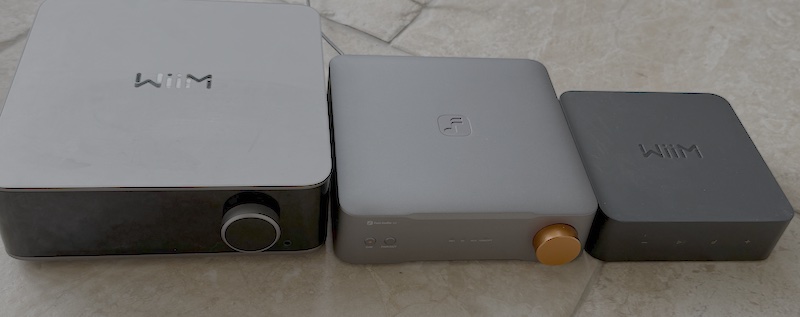
It is the clearest contrast with a rival like the Fosi Audio S3 — good hardware, but software still finding its feet. Side by side the maturity gap is obvious:
What’s in the Box
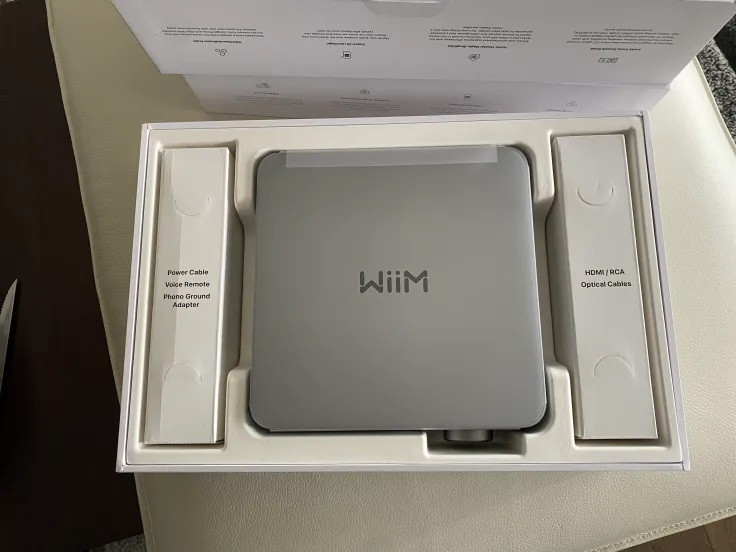
The unboxing sets a high standard — a substantial, classy box with a slow-release lid, the Amp itself, a remote identical to the other WiiM devices, and higher-quality power, RCA and HDMI cables. The attention to detail hints at the premium experience the Amp aims to deliver.
 |
 |
Setup and Use
Setup is straightforward through the WiiM Home app — connect to Wi-Fi, update the firmware, and you are running. It ships with a Squeezelite client and sensible power management. The main ergonomic gripe is the absence of a physical on/off switch, which a few users will miss.
USB media
The Amp can act as a basic UPnP server from its USB port. A small flash drive is handled easily; larger external HDDs can hit power limits and need a powered Y-cable, but it will eventually index a large library from an external SSD. As a casual, ad-hoc media server it is fine rather than a NAS replacement.
Sound Impressions
The Amp is eminently listenable, and the TPA3255 gives it real power for the price. With both modest and higher-quality speakers it performs well above expectations, though at higher volumes it can sound slightly glassier than far more expensive amplifiers — which is exactly the kind of compromise you accept happily at this price.
Subwoofer and HDMI ARC
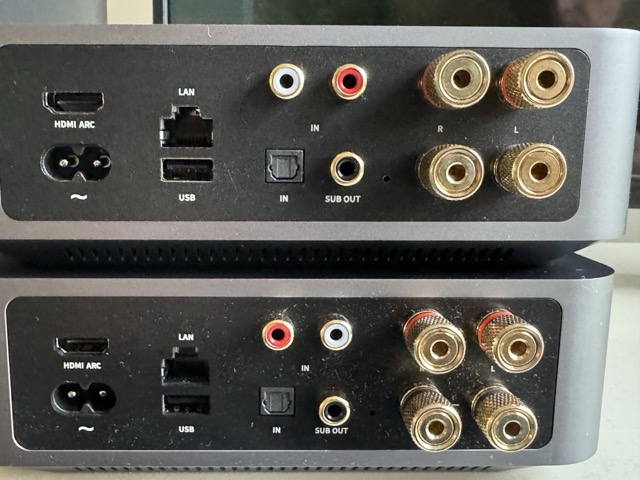
The subwoofer output and crossover settings are genuinely useful for building a small system, and the HDMI ARC input makes it a tidy TV-audio solution — with the usual caveats around audio-format support and input-switching times. The rear panel shows just how much is packed in:
Specifications
| Specification | Value |
|---|---|
| Amplifier | TI TPA3255 Class D |
| Power output | 2×100W into 4Ω, 2×60W into 8Ω |
| DAC | ESS ES9018K2M |
| SINAD (ASR, HDMI ARC in, ~5W/4Ω) | 89.5 dB (Ch1) / 87.6 dB (Ch2) |
| THD+N (HDMI ARC in, ~5W) | 0.0034% (Ch1) / 0.0042% (Ch2) |
| Power output (ASR-verified) | 120W into 4Ω, 60W into 8Ω |
| Wireless | Dual-band Wi-Fi, Bluetooth 5.0 (bidirectional) |
| Streaming | AirPlay 2, Chromecast, Spotify Connect, DLNA, Roon Ready |
| Inputs | HDMI ARC, optical, USB, RCA line in |
| Outputs | Speaker terminals, subwoofer out |
| Room correction | RoomFit, per-source PEQ |
| Made by | Linkplay Technology |
Measurements
The Amp’s amplifier section has not changed since launch — firmware improves the streaming and room-correction layer, not the TPA3255 output stage — but it is worth knowing exactly what that stage measures, and for that I am leaning entirely on Amir’s bench work rather than guessing. My thanks to Amir at Audio Science Review for the Audio Precision measurements below — this is the review to go to for the full picture, including load-dependency and multitone results that go well beyond what I can test at home.
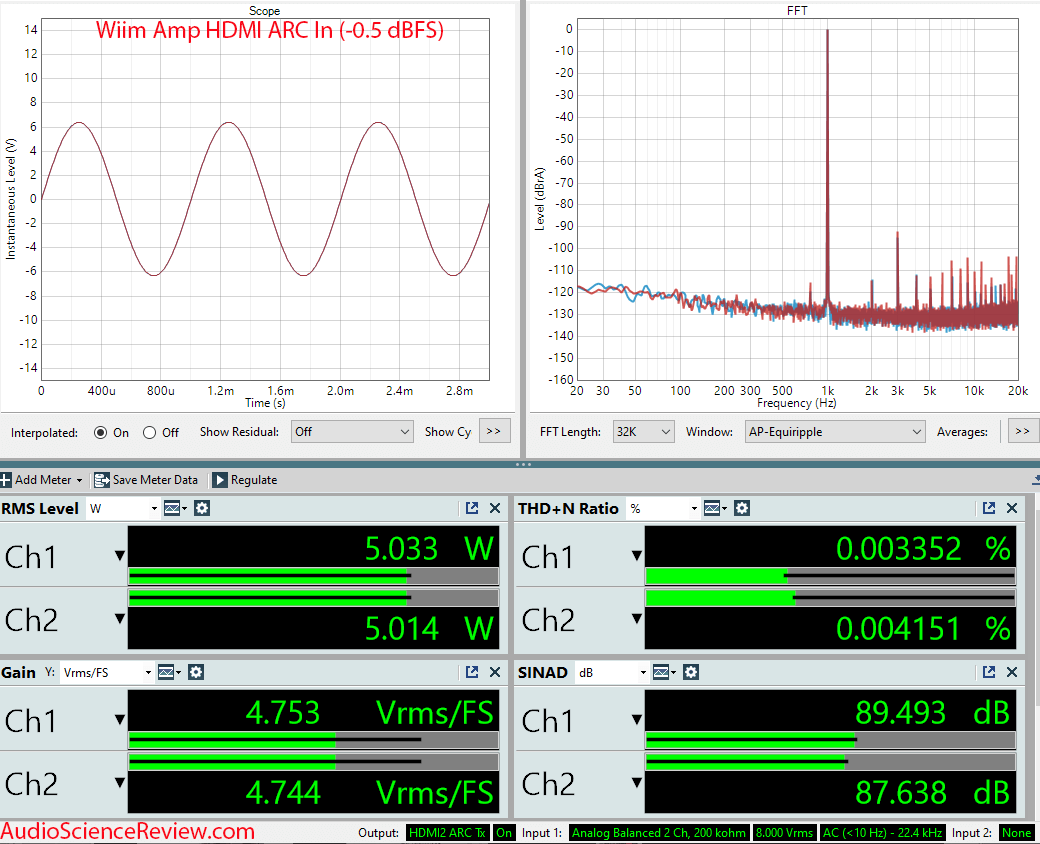
Driving the HDMI ARC input at roughly 5W into 4Ω, Amir measured 89.5 dB SINAD on channel 1 and 87.6 dB on channel 2, with THD+N of 0.0034% and 0.0042% respectively — clean, competent numbers rather than class-leading ones, and entirely consistent with what I hear at sensible listening levels. Power output matched WiiM’s own claims, at 120W into 4Ω and 60W into 8Ω. The one design limitation Amir flagged is a degree of frequency-response load-dependency that is common to lower-cost Class D designs, along with weaker crosstalk on the analogue input than on digital — his verdict was still that the Amp is “a very well executed streaming, multi-room amplifier” that “easily plays against big boys of streaming,” and it made his recommended list. WiiM’s newer Amp Pro and Amp Ultra siblings measure meaningfully better again thanks to post-filter feedback (PFFB), but that is a hardware change in the newer models rather than something firmware could bring to this one.
Rating Explanation
The Pragmatic Rating of 5 reflects how much system the Amp delivers in one box: streaming, room correction, HDMI ARC, a subwoofer output and a capable TPA3255 amplifier, all driven by the excellent WiiM app and improved continuously through firmware. The Features rating of 5 is easy to justify given everything it folds in. The Price rating of 4 acknowledges £299/$299 is a real outlay, even if it is strong value, and the Measurements rating reflects clean, capable amplification that stops just short of the very best.
Conclusion
The WiiM Amp is one of the most compelling single-box systems around: stylish, easy to set up, genuinely powerful for the money, and — crucially — anchored by the same continually-improving WiiM software that defines the range. It can serve as a primary system or a superb secondary one, and like the rest of the WiiM lineup it has only gotten better since launch.