WiiM Ultra
The flagship WiiM — a touchscreen streamer that became my everyday reference source
The WiiM Ultra is the top of the range and, for me, the most-used WiiM of all. It pairs an ES9038Q2M DAC with a 3.5" colour touchscreen, a full set of analogue and digital I/O — including a moving-magnet phono input, HDMI ARC, optical in/out, coaxial and a subwoofer output — and the same WiiM Home app that ties the whole ecosystem together. Like the rest of the range, it is reviewed here as a long-term reference rather than a launch snapshot, because the story is one of steady improvement.
In practice the Ultra has become my default digital source and album-art viewer — it appears in the system behind almost every review I publish, feeding a DAC or amplifier while its touchscreen shows the now-playing artwork, VU meters and metadata. That daily, across-the-board use is exactly why it earns a long-term write-up rather than a quick verdict.
I would like to thank WiiM for providing the Ultra for the purposes of this review.
If you are interested in finding more information about this product, you can find it at the official WiiM product page.
The WiiM Ultra typically retails for around $329.
Software and the WiiM App — a story of constant improvement
This is, like the rest of the WiiM range on this site, a long-term usage review rather than a launch-week snapshot, and the Ultra is the one that has surprised me the most — I did not expect a flagship I already rated highly at launch to keep earning that rating in new ways years later. As with every WiiM device, the hardware is only half the product — the WiiM Home app and the firmware are the other half, and both have improved continuously since launch. A WiiM Ultra is a more capable device today than it was on day one, which is exactly why these reviews are framed as living references.
On the Ultra the software story has an extra dimension: the colour touchscreen. Beyond the app’s multi-room, deep streaming-service support, parametric EQ and room correction, the on-device screen has gained album-art display, VU meters and spectrum views — and it is genuinely useful as a glanceable now-playing display in a rack. The WiiM app remains one of the most solid and feature-complete control apps in streaming audio, and the Ultra is its fullest hardware expression.
The Ultra launched in Q3 2024 already well specified, and firmware has kept adding to it rather than letting it sit. Roon Ready certification followed launch, turning the touchscreen streamer into a proper Roon core endpoint rather than an app-only device. Through late 2024 it gained Room Correction with independent left/right channel tuning and multiple measurement passes, plus audio de-noising specific to the Ultra’s phono/line inputs. By 2025 that had grown into full RoomFit, stacked so PEQ and room correction can run together rather than replacing one another, alongside a dedicated Headphone EQ profile for the front-panel output and subwoofer calibration that automatically aligns level and timing with the main speakers. The touchscreen itself has also picked up refinements along the way — additional VU meter and now-playing display options that were not part of the original release.
None of that — Roon Ready, RoomFit, the headphone EQ, or the subwoofer calibration — was present when the Ultra shipped; it is the clearest example in the range of a flagship that has kept earning its price after the sale.
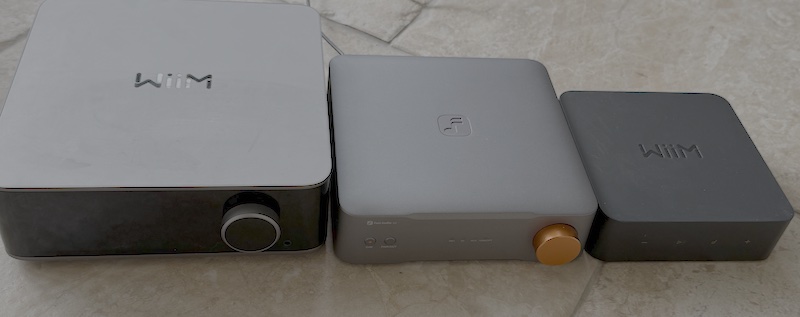
That continual-improvement story is the clearest contrast with a rival like the Fosi Audio S3 — a streamer with genuinely good hardware but software that, for now, is still finding its feet. Side by side, the maturity gap is obvious:
What’s in the Box
The Ultra ships with the unit itself, a Bluetooth voice remote, an AC power cable, an HDMI cable, RCA and optical audio cables, a phono ground adapter, and a quick-start guide — everything needed to connect it to a full system, including a turntable, without a trip to the cable drawer.
Build Quality and the Touchscreen
The Ultra is the most substantial and premium-feeling device in the range, with a metal chassis and the 3.5" colour touchscreen dominating the front. The screen is the headline: responsive, bright, and configurable to show album art, VU meters or a spectrum display, it makes the Ultra as much a piece of system furniture as a source.
Features and Connections
The Ultra has the most complete I/O in the range. Inputs include HDMI ARC, optical, line in and a moving-magnet phono input; outputs include RCA line out, optical and coaxial digital, and a subwoofer output. Add Wi-Fi, wired Ethernet, AirPlay 2, Chromecast, Bluetooth and the full set of streaming services, and it can sit at the centre of almost any system. The ES9038Q2M DAC and the app’s PEQ and room correction make it a genuinely capable standalone source, not just a streamer feeding something else.
Sound Impressions
As my everyday source the Ultra has been transparent and reliable through its analogue RCA output — the ES9038Q2M gives a clean, neutral presentation with no obvious character of its own, which is exactly what you want from a device that spends most of its life feeding other equipment rather than being the last link in the chain. Used as a pure digital transport into an external DAC it is just as unremarkable in the best sense: whatever character you hear downstream is coming from the DAC, not the Ultra. The one area I would not lean on is the front-panel headphone output — usable in a pinch, but with enough output impedance that it is not where I would go for serious headphone listening.
Specifications
| Specification | Value |
|---|---|
| DAC | ESS ES9038Q2M |
| Headphone amp | TPA6120A2 |
| SINAD (ASR, analogue RCA) | ~115 dB |
| Dynamic range | Excellent — among ASR’s best-performing DACs |
| Wireless | Wi-Fi 6E, Bluetooth 5.3 (SBC/AAC only, no LDAC) |
| Display | 3.5" colour touchscreen |
| Inputs | HDMI ARC, optical, coaxial, RCA line in, MM phono |
| Outputs | RCA line out, optical, coaxial, subwoofer out, headphone (3.5mm) |
| Streaming | AirPlay 2, Chromecast, Spotify Connect, DLNA, Roon Ready |
| Room correction | RoomFit (stacked with PEQ) |
| Price at launch | $329 |
| Made by | Linkplay Technology |
Measurements
ASR’s September 2024 review measured the Ultra streaming into its line/RCA output at around 115 dB SINAD, with excellent dynamic range and perfect linearity:
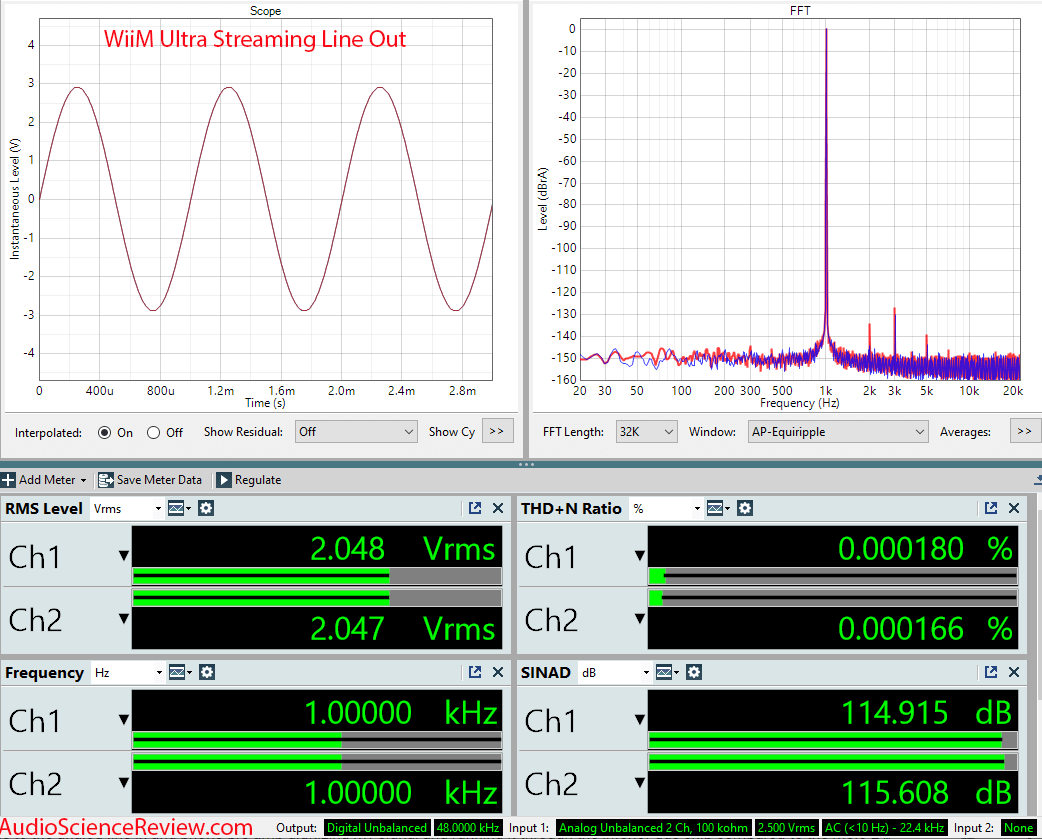
Amir’s conclusion was that it “easily makes way for itself among our very competent DACs, obviating the need to use an external one,” which matches how I actually use it — the Ultra’s internal DAC is good enough that I trust its analogue output directly rather than routing it through an external DAC. Two caveats are worth flagging for anyone chasing the last word in performance: THD+N at 48kHz sample rate is comparatively weak (a noise-shaping artifact of the ESS chip that clears up at higher sample rates), and there is no digital filter option to tune around it. The phono stage’s noise floor is elevated, more so in MC mode than MM, and Bluetooth is limited to SBC and AAC with no LDAC support. None of that changes the headline result — the digital and analogue line-level path is genuinely excellent — but they are the specific areas firmware has not been able to fix, because they are baked into the hardware and codec licensing rather than software.
Rating Explanation
The Pragmatic Rating of 5 reflects a device that has become the hub of my listening — the most complete WiiM, with the best DAC, the fullest I/O, and a touchscreen that earns its place as a now-playing display. The Features rating of 5 is straightforward given the connectivity, phono input and screen. The Price rating of 4 acknowledges that at around $329 it is the most expensive WiiM, even if it is strong value for everything it includes, and the Measurements rating reflects a clean, capable output from the ES9038Q2M.
Conclusion
The WiiM Ultra is the flagship that justifies its place by sheer usefulness: it is the source I reach for first, the album-art display in my rack, and the most complete expression of the WiiM ecosystem. Like every WiiM, it has improved steadily through firmware since launch — and as the device I rely on across almost every review, it is the easiest in the range for me to recommend to anyone who wants one box to do everything.