CMF Headphone Pro (by Nothing)
Comfort, design, and value — with one big caveat
After spending a lot of time with the Nothing Headphone (1), I was curious to see how the CMF Headphone Pro stacks up. The short version: I actually prefer wearing the CMF Pro — it’s more comfortable for long sessions, looks great, and the price is extremely compelling under €100.
What holds it back from a 5‑star recommendation is EQ. The built‑in presets are acceptable but not great, and the custom EQ gives you just three bands. Without proper PEQ, it’s harder to dial in precise corrections compared with its bigger brother. If CMF/Nothing adds full PEQ in a future update, this would be dangerously close to “best in class” for value.
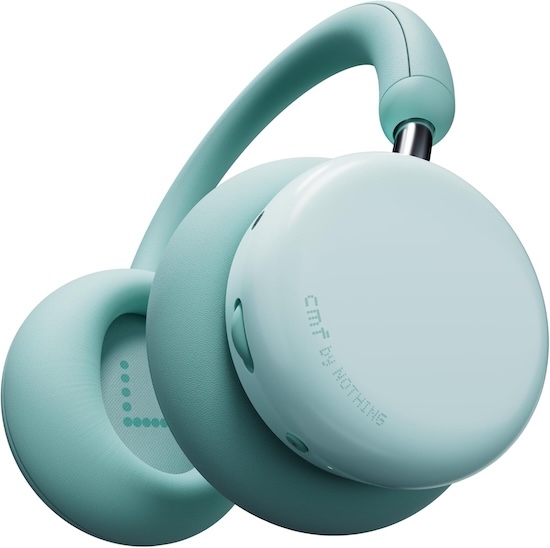
Disclosure: I bought the CMF Headphone Pro myself on Amazon for about €90 with a discount.
Purchase link: Amazon.de product page
Official info: CMF Headphone Pro product page
I’ve spent the past couple of weeks using the CMF Headphone Pro at home, outdoors, and on commutes. I really like these headphones overall, but I do have a few niggles I’ll point out along the way. First, let’s get the unboxing out of the way.
Unboxing and first impressions
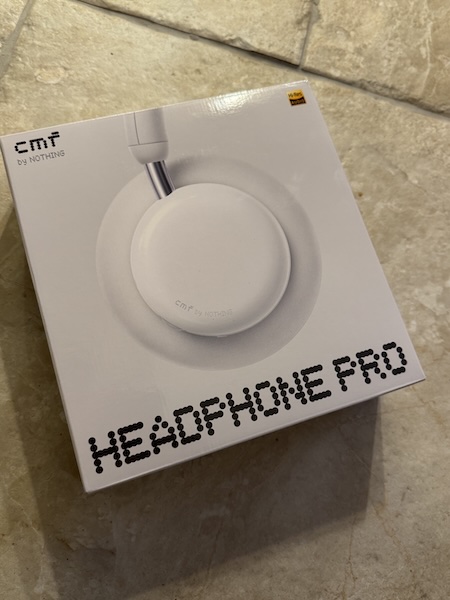
The CMF Headphone Pro arrives in clean, minimal packaging:
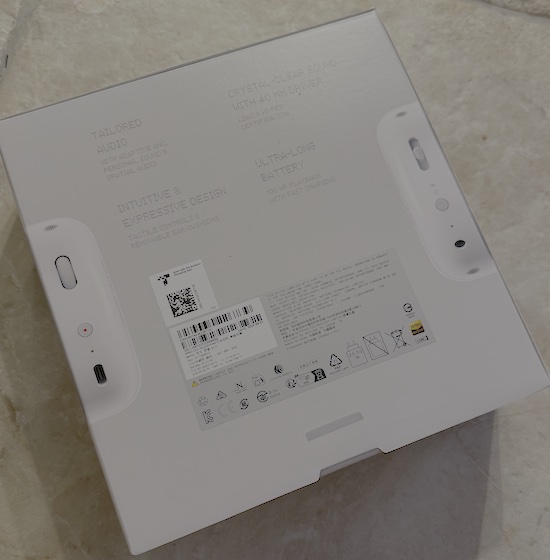
The back of the box provides key specifications:
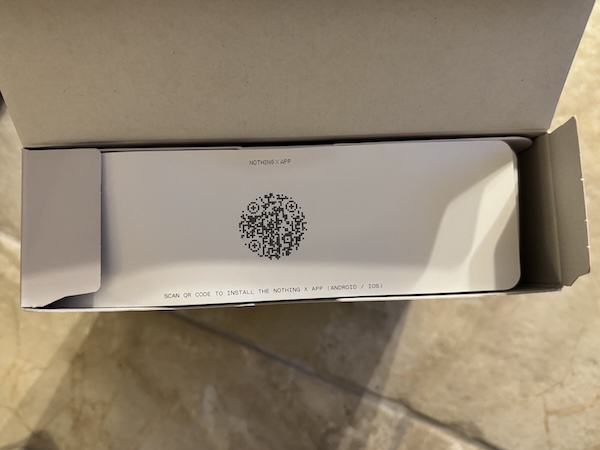
Opening the box reveals a QR code for the companion app:
The headphones are well protected inside:
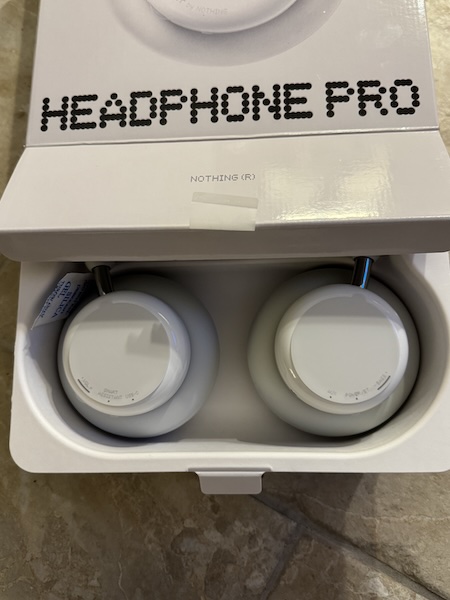
Here’s the headphone out of the packaging:
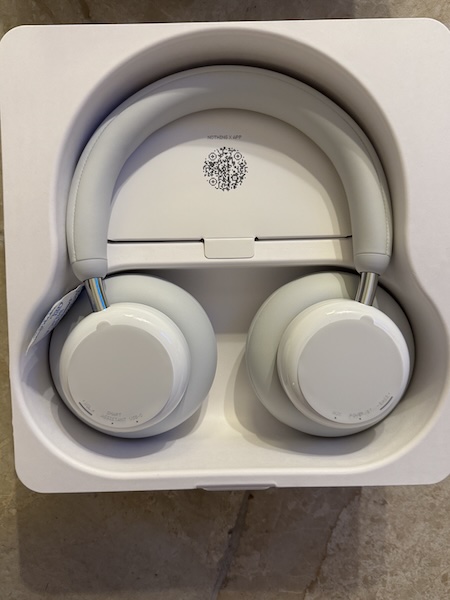
Accessories are stored in a compartment within the headphone itself:
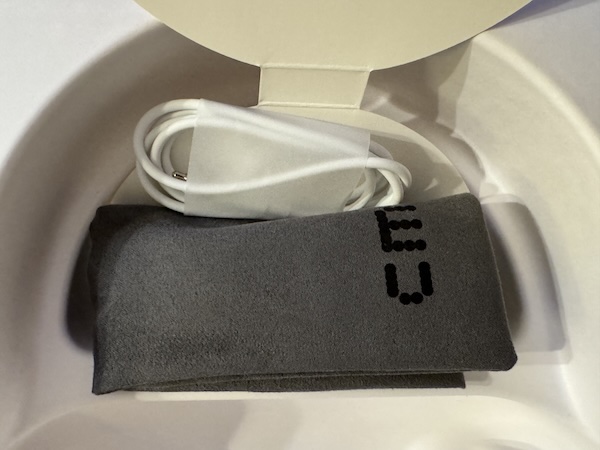
Everything that comes in the box:
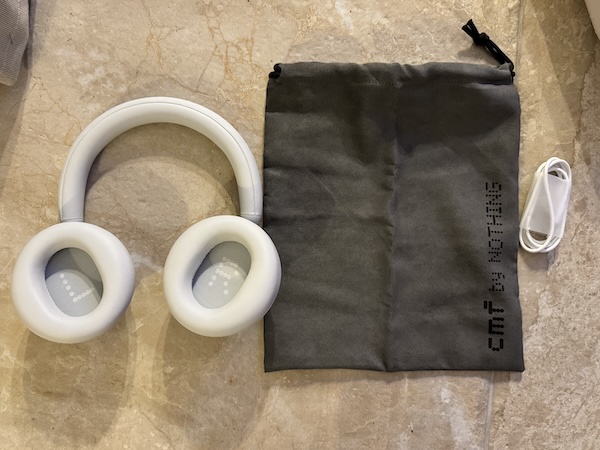
Included accessories:
- CMF Headphone Pro
- USB‑C charging cable
- Cloth storage bag
- Documentation
Build overview:
The earcups use smooth plastics with neat seams. Pads are removable for easy cleaning or replacement. The headband has even padding with sensible weight distribution. Hinges and yokes move confidently with no concerning creaks on my unit.
Controls are physical and tactile: a slider for bass/treble emphasis, a volume knob, and a push button for ANC modes. This is refreshing compared to touch-only controls on many competitors.
Fit and comfort
Comfort is a standout. Clamp is moderate and pressure distribution is even; I found them more comfortable than the Nothing Headphone (1) for multi‑hour use. Earpads are easy to remove and clean, which helps long‑term.
- Weight: ~283 g — balanced well enough to avoid hotspots
- Glasses comfort: Good seal with normal frames; very thick frames may slightly reduce ANC effectiveness (as usual)
- Pads: 96 × 95.7 × 30 mm pads, soft with a stable seal
Features and performance
Below is a pragmatic, feature‑by‑feature summary based on the product page and my use:
Battery and charging
- Playback: Up to 100 hours (ANC off) or 50 hours (ANC on) with AAC at 50% volume
- LDAC playback: Up to 70 hours (ANC off) or 38 hours (ANC on)
- Talk time: Up to 50 hours (ANC off), 35 hours (ANC on)
- Charging: USB‑C, full charge in ~120 minutes
- Fast charge: 5 minutes → up to 8 hours (ANC off) or up to 4 hours (ANC on) at 50% volume
Controls (on‑ear, no display)
- Tactile controls on the headphone itself: a bass/treble slider, a volume knob, and a push button for functions
- Intuitive to use; no reliance on touch surfaces
Spatial audio
- Static Spatial Audio with two modes: Cinema and Concert
- Each mode adjusts width/depth/clarity for a more immersive presentation
ANC and transparency
- Hybrid ANC with environment‑adaptive algorithm
- Automatically switches among strong, moderate, and light modes
- Transparency mode available
- Noise reduction depth: up to 40 dB (claimed)
- Five microphones total with a 3‑mic ENC call architecture and wind noise conduction mesh
Codecs and connectivity
- Bluetooth 5.4, range up to 10 m
- Codecs: AAC, SBC, LDAC
- Dual connection supported
- Platform support: Android 5.1+ and iOS 13+
- Hi‑Res certified (wired and wireless)
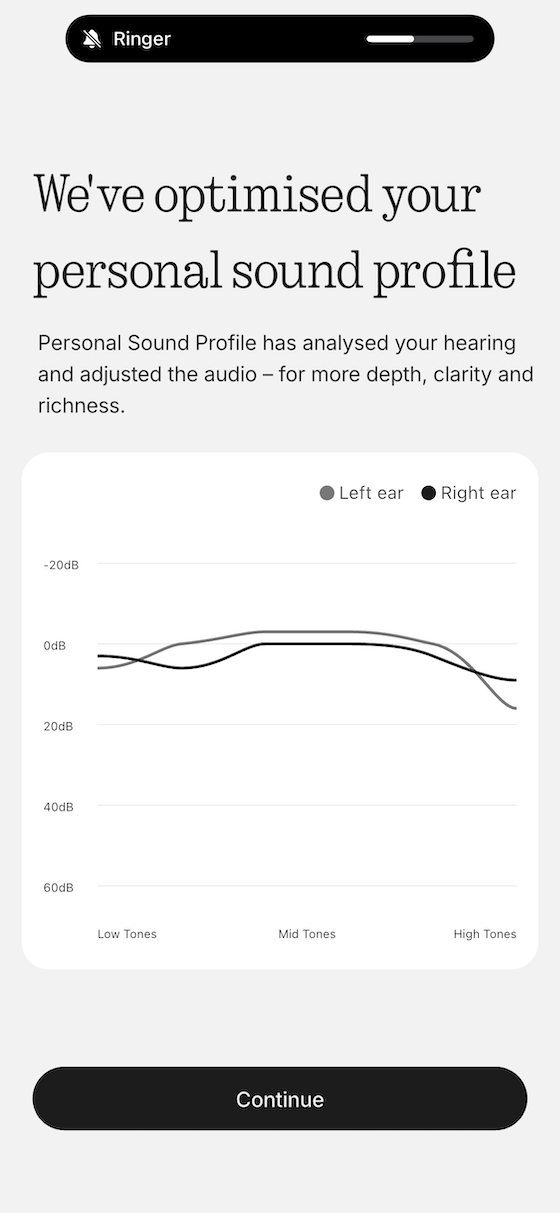
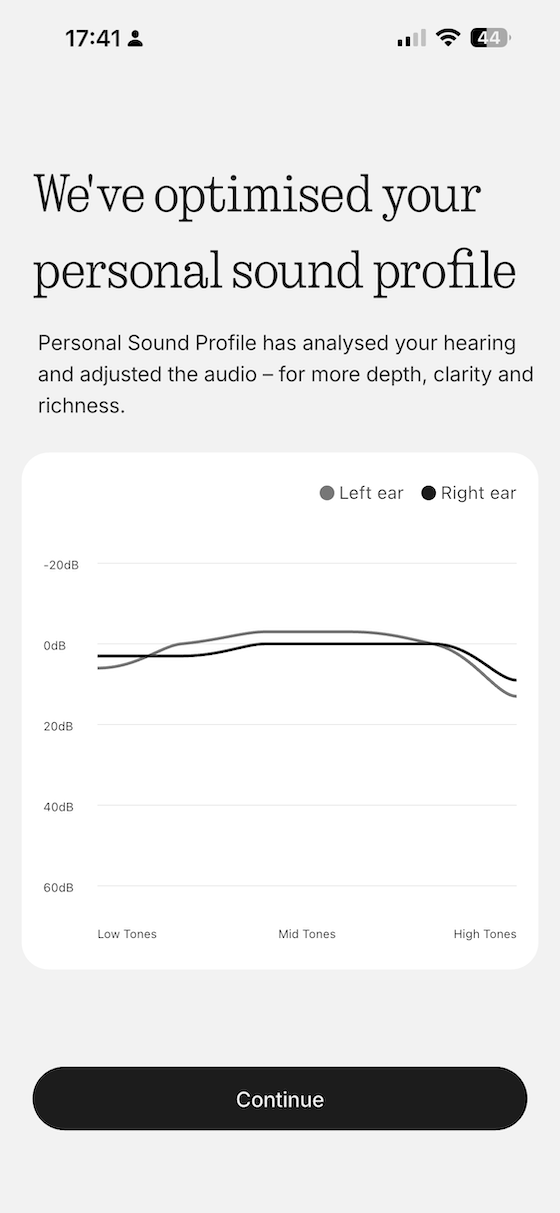
Personal Sound (profile saved on device)
- A three‑minute listening test in the app calibrates the sound and saves the profile to the headphone for use across devices
 |
 |
Notes on EQ:
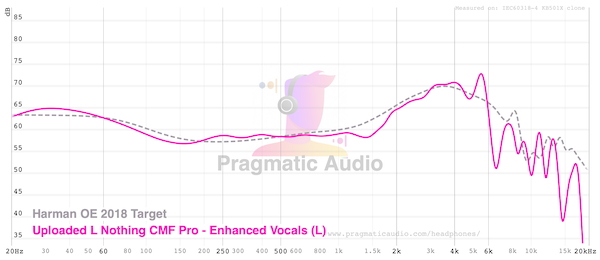
- Built‑in presets: Acceptable but not great
- Custom EQ: 3‑band only — blunt tool compared to full PEQ
- Key drawback: No PEQ; this is the main reason it doesn’t get 5/5 from me
Design extras
- Removable/replaceable earpads (“Ontwerp” note in the specs)
- IPX2 water resistance
- LED charging status
- Google Fast Pair and Microsoft Swift Pair
- Low latency mode available
Sound impressions
Out of the box, the CMF Headphone Pro aims for a broadly agreeable balance that works well for general listening and streaming. The stock tuning is serviceable; with LDAC it cleans up nicely. The Spatial Audio modes are fun, but for music I mostly stuck to standard stereo.
- Bass: With the slider centered, bass is full but not overblown. Slide toward “bass” for extra punch; I preferred a slight bump for casual listening. Sub‑bass reaches low without smearing the mids.
- Midrange: Clear vocal presence with decent body; dialogue and podcasts are particularly easy to follow. Little shout, even at higher volumes.
- Treble: Smooth and safe with LDAC; avoids edgy peaks. Detail comes through but don’t expect “sparkle” chaser territory.
- Soundstage & imaging: Naturally sized with good center stability. Spatial modes widen things, but standard stereo remains the most accurate for music.
EQ comments:
- The lack of PEQ limits precise corrections. The 3‑band EQ can nudge tonality but can’t surgically fix narrow areas.
- Presets are fine as a quick “set and forget,” but they won’t satisfy those who like to dial in exact targets.
Comparisons
Versus Nothing Headphone (1)
The CMF Headphone Pro and Nothing Headphone (1) share DNA but target slightly different use cases:
Comfort: I prefer the CMF Pro for extended listening sessions. The clamp pressure is more evenly distributed, and the earpads feel slightly softer on my setup. Both are comfortable, but for 3+ hour sessions, the CMF Pro wins for me.
ANC: Both offer competitive noise cancellation for their respective price points. The Nothing (1) has slightly more aggressive ANC in extreme noise environments, but the difference is modest. Seal quality matters more than the headphone choice for real-world ANC performance.
Sound Quality: Stock tuning is warmer on the CMF Pro, more neutral on the Nothing (1). With EQ, the Nothing (1) pulls ahead due to full PEQ support. The CMF Pro’s 3-band EQ is functional but limiting if you want precise corrections.
Features: The Nothing (1) offers more customization through its app, including full PEQ and more granular controls. The CMF Pro keeps things simpler with physical controls (bass/treble slider, volume knob) that work without pulling out your phone.
Value: At under €100 (often €90 or less with discounts), the CMF Pro is exceptional value. The Nothing (1) typically costs more but justifies it with added flexibility.
Versus Other Sub-€100 ANC Headphones
Versus Earfun Tune Pro: The Earfun offers better app-based EQ flexibility with 10-band PEQ, making it more tunable than the CMF Pro. However, the CMF Pro has better physical controls and a more premium aesthetic. Comfort is comparable; both excel in their price range.
Versus UGreen Max5C: The CMF Pro is more comfortable and has better default tuning. The UGreen lacks proper EQ customization (preset-only), giving the CMF Pro an edge despite both having limited EQ compared to true PEQ options.
See the Measurements section below for detailed FR comparisons against these competitors.
Specifications and measurements
Specifications (as provided)
| Spec | Detail |
|---|---|
| Dimensions (H × W × D) | 168.5 × 95.7 × 188.5 mm |
| Weight (headphones) | 283 g |
| Earpads (H × W × D) | 96 × 95.7 × 30 mm |
| Earpads weight | 45 g |
| Drivers | 40 mm |
| Frequency response | 20 Hz – 20 kHz |
| Diaphragm | Dome: PEN+PU; Coating: Nickel plating |
| Tuning | Nothing |
| Battery type | Rechargeable Li‑ion, 720 mAh |
| Charging | USB‑C, ~120 mins to full |
| Fast charging | 5 min → up to 8 h (ANC off) / up to 4 h (ANC on) at 50% volume |
| Playback (AAC) | Up to 100 h (ANC off) / up to 50 h (ANC on) |
| Playback (LDAC) | Up to 70 h (ANC off) / up to 38 h (ANC on) |
| Talk time | 50 h (ANC off) / 35 h (ANC on) |
| ANC type/depth | Hybrid ANC, up to 40 dB |
| ANC frequency range | 2000 Hz |
| Microphones | 5 total (3‑mic ENC architecture for calls) |
| Connectivity | Bluetooth 5.4, 10 m range, dual connection |
| Platforms | Android 5.1+ / iOS 13+ |
| Codecs | AAC, SBC, LDAC |
| Other features | Google Fast Pair, Microsoft Swift Pair, Low latency, LDAC & Hi‑Res (wired/wireless), LED charge status, IPX2 |
Measurements
I measured the CMF Headphone Pro on my standard headphone measurement rig (KB501X with 711 clone coupler). All measurements can be viewed on my measurement database here.
Default Frequency Response
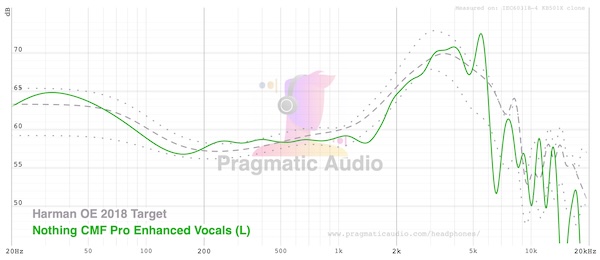
Here’s the CMF Headphone Pro’s default tuning compared to the Harman target:
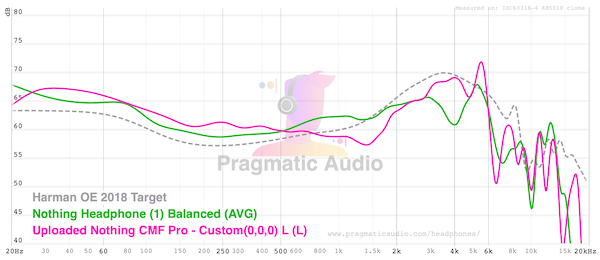
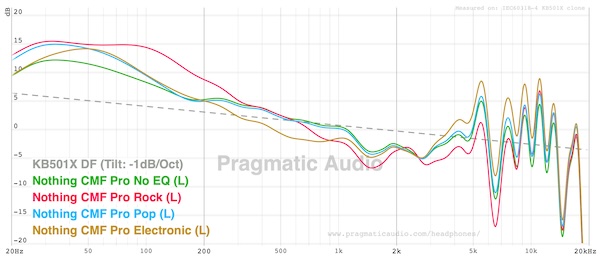
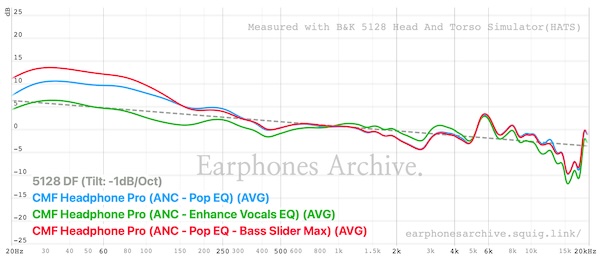
The stock tuning shows a warm tilt with elevated bass and a gentle treble roll-off typical of consumer-friendly wireless headphones.
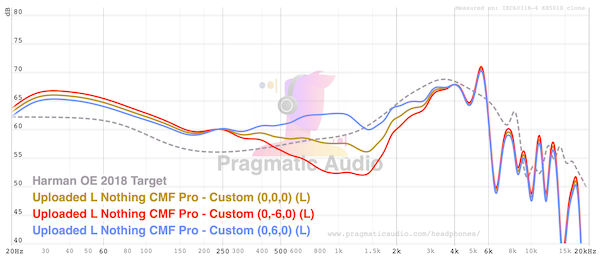
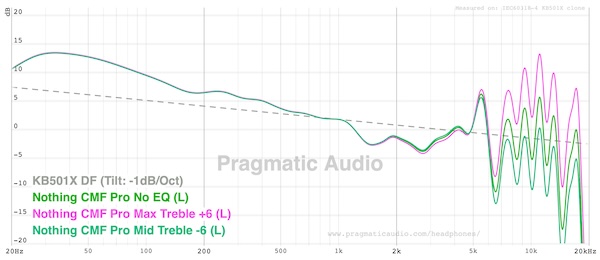
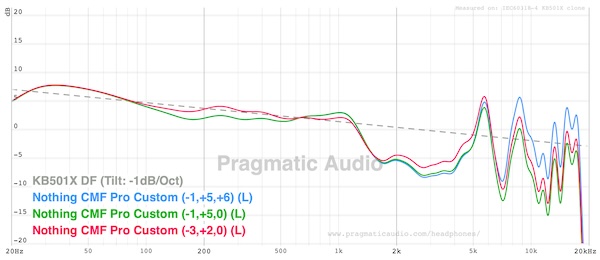
EQ Adjustments via the 3-Band EQ
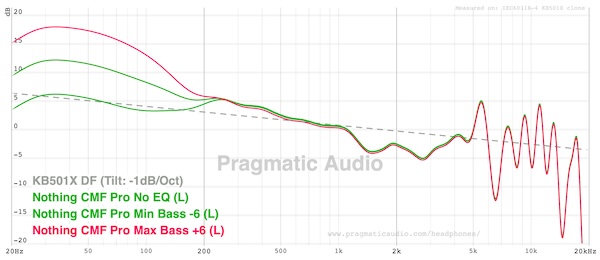
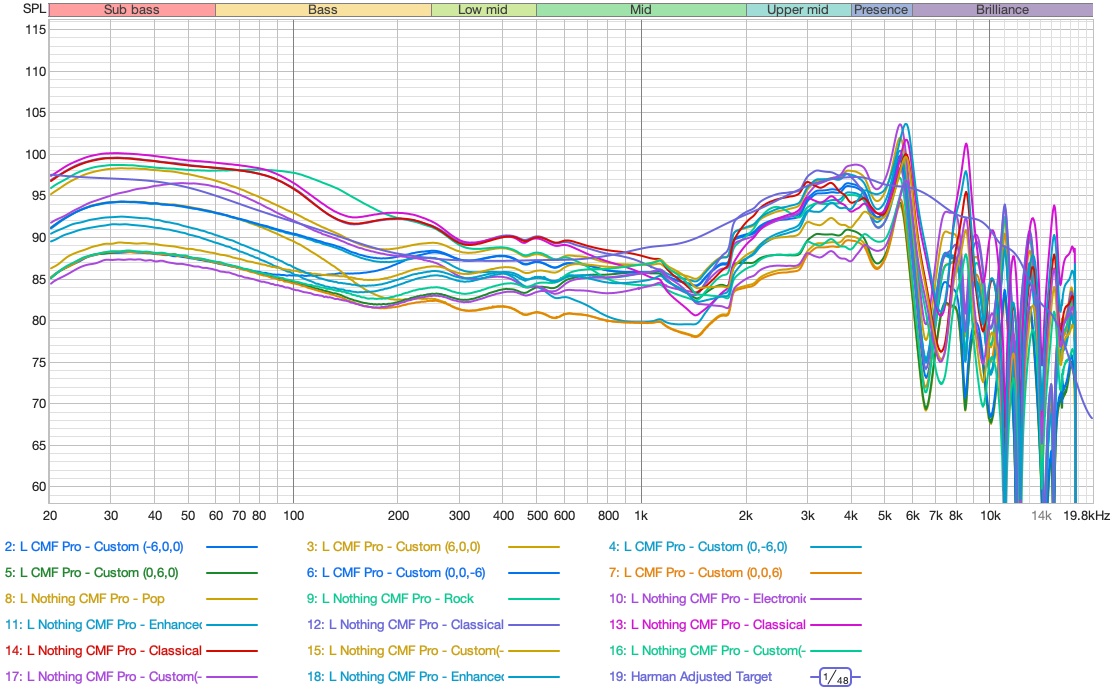
The CMF app provides a 3-band EQ. Here’s how the bass adjustments affect the frequency response:
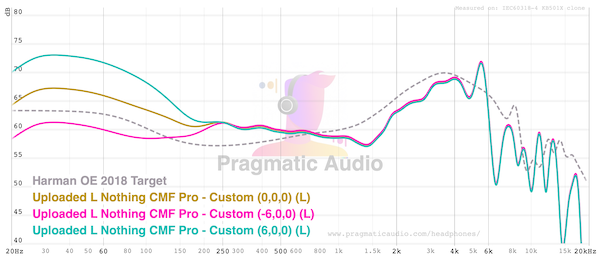
The bass slider provides meaningful adjustment range, though without PEQ precision.
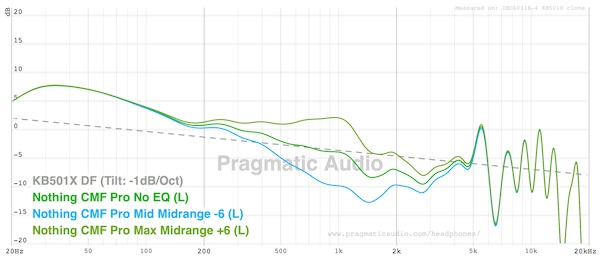
Midrange adjustments:
And treble adjustments:
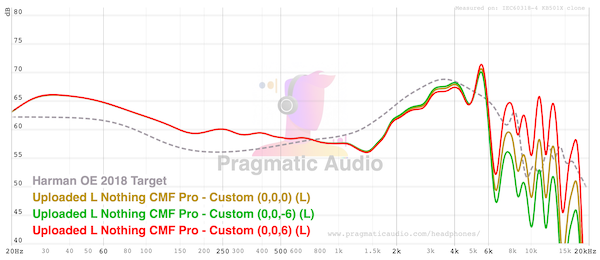
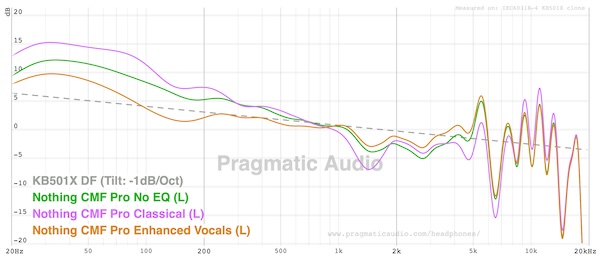
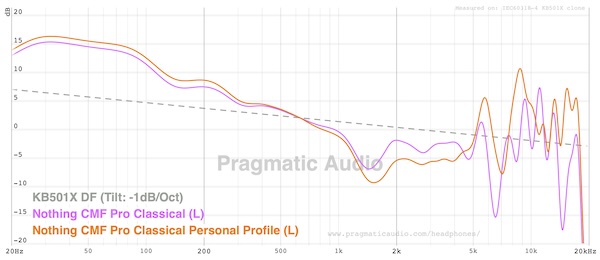
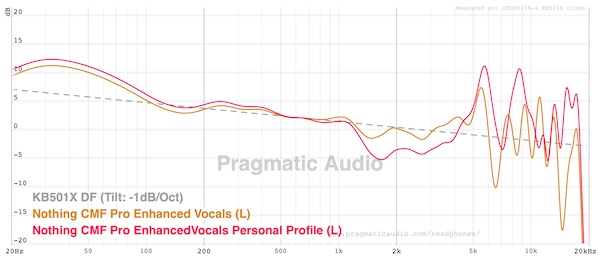
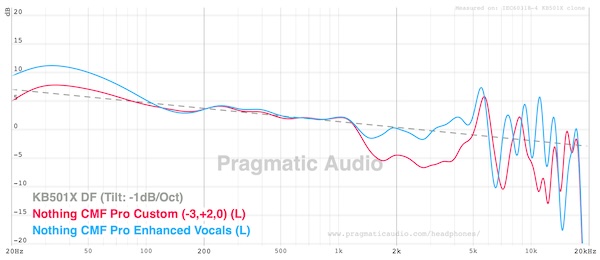
While these adjustments work, they’re broad strokes compared to proper parametric EQ. The best built-in preset I found was “Enhanced Vocals”:
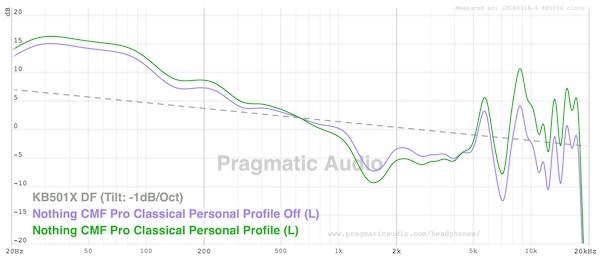
Personal Sound Profile Impact
The CMF app includes a “Personal Sound” calibration test. Here’s how it affected the frequency response:
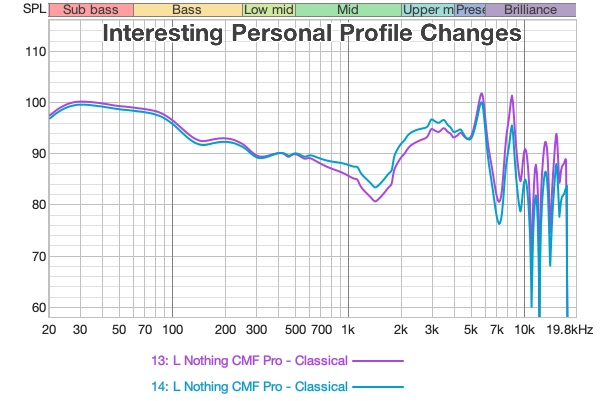
The personalization made subtle but measurable changes, primarily in the upper midrange and treble regions.
Additional FR Comparisons
Here are various views comparing the CMF Headphone Pro against different targets and headphones:
This shows the CMF Pro maintaining reasonable tonality across different measurement angles.
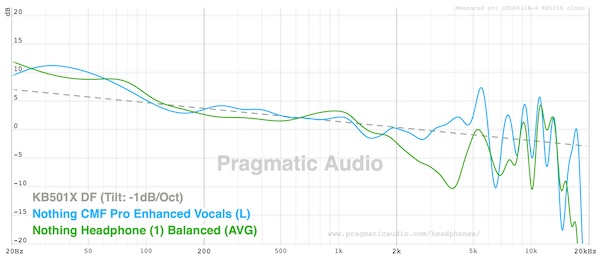
Comparing against the Nothing Headphone (1) and other competitors:
Channel matching is excellent:
Additional frequency response perspectives:
Overview of all measurements taken:
Measurement notes:
- Same coupler/mic chain I use for other Bluetooth headphones (KB501X with 711 clone)
- Multiple seatings averaged; compensation vs Harman OE 2018 target
- All measurements taken with ANC on via LDAC codec unless otherwise noted
- Channel matching was verified across multiple insertions
Rating explanation
Pragmatic Rating: 4/5
What I loved:
- Comfort (better than Nothing Headphone (1) for me)
- Looks and overall build execution at the price
- Strong value: LDAC + ANC + long battery claims under €100
What holds it back:
- No full PEQ; only 3‑band EQ and middling built‑in presets
Who it’s for:
- Listeners who prioritise comfort and simple, on‑device controls
- Value seekers who want LDAC, ANC, and long battery life without spending much
Who should look elsewhere:
- Users who rely on precise PEQ for tuning
Conclusion
The CMF Headphone Pro is a very easy recommendation in the sub‑€100 bracket if you value comfort, straightforward controls, and solid ANC with LDAC support. It’s the missing full PEQ that keeps it from being “almost perfect.” If Nothing/CMF enables proper parametric EQ in the future, this would jump straight to a 5‑star pick for pragmatic listeners. Until then, it’s a strong 4/5 for getting most of the important things right at a great price.