FiiO EH13
Comfort, PEQ, and an unbeatable price: FiiO’s boldest wireless headphone yet
After the FiiO EH11 impressed as a retro on-ear at its modest price, the EH13 is a more ambitious proposition: a full-size, over-ear, ANC Bluetooth headphone at just $50. What makes it genuinely interesting is that it arrives with onboard parametric EQ — a feature that has only just begun appearing across the sub-$100 ANC category, and one that changes what you can actually do with a headphone at this price.
For someone who loves PEQ and loves headphones and has developed devicePEQ — an open-source web Bluetooth tool for applying PEQ directly to devices with ‘on board’ PEQ, the EH13 was a product I had to hear and I have really enjoyed while reviewing it over the past few weeks.
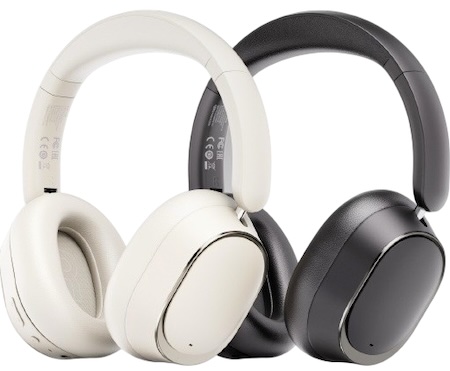
I would like to thank FiiO for ultimately providing 2 EH13’s for the purposes of this review. FiiO subsequently supplied a second unit for verification — both units have been measured and the results are presented below.
The unit reviewed here is the Black variant. The EH13 is also available in a Cream colourway.
If you are interested in finding more information about this product, you can find it at the official FiiO product page.
The EH13 typically retails for approximately $50 / €55 and I believe it the cheapest headphone with PEQ available.
I have been living with the EH13 for roughly a month, using it during commutes, at my desk, and in various real-world environments where a capable wireless headphone earns its place.
The headline feature is the onboard parametric EQ and I will get into just how far it can take you. What it takes to bring it to a neutral baseline. That finding is worth understanding before you purchase, and I will come back to it in the measurements section.
But first, let’s take a look at what’s in the box.
Unboxing and Packaging
The EH13 arrives in a compact, clean box that is entirely appropriate for a $50 headphone:
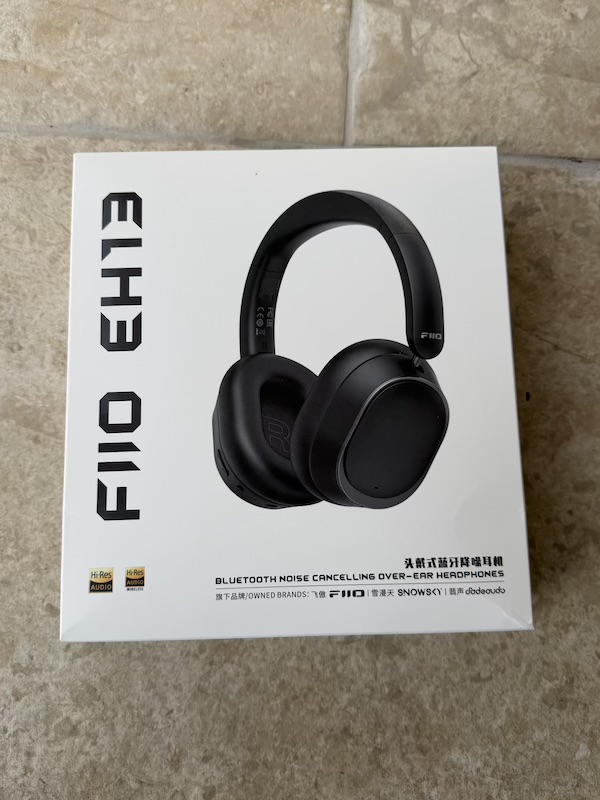 |
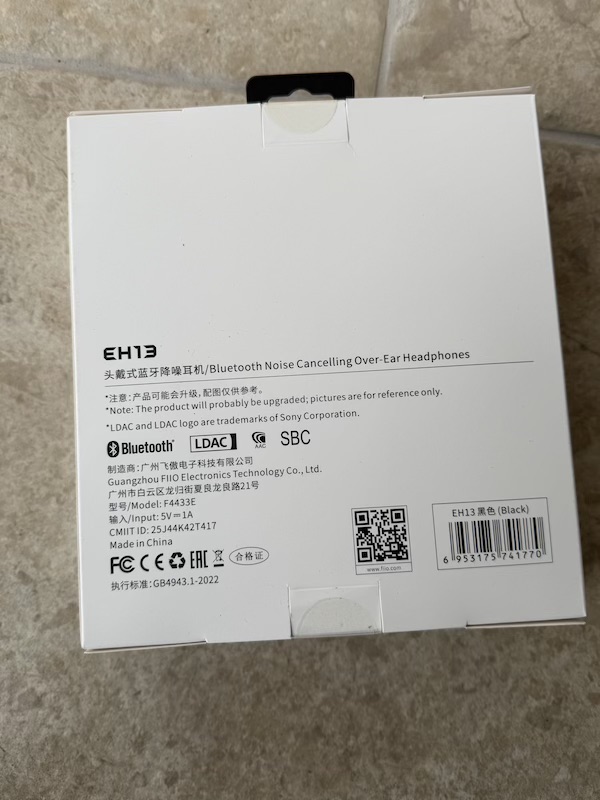 |
FiiO has never been one for elaborate packaging at this price tier, and the EH13 is no exception, with the $50 headphone sitting neatly inside a foam insert you cannot expect a travel case or second earpads.
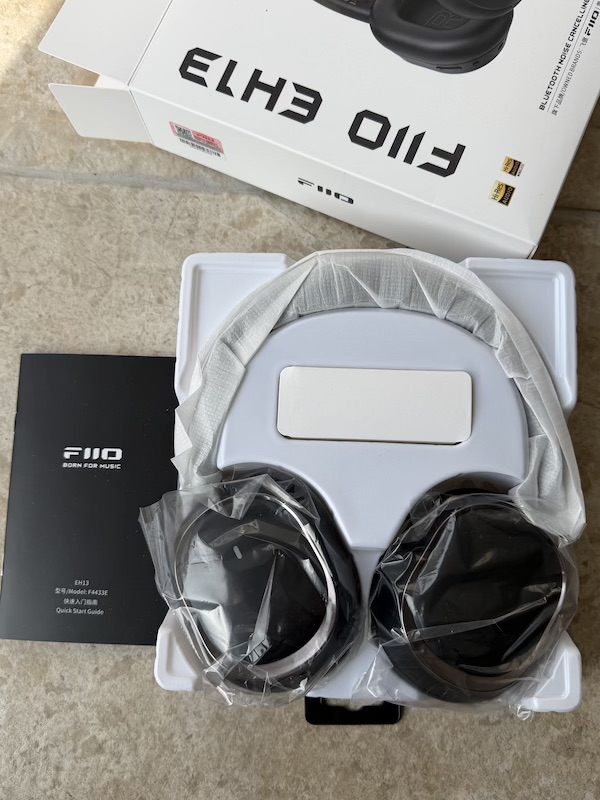
But opening the box reveals the EH13 looking considerably more polished than its price might lead you to expect:
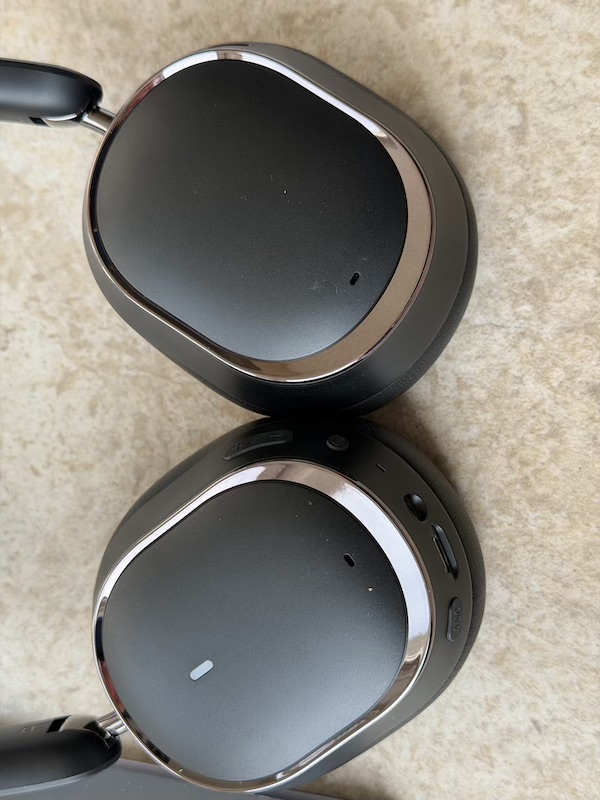
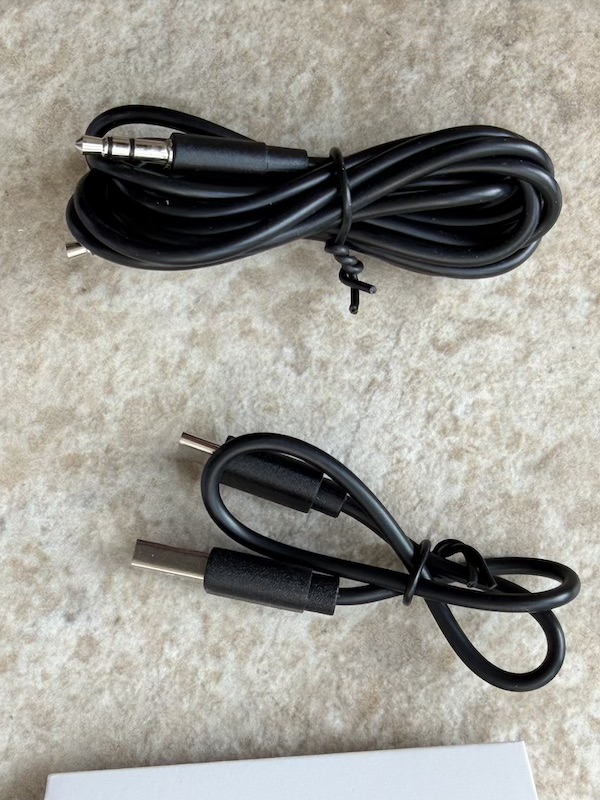
Inside the box you will also find a 3.5mm analogue audio cable, and a USB-A to USB-C charging cable:
 |
 |
Overall, it is a much better experience than I expected for $50.
Build Quality and Comfort
First impressions out of the box are genuinely good.
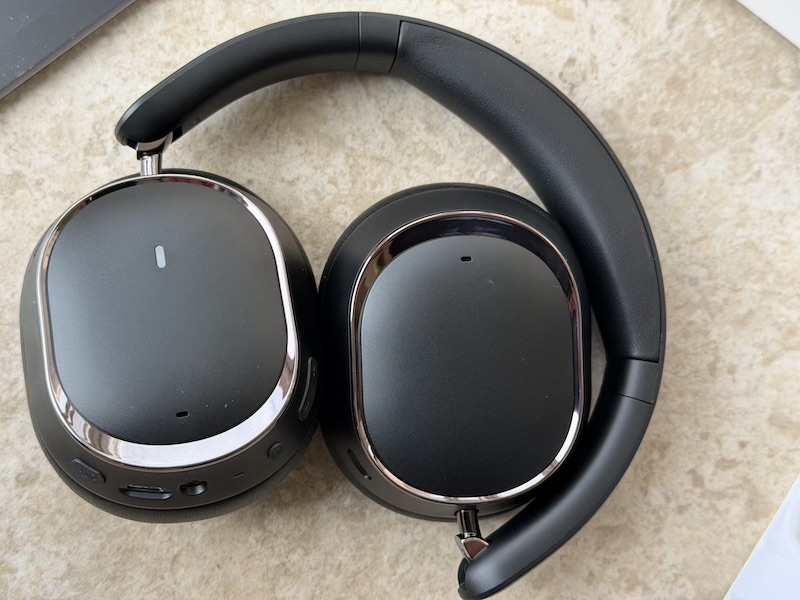
The EH13 has a clean, restrained aesthetic — nothing showy, but well-proportioned and finished with a tidiness that belies the price. It feels solid in the hands without being heavy, and the folding mechanism is a welcome practical feature for anyone carrying these outside the home:
The hinge mechanism feels secure yet flexible enough to fold multiple ways:
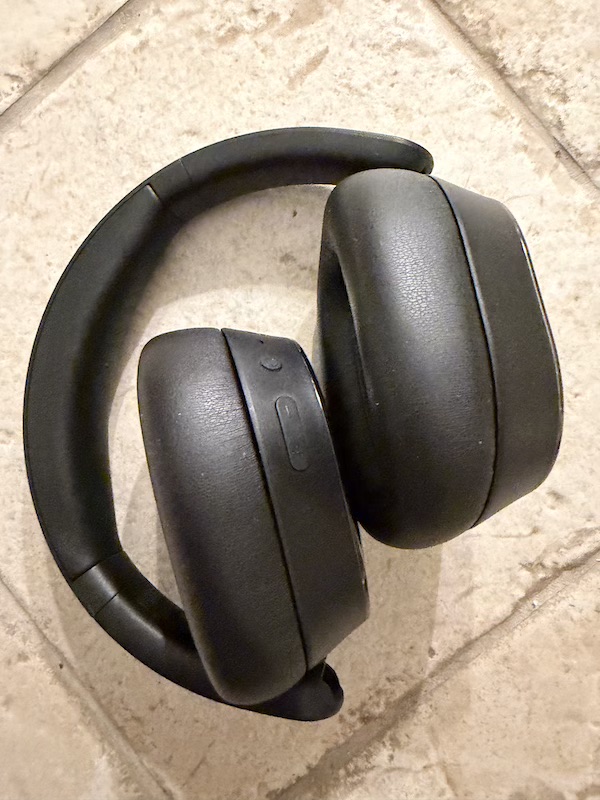
The earcups fold flat and the headphone collapses into a compact form, making it reasonably travel-friendly even without a dedicated case.
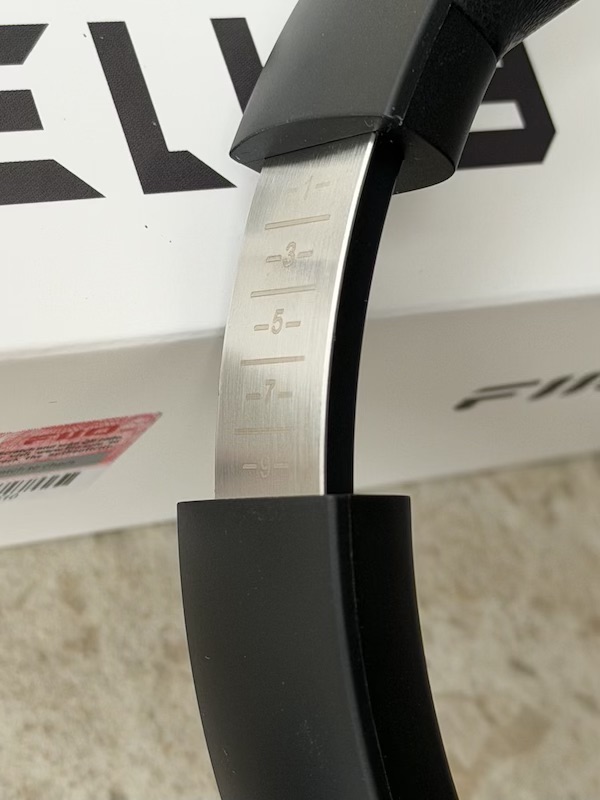
The headband is decent for the price with very deep cushioning on the headband:
 |
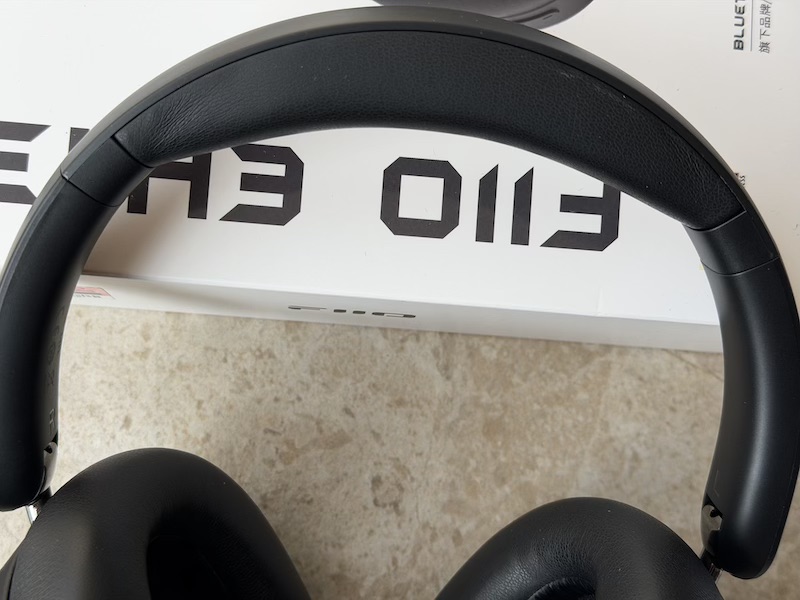 |
The extension range is generous enough to suit larger head sizes comfortably, and the cushioning is deep and well-padded.
Weight distribution is even, and I found myself wearing the EH13 for extended sessions without any discomfort at the crown.
I would go as far as saying this is one of the most comfortable bluetooth ANC headphone I have used at any price.
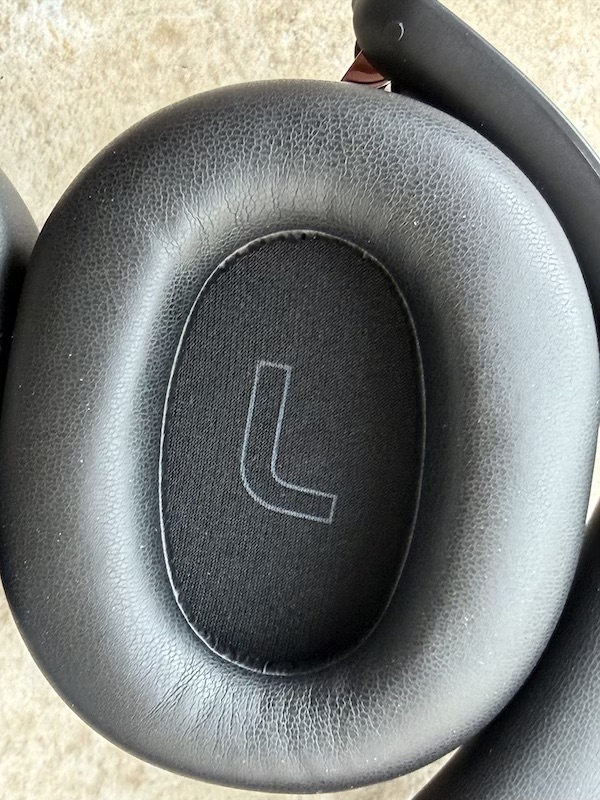
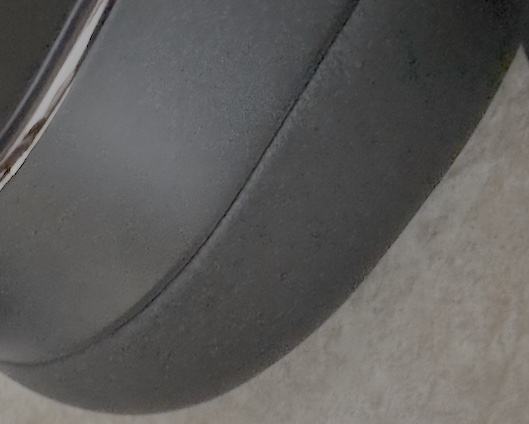
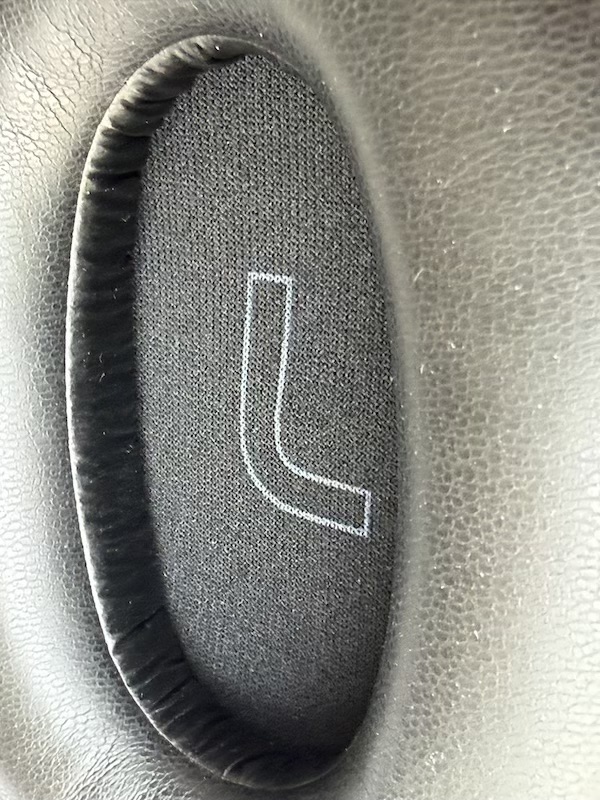
The earpads are where the EH13 makes perhaps its most impressive statement relative to its price as they are both deep and relatively large.
As the exterior profile makes clear, the earcups are generously deep — deep enough to accommodate most ear shapes without the ear pressing against the driver housing. The pleather material has a soft feel and seals comfortably against the head. Comfort, in short, is exceptional for $50 and represents a deliberate design priority that is evident in every aspect of the fit.
 |
 |
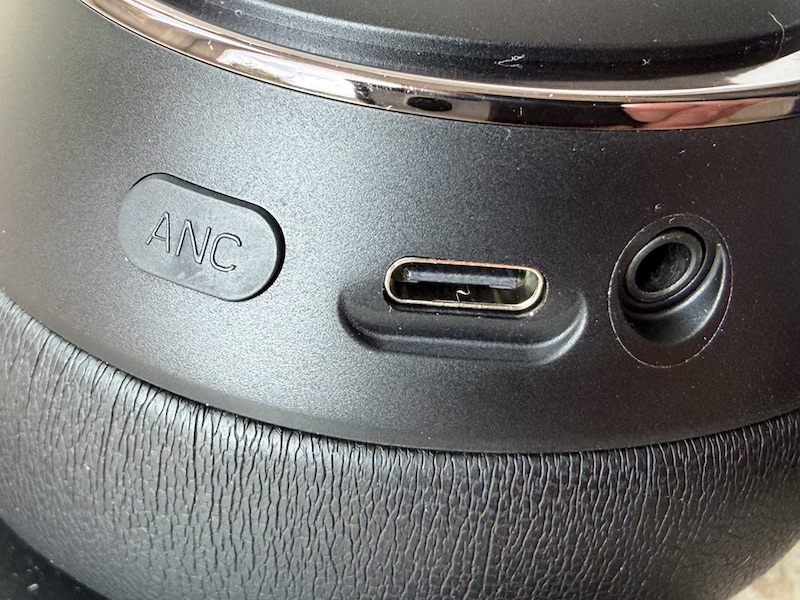
Physical controls are sensibly arranged:
 |
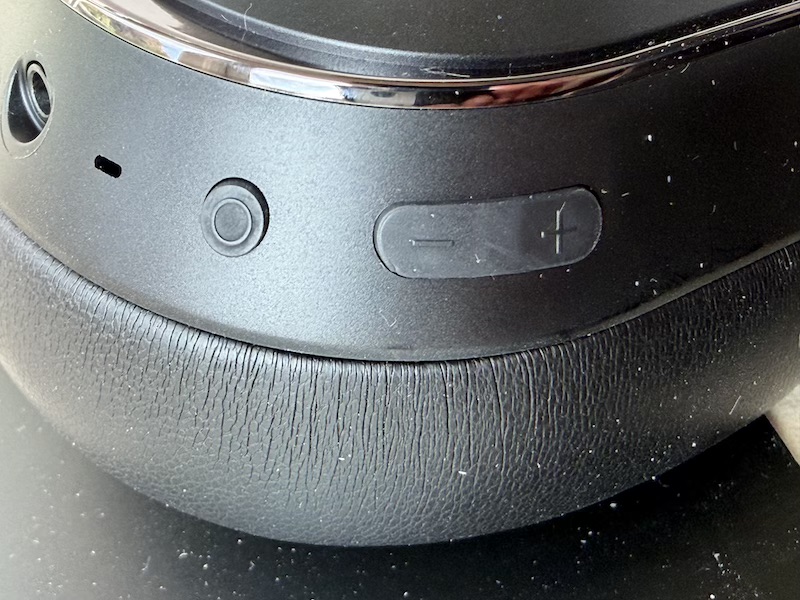 |
The right earcup carries the power button and a dedicated volume rocker, while the left earcup houses the ANC mode button alongside the USB-C charging port and the 3.5mm analogue input.
The layout is logical and easy to navigate by feel after a short learning period.
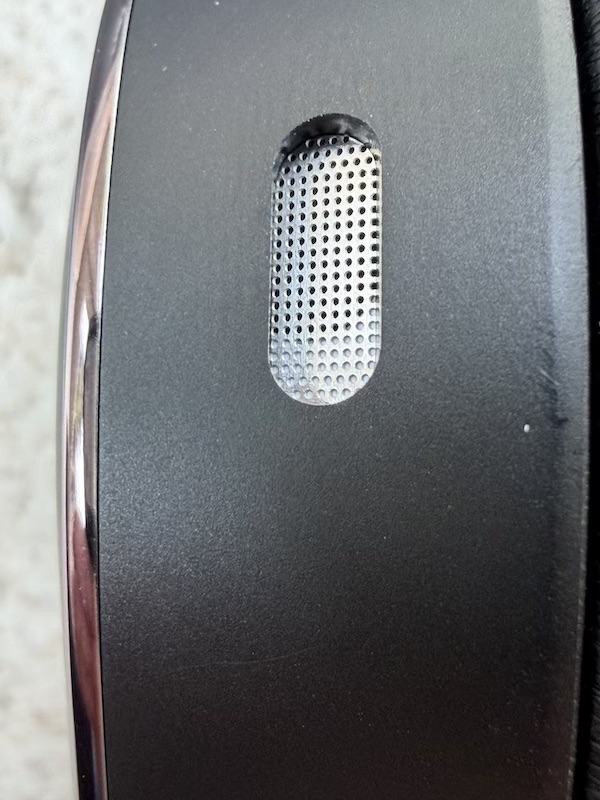
The microphone grilles are neatly integrated into the earcup design, but I feel the microphone quality is poor both for ANC and for call quality. It is adequate for brief calls in moderate environments — but this is not a headphone that will rival the call-handling sophistication of flagship wireless headphones.
Features and App
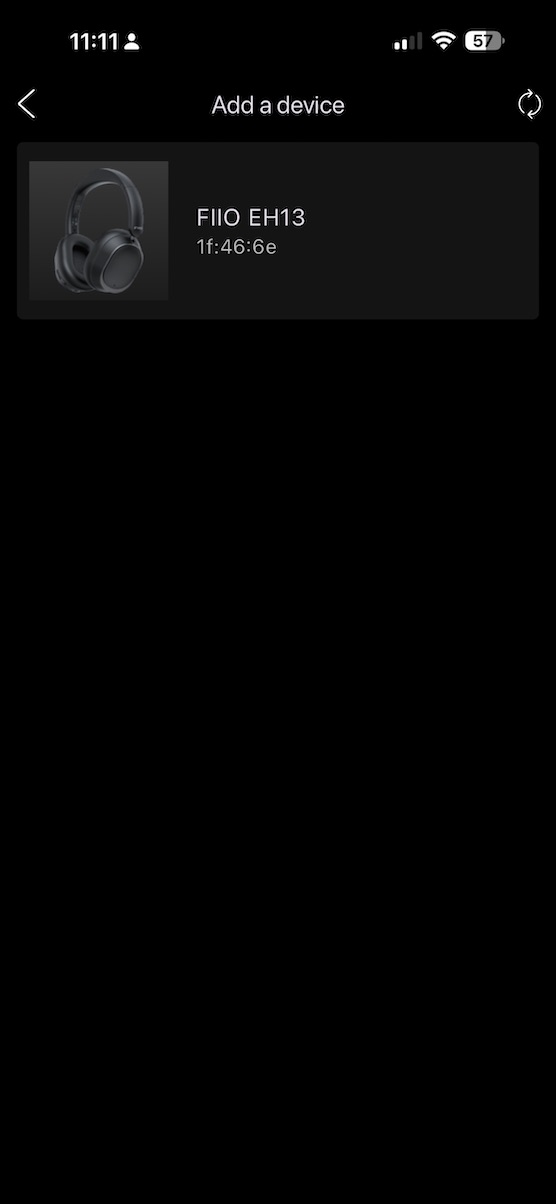
The FiiO Control app is the primary gateway to the EH13’s more interesting functionality, and first impressions are mixed, compared to some other ‘companion apps’ I have used with ANC headphones, we only get a bare bones of functionality:
 |
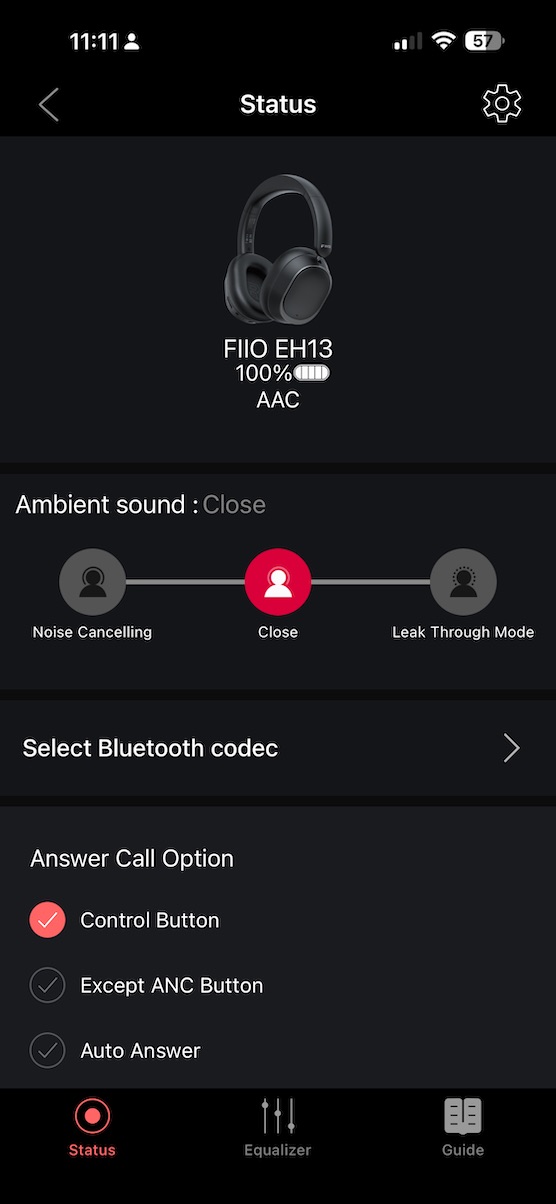 |
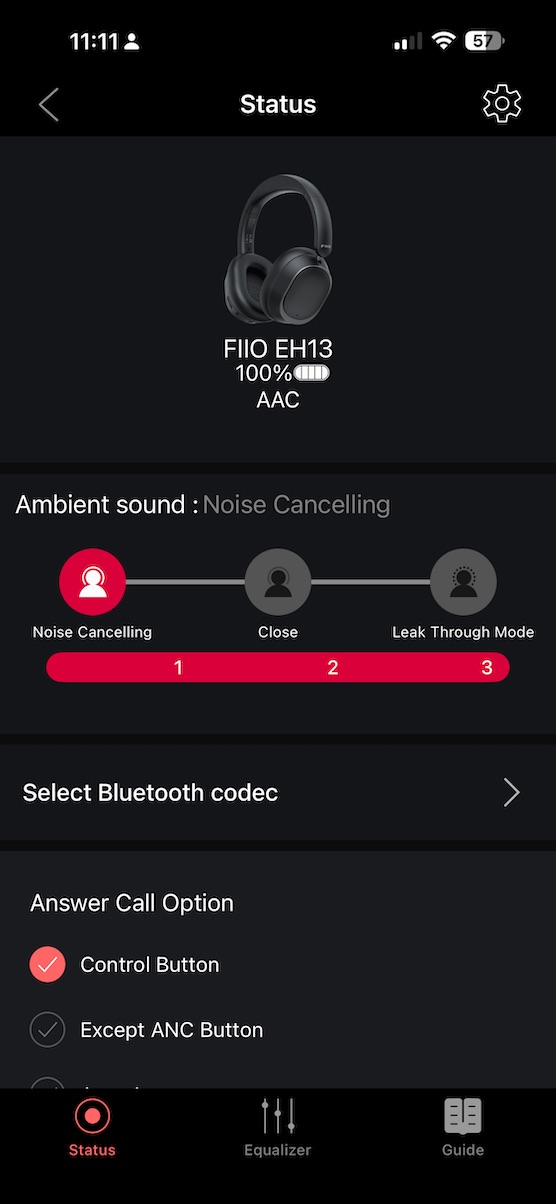
Pairing and setup are straightforward, and the home screen provides access to ANC settings, Bluetooth codec selection, and button configuration.
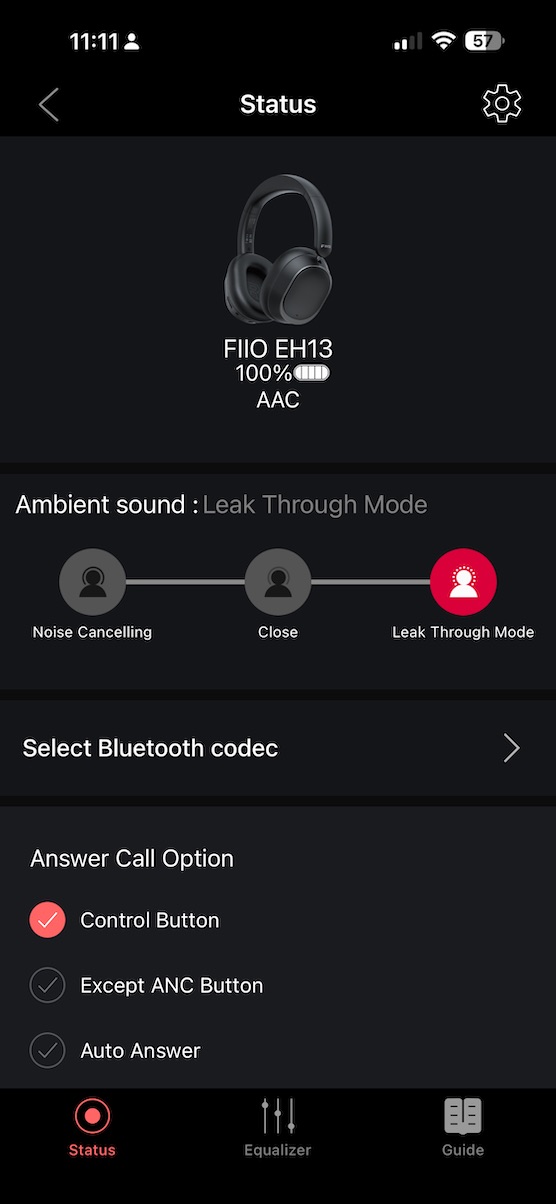
The interface is functional without being particularly polished, and some of the labels are oddly translated, transparency mode, for instance, appears in the app as “Leak-Through Mode.”
 |
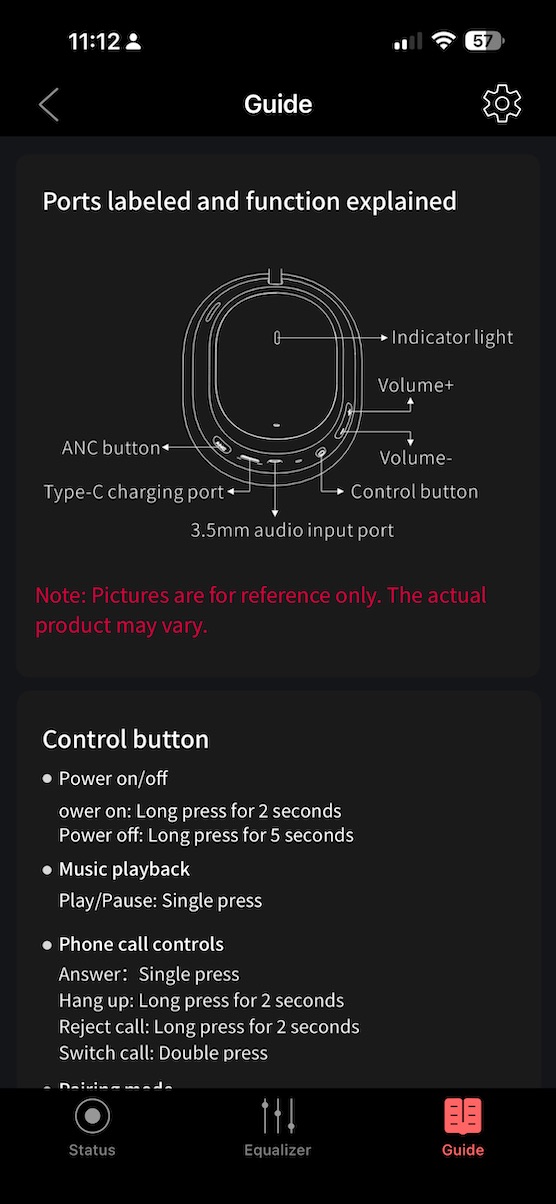 |
The app includes a guide to physical controls, which is a useful touch.
The ANC configuration screen offers multiple intensity levels, though absent is any form of wind noise cancellation — a meaningful gap if you intend to use the EH13 outdoors on windy days, where the microphones will pick up considerable wind noise.
 |
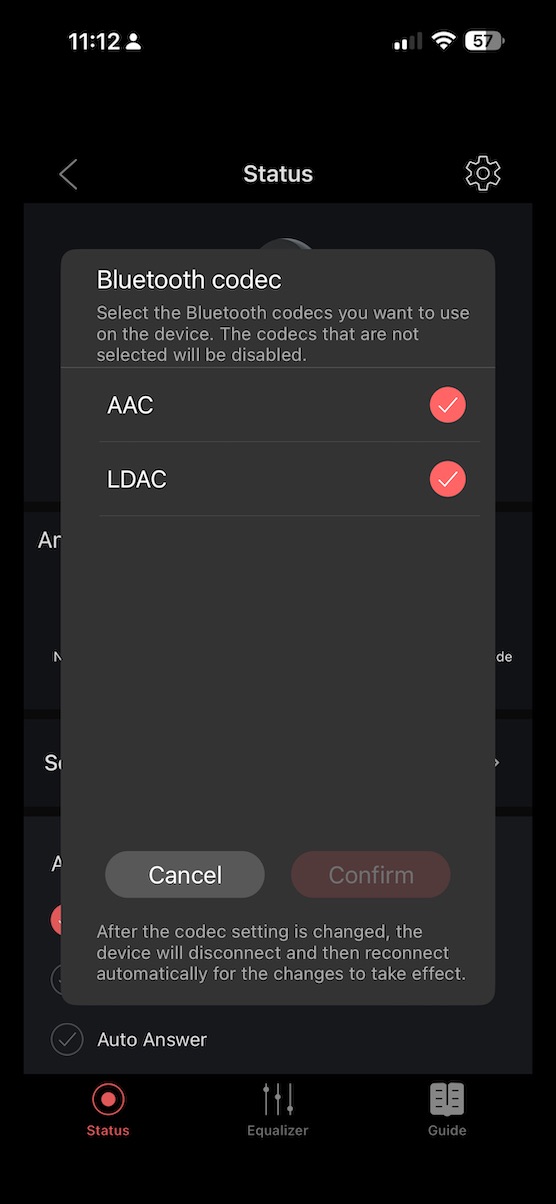 |
Codec support is lean — SBC, AAC and LDAC, with no AptX — but LDAC is the codec that matters most for audio quality over Bluetooth, and its inclusion here is what counts. Android users with an LDAC-capable source will want to use it; iPhone listeners will be limited to SBC, which is the one meaningful connectivity caveat for Apple users. The EH13 also supports Bluetooth 6.0 and multipoint connection, allowing simultaneous pairing to two devices — a genuinely useful convenience for anyone switching between a phone and a laptop.
But thankfully the onboard parametric EQ is the headline feature, and it is very impressive at $50:
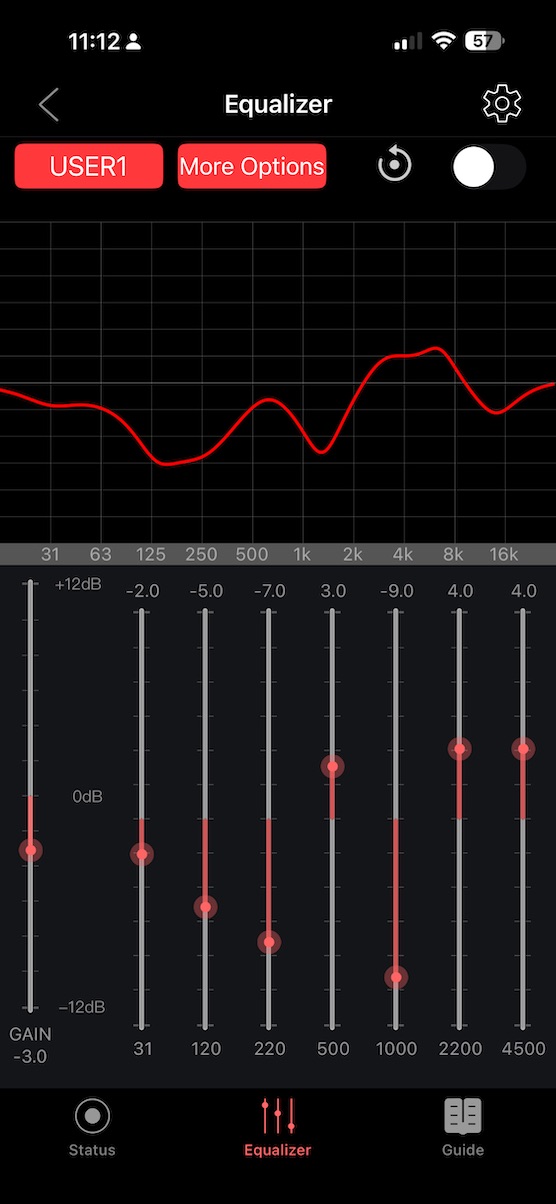
FiiO have used the PEQ by default to fix much of the drivers issues so you see their ‘preset’ when you disable the EQ:
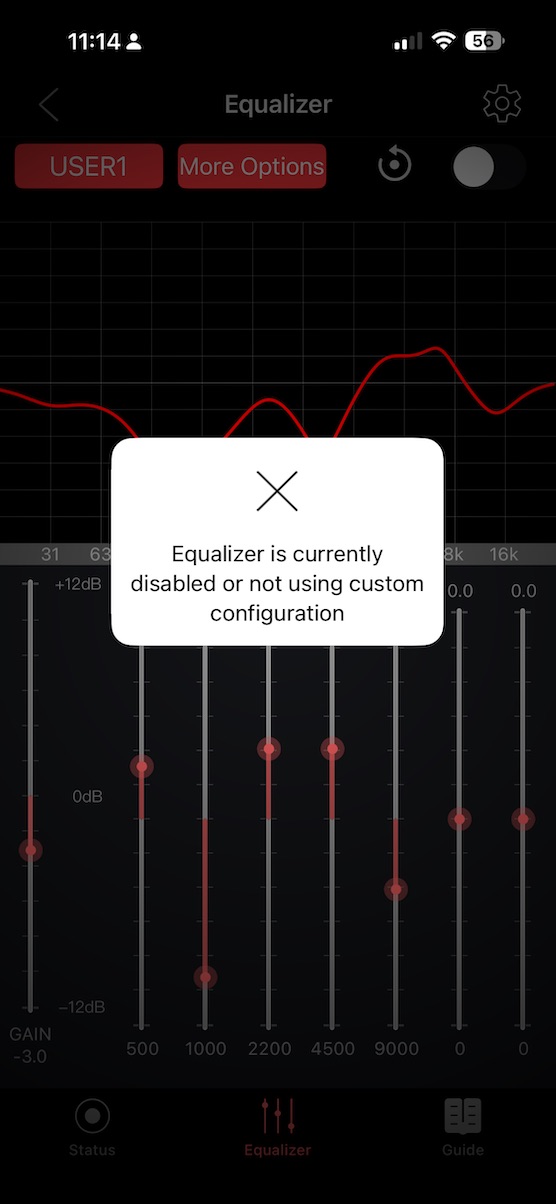
Activating the PEQ replaces the default tuning curve entirely — you cannot tweak around the existing EQ, you must build a correction from a flat baseline.
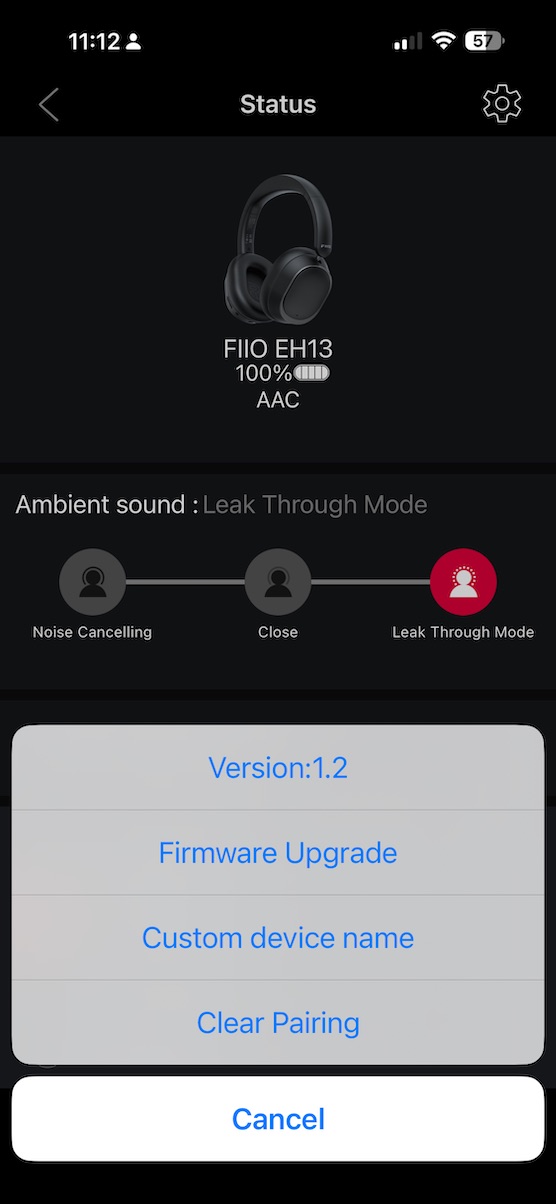
For someone comfortable with parametric EQ, this is understandable; for a listener hoping to make minor additive adjustments, it adds a layer of complexity.
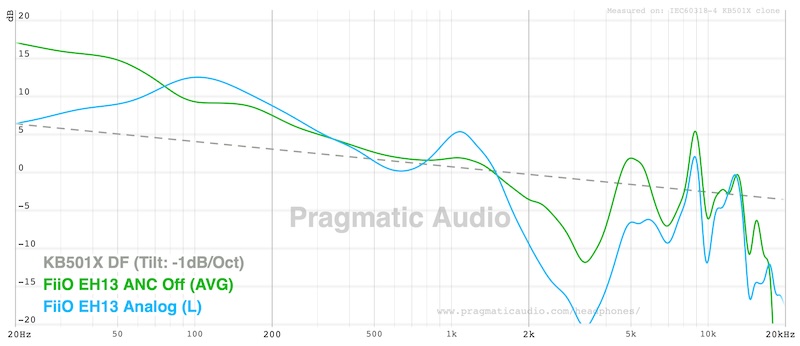
But the band count is sufficient to implement a meaningful correction, and while the EH13 responds well to parametric shaping, as you will see in the measurements later, the analog / No PEQ applied tuning of this headphone is pretty poor so you will need to use a lot of major changes to get a neutral sounding headphone, especially in the upper midrange.
Active Noise Cancellation
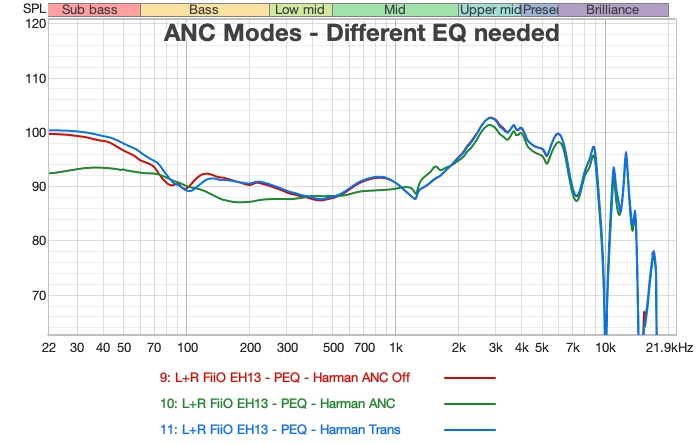
The EH13 uses a hybrid feedforward-feedback ANC system with up to -42dB of rated noise reduction across three selectable intensity levels. In practice, it provides some very basic attenuation of steady-state background noise especially in the bass region — so air conditioning, road hum, some ambient office sound was reduce and is helpful in moderately noisy environments, but here are some measurements of the ANC to highlight how I feel about the ANC:
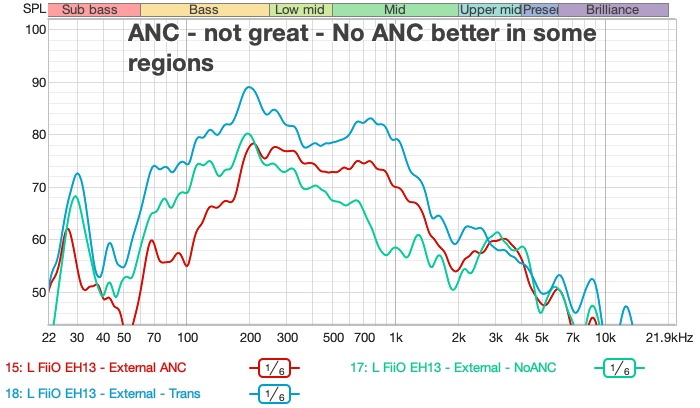
The ‘Red’ ANC line should be below both blue ‘Transparency’ and Green ‘No ANC’ but in some midrange frequencies the ‘ANC On’ was worse than ‘No ANC’ and was actually ’louder’ in those region, when ideal ANC would reduce all outside noise.
FiiO supplied a second unit as I felt maybe the microphones were broken on my initial unit, but measuring both side by side confirmed that the ANC performance is not great and I expected more but again at this price point any useful ANC is relatively speaking a decent feature and it does work reasonable well in airplane cabins and other bass heavy environments.
I do have a working hypothesis about the ANC performance relative to competitors like the Tanchjim Rita: the EH13’s deep, roomy earcup cavity — the very feature that makes it comfortable — creates a larger internal volume that is inherently harder to cancel effectively.
Headphones with shallower, more aggressively sealing earcups tend to achieve stronger ANC at this price tier, but they compromise on all-day wearability to do so.
But, for example the app also lacks wind noise cancellation, so outdoor use on blustery days will introduce some wind noise through the microphones even more. In fact, I could not listen with ANC enabled when out walking.
Sound Impressions
All listening impressions were gathered over approximately a month using LDAC via a FiiO DAP and my iPhone 17 Pro Max via AAC. The impressions below are formed without active noise cancellation engaged unless otherwise stated.
Specifically because ANC measurably alters the frequency response:
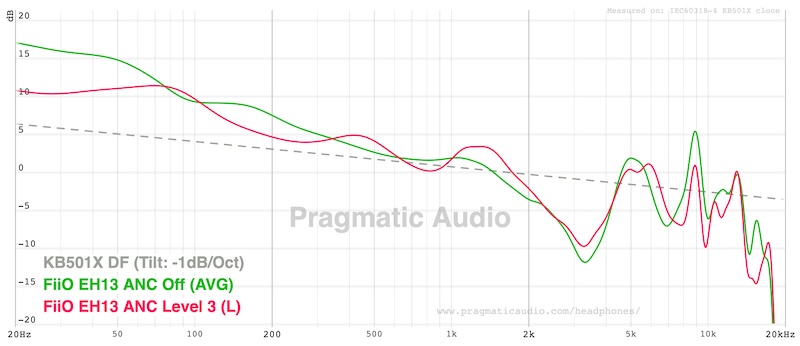
and as I mentioned earlier, I didn’t find the ANC particularly useful in many environments, so I mainly listened with ANC off but with the default tuning FiiO provided ( which was different than the Analog tuning ).
Bass
The EH13’s bass sits on the warmer side of neutral, with a mid-bass presence that gives drums and lower-register instruments a rounded, pleasant fullness. Sub-bass extension is respectable for a closed-back Bluetooth headphone at this price — there is genuine weight and authority when the material calls for it — but it is the mid-bass region that is most assertive, imparting a degree of bloom that can soften the distinction between kick-drum body and sub-bass texture.
On Donald Fagen’s The Nightfly, the tight, extended low end that makes that recording a classic audiophile reference comes through with satisfying authority, though the slight mid-bass warmth gently rounds the edges of the textural detail that a leaner transducer would render more precisely. For a $50 headphone, this is nonetheless impressive low-end performance, and a modest PEQ nudge to tighten the mid-bass brings things into a more neutral balance quickly.
Midrange
The midrange is one of the EH13’s stronger suits. Vocal timbre is largely convincing, with a natural density that avoids the hollow, mid-scooped presentation common in budget Bluetooth headphones. There is a slight forward quality to vocals — they sit a touch closer in the mix than some listeners will prefer — but this gives singers a pleasing intimacy that works well with vocal-led material.
Dire Straits’ Brothers in Arms is worth reaching for here: Knopfler’s voice and guitar carry genuine body and presence, and the instrumental separation, while not exceptional, is coherent enough to follow individual lines without confusion. The one area of note is the upper midrange, where the presence region trails off somewhat earlier than ideal, taking a little of the forward bite off acoustic instruments and electric guitar transients. This is the single most audible tonal characteristic of the EH13 in its default state, and the easiest to address with PEQ.
Treble
The lower treble and presence region — roughly 2–5 kHz — is the EH13’s most significant departure from a neutral baseline. The relaxed presentation in this band smooths over some textural detail in acoustic instruments and dulls the leading edge of transients slightly.
On Nils Lofgren’s Keith Don’t Go, the pick attack and high-harmonic shimmer that make that recording a beloved audiophile reference are present but slightly veiled, lacking the forward snap that a more even-handed response would deliver. Beyond the presence region, the treble behaves well: no objectionable sibilance, no glassy brittleness in the upper registers, and extension is adequate for the price. Cymbals have reasonable shimmer and decay, and the overall treble is inoffensive enough that many listeners will not find it bothersome. A targeted boost in the 3–5 kHz region via PEQ is, however, transformative — it is the correction that unlocks the most of what the EH13’s driver is capable of but at the cost of some dynamic range.
Soundstage and Imaging
Soundstage width is constrained, as is typical for closed-back ANC headphones at this price. The EH13 presents music in a relatively intimate, head-locked space rather than projecting a wide external field, and listeners accustomed to open-back headphones will notice the difference immediately. What the EH13 does well within that intimate frame is imaging — instruments are placed with reasonable precision, and centre focus is solid throughout. On Miles Davis’ Kind of Blue, the positioning of piano, bass, and brass is coherent enough to follow individual instruments without effort, which is more than can be said for some budget wireless headphones that smear the stereo image into an undifferentiated wall of sound. The overall result is a nicely detailed, tonally coherent listening experience — particularly once PEQ is applied — that rewards attentive listening despite its spatial constraints.
Comparisons
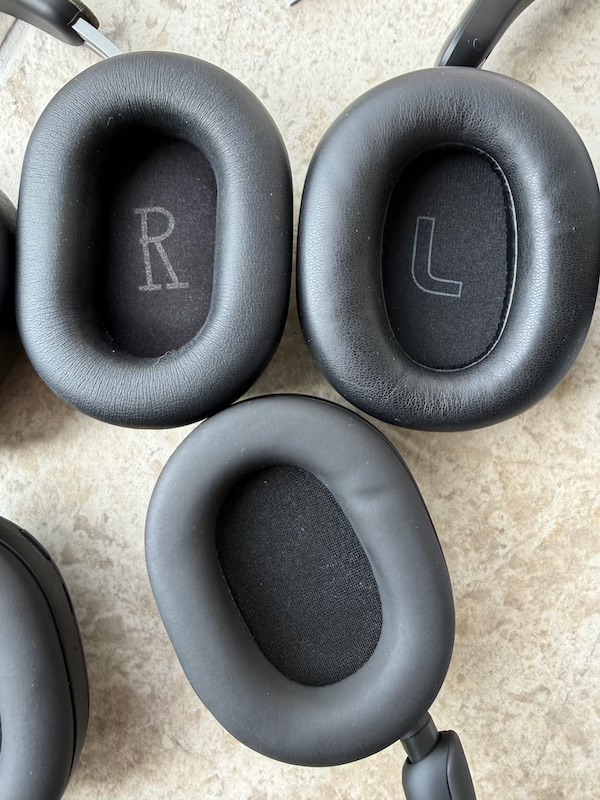
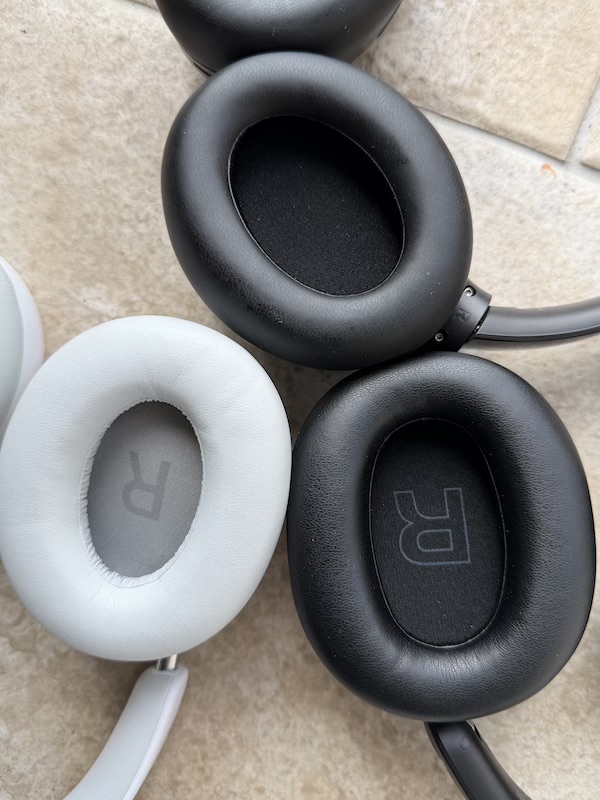
For comfort for me the EH13 is probably the best ANC headphone I have in my collection, this comes down entirely to the size of the earcups, while not having full ‘audiophile’ dimenions they compare very well against the ANC bluetooth competition:
| With Moondrop Edge and Sony XM5 | With the RITA and Roseselsa Cambrian: |
|---|---|
 |
 |
vs. Tanchjim Rita — The Tanchjim Rita is the EH13’s most direct rival, and the comparison is instructive precisely because the two make such different trade-offs.
The Rita has a more neutral default tuning that
requires less PEQ intervention out of the box, and its ANC performance is meaningfully stronger:
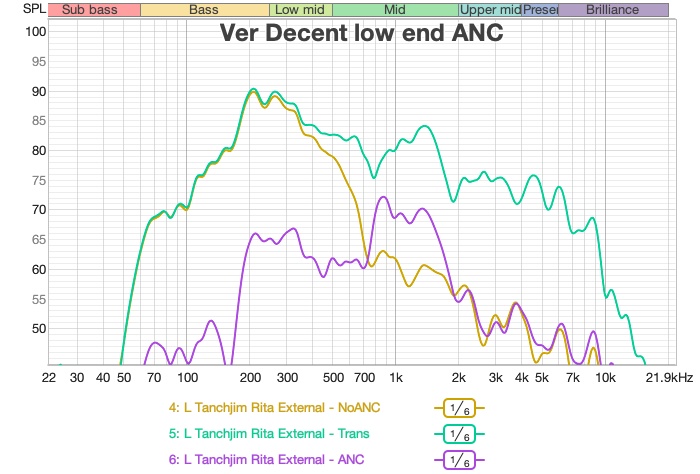
I believe this is at least partly a function of the Rita’s smaller, shallower earcup cavity — which seals more aggressively and creates a more controlled acoustic environment for noise cancellation.
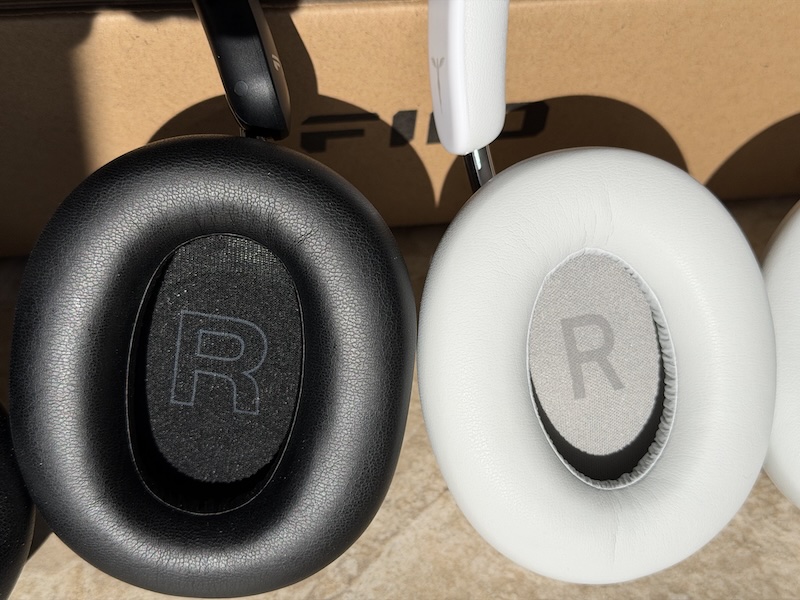
The trade-off is that the EH13 is considerably more comfortable on my larger ears over extended listening sessions precisely because of that deeper, roomier earcup.
Both headphones support onboard PEQ, and once corrected, the EH13 can be dialled into a sound that competes comfortably with the Rita.
The EH13 also undercuts the Rita on price. If ANC performance is your primary concern, the Rita holds the edge; if comfort and value are the priority, the EH13 edges it.
vs. Moondrop Edge — The Moondrop Edge has a strong default frequency response and some genuinely impressive features, though the Moondrop app remains one of the more confusing interfaces in the category, even after the recent update that brought onboard PEQ to the Edge.
For listeners willing to invest a few minutes in EQ calibration, the FiiO is a compelling alternative. The Edge has
similar problems in the ANC department to the EH13 though arguable a little less noisy with ANC enabled:
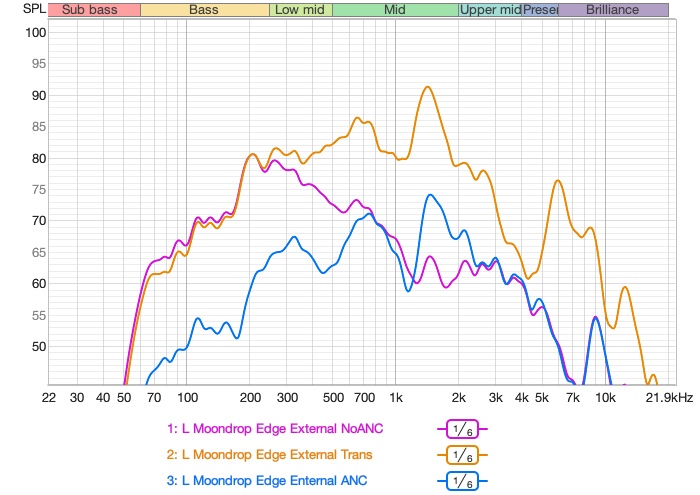
vs. Sony WH-1000XM5 — Comparing a $50 headphone to a flagship is an exercise in appropriate expectations. The Sony WH-1000XM5’s ANC is in a different class entirely — more aggressive, more consistent across frequency bands, and including wind noise suppression that the EH13 entirely lacks. e.g. It is better both passively and actively removing most of the background noise and the ’noise’ it introduces is not audible.
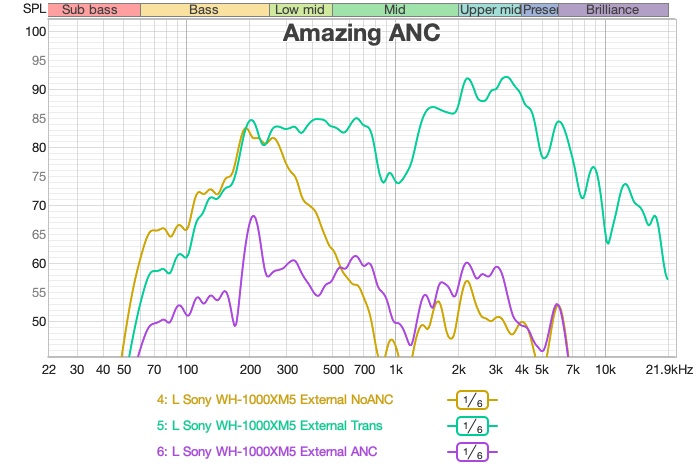
The XM5 also offers auto-pausing when the headphones are removed, sidetone during calls so you can hear your own voice naturally, and call handling that is genuinely superior. The XM5’s default tuning is bass-heavy, but with EQ applied it approaches a more neutral ideal — and here the comparison becomes interesting: with PEQ applied, the EH13 can hold its own tonally against the Sony in a way that is remarkable given the price difference.
The XM5 remains the more complete overall product, but for listeners whose primary concern is musical enjoyment and who can live with the EH13’s ANC limitations, the FiiO delivers extraordinary value at one-fifth the price.
vs. The Ugreen Max5C
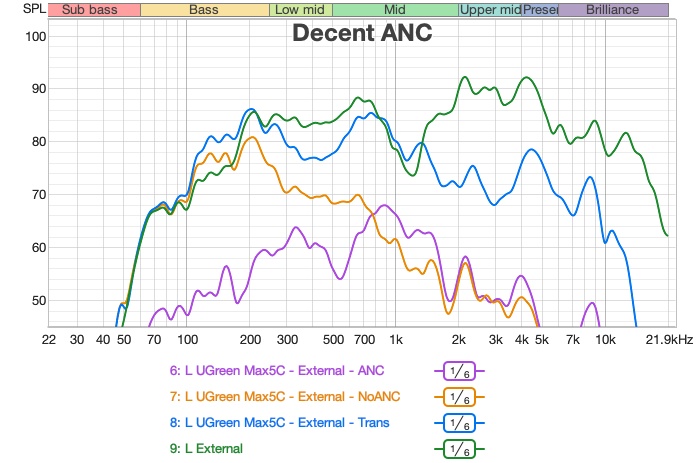
The similar priced UGreen has better ANC but of course lacks PEQ, though its Jazz profile is pretty neutral. Here is the ANC performance:
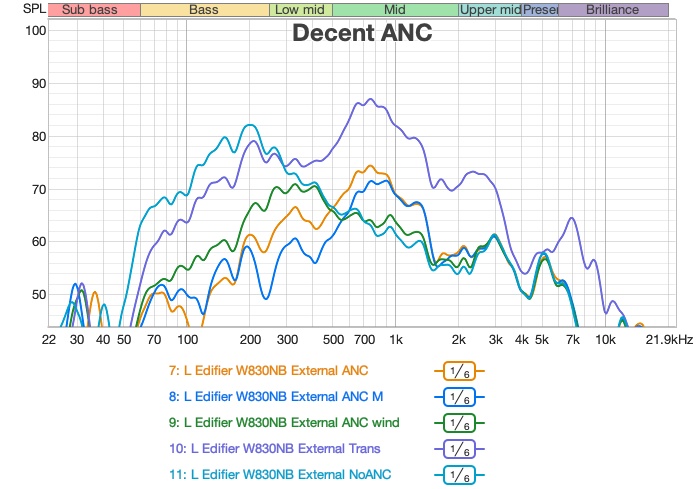
vs. Edifier W830NB The $80 Edifier W830NB which is over a year old now has basic PEQ but has features like Wind Noise cancellation and some decent ANC performance especially if you switch arond the different ANC profiles and is almost as comfortable as the EH13:
Specifications and Measurements
| Specification | Detail |
|---|---|
| Model | FiiO EH13 |
| Driver | 40mm dynamic, sapphire-coated composite diaphragm (sapphire dome + PEEK+PU surround) |
| Frequency Response | 20Hz – 40kHz |
| Impedance | 16Ω |
| ANC | Hybrid feedforward-feedback, up to -42dB, three levels (High / Medium / Low) |
| Microphones | 5 built-in (feedforward + feedback + ENC for calls) |
| Bluetooth Version | 6.0 |
| Codecs | SBC, LDAC (up to 990 kbps) |
| Certifications | Hi-Res Audio, Hi-Res Audio Wireless |
| Battery Life | Up to 75 hours (ANC off) / Up to 45 hours (ANC on) |
| Charging | USB-C, approx. 2 hours |
| Wired Input | 3.5mm TRS |
| Multipoint | Yes (2 devices simultaneously) |
| Sound Modes | Gaming Mode, Cinema Mode |
| App | FiiO Control App (EQ, ANC control, presets) |
| Earcup Pressure | 4.2N ± 0.3N |
| Weight | Approx. 278g |
| Colours | Black, Beige (Cream) |
| In the Box | EH13 headphones, USB-A to USB-C cable, 3.5mm audio cable, quick start guide |
| Price | ~$50 / €55 |
Note: AAC is not officially listed for the EH13, but it does work.
Measurements
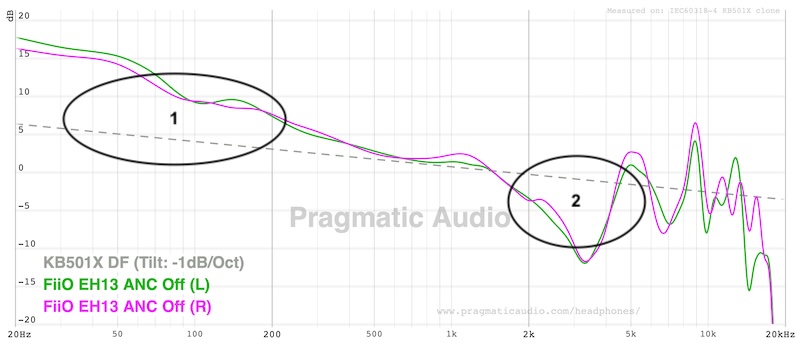
The EH13’s frequency response reveals a headphone that has been tuned with some thought, but with a characteristic
mid-bass warmth and a presence region that sits lower than a neutral target would suggest:
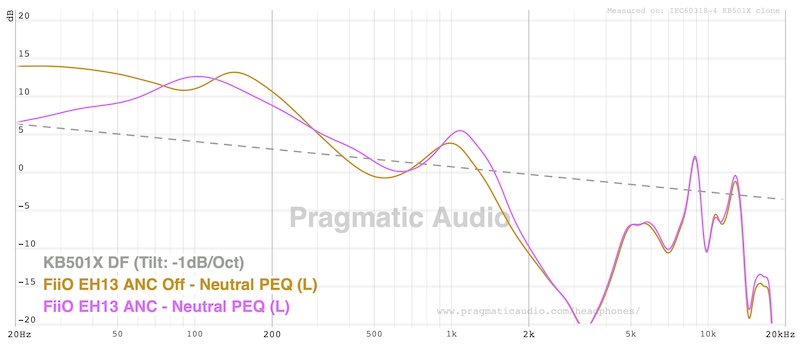
With ‘Analog’ and with PEQ enabled but with a set of flat PEQ filters you get a very different frequency response:
Engaging ANC measurably alters the frequency response, with reinforcement in the bass and some shifts in the mid-frequency range that change the tonal character:
If you intend to listen primarily with ANC engaged, it is worth calibrating your PEQ separately for that mode rather than carrying over settings from ANC-off listening.
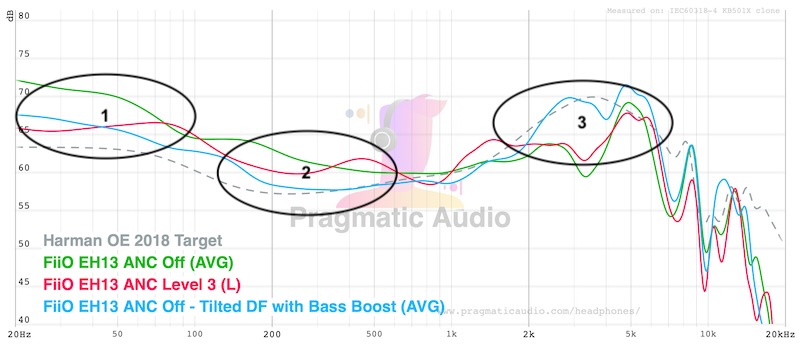
I highlight a few areas were I feel the default tuning with ANC could do with some changes, but remember when you engage the custom PEQ you will loose FiiO ‘out of the box’ PEQ so you should really reference the ’neutral’ No PEQ applied measurements before applying your own PEQ changes.
Note: as a comparison this is the ’neutral PEQ’ comparison with the same on the Tanchjim Rita:
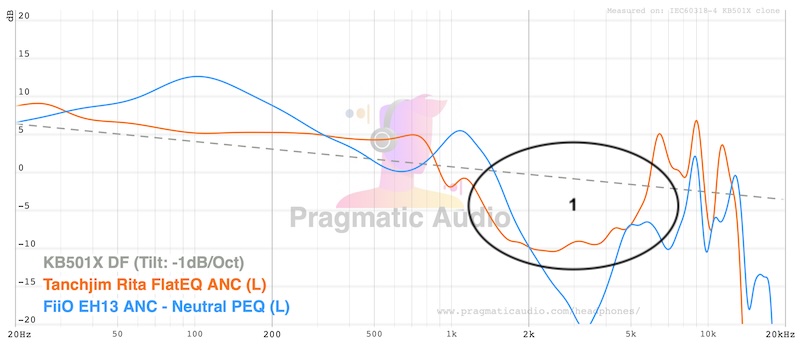
As you can hopefully see the Rita is much easier to move to a neutral tuning than the EH13.
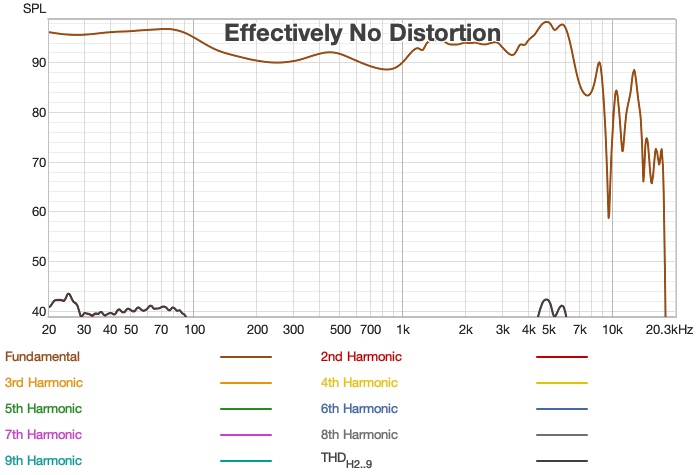
The distortion measurements are genuinely impressive for the price:
 |
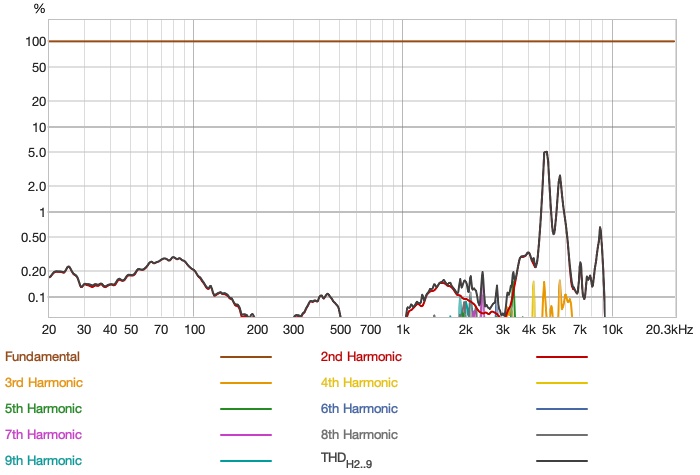 |
Distortion remains remarkably low across the audible range, which is a testament to the driver quality FiiO has deployed here. A clean, low-distortion transducer is an excellent foundation for PEQ correction — you are shaping a capable driver rather than fighting its limitations.
Unit Consistency
Measuring both review units side by side produced a clear result: the EH13 is an exceptionally consistent headphone between samples.
Here is the ANC comparison:
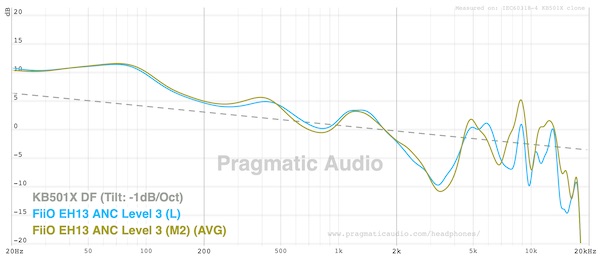
The frequency response tracks closely across both units, confirming that the tuning characteristics discussed throughout this review are reliable and reproducible — not an artefact of a particular sample.
Here is the comparison with no ANC:
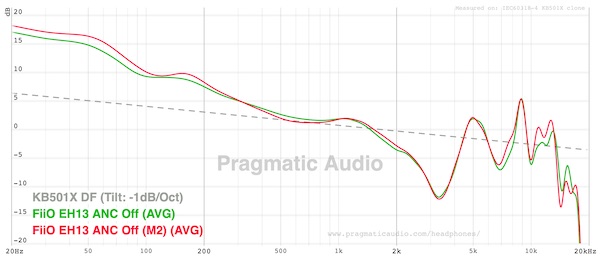
The Neutral PEQ comparison between units is possible the most important measurement in this review as it can allow you to correctly tune your own EH13 via FiiO PEQ. It maps out exactly what correction the EH13 requires to reach a flat, neutral baseline — and the magnitude of that correction is significant.
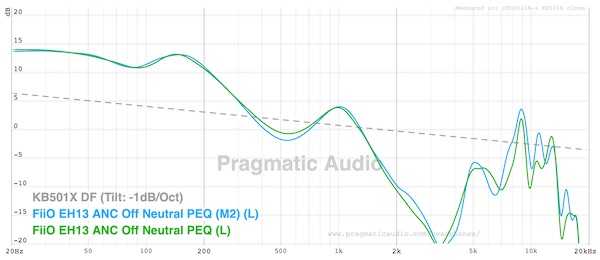
But as I mentioned earlier the required PEQ will not be a light touch: reaching a natural, neutral frequency response from the EH13’s default tuning requires substantial adjustments, particularly in the presence region and upper midrange.
But at least there is a consistent replication of this curve across both units confirms that you can get a consistent change via PEQ.
So, after I played around a little and I mostly found this level of PEQ the most interesting, given the EH13 a
sub-bass boost that matched that upper treble that I didn’t change via EQ as it will be different on everyone head:
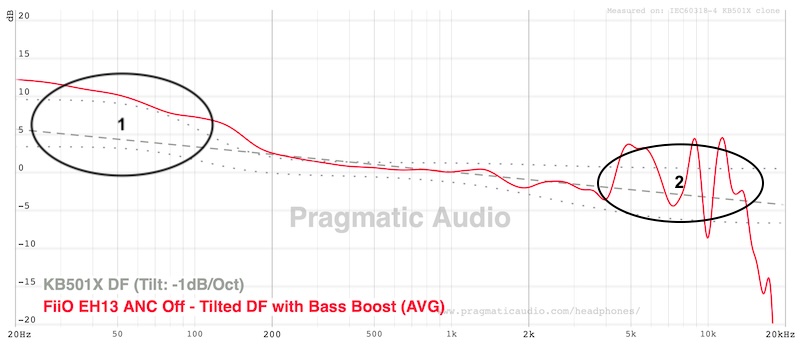
For those looking to apply PEQ without manual calibration, I am pleased to note that an upcoming release of my devicePEQ tool will include support for the EH13, the Tanchjim Rita, and the Moondrop Edge — making it possible to apply a recommended correction directly from a Chrome browser via Web Bluetooth, without requiring any dedicated app.
DevicePEQ is already available for headphone and IEM measurements on Pragmatic Audio; the Bluetooth PEQ capability for these three ANC headphones specifically is coming in the next release.
For web developers interested in integrating PEQ support for their own pages, the Bluetooth integration approach is documented and the tool is open-source and I have a test page available here.
Frequency Response comparisons:
Here are the 3 recent ANC headphones with PEQ capabilities but with their default tuning, the Tanchjim Rita, the
Moondrop Edge and the FiiO EH13:
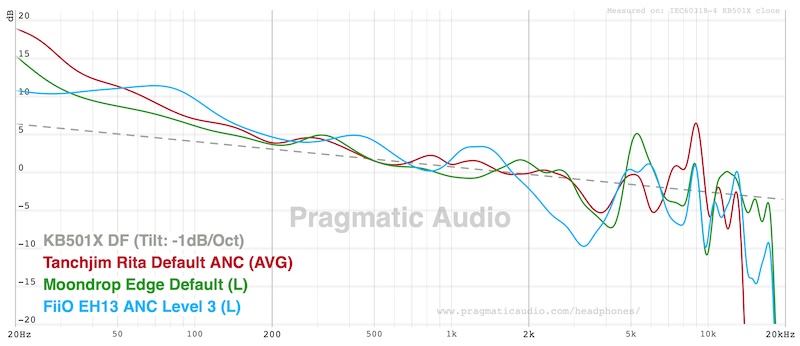
You can see that the EH13 is still not ideal even though FiiO could have made more extensive changes using the on-board PEQ / DSP of the headphone. The Rita is more U shaped and the Edge is probably the most balanced of these 3 headphones. Of course with onboard PEQ you can play around with your own tuning on any of these headphones.
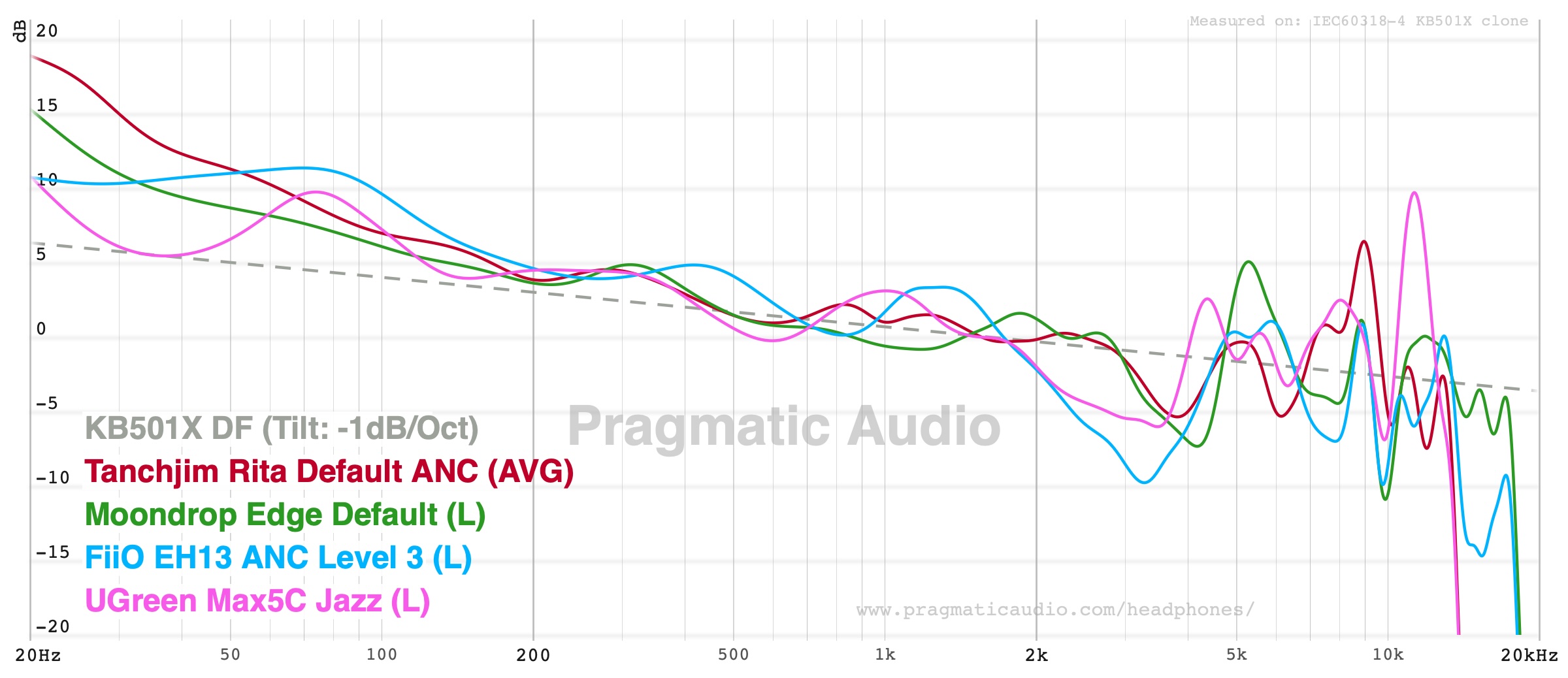
As for other alternatives, I feel the similarly priced UGreen Max5C is still a good option and the Earfun Wave Pro should not be forgotten:
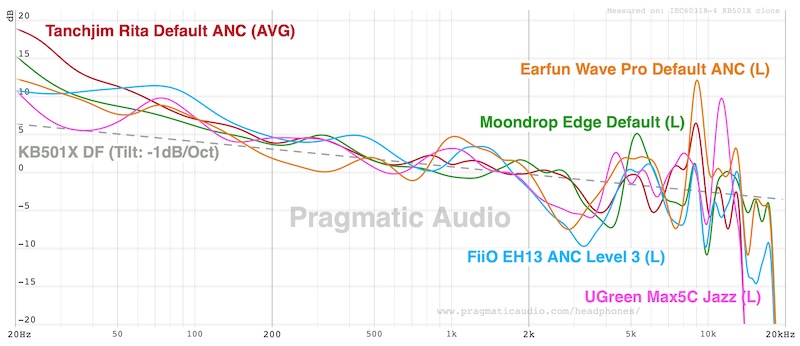
But overall, if you mainly want a super comfortable bluetooth headphone for casual listening around your house and are willing to put some effect into the onboard PEQ of the EH13, I feel this can be an amazing deal for $50.
Rating Explanation
The EH13 earns its price and features ratings of five because it does something genuinely difficult: it combines exceptional comfort, LDAC Bluetooth connectivity, and onboard parametric EQ — all for $50. At this price, any one of those features would be noteworthy in isolation. Together, they constitute a package that is remarkable on specification alone, and the fact that the EH13 undercuts both the Tanchjim Rita and the Moondrop Edge while matching them on core feature parity makes it a compelling value proposition.
The pragmatic rating of four reflects more genuine sense of disappointment, particularly given the company behind this headphone. FiiO has produced some of my favourite recent headphones — the FT7, the FT1, the FT1 Pro, and the JT7 are all products I have admired and used extensively. FiiO is also one of the very few manufacturers that actively champions onboard PEQ across their entire lineup and I believe use measurement rigs as part of their design process, which makes the EH13’s default tuning outcome all the more surprising.
This combined with what I feel is disappointing ANC performance made me give the EH13 only 4-stars though obviously still a great rating but it is a more qualified recommendation than the feature list alone would suggest.
Conclusion
FiiO’s return to the over-ear Bluetooth ANC market with the EH13 is a mixed verdict. The comfort is genuinely exceptional — among the best at any price in this category — and the onboard PEQ is a feature that belongs on headphones costing two to three times as much. The price is extraordinary, and those things are real.
But I find myself slightly disappointed, which is a feeling I do not often associate with FiiO at any price. This is a company capable of producing great sounding headphones out of the box, headphones I consider among the best in their respective categories.
But at $50, the FiiO EH13 is still a headphone worth considering — the comfort alone is worth something, and the driver quality gives PEQ correction real results. But go in knowing that you are buying a platform that needs tuning to reach its potential, not a headphone that sounds the way FiiO’s best products do straight out of the box.