Aiyima DAC-A7
An ES9038Q2M Desktop DAC-Amp with Bluetooth 5.4, LDAC, and 1500mW Under $100
Aiyima have been making affordable desktop audio hardware for years — amplifiers, DAC-amps, and power supplies that consistently punch above their price. I have owned and used several of their products over the years, and my first proper standalone headphone DAC-amp was actually their older DAC-A3 — a unit I still have, and one that served its purpose well when I was getting into the headphone hobby. The DAC-A7 is the natural successor to that idea: the same concept — give someone who has just bought a decent pair of headphones a clean, powerful, versatile desktop interface — executed with considerably more sophisticated hardware.
At $99 (or around €80 on Amazon.de with a discount), the DAC-A7 is built around the ESS ES9038Q2M and Texas Instruments TPA6120A2 chipset combination, paired with four socketed OPA1612 op-amps and a Qualcomm QCC3084 Bluetooth 5.4 module. The result on paper — THD+N of 0.0003%, SNR of 120dB, 1500mW output power, LDAC support — is extremely competitive for the price.
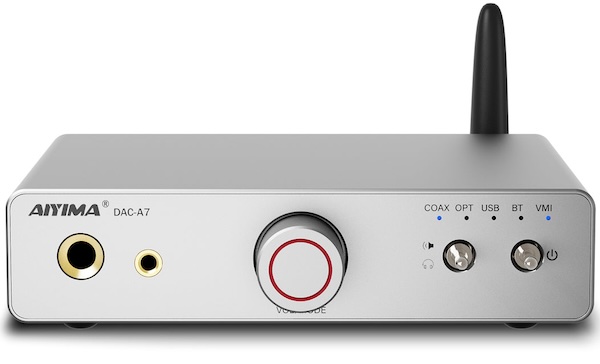
I purchased the Aiyima DAC-A7 on Amazon.de for approximately €80 with a promotional discount applied.
If you are interested in finding more information about this product, you can find it at the official Aiyima product page.
The Aiyima DAC-A7 typically retails for $99.
I have been using the DAC-A7 for a few weeks now, rotating it against considerably more expensive desktop DAC-amp combinations and evaluating it with headphones ranging from easy IEMs to the Sennheiser HD600 and the Hifiman Edition XV. The honest conclusion is that for the price, it is very difficult to fault. Let’s look at what comes in the box first.
Unboxing and Packaging
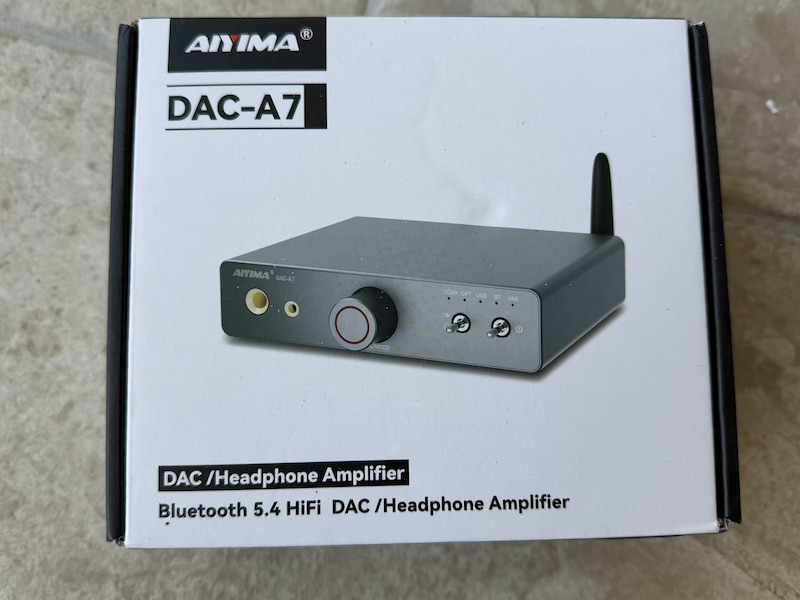
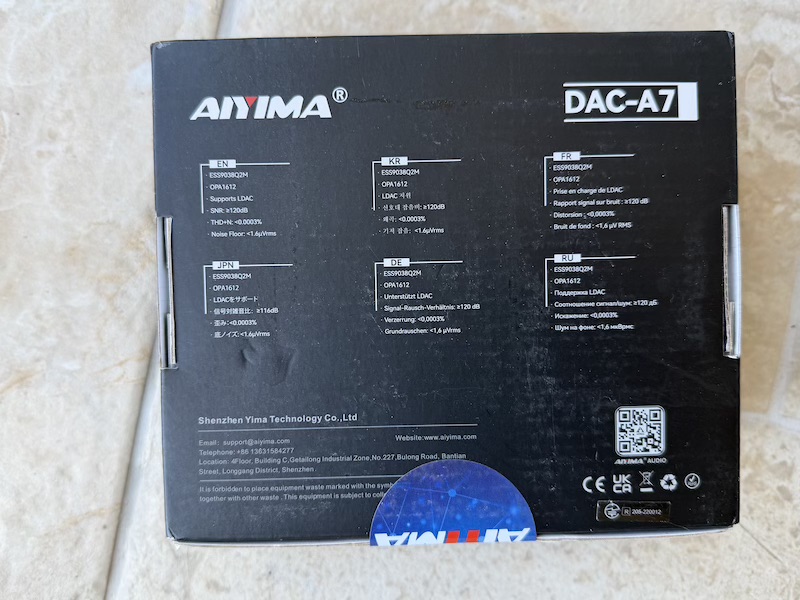
The packaging is functional rather than premium, which is the right call at this price — the money has clearly gone into the internals rather than the box. The outer sleeve and inner arrangement are clean and protective:
 |
 |
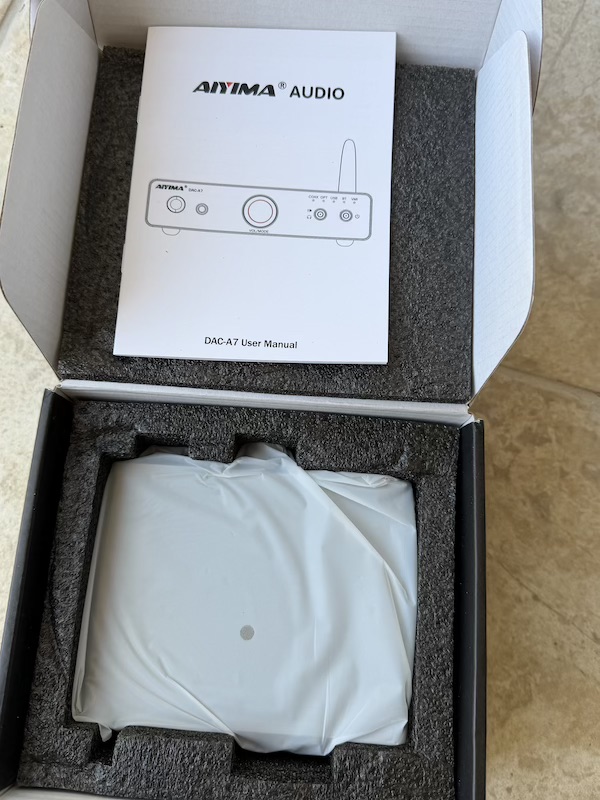
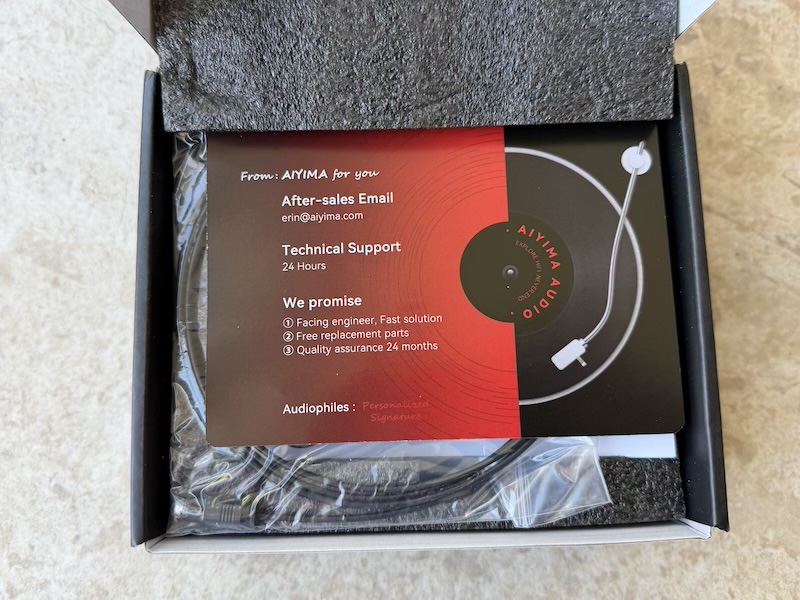
Opening the box reveals the DAC-A7 nestled in foam alongside the accessories and the user manual:
 |
 |
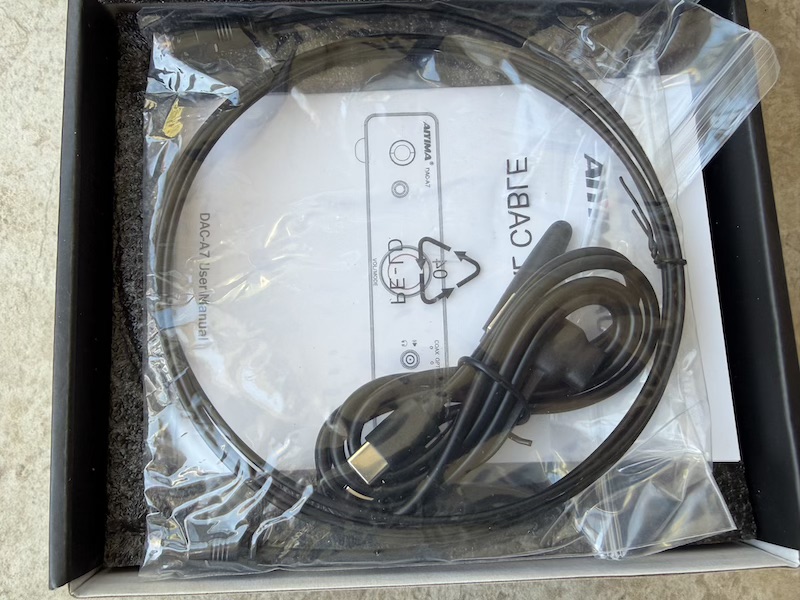
In the box: the DAC-A7 unit, a Bluetooth antenna, a fibre optic cable, and a USB-A/C to USB-C cable. The accessories tray shows everything clearly:
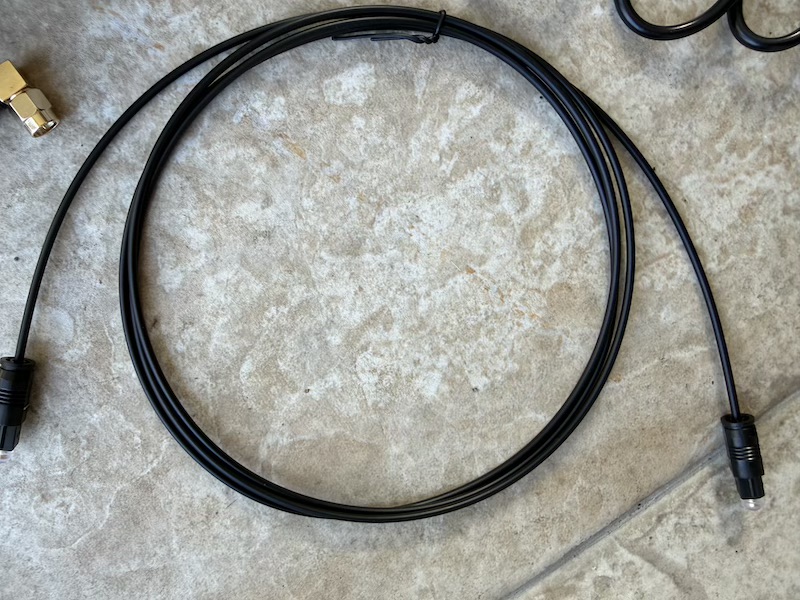
The optical cable is a decent length and perfectly functional for connecting to a TV or CD transport:
 |
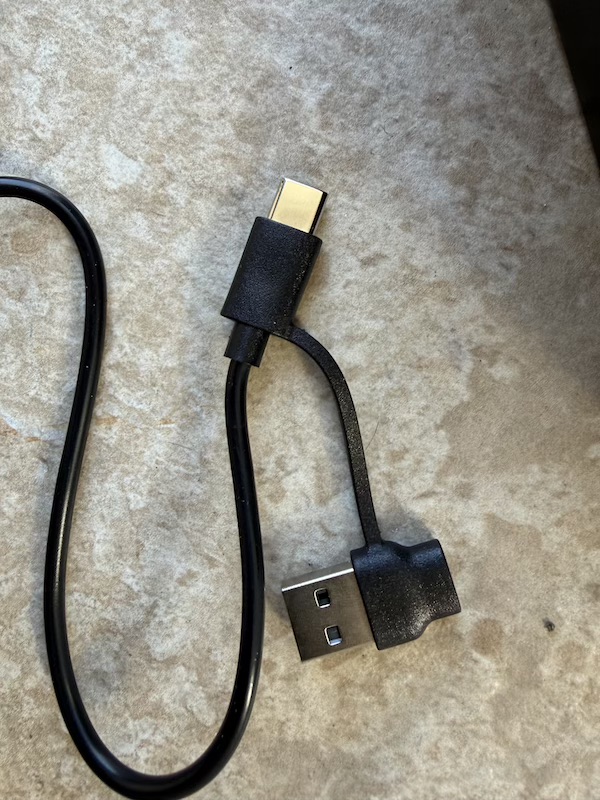 |
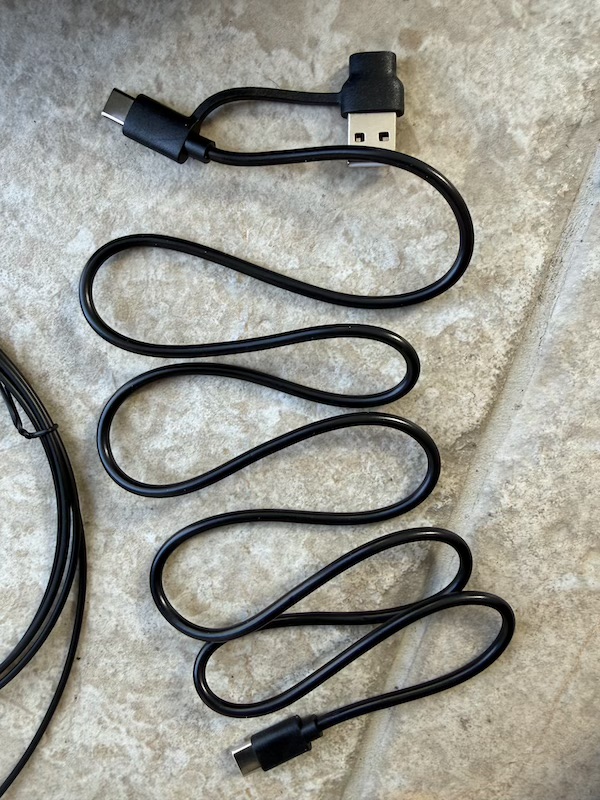
The USB cable takes the prize for being amusingly long — coiled up in the box like a small snake, it is far more generous than most USB cables bundled with similarly priced equipment:
Build Quality
The DAC-A7 is compact at 130×100×30mm and weighs 400g — small enough for any desk corner, light enough that it will not demand attention. The aluminium chassis has a clean silver finish, and the front panel is well-organised with input source LEDs (COAX, OPT, USB, BT, VMI), a headphone/line output toggle, and a power button flanking the central volume knob.
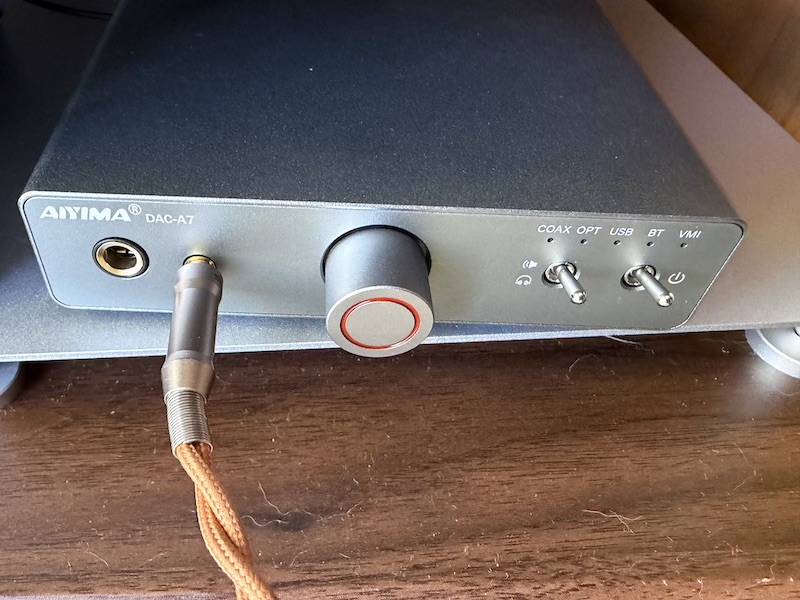
The volume knob is continuous with no physical end stop — a practical annoyance if you want to quickly return to a known level — and the red indicator ring around it lights up when the unit is powered on, which is a neat touch.
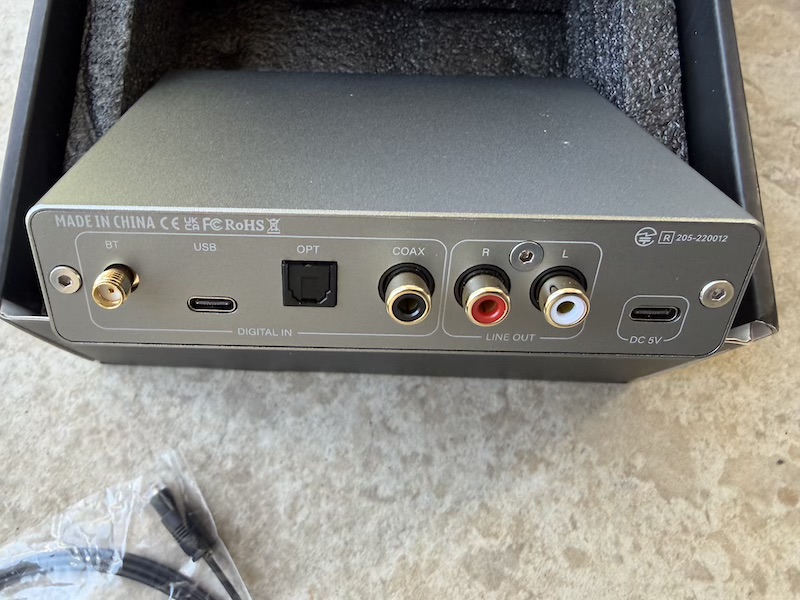
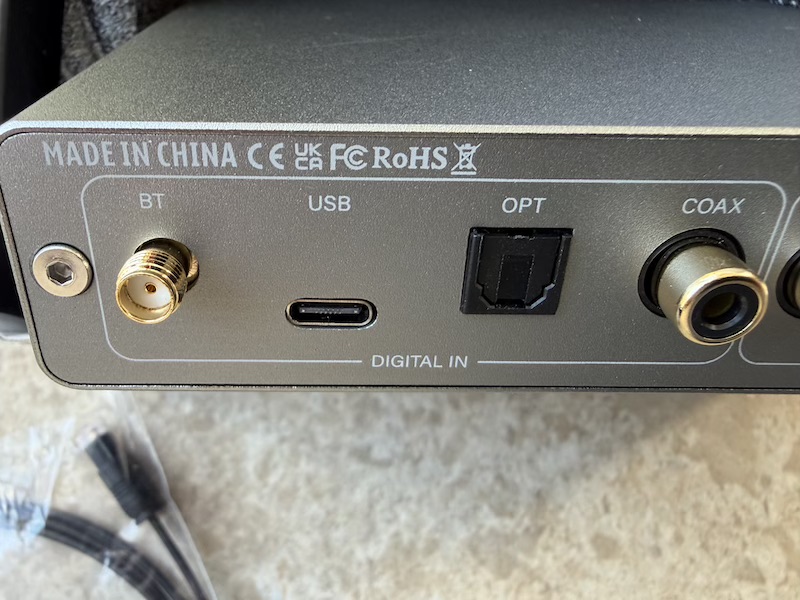
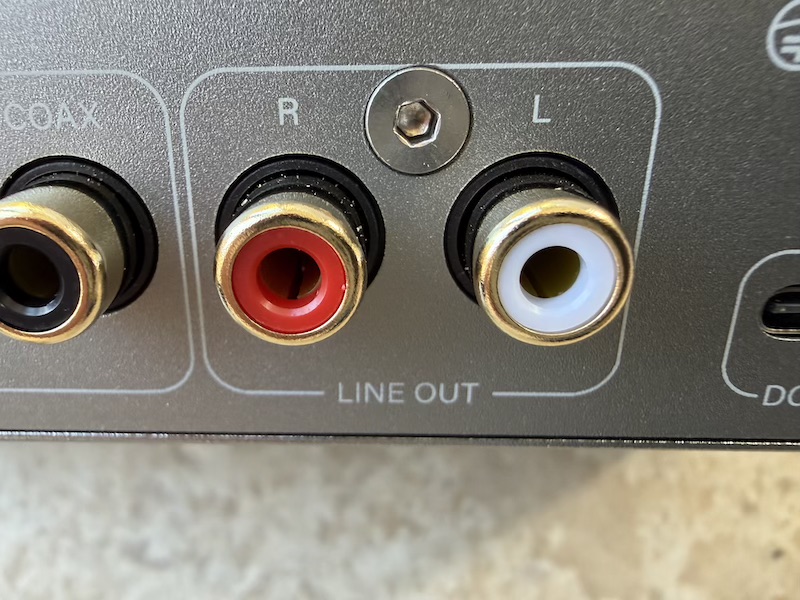
The back panel carries everything you would expect: BT antenna connector, USB, optical, coaxial, RCA line outputs, and the DC power input. Here it is unloaded:
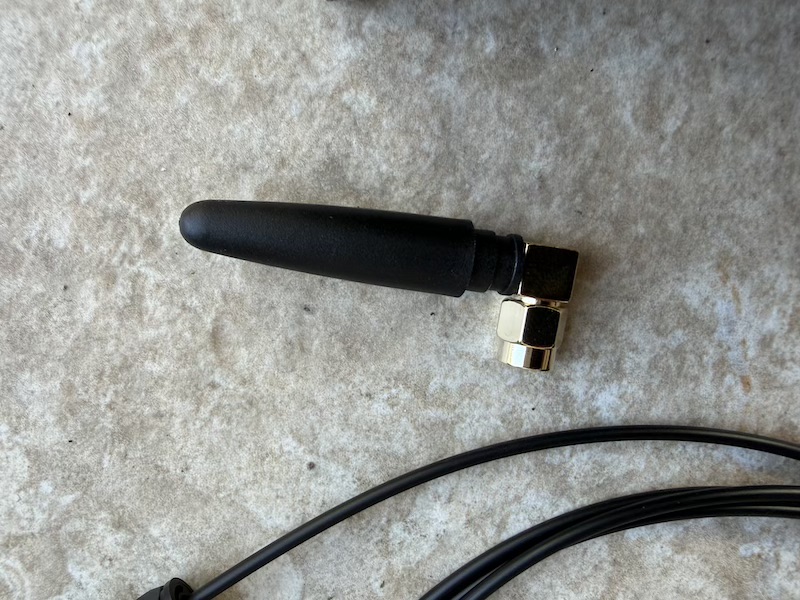
The bluetooth antenna:
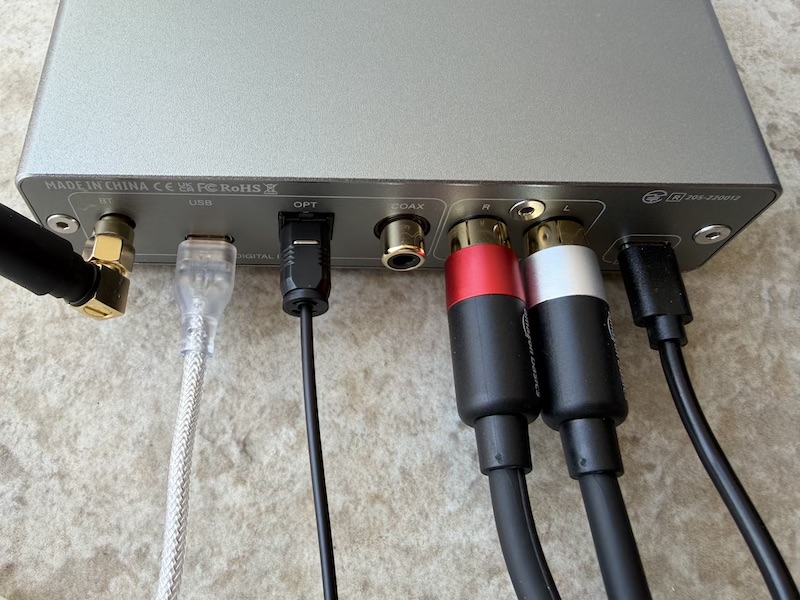
And here it is with cables attached, giving a sense of how the connections sit in a real desk setup:
 |
 |
Here was my test setup with various connections, though I didn’t bother testing the coax connection:
Features
Connectivity and Inputs
The DAC-A7 covers four digital input sources: USB (UAC2, plug-and-play on macOS, Windows, and Linux with no driver required; UAC1 mode available for gaming consoles), optical TosLink, coaxial S/PDIF, and Bluetooth 5.4. There is also a VMI (Variable Microphone Input) source for connecting an analogue input directly to the front panel, adding a fifth source for aux-type connections. Maximum sampling rate on wired inputs is PCM 24-bit/192kHz; Bluetooth via LDAC or aptX HD reaches 24-bit/96kHz.
Bluetooth 5.4
The Qualcomm QCC3084 chip handles Bluetooth duties and supports the full high-resolution codec stack: LDAC, aptX HD, aptX, AAC, and SBC. In practice, switching between USB (computer) and Bluetooth (iPhone) was seamless — the connection established quickly and held stable across a normal desk environment. AAC and LDAC both worked without needing to configure anything, which is exactly how it should be at any price point.
Headphone Amplifier and Op-Amps
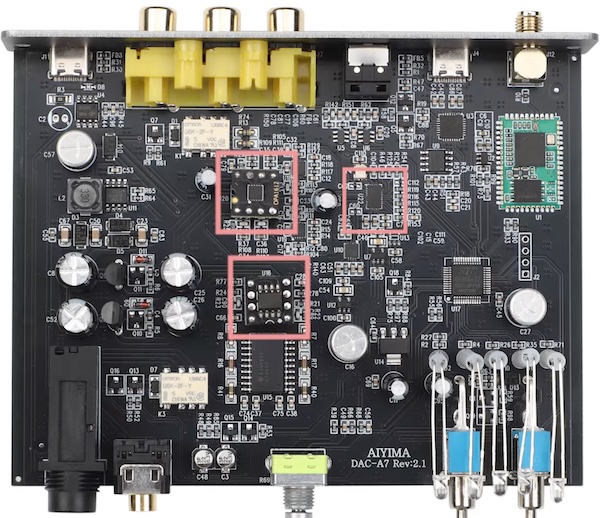
The TPA6120A2 headphone amplifier delivers 1500mW into 32Ω and is designed to handle headphones from 16Ω to 600Ω. Four socketed OPA1612 op-amps handle the analogue signal processing stages — a detail visible in the internal PCB photo:
I did not swap the op-amps during my time with the unit, but the socketed design is something I genuinely appreciate. It means the DAC-A7 can be tuned further by more adventurous owners later — and it signals that Aiyima have built the hardware with a degree of care that goes beyond what the price strictly requires.
Both headphone jacks (6.35mm and 3.5mm) are single-ended, so there is no balanced 4.4mm output:
Preamp Mode and Line Output
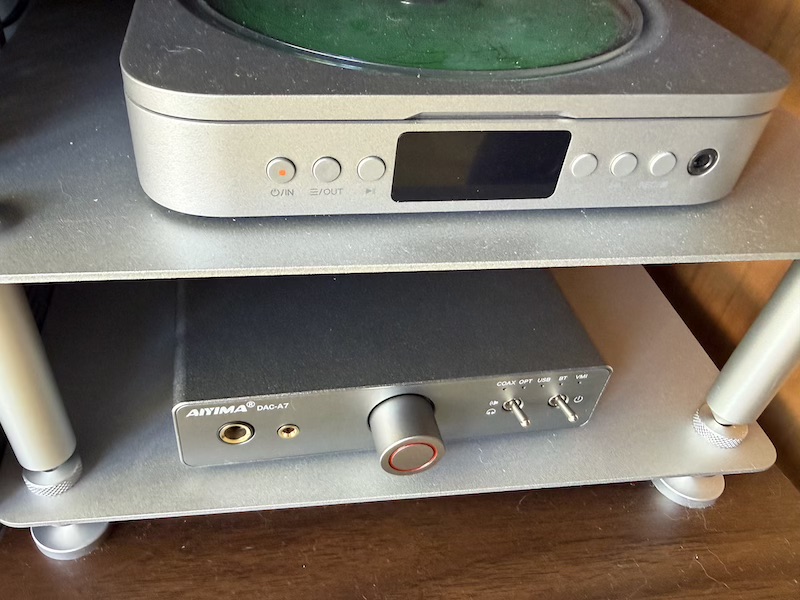
A button on the front panel switches between headphone output and line output (RCA), allowing the DAC-A7 to function as a clean digital-to-analogue converter and preamplifier feeding a power amplifier or active speakers directly. The DAC-A7 can happily sit on a rack with other equipment, so here it is with a CD ’transport’ where the output of the CD is feed directly into the digital input of the DAC A7:
Sound Impressions
All listening was conducted with the DAC-A7 in USB input mode, connected to a computer via the included cable. Headphones used included the Hifiman Edition XV, Sennheiser HD600, and a selection of IEMs. Volume management was done via the front-panel knob in headphone output mode.
Bass
The low end is tight and controlled — there is no added warmth or mid-bass bloom from the DAC stage, which is precisely what you want from a clean, transparent implementation. The TPA6120A2 amp keeps pace comfortably with even the planar magnetics. On “Way Down Deep” by Jennifer Warnes the sub-bass weight is present without bleeding into the midrange, and the Hifiman Edition XV’s planar low end is handled with enough authority that I never felt the need for more headroom.
Midrange
The midrange is neutral and uncoloured. Vocal body and instrumental timbre are accurate rather than flattering — the DAC-A7 does not add warmth or add presence emphasis to make the sound more immediately impressive. It simply passes the signal. On “Fast Car” by Tracy Chapman the guitar texture and vocal sit cleanly in the mix without the DAC stage doing anything to draw attention to itself, which is exactly the right behaviour. The Sennheiser HD600, which can expose any mid-range colouration fairly quickly, sounds exactly like itself — detailed, slightly warm from the headphone’s own character, without any editorialising from the source chain.
Treble
Treble extension is clean and grain-free. There is no glassiness or artificial brightness, and the noise floor is completely silent even with sensitive IEMs plugged in directly — which is the most revealing test for any headphone amplifier stage. “Tamacun” by Rodrigo y Gabriela has enough upper-frequency guitar texture to reveal early roll-off or added edge, and the DAC-A7 handles it without either problem.
Soundstage
Soundstage is appropriate for a neutral, transparent DAC stage — nothing artificially widened or narrowed, just the recording as it was mixed. Image focus is accurate and channel separation is clean. The DAC-A7 does not try to add sonic character, and the spatial presentation reflects that.
Comparisons
I have been comparing the DAC-A7 directly against two very different — and more expensive — desktop DACs, both of which represent the kind of upgrade you might make after starting with something like the A7:
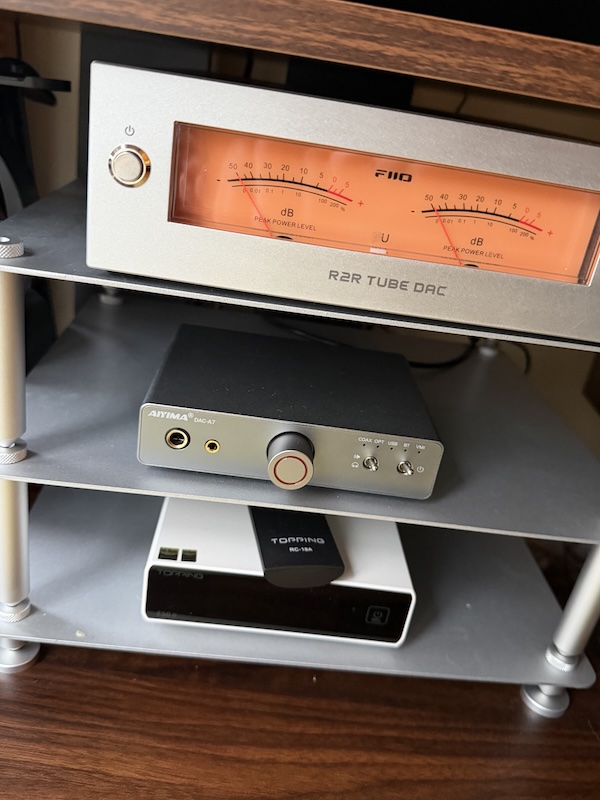
Think of them as two pills pointing in opposite directions: the warm, retro route of the FiiO Warmer (with its R2R and Tubes) causing a very distinctive tonality change, or the clean, ultra-technical route of the Topping. Both are valid in this hobby, but the point hopefully is that the DAC-A7 is the device that gets you into the audiophile game in the first place and could easily be everything you need, these other two are where you might go next, if and when you decide which flavour you want.
Subjectively, the DAC-A7 is not quite as clear-sounding as the Topping E50 II, and of course it lacks the E50 II’s parametric EQ — but at roughly half the price, and with a headphone amp built in, it remains the better bargain for someone getting into the hobby.
FiiO Warmer R2R
The FiiO Warmer R2R DAC takes the opposite philosophy to the Topping: it is a resistor-ladder (R2R) DAC with a tube stage, built to add warmth and character rather than chase outright neutrality. Switched into its NOS mode, the Warmer has an obvious euphonic warmth — the kind of gentle, analogue-leaning colour that the tubes and R2R circuit are there to provide — and it is something the DAC-A7 simply does not try to do. By comparison, the A7 sounds distinctly more neutral; it is the more honest, uncoloured converter of the two. Which you prefer is a matter of taste rather than tier: the Warmer is the route for a listener who wants that tube-and-R2R flavour, while the A7 keeps things clean and accurate.
Aiyima DAC-A3
The DAC-A3 was my first standalone headphone DAC-amp and I still have it. Side by side, the generational improvement is immediately visible: the A7 is larger, more professionally finished, and considerably more connected:
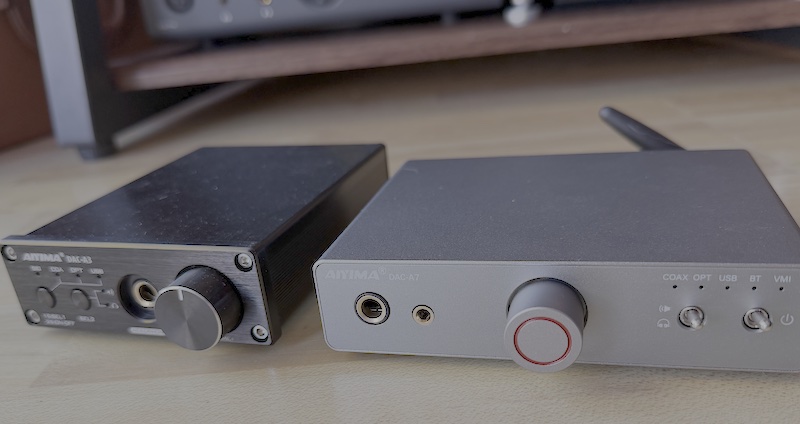
The A7 is an upgrade in every meaningful dimension: cleaner measurements, more input options, Bluetooth, higher output power, and an analogue preamp mode the A3 lacks. But both devices serve exactly the same purpose — giving someone who has just bought a decent pair of headphones a clean, capable interface without asking them to spend much money doing it. The A7 simply does it a lot better.
Topping DX5 II
The Topping DX5 II is the more direct integrated comparison — also a DAC-amp combo — at $299. It adds balanced headphone outputs, considerably higher output power, crossfeed, and a more sophisticated app ecosystem. If you are driving very demanding high-impedance headphones or specifically need the balanced output, the DX5 II is worth the three times higher cost. For the majority of headphones in regular use, the DAC-A7’s 1500mW is more than adequate, and the price difference is very real.
Specifications and Measurements
| Specification | Value |
|---|---|
| DAC chip | ESS ES9038Q2M |
| Headphone amp | Texas Instruments TPA6120A2 |
| Op-amps | 4× Texas Instruments OPA1612 (socketed) |
| Bluetooth chip | Qualcomm QCC3084 |
| Bluetooth version | 5.4 |
| BT codecs | LDAC, aptX HD, aptX, AAC, SBC |
| BT max resolution | PCM 24-bit/96kHz |
| Wired max resolution | PCM 24-bit/192kHz (USB, Optical, Coaxial) |
| Output power | 1500mW @ 32Ω |
| Headphone impedance | 16–600Ω |
| THD+N | <0.0003% |
| SNR | ≥120dB |
| Noise floor | 1.6µVrms |
| Frequency response | 20Hz–20kHz (±0.3dB) |
| Outputs | 6.35mm headphone, 3.5mm headphone, RCA line |
| Inputs | USB-C, Optical, Coaxial, Bluetooth 5.4, VMI |
| Preamp mode | Yes |
| Power | DC 5V/2A via USB-C |
| Dimensions | 130×100×30mm |
| Weight | 400g |
| OS compatibility | Windows 10/11, macOS, Linux, iOS, Android, UAC1 for consoles |
The frequency response is as flat as a standalone line from 30Hz to 20kHz — textbook behaviour from the ES9038Q2M:
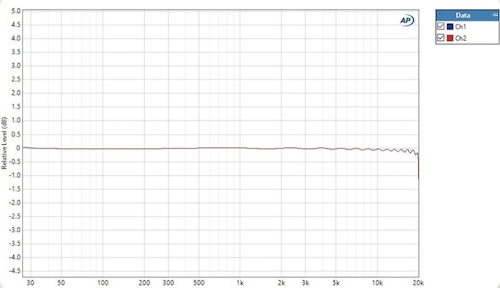
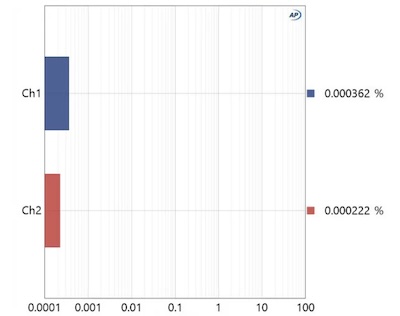
The THD+N measurement confirms the specification’s claims. At 0.000362% on Channel 1 and 0.000222% on Channel 2, the measured distortion lands right in line with the sub-0.0003% figure Aiyima quote. This translates to an effective SINAD of approximately 113dB — a figure that is excellent for any audio product and remarkable for something at this price point:
Rating Explanation
The DAC-A7 earns a pragmatic rating of four — an easy recommendation, but with an honest acknowledgement of what it is and is not. It delivers transparent, clean audio with a silent noise floor, enough output power for the vast majority of headphones, and a connectivity package that covers every common source you would want to connect on a desktop. At €80–$ 99, that combination is extremely difficult to replicate. The socketed op-amps are a thoughtful touch that hints at the level of care put into the design.
The features score of four rather than five reflects what the DAC-A7 does not have compared to more expensive competitors: no parametric EQ, no balanced headphone output, no dedicated app for configuration or fine-tuning. These are not problems at this price — they are simply the honest limits of the product tier. The volume knob without an end stop is a minor irritation in practice, and the lack of a 4.4mm balanced jack is not something Aiyima claims, but worth knowing if you assumed otherwise from product images.
Price scores five without reservation. A measurement-clean desktop DAC-amp with Bluetooth 5.4, LDAC, multiple digital inputs, preamp mode, and enough power for demanding planar headphones for under $100 is genuinely exceptional value.
Conclusion
My first standalone headphone DAC-amp was the Aiyima DAC-A3 — and I bought it for exactly the same reason most people will consider the DAC-A7 today: I had good headphones and needed a clean, affordable desktop interface to drive them properly. The DAC-A7 fills that role at a significantly higher level than the A3 ever could. Neutral, transparent, powerful enough for planars, quiet enough for sensitive IEMs, with Bluetooth 5.4 that just works across devices — and all of it in a tidy aluminium box that will sit unobtrusively on any desk.
If you are looking for your first dedicated desktop DAC-amp, or want to upgrade from a portable dongle to something with proper desktop headroom, the Aiyima DAC-A7 is the obvious starting point. It is the kind of device that removes all the reasons not to listen to music properly.