FiiO SnowSky Oak Nano
SnowSky’s first flagship IEM is the spiritual successor to the FD7
The Oak Nano was originally planned as the FD17 — the direct successor to FiiO’s FD7, a well-regarded single dynamic driver IEM that used a pure beryllium diaphragm. The FD7 was discontinued when the beryllium supply became unworkable: the material is only manufactured in one facility worldwide, in the United States, and lead times had grown to the point that production could not continue.
The Oak Nano is FiiO’s answer to that problem — a beryllium alloy diaphragm that, according to FiiO, performs closer to pure beryllium than conventional beryllium-plated designs, combined with a titanium alloy shell machined to watch-grade tolerances.
At some point in development, the decision was made to release the Oak Nano under the SnowSky sub-brand rather than as the FD17, making it the first flagship IEM in that line at $449. Whether you come to it knowing the FD7 or encountering FiiO’s single-driver flagship for the first time, the Oak Nano is a notable arrival.
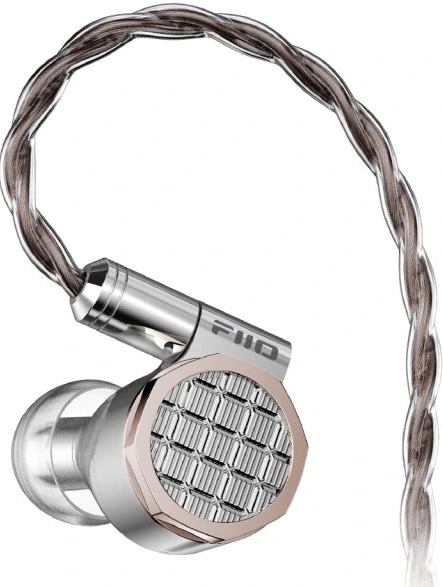
I would like to thank FiiO and SnowSky for providing the Oak Nano for the purposes of this review.
If you are interested in finding more information about this product, you can find it at the official FiiO product page. Note that at the time of writing the Oak Nano had not yet been officially released.
The FiiO SnowSky Oak Nano retails for $449.
I have been using the Oak Nano as my main daily driver IEM for 2 weeks now, fully each day to get a more complete picture of its character than say an evening listening can provide. The first week confirmed some expectations and shifted a few others — in particular, this is a different tuning than the original FD7, while that IEM had a natural slightly V-shaped tuning, but the tuning on the Oak Nano is more inline with some recent FiiO IEMs, I guess more like a modern, more refined version of FiiO ‘House Sound’ — maybe think of it as a better FD15.
But before I get into the sound signature, let’s have a look at the very nice unboxing experience:
Unboxing and Packaging
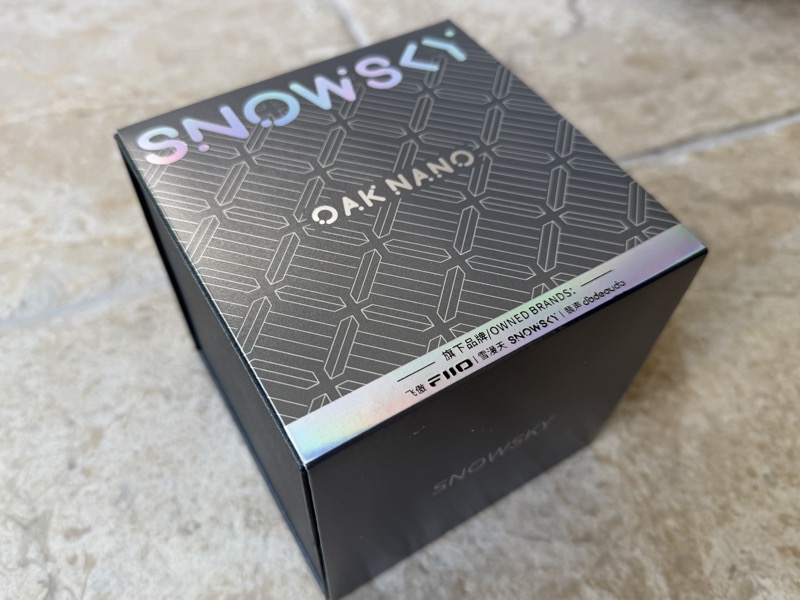
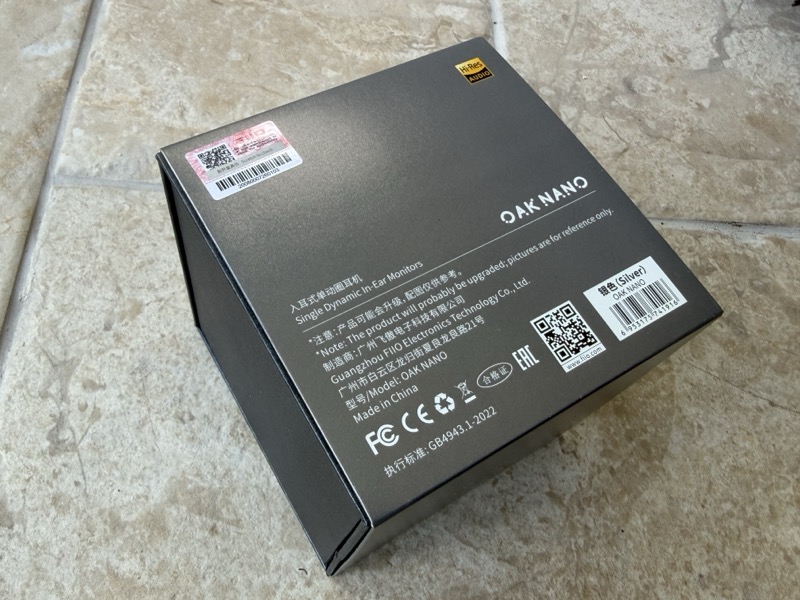
The outer packaging is clean and premium — SnowSky presentation without any excess:
 |
 |
You are immediately presented with the impressive looking box with the snowsky branding on it:
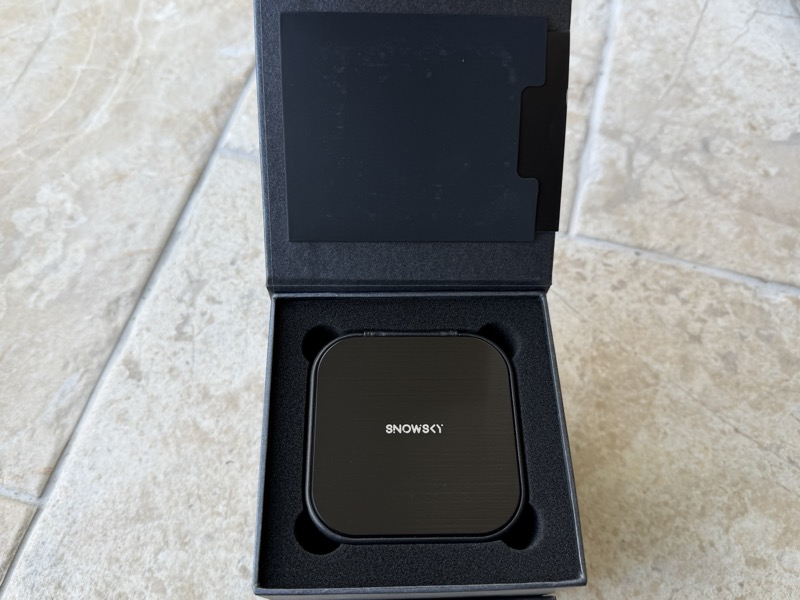
Opening the box reveals the earphones seated in a precisely cut foam interior:
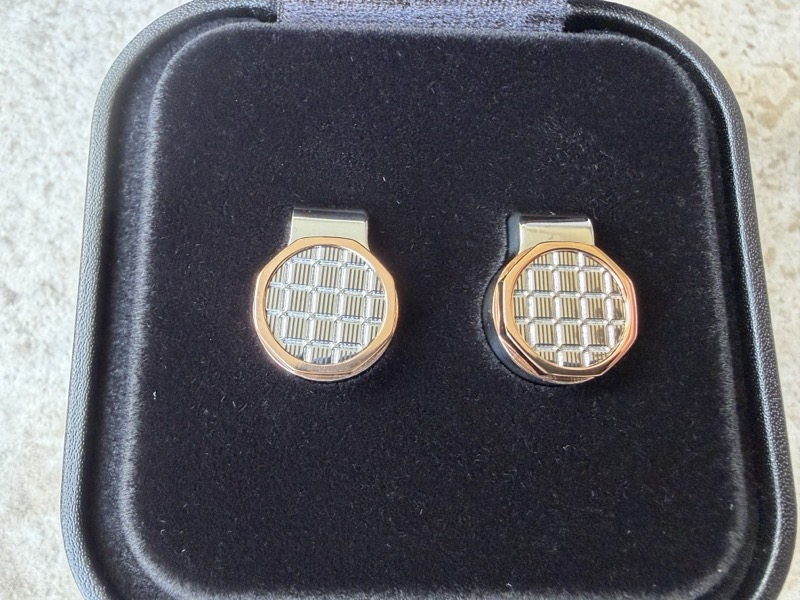
The titanium alloy shell catches light well and looks very premium inside this box.
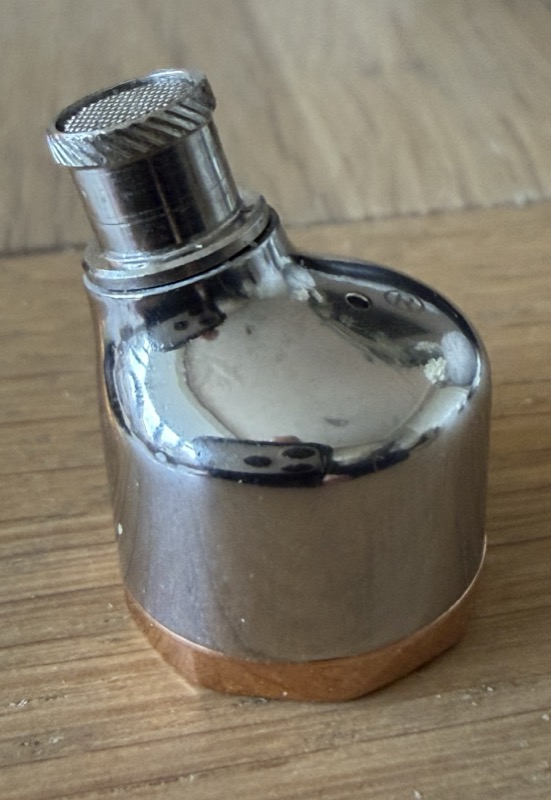
The shell features a precision-machined vent on the rear face — visible here:
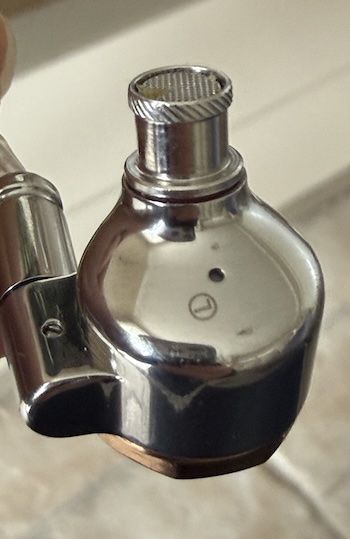
This vented design allows the dynamic driver to breathe more freely, which can contribute directly to a more spatial openness you hear in the sound.
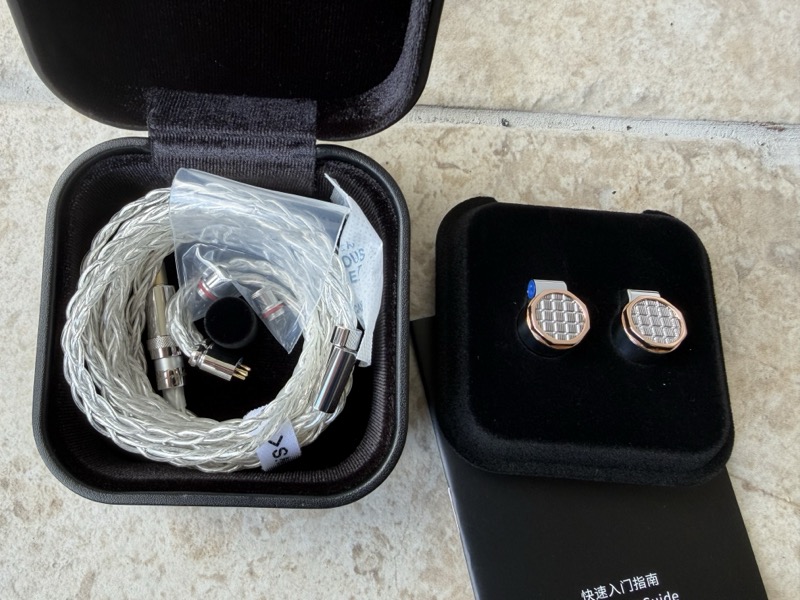
Removing the top you get access to the excellent high-quality cable:
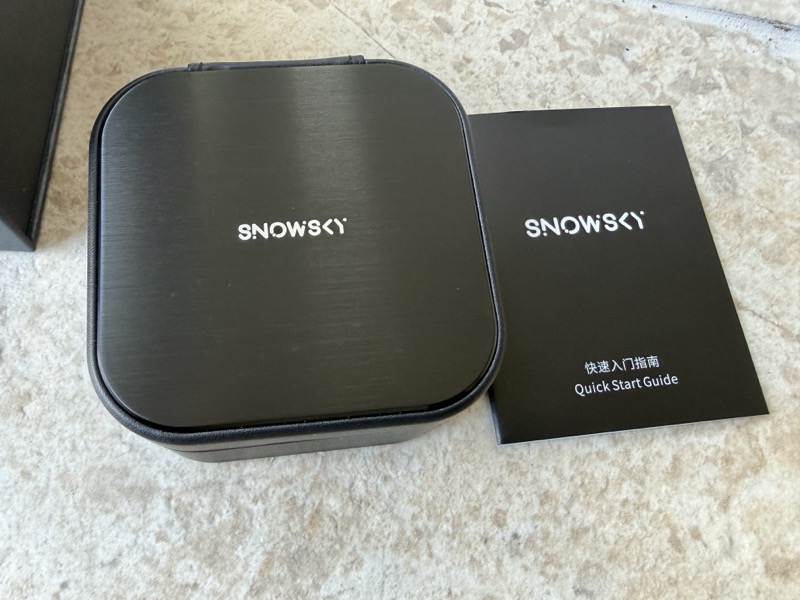
You get a small manual under the box:
Underneath this section of the box you have 2 more ‘drawers’ with extras:
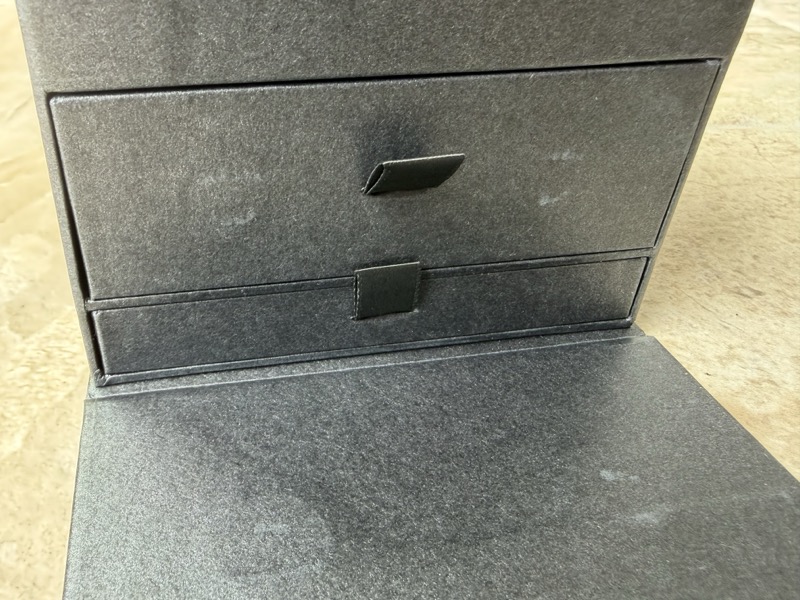
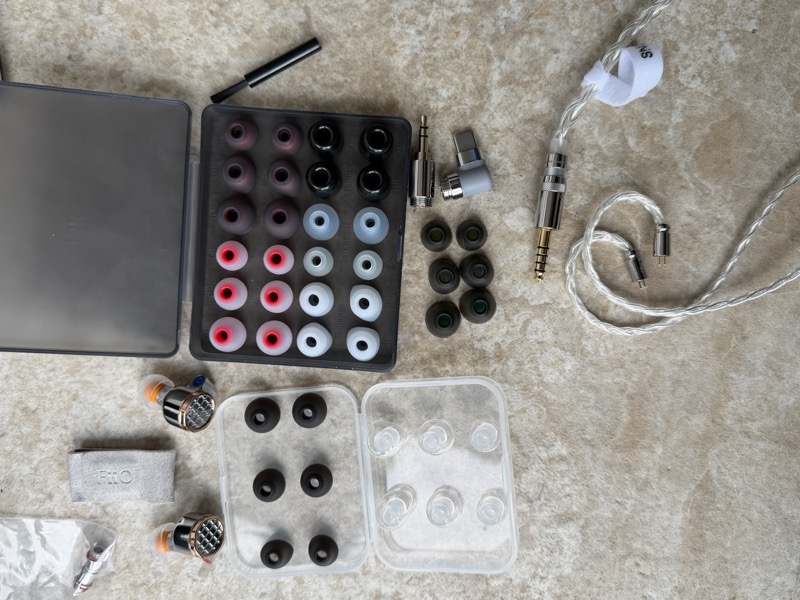
Each layer has lots of accessories:
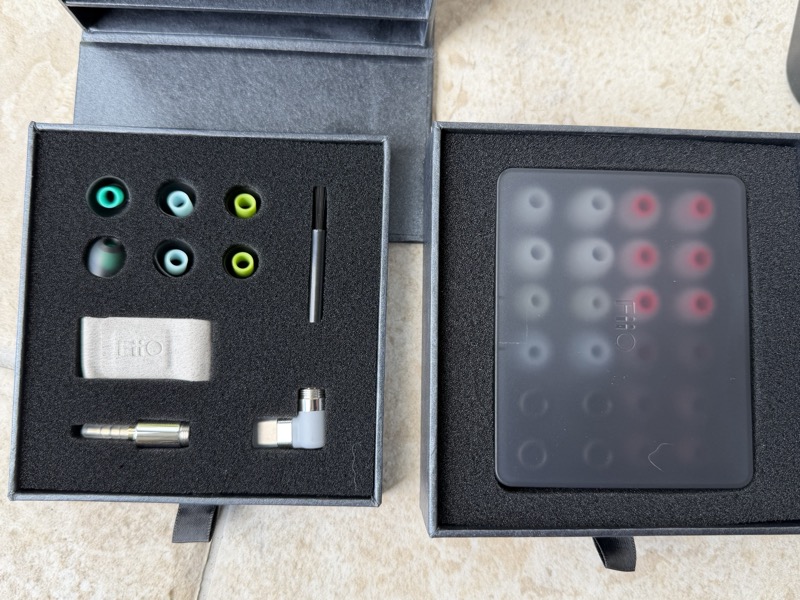
And there is even a second layer of eartips in one of the drawers:
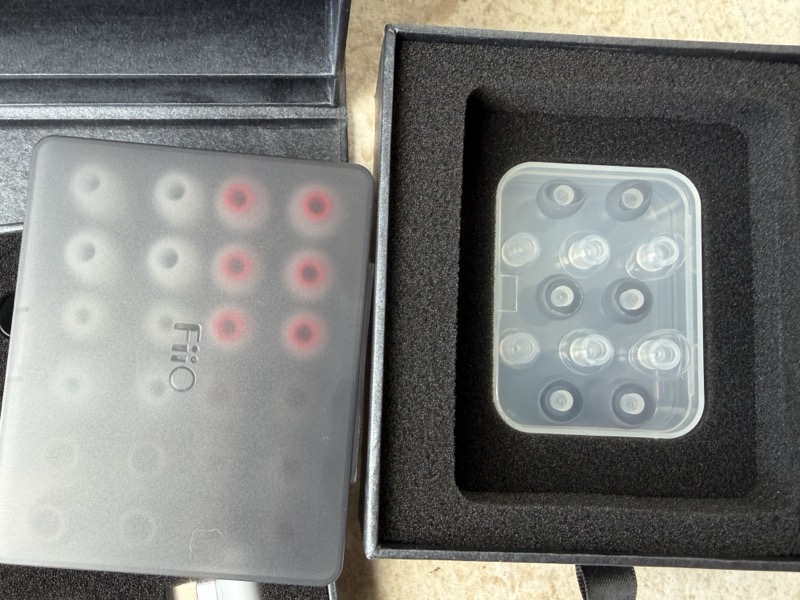
The eartip selection is genuinely generous — one of the better-stocked tip selections I have seen at this price (or any price):
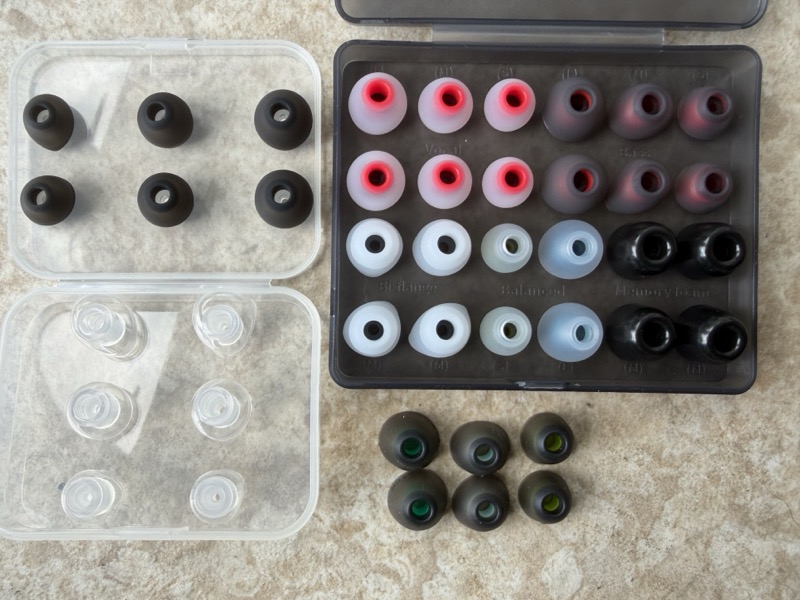
There were also eartips in the drawer with the cable adapters:
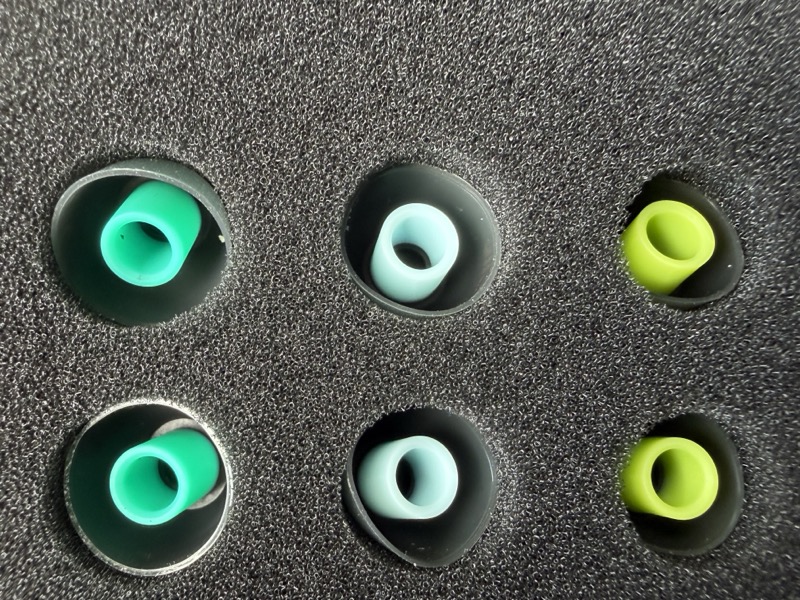
Overall, Snowsky has given you a flagship level of extras with the Oak Nano:
Build Quality and Design
The Oak Nano shell is machined from titanium alloy apparently using watch-grade manufacturing processes:
 |
 |
It is both lighter and more solid than you might expect, so a good quality finish IMO. The shell features multiple vent openings at different positions, not just the single rear vent:
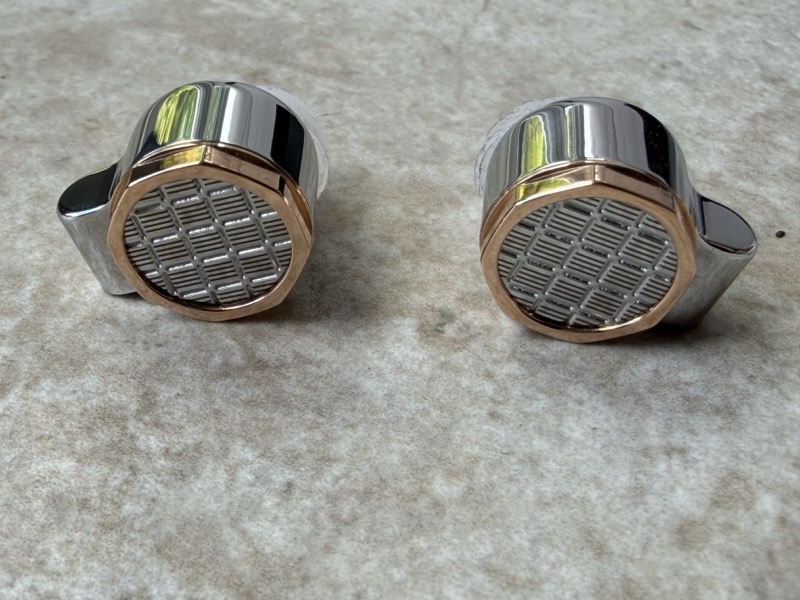
The grille design is the most distinctive visual element, and I think it looks very nice:
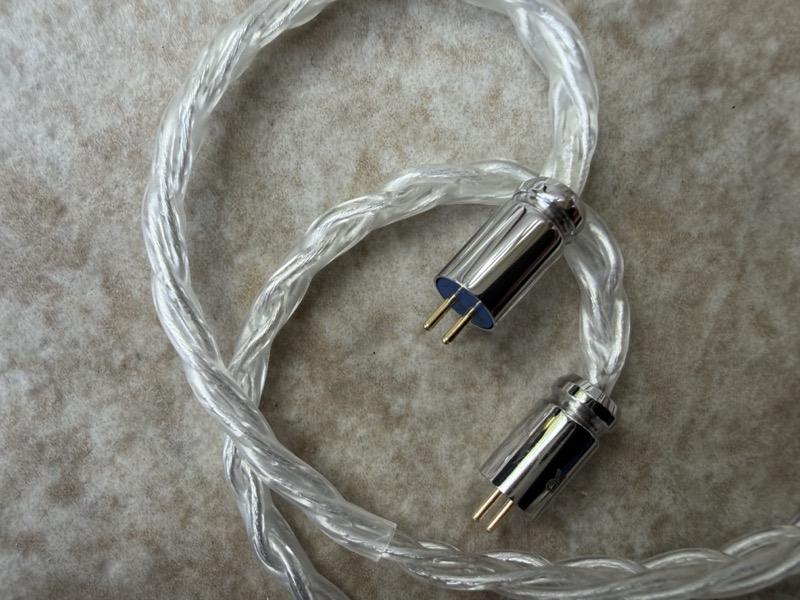
The cable conductors are also very high quality, and I like how they are color coded. The cable includes a chin slider at the splitter for fit adjustment:
Nozzle Comparison: Black vs Red
One of the most practical customisation options included in the box is a second set of nozzles:
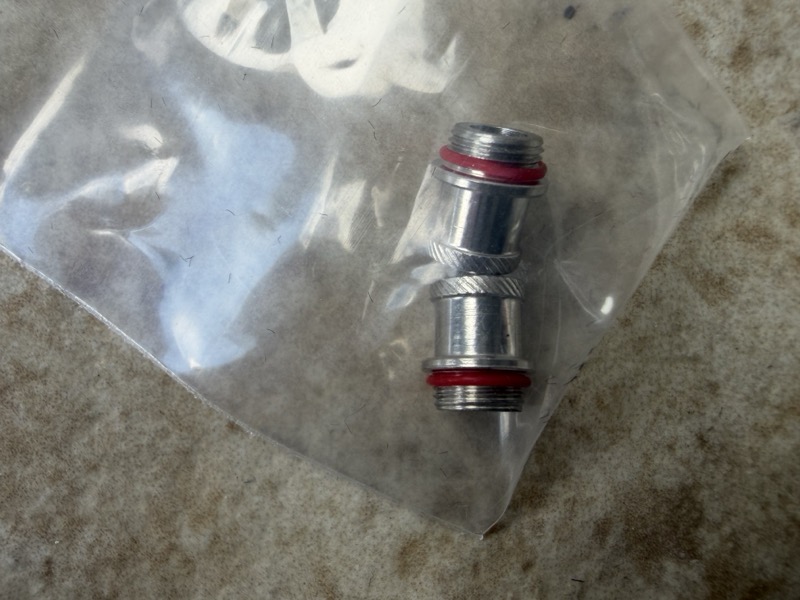
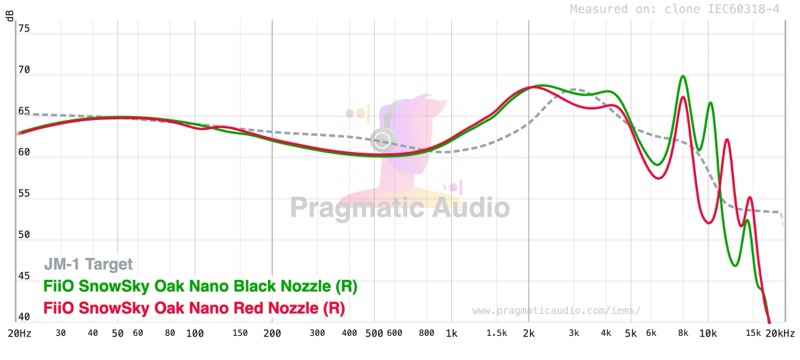
The default black nozzles present the full Oak Nano tuning — including its treble extension. The red nozzles reduce treble energy slightly for a more relaxed and in my opinion, balanced presentation.
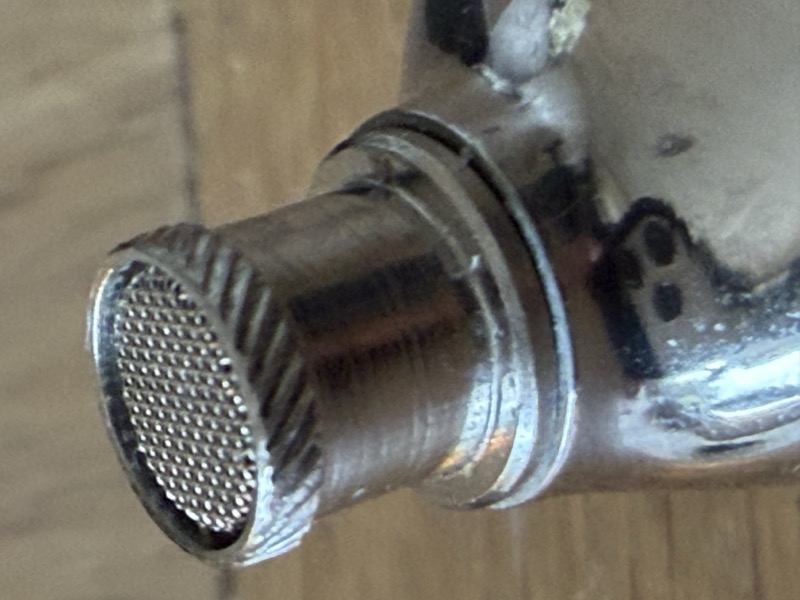
After the first week of use, I actually settled on the alternative ‘red’ nozzles as my daily preference. The extra treble from the black nozzles was not fatiguing, but the red variant brought the tonal balance to what I consider optimal for long sessions. For listeners who prefer a brighter signature, the black nozzles are the obvious choice.
Fit and Comfort
The Oak Nano uses a smaller shell than the trend toward multi-driver designs with large housings that require deep ear insertion or unusual angles. The nozzle angle suits my ears well (as it did with the FiiO FD15), and with the right tip from the extensive selection included, the fit was secure and fatigue-free across full working days.
The titanium shell’s light weight is also a benefit with the lightweight comfort.
Features
The Modular Cable and Adapter System
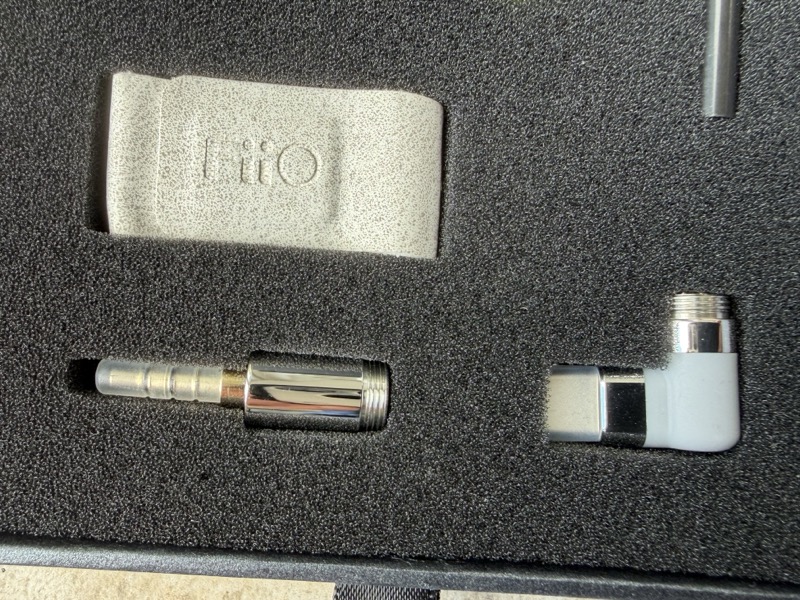
The Oak Nano’s standout feature is its modular cable and three-adapter system; you get 2 alternative adapters in the
accessory box, including a 4.4mm and a usb-c adapter (which has parametric EQ):
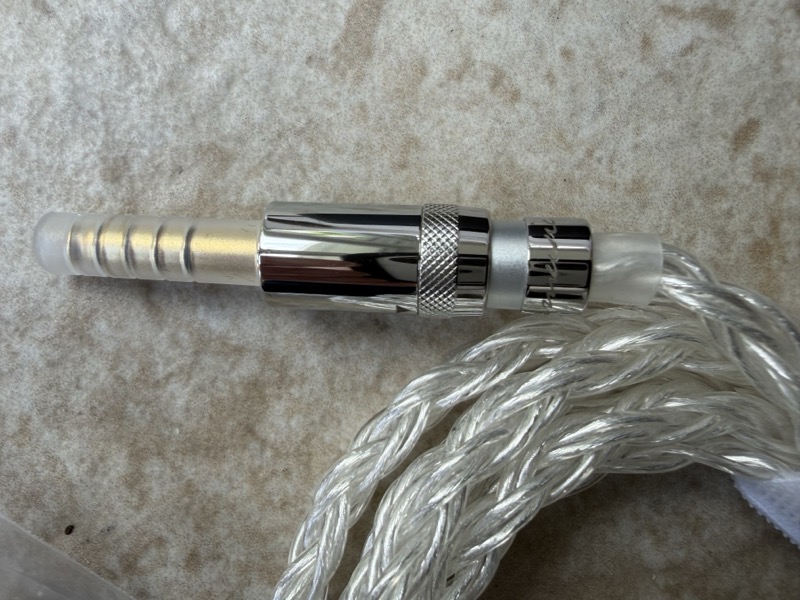
The cable itself with the connector screwed into place:
The usb-c adapter is one of the smallest I have seen, here it is compared to the already tiny Truthear KeyX:
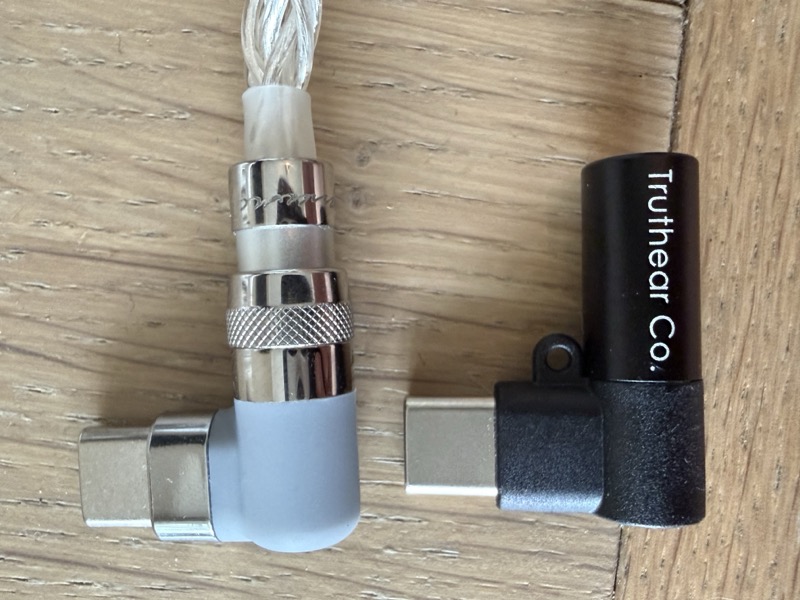
USB-C Adapter with Parametric EQ
I always like to see a USB-C adapter included with flagships and the fact you get Parametric EQ is the genuinely fantastic, I think. I immediately went and enabled this dongle with my DevicePEQ plugin, so support for directly connecting the Oak Nano into various online measurement databases will appear very soon. For listeners who want to align the Oak Nano’s signature with a measurement target, dial in a custom curve, or simply correct the nozzle-dependent treble behaviour, this adapter makes the whole process straightforward.
Sound Impressions
Listening was done across three different setups to get a sense of how the Oak Nano performs from different sources. The primary impressions below are from the 4.4mm balanced adapter into the CrinEar Protocol Max (no EQ). I also spent time with the provided USB-C adapter directly from my iPhone, which is the most convenient everyday carry option and where the built-in PEQ becomes particularly useful. The third setup was the 3.5mm adapter into my MacBook Pro via the Apple USB-C dongle — a common desk listening scenario. All three worked without issue; the Oak Nano is easy to drive and scales gracefully rather than demanding a specific source. Sound impressions below are with no EQ adjustments and using the red nozzles unless otherwise noted.
Bass
Bass extension is solid, with good texture and control through the mid-bass. The low end has genuine weight — this is not a thin, analytical presentation — but it does not overwhelm the midrange that sits above it.
On “Angel” by Massive Attack the sub-bass weight and slow decay are rendered with appropriate authority, and the beryllium alloy diaphragm’s fast transient response keeps the bass textured rather than soft.
Midrange
The midrange is the Oak Nano’s defining characteristic. It is forward — noticeably so — in a way that makes acoustic music, vocals, and instruments with the natural body genuinely engaging.
On “Fast Car” by Tracy Chapman the vocal sits close and immediate, the guitar body is present without being heavy, and the overall sense is of a live performance rather than a recorded one. This tuning is not for everyone: listeners who prefer a flatter, more analytical midrange or a Harman-adjacent response will find the Oak Nano’s presentation too upfront. But for those who like midrange energy — and I am firmly in that camp — the Oak Nano’s character is one of the more enjoyable I have spent time with at this price.
Treble
With the black nozzles, treble is present and extended — there is sparkle and detail, and the beryllium alloy diaphragm’s high-frequency resolution is evident on “Tamacun” by Rodrigo y Gabriela, where the upper-register guitar attack arrives cleanly and with body.
With the red nozzles, the treble pulls back slightly to a more balanced level relative to the midrange, which is where I ended up for daily use. Neither option is harsh, but the black nozzles are the sharper tool and the red nozzles are the more comfortable long-session choice for most ears.
Soundstage
For a single-driver IEM, the Oak Nano’s soundstage is pretty great. The multiple vent openings across the shell — not just the single rear vent — allow the dynamic driver to breathe more freely than a conventional sealed design, and I believe this is a significant contributor to the open, wide character I kept noticing during extended listening. The result is a spatial presentation that feels considerably more open than the form factor usually allows.
Imaging is precise, and the mid-forward tuning contributes to a stable, well-defined centre image — vocals and solo instruments are cleanly positioned. Width and instrument separation are both among the strongest I have heard from a single DD IEM at any price, and the effect is one of the things that makes extended listening sessions genuinely enjoyable.
Comparisons
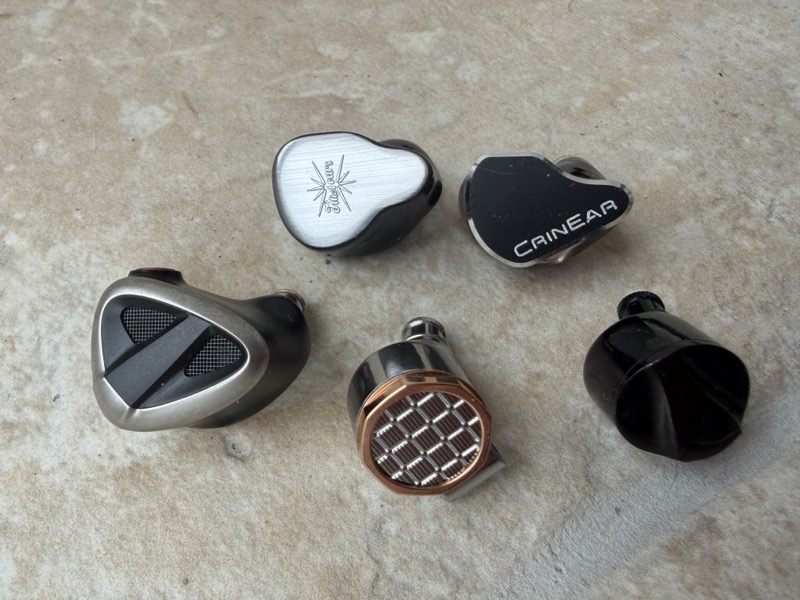
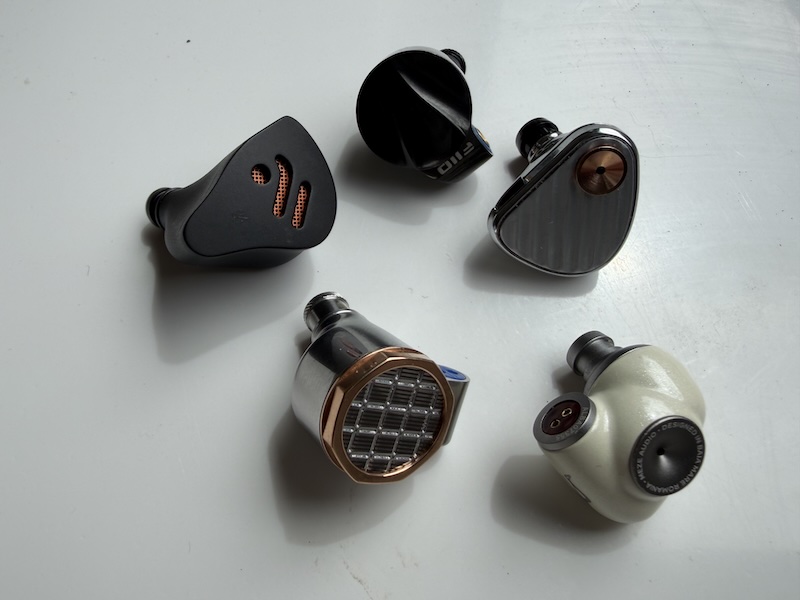
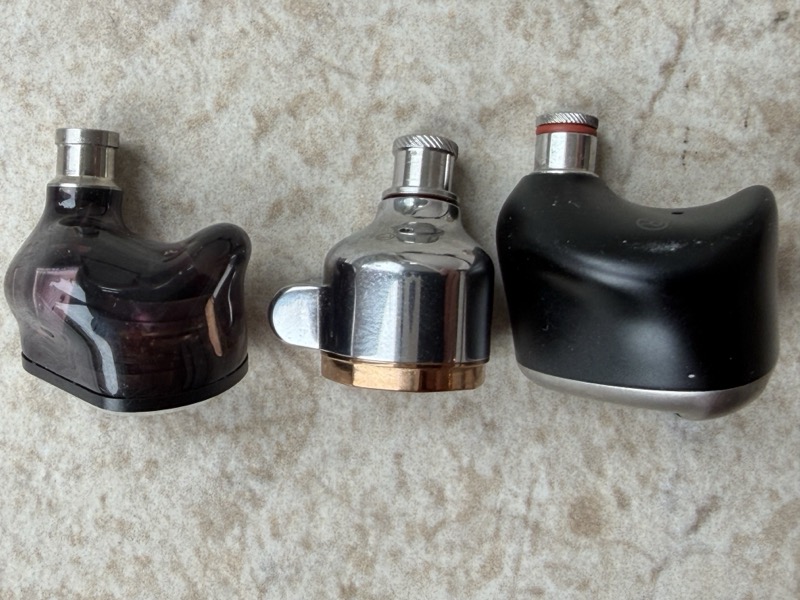
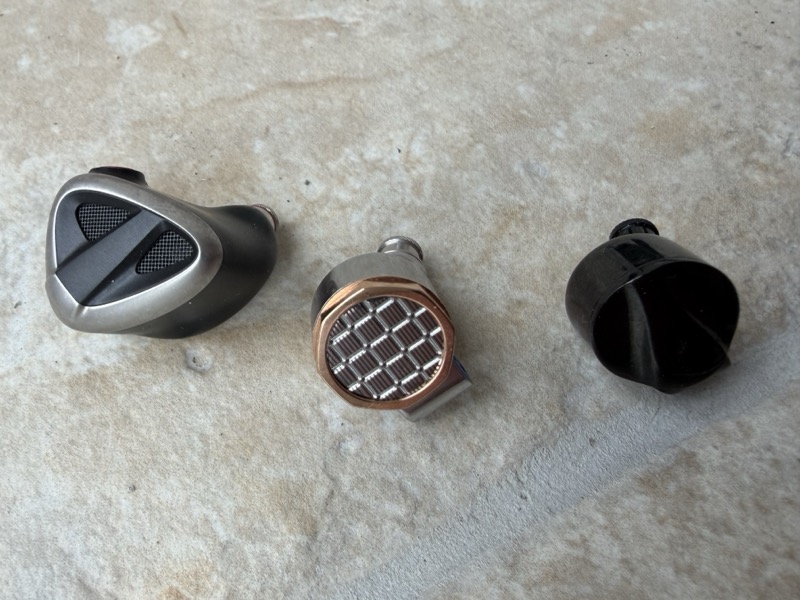
The group comparison below puts the Oak Nano alongside a few other IEMs, the Crinear Daybreak, FiiO FH19, FD15, KiwiEars KE4 and then also with the Fosi Audio IM4 and the Aune IR300 to show the range of shell sizes and designs:
 |
 |
Some close comparisons:
 |
 |
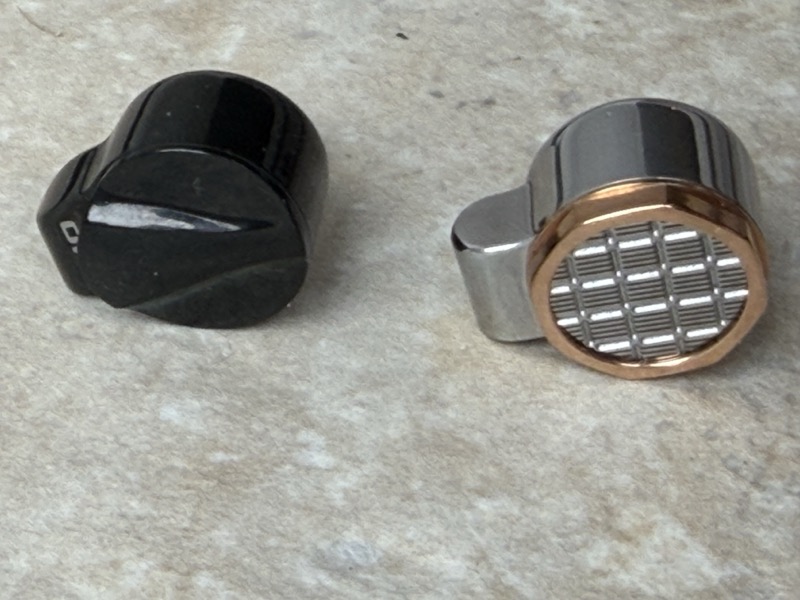
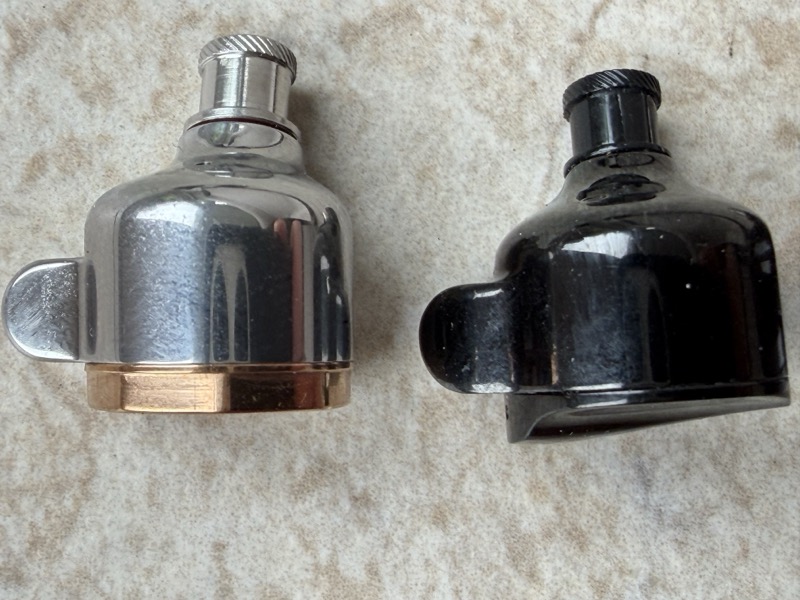
FiiO FD15
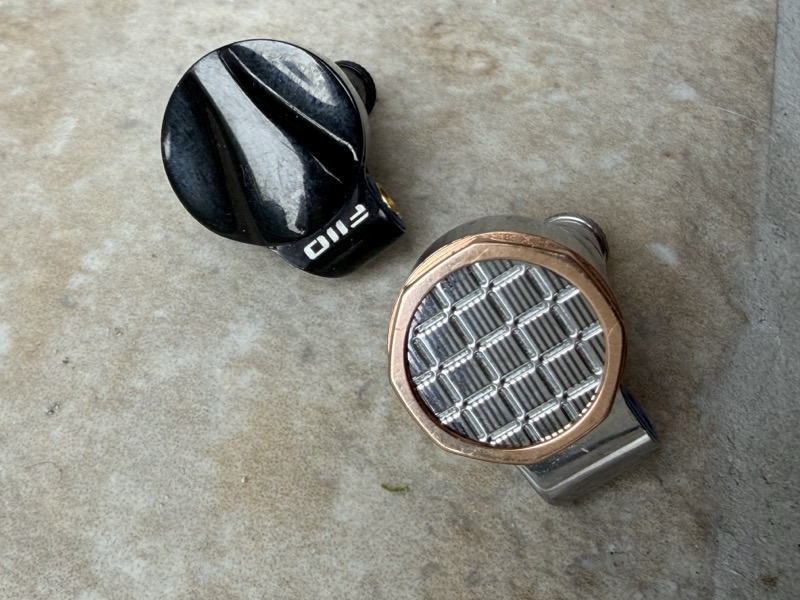
The FiiO FD15 uses a magnesium/aluminium alloy shell and a different diaphragm material — the Oak Nano moves up to titanium alloy construction and the beryllium alloy diaphragm, with a correspondingly higher price.
 |
 |
| ————————————————————————————— | —————————————————————————————– |
 |
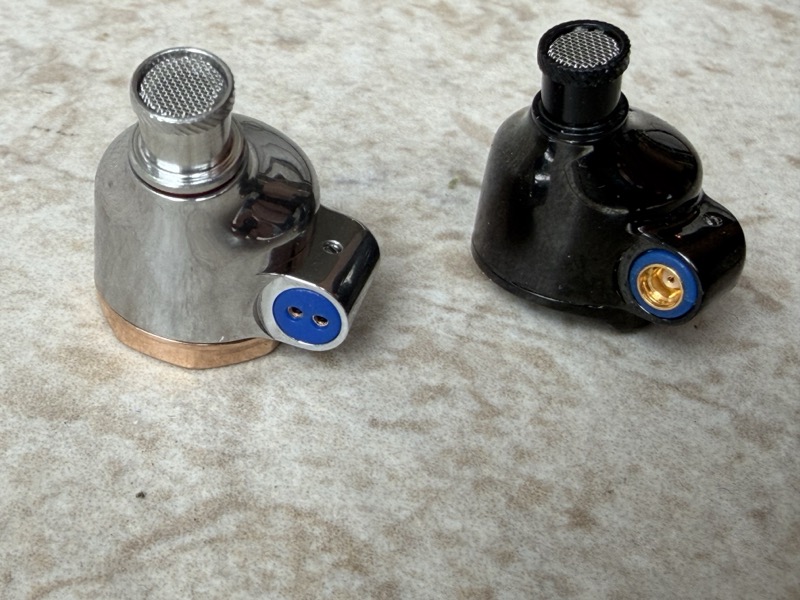 |
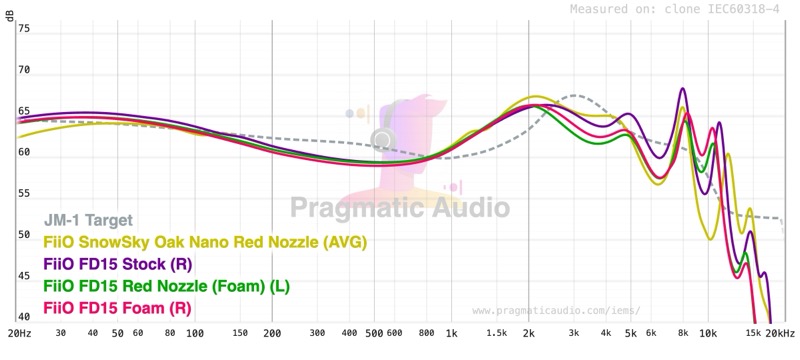
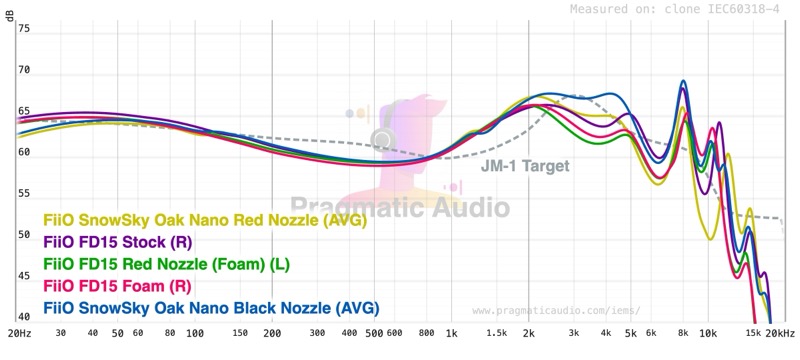
Sound-wise the Oak Nano has a somewhat similar tuning with that FiiO midrange ‘House sound’ but to my ear slightly mid-forward and spatially open, while the FD15 is the more conventionally balanced option. At roughly half the Oak Nano’s price, the FD15 remains an excellent single DD IEM; the Oak Nano is the step up for those who want the more engaging midrange character and the more expansive soundstage.
FiiO FX17
The FiiO FX17 is a very different proposition — a hybrid multi-driver design featuring an electrostatic driver configuration, priced at around $1,499. At more than three times the Oak Nano’s price, the FX17 offers a higher level of technical resolution and a more analytical presentation. The Oak Nano counters with a more cohesive, vocal centric timbre — a single DD advantage — and the notably wide soundstage. These are genuinely different experiences at very different price points; the FX17 is the step-up for those who want the last word in resolution and are willing to pay for it.
Fosi Audio IM4
The Fosi Audio IM4 is a considerably more affordable IEM that punches well above its class. At its price it competes on value rather than outright performance, and the Oak Nano is the clearer driver and the better-built device. The IM4 is the entry to this conversation; the Oak Nano is for someone who has already been through the IM4 class and wants more.
Meze Alba
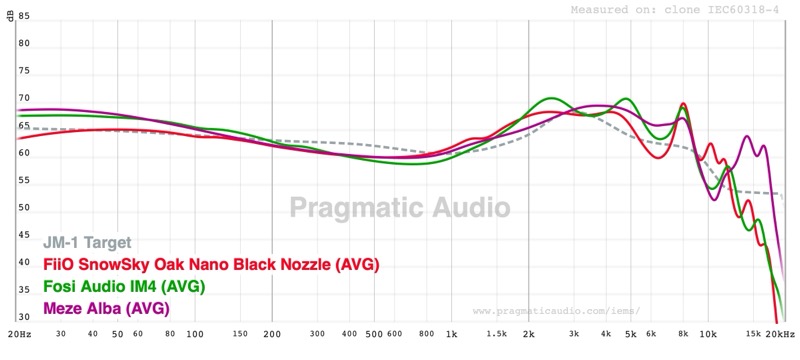
The Meze Alba is a single dynamic driver IEM at around $159 — considerably more affordable than the Oak Nano and still one of my favourites with a smaller IEM shell. The Alba has a more V-shaped, Harman-adjacent tuning: more bass emphasis and more treble energy relative to the midrange, which is the opposite of the Oak Nano’s mid-forward character. If you prefer a Harman-style signature and want to spend less, the Alba is a strong option at its price. The Oak Nano is the choice for those who specifically want the mid-forward presentation and the wider, more open soundstage that the Alba cannot match.
Specifications and Measurements
| Specification | Value |
|---|---|
| Type | Single dynamic driver IEM |
| Wearing style | Over-the-ear |
| Driver | Beryllium-coated dynamic driver |
| Frequency response | 10Hz–40kHz |
| Impedance | 50Ω @ 1kHz |
| Sensitivity | 112dB/mW @ 1kHz |
| Shell | Titanium alloy (watch-grade machining) |
| Design | Vented dynamic driver |
| Nozzles | Two included (black / red — treble variation) |
| Cable | Cryogenically treated silver-plated monocrystalline copper, ~1.2m |
| Connector | 0.78mm 2-pin |
| Audio plug | Straight, twist-lock swappable |
| Earbud weight | ~8.9g (excluding cable) |
| Adapters | 3.5mm SE, 4.4mm balanced, USB-C with built-in PEQ |
| Price | $449 |
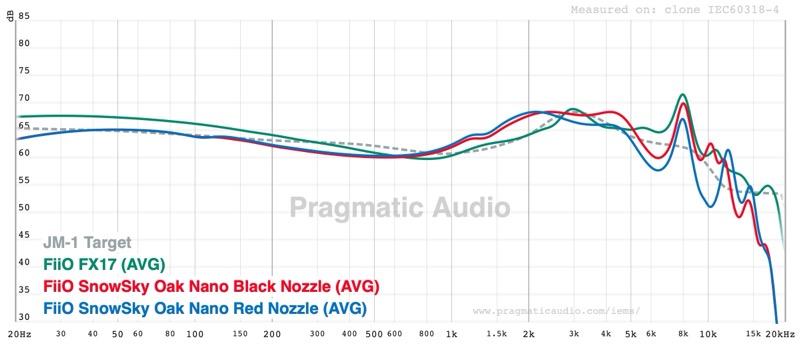
The frequency response graphs tell the most important story. Here is the Oak Nano with both nozzle options plotted against the JM1 target — the mid-forward character is clearly visible, and the treble difference between the black and red nozzles is obvious:
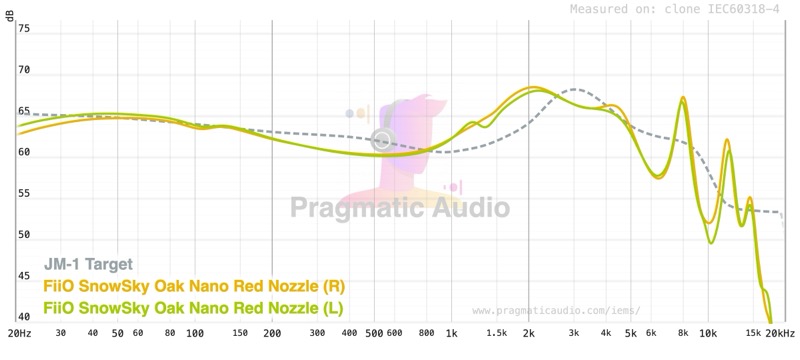
The left and right channel matching on the red nozzle is excellent, confirming the build quality is consistent unit-to-unit:
Compared against the FX17 with both Oak Nano nozzle options — useful for understanding where each sits in the FiiO line relative to the JM1 target:
The Oak Nano against the FD15, you can see they both share a lot of similarities:
A combined view showing the Oak Nano red nozzle and black nozzle alongside the FD15 with red nozzle and foam measurements:
The multi-IEM comparison below shows the Oak Nano alongside the Fosi IM4 and Meze Alba — useful context for how the mid-forward signature compares to more affordable alternatives at lower price points:
And with the Aune IR300 and the Fosi Audio IM4 again, this time with the scale zoomed in to exaggerate the differences for clarity:
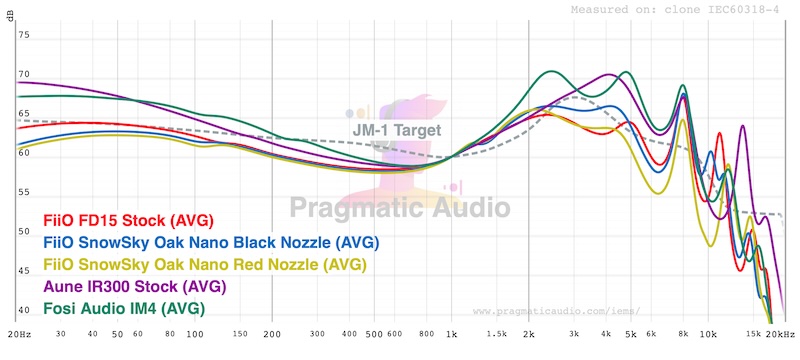
You can see that the FiiO dynamic driver is considerably more balanced and less V-shaped than either the Fosi or the Aune — and the Oak Nano’s treble is noticeably more refined, which is where a significant part of the price premium goes.
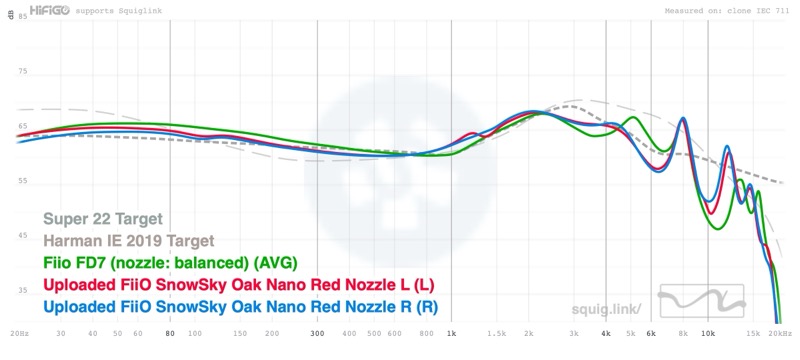
I never reviewed the original FD7, so I haven’t got a compatible measurement, but I believe this measurement was taken with a similar setup to mine, so this might be indicative of the differences, you can see that the original FD7 was a little warmer but wasn’t as forward in the midrange as the Oak Nano:
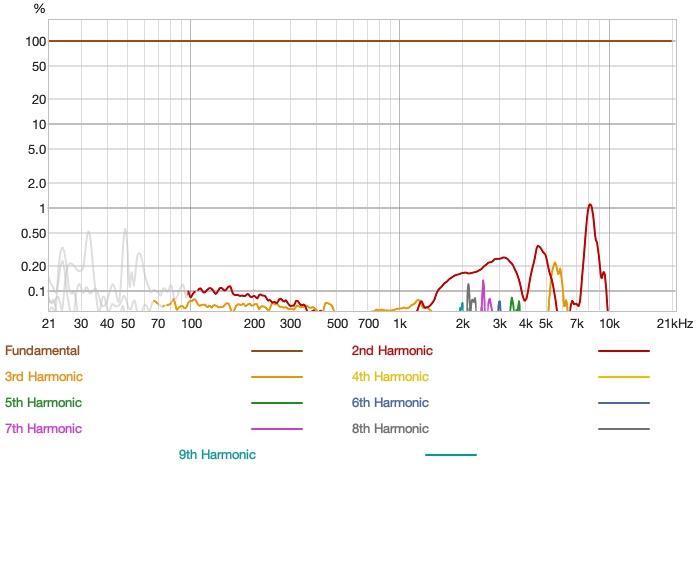
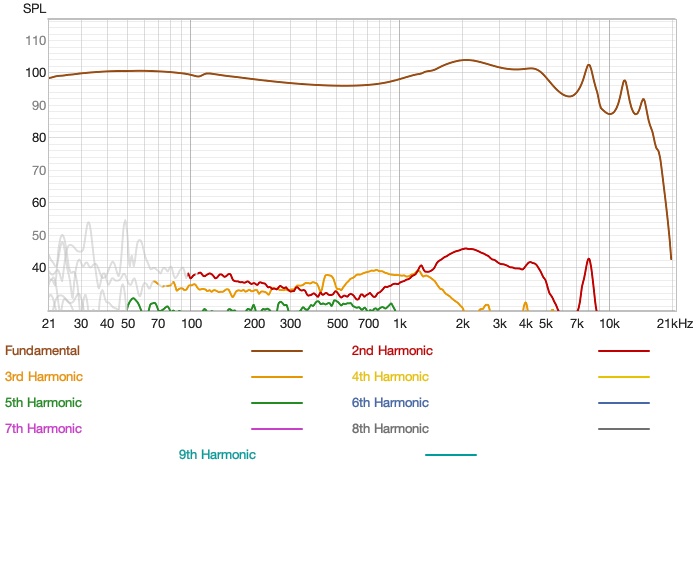
Distortion figures are clean throughout — the single DD design with the beryllium alloy diaphragm produces minimal harmonic distortion across the audible band:
 |
 |
Rating Explanation
The Oak Nano earns a pragmatic rating of four. It is a genuinely excellent single dynamic driver IEM — the beryllium alloy diaphragm delivers the cohesive timbre and fast transient response that makes single DD designs compelling, the titanium shell is beautifully made, and the soundstage sets it apart from many IEMs.
The accessory package — two nozzle sets, three cable adapters including the PEQ-enabled USB-C dongle, and a comprehensive eartip selection — is among the most complete I have encountered from any IEM at this price.
So, the four rather than five reflects that the Oak Nano’s sound signature I feel will be genuinely polarising. Listeners who prefer a flatter, more analytical response or a Harman-adjacent curve will find the midrange presentation too forward, and the mid-forward tuning will not suit every listener. At $449 the market is demanding, and the Oak Nano asks you to specifically want what it offers.
Features score five without hesitation. The dual nozzle system, modular cable with three adapter types, PEQ-capable USB-C dongle, and extensive eartip library represent one of the most comprehensive accessories packages available at this price. The PEQ adapter in particular is a feature that turns the Oak Nano into a fully tuneable system without additional investment. I am 100% sure we will see a simple PEQ adjustment appear in the next few weeks to give the Oak Nano the FD7’s sound signature (if I had measured the FD7, I would have provided it in this review).
Conclusion
Overall, I feel the Oak Nano is a worthy flagship for Snowsky, but if you have fond memories of the FD7 and have been looking for a worthy follow-up, the Oak Nano might not be it, for me, it is a worthy upgrade over the FD15 which is probably what FiiO were aiming for, if you want a premium DD IEM with excellent accessories and a vocal midrange forward tuning, the Oak Nano is one to look at.
It may not carry the FD7’s name, but the Oak Nano carries something of its legacy, the conviction that a single exceptional DD driver, the right materials and the right acoustic space, still has something to say.