Fosi Audio Merak CD Player
A Compact CD Player That Earns Its Keep as a Desktop Transport
After the Fosi Audio Luna 3 turntable and the S3 streamer, the Merak is another unexpected move from Fosi: a standalone CD player, and their first one. The Merak is compact, priced at $169.99, and built around a CS43131 DAC and TPA6120 headphone amplifier. On paper it looks less like a nostalgia product and more like a small desktop transport that happens to play discs.
I would like to thank Fosi Audio for providing the Merak for the purposes of this review.
If you are interested in finding more information about this product, you can find it at the official Fosi Audio product page.
The Fosi Audio Merak CD Player retails for $169.99.
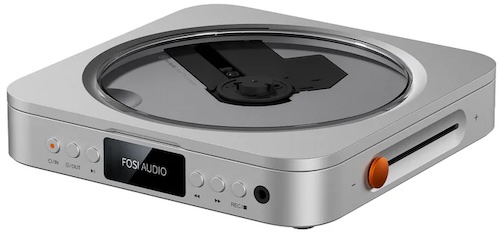
I have been living with the Merak for about four weeks, mostly connected via optical output to my FiiO K17. It has settled into a simple role in my rack: the source I use when I want to play a full CD without opening an app or thinking about playback settings. The slider volume control — a long-throw mechanism on the side panel — is the standout physical detail, and the one that most visitors to my desk have commented on. I will come back to how it compares with the more feature-heavy FiiO DM13, but first, let’s take a look at what’s in the box.
Unboxing and Build Quality
My review unit arrived in a plain white box — this was a pre-release sample, so the retail packaging will differ — but it protected the player properly during transit.
 |
 |
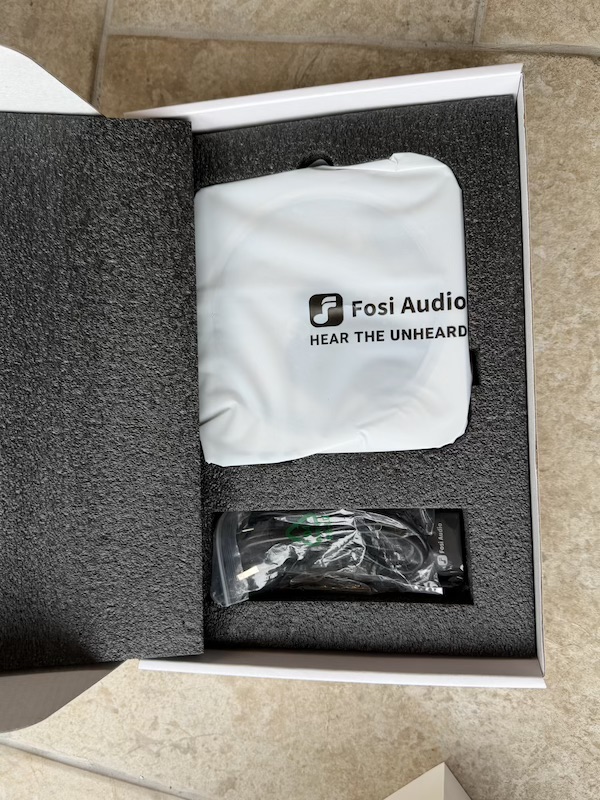
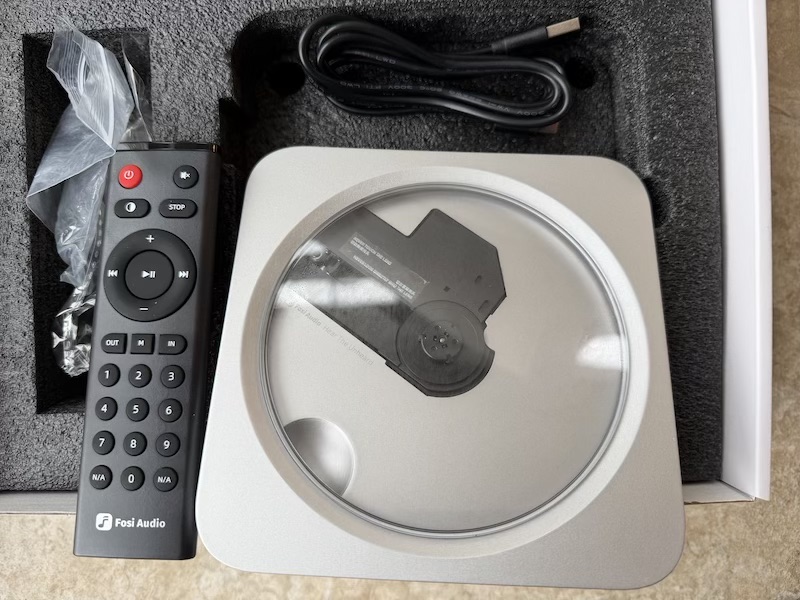
Opening up reveals the Merak nestled in protective foam, immediately striking for its compact size — smaller than it looks in most online images or expo footage. In the box you get: the Merak CD player, a power cable (no power supply included — it runs on DC 5V/2A via USB-C), a 12V trigger cable, the infrared remote control, and a user manual.
 |
 |
The build quality is solid in the hand. The chassis has a satisfying weight to it for its size — not heavy, but with enough mass to feel purposeful rather than cheap. The finish is silver, which I will note sits visually apart from the rest of the Fosi ecosystem if you are running a full Fosi rack; most of their desktop products are black. That is purely an aesthetic observation rather than a functional one, but it is worth knowing if visual cohesion in a stacked system matters to you.
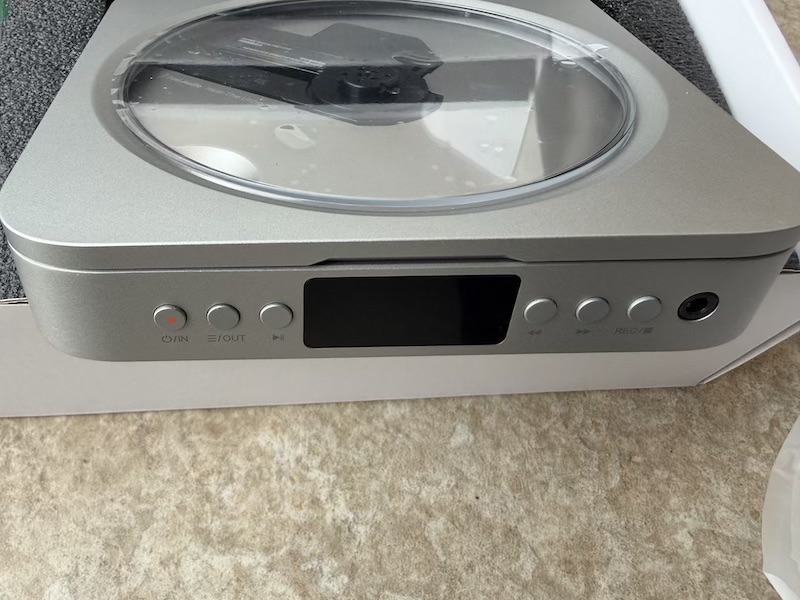
The front panel is compact and deliberately minimal: a small OLED display for track and playback status, a motorised disc tray, and a handful of small buttons. There is no Fosi logo or orange volume accent on the front panel itself, which is an odd omission, but it gives the face a clean, unbranded look.
 |
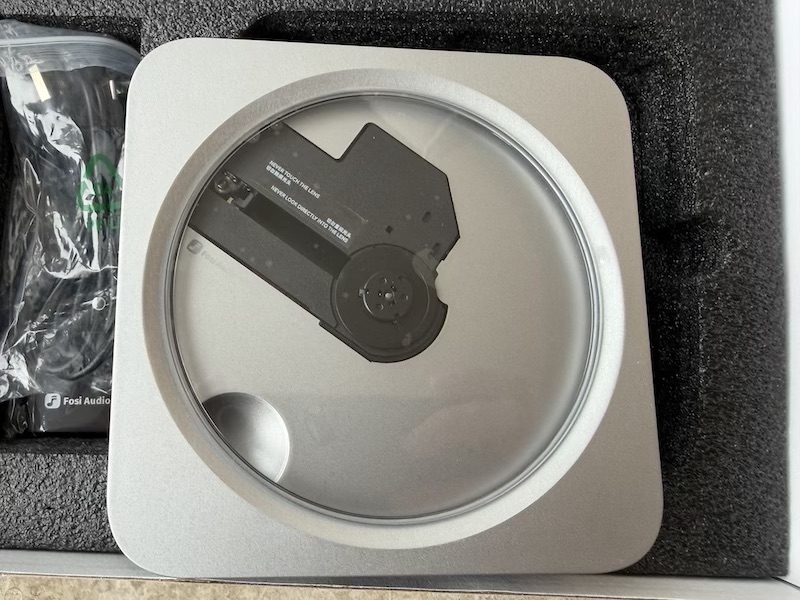 |
The top surface is clean and uncluttered, with the disc tray mechanism sitting neatly flush when closed. One practical point: when optical or line-out cables are inserted in the rear, the tray door’s opening angle is slightly constrained by the plugs. There is also no locking mechanism or magnet to hold the lid closed, so the disc tray sits on friction alone when shut. It is not a major issue, but on a tight desk with thick cables it is something to account for during placement.
One build detail worth flagging: the bottom panel is noticeably thin for the overall chassis size and resonates when tapped. It is not something you encounter during normal use — the unit sits on its rubber feet and does not flex — but it does undercut the otherwise solid feel of the device in a way that is hard to ignore once you notice it.
The standout physical detail is the volume slider on the side panel — a long-throw linear control that handles volume with a smooth, satisfying action quite unlike any rotary knob.
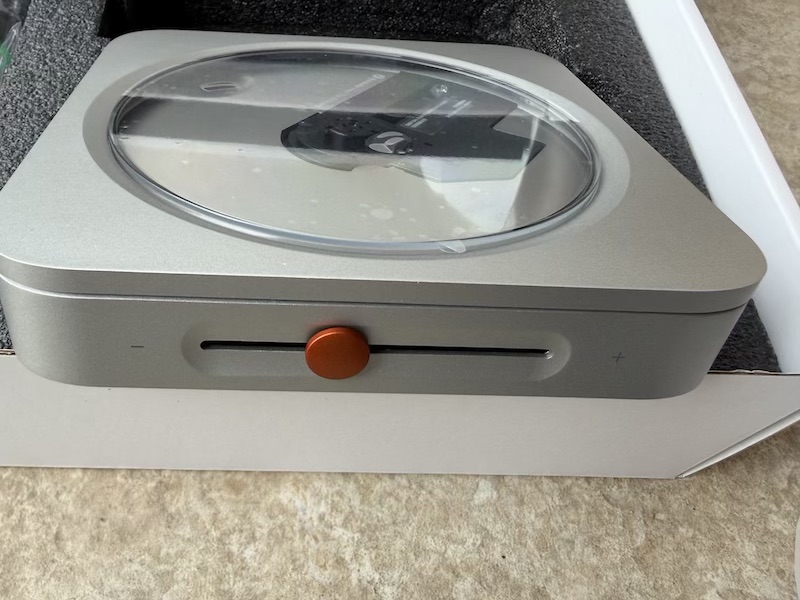
When I use the Merak as a transport with volume management handled downstream by the FiiO K17, I never touch this slider at all. But when I plug headphones directly into the front 3.5mm jack, it becomes the most tactile thing about the experience. There is a very slight channel imbalance at the extreme low end of the travel — typical of long-throw sliders — but above that threshold it is perfectly even and responsive.
Features
Playback and Format Support
The Merak handles standard pressed CDs (CDDA), CD-R, and CD-RW discs, and the USB-A port on the rear accepts flash drives containing MP3, WAV, FLAC, AAC, APE, and WMA files — up to 128GB in capacity. Track skipping is fast and disc reading is quiet and stable, even on older self-pressed discs that occasionally cause issues on cheaper players. The ESP (Electronic Shock Protection) switch on the rear provides a 60-second audio buffer to absorb vibration without interrupting playback — a carry-over from the Merak’s portable-adjacent design ambitions. In practice the player is stable even with ESP switched off; it does not skip even under some light handling stress.
One behaviour to be aware of: there is a brief delay between pressing play and audio actually reaching the output. For most recordings this is imperceptible, but tracks that open with sound from the very first moment can have their opening cut off. It is the kind of thing that may be addressable in a firmware update, but as shipped it is worth knowing.
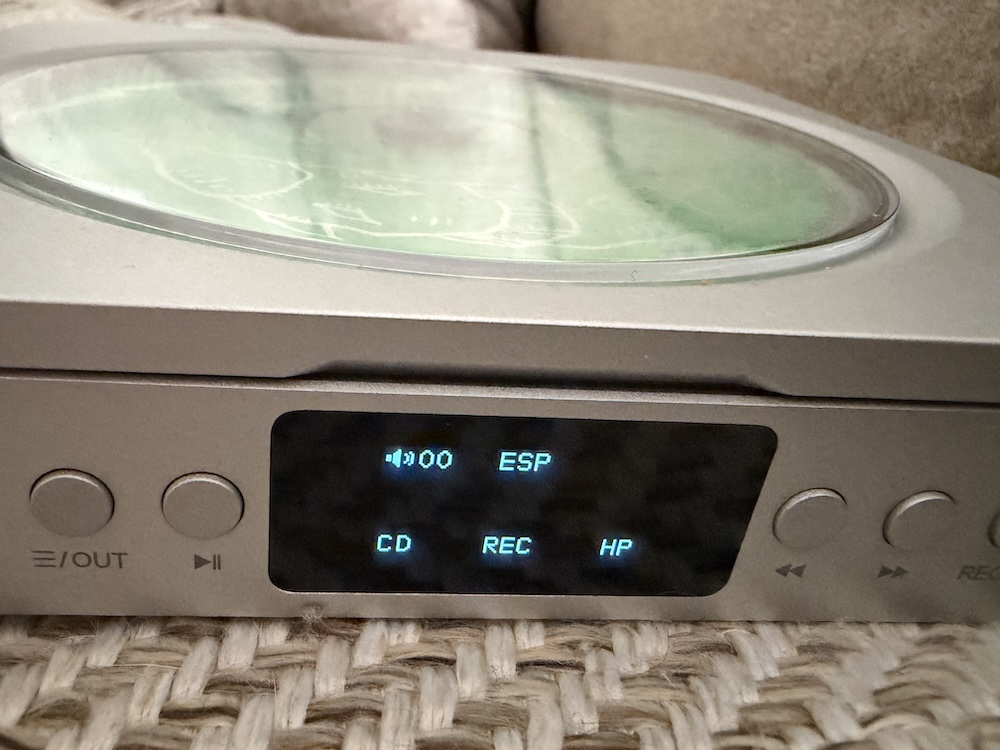
The OLED display is clear and bright, with adjustable brightness, showing track number, elapsed time, and playback status cleanly at a desk distance.
Remote Control
The Merak ships with an IR remote that covers the full function set: play, pause, stop, skip forward and back, repeat modes, and volume. The claimed effective range is seven metres and in practice it works reliably from across a normal room without needing to aim carefully.
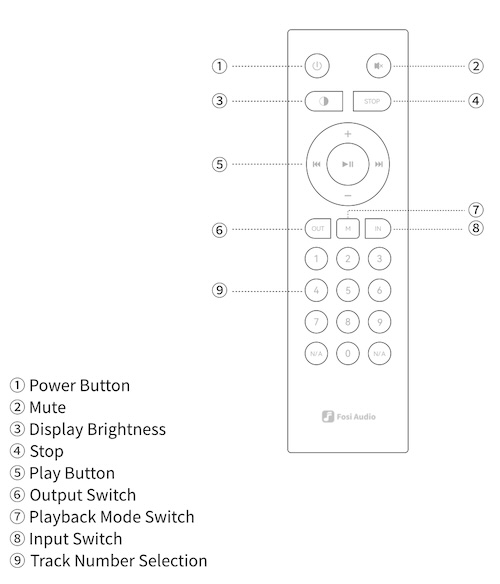
The guide above illustrates every button’s function clearly. It is worth a quick read before first use, since a few of the mode buttons are not immediately obvious from the labelling alone. Once you know the layout, having full control without touching the unit is useful, especially with the power button on the rear panel.
Outputs and Connectivity
The rear panel carries everything you need for desktop integration: 3.5mm line output, optical (TosLink) digital output, the USB-A port for flash drives, and the USB-C DC input. A 12V trigger output allows the Merak to power-sequence downstream components automatically when the player switches on — a useful integration feature at this price point that you would typically expect to find on considerably more expensive gear.
The optical output is the reason the Merak now has a permanent place in my rack. Connected to the FiiO K17’s optical input, it delivers a clean, stable digital signal and lets the K17 handle conversion. The difference compared with the Merak’s own DAC is audible but not dramatic — the internal CS43131 is capable — but for critical listening I prefer using it purely as a transport.
CD Recording to USB
The Merak includes a rip-to-USB function, recording individual tracks or full discs as uncompressed WAV files at 16-bit/44.1kHz. My experience with this feature was mixed, though I am reasonably confident the issues I encountered — primarily around the USB drives I used — reflect limitations on the media side rather than the Merak itself. The rip function is noted to require FAT32-formatted drives up to 32GB, and the interaction with larger or differently formatted drives is variable. For users who want a standalone solution to digitise their CD collection without a computer, the feature works when the right USB drive is used — but it is not the Merak’s headline selling point and I would not weight it heavily in a purchase decision.
What Is Missing
The Merak cannot function as a USB DAC for a laptop or computer — the USB-C port is power-only. There is no internal battery, which the ESP switch somewhat implies it should have; you cannot run it from a powerbank in any practically useful way since there is no carrying handle or locking disc mechanism. If you are looking for a portable CD player in the FiiO DM13 sense — something with a battery that travels — the Merak is the wrong product. For desk and rack use, those omissions are completely irrelevant.
Sound Impressions
All critical listening was conducted with the Merak connected optically to a FiiO K17 as transport, with secondary impressions gathered via the 3.5mm headphone output using the Sennheiser HD600 and a pair of harder-to-drive planar headphones. Source material was exclusively CD — pressed originals and a small selection of CD-Rs.
As a Transport
The optical output connected to the K17 is the primary reason the Merak has stayed in my rack. CDs that I know well sound clean and stable, without obvious added warmth or brightness from the player itself. Donald Fagen’s The Nightfly sounds precise and natural, and Steely Dan’s “Aja” has the kick drum and bass guitar definition I expect from that recording. For a $169 CD transport, that is exactly the result I want.
Headphone Output
The 3.5mm headphone output, driven by the CS43131 DAC and TPA6120 amp, is competent for the price. At 210mW into 32Ω the Merak has enough headroom for the HD600, and it handled planar headphones without audible strain at reasonable listening levels. The presentation is clean and neutral, with no obvious mid-bass thickening or treble glare. Joni Mitchell’s “A Case of You” sits naturally through the HD600, and Nils Lofgren’s “Keith Don’t Go” keeps enough guitar texture and upper-harmonic detail to show that the built-in output is more than an afterthought.
The honest caveat: if you have access to a better headphone amplifier — and at this price you likely do, or will soon — you will route the Merak through it rather than rely on the built-in output for serious listening. I use the K17’s headphone stage for that purpose without a second thought. The Merak’s 3.5mm output is best understood as a competent convenience feature rather than the primary reason to buy the device.
Comparisons
Fosi Audio Merak vs FiiO DM13
The FiiO DM13 is the natural comparison. It is a much more feature-complete device: dual CS43198 DAC chips, dual SGM8262 headphone amplifiers, a 4.4mm balanced output, Bluetooth, a 3750mAh internal battery delivering around ten hours of playback, USB DAC functionality, and balanced line outputs — all at a price premium over the Merak. On paper, the DM13 does more.
In practice, I found myself reaching for the Merak more often for straightforward album listening. The reason is simple: the DM13’s menu system makes basic playback feel like a small decision tree. None of it is difficult, but it is not instinctive either. The Merak behaves like a CD player should: press play, it plays. For the 99% of my CD use that consists of putting on a full album and listening without interruption, the Merak is less friction. The DM13 earns its price if you need the battery, balanced outputs, or USB DAC function. For a desk-based transport, the Merak is the more focused answer.
Specifications and Measurements
Specifications
| Specification | Detail |
|---|---|
| Chipset | SC6137D + CS43131 + TPA6120 |
| Max Sampling Rate (CD) | PCM 16-bit / 96kHz |
| Max Sampling Rate (USB) | PCM 16-bit / 96kHz |
| Headphone Impedance | 16–300Ω |
| Inputs | CD, USB-A (flash drives up to 128GB) |
| Outputs | 3.5mm Headphone, LINE (3.5mm jack), OPT (TosLink), 12V Trigger |
| CD Formats | CDDA, CD-R/CD-RW (partially); pressed originals recommended |
| CD-R File Formats | FLAC, WAV, WMA, AAC, MP3 |
| USB Drive File Formats | MP3, WAV, FLAC, AAC, APE, WMA |
| SACD | CD layer only |
| Rip Function | WAV 16-bit/44.1kHz, FAT32 drives up to 32GB |
| Remote Control | IR, up to 7 metres |
| Power Input | DC 5V / 2A (USB-C) |
| Firmware Update | Via USB-A flash drive |
3.5mm Headphone Output (CD):
| Metric | Value |
|---|---|
| Rated Power | ≥210mW + 210mW (32Ω, THD+N <1%) |
| SNR | 121 dB (A-weighted) |
| THD+N | 0.002% (A-weighted) |
| Dynamic Range | 121 dB |
| Noise Floor | ≤3µV (A-weighted) |
LINE Output (CD):
| Metric | Value |
|---|---|
| Output Level | ≥2Vrms |
| SNR | 124 dB (A-weighted) |
| THD+N | 0.0009% (A-weighted) |
| Dynamic Range | 124 dB |
| Noise Floor | ≤3µV (A-weighted) |
The LINE output figures — 124dB SNR, 0.0009% THD+N — are strong for a CD player at this price. The 3.5mm output numbers are also respectable, with 121dB SNR and 210mW of available power translating to the clean, low-noise background I heard during listening.
Measurements
Independent bench measurements from ASR forum member NTTY at AudioScienceReview confirm what the specifications imply: the Merak’s optical output performs as a clean, low-jitter transport. NTTY’s conclusion in his own words: “It is the best CD Transport I measured, and the cheapest.” The measured data backs that up:

With the disc loaded and the OLED display showing track progress, the Merak’s day-to-day operation is as quiet and unfussy as those numbers suggest — it simply gets on with playing.
Rating Explanation
The Merak earns its pragmatic rating of four because it does the basic CD player job well: spin discs, read them reliably, and output a clean signal at a fair price. The optical output makes it useful as a transport for anyone with an external DAC or integrated amplifier with a digital input, and the headphone output provides enough clean power to be usable on its own. The slider volume control is a small delight, and the IR remote simply works. For desk-based album listening rather than portable playback, this is an easy recommendation.
The features rating of four is the honest acknowledgement of what the Merak is not. The absence of a battery is a real limitation if portability matters to you — the ESP switch and compact dimensions suggest it was at least considered in the design — and the inability to function as a USB DAC for a laptop is a gap that competing products at similar or higher prices have covered. The CD ripping function is present and useful when the right USB drive is used, but it is not reliable enough across all media to be weighted heavily. None of these are problems for my primary use case, but they are real limitations for someone buying with different expectations.
The price rating of five reflects the straightforward reality that $169.99 for this level of transport quality and headphone amplification is competitive. The specifications back it up: 124dB SNR and 0.0009% THD+N on the line output are benchmark figures for the category.
Conclusion
The Fosi Audio Merak CD Player has been a pleasant and uncomplicated addition to my desk. It does not really work as a portable device, despite the size and the ESP switch, and it is not trying to cover every digital audio use case. What it is, at an honest price, is a compact CD transport with a clean optical output, enough headphone power to be useful standalone, and a satisfying slider volume control that somehow makes putting on a CD feel more considered than reaching for a phone.
If you have a collection of CDs and a hi-fi chain with a spare digital input, the Merak earns its place in it without drama or qualification. If you need Bluetooth, balanced outputs, or a battery for portable use, look at the FiiO DM13 instead. The Merak is for listeners who have decided what they want — a good CD transport for the desk — and want exactly that, done well, without paying for features they will not use.