Crosszone CZ-12
A spatial, retro, unmistakably Japanese headphone like nothing else — now lighter and cheaper
Crosszone build headphones around an unusual idea: instead of firing one driver straight into each ear, every earcup carries three drivers and an acoustic delay system that mixes a time-delayed, attenuated version of the opposite channel into what you hear. The goal is to recreate the inter-aural crossfeed you naturally get from a pair of loudspeakers in a room, so the image forms in front of you rather than as the familiar left-centre-right line drawn through the middle of your head.
The CZ-12 is the newest and most affordable entry in that lineup, sitting below the CZ-8A, CZ-10 and the flagship CZ-1. It keeps the same fundamental three-driver architecture but drops to 310g, adds a folding headband and a bundled carry case, and lands at roughly half the price of the models above it. At ¥99,000 (around $640) it is still not cheap, but it is the cheapest way into Crosszone’s signature effect.

I would like to thank Crosszone for providing the CZ-12 for the purposes of this review, and for the time spent showing me the range in person.
If you are interested in finding more information about this product, you can find it at the official Crosszone product page.
The Crosszone CZ-12 retails for ¥99,000 in Japan (approximately $640).
I spent time with the CZ-12 both at a desk and while visiting Crosszone in Japan, where I could hear it directly against the rest of the range. The short version is that this is not a headphone you judge on tonal balance alone — the interesting part is what it does with space, and how that changes the way familiar recordings present. But first, let’s take a look at what’s in the box — because the CZ-12 makes its first impression as a beautifully made, retro Japanese headphone, before you discover what it is actually doing.
Unboxing and Packaging
The packaging is straightforward rather than lavish, which suits a model designed to bring the price down. The outer box carries the product imagery front and back:
 |
 |
The headline inclusion this time is the carry case — on the higher Crosszone models this was often a separate purchase, but the CZ-12 bundles it. It is a retro-styled soft case that I liked a lot, and it is the main concession to portability alongside the folding headband:
 |
 |
From the back it is just as neatly finished:

Inside, the headphone and cable pack down neatly, with room for the manual:

The whole package reads as practical: a headphone that wants to come with you, in a case that protects it without adding bulk:

Design and Build Quality
The CZ-12 is a closed-back, over-ear design that is noticeably lighter than the metal-heavy models above it. The earcups hold the three-driver array, and you can see the multiple drivers through the cup opening when the earpads are off:

The earpads are a key part of how a Crosszone works — the acoustic chambers behind them are doing real work, not just providing comfort — so they are worth a close look:

At 310g the CZ-12 sits comfortably for long sessions, and the folding headband makes it easier to stow than any previous Crosszone. The clamp is moderate and the pads are deep enough to clear my ears, which matters for a closed-back you may wear for a whole listening session.
Seeing the Range in Person
I was lucky enough to spend time with the full Crosszone range, both at the Crosszone office, where I met the team, and at the e-earphone shop in Tokyo. Comparing the earcup sizes and headbands across the line shows how much the CZ-12 has been simplified to hit its price:
 |
 |
 |
 |
 |
 |
It was also striking, walking into the e-earphone shop in Tokyo, just how prominently Crosszone is displayed — a good reminder of how popular the brand is on home soil:
 |
 |
 |
 |
 |
The Technology Inside: How the CZ-12 Recreates a Loudspeaker
Pick the CZ-12 up out of that retro case and it feels like a beautifully made, slightly old-school Japanese headphone — and then you remember what it is actually doing, which is something no conventional closed-back even attempts. This is the point where the CZ-12 stops being “a lovely retro headphone” and becomes genuinely unusual.
A conventional headphone is a minimum-phase device: each ear hears only the driver in its own earcup, with no acoustic crosstalk between the two channels. That is not how we hear loudspeakers in a room, where sound from the right speaker reaches your right ear first and then, a small but specific time delay later, also reaches your left ear after bouncing around the space. From roughly the late 1980s onwards, as headphone listening became common, producers and mixers increasingly tuned their work to translate on both speakers and headphones — pulling images more towards the centre and away from hard left/right panning. A great deal of earlier music, and plenty of specific genres since, was instead mixed to sound its best on speakers alone. If you love those recordings — particularly the wide, spacious masters of roughly 1967 to 1985, before headphone-aware mixing took over — a normal headphone simply cannot present them the way they were meant to be heard.
Crosszone’s answer is to rebuild that loudspeaker-in-a-room behaviour inside the headphone itself. If you have not come across crossfeed before, the underlying problem is simple: a headphone delivers each channel to only one ear, which is not how we hear loudspeakers or live sound in a room. Crosszone’s own diagrams are the easiest way in — the HRTF illustration shows why headphone and speaker listening differ, and their localisation diagram shows the goal, moving the image out of your head and into the space in front of you:
 |
 |
To actually produce that effect, Crosszone use three drivers per side — a high-frequency driver, a low-frequency driver, and a separate reverse-channel driver that handles the crossfeed signal — with acoustic delay chambers behind the pads that time-align and attenuate the opposite-channel signal so it arrives slightly later and quieter, the way sound from a left speaker reaches your right ear in a room. Up close you can see the real assembly and the acoustic chamber behind the pad, and the cutaway makes the specific driver architecture clear — this is not the single driver of an ordinary closed-back:
 |
 |
For the full picture of what happens to the signal, Crosszone’s more detailed diagrams show how the opposite channel is filtered and time-delayed, then acoustically mixed into what each ear hears, mimicking the path that sound takes from a speaker to your far ear:
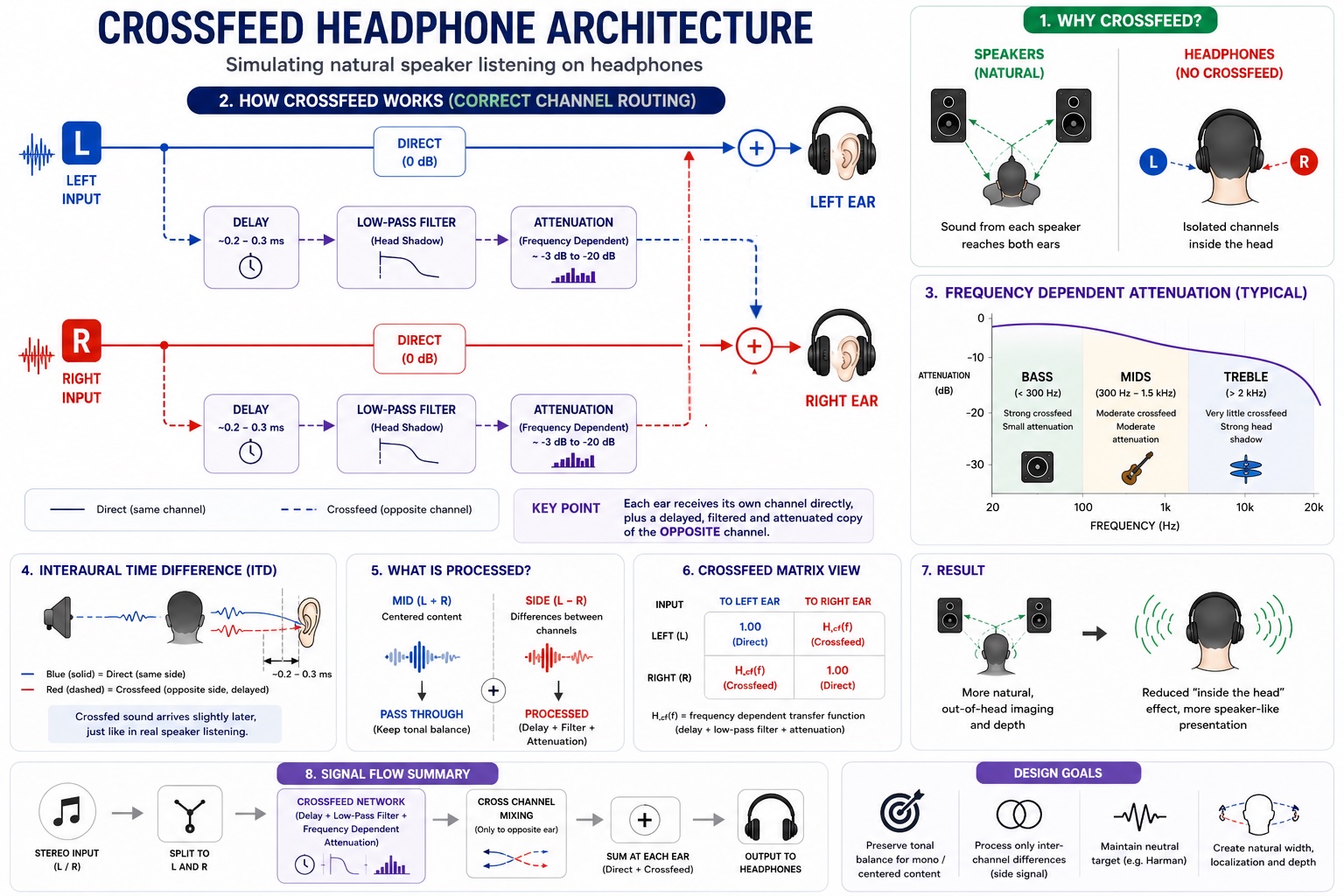 how Crosszone's crossfeed architecture works
The deeper and more interesting part for audio nerds is what this does to the phase behaviour. Sound from the right speaker bounces around the room and reaches the near right ear first, with the left ear hearing a delayed, altered version a defined interval later — and it is that inter-aural delay that gives speaker-mastered recordings their width. Crucially, Crosszone implement this in the analog domain, which means the CZ-12 is no longer a simple minimum-phase device:
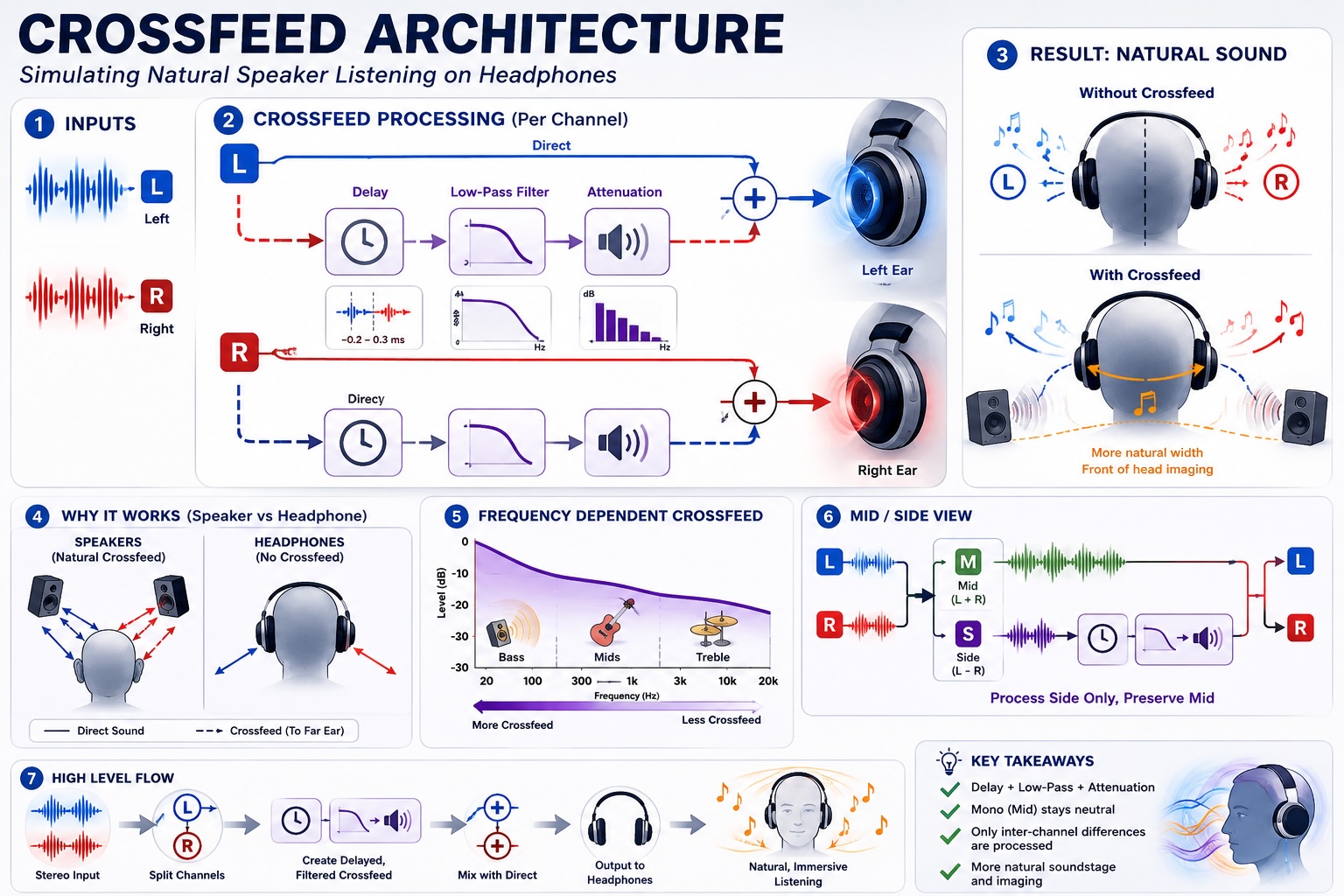 minimum phase explained, implemented in the analog domain
There is an important consequence of that, and it is the reason the measurements later in this review look the way they do. Because each ear hears a summed combination of its own channel and a filtered, delayed version of the other, the frequency response is far more complicated than a conventional headphone’s — particularly through the summed midrange around 1–4kHz, where the response will look different from what people expect and different from any normal headphone. The only other way to get this effect is with digital crossfeed DSP filters, which by their nature have to operate in the digital domain; the CZ-12 is the cheapest way to get it done acoustically, in analog, in a headphone you can take anywhere.
With all of that in mind — a distinctly different, analog way of presenting a stereo recording — we can finally talk about how it actually sounds.
Sound Impressions
I listened to the CZ-12 from a desktop chain, and the right way to approach it is to judge the spatial presentation first and the tonal balance second. The crossfeed is the point: it is not subtle, and it changes how every recording sits.
Bass
The low end has reasonable weight but it is shaped by the crossfeed processing rather than tuned for slam. There is usable sub-bass extension and the mid-bass is present without dominating, though the measured response shows a dip just below 100Hz that takes some of the body out of the lowest notes. On “Angel” by Massive Attack the deep synth line is there and holds its shape, but it does not hit with the physical authority of a bass-first closed-back. This is a low end built to serve the soundstage, not to thump.
Midrange
The midrange is where the spatial trick is most obvious, because vocals and central instruments are pushed forward and out rather than planted between your ears. Tonally it is a little uneven out of the box — there is some lower-mid emphasis and a recessed zone in the presence region — so timbre can sound slightly different from a conventional headphone. On “Fast Car” by Tracy Chapman the vocal sits in front of you in a way that is unusual and quite natural for acoustic material, even if the note weight is not perfectly even.
Treble
Treble is the part most likely to need attention. There is a notable peak in the lower treble and then some unevenness above it, which can add bite on bright recordings. On “Billie Jean” by Michael Jackson the hi-hats have plenty of energy and good decay, but sensitive listeners may find the upper presence a touch forward before EQ. Extension is fine; it is the balance through 2–8kHz that the measurements flag.
Soundstage and Imaging
This is the whole reason the CZ-12 exists, and it delivers. The image is pushed out and forward, with a sense of width and front-placement that conventional headphones simply do not produce, and it makes long listening feel less fatiguing because the sound is not pressed against your ears. On “Hotel California” by the Eagles the intro guitars and the crowd spread out ahead of you rather than wrapping around the inside of your skull, and the effect is convincing enough that switching back to a normal headphone feels oddly closed-in. The CZ-12 is at its most convincing, though, with older speaker-mastered material: “While My Guitar Gently Weeps” from the Beatles’ White Album sounded more spatially wide and correct here than on any headphone I have previously tried, with the hard left/right panning of that 1968 mix finally resolving in front of you instead of yanking each part to one ear. “Dear Prudence” from the same album opens out the same way, the layered guitars and backing vocals settling into a believable width rather than collapsing into the centre of your head. It is not a hyper-precise studio image — pinpoint localisation is traded for that loudspeaker-like spread — but for relaxed, long-session listening it is the CZ-12’s defining strength.
Comparisons and Measurements
A quick word on the comparison shots that follow: most of these are against more conventional closed-backs, and they are offered as context for how unusual the CZ-12’s presentation is rather than as direct competitors — very few of these headphones are trying to do what the Crosszone does.
I compared the CZ-12 against a wide spread of closed and semi-closed designs, including the Sivga Robin, the FiiO FT1, the Hifiman Audivana LE, a Sundara Closed, the ZMF Bokeh and a Verum 2:
 |
 |
 |
 |
 |
 |
 |
 |
Against all of them the takeaway is the same: those headphones may measure closer to a neutral target and several are tonally more even, but none of them place the image outside your head the way the CZ-12 does. If you want a conventional reference closed-back, most of the comparison set is an easier recommendation; if you want the crossfeed effect, only the Crosszone delivers it.
The frequency response tells the rest of the story. Against the Harman over-ear 2018 target the CZ-12 is clearly not a neutral-tuned headphone — that is partly inherent to how the crossfeed shapes the response at the ear:

Channel matching between left and right is reasonable, which matters more than usual here because the crossfeed depends on the two sides behaving consistently:

The combined view shows the overall shape, including the sub-100Hz dip and the lower-treble peak called out in the listening notes:

It is also instructive to compare the CZ-12 against the CZ-8A above it, both on its own and against the KB501X measurement rig, to see how the cheaper model differs from its more expensive sibling:
 |
 |
And against a broader set of references — the Meze 99 Classics V2 and JM Audio XTC, and separately the Aune SR7000 and Audeze Maxwell — to place its tuning in context:
 |
 |
For wider context across the Crosszone range and some well-known references, this view adds the Hifiman Audivana and a Yamaha alongside the CZ-8A:

Distortion is well controlled for this kind of design, with no alarming spikes in the critical band:
 |
 |
Specifications
| Specification | Value |
|---|---|
| Type | Over-ear, closed-back |
| Driver configuration | 3 per side (23mm HF + 35mm LF + 35mm cross-feed) |
| Diaphragm | Beryllium-coated |
| Impedance | 75Ω |
| Sensitivity | 99dB |
| Frequency response | 20Hz – 40kHz |
| Weight | 310g (without cable) |
| Cable | OFC, 1.5m, terminated in 3.5mm |
| Acoustic technology | ART (Acoustic Resonance Technology) + ADC (Acoustic Delay Chambers) |
| Included | CZ-CC10 carry case |
A note on the figures: the 75Ω impedance is the figure from Crosszone’s official page, and the cup-side connector standard was not clearly specified at the time of writing, so confirm that against the unit if it matters to you.
EQ suggestion
The stock tuning benefits from EQ to even out the sub-bass dip, tame the lower-treble peak, and lift the presence region. The following parametric filters are a reasonable starting point:
Preamp: -5.6 dB
Filter 1: PK Fc 60 Hz   Gain +6.5 dB  Q 2.20
Filter 2: PK Fc 99 Hz   Gain -6.2 dB  Q 1.00
Filter 3: PK Fc 300 Hz  Gain +2.5 dB  Q 2.00
Filter 4: PK Fc 460 Hz  Gain -3.7 dB  Q 2.00
Filter 5: PK Fc 1300 Hz Gain +2.4 dB  Q 2.00
Filter 6: PK Fc 2600 Hz Gain -6.2 dB  Q 2.00
Filter 7: PK Fc 5600 Hz Gain +8.6 dB  Q 0.50
Filter 8: PK Fc 8000 Hz Gain -5.0 dB  Q 1.00
You do not need to be precise about it, though — even a small cut to the bass is enough to lift the CZ-12 from very good to genuinely extraordinary especially with the right music, and it is the work of a moment from a phone or a DAC’s PEQ. Here it is set up to apply exactly that kind of light, bass-taming EQ, sitting alongside the Truthear KeyX:

Rating Explanation
The Pragmatic Rating of 5 reflects how much credit the CZ-12 earns simply for trying to do something different — and doing it acoustically, in the analog domain, inside a headphone. The crossfeed soundstage is the reason to buy a Crosszone, and the CZ-12 makes that effect more affordable and more portable than ever without losing it. With the right material it is remarkable: older, speaker-mastered recordings open up with a width and spaciousness that no conventional closed-back, and few open-backs, can produce — and even some modern tracks with a wide mix, such as Björk’s “Hunter”, sound incredibly spacious through it. For relaxed, long-session listening, and for anyone who finds conventional in-head imaging fatiguing, it is genuinely special.
The Price Rating of 4 reflects good value for what you actually get: the full Crosszone crossfeed effect, the three-driver-per-side architecture, a folding design and a bundled case, at roughly half the price of the models above it. At around $640 it is not cheap in absolute terms, but it is the most accessible route into a technology nobody else offers, and on that basis it is well judged.
The honest limitations remain. The stock tonal balance is uneven — a sub-100Hz dip and a lower-treble peak that benefit from the EQ suggested above — and the summed midrange means this will never measure like a neutral reference, so it is not the headphone for someone who wants out-of-the-box accuracy or pinpoint studio localisation. It is a specialist, and you should know that going in.
This is a headphone — or rather, this is one of the Crosszone headphones — that arguably belongs in every serious listener’s collection, with one big caveat: only if you actually listen to that older, speaker-mastered music, roughly 1967 to 1985, from before headphone-aware mixing became the norm. If you do, nothing else at this price will show you those recordings the way the CZ-12 can.
Conclusion
The CZ-12 is the most accessible version yet of Crosszone’s central idea, and it keeps the part that matters: the sound moves out of your head and into the space in front of you, the way a good pair of speakers would. It is lighter, it folds, it comes with a case, and it costs roughly half what the models above it do, all while preserving the analog crossfeed effect that defines the brand and that nobody else implements this way.
It needs a little EQ to sound its tonal best and, by design, it will never measure like a neutral reference — the summed midrange sees to that. But that is not the point. If you love older, speaker-mastered recordings and have only ever heard them collapse into the middle of your head on headphones, the CZ-12 is the cheapest ticket to hearing them open back up — and the effect is convincing enough that going back to a normal headphone feels strangely flat and closed-in.