Dayton Audio CS1200 Wood
A 12" Powered Subwoofer That Digs Down to 26 Hz for €329
The CS1200 is the largest subwoofer in Dayton Audio’s Classic Collection, built around a 12" mineral-filled poly cone woofer and a 200W RMS Class-D amplifier rated for up to 111 dB of output. I bought mine for €329 alongside a pair of Dayton Audio’s own Classic B65 bookshelf speakers, specifically because decent affordable subwoofers are much harder to find here in Europe than they are in the US — as soon as I spotted the CS1200 available through a European retailer, I jumped at the chance to buy it alongside its sibling B65s.
It’s a vented design tuned to 32 Hz, with a full set of home-theater-friendly connections and controls on the back rather than the bare-minimum level knob some subs in this class ship with.
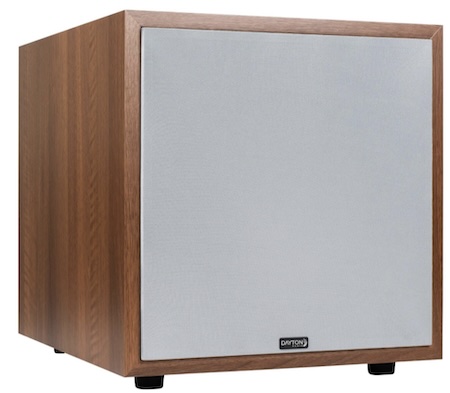
I purchased the CS1200 for the purposes of this review.
If you are interested in finding more information about this product, you can find it at SoundImports.eu.
The Dayton Audio CS1200 (Wood) retails for €329.
I’ve had the CS1200 set up for about four weeks now, running alongside the Classic B65 pair as a small 2.1 system in one of my listening spaces. The looks and the depth of bass on offer were the two things that stood out immediately, and both have held up well over the weeks since. But first, let’s take a look at what’s in the box.
Unboxing and Build Quality
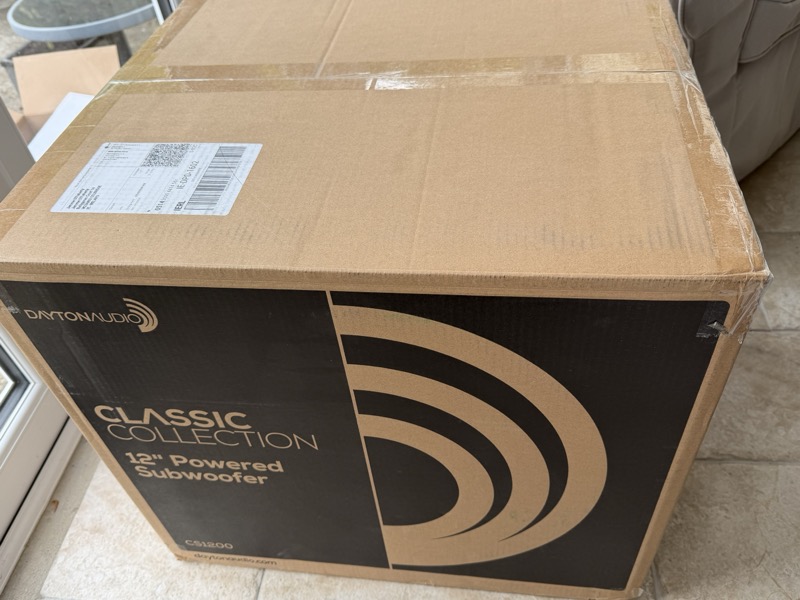
The CS1200 arrives in a large kraft shipping carton, clearly printed with the Dayton Audio Classic Collection branding and the “12" Powered Subwoofer” designation along with the CS1200 model number:
Inside, the subwoofer itself is wrapped in a heavy white protective sleeve rather than a thin plastic bag:

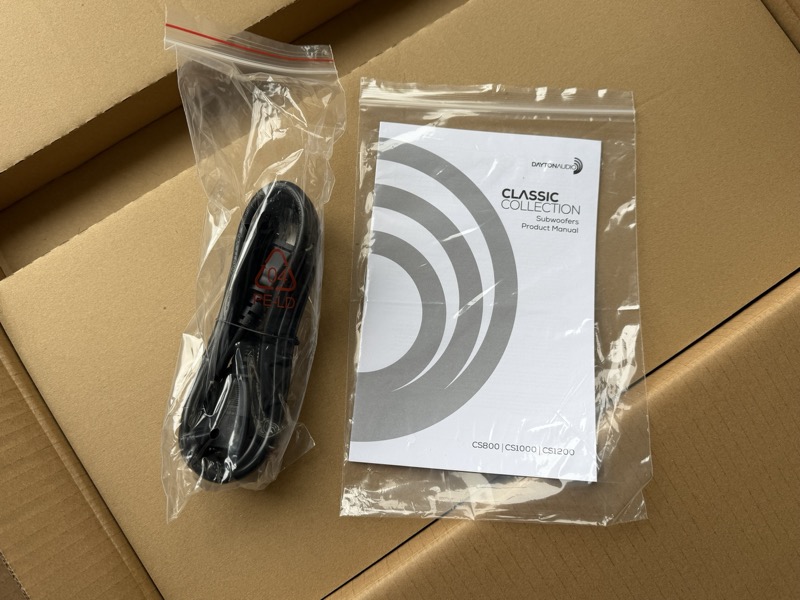
In the box you get the subwoofer itself, a detachable grille, a power cable, and a product manual — the cable and manual are shown here together:
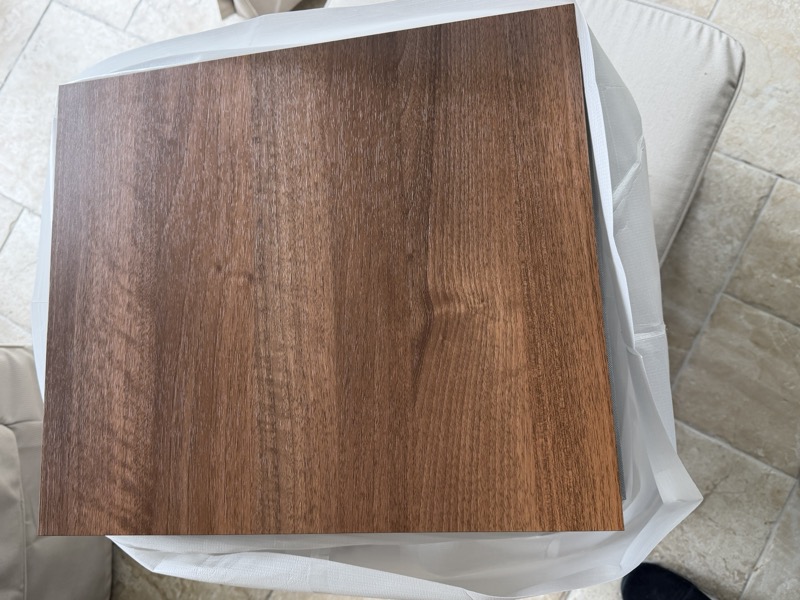
One detail I hadn’t expected: the top wood panel ships as a separate wrapped piece rather than pre-attached, which I photographed still in its own plastic wrap before fitting it:
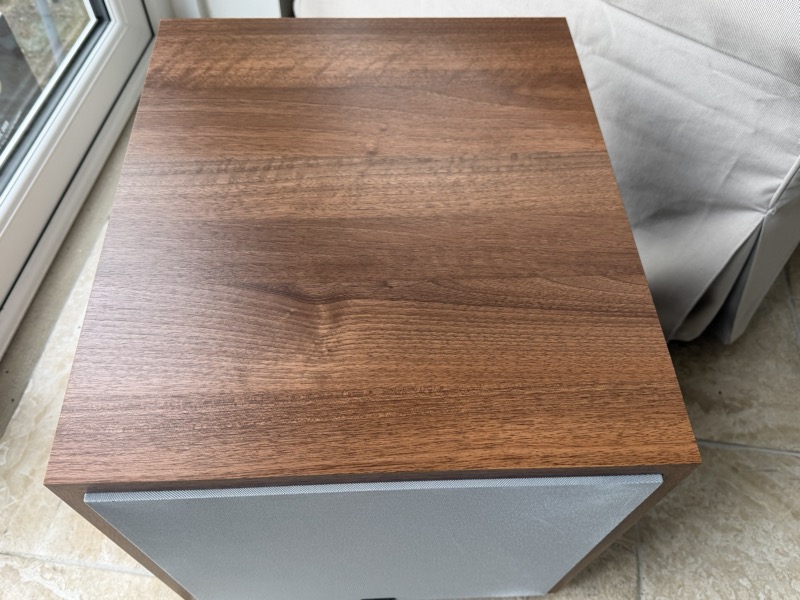
Once assembled, the wood finish on top is genuinely attractive and matches the Classic B65 speakers well:
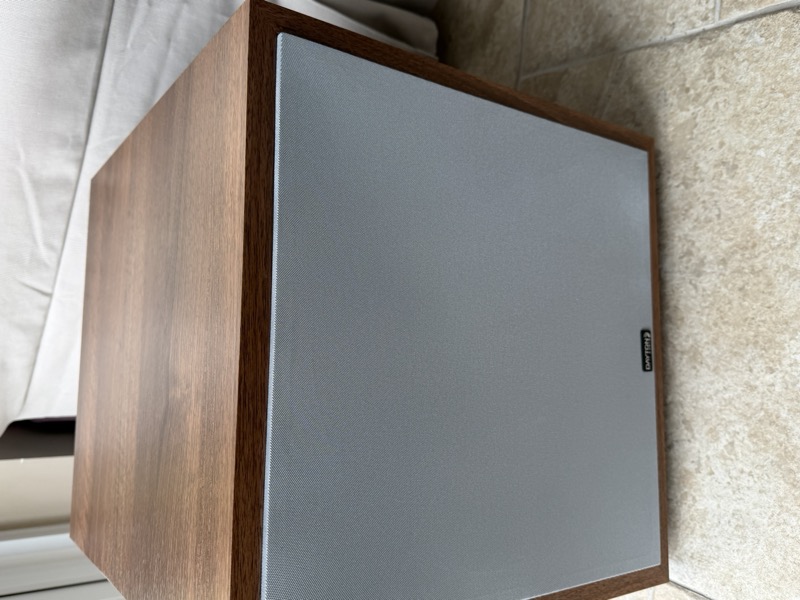
With the grille on, the CS1200 has a clean, unfussy look that will sit comfortably next to a TV unit or in a hi-fi rack without drawing attention to itself:
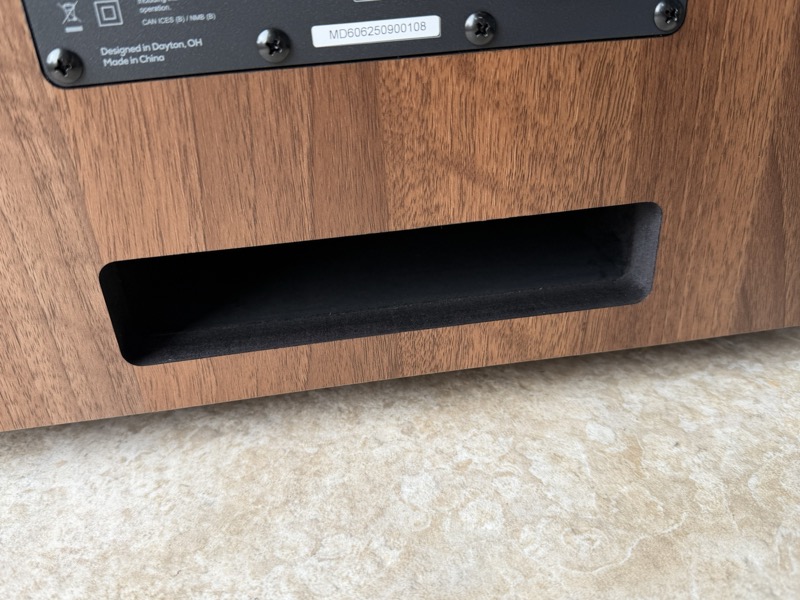
Around the front-bottom of the cabinet is a slot-loaded bass port, tuned as part of the enclosure’s 32 Hz vented design:
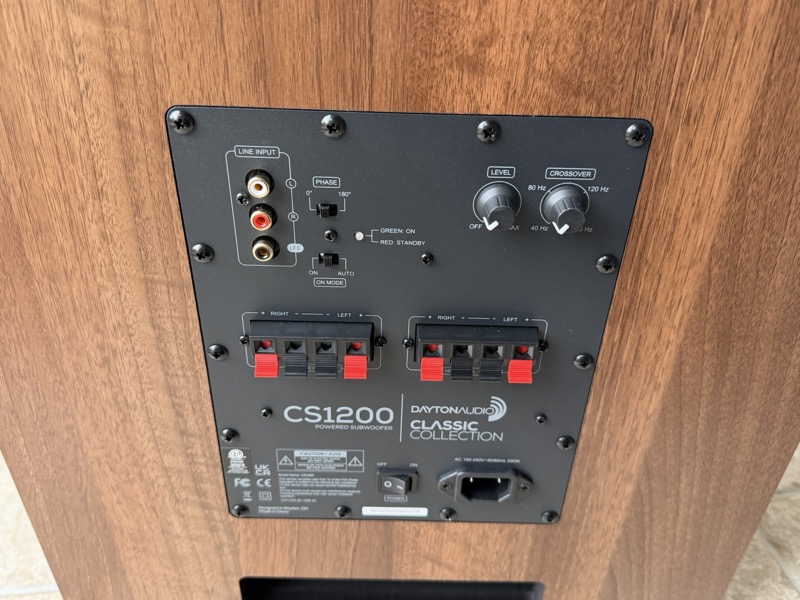
The back panel is where the CS1200 earns its home-theater credentials: stereo RCA line-level inputs, a dedicated LFE input that bypasses the internal low-pass filter, speaker-level terminals with passthrough for legacy systems, and controls for level, crossover frequency (40–160 Hz), 0°/180° phase, and auto-on/standby mode:
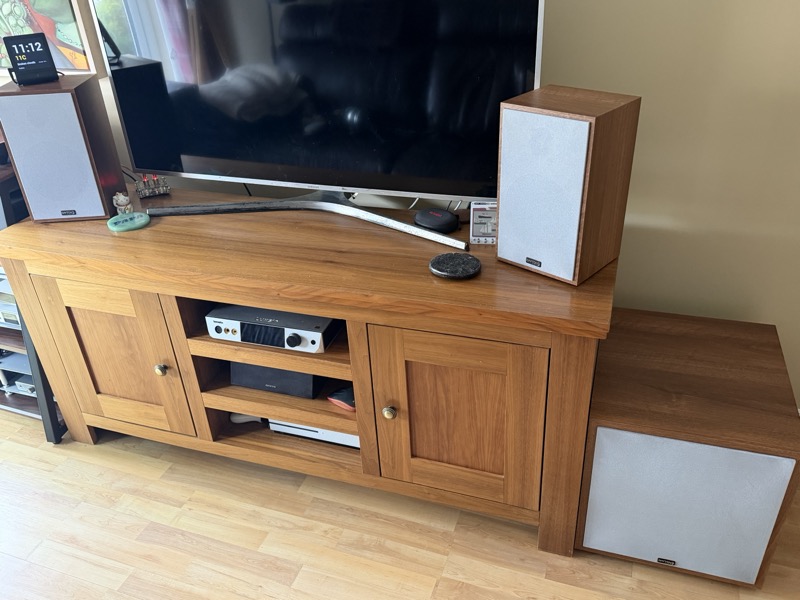
Here’s the CS1200 set up alongside the Classic B65 pair as the 2.1 system I’ve been living with for the past month:
Sound Impressions
I’ve had the CS1200 running for about four weeks now, crossed over with the Classic B65 pair in a 2.1 configuration.
This is a subwoofer that reaches deeper and cleaner than its price would suggest. It extends down toward its rated 26 Hz with real authority rather than just adding a vague low-end hump, and it does that while still looking like a piece of furniture rather than a plain black box. Dialling in the crossover and phase controls on the back panel made it straightforward to blend the sub in with the B65 pair, filling in exactly the low-end weight I found missing when running the B65s on their own — which tracks with the B65’s own 55Hz low-end limit and modest power handling. For music and movies alike, the combination of real sub-bass extension and a fair price is what stands out most after a month of use.
Comparisons
Against the Fosi Audio SW10, the two make for a useful comparison of affordable 2.1 subwoofer options, and having both the Fosi Audio pairing and the Dayton Audio pairing in the same room makes for a genuinely interesting comparison of relatively cheap 2.1 systems as complete packages, rather than just comparing subwoofers in isolation. I’ll expand on the specific differences between the SW10 and the CS1200 once I’ve spent more direct back-to-back time with both.
Specifications
| Specification | Value |
|---|---|
| Type | Powered subwoofer, vented enclosure |
| Driver | 12" mineral-filled poly cone woofer |
| Amplifier | 200W RMS Class-D |
| Maximum output | 111 dB |
| Frequency extension | 26 Hz |
| Enclosure tuning | 32 Hz (vented) |
| Low-pass crossover | Adjustable, 40–160 Hz |
| Phase | 0° / 180° switchable |
| Inputs | Stereo RCA line-level, dedicated LFE (bypasses low-pass filter), speaker-level with passthrough |
| Power supply | 100–240V, 50/60 Hz |
| Standby consumption | 0.5W |
| Auto-on | Yes, signal-sensing |
| Dimensions | 394 × 457 × 416 mm |
| Weight | 17.78 kg |
| Price | €329 |
The 32Hz vented tuning and 200W Class-D amp are a sensible pairing for a cabinet this size: a vented enclosure gets you deeper, more efficient extension than a sealed box of the same volume would manage, and the Class-D amp has the headroom to drive that tuning without running out of steam at higher volumes — which is consistent with the 111dB maximum output on the spec sheet and the sense of authority I heard in listening.
Rating Explanation
The Pragmatic Rating of 5 reflects a subwoofer that does exactly what it needs to do — genuinely deep, authoritative bass extension, a full set of home-theater-relevant connections and controls, and a wood finish that actually looks good in a living room — all at a price that’s hard to find matched in Europe. The Price Rating of 5 follows directly from that: at €329, the CS1200 undercuts what comparable extension and build quality usually cost once you factor in import pricing outside the US, where the selection of affordable, well-built subwoofers is much thinner.
The Features Rating of 4 reflects a genuinely complete control set — adjustable crossover, phase switching, a dedicated LFE input, speaker-level passthrough, and auto-on standby — with only a minor deduction for the top panel shipping unattached rather than pre-fitted. The Measurements Rating of 5 is based on the specification sheet and my own listening, which both point to a sub that reaches its rated extension with genuine authority rather than falling short of the numbers on the box; I have not measured it yet, so treat that as a listening judgement rather than a verified one.
Conclusion
The CS1200 reaches deeper and cleaner than its €329 price would suggest, particularly for anyone in Europe who has struggled to find a well-built, deep-reaching sub without paying US-market prices for imported options. It looks good, integrates easily thanks to its full set of home-theater controls, and adds exactly the low-end weight the Classic B65 pair needs to work as a satisfying small 2.1 system. If you’re building an affordable home theater or hi-fi setup, the CS1200 belongs on your shortlist.