ddHiFi Memory AL4.4: A Memory Worth Cherishing
ddHiFi’s Small Planar Wears Like an Earbud and Sings Like a Vocal IEM
A midrange-forward tuning developed with Moondrop, in aluminium shells that suit smaller ears, with sub-bass as the deliberate trade.
ddHiFi was founded in 2017 by Demond Ding, who came from FiiO and OPPO, and the company built its name on cables, adapters and connectors before its first IEM, the Janus, arrived in 2020. Accessories are still most of the catalogue, which is worth knowing because the same attention to finish carries into the IEMs. I reviewed the original Memory in its USB-C variant last year and came away with a good impression of its tuning and build. The Memory AL4.4 is that Memory reimagined: it keeps the name and the E13P designation, but this is a new Memory rather than the old one with a different plug. It is a 4.4mm balanced planar IEM built around a 13mm annular planar driver, developed with Moondrop’s assistance, in CNC-machined aluminium shells, priced at $159.99.
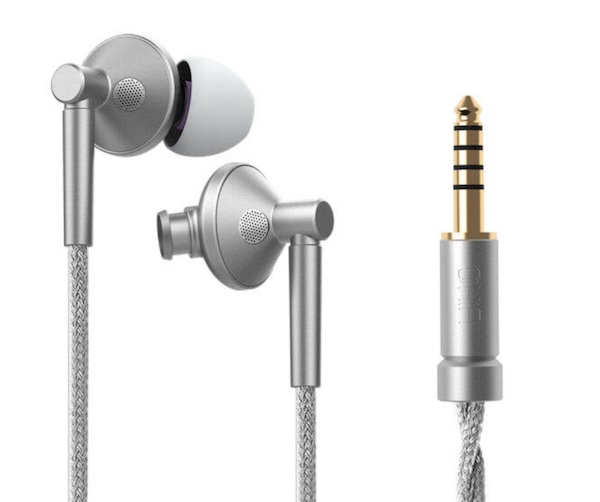
I would like to thank ddHiFi for providing the Memory AL4.4 for the purposes of this review.
If you are interested in finding more information about this product, you can find it at the official ddHiFi product page.
The ddHiFi Memory AL4.4 retails for $159.99.
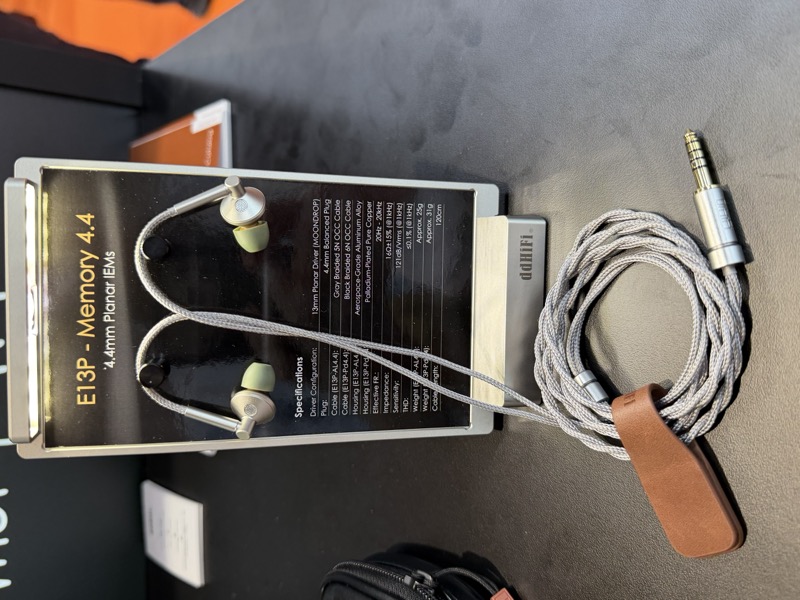
I picked this one up in person at Vienna High End, and grabbed a shot of ddHiFi’s own display card while I was on the show floor, the full spec sheet alongside a coiled AL4.4 cable:
I have been using the Memory AL4.4 for a few weeks, mostly on commutes and at the desk. The earpieces are small and light, which matters if you have smaller ears, and the carrying case is better than the usual IEM pouch. But first, let’s take a look at what’s in the box.
Unboxing and Build Quality
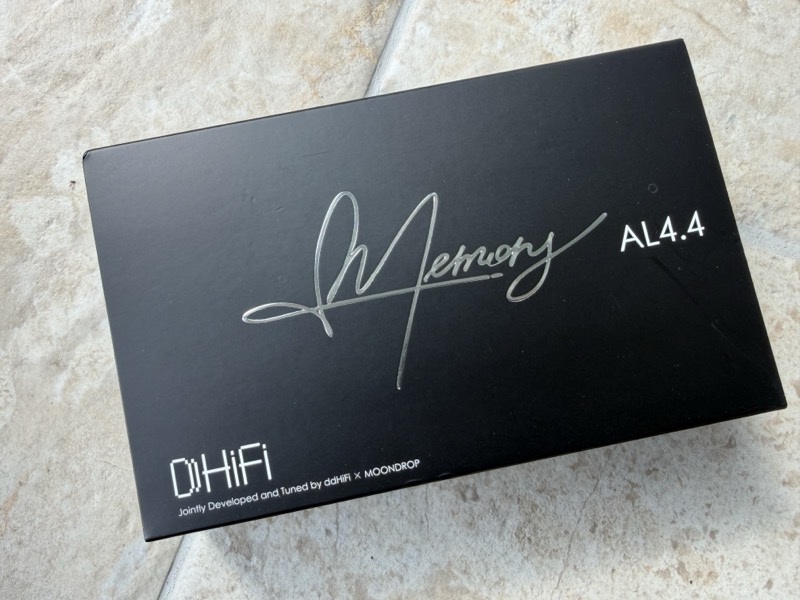
The outer box is a plain matte black affair with a large embossed “Memory” signature and the “AL4.4” designation alongside it:
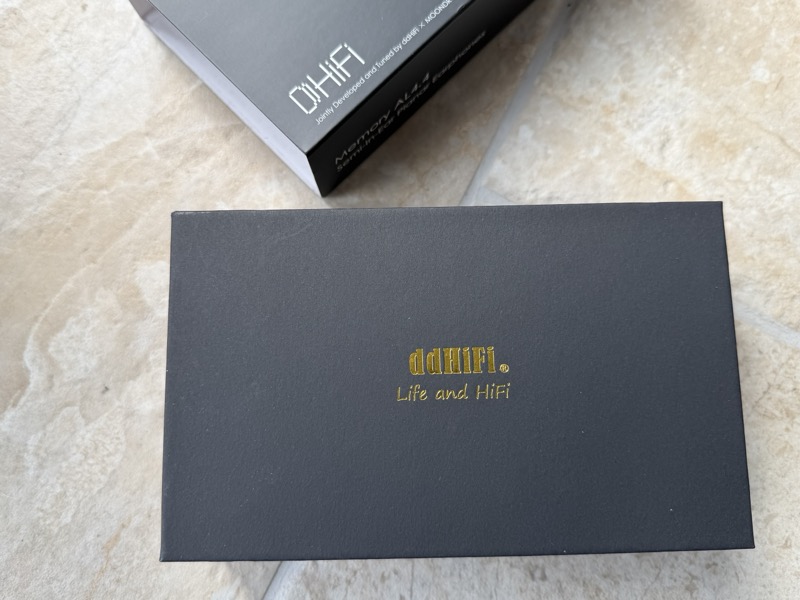
Sliding that sleeve off reveals a second, inner box carrying ddHiFi’s “Life and HiFi” branding in gold foil:
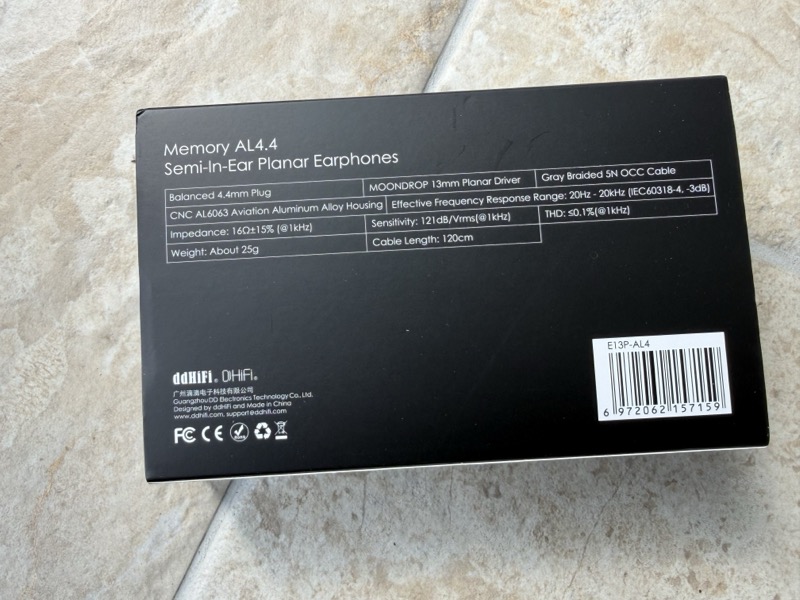
The back of the outer box carries the full specification sheet, so driver type, plug, impedance, sensitivity and cable details are printed on the packaging rather than tucked away in a leaflet:
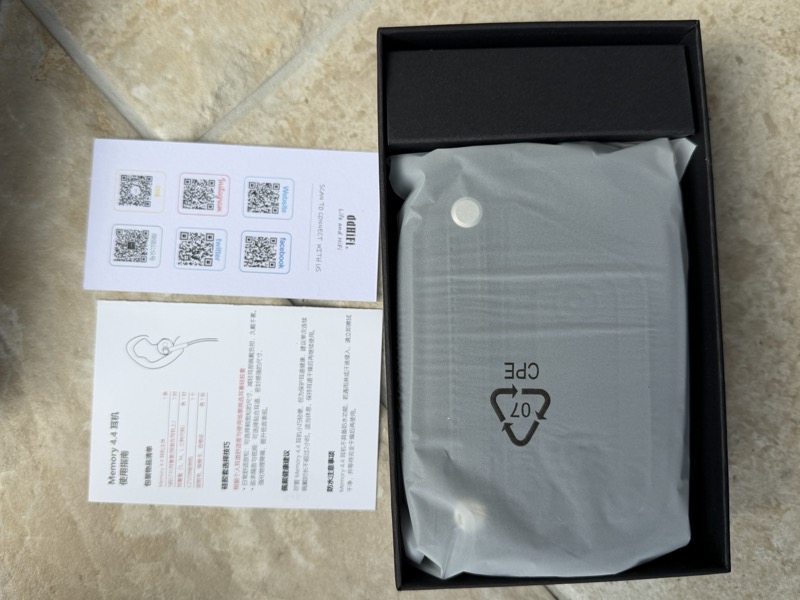
Inside, a manual and a QR code card for ddHiFi’s social channels sit above the wrapped carrying case:
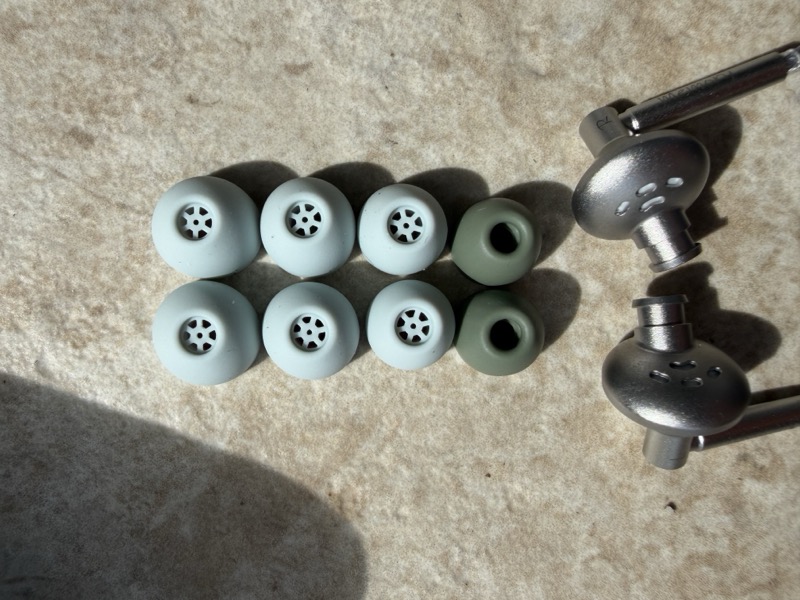
In the box you get the earpieces with ddHiFi’s own ST35 tips pre-fitted, the fixed 120cm grey braided 5N OCC cable terminated in 4.4mm balanced, three pairs of Kiwi Ears KiwiFlex tips in S, M and L, the carrying case, and the manual.
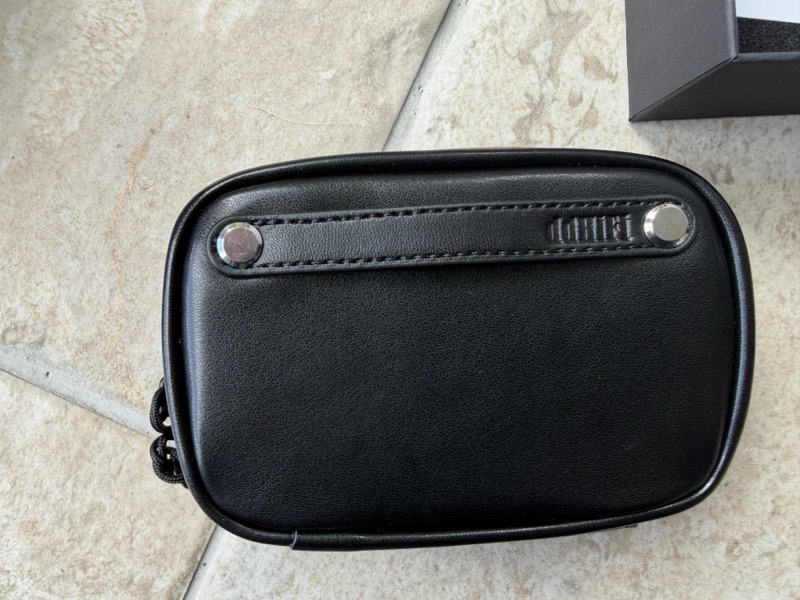
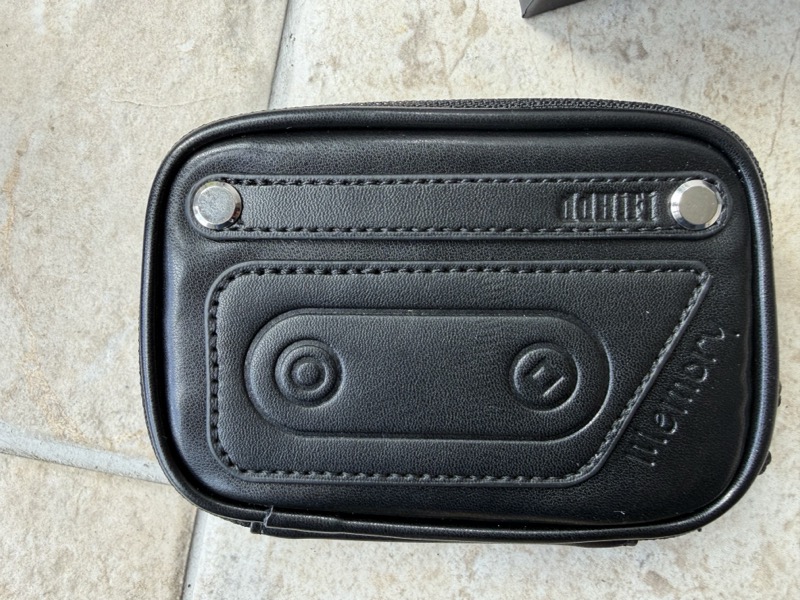
The case is ddHiFi’s CZ120B Retro, styled after an old cassette player, finished in microfiber leather with YKK zippers, and split inside into two compartments so the earpieces do not knock into each other in transit:
 |
 |
It is a better case than most IEMs get by default, and that is part of the value here.
The KiwiFlex tips are shown here alongside the earpieces, with the green ST35 tips already fitted:
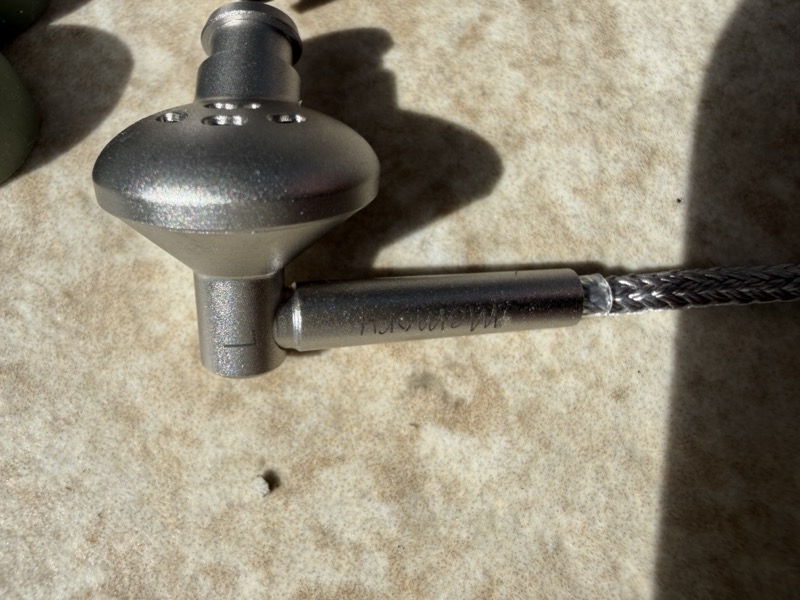
The earpieces are CNC-machined from AL6063 aluminium alloy, and that shows in the hand: smooth metal shells rather than the resin or plastic housings common at this price:
 |
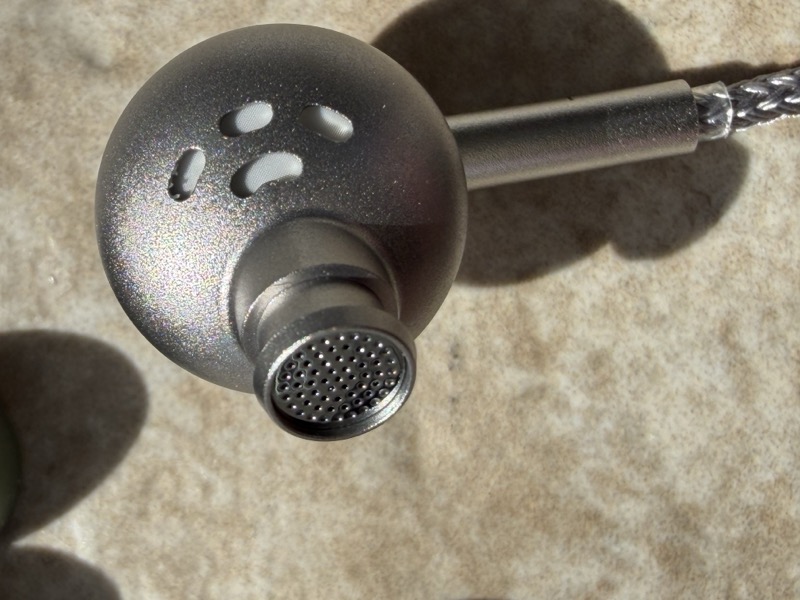 |
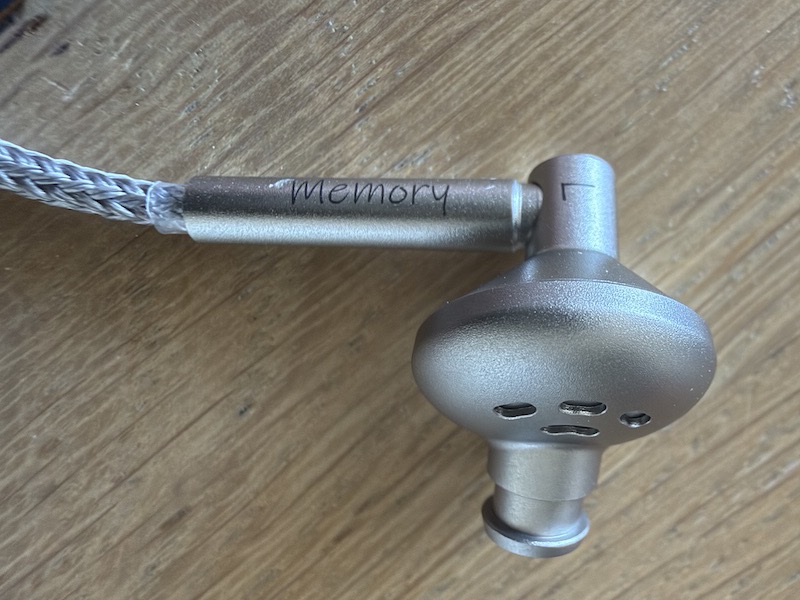
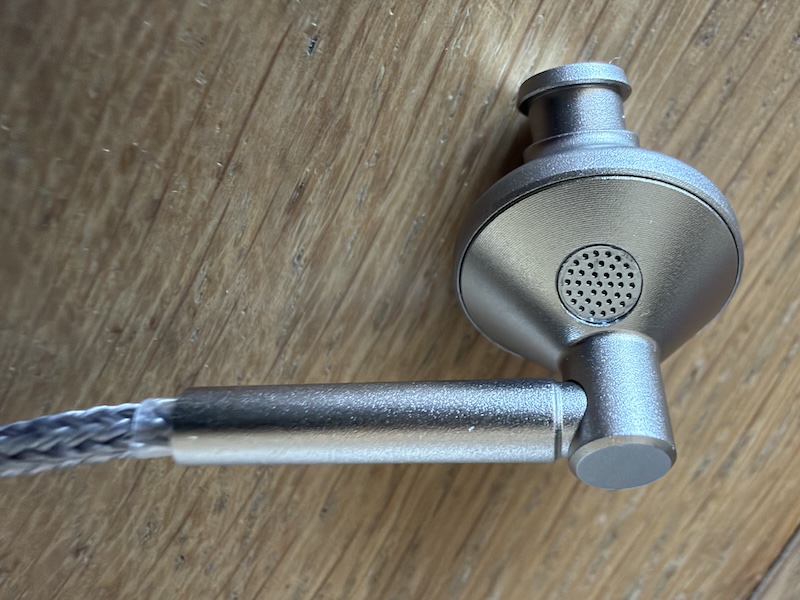
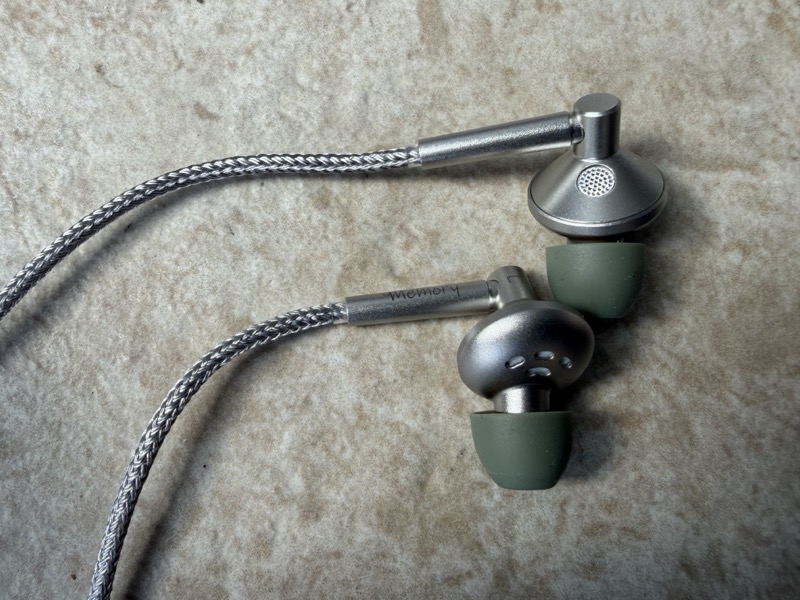
A top-down look at the L earpiece shows the vent holes on the rear chamber and the “Memory” text engraved on the metal barrel where the cable enters the shell. The cable is fixed, not detachable, which is the one build decision I would question on an IEM you are likely to keep for years. The cable itself is the usual ddHiFi standard, which is to say exceptional: supple, well finished, and with no microphonics in use. A straight-on angle shows the small vent grille set into the faceplate:
 |
 |
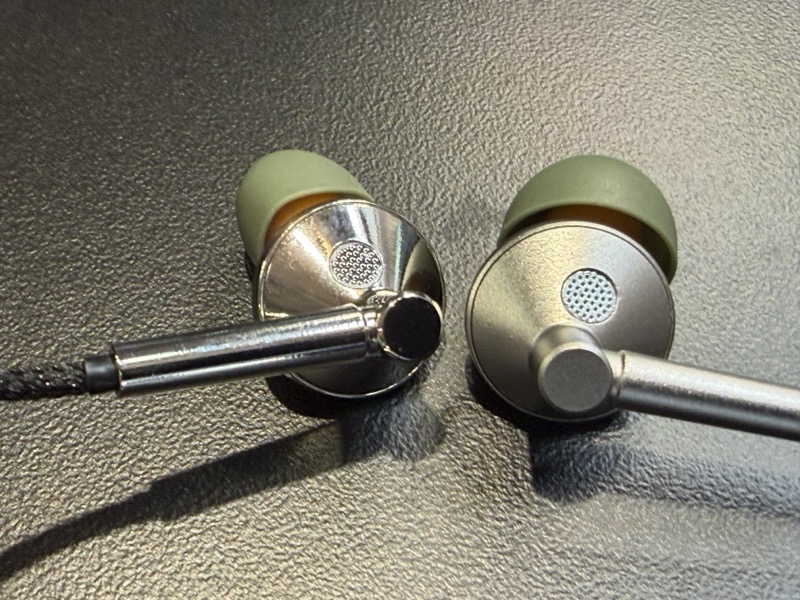
Laid flat together, the pair show the matching aluminium shells and the green silicone eartips fitted for this review:
 |
 |
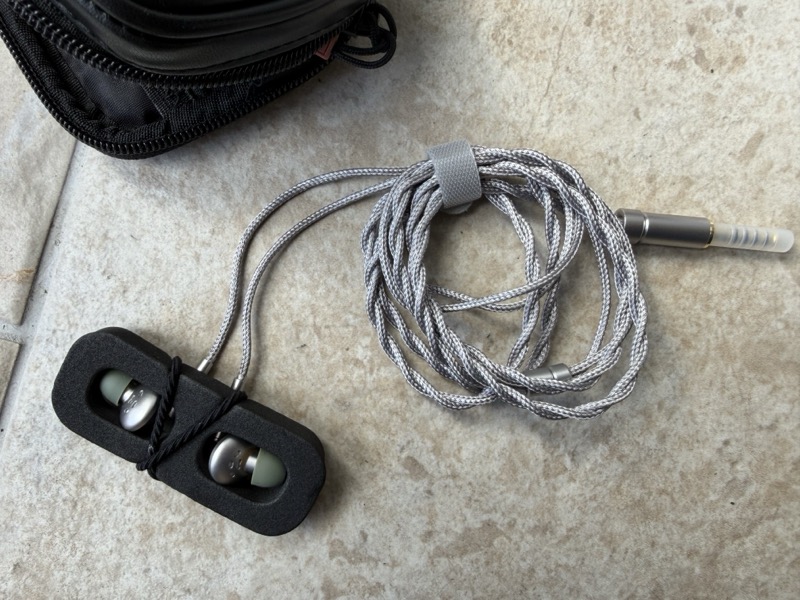
Seated in their foam travel holder with the cable coiled alongside the case, the whole thing is more carefully put together than most at this price:
Fit and Comfort
At around 25g for the pair, the Memory AL4.4 disappears in the ear far more readily than its metal shells suggest, and this is one of the more comfortable metal-shelled IEMs I have worn. The main thing to understand is how it is worn. ddHiFi call it a semi-in-ear design, and in practice you wear the Memory more like an earbud than a typical IEM: the cable hangs straight down rather than wrapping over your ear, and the shell sits shallow in the concha rather than being pushed deep into the canal.
That has two consequences. When it fits well it stays put and keeps its bass. Getting to that fit depends on your ear anatomy more than usual. I briefly used the pre-fitted green ST35 tips, found I was not getting a reliable seal, and switched to the larger KiwiFlex tips from the box, which fixed it. My wife had no trouble at all and stayed with the green tips. Isolation splits the same way: she found it isolated well, while out walking I found the isolation was not great even with the larger tips. If you have smaller ears that struggle with bulkier designs, this shallow fit is a real advantage.
Features and Technical Overview
The Memory AL4.4 is built around a 13mm ultra-linear, full-range annular planar driver, developed with Moondrop, which ddHiFi say is not the same driver used in the USB-C Memory I reviewed last year. Their claim is that the double-suspension structure and four-magnet array give four times the electro-acoustic efficiency of a similarly sized dynamic driver and ten times that of a conventional 14.5mm planar, while reducing the non-linear distortion planars are known for. If that holds up, the driver should be easier to run from low-power sources while staying controlled at higher levels.
ddHiFi describe the tuning as a full acoustic redesign rather than the old driver in a new shell. In their own words: “Unlike the USB version, the Memory 4.4 has undergone a complete acoustic overhaul. The position and surface area of the front and rear chamber vents have been entirely redesigned. Paired with a custom-shielded cable and a dedicated plug, it offers broader source compatibility and focuses on the purest high-fidelity music playback.” That is the manufacturer’s framing; the measurements below show what the overhaul amounts to in practice. The practical part is uncontroversial: a conventional 4.4mm balanced lead rather than a USB-C dongle means it works with any 4.4mm source, a desktop amp, a DAP or a portable dongle. Because the cable is fixed, a 3.5mm source needs a 4.4mm to 3.5mm adapter, which ddHiFi, of all companies, are not short of.
Sound Impressions
Bass
The bass is decent, and the sub-bass is rolled off. Those two facts sit together more comfortably than they sound. What the AL4.4 gives you is a low end with tidy texture and definition rather than physical slam, and the closest reference point I can offer is a Sennheiser HD600, which from me is a compliment. Not every IEM needs to be a bass cannon.
Because there is still usable output down to around 50Hz, most music sounds natural rather than thin. Led Zeppelin’s “Whole Lotta Love” keeps the weight and drive in the bass guitar and kick where the track lives. The genre that suffers is EDM, where the impact sits at 30 to 40Hz, and that is the region the AL4.4 has given away. James Blake’s “Limit to Your Love” is the clearest demonstration: the famous sub-bass drop is present as a note rather than as pressure in your ears, and if that track is your benchmark this is not your IEM.
Midrange
The midrange is the star. Vocals sit forward with real texture, and the measurement shows why: a 2.8kHz ear-gain peak that arrives a little early and a little hot. Tracy Chapman’s “Fast Car” is the obvious test, and her voice is placed right at the front of the mix with the grain and breath intact. “Sweet Jane” by the Cowboy Junkies gets the same treatment: Margo Timmins is close and intimate, and the sparse arrangement gives the AL4.4 room to show what it does well.
Some of my favourite IEMs share this kind of midrange forwardness, so I am predisposed to like it. That cuts both ways: if you are chasing strict neutrality, look elsewhere. This is a voiced tuning, not a neutral one.
Treble
The treble is controlled through the 4kHz to 8kHz region where things most often go wrong, so there is no glare or hardness on sibilants. What makes it more interesting than a simple relaxed treble is the activity higher up, which gives the AL4.4 real detail on a lot of tracks. Tool’s “Chocolate Chip Trip” shows it: the cymbal and percussion work has air and separation rather than being rounded off into a wash. “Billie Jean” holds onto the shaker and the top end of the drum machine without getting splashy.
I would not call this IEM boring. I would call it safe: it takes few risks, but it does not sound sanded down either.
Soundstage and Imaging
Imaging and soundstage are both very decent. “Hotel California” spreads out properly and the guitars sit in defined places rather than piling up in the middle. Dire Straits’ “Private Investigations” is the better test, with its long quiet passages and hard-panned detail, and the AL4.4 keeps the space between events convincing.
Taken as a whole, in a market filled with variations on Harman, V-shaped, U-shaped and now JM-1, coming across a genuinely midrange-forward tuning is refreshing.
Comparisons
The natural comparison is my own ddHiFi USB-C Memory, the USB-C planar IEM I reviewed last year. The same family name does not guarantee the same tuning: ddHiFi describe the AL4.4 as having a different driver and redesigned chamber vents, and the measurements bear that out.
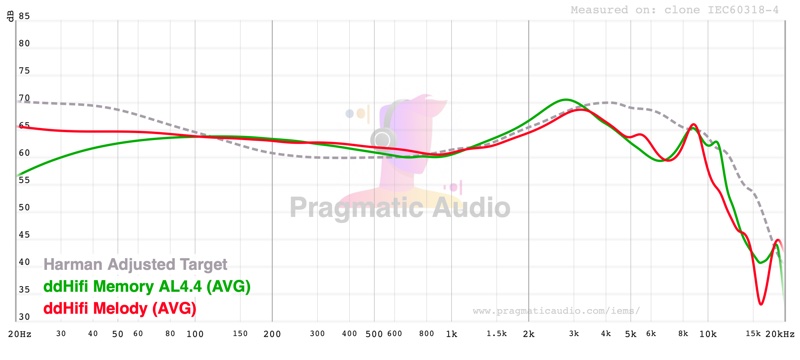
The graph puts a number on the “complete acoustic overhaul” ddHiFi describe, with the older USB-C Memory that I reviewed previously alongside the AL4.4. The overhaul is narrower than the phrase suggests. Between 200Hz and 2kHz the two are within a decibel or two of each other, and both share the same 6 to 7kHz dip, the same 8.5kHz peak, and the same steep roll-off above 10kHz.
Where they differ is the sub-bass and the shape of the ear-gain peak. Below 100Hz the USB-C Memory holds up considerably better, measuring around 64dB at 20Hz against the AL4.4’s 56dB, roughly 8 to 9dB more output where it is most audible as weight. The AL4.4’s ear-gain peak is slightly higher in level and sits slightly lower in frequency. So the overhaul is real, but it reads as a deliberate trade, less sub-bass and a reshaped upper midrange, rather than a wholesale retuning.
The reason the older model measures the way it does is the DSP in its USB-C dongle, which pulls the tuning towards JM-1. Getting a JM-1-focused result out of a $159 IEM is no bad thing, and plenty of people will prefer it. But the AL4.4’s tuning strikes me as the more mature of the two: the USB-C Memory was very focused on delivering JM-1, while the AL4.4 has a point of view of its own, and I appreciate it precisely because it is not chasing a target curve.
Specifications and Measurements
Specifications
| Specification | Value |
|---|---|
| Driver | 13mm ultra-linear full-range annular planar driver, developed with Moondrop |
| Plug | 4.4mm balanced |
| Frequency range | 20Hz – 20kHz |
| Impedance | 16Ω ± 15% (@1kHz) |
| Sensitivity | 121dB/Vrms (@1kHz) |
| THD | ≤0.1% (@1kHz) |
| Housing | CNC AL6063 aerospace-grade aluminium alloy |
| Cable | Grey braided 5N OCC cable, 120cm |
| Weight | Approx. 25g |
| Price | $159.99 |
The figures above are ddHiFi’s own published specification. My measurements, on a clone IEC60318-4 coupler, follow.
Frequency Response
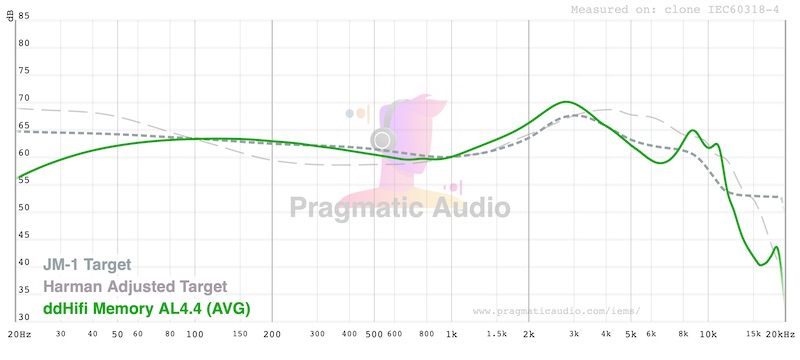
This is a midrange-forward tuning with a gentle bass roll-off and some genuine detail up top. I would call it safe in the sense that nothing here will catch you out, not in the sense that it is dull.
The roll-off is the defining feature. The AL4.4 tracks both targets closely from roughly 200Hz up to 1kHz, but below 100Hz it falls away steadily, reaching about 56dB at 20Hz where the Harman Adjusted Target sits near 69dB, a shortfall of roughly 13dB in the deepest sub-bass. The roll-off is gradual rather than a cliff, and there is still usable output at 50Hz, which is why this reads as a tuning choice rather than a broken bottom end.
The ear-gain peak arrives a little early and a little hot, around 70dB at approximately 2.8kHz where the Harman plateau sits nearer 3.5 to 4kHz, and that is what gives the tuning its character. From 4kHz to 7kHz the response falls below both targets, bottoming around 58dB near 7kHz against Harman’s 65dB, which is why the presentation stays clear of glare despite the prominent ear gain below it. A narrow peak returns to about 65dB near 8.5kHz, with further activity through the upper treble before a steep roll-off above 10kHz and a deep notch close to 15kHz. That upper-treble activity is where the detail comes from.
Distortion
 |
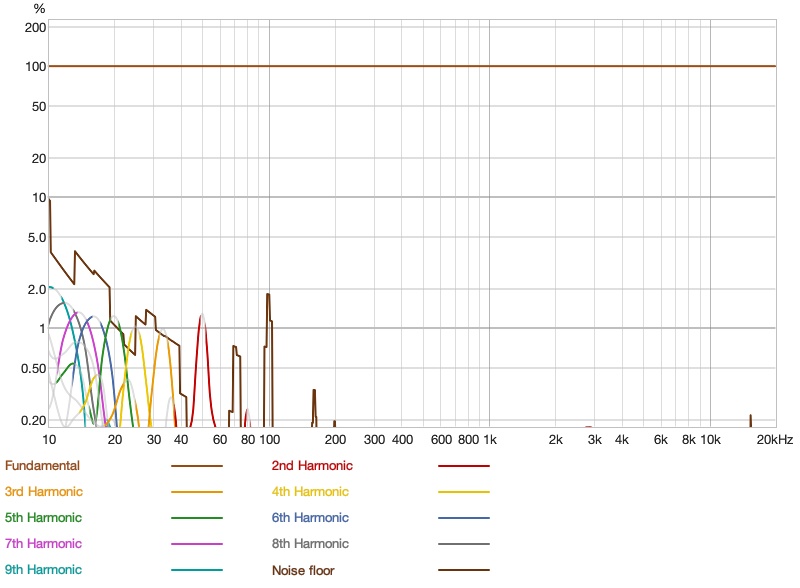 |
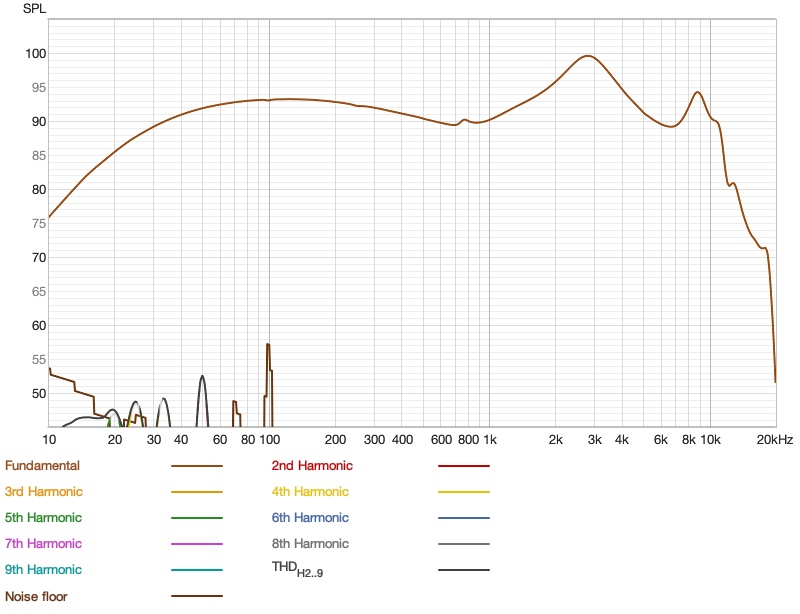
Distortion is excellent, and there is nothing here to be concerned about. Through the midrange and treble the harmonics sit at the floor of the measurement, and the small rise at the very bottom is in the region where coupler and seal effects contribute as much as the driver, and where the AL4.4 has little output to distort in the first place.
Rating Explanation
The Pragmatic Rating of 4 reflects an IEM that gets the basics right: solid aluminium shells, a driver design with some engineering behind it, and an unusually good case. The Features Rating of 4 reflects the driver design and the move to a standard 4.4mm balanced connection instead of the USB-C approach of the earlier Memory, held back by the fixed cable.
The Price Rating of 4 reflects reasonable value at $159.99 for the build, accessories and driver, held back from a five by the sub-bass shortfall, which narrows who this suits. The Measurements Rating of 4 rests on measured data: distortion is low across the band, but the frequency response gives up roughly 13dB of sub-bass against the Harman Adjusted Target, which is a real limitation rather than a matter of taste.
This is a sensible option for anyone who wants a compact, comfortable planar IEM, especially if smaller ears make fit harder than it should be, and particularly if you listen to vocals and acoustic material where the forward midrange is the point. It is the wrong choice if your listening depends on low-end weight.
Conclusion
Build and presentation make the Memory AL4.4’s first case: the aluminium shells feel solid, the earbud-style fit is comfortable once you find your seal, and the carrying case is better than the usual throwaway pouch. The sound makes the second. The midrange is the reason to buy this, with vocals forward and textured, the treble is controlled where it matters and active enough higher up to keep things interesting, and the bass is where you pay for it: usable down to around 50Hz, then gone, a deliberate trade but a trade all the same.
The Memory AL4.4 is a well-made IEM I would point smaller-eared listeners toward without hesitation, provided they know what they are giving up at the bottom. If James Blake’s “Limit to Your Love” is your benchmark, look elsewhere. If Tracy Chapman’s “Fast Car” is, this is a lot of IEM for $159.99.