FiiO Jade Audio JT9: Did FiiO Improve the JT7?
The JT7 is only a few months old — the JT9 is FiiO’s attempt to refine it, in four ways
A neutral open-back planar on the same 95×86 mm driver family — measured here on a KB501X soft ear/pinna against the JT7, the FT1 Pro and the Sundara.
I reviewed the FiiO Jade Audio JT7 last year and the FiiO FT1 Pro before that. The JT7 in particular has become something close to legendary at its price, and it is only a few months old, so a headphone sitting above it this soon is not what I expected to be writing about.
The JT9 uses the same 95×86 mm planar driver footprint, and FiiO’s own launch material makes a specific engineering claim: the resonant frequency has been lowered relative to the JT7 and the FT1 Pro. That claim is the one thing about the JT9 that is easy to check instead of argue about, and it is the reason I wanted to measure it next to the other two rather than review it on its own.
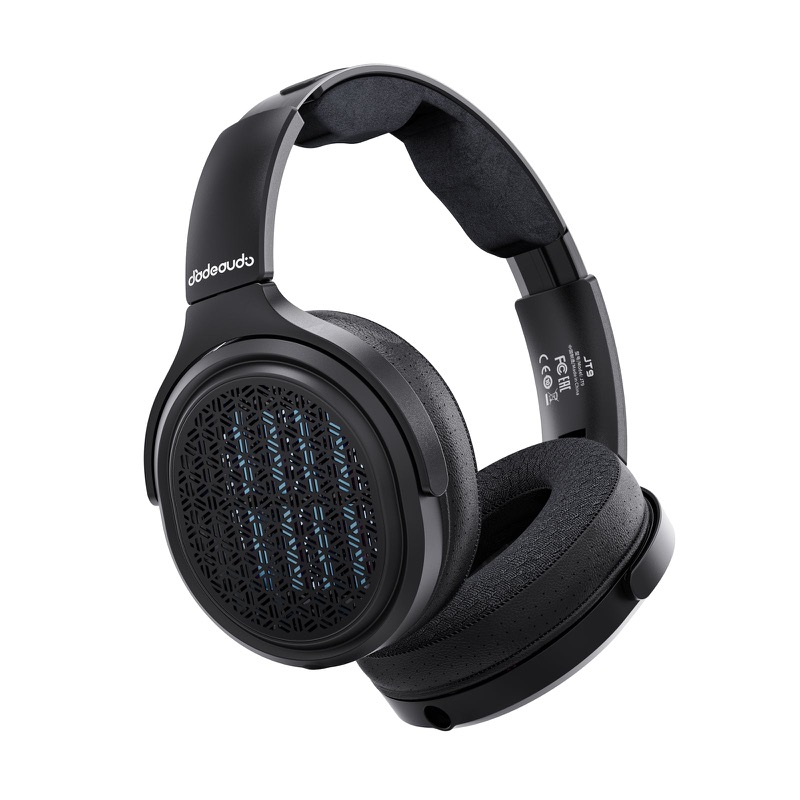
I would like to thank FiiO for providing the JT9 for the purposes of this review.
If you are interested in finding more information about this product, you can find it at the official launch page, on the official Jade Audio product page, and at retailers such as Apos Audio.
The JT9 retails for $159.99 at Apos Audio, with other listings at $169.99 (prices checked September 2026). It launched in China in August at roughly $148. Available in Black, with a Deep Brown version announced but not yet released — the unit here is the Black version.
I have had the JT9 for about three weeks. Most of that has been at a desk at home, but because it is so easy to drive I took it to the US on a recent trip and ran it straight out of a MacBook Pro while working in an office, with no amplifier and no complaints. Most of my listening has been on the single-ended cable. I also ran it balanced from the Jade Audio Gigas1, and that pairing has so much power in reserve that the JT9 sounds completely effortless.
What I found is that the JT9 is better than both of them in four separate ways. None of the four is dramatic on its own, and none of them is something the JT7 was crying out for — three are audible and one of them is simply in the box. I will come to all four in turn, but the rest of the package is the familiar Jade Audio unboxing, so start there.
Unboxing and Build Quality
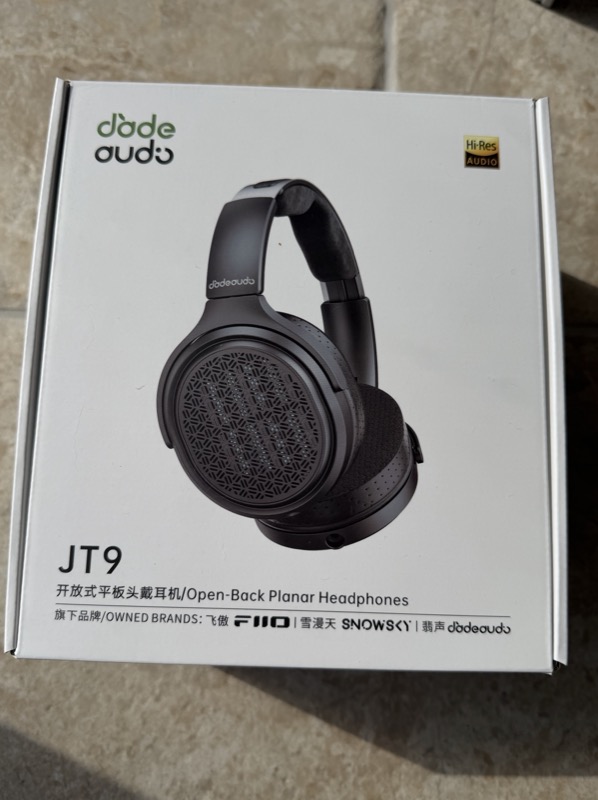
The retail box is the same small white cube Jade Audio has been using, with the green wordmark up top and the product shot doing the work. The front tells you what it is without needing the spec sheet — open-back planar, Hi-Res Audio logo in the corner — and it lists FiiO, Snowsky and Jade Audio along the bottom as the group’s three brands:
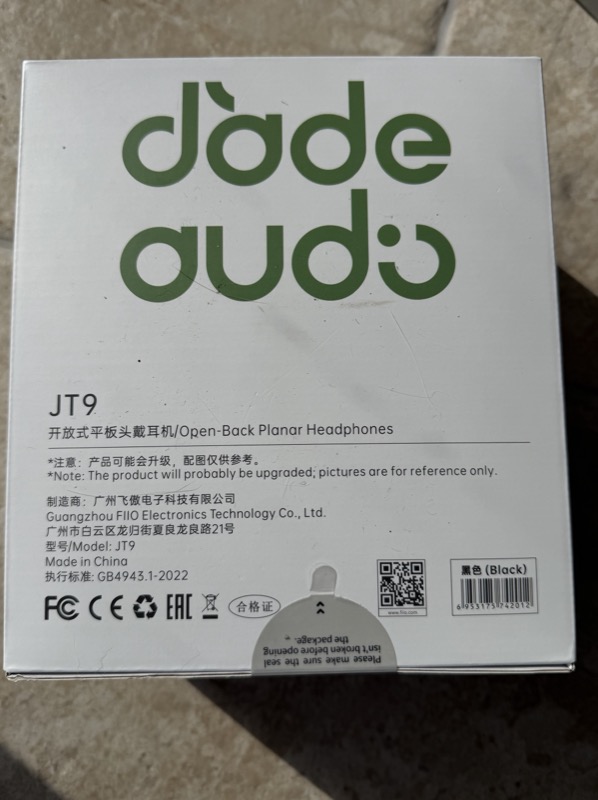
The rear panel is mostly the wordmark again, with the model designation, the manufacturer address in Guangzhou, the regulatory marks and the colour variant printed small along the bottom. Note the line FiiO prints there itself: “the product will probably be upgraded; pictures are for reference only”. Here it is:
Lift the lid and the case fills most of the volume, with the cables bagged alongside it, not inside it:
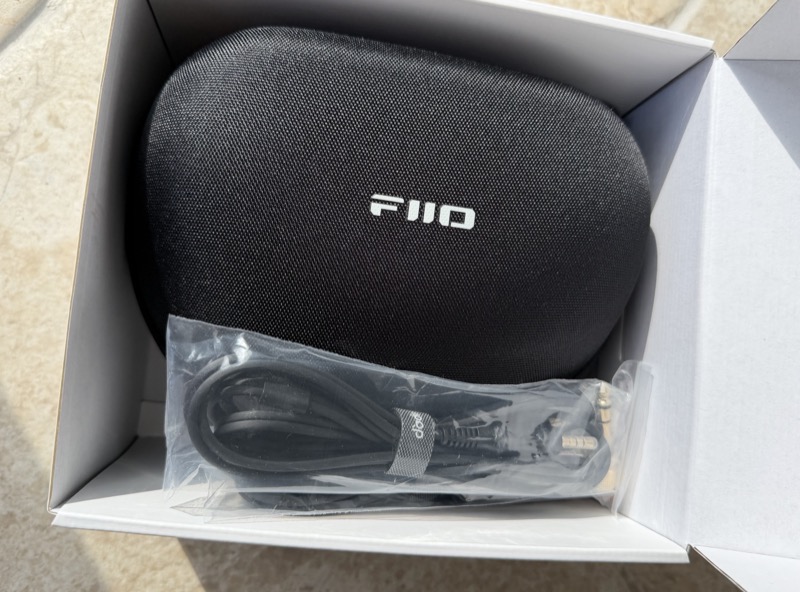
Laid out, the contents are the hard zip case, a quick start guide and the two cables in separate bags — the 3.5 mm single-ended and the 4.4 mm balanced. Jade Audio’s own packing list on the Chinese product page settles what should be in the box: the headphone, a 3.5 mm single-ended cable, a 4.4 mm balanced cable, a 3.5 mm female to 6.35 mm male adapter, the storage case, the quick start guide and the retail packaging. Both cables terminate in dual 3.5 mm plugs at the headphone end:
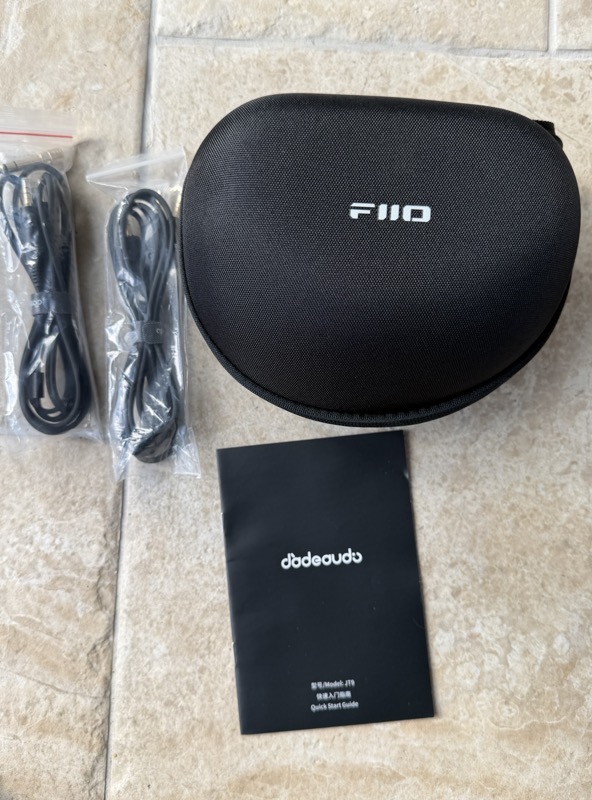
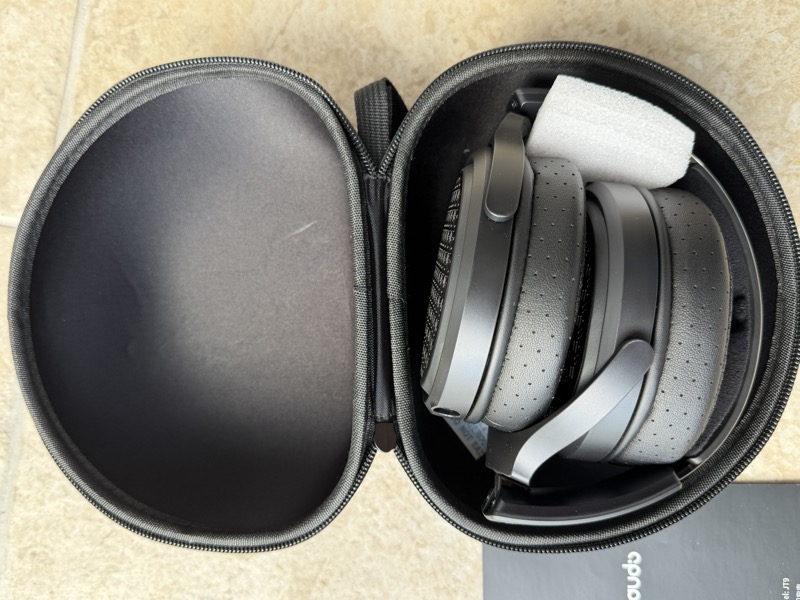
The case is the more interesting inclusion. At this price a cloth pouch is normal — the JT7 shipped with one — and instead the JT9 gets a semi-rigid zip case that Jade Audio describe as a waterproof and moisture-resistant woven-fabric storage case cut to fit the JT9, carrying the FiiO logo instead of the Jade Audio one. The cups fold flat and rotate to fit inside it, so the headphone genuinely packs down instead of merely being storable:
The cables get a paragraph of their own in Jade Audio’s copy. They describe them as tuned for the planar driver, made from high-purity oxygen-free copper blending 0.06, 0.08 and 0.12 mm strands to a single-conductor 22 AWG total, and they claim that mix thickens the lower midrange and adds bass weight and atmosphere. A cable that changes the tonal balance of a 20 Ω headphone is a claim I would want measured before I believed it, and the strand mix is a construction detail, not evidence for it.
In the hand the JT9 is much the same proposition as the JT7. It is light, and I know some people will read the mix of metal and plastic as not premium enough for the money. I do not, because the proportions look right to me for a headphone at this price: enough metal where the load goes, plastic where a repair should be cheap, and nothing that feels out of place or misjudged. Nothing creaks or rattles. It is a very good design at this price point for a headphone that should still be working in several years, and the hard case earns its place instead of just filling the box, which is most of what justifies the gap to the JT7.
Fit and Comfort
FiiO’s published weight is 365 g excluding cable, which puts the JT9 between the JT7 at 318 g and the Hifiman Sundara at 372 g. The suspension is a multi-axis yoke with a suede-covered headband pad, and the earpads are perforated with an asymmetric internal shape — FiiO calls them “3D asymmetrical ergonomic” pads, which in practice means the front of the pad is shallower than the rear to follow the angle of the ear.
Perforated pads matter more than they sound like they should on this family of headphones. When I measured the JT7 I found that swapping its perforated pads for the non-perforated FT1 pads shifted the midrange audibly, so the JT9’s pad choice is part of its tuning as much as a comfort decision. Jade Audio’s own explanation of the pad shape is that it copies the contour of a face instead of sitting as a flat ring, and that the three-axis rotating yoke is what lets that shape seal evenly and spread clamp force; they also claim the redesigned cups reduce the “in-head” effect on vocals and widen the front-to-back stage, which is a listening claim, not a measurement, and is not something I can confirm from a frequency response curve.
The articulation figures Jade Audio publish are 90 degrees of fold rotation, 35 degrees of horizontal rotation, 45 degrees of tilt and about 38 mm of headband slide, and they give the folded package as roughly 170 mm wide by 135 mm tall by 106 mm deep. Their weight framing is 365 g against the “400 g and above” they attribute to same-class planar headphones, so the marketing claim is about 40 g saved, not about being light in absolute terms — 365 g is still heavier than the JT7.
Comfort is excellent, and again very close to the JT7. The earpads are among the more comfortable I have used at this price, and the headband has a notch through the middle of the pad that keeps the crown of your head from getting warm on long sessions. There is plenty of range in the extensions and enough movement in the yokes that it settles without hunting for a position, and at 365 g it is light enough that weight never became the thing I noticed. I have not found a hot spot or a session length that made me want to take it off.
Sound Impressions
Jade Audio’s own description of what they were aiming at is worth reading before anyone else’s, because it is unusually specific for marketing copy. The Chinese product page quotes Joseph, chief engineer of FiiO’s IEM R&D centre, saying the JT9’s brief was to be easier to listen to for long stretches with a more orderly stage, that its design took the sound of the JT7 and FT1 Pro as the starting point, and that the secondary sapphire plating was chosen to extend the response at both ends — a loose low end and a clear treble that suits strings. Elsewhere on the same page they claim the improved manufacturing gave the driver a lower resonant frequency, and with it deeper bass extension and a warmer, thicker tone. Those are claims about intent; the graphs further down are the part that can be checked.
Before my own notes, the common descriptions of the JT9 elsewhere are consistent on the low end and slightly split on everything above it. Headfonics describe the tonality as warm and bassy and moderately V-shaped, with a relaxed midrange and a light, gentle treble, and single out the soundstage as unusually large for the price. Audio Rabbit Hole reach a similar conclusion about the bass — more of it than most open-back planars, and physical instead of merely present — but hear the midrange as clear and textured rather than relaxed, and the treble as crisp and extended without becoming fatiguing on the stock pads. The consensus description across both is that the JT9 is the bass-forward member of this driver family, and that the staging and separation are what you notice first. There are still relatively few published reviews, so treat that consensus as provisional.
My listening was split between the single-ended cable from a MacBook Pro headphone output, which drives the JT9 to more than enough level on its own, and the balanced output of the Jade Audio Gigas1, which has far more power than this headphone will ever ask for. Levels were ordinary, nothing unusual; the measurements below were taken at about 89 dB SPL with a 100 dB peak.
Bass
The bass is the reason to buy this headphone. Subjectively it is the best bass of any FiiO or Jade Audio headphone I have heard, and it reads as extension rather than as bloom. It does not have the excursion problem the FT1 Pro had, and it goes deeper into the sub-bass than the JT7 does. What makes it work is that it is linear: the response holds a nearly straight line from 20 Hz up through the lower midrange, so there is no mid-bass hump adding weight where you did not ask for it. On sustained low passages, the organ pedal that opens Bach’s Toccata and Fugue in D minor or the synthesiser floor under Massive Attack’s “Angel”, it stays controlled and stays out of the way of everything above it. That is exceptionally good bass for an open back at this price.
Midrange
Midrange tonality is very good. There is a slight chasing of soundstage in the way the response sits through 1 to 2 kHz, and the measurements bear it out: of the four headphones here the JT9 is the one furthest back at 2 kHz, about 3 dB below the JT7 and 5 dB below the Sundara in that region. It is a shape the other FiiO headphones lean on to a lesser degree and that some Hifiman models do too, and it is the one thing that keeps me from calling the tonality faultless. It is audible if you listen for it, mostly as a small step back in the upper part of a vocal, but it never made a voice sound thin or hollow. Joni Mitchell’s “A Case of You” comes through with the note weight and the timbre intact. Overall this is excellent tonality, and if I had to summarise the midrange in one line it is that the dip is a measurable characteristic, not a complaint.
Treble
Treble is the most contentious area, and it is where the JT9 has already been criticised. Some users have found it has too much of it, and when I heard a pre-release sample at High End Vienna I thought the same — it seemed a little too forward then. My view of the retail unit is different. FiiO have toned the treble down and smoothed it out, and while the overall level is similar to the JT7 and the FT1 Pro, on my head it is subjectively the smoother of the three. I have no complaints about it: cymbals have energy without splashing, sibilance stays where it belongs, and I did not find glare on anything I played. In the sub-$200 bracket this is probably my headphone of the year for tonality. FiiO took something already good in the JT7 and tweaked it into something slightly better.
Soundstage and Imaging
Staging is good, better than it has any business being at this price, though not at the level of the egg-shaped Hifiman open backs. The Edition XS still has more width and more air around individual instruments. What the JT9 does well is keep images focused and stay orderly when a recording gets busy, which is what FiiO said they were aiming at. I would call the large stage other reviewers report real but not extraordinary.
Comparisons
Against the JT7, the JT9 is the more expensive and more completely equipped of the two. The JT7 is $109.99 with a cloth pouch; the JT9 is $159.99 with a folding frame and a hard case, and it is 47 g heavier for it. On paper the drivers are close relatives — the same 95×86 mm footprint, 18 Ω and 92 dB/mW on the JT7 against 20 Ω and 95 dB/mW on the JT9 — and neither needs anything unusual to drive it. The measured difference is concentrated below 60 Hz, which is discussed with the graphs below. If you do not care about the bottom octave and you do not need the headphone to fold, the JT7 is the cheaper answer and the difference is $50.
The FT1 Pro is the other in-house comparison, and it is a different kind of product: heavier, non-folding, and built on the FT1’s closed-back chassis. It is also the headphone whose sub-bass FiiO deliberately pulled back between the pre-release and retail versions, after acknowledging the pre-release unit had its F0 resonance designed too low. Read alongside FiiO’s claim that the JT9 lowers the resonant frequency again, that history is worth keeping in mind instead of reading the JT9 as a straight upgrade — the two decisions point in opposite directions.
The Hifiman Sundara is the outside reference and the price comparison that has moved. It was $279 when I reviewed it, is rated at 37 Ω and 94 dB, and weighs 372 g. It remains the better-finished headphone of the group, with a headband mechanism the FiiO frames do not match, and the measurements say its better channel reaches 20 Hz as deep as the JT9 does instead of falling short of it. Where it loses is channel matching down there, several decibels between its two channels at 20 Hz where the JT9 stays close together, and price. If you want the smoothest 1–8 kHz of the group and you are happy to pay for build, the Sundara case still holds; if you want the same bottom octave from both ears for a good deal less money, the JT9 is the better buy.
If I were buying one of the four today, I would buy the JT9 ahead of the JT7, the FT1 Pro and the Sundara. It is close, and I want to be clear about how close: I would not sell any of those three to fund a JT9. But in the specific ways that matter to me — the sub-bass, the linearity of the whole bass response, and the smoothness of the treble on my head — this is the better headphone in this price bracket.
Specifications and Measurements
Specifications
This is Jade Audio’s published specification, taken from the official Jade Audio product page (checked 9 September 2026), FiiO’s launch page and the Apos Audio listing. The specification text on the Jade Audio page is set inside images in Chinese rather than as web text, so the wording below is my translation of it:
| Item | Description |
|---|---|
| Product name | Open-back planar over-ear headphones |
| Model | JT9 |
| Driver | 95×86 mm in-house planar magnetic unit |
| Diaphragm | 1 µm PET base film with sapphire and aluminium dual coating (patent ZL2024205488218) |
| Voice coil process | 28 nm chip-grade deposition: coil sputtered at 6.6×10⁻³ Pa and 120 °C |
| Magnet system | Uniform equal-magnetic-field design with chamfered magnets (patent ZL202420884963.1) |
| Frequency response | 7 Hz–40 kHz |
| Sensitivity | 95 dB/mW @ 1 kHz; 112 dB/Vrms @ 1 kHz |
| Impedance | 20 Ω @ 1 kHz |
| Recommended power | 300 mW or higher |
| Earphone connector | Dual 3.5 mm (TS) |
| Audio plugs | 3.5 mm single-ended and 4.4 mm balanced |
| Cable | 22 AWG high-purity oxygen-free copper, approx. 1.5 m; blend of 0.06, 0.08 and 0.12 mm strands |
| Headband adjustment | 90° fold rotation, 35° horizontal rotation, 45° tilt, approx. 38 mm slide |
| Folded size | Approx. 170 × 135 × 106 mm |
| Weight | Approx. 365 g (excluding cable) |
| Certification | Japan Audio Society Hi-Res Audio |
| In the box | Headphone, 3.5 mm cable, 4.4 mm cable, 3.5 mm female to 6.35 mm male adapter, storage case, guide |
| Colours | Black; Deep Brown, which Jade Audio expect to go on sale in September 2026 |
Two of those numbers matter in practice and the rest are marketing. 20 Ω at 95 dB/mW means a phone dongle will make it loud; FiiO’s own “300 mW or higher” recommendation is about headroom on dynamic peaks rather than about reaching listening level. The 7 Hz–40 kHz figure is a manufacturer frequency response range with no tolerance attached, so it tells you nothing useful — the graphs below are the actual answer. Jade Audio’s own pairing advice on the same page is consistent with that reading: they suggest the QX11, BTR15, M21, DM13 and DM15 as sufficient, and only recommend the K11 series, K13 R2R or a Class A desktop amplifier if you want more stage width, dynamics and grip — an upsell rather than a requirement.
The engineering claims behind those rows are worth separating from the numbers. Jade Audio describe the diaphragm as high-performance PET carrying two stacked coatings, and they split the jobs between them: aluminium for conductivity, which they say lowers impedance and the drive threshold, and sapphire for stiffness, which they credit with the high-frequency resolution. The coil itself is described as deposited using a 28 nm semiconductor-style process — the target metal ionised in a 6.6×10⁻³ Pa vacuum at 120 °C and drawn onto the film by charge attraction — which they argue gives better coil consistency and durability than a conventional process. The magnet claim is a distortion claim: rectangular magnets give an uneven field, uneven field gives uneven force across the diaphragm and therefore breakup modes, and their curved and chamfered magnets are meant to even the field out and reduce distortion. Jade Audio’s own figures for the diaphragm are 1 µm against the “3 µm and above” they attribute to conventional planar headphones. All of that is their reasoning, not measured evidence, and none of it is visible on a frequency response curve — a distortion sweep is where a magnet claim like that would show up or fail to.
Jade Audio also publish one measurement of their own on that page, presented as part of the Hi-Res certification claim, with no rig, coupler, smoothing or channel stated:
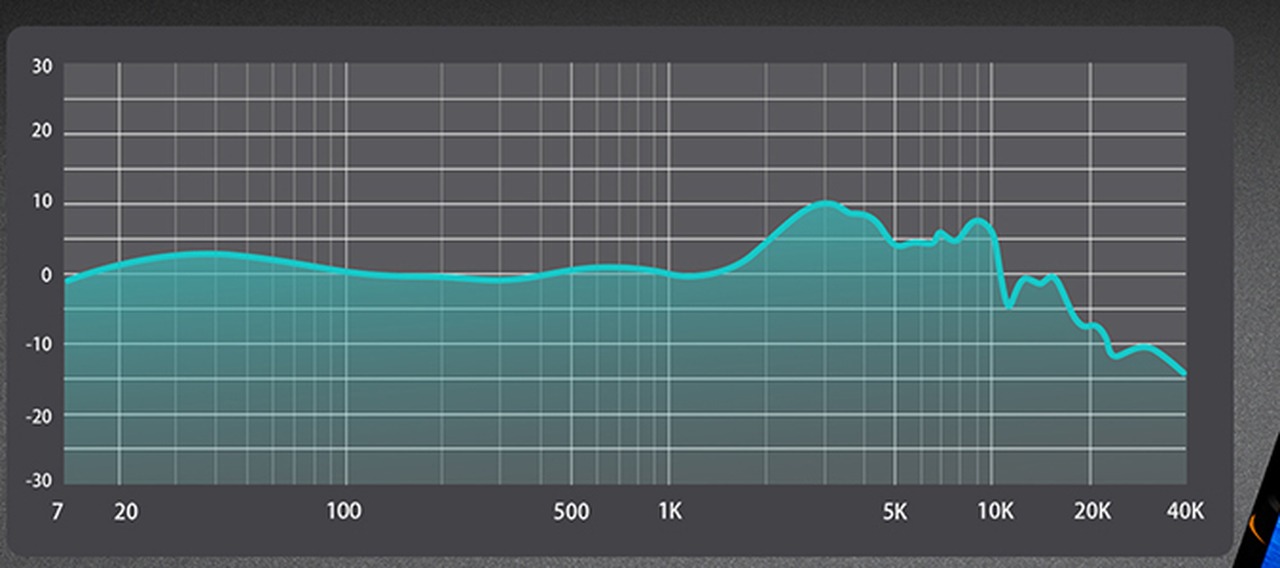
Read it as a manufacturer marketing curve and nothing more. It shows a broad low bass lift of a few decibels, a flat run through the midrange, a peak of about 10 dB near 3 kHz and a collapse above 10 kHz. It is not evidence that their claims are true, it is not comparable with my measurements below because the rig and normalisation are unknown, and it is the same shape any planar headphone would produce on a compensated fixture. I include it because it is the only number-bearing measurement they publish, not because it confirms anything.
Frequency Response
These are my own measurements, taken on my KB501X soft ear/pinna with a 711 clone coupler. Two
caveats before the curves. The JT9 trace is a single left-channel capture, labelled L, while the
JT7, FT1 Pro and Sundara traces are channel averages, so small differences between them are not
significant. And everything above roughly 8 kHz on this rig is dominated by coupler and pinna
resonances more than by the headphone’s tuning, so the large oscillations up there should not be
read as audible differences. Every decibel figure I quote below is taken from the underlying REW
captures, not read off the plot, with each curve referenced to its own 500 Hz level, so you can
check any of them against the raw traces in the
headphone measurement database.
Starting with the JT9 against the JT7 and the KB501X diffuse-field target with a −1 dB/octave tilt applied:
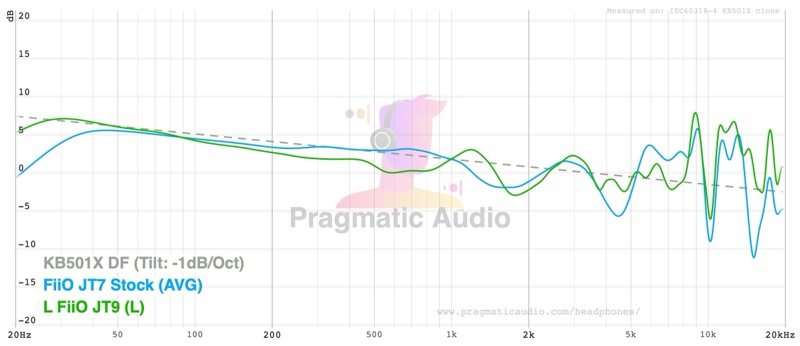
The bottom octave is the headline. The JT7 has already fallen away by 20 Hz, well down on its own 50 Hz level, while the JT9 is still rising at 30–35 Hz and sits above the tilted target from about 25 Hz to 45 Hz. That is the lowered resonant frequency FiiO claims, and it is the single largest difference between the two headphones. Both then converge from around 80 Hz and track the target closely through the midrange. The JT9 is not simply flatter, though: it has a broad shallow dip of a decibel or two centred around 450–550 Hz and a small bump peaking near 1.2 kHz, where the JT7 runs smoother and more evenly along the target line. Both share the dip around 2 kHz and the peak at roughly 3 kHz, and through 5–8 kHz the JT9 sits a couple of decibels above the JT7, whose 6–7 kHz notch is noticeably deeper.
Adding the FT1 Pro with its retail stock pads shows the same pattern extending to the third member of the family:
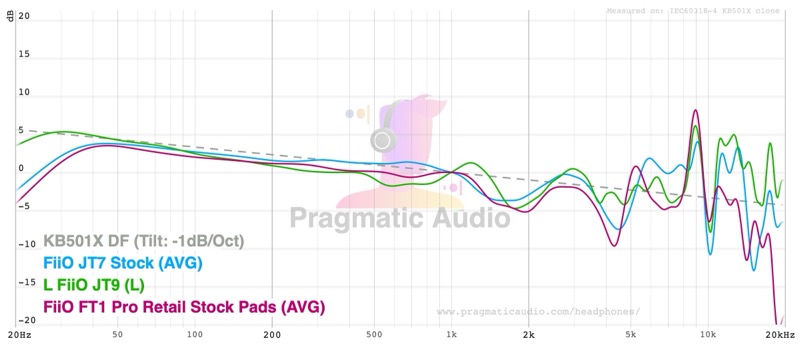
At 20 Hz the FT1 Pro is the lowest of the three and the JT9 clearly the highest, and the gap between them is large enough that no amount of reseating closes it; by 60 Hz all three sit within about half a decibel of each other, so the whole difference lives in the bottom octave and nowhere else. This is the visible consequence of the FT1 Pro’s retail-version sub-bass roll-off, which FiiO introduced deliberately. Through the presence region the three diverge in a different way: the FT1 Pro has the deepest 2 kHz dip of the group, and the JT9’s 1.2 kHz bump is the one shape none of the others share.
Swapping the FT1 Pro for the Hifiman Sundara puts the FiiO pair against the long-standing mid-fi reference:
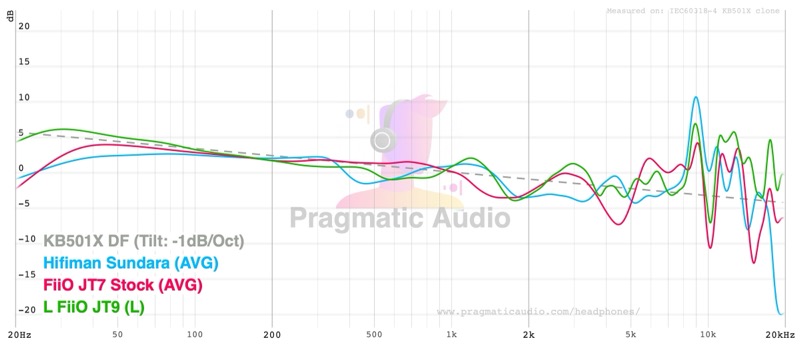
This is the graph that corrected something I had assumed. The Sundara’s bottom octave is not shallower than the JT9’s: on its better channel it reaches 20 Hz as deep as the JT9 does, and it is the JT7 that is the outlier of the three down there. What the Sundara does have is a channel mismatch. Its left channel holds level to 20 Hz while its right channel falls away sharply, a spread of several decibels that I could not reduce by reseating it, where the JT9’s two channels stay close together. So the JT9’s advantage over the Sundara at the bottom is consistency between the two ears, not raw depth, and that is worth more in practice than it sounds — a bass note that arrives at different levels in each ear loses its centre. Higher up, the Sundara rises steadily from 500 Hz through 2 kHz where both FiiO headphones stay closer to flat, which is the shape behind its reputation for a forward upper midrange. Judged as root-mean-square deviation from the tilted target between 1 kHz and 8 kHz, the Sundara is actually the most even of the three at about 3.6 dB, with the JT9 at 4.7 dB and the JT7 at 4.8 dB — so the JT9 is the more even of the two FiiO headphones through that band, but not the most even here. Above 8 kHz the Sundara shows the large narrow peak near 9–10 kHz and steep collapse toward 20 kHz that this rig always produces with it, which is why I would not read anything into that region.
Finally, the same three plotted against the Harman OE 2018 target on an absolute scale instead of normalised:
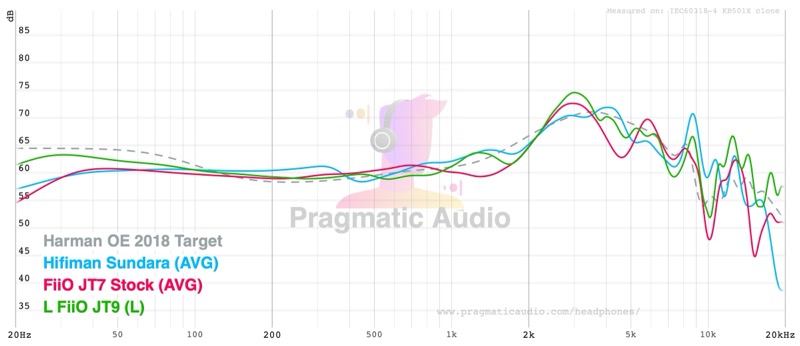
Harman OE asks for a bass shelf that none of these three reach, which is the usual story for open backs. The useful detail is the ranking: on this absolute scale the JT9 gets closest to that shelf, with the Sundara and JT7 both a couple of decibels further from it and much of a muchness between themselves. An absolute plot mixes sensitivity in with tuning, so treat that as a rough ordering, not a measurement. Through 200 Hz to 1 kHz the two FiiO headphones sit close to the target line while the Sundara runs slightly above it. All three then follow Harman’s ear-gain rise into the 2.5–3 kHz region and reach a similar peak level, so the JT9’s tonal balance is not unusual there. The divergence from 3 to 6 kHz, where all three sit above the target, is a shape this driver family shares, not something specific to the JT9.
The short version of all four graphs is that the JT9 is the member of this driver family that actually reaches 20 Hz, and it pays for that with a slightly less even lower midrange than the JT7. Whether that is a good trade depends on what you listen to.
Distortion
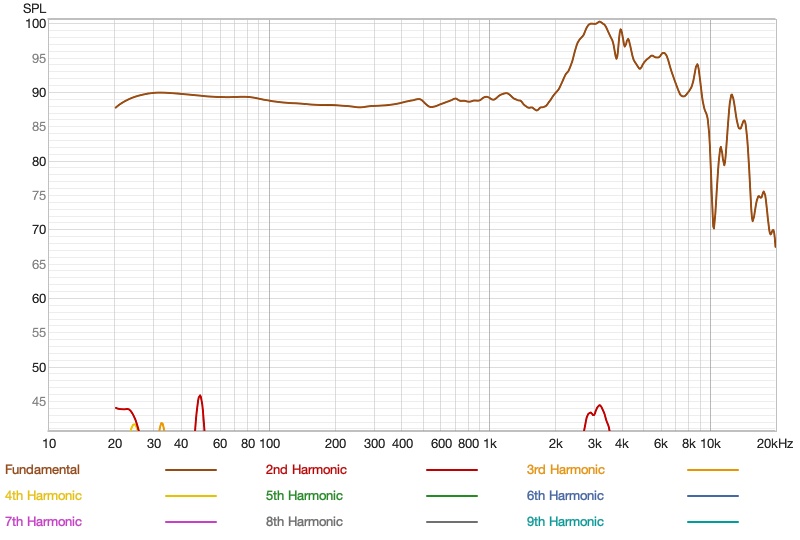
Jade Audio’s uniform-magnetic-field claim is the one engineering claim on their page that a measurement can settle, so this is the section where it either holds up or does not.
I ran a harmonic distortion sweep on the same KB501X rig, with the fundamental sitting at about 89 dB SPL through the midrange and peaking near 100 dB at 3 kHz, which is louder than I actually listen. The absolute plot puts every harmonic between 42 and 46 dB at its highest, roughly 45 dB below the fundamental:
The same sweep expressed as a percentage of the fundamental is the more readable version:
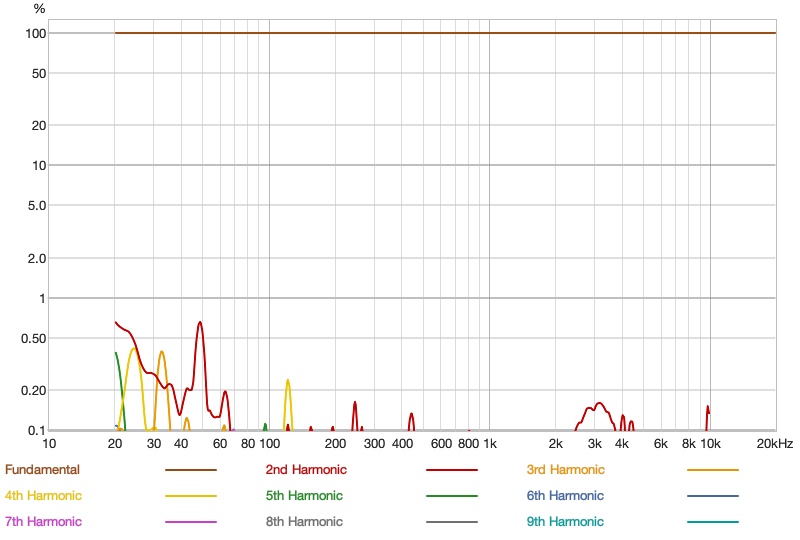
Second harmonic distortion peaks at about 0.7% at 20 Hz and again around 55 Hz, falls below 0.3% above 60 Hz, and stays under 0.2% through the midrange and treble. At 89 dB average with a 100 dB peak, that is essentially no distortion at any level I would use. The practical consequence is headroom for EQ: if you want to add several decibels of bass shelf and turn the JT9 into a bass monster, the driver has the room to take it without audible strain. On this evidence the magnet claim holds up.
Rating Explanation
Five for pragmatic, because this is the headphone in this bracket I would actually buy, and because everything about owning it is straightforward: easy to drive, comfortable for hours, and built to be repairable. Four for price, not five, only because it is $50 more than the JT7 and the JT7 is still a very good headphone — the gap buys the bottom octave, the folding frame and the case, and whether that is worth it depends on you. Five for features, because it is easier to drive than its siblings and the hard case is a real part of the package and not a token. Five for measurements: real output at 20 Hz where the JT7 and FT1 Pro roll off, a linear bass response with no mid-bass hump, the smoother 1 to 8 kHz of the two FiiO headphones against the tilted diffuse-field target, and distortion low enough to be irrelevant at listening levels. Another exceptional headphone on my measurement rig. The thing I would mark down if I were being strict is the 1 to 2 kHz dip, which is the price paid for the staging.
Conclusion
The JT9 is not a straightforward upgrade of the JT7, and reading it that way is the mistake the $50 price gap invites. It is the same driver family tuned to a different priority: FiiO lowered the resonant frequency, and the measurements show that paid off in the bottom octave: the JT9 extends audibly lower than either the JT7 or the FT1 Pro, and neither of those two is close to it at 20 Hz. What it gives up is a little of the JT7’s midrange evenness, in the form of a shallow dip through the lower midrange and a small bump around 1.2 kHz. The folding frame and hard case are real additions, not packaging, and at 20 Ω and 95 dB/mW nothing about driving it is complicated.
If I had the extra cash I would stretch to the JT9 over the JT7, and I would do it without much hesitation if I were travelling with it, because being this easy to drive genuinely matters when your source is a laptop and the hard case matters when it is in a bag. If you already own the JT7 and you are happy with its bass, the upgrade is arguable and you can skip it. If you are buying your first open-back planar under $200 and you want a bottom octave that is actually there, buy this one.