FiiO K17 R2R: R2R Without the Compromise
FiiO’s flagship desktop DAC/amp, with the AK4499EX chips replaced by a discrete, high-quality “R2R Pro” resistor ladder
Same 4W amplifier, same 31-band PEQ, same streaming stack — a different way of turning numbers into voltages.
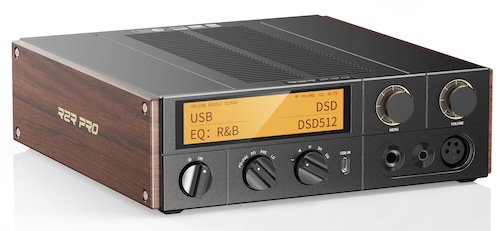
I reviewed the FiiO K17 in April 2025 and the smaller K13 R2R at the end of that year. The K17 R2R is what happens when you put those two ideas in the same chassis: FiiO’s flagship desktop DAC/amp, with the dual AK4499EX delta-sigma converters taken out and a discrete resistor-ladder DAC — which FiiO brands “R2R Pro” — put in their place. Everything else is recognisably the K17.
FiiO have somehow figured out how to update the already retro-futuristic K17 with something even more retro-futuristic: a nice wooden finish on the side panels and a high-quality “R2R Pro” ladder in place of the chips.
That makes it an unusually clean question to ask of a product. The amplifier stage, the power supply, the PEQ engine, the network streaming, the touchscreen, the remote and the connector count are all shared with a device I have already spent months with. What changes is the converter, and whether the discrete approach costs anything measurable or audible.
I would like to thank FiiO for providing the K17 R2R for the purposes of this review.
If you are interested in finding more information about this product, you can find it at the official product page and the parameters page. Note that the parameters page needs to be switched to Simplified Chinese to show the K17 R2R’s own specifications — see the Specifications section below.
The K17 R2R retails for $989.99 in the US (Apos Audio, checked September 2026) and €999 including VAT in Germany (FiiO’s own EU shop, same date). It comes in two finishes: a silver chassis with imported ash side panels, or a black chassis with black walnut. The unit reviewed here is the black walnut version.
The K17 R2R has been on my desk alongside two other FiiO units I know well, and that is the useful part of this review rather than an accident of what happened to be here. I have been listening to the original K17 and to the K13 R2R, and the shortest description of the K17 R2R I can give is that if those two had a baby, this is roughly what you would get: the K17’s chassis, amplifier, DSP and streaming stack, with a resistor ladder where the AK4499EX chips used to be.
The two things I noticed early are both worth stating up front. The R2R Pro ladder in here is audibly cleaner than the one in the K13 R2R, which is not something I expected to be able to say about two implementations of the same architecture from the same company. And the K17 R2R shipped with DLNA support that the original K17 only received recently, in firmware — a small detail that says something about which of the two is the current design.
But first, let’s take a look at what’s in the box.
Unboxing and Build Quality
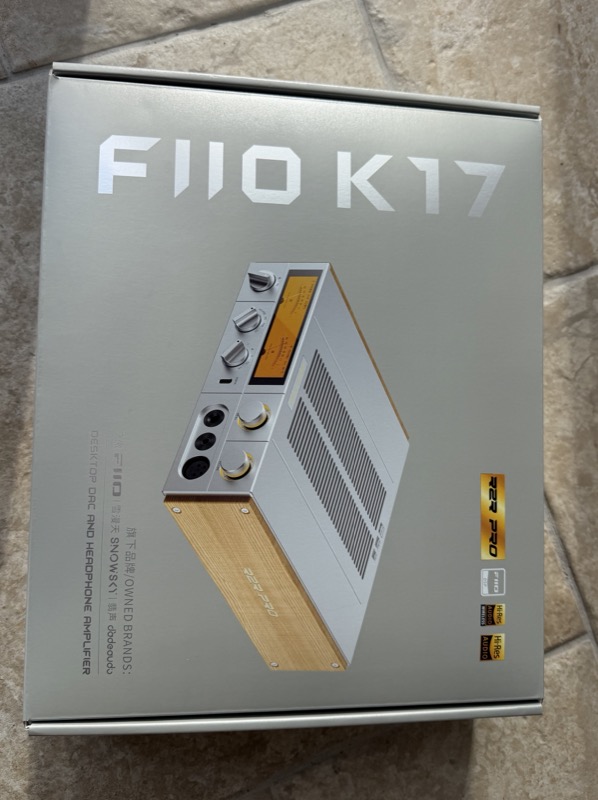
The packaging is the same grey card sleeve FiiO uses across the K-series flagships, printed with a photograph of the silver-and-ash variant regardless of which finish is inside:
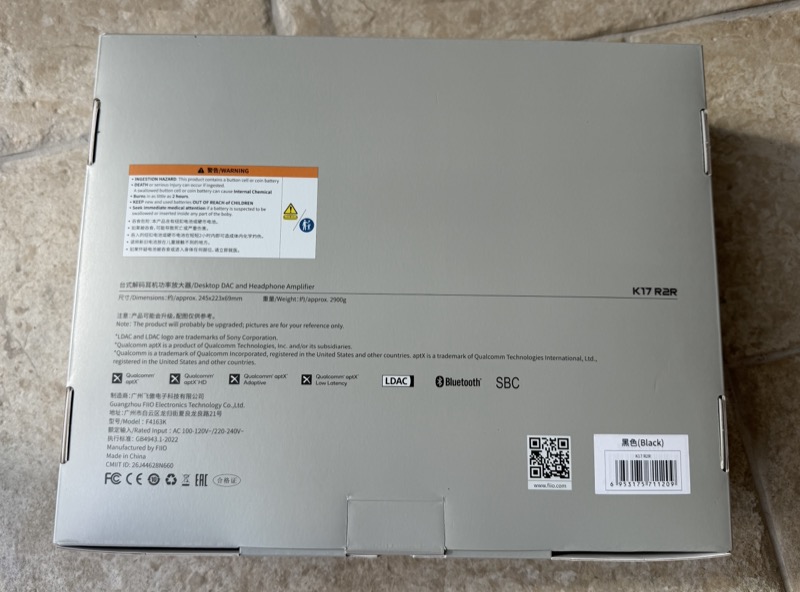
The rear of the box is where the useful information lives. It confirms the model number F416JK, the dimensions of 245 × 223 × 69 mm and a weight of approximately 2,900 g, the Bluetooth codec list including LDAC and the aptX family, and — via the barcode label — that this is the Black unit:
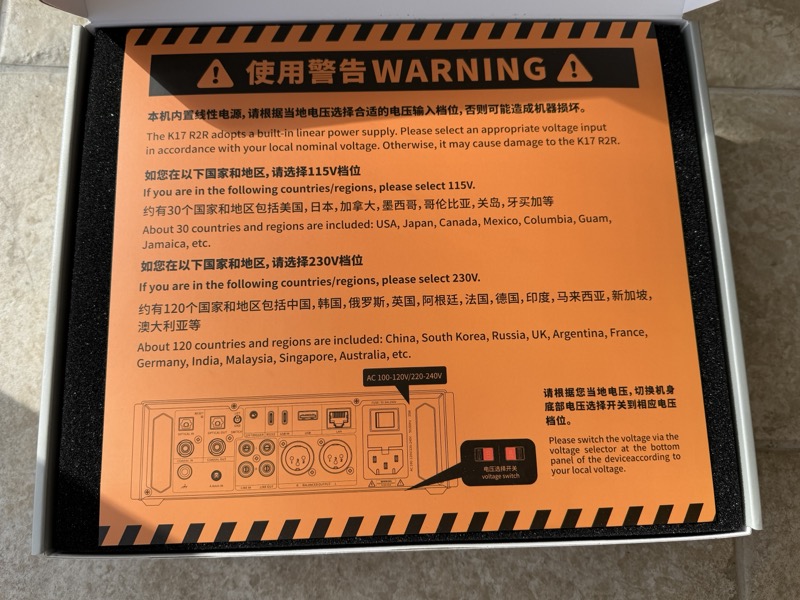
Lift the lid and the first thing you meet is not the unit but an orange warning card, and it is worth reading rather than discarding. The K17 R2R has an internal linear power supply with a manually selected voltage range, and the switch is on the underside of the chassis. Set to the wrong position it can damage the unit, so the card lists which regions need 115 V and which need 230 V:
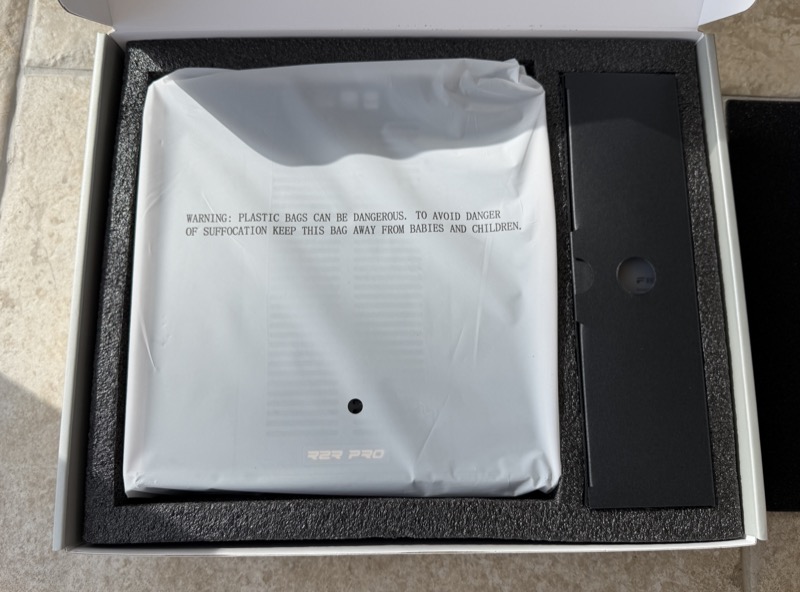
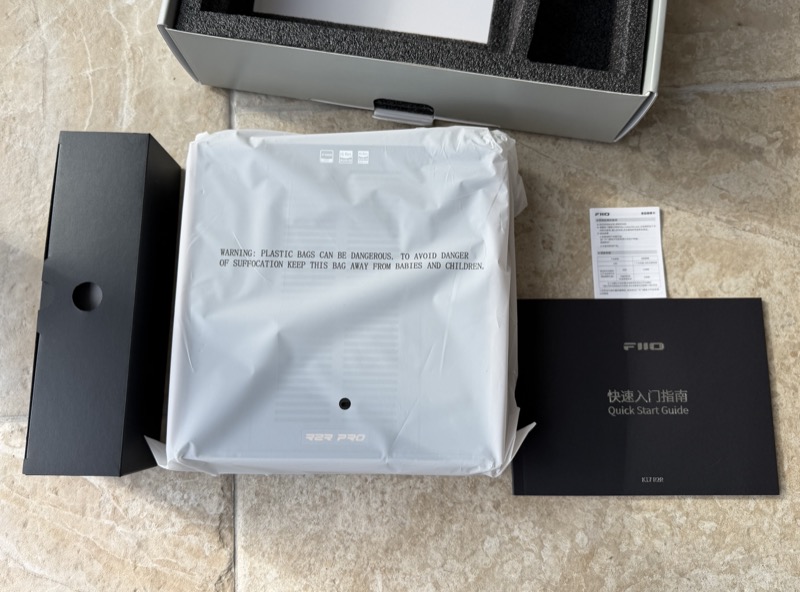
Under the card, the unit sits wrapped in a printed bag with the R2R Pro logo showing through, in a foam tray alongside a separate compartment for the remote and cables:
 |
 |
Under the tray there is a second layer of foam, which is the sort of packing you want under a 2.9 kg device that will be handled by several couriers:
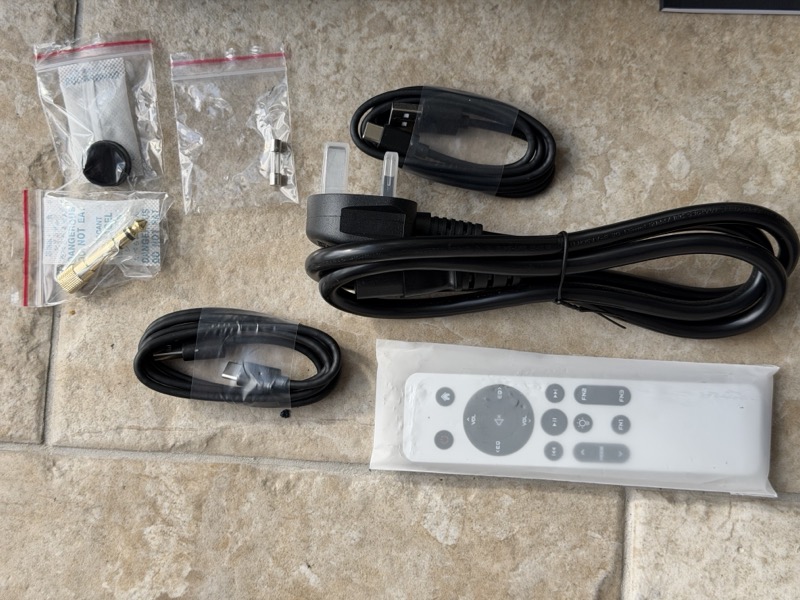
The accessory set is short and sensible: the unit itself, an AC power cable, the aluminium remote, two USB data cables, a gold-plated 6.35 mm to 3.5 mm headphone adapter, a spare fuse, a decorative plug for the 4-pin XLR socket, a warranty card and a quick start guide.
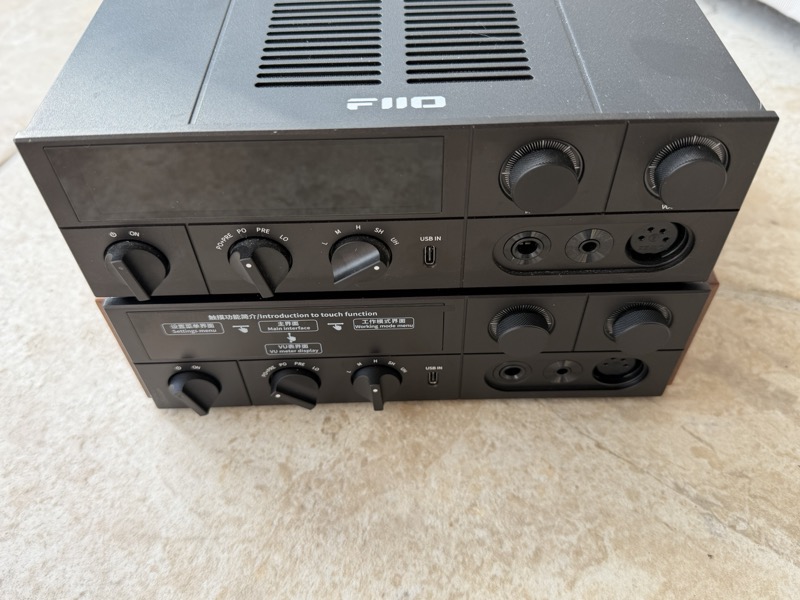
The front panel is busier than most desktop DAC/amps and rewards a moment’s study before you plug anything in. From the left there is a power knob, a four-position output selector (PO+PRE, PO, PRE, LO), a five-position gain switch running L, M, H, SH and UH, and a USB-C input for a phone or digital audio player. On the right sit the menu and volume knobs, then the 6.35 mm, 4.4 mm and 4-pin XLR headphone outputs. Above them FiiO has silkscreened a guide to the touchscreen gestures — swipe up for the settings menu, down for the VU meter, left and right for the main interface and the working mode menu:
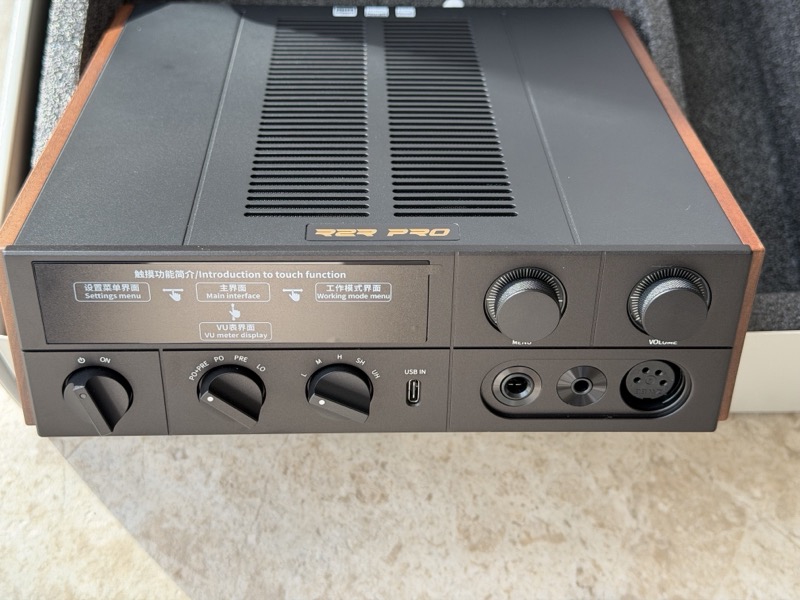
Five gain positions is more than most amplifiers offer, and the practical consequence is that sensitive IEMs and 300 Ω planars can share the same device without either living at the bottom of the volume range or running out of travel.
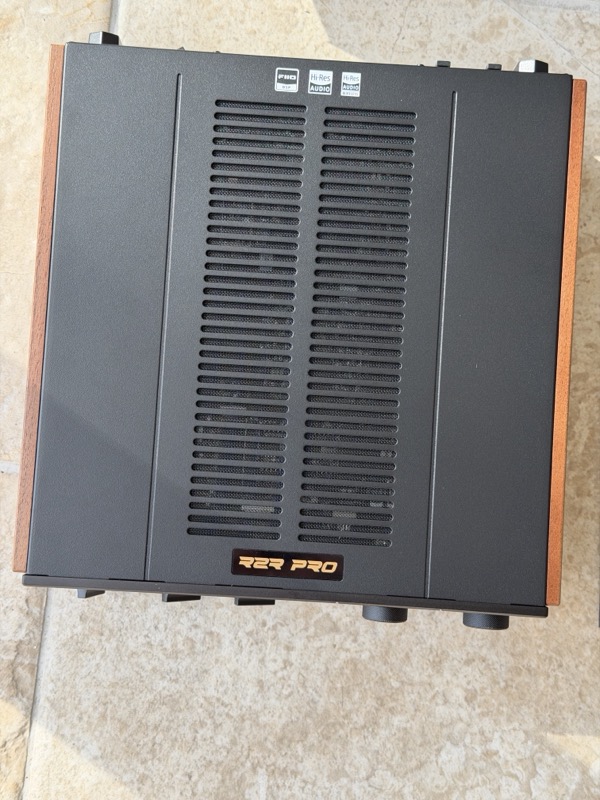
The top plate is a large ventilation grille with the R2R Pro badge below it, which is the only external clue that this is not a standard K17:
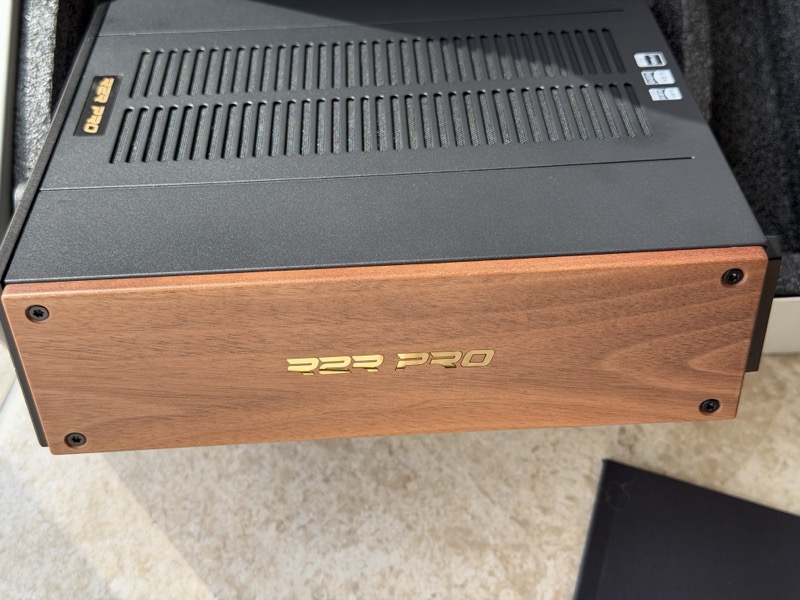
The side panels are the visual change from the K17. Solid wood cheeks are bolted to the chassis with four visible screws each, with the R2R Pro name inlaid in gold. On the black unit the wood is black walnut, and because it is real timber the grain differs between units:
 |
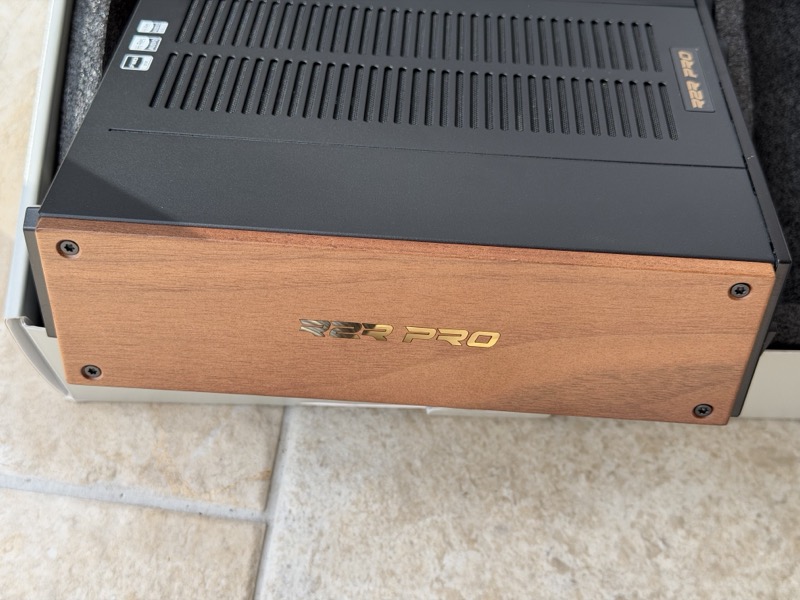 |
Seen from above, the wooden cheek sits proud of the chassis and the side of the case carries its own vent slots, so the amplifier is venting through the sides as well as the top:
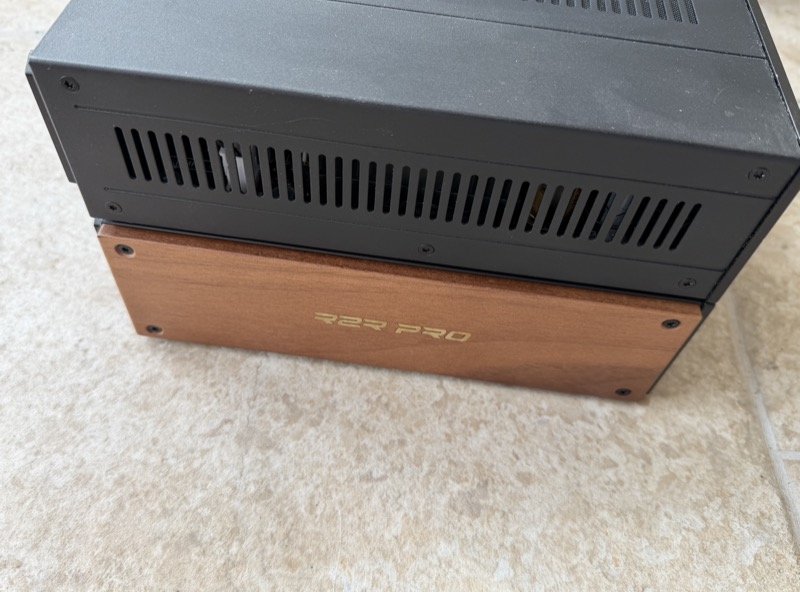
FiiO do not publish a thermal figure and I did not instrument the chassis, so I will not put a number on it. The vents run the full length of the top plate above the amplifier section, which is where the heat is generated, so leaving clearance above it is sensible on general principles.
Features and Performance
The R2R Pro converter
FiiO describe the converter as a proprietary 24+5-bit segmented R2R Pro resistor array, in which the upper five bits are handled by 31 thermometer-coded resistors rather than being carried by the ladder itself. The engineering reason for that is straightforward: in a plain resistor ladder the errors of the most significant bits accumulate and dominate linearity, and segmenting the top bits into equally weighted elements means a mismatch in any one of them contributes a much smaller error. This matters because it is the mechanism by which a discrete ladder can get close to the linearity of an integrated delta-sigma part; whether it does here is a question for the measurements section rather than the marketing copy.
Around the converter, FiiO list an ES9821Q ADC for the analogue inputs, an M21586Q 64-bit floating-point DSP running at 360 MHz for the PEQ and volume, and three low-phase-noise oscillators — two ACCUSILICON AS318-L units at 45.1584 MHz and 49.1520 MHz plus a FiiO-specified 12 MHz part. The amplifier is a discrete Class AB current stage using ON Semiconductor MJE243/253 output transistors, fed by a 35 W linear supply with five 4,700 µF reservoir capacitors and separate rails for the analogue and digital sections. All of that is the manufacturer’s description of its own design, not an independent verification of it.
Inputs, outputs and the rear panel
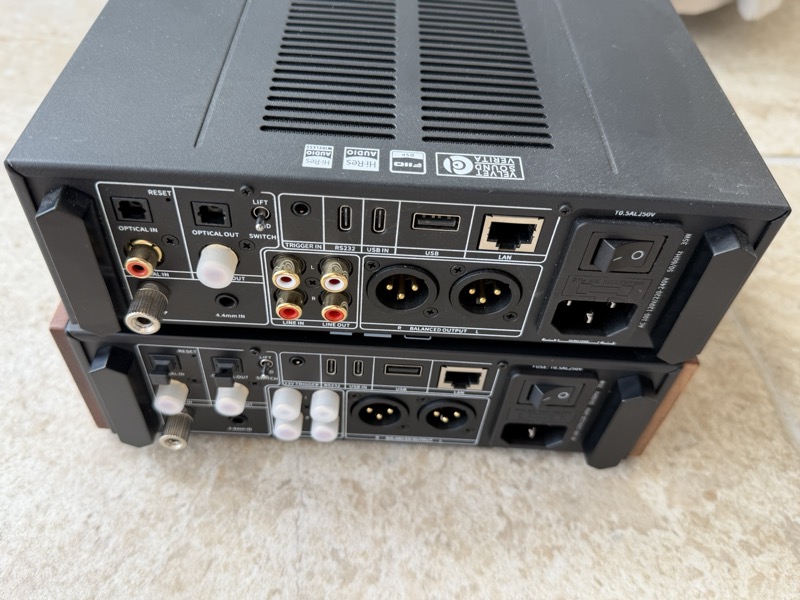
The rear panel is dense, and the layout is the same as the K17’s:
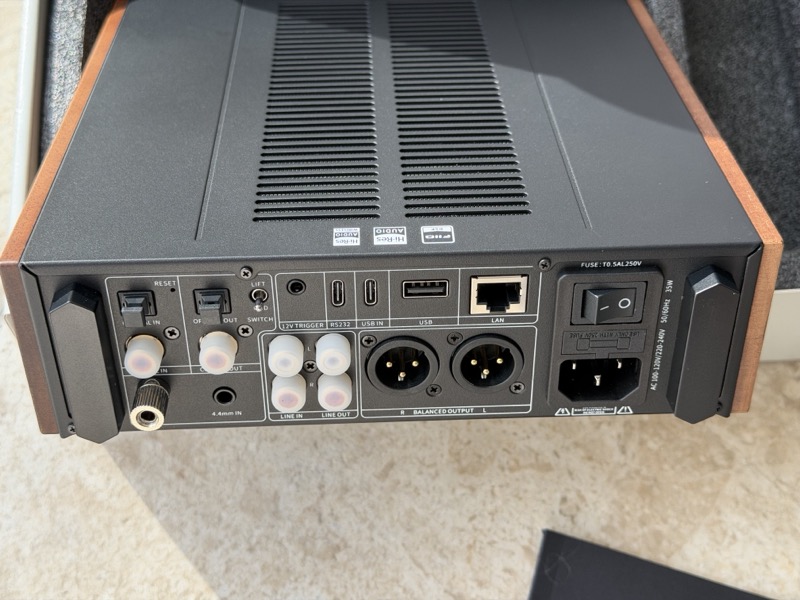
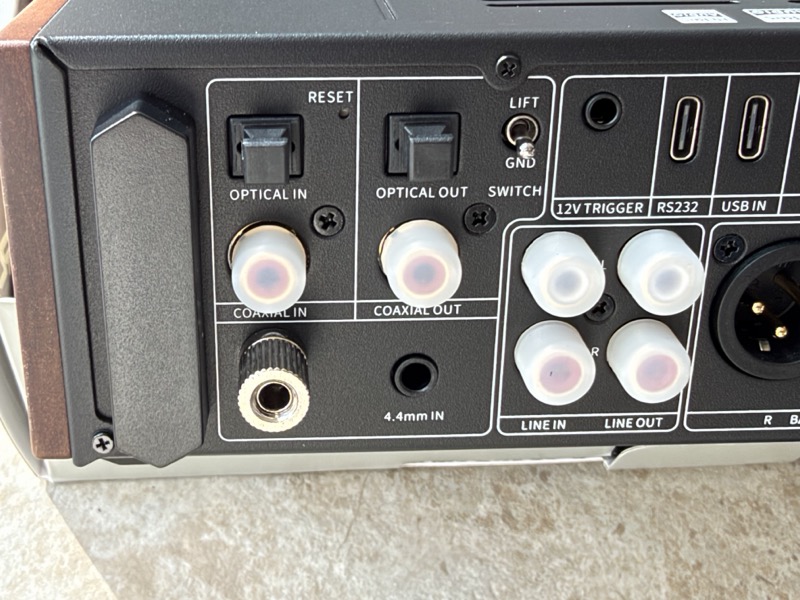
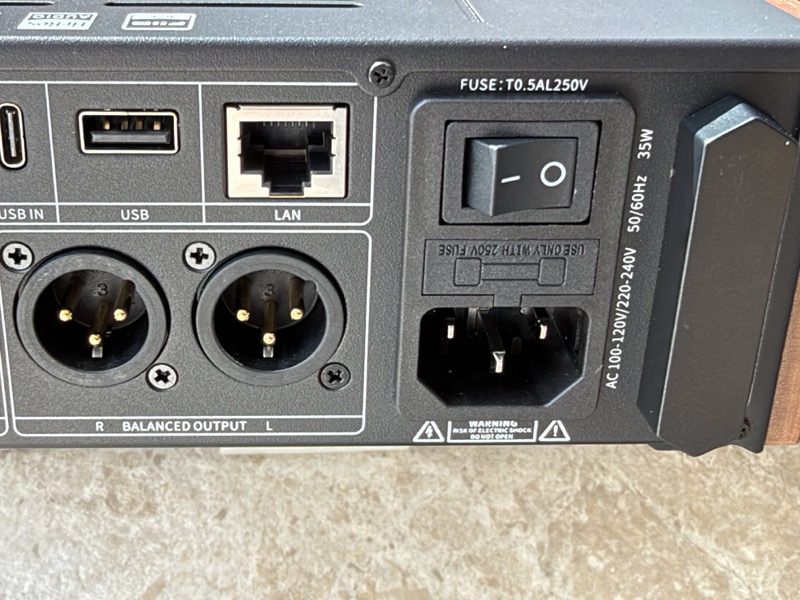
The left half carries optical in and optical out, coaxial in and coaxial out, a ground lift switch, a 4.4 mm balanced analogue input, and RCA line in and line out. The right half has a 12 V trigger, an RS232 port, a USB-C input for a computer, a USB-A host port for storage, gigabit Ethernet, two male XLR balanced line outputs, and an IEC inlet with a fused mains switch rated at 35 W:
 |
 |
Two things are worth pulling out of that list. The analogue inputs — RCA and 4.4 mm balanced — go through the ES9821Q ADC and then the DSP, which means you can apply the K17 R2R’s PEQ to an analogue source such as a phono stage or a DAP’s line output. And the pair of balanced XLR outputs plus the switchable PRE mode means this can be the volume control for a set of active monitors rather than only a headphone amplifier. The 12 V trigger and RS232 port suggest FiiO expect some of these to end up in installed systems.
The display, and getting around it
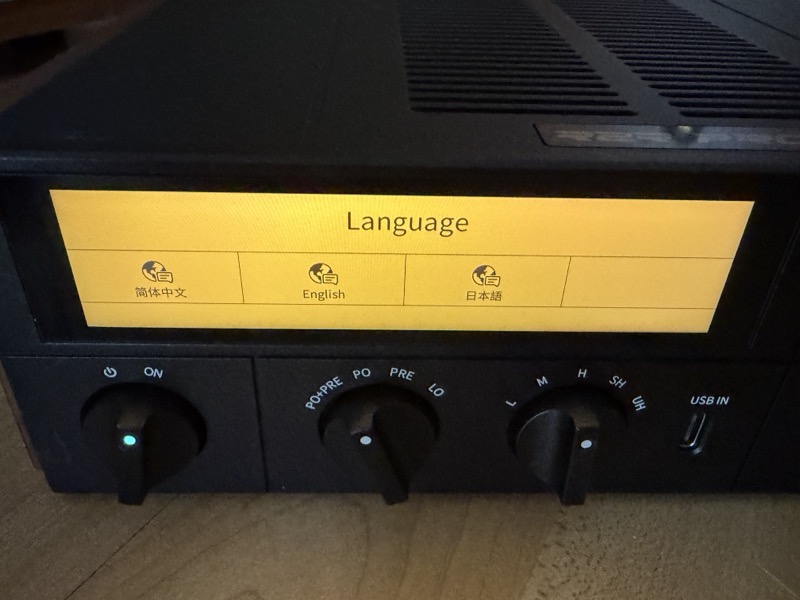
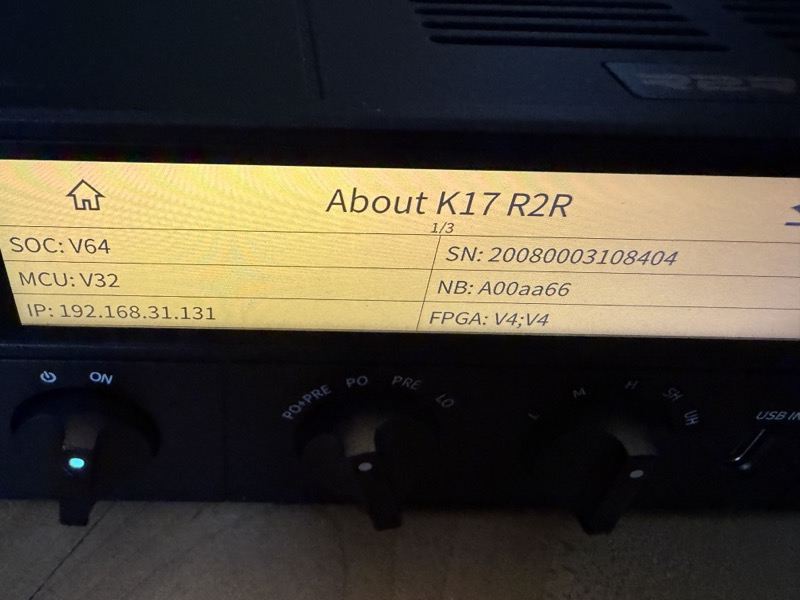
The 3.93-inch LCD is styled as a backlit amber dial, which reads as a deliberate nod to older equipment rather than a modern black-background screen. The menus are legible and the touch layer works, though most day-to-day changes are quicker on the knobs. Language options are Simplified Chinese, English and Japanese, and the About screen reports the SOC, MCU and FPGA firmware versions alongside the unit’s IP address, which is genuinely useful when you are trying to reach it over the network:
 |
 |
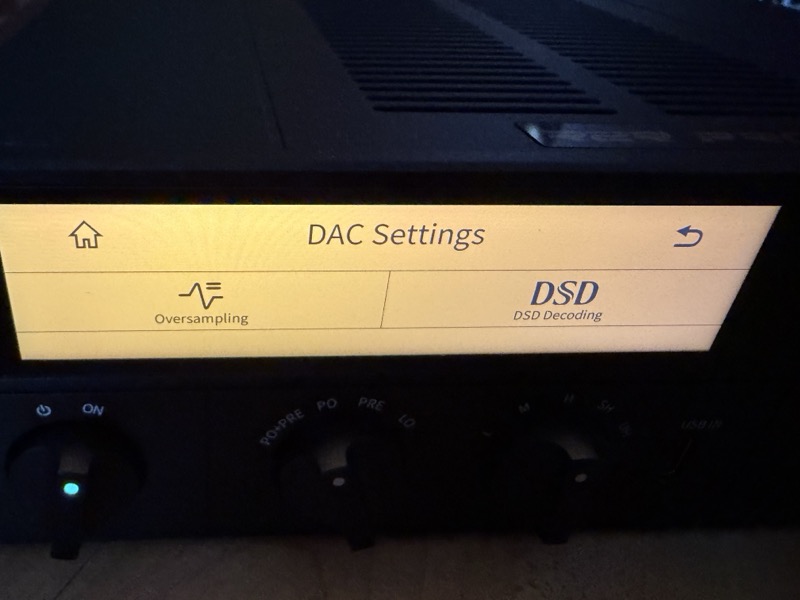
The DAC Settings menu holds the two options that matter most for how this device behaves. One is DSD decoding; the other is oversampling, and it is a straight choice between NOS and OS:
 |
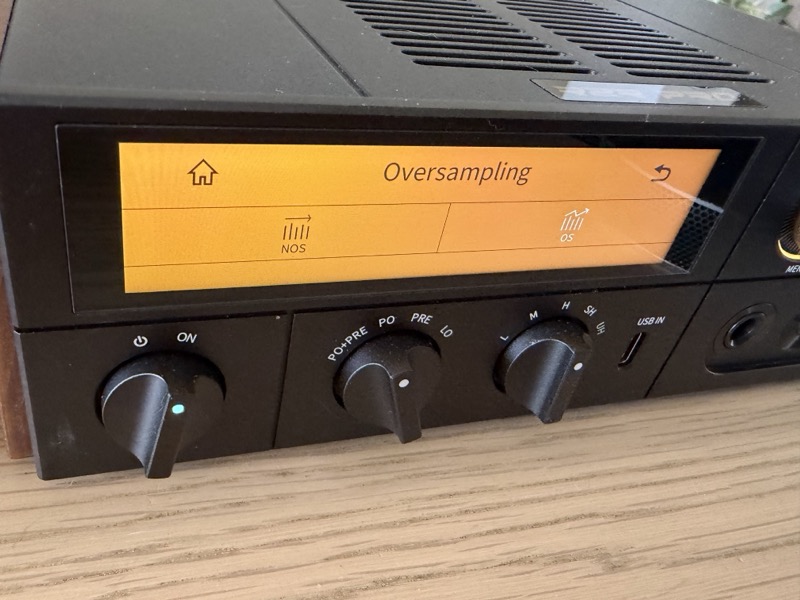 |
This is the same pair of modes the K13 R2R offers, and the engineering behind them is worth stating plainly rather than in the language the hobby usually uses. OS applies a digital reconstruction filter before the ladder, which is what a correctly implemented DAC is supposed to do: it removes the images above the Nyquist frequency and gives you a flat response to the band edge. NOS omits that filter, which produces the familiar high-frequency roll-off — a sinc-shaped droop that is a few tenths of a dB by 10 kHz at 44.1 kHz and steepens toward 20 kHz — plus ultrasonic images that the filter would otherwise have removed. NOS is not a more accurate mode; it is a different, measurable frequency response that some listeners prefer. If you like what NOS does, the honest version of that preference is that you like a gentle treble tilt, and the K17 R2R will let you have it either from the NOS filter or from the PEQ.
The DSD option beside it is the other one worth understanding, and it is a two-way choice as well: D2P converts DSD to PCM so the rest of the chain, the PEQ included, can work on it, while 1BIT feeds the ladder directly and bypasses that processing:
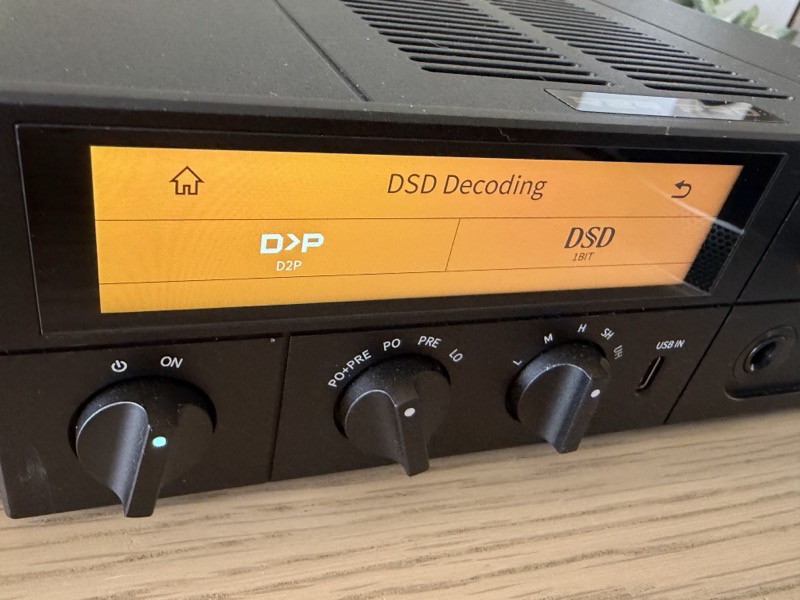
That is the trade in one screen. If you want EQ on your DSD library, D2P is the setting; if you want the shortest path from the file to the resistors, 1BIT is, and you give up the DSP to get it.
Network playback, Roon and the FiiO Control app
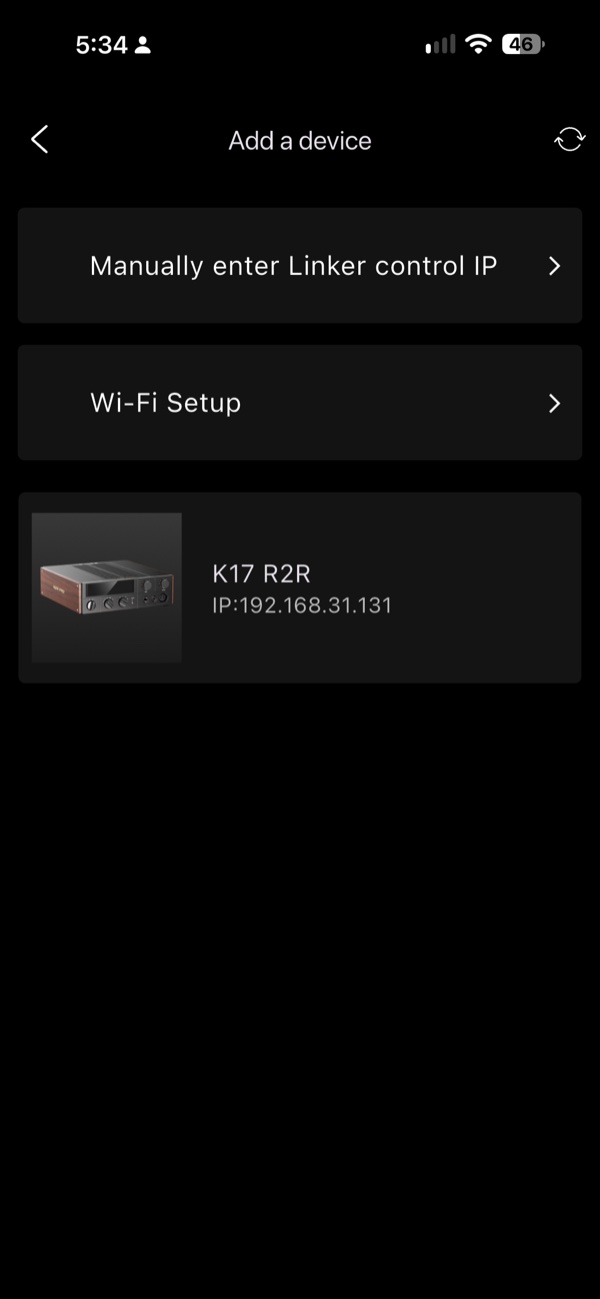
The K17 R2R is a network device as well as a USB DAC. FiiO list Roon Ready, AirPlay and Qplay certification, and NAS playback over NFS and SMB, with either gigabit Ethernet or dual-band Wi-Fi through the AP6256 module and the two rear antenna posts. In practice this means the unit gets an IP address and the phone app finds it there rather than over Bluetooth, which is a different setup experience from every other FiiO DAC/amp I have used:
 |
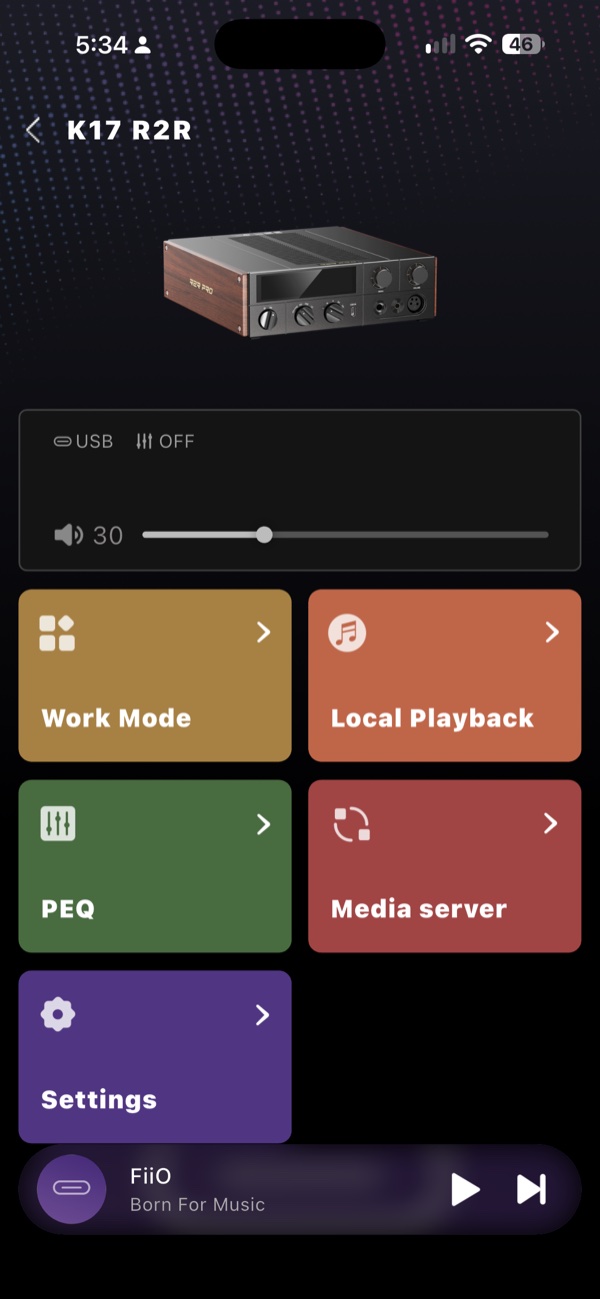 |
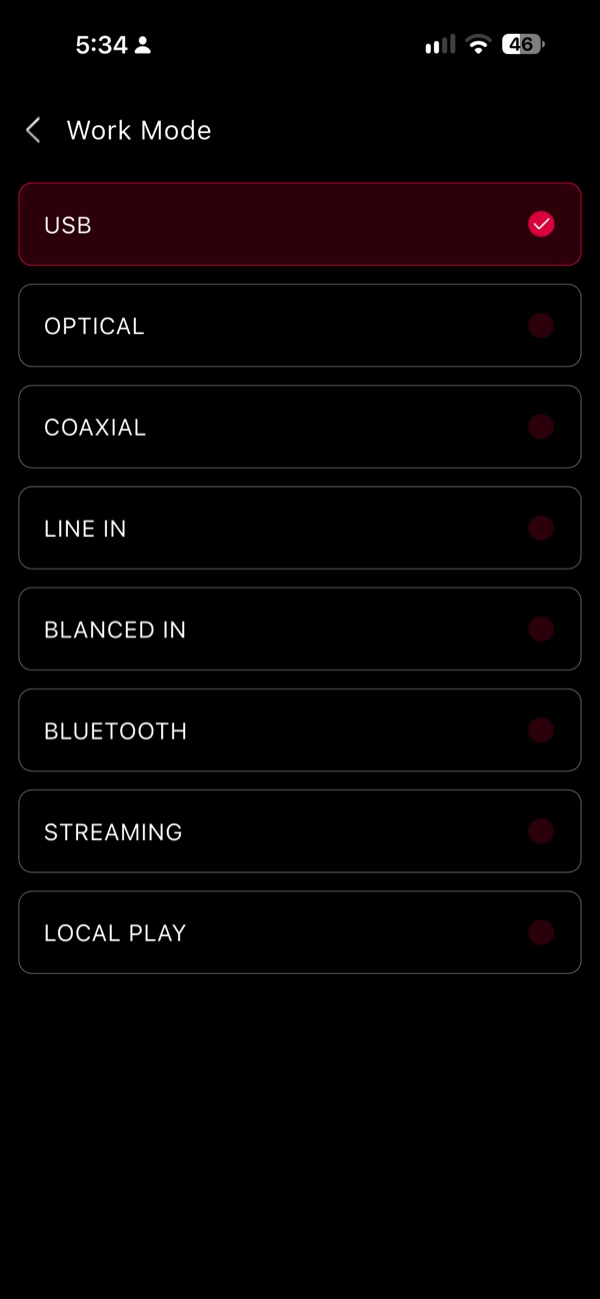
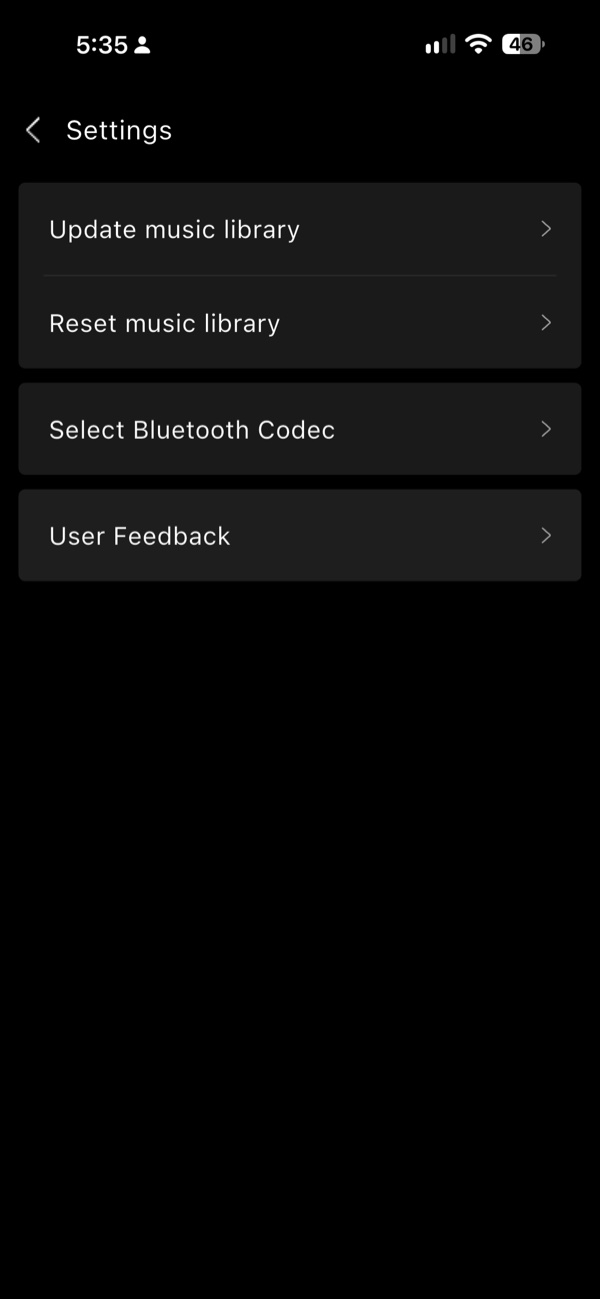
The app’s home screen shows the current input and volume and then five tiles: Work Mode, Local Playback, PEQ, Media Server and Settings. Work Mode is the input selector, and it lists all eight of the operating modes FiiO advertise — USB, optical, coaxial, line in, balanced in, Bluetooth, streaming and local play. The Settings page is thinner than you might expect: a music library refresh and reset, Bluetooth codec selection, and a feedback link:
 |
 |
The app still ships the misspelled “BLANCED IN” label visible in that list, which is a small thing, but the FiiO Control app has had a long run of small things like it.
One capability is missing from FiiO’s own feature list and turns out to matter: DLNA. Push to the K17 R2R from any DLNA controller and it plays, with cover art, the format and rate, transport controls and the active PEQ preset all on the amber display at once. This is David Bowie’s “Beauty and the Beast” arriving over DLNA at 44 kHz, with the custom1 PEQ preset engaged and the headphone output on high gain:
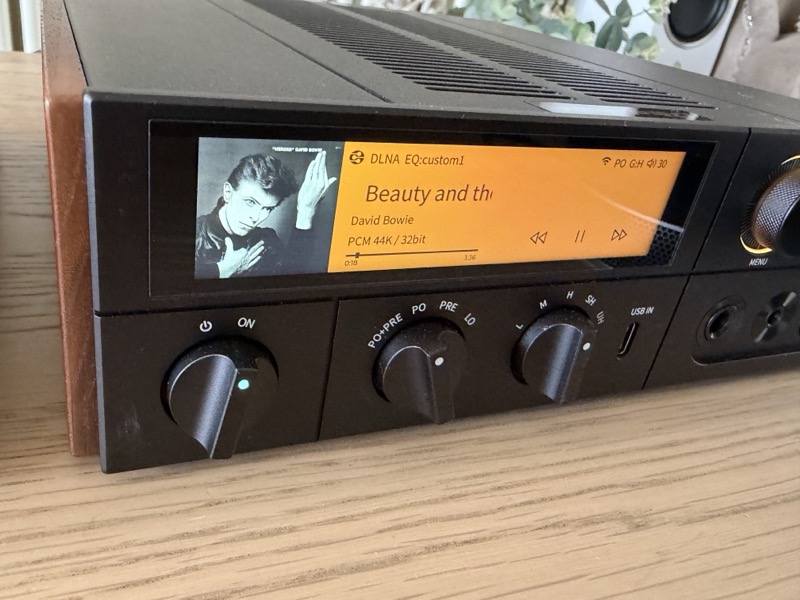
That screen is worth dwelling on because of what it puts in one place. The source is a network push rather than a USB cable, the PEQ is applied to it, and the volume, gain position and output are all readable from across a desk. It is the closest thing FiiO make to a self-contained desktop source.
The K17 R2R had DLNA from the start. The original K17 only gained it later, in a firmware update, and updating a K17 is itself done over the network — here is one prompting for V249 with the K13 R2R sitting on top of it:
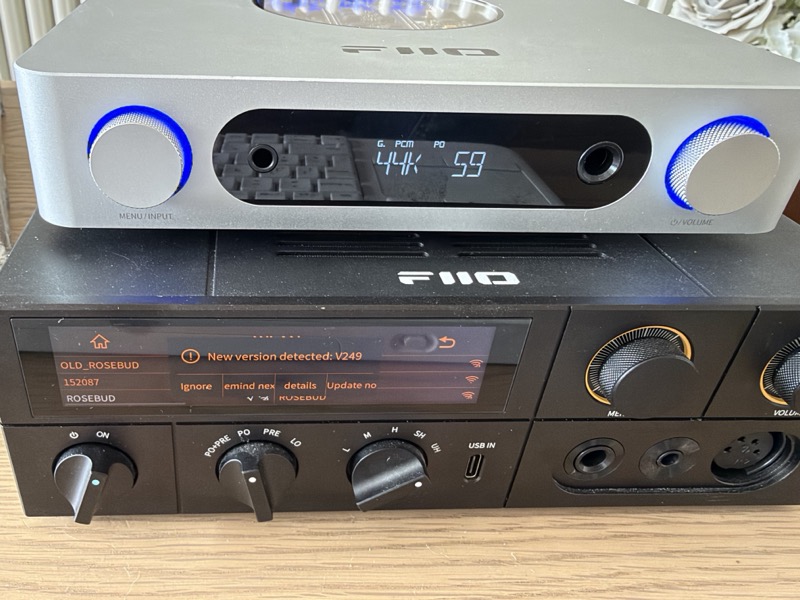
The K17’s DLNA support arrived very recently. The direction of travel is the point: features are landing on the R2R model first and the K17 is being brought up to it, which tells you which of the two FiiO consider the current design.
PEQ
FiiO specify a 31-band parametric EQ with a gain range of +12 to −24 dB, running in the M21586Q DSP, and they note that PCM material between 44.1 kHz and 96 kHz is processed without a sample rate conversion step. The app’s graphic view exposes those bands on 1/3-octave centres with the sliders labelled by frequency, and there is an Advanced button for editing filters by frequency, gain and Q rather than by slider:
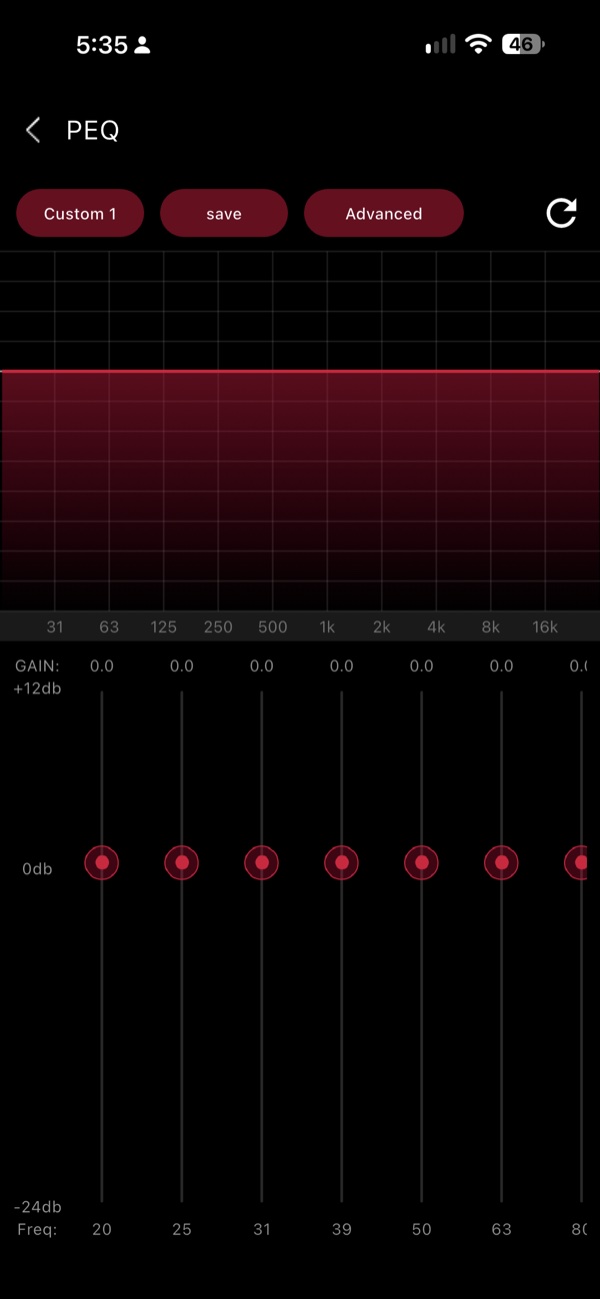
This is the same PEQ engine and the same range of control as the K17, and it is the feature that does most to make the NOS-versus-OS argument academic. If you want a treble tilt, you can dial one in and keep the reconstruction filter; if you want to correct a headphone, you have 31 bands and enough negative gain headroom to do it without clipping.
The detail that matters more than the interface is where the PEQ applies: on the K17 R2R it is applied to every output, which is not the case on every amplifier with an EQ in it. Some apply it only to the headphone stage and leave the line outputs untouched, which quietly breaks the setup if you are using the unit as a preamp. Here the correction follows the signal wherever it leaves the box.
The remote
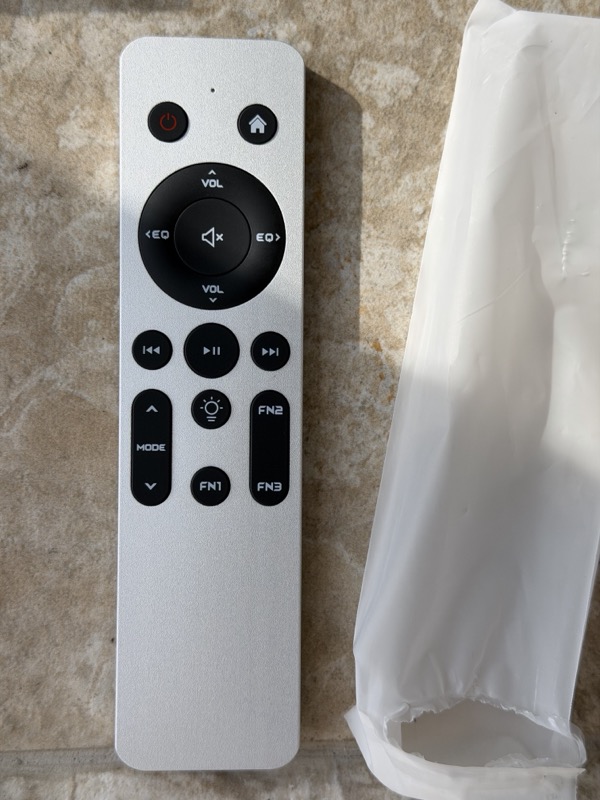
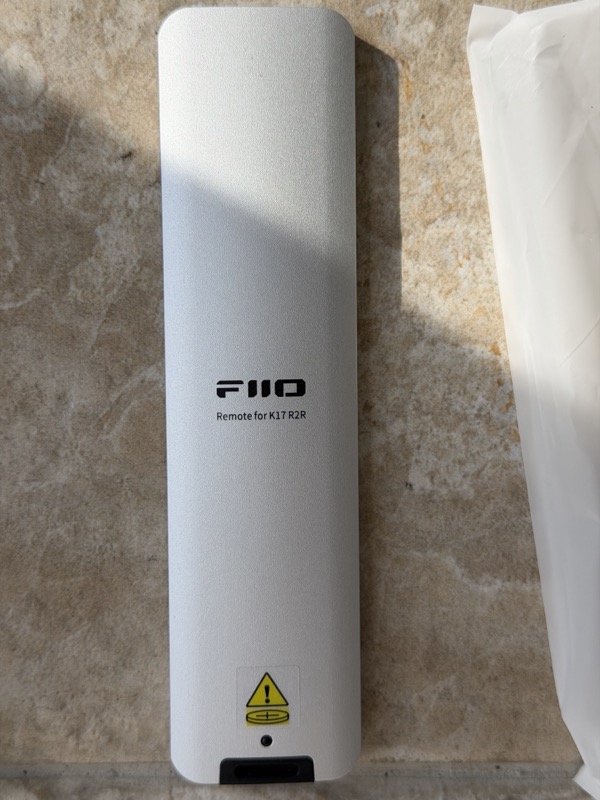
The included remote is a machined aluminium slab, and FiiO have clearly looked at an Apple TV remote while designing it. It carries power and home, a volume and EQ ring with mute in the centre, transport controls, a backlight button, a MODE rocker for cycling inputs, and three assignable FN keys:
 |
 |
The resemblance is not subtle when you put the two side by side — the FiiO remote is longer and carries roughly twice as many buttons, but the proportions, the brushed finish and the circular control ring are all borrowed:
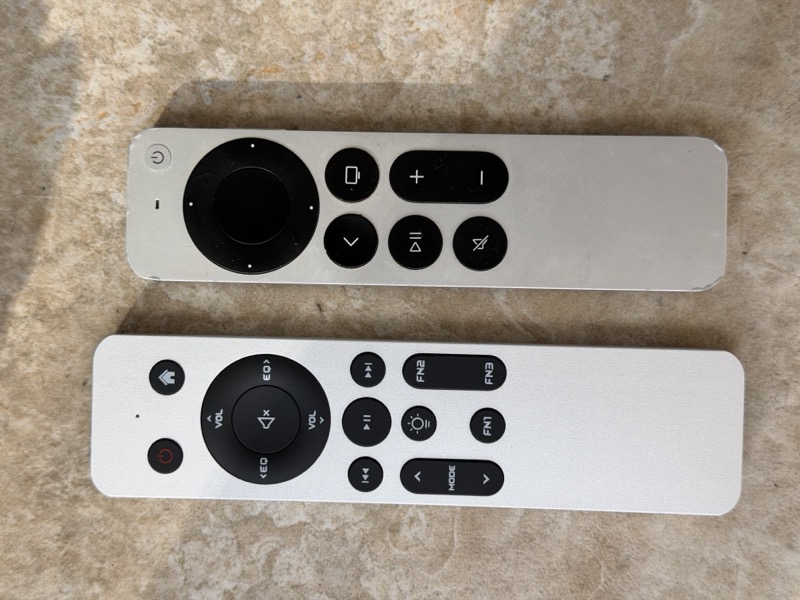
Note that the remote is silver on both finishes, so on the black walnut unit it does not match.
The remote is the only one the unit will accept — FiiO’s specification says infrared, supplied unit only — so if it is lost it is not replaceable with a universal handset. That is worth knowing before it matters.
Sound Impressions
The K17 R2R is not a transducer, and the framing that matters is transparency rather than tonality. On the manufacturer’s own figures for the headphone outputs at the highest gain setting — SNR ≥124 dB A-weighted, THD+N below 0.0055% single-ended and 0.0052% balanced, and a noise floor between 2.6 µV and 7.9 µV depending on which output and which gain you use — a device performing to specification, in OS mode with PEQ flat, should be inaudible as a signature. Those distortion figures are roughly an order of magnitude higher than the standard K17’s published numbers, but 0.0055% is about 85 dB below the fundamental, which is still a long way below where distortion becomes audible on music. What you hear is the headphone or the speakers, the room, and whatever EQ you have applied. The two settings that can change that are NOS, which is a real and measurable frequency response change, and the PEQ, which is a deliberate one.
That leaves a short list of things that genuinely differ between amplifiers at this level and are worth reporting from actual listening: audible noise on sensitive IEMs, whether the volume steps are fine enough at low levels, whether the amplifier holds up on difficult loads at the gain setting you actually use, and whether NOS is distinguishable from OS when you are not looking at the screen.
The noise floor is excellent, and on the only test that really matters for it I could not fault the unit: with sensitive IEMs on low gain I heard nothing at all with no music playing. FiiO’s published figure for that combination is a noise floor below 2.6 µV A-weighted, and it behaves like it.
The five gain positions are not evenly spaced, and reading the published output voltages into 32 Ω shows how unevenly. On the balanced output the steps run Low to Mid +6.4 dB, Mid to High +3.1 dB, High to Super High +11.4 dB, and then Super High to Ultra High just +0.2 dB. The single-ended output is the same shape with a slightly less extreme top: +4.4, +3.5, +11.4 and +2.8 dB. So the range is three closely spaced low positions, one large jump, and then two settings at the top that are within a fraction of a decibel of each other on balanced. In use High, Super High and Ultra High feel interchangeable, because all three are already more than loud enough on anything reasonable, and the top two genuinely are the same setting on the balanced output. Five positions, but not five useful ones.
On Ultra High gain the available power was excellent on every headphone I tried, and that includes the Lily Audio Genesis One, which is the hardest thing to drive I own and the headphone that has found the limit of almost everything else on this desk. The balanced output’s published 17 Vrms into 300 Ω is what makes that possible, and it is the figure to look at rather than the wattage.
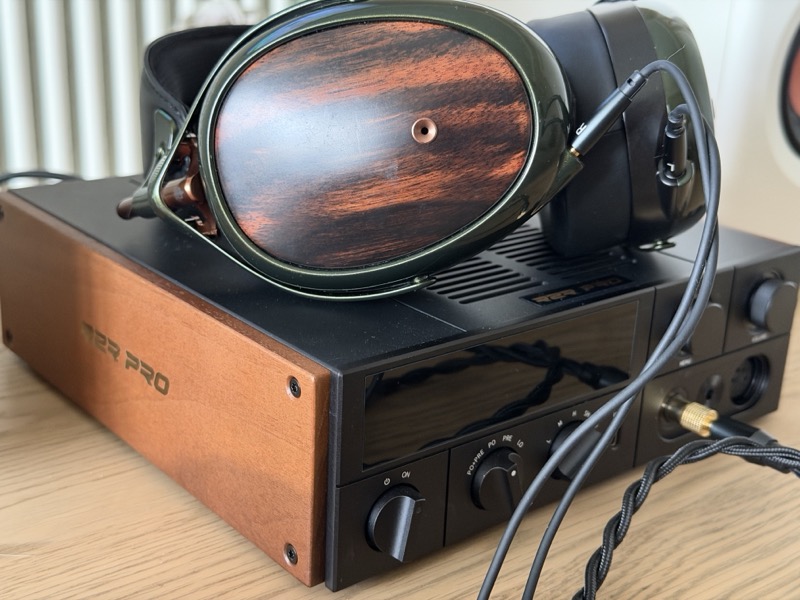
There is a less technical reason this unit has stayed on the desk, and I may as well admit it. The walnut cheeks make it the best-looking desktop box I own, and it turns out to pair visually with wooden headphones in a way that is entirely irrelevant to the measurements and impossible to ignore once you have seen it. This is the Meze Strada on top of it, running from the 4.4 mm balanced output:
Picking OS from NOS is hard, and I want to be careful about how I say that. My preference is OS, and the reason is that with the R2R Pro ladder in OS mode the response is extremely neutral — there is nothing to describe, which is the correct outcome for a converter. NOS is there for people who want to hear the R2R architecture doing something, and if that is what you are buying an R2R DAC for, the option is one tap away and costs nothing. That is the right way round: neutral by default, character on request. FiiO have given the R2R audience what it wants without making everyone else live with it.
It is worth being explicit about why that matters more now than it would have a couple of years ago, because it is the strongest argument for this generation of R2R and it is easy to miss. In OS mode this converter is, to my ears, effectively as good as a solid-state device. It still trails slightly on absolute measurements — FiiO’s own numbers say so, and I would not pretend otherwise — but the gap is no longer one you can hear on music. Once that is true, the NOS mode stops being a consolation for buying an R2R DAC and becomes a genuine advantage: you get a converter that is transparent when you want it to be, plus an option nobody else in the chain can give you.
There is a further thought there for anyone who likes to experiment. NOS output is unfiltered by definition, which means the reconstruction filter becomes something you can choose rather than something the chip designer chose for you. If you have a device further down the chain capable of a better filter than the one inside the converter, NOS hands you the raw material to apply it. I have not tested that myself, so treat it as an avenue rather than a recommendation — but it is the kind of option that simply does not exist on a delta-sigma DAC, and it is a real argument for having NOS available on a converter that is already transparent in OS.
Because the PEQ applies to every output and to the analogue inputs as well, the analogue-in path plus DSP is usable in earnest rather than as a curiosity — you can put a phono stage or a tape deck through 31 bands of correction and take the result out of the balanced preamp outputs. That is an unusual thing for a device at any price to offer.
Comparisons
The most direct comparison is with the K17, because on paper the two are the same amplifier. Both quote ≥1,850 mW into 32 Ω single-ended and ≥240 mW into 300 Ω, and ≥4,000 mW into 32 Ω balanced and ≥950 mW into 300 Ω. Both have the 31-band PEQ, the same rear panel, the same three headphone outputs and the same five gain positions. What separates them is the converter — dual AK4499EX plus AK4191 in the K17, the discrete R2R Pro ladder here — and the wooden side cheeks. The specifications separate them too, and by more than the marketing does: FiiO claim THD+N below 0.0005% for the K17’s single-ended output at ultra high gain and below 0.0055% for the K17 R2R’s, and while the two are quoted at different levels (−12 dB against −6 dB) and so are not directly comparable, the gap is around twenty decibels. Channel separation drops from ≥119 dB to ≥116 dB balanced, the frequency response tolerance loosens from 0.05 dB to 0.15 dB across the audio band, and native DSD support falls from DSD512 to DSD256. Against that, the K17 R2R publishes figures for all five gain settings rather than two, gains network OTA firmware updates, and is 150 g heavier and slightly larger for the wooden cheeks. Prices are close enough that this is not a step up or down but a choice: the K17 R2R at $989.99 sits in the same band as the K17. When I measured the K17 I got a SINAD of 105 to 106 dB from the 32 Ω single-ended and balanced headphone outputs on ultra-high gain, which is the number the K17 R2R has to be judged against.
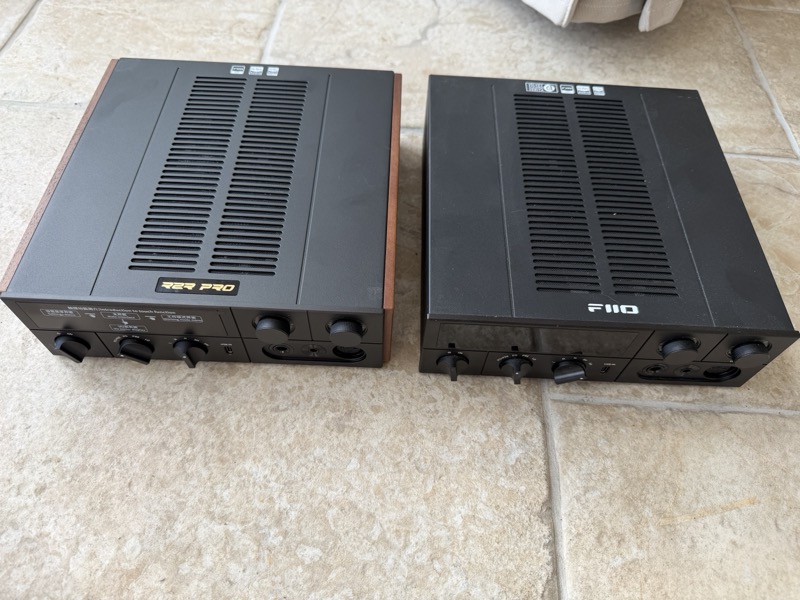
Stacked, the family resemblance is close to total. The front panels differ only in the silkscreened touch-gesture guide and the wood; the rear panels are functionally identical:
 |
 |
In OS mode there was subjectively very little between the K17 R2R and the original K17, which is the answer I hoped for rather than the one I expected. Two transparent converters should sound the same, and these two do. The K17 has slightly more power on paper, and at this level that difference is small enough that it will not decide anything: both have more than any headphone I own needs. So the choice between them is not a sound quality question in OS mode. It is a question of whether you want NOS available as an option, and whether you want the converter FiiO designed themselves.
Against the K13 R2R the gap is size, power and streaming rather than architecture. Both are R2R ladders with OS and NOS modes and app-driven PEQ, but the K13 R2R is around $320, quotes 2,400 mW into 32 Ω from its 4.4 mm balanced output, offers 10 bands of PEQ in the app, and has no network playback, no touchscreen and no analogue-in PEQ path. The comparison that told me the most, though, was sonic rather than structural, and it is the one finding here I would put my name to before I have measured anything: the R2R Pro ladder in the K17 R2R is cleaner sounding than the one in the K13 R2R. Not a different tuning — cleaner, in the sense of less of a veil over quiet detail. I would not have predicted that two R2R implementations from the same company, both with OS and NOS modes, would separate that clearly, and it is the strongest practical argument for the K17 R2R over the cheaper ladder.
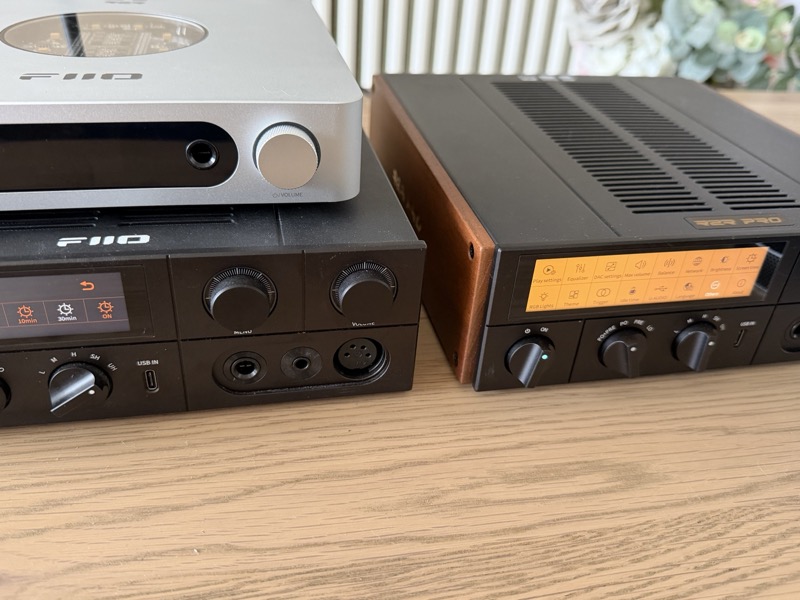
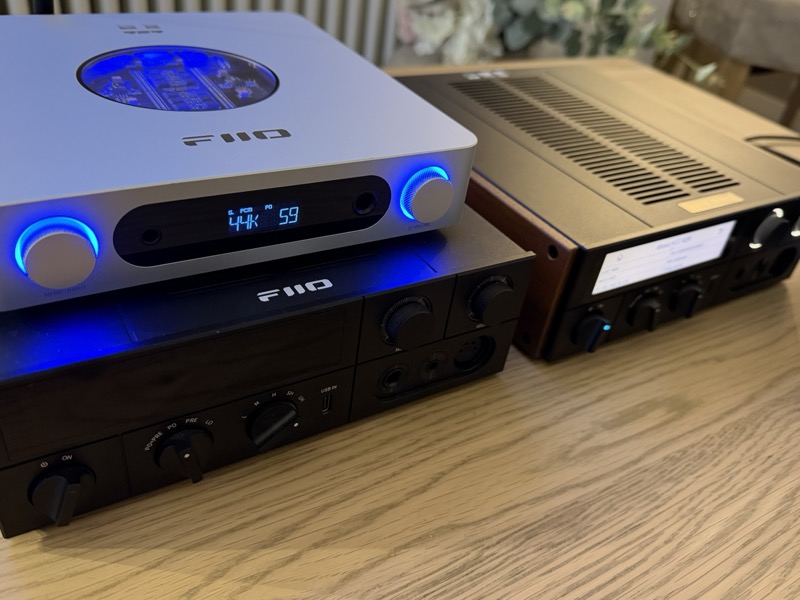
All three together makes the lineage obvious. On the left, the original K17 with the K13 R2R stacked on it; on the right, the K17 R2R with its walnut cheek and R2R PRO badge:
 |
 |
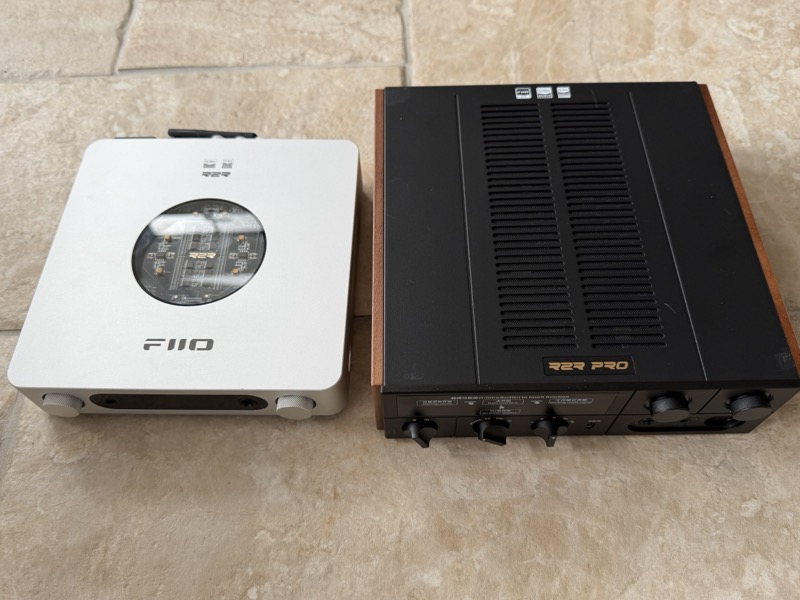
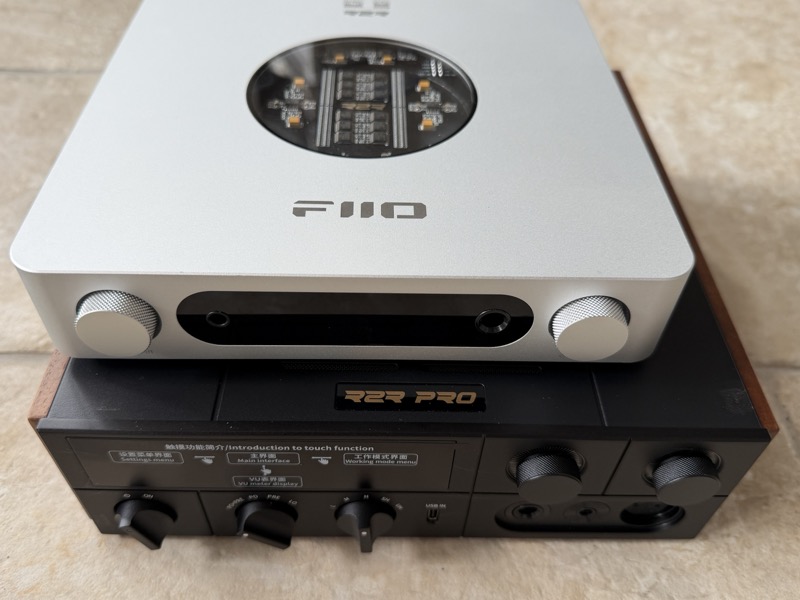
Put next to the K17 R2R the K13 R2R is visibly a different class of object — smaller, flatter, and with its resistor array on show behind a circular window rather than hidden under a vented lid:
 |
 |
If you want the R2R architecture and nothing else on the list, the K13 R2R is enough and saves around $670. The K17 R2R only makes sense if you specifically need the extra voltage into high impedances, the Roon Ready and NAS playback, the 31 bands, the analogue-in DSP path or the balanced XLR preamp outputs.
The Topping DX5 II is the uncomfortable comparison, and it is uncomfortable on price. At $299 it quotes up to 7,600 mW from its X-Hybrid balanced amplifier, has PEQ through the ToppingTune software, and measures at a level where transparency is not in question. If your requirement is “a transparent DAC and a lot of power for headphones”, the DX5 II covers it for less than a third of the money and with more headroom. What it does not have is network streaming, a touchscreen, a remote, five gain positions, an analogue input with DSP, or a resistor ladder. The K17 R2R is not a sound-quality upgrade over a DX5 II; if it is an upgrade at all it is a features-and-integration one, and you should be clear which of those you are paying for.
The Burson Playmate 3 approaches the same job from a different direction: Class A, single-ended only, swappable op-amps, around 2.5 W into 32 Ω but only 150 mW into 300 Ω, and $599 for the Standard Edition. Against the K17 R2R it gives up balanced outputs entirely, gives up a great deal of power into high-impedance headphones, and has no PEQ, network playback or app. It offers instead the op-amp rolling and the Class A output stage that some buyers specifically want. If you want to tinker with the analogue stage, the Burson is the more interesting box; if you want a fixed, well-specified device that also streams and equalises, the FiiO is.
The DX5 II and the Burson Playmate 3 are both excellent headphone amplifiers with their own characters, and nothing I heard suggests the K17 R2R beats either on transparency — at this level that is not where the differences live. The K17 R2R costs about three times the DX5 II, and what earns that is everything around the converter: the count of inputs and outputs, the power on tap, and the feature set as a whole. This is a streamer, a preamp and a headphone amplifier in one box, in a chassis with a genuinely handsome retro look that the walnut cheeks improve further. If all you need is a transparent DAC and a strong headphone stage, the DX5 II does that for a third of the money and you should buy it. If you want the one box on the desk to be the whole system, that is what the extra money buys, and on that basis it earns its price.
Specifications and Measurements
Specifications
These are FiiO’s own published specifications for the K17 R2R, taken from www.fiio.com/K17R2R_parameters and the K17 R2R product page, checked on 9 September 2026. They are manufacturer claims, not measurements.
One practical warning before the numbers. The parameters page serves different content depending on the language it is set to. With the site in English it publishes the standard K17’s table under the K17 R2R URL — the model line reads “K17”, the DAC line reads “AK4191EX+AK4499EQ*2”, the weight is 2,750 g and the dimensions are 244.6 × 213 × 66.8 mm. Switching the site to Simplified Chinese with the language selector in the header returns the K17 R2R’s own table: model “K17 R2R”, DAC “FiiO in-house R2R PRO DAC”, 2,900 g, 245 × 223 × 69 mm, and a considerably longer performance section covering all five gain settings. The figures below come from the Chinese version, because it is the one that describes this product. If you follow the link and see AK4499 chips, switch the language.
| Specification | FiiO K17 R2R |
|---|---|
| DAC | FiiO in-house 24+5-bit segmented R2R Pro discrete resistor array; upper 5 bits decoded by 31 thermometer-coded resistors |
| SoC / MCU | Ingenic X2000 / ESP32-S3 |
| USB receiver | XMOS XU316 |
| ADC (analogue inputs) | ES9821Q |
| DSP | M21586Q, 64-bit floating point, 360 MHz |
| Clocks | Two ACCUSILICON AS318-L (45.1584 MHz, 49.1520 MHz) plus a FiiO-specified 12 MHz part |
| Amplifier | Discrete Class AB op-amp plus transistor current stage, ON Semiconductor MJE243G/253G |
| Oversampling | Selectable OS / NOS |
| Working modes | USB DAC, coaxial, optical, line in, balanced in, Bluetooth, streaming, local playback |
| Headphone outputs | 6.35 mm single-ended, 4.4 mm balanced, 4-pin XLR balanced |
| Gain positions | Five — ultra high, super high, high, medium, low |
| Recommended load impedance | Single-ended 8–150 Ω; balanced 8–350 Ω |
| Line outputs | RCA 2.5 Vrms, XLR3 5 Vrms (1 kHz @ 10 kΩ) |
| Frequency response (all outputs) | 20 Hz – 20 kHz within 0.15 dB; 20 Hz – 80 kHz within 3 dB |
| USB decoding | PCM to 768 kHz/32-bit, DSD256 native |
| Coaxial input / output | To 192 kHz/24-bit, DSD64 |
| Optical input / output | Input to 96 kHz/24-bit; output to 192 kHz/24-bit |
| Streaming / local playback | To 384 kHz/32-bit, DSD256 (DoP over streaming) |
| MQA | Full decoding |
| Analogue inputs | RCA line in, 4.4 mm balanced in (via ADC, PEQ available) |
| Network | Gigabit Ethernet, dual-band 2.4/5 GHz Wi-Fi (AP6256); Roon Ready, AirPlay, QPlay; NAS via NFS/SMB |
| Bluetooth | 5.1 — SBC, aptX, aptX LL, aptX HD, aptX Adaptive, LDAC |
| PEQ | Global 31-band, +12 to −24 dB, Q 0.4–128; no PEQ on the digital outputs; Android/iOS app, PC browser or FiiO DSP software |
| Display | 3.93-inch LCD, 240 × 1020, laminated, touch |
| Other connectors | 3 × USB-C (two data, one RS232 DSP), 1 × USB-A host, 12 V trigger on 3.5 mm (in/out/off), ground lift switch, M4 banana chassis earth post |
| Power supply | 35 W low-noise linear, AC 100–120 V / 220–240 V 50/60 Hz (manual voltage switch) |
| Dimensions | Approximately 245 × 223 × 69 mm |
| Weight | Approximately 2,900 g |
The output figures are published per gain setting, in OS mode, which is more detail than most manufacturers give and worth reproducing in full. Single-ended, from the 6.35 mm output:
| Gain | 16 Ω | 32 Ω | 300 Ω | THD+N | Noise floor | SNR | Peak output |
|---|---|---|---|---|---|---|---|
| Ultra high | ≥1,800 mW | ≥1,850 mW | ≥240 mW | <0.0055% (1 kHz/−6 dB) | <5 µV | ≥124 dB | >24 Vp-p |
| Super high | ≥1,800 mW | ≥1,000 mW | ≥120 mW | <0.0056% (1 kHz/−6 dB) | <5 µV | ≥121 dB | >17 Vp-p |
| High | ≥130 mW | ≥70 mW | ≥10 mW | <0.0052% (1 kHz/−8 dB) | <3 µV | ≥115 dB | >4.5 Vp-p |
| Medium | ≥65 mW | ≥35 mW | ≥5 mW | <0.0051% (1 kHz/−8 dB) | <2.8 µV | ≥113 dB | >3 Vp-p |
| Low | ≥15 mW | ≥10 mW | ≥1 mW | <0.0053% (1 kHz/−8 dB) | <2.6 µV | ≥110 dB | >1.6 Vp-p |
All per channel, at THD+N < 1%, into the stated load, with output impedance quoted as < 1 Ω at 32 Ω and crosstalk as ≥76 dB at 1 kHz. And balanced, from the 4.4 mm or 4-pin XLR outputs:
| Gain | 16 Ω | 32 Ω | 300 Ω | THD+N | Noise floor | SNR | Peak output |
|---|---|---|---|---|---|---|---|
| Ultra high | ≥1,800 mW | ≥4,000 mW | ≥950 mW | <0.0052% (1 kHz/−8 dB) | <7.9 µV | ≥124 dB | >48 Vp-p |
| Super high | ≥1,800 mW | ≥3,900 mW | ≥480 mW | <0.0052% (1 kHz/−8 dB) | <7.9 µV | ≥123 dB | >34 Vp-p |
| High | ≥470 mW | ≥270 mW | ≥30 mW | <0.0051% (1 kHz/−8 dB) | <3.4 µV | ≥119 dB | >9 Vp-p |
| Medium | ≥235 mW | ≥140 mW | ≥20 mW | <0.0051% (1 kHz/−8 dB) | <3.3 µV | ≥116 dB | >6.4 Vp-p |
| Low | ≥60 mW | ≥35 mW | ≥5 mW | <0.0052% (1 kHz/−8 dB) | <3 µV | ≥111 dB | >3.2 Vp-p |
Output impedance on the balanced outputs is quoted as < 1.5 Ω at 32 Ω, and crosstalk ranges from ≥116 dB on the two highest gain settings down to ≥107 dB on low gain. The line outputs are specified separately: RCA at 2.5 Vrms with THD+N < 0.0051% (1 kHz/−10 dB into 10 kΩ), SNR ≥121 dB and a noise floor under 2.2 µV; XLR3 at 5 Vrms with THD+N < 0.005% (1 kHz/−8 dB into 10 kΩ), SNR ≥125 dB and a noise floor under 2.6 µV. The XLR line output is the best-specified port on the device, which makes sense if you are using it as a preamp.
Two things fall out of those tables. The first is that the 300 Ω balanced figure of ≥950 mW, quoted at 17 Vrms, is the number that actually matters: power into 32 Ω is easy and mostly irrelevant, and 17 Vrms into 300 Ω is enough voltage for essentially anything you would put on your head. The second is that the useful power is concentrated in the top two gain settings — balanced high gain manages 30 mW into 300 Ω, an order of magnitude less than super high — so with a demanding high-impedance headphone you are working in ultra high or super high whether you like the volume-knob position or not. Conversely, low gain single-ended is specified at 0.5 Vrms and a 2.6 µV noise floor, which is the setting sensitive IEMs want.
Manufacturer measurements
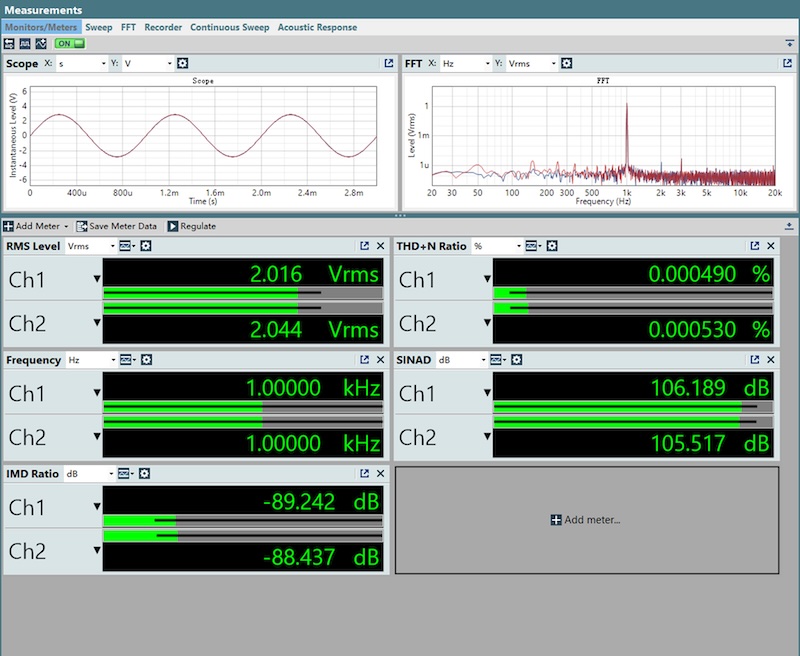
FiiO’s parameters page carries an Audio Precision section, and it is worth reproducing here because of what it does and does not establish. The dashboard capture is taken at 1 kHz into 32 Ω at about 2 Vrms from the 6.35 mm single-ended output, and it reads a SINAD of 106.189 dB on channel one and 105.517 dB on channel two, with THD+N of 0.000490% and 0.000530% and IMD at −89.2 dB:
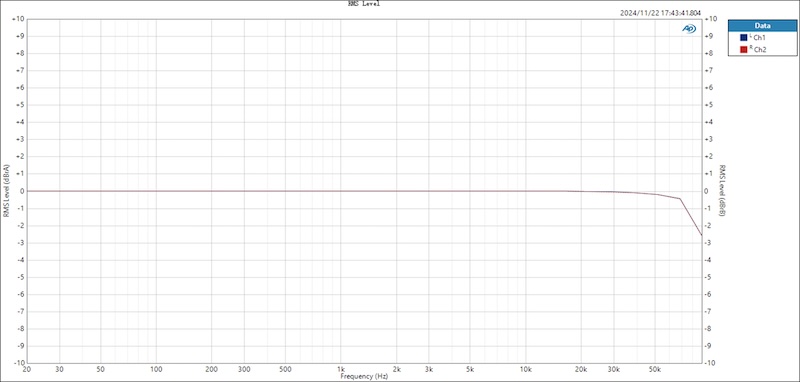
The frequency response sweep is the flat line a modern transparent amplifier should produce, holding level through the audio band and still within a fraction of a decibel at 30 kHz before rolling away above it:
And distortion versus frequency is flat at roughly 0.0005% from 20 Hz to 10 kHz, with a small rise around 8 kHz and a fall above it:
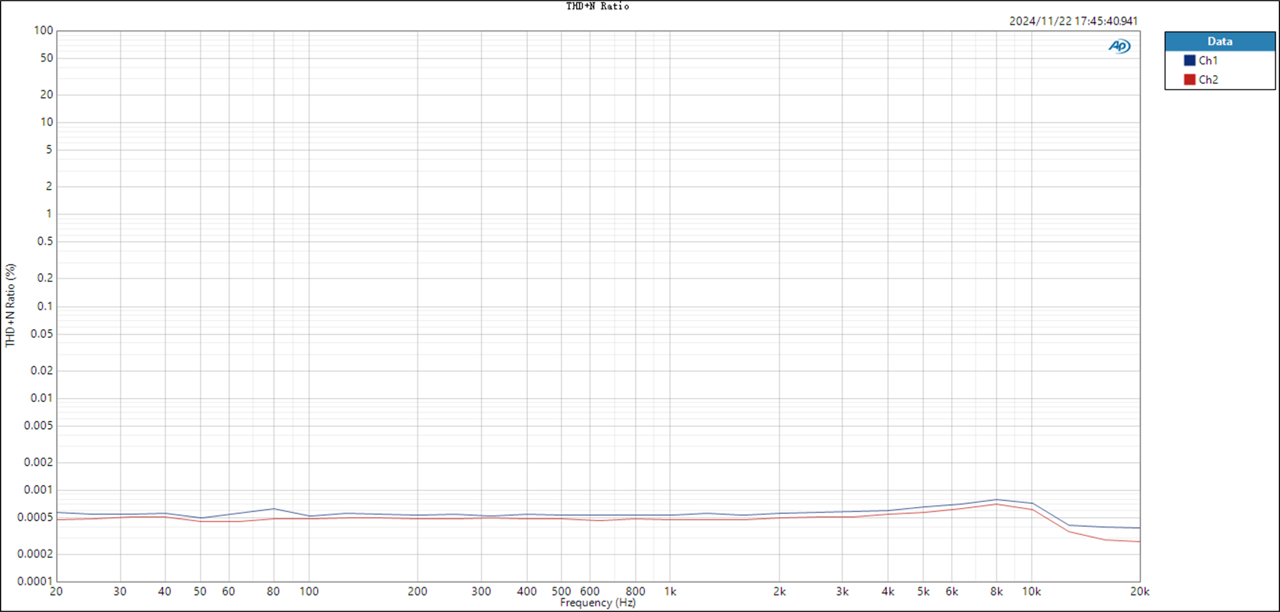
Those are excellent numbers. The problem is which product they belong to. Every one of these captures is timestamped 22 November 2024, months before the K17 R2R existed, and the same image files are served on the standard K17’s page. The numbers say the same thing: 0.00049% THD+N is a SINAD of about 106 dB, which is the standard K17’s published claim of below 0.0005% and roughly twenty decibels better than the K17 R2R’s own published 0.0055%. The test conditions match the K17’s specified distortion conditions rather than the R2R’s, too. So the honest reading is that these are the K17’s measurements, published on the K17 R2R’s page.
That is not the same as saying they tell you nothing about this unit. The two products share the amplifier, the analogue output stage and the chassis, so these sweeps are good evidence that the shared parts are excellent and that FiiO’s flat-response and low-distortion claims for the platform hold up. What they cannot tell you is how the R2R Pro ladder itself measures, which is the one question a buyer of this model actually has. On FiiO’s own specification the answer is 0.0055% single-ended, about 85 dB below the fundamental — still far below audibility on music, and still twenty decibels short of the chips it replaced.
That leaves the R2R with a specification table and no distortion sweeps of its own, which is a shame, because a discrete ladder is exactly the kind of design where the interesting questions — how linear is it at low levels, and how does distortion behave across the band and across output level — are not answered by a single THD+N figure at −6 dB.
I have not measured the K17 R2R myself yet. When I do, the numbers that will settle it are SINAD at 32 Ω on both outputs at each gain setting, low-level linearity, a multitone, output impedance and the OS-versus-NOS response difference. Until then, nothing in this review is a claim about this converter’s measured performance.
Distortion, and what R2R now costs
Discrete R2R DACs have had a rough reputation with the measurement-minded, and until recently it was deserved. Interviewed at SIAS 2026, Amir of Audio Science Review put it bluntly: R2R designs “used to be a really bad idea, because they were just different for the sake of being different”, but “in the last two years they’ve managed to substantially close the gap”, and on custom DAC designs in general, “six months ago I would have said it’s a bad idea … it still makes things more expensive, but audibly there’s not a drawback that I think you should worry about” (the segment starts at 11:36). He was talking about discrete DACs generally rather than FiiO’s R2R Pro design, and his example was a Topping, but the K17 R2R is the unit that makes me think he is right. Six to nine months ago that quote would have read as a concession; on this device it reads as a description.
There is a commercial reading of this too, and I think it is the more important one. Converter silicon has been in short supply and the companies that make it have been consolidating, so a manufacturer whose entire product line depends on somebody else’s DAC chip is exposed in a way it was not five years ago. Designing and building the converter in-house removes that dependency, and it buys something else that matters more over time: FiiO can shape the ladder, the FPGA that drives it and the analogue stage around it as one design, for their own chassis, instead of accepting a chip specified for everyone’s. That is vertical integration doing what vertical integration is supposed to do. It costs more per unit than buying a chip, and the specifications further down show that cost honestly, but as a strategy for a company at FiiO’s scale it looks like the right call rather than a gimmick.
The other half of that argument is that the engineering has caught up. R2R used to be a trade: you accepted measurably worse performance in exchange for a particular character, and for a long time that trade was a bad one. The implementations arriving now — this one included — are respectable in a way their predecessors were not, and that changes the calculation entirely. A company can build its own converter, remove its dependence on a silicon supply chain it does not control, and no longer have to ask its customers to forgive the result. That is a much stronger position than it sounds, and it is why I think more manufacturers will go this way.
What the R2R Pro ladder actually measures is still the open question, and it is the one that decides whether the architecture is a design choice you pay for or a compromise you can hear. FiiO’s own 0.0055% puts it comfortably on the right side of that line for music, and everything I heard over weeks of listening is consistent with a transparent device. But consistent with is not the same as verified, and I would rather say so than dress a specification up as a result.
Rating Explanation
Five for features, which is the least arguable of the four. Eight input modes, network streaming with Roon Ready and AirPlay, DLNA, NAS playback over SMB and NFS, 31 bands of PEQ applied to every output including the analogue inputs, five gain positions, three headphone outputs, balanced XLR preamp outputs and a 12V trigger. I cannot think of another desktop unit that does all of that. Five for pragmatic, because it collapses a streamer, a preamp and a headphone amplifier into one box that then needs nothing else, and because in use it simply worked: no hiss, no gain setting I could not use, enough power for the hardest headphone I own. Four for price, because $989.99 is a lot of money and the DX5 II covers the core job of transparent DAC plus strong headphone stage for a third of it — the K17 R2R earns its price on breadth, not on sound quality, and that will not be worth it to everyone. Four for measurements, and this is the number I hold most loosely: FiiO’s own published 0.0055% is good enough to be inaudible on music but is twenty decibels behind the chips this converter replaced, the AP graphs on their page turn out to be the K17’s, and I have not measured it myself. If my own measurements come in at or above the specification I would move that to five; if the low-level linearity disappoints, it comes down.
The framing for those scores, whatever they end up being, is that this is a feature-rich device at a price where transparency is not scarce. The features are real and unusual at any price — network streaming with Roon Ready, 31 bands of PEQ that also apply to analogue inputs, five gain positions, three headphone outputs and a balanced preamp — and the build is what €999 should buy. The limitations are equally concrete: the R2R architecture is a cost, the FiiO Control app remains rough at the edges, and the nearest cheaper alternatives cover the core job of a transparent DAC with a powerful amplifier for a fraction of the money.
Conclusion
The K17 R2R is the clearest version of a question FiiO have been circling for a few years: if you already build a flagship desktop DAC/amp with a strong amplifier, a serious DSP and a real streaming stack, does swapping the converter for a discrete resistor ladder cost you anything you can measure or hear? Everything else about this unit is a K17, which makes it a good place to find out.
My answer, before the measurements and with that caveat attached, is that this is the version of the K17 I would choose. The original K17 was, along with the Luxsin X9, my favourite headphone DAC/amp of last year, and the K17 R2R reads as the natural next step from it rather than a side-grade: the same amplifier and the same features, plus DLNA, plus a converter that FiiO own outright, and an R2R implementation clean enough to make the case for the architecture instead of asking you to forgive it. On what I have heard so far it is already on my shortlist for best headphone amplifier of 2026.
Buy the K17 R2R over the standard K17 if you want NOS on the menu, if the in-house converter appeals to you as engineering rather than as a badge, or if the wooden cheeks and the newer feature set are worth the same money to you. Do not buy it expecting an audible upgrade in OS mode, because there is not one, and do not buy either K17 if a transparent DAC with a powerful headphone stage is all you actually need — that costs a third as much. But as the flagship of a desk, this is the version I would choose.