Audeze Maxwell: Still the Best Audiophile Gaming Headphone
The audiophile gamer’s endgame: Maxwell nails tuning, features, and EQ
The Audeze Maxwell is that rare wireless, closed-back headset that genuinely satisfies audiophile listening while still being purpose-built for games and daily communications. What won me over is the default tonality—natural, resolving, and with a genuine low-bass shelf that the measurements further down confirm rather than flatter. Combine that with powerful onboard EQ (including full PEQ via AudezeHQ), sidetone, and convincing immersive presets, and you’ve got something that works everywhere: desk, couch, and on the go.
It isn’t perfect. The weight is on the higher side and the headband adjustment (very similar to the MM‑100) uses a small, fixed set of detents—if it fits your head shape, it’s great; if not, there’s less micro‑adjustability than I’d like. But judged as a whole, Maxwell is one of the most pragmatic audio purchases I’ve made in years.
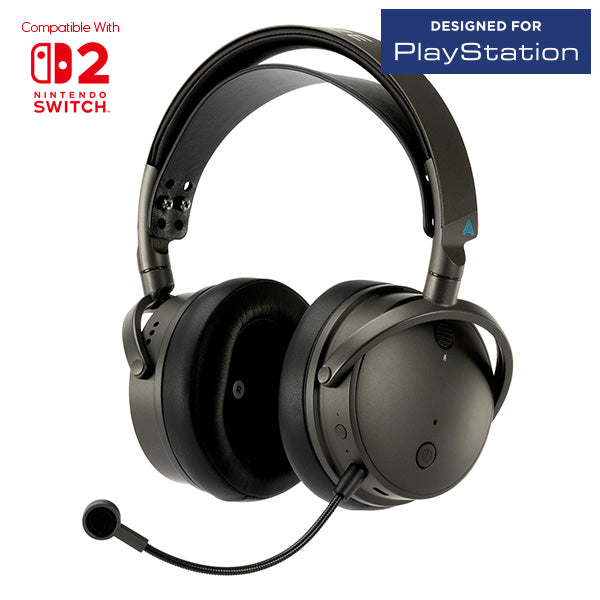
Audeze sells the Maxwell in two versions that are not interchangeable, and the difference matters before you buy:
I would like to thank Audeze for providing the Maxwell for the purposes of this review and for allowing me to both review it and investigate enabling PEQ alongside the EQ already offered in the AudezeHQ app.
The Maxwell is sold as two separate SKUs. On Audeze’s own store, checked on 9 September 2026, the PlayStation version (SKU 208-MW-1120-01) is $299 and the Xbox version (SKU 207-MW-1120-01) is $329, the premium covering the licensed Xbox Wireless radio and the Dolby Atmos licence Audeze includes with that variant. The blue accent stripe on my box and the blue USB dongle in the foam tray identify mine as the PlayStation version, so nothing in this review covers the Xbox model’s game/voice mix dial.
One thing to know before reading any further: as of the date I checked, Audeze’s own product page labels the Maxwell “a legacy product and no longer available for sale” and points visitors at the newer Maxwell 2 and Maxwell 2 ANC instead. The prices above are the last listed prices rather than live ones. Everything below still applies to the headset I have, and the used market for it is now the realistic way to buy one, but this is a review of a headphone Audeze has moved past — not a purchase recommendation you can act on at Audeze’s checkout.
If you are interested in finding more information about this product, you can find it at the Audeze Maxwell product page
I have had the Maxwell for six months at the time of writing, and for most of that it has been my reference gaming headset — the one everything else gets compared against rather than one I picked up for the review.
In euros there is no Audeze EU storefront to quote, so the nearest figure I could stand behind is the European retailer PremiumHIFI, which on the same date listed the PlayStation version at €399 and the Xbox version at €439 — the same roughly €40 premium for the Xbox model.
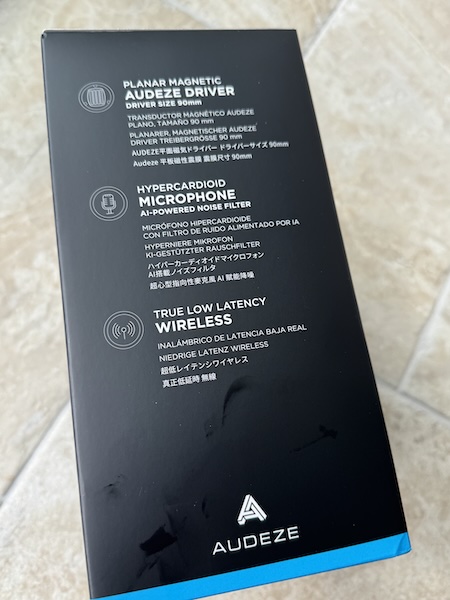
Audeze’s own framing for the Maxwell is worth separating from what I heard. Their specification puts a 90 mm planar magnetic transducer in each cup, with an ultra‑thin Uniforce diaphragm, a Fluxor magnet array built from N50 neodymium, and Fazor phase management. Their claims for those three trademarked parts are, in order, that the patterned Uniforce trace keeps the driving force even across the diaphragm rather than concentrated where the traces happen to run, that the Fluxor arrangement pushes flux through the diaphragm instead of wasting it in the magnet structure, and that the Fazor elements manage the air path in front of and behind the diaphragm to reduce the reflections that would otherwise smear the response. The same specification quotes 10 Hz to 50 kHz, greater than 120 dB maximum SPL, and THD below 0.1 per cent at 1 kHz and 1 mW.
Those are manufacturer claims about mechanism and manufacturer figures for performance, not measured results, and I have not verified any of them. What a 90 mm planar in a closed cup does explain is the weight, and it is worth saying that Audeze’s published figure is 490 g while my scale read 516 g with the boom mic detached — a 26 g gap that is either sample variation, Audeze quoting the headset without something, or my scale, and I have not chased down which.
The variant split goes deeper than the spatial audio licence, and it is worth knowing which way round it cuts. The dongle itself is variant‑specific, with a physical switch offering PS, Xbox and PC positions — you set it to whichever version you bought, or to PC for everything else, which per Audeze’s guide covers PC, Mac, the Nintendo Switch and the Steam Deck. The Xbox unit’s Dolby Atmos licence activates automatically on Xbox and on PC; the PlayStation unit gets Tempest 3D instead. On the connectivity side the Xbox variant is dongle‑or‑analog only, with no wired USB audio path, while the PlayStation variant supports the dongle, wired USB and the 3.5 mm input.
The awkward one is the game/chat mix, and it lands on the version I have. Audeze’s own guide is blunt about it: on Xbox the mixer hooks into the console’s party chat and works out of the box, on PC and Mac it works through two audio endpoints, and on the PS5 it does not work at all — Sony has not exposed game/chat balance to third‑party headsets, so the wheel on the headphone does nothing and you adjust the balance in the console’s quick menu instead. That is Sony’s restriction rather than Audeze’s, but if game/chat mixing is the reason you are buying a headset and you game on a PS5, know that this feature is not available to you on any variant.
Unboxing and Build Quality
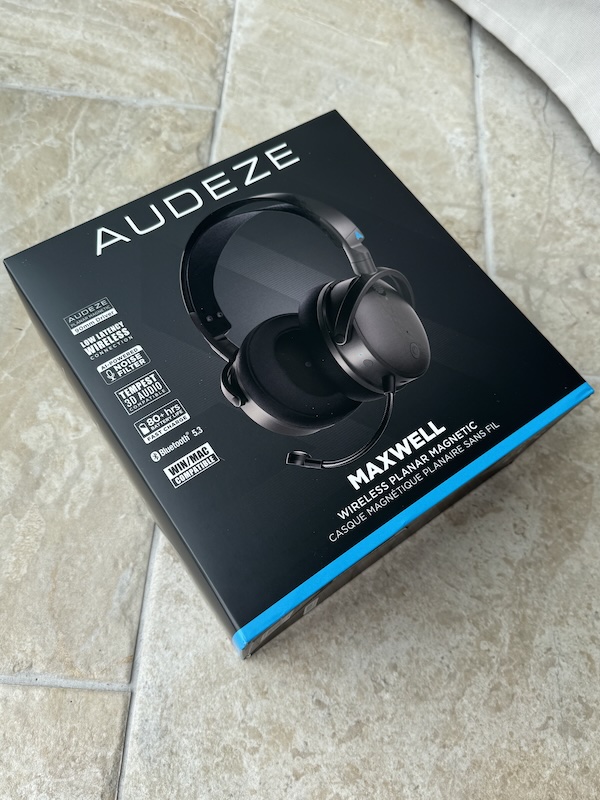
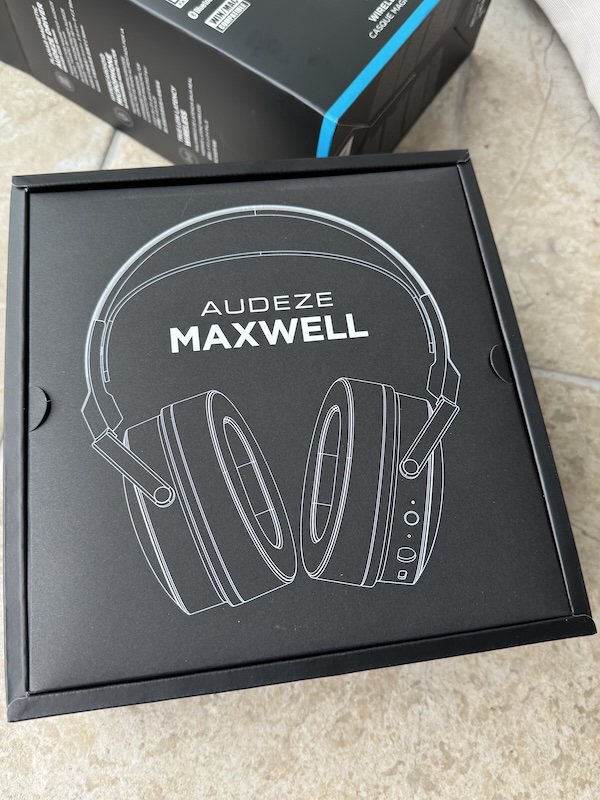
Packaging is tidy and protective with a gamer‑ready yet tasteful presentation. The front of the sleeve is a straight product shot with a column of feature icons down the left edge — low‑latency wireless, AI noise filter, Tempest 3D Audio, 80+ hours, Bluetooth 5.3, Windows and Mac compatibility — and the blue stripe along the bottom edge is how you tell the PlayStation box from the green Xbox one at a glance:
 |
 |
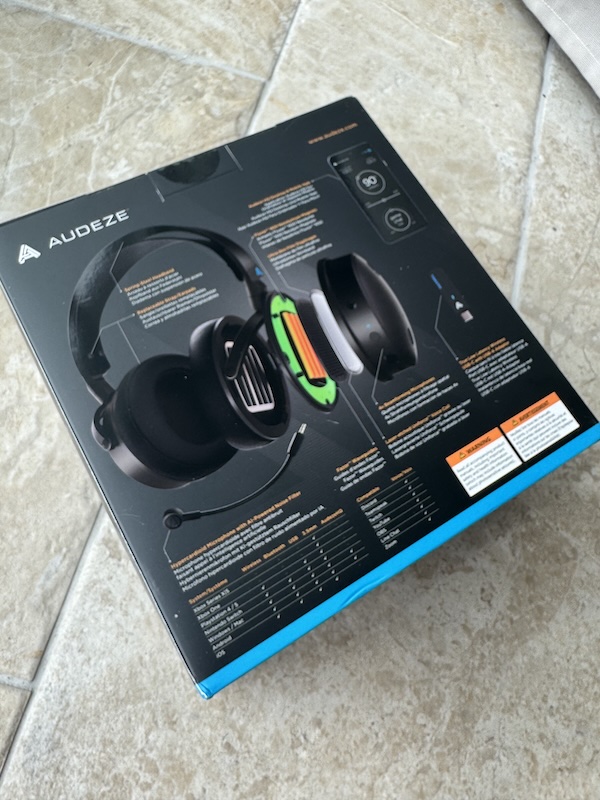
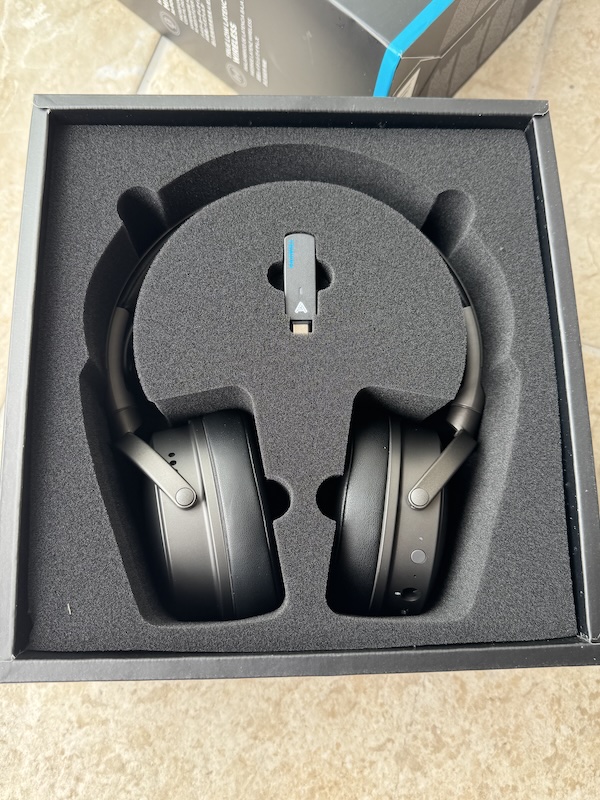
The back of the box carries the specifications, including a compatibility grid that spells out which connection method works on which platform, and lifting the lid shows the headphone seated in its foam:
 |
 |
The headphone sits in a moulded foam tray with the wireless dongle slotted into its own cutout above the headband — and that dongle is blue, which is the second confirmation that this is the PlayStation variant:
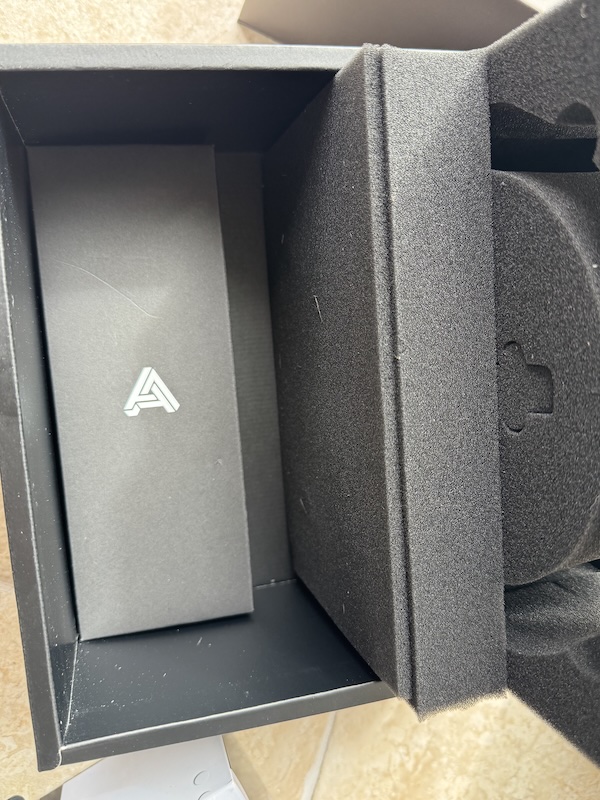
The accessories live in their own tray underneath the headphone, in a plain black card box with the Audeze logo:
Laid out, that tray holds the detachable boom microphone with its foam windscreen, a USB‑C cable, a longer USB‑A extension lead for the dongle, the Maxwell user guide, and a quick‑start leaflet:
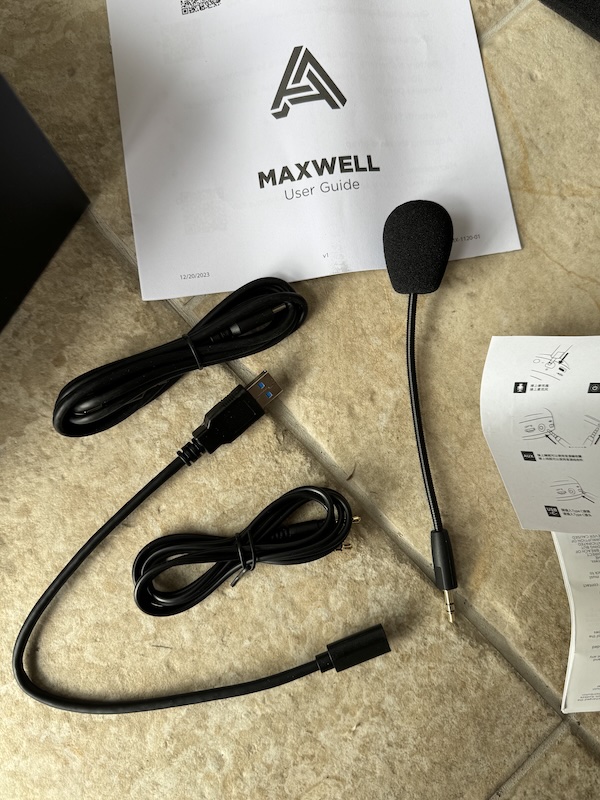
Audeze’s published package list for the Maxwell is the headset, the detachable hypercardioid boom microphone, the USB‑C wireless dongle, a USB‑C to USB‑C cable, a USB‑C to USB‑A adapter, a 3.5 mm TRRS analog cable, and the quickstart guide and warranty card. That accounts for everything in the photo except the 3.5 mm TRRS cable, which was in my box but did not make it into this shot.
Build quality is robust, with dense cups, a steel headband yoke, and plush pads. It feels premium and durable—the flip side is mass. The controls are tactile with sensible separation for volume, mic mute, Bluetooth and power, so you can find them by feel without lifting a cup, and on the Xbox version there is an additional game/voice mix control.
Fit and Comfort
Maxwell is comfortable in pad feel and clamp, but you do notice the weight during long marathons. The headband uses fixed detents with a limited range—similar to the MM‑100—so fit is great if you are within those steps but less customizable than fully sliding designs. The pads seal well without hot spots, and the clamp is moderate. If you’re sensitive to weight, consider a short break every few hours.
The pads themselves are plush and breathable and give a good seal for closed‑back isolation, and the clamp is moderate enough to stay stable for desk use without becoming a vice. The headband is quick to set because of those detents, but it is not ultra‑granular, and the weight is noticeable even though the tuning and the features go a long way towards earning it. That headband is the same design language as the Audeze MM‑100, so if you have tried an MM‑100 and it sat well, you already know whether the Maxwell will. On my head it is fine, and I want to be clear about that before criticising it — the fit is good and the pressure is spread well. The limitation is the number of positions: the clips move between a handful of fixed points, and if your head falls between two of them there is nothing you can do about it. Compared with the self‑adjusting suspension on Meze’s designs like the 109 Pro, which finds its own position rather than asking you to choose one, or the newer Hifiman mechanism on the Edition XV that slides smoothly instead of clicking between steps, the Audeze approach is the least accommodating of the three. It is a mechanism that works if it happens to suit you, rather than one that adapts to you.
The earcup openings are generously sized, which is a large part of why the pads seal without hot spots:
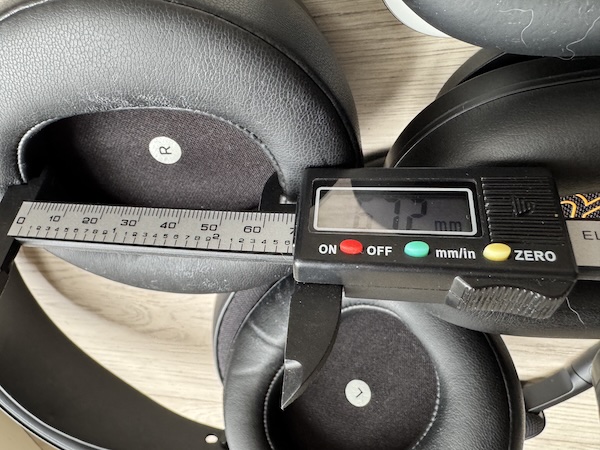
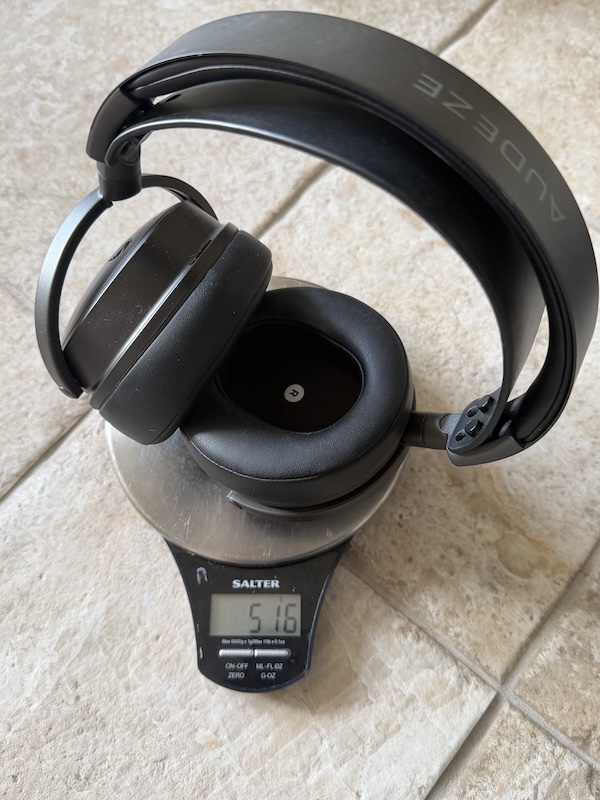
Weight is the honest caveat, and it is easier to judge against other closed headphones I had to hand. The Maxwell came in at 516 g on my scale — heavier even than the wood‑cupped ZMF Bokeh Closed at 501 g, and 182 g more than the Yamaha YH‑C3000 at 334 g:
 |
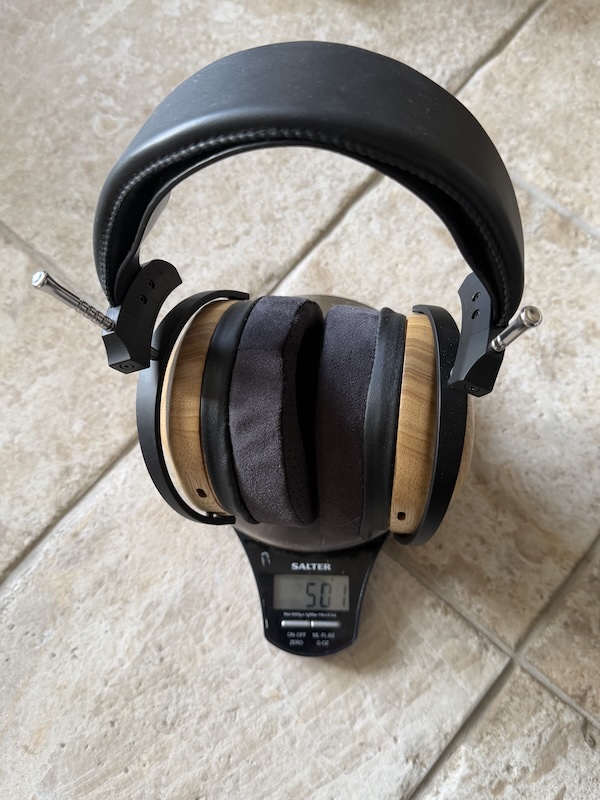 |
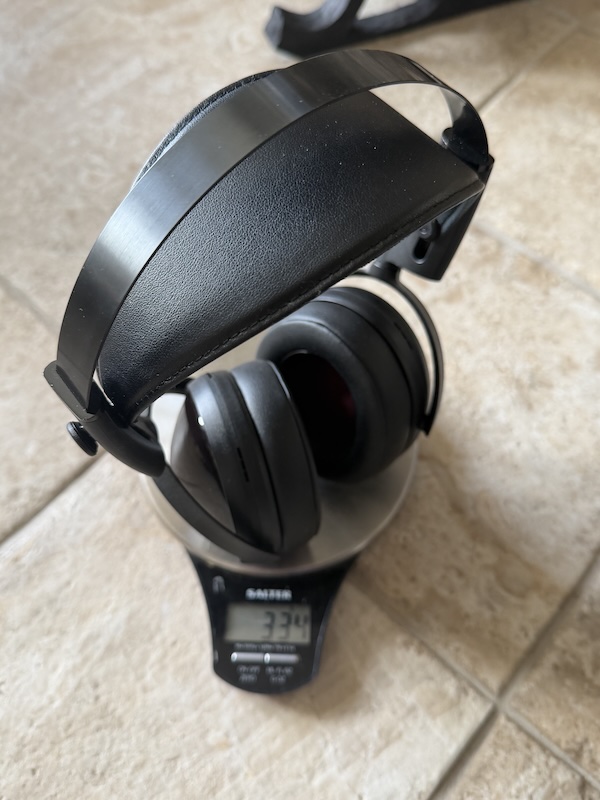
That is the number behind every comfort comment in this review. It is not unusable — the pads and headband spread it well — but it is real, and a 334 g headphone feels like a different category on a long session. For scale, the MM‑100 I keep comparing the headband to is 392 g, and the Sennheiser HD 480 PRO measured 213 g on the same kitchen scale — less than half the Maxwell. None of those three carry batteries, radios, amplification and a microphone array, which is exactly where the Maxwell’s extra mass goes, but the arithmetic still lands on your head.
The other thing I would change is the controls. Everything lives on the left earcup — volume wheel, sidetone, mute, Bluetooth, power — and there are enough of them, close enough together, that I regularly hit the wrong one. Reaching up to adjust volume and instead enabling sidetone, so that my own voice is suddenly in my ears mid-track, is a mistake I have made more than once. The buttons work and they are all where Audeze’s diagram says they are; the problem is that a closed headphone you cannot see the side of asks you to find them by feel, and by feel several of them are similar. It is the kind of irritation that never quite goes away, because muscle memory only helps once you have already learned which mistakes you make.
Features and Performance
Maxwell reads like a feature checklist done right for both music and games, and the important thing is that the list is not padding — nearly all of it gets used in normal operation. The primary link is 2.4 GHz low‑latency wireless through the bundled USB dongle, which covers PC, Mac and consoles, with the Xbox and PlayStation variants carrying different radios. Alongside that there is Bluetooth 5.3 for mobile use, and the two radios run simultaneously, so you can take a phone call over Bluetooth while the game audio keeps arriving over the dongle. Audeze claim three times the range of a conventional 2.4 GHz link for that dongle, and unusually they have published actual latency numbers rather than only the word “ultra‑low”: in a 2023 response to RTINGS’ review they reported 24.85 ms for the dongle and 14.31 ms over USB, measured on an Audio Precision APx525, and argued the dongle’s true figure is nearer 18 ms once the measurement microphone’s own latency is subtracted. Those are Audeze’s measurements of their own product, so treat them as a manufacturer claim with a method attached rather than as independent verification — but a method attached is more than most gaming headsets offer. Wired, the Maxwell works as a USB‑C audio device rather than only as a charging port — Audeze describe it as presenting dual audio endpoints with game‑chat mix over USB — and there is a 3.5 mm TRRS analog input as a fallback. That analog input is worth a caveat: Audeze specify it as active, so it is not a way to use the Maxwell as a passive headphone once the battery is flat.
On the wireless side the codec support is unusually broad for a gaming headset. Audeze list Bluetooth 5.3 with multipoint, LE Audio, LC3, LC3plus, LDAC, AAC and SBC, and quote high‑resolution audio up to 24‑bit/96 kHz over both the wireless link and USB. LC3plus in particular is rare, and the presence of both it and LDAC means the Maxwell has a good answer whichever phone you pair it to.
The microphone system is one of the genuinely good parts. There is the detachable boom mic in the box, and there are onboard beamforming microphones with AI noise reduction for when you would rather not have a boom arm in front of your face. Sidetone is adjustable, which matters more than it sounds on a closed headphone with this much isolation — without it you end up shouting. Battery life feels basically multi‑day in practice, and the specification backs that up: an 1800 mAh lithium‑polymer cell rated at over 80 hours of wireless playback at 80 dBA, charging over USB‑C at up to 5 V and 1.8 A, with 25 per cent in 20 minutes and a full charge in two hours. Audeze’s own marketing copy on the same page claims 90 hours where the specification table says over 80, so take the headline number with a little salt — 80 is the one they are willing to write into a spec.
The immersive and spatial presets are tuned for different game genres and for cinema, and firmware updates have kept adding refinements over the life of the product.
Audeze’s published patch notes for the Maxwell run from v1.0.1.32 in March 2023 to v1.0.1.74 in September 2024, and they are a reasonable record of a company that kept working on a product: v1.0.1.46 increased amplifier gain, v1.0.1.51 fixed LDAC playback when user EQ values were loaded, v1.0.1.56 added head‑tracking centre calibration by double‑tapping the left cup, v1.0.1.61 changed the default auto power‑off from five minutes to an hour and addressed tuning inaccuracies in some EQ presets, and v1.0.1.74 modified output gain slightly. That is a headphone that improved after purchase, which is the point.
PEQ and Presets
This is where Maxwell shines for tinkerers. The AudezeHQ app exposes graphic EQ and full PEQ, letting you gently tailor the already excellent stock tonality. The key point is that Maxwell takes EQ well without losing composure, which is not a given on all wireless headsets.
What the app actually offers, per Audeze’s user guide, is six factory presets alongside four user slots, all of them cycled from the headset itself by double‑tapping the volume wheel. The factory six are Audeze (the default curve), Bass Boost (which Audeze describe as a bass shelf with a relaxed upper midrange), Treble Boost, Immersive, Competition (midrange and lower treble forward, bass reduced) and Footsteps. The four user slots are EQ1 through EQ4, and they are where anything you build yourself lives.
The reason PEQ is more interesting here than a graphic EQ slider bank is where the filters end up. They are written into the headphone, not applied by a player app, so they follow the headset onto a console or a phone that has no EQ of its own. On the Maxwell that store is those four user slots, ten bands each, with gain adjustable across a ±12 dB range — which is the configuration DevicePEQ uses when it talks to the headset over Bluetooth LE, rather than over USB. Worth being honest about the provenance of those numbers: the four slots and the ±12 dB range come from the DevicePEQ device profile, and the ten‑band count is repeated in the AudezeHQ app store listing, but I could not find an Audeze specification page that states the band count, the available filter types or the Q range. If you want to know exactly what the ten bands let you do, the app is currently a better source than Audeze’s documentation.
One editing quirk from the guide that will save you five minutes of confusion: on mobile, music has to be playing while you make EQ adjustments, or the changes do not take. On desktop they auto‑save to whichever user preset is selected. Audeze also publish a set of game‑specific downloadable presets for a handful of titles, and there are third‑party preset files circulating that import into the same user slots.
A few useful starting points, if you want somewhere to begin rather than a finished curve:
- Sub‑bass lean mixes: +2 dB low shelf @ 80 Hz, Q 0.7
- Extra presence for quiet vocals: +1.5 dB @ 3 kHz, Q 1.2
- Bright recordings: −2 dB @ 6.5 kHz, Q 1.0
Here is DevicePEQ writing parametric filters straight to the Maxwell:
Given how many codecs the Maxwell supports, which one a given phone actually settles on is worth checking rather than assuming. Here it is being verified with a Bluetooth test tool:
Sound Impressions
All impressions below are with the default tuning (latest firmware), PEQ off unless noted, using the 2.4 GHz dongle for low latency and USB‑C for hi‑res listening, with LDAC on mobile.
Before my own notes, it is worth setting out the common descriptions of the Maxwell elsewhere, because on two points they do not match what I hear. The consensus across RTINGS, SoundGuys, Headphones.com, TechRadar and SoundStage! Solo is that the Maxwell is warm‑leaning overall with bass that is clean and controlled rather than boomy — and notably, almost nobody calls it bass‑heavy. RTINGS measure the bass at only about +2 dB above their preference curve and the treble at roughly −1 dB, SoundGuys go further and call the stock bass under‑emphasised, and TechRadar and SoundStage! Solo both say it lacks slam. Most of them describe the treble as smooth to slightly dark and non‑fatiguing, with energy concentrated around 3–6 kHz that gets read either as forward mids or as recessed lower mids; Tom’s Hardware is the outlier in calling the highs bright and aggressive. The one descriptor with no consensus at all is soundstage: Headphones.com and SoundStage! Solo call it unremarkable for a closed‑back, while TechRadar and Tom’s Hardware call it wide. RTINGS also flag an audible left/right driver mismatch in the high bass and low midrange, in both phase and frequency response — Audeze publicly disputed RTINGS’ latency and phase methodology but not their frequency response. I have not measured the Maxwell, so I cannot arbitrate any of that; my own notes follow, and where they diverge from the consensus I would rather show you both than quietly pick one.
Bass
The updated default adds a tasteful sub‑bass lift that gives modern productions proper foundation without masking mid‑bass texture. It’s tight, controlled, and reaches deep for a closed wireless headset. EQ headroom is excellent—if you want more rumble for EDM, Maxwell takes it cleanly. On Massive Attack’s “Angel” the sub‑bass swells are solid and well‑defined with no mid‑bass bloom, and on James Blake’s “Limit to Your Love” the ultra‑low sine hits render confidently, with good grip.
Midrange
Midrange is natural and clear, with vocals presented slightly forward of strictly neutral but never shouty. Instrument timbre is convincing—pianos and strings have body, and guitars retain bite without glare. Dialog in games is articulate even during heavy FX scenes, thanks to transient cleanliness and disciplined bass. On Norah Jones’ “Don’t Know Why” the breath and chest resonance strike a pleasing balance, and on Fleetwood Mac’s “Dreams” the vocal layering separates cleanly over the driving rhythm guitar.
Treble
Treble is clean and extended without becoming brittle. Cymbal sheen and air are present, but Maxwell avoids the glassy edge some gaming headsets exhibit. On rough masters, the top end remains listenable; with good recordings, microdetail comes through easily. A tiny PEQ shelf up top can increase “sparkle” if you prefer. Bill Evans’ “Waltz for Debby” shows the ride cymbal texture and decay feeling natural, and on Radiohead’s “Everything In Its Right Place” the upper harmonics are crisp without etch.
Soundstage and Imaging
For a closed design, stage width is solid with convincing center image stability and good front‑to‑back layering. Imaging precision is excellent—positional cues in competitive titles are easy to locate. The immersive presets can widen the sense of space for movies; for music I mostly stay in stereo.
Comparisons
Against the other wireless gaming headsets, the Maxwell’s advantage is tonal rather than featural. The SteelSeries Arctis Nova Pro Wireless is feature‑rich and comfortable, but its out‑of‑box tonality is less natural and its EQ lacks the finesse of full PEQ; Maxwell sounds more audiophile and scales better with EQ. The Sony WH‑1000XM5 has class‑leading ANC and is considerably lighter, but Maxwell’s stock tuning is more accurate, its dynamics are punchier, and its imaging is superior for gaming — Sony wins travel, Maxwell wins listening and latency‑sensitive play. The Beyerdynamic DT 700 Pro X is a wired studio closed‑back, lighter and with excellent isolation, but it needs a chain and brings no wireless and no microphone suite; Maxwell gets you 90 to 95 per cent of that studio neutrality with far more versatility. Those three are my own listening rather than measurements, and none of them is a headphone I have written up here, so take them as impressions rather than as anything I can point you at.
Among the closed‑backs I have reviewed, the most useful comparison is the Sennheiser HD 480 PRO, because it is in the same money — $399 against the Maxwell’s $299 — and I called it the most pragmatic closed‑back under $1,000. It is a wired studio headphone in every sense that matters here: a 38 mm dynamic driver into a 130 Ω load, a detachable mini‑XLR cable, no radio, no battery, no microphone, and 213 g on the scale against the Maxwell’s 516 g. If you sit at a desk with a DAC and never need to walk away, the HD 480 PRO is the more comfortable and the more straightforwardly neutral of the two. The Maxwell’s case is everything the HD 480 PRO deliberately does not do: wireless to a console, a microphone that does not need a separate arm, and EQ that lives on the headphone.
The Audeze MM‑100 is the closest relative and the reason the headband comment in this review is not a surprise. It uses the same fixed‑detent adjustment, it is $399 against the Maxwell’s $299, and at 392 g it is 124 g lighter — a wired planar with none of the Maxwell’s radios. If you like Audeze’s planar tonality and have no use for wireless or a microphone, the MM‑100 is the cheaper way to the driver family; the Maxwell is what you buy when the headset half of the job matters as much as the headphone half.
The Moondrop Edge is the interesting cheap counterpoint, because it is the other wireless headphone I have reviewed where a firmware update added real PEQ long after launch — in the Edge’s case turning an $89.99 ANC headphone into something you can actually tune. The Edge is a fraction of the price and has ANC the Maxwell does not, but it is a 40 mm dynamic rather than a planar, and it has no low‑latency dongle. The pattern the two share is worth naming: on both, the headphone you own today is better than the one that shipped, because the manufacturer kept working on the firmware.
The Sivga Robin SV021 Pro V2 earns a mention for a reason that has nothing to do with sound. At $179.99 it is the other closed‑back where my verdict came with a headband caveat attached — an excellent bargain if the headband fits your head. The Maxwell has the same conditional attached to it, for the same reason, and it is worth saying plainly that a fixed‑detent headband is a fit lottery in a way a sliding one is not.
Finally, on the gaming side, the Kiwi Ears S‑Link is the $25.99 answer to the same problem from the opposite direction: a USB‑C cable with a DAC, dual microphones and a five‑band PEQ stored on the cable itself, for people who already own IEMs. It is a fraction of the Maxwell’s cost and does the mic‑plus‑EQ trick for whatever you plug into it, but it is a wired dongle with no wireless, no battery and five bands to the Maxwell’s ten. If the Maxwell’s price is the obstacle and you are happy with IEMs, that is the cheap route to the same two features.
Specifications and Measurements
Specifications
Everything in this table is the manufacturer’s published specification unless the row says otherwise.
| Style | Over‑ear (circumaural), closed‑back |
| Transducer type | Planar magnetic, 90 mm |
| Diaphragm | Ultra‑thin Uniforce™ |
| Magnet structure | Fluxor™ array, N50 neodymium |
| Phase management | Fazor™ |
| Frequency response | 10 Hz – 50 kHz |
| Maximum SPL | >120 dB |
| THD | <0.1% (1 kHz, 1 mW) |
| Spatial audio | Dolby Atmos (Xbox version); Tempest 3D (PlayStation version) |
| Weight | 490 g published; 516 g measured on my scale |
| Wireless | Ultra‑low‑latency 2.4 GHz USB‑C dongle; Bluetooth 5.3 |
| Bluetooth codecs | Multipoint, LE Audio, LC3, LC3plus, LDAC, AAC, SBC |
| Wired digital | USB‑C, dual audio endpoints with game‑chat mix, up to 24‑bit/96 kHz |
| Wired analog | 3.5 mm TRRS, active (not passive) |
| Microphones | Detachable hypercardioid boom; beamforming array with physical and AI noise reduction; internal chat mic |
| Battery | 1800 mAh Li‑polymer; >80 hrs wireless playback @ 80 dBA |
| Charging | USB‑C, 5 V / 1.8 A max; 25% in 20 min, full in 2 hrs |
| Controls | Volume, sidetone, mute, Bluetooth, power; Xbox version adds game/voice mix |
| App | AudezeHQ (iOS, Android, macOS, Windows) with presets + PEQ |
| Onboard EQ store | 4 preset slots × 10 bands, ±12 dB (per the DevicePEQ device profile) |
| Warranty | 1 year |
| Price | $299 PlayStation / $329 Xbox, last listed on the Audeze store, 9 September 2026 (now a legacy product) |
Everything above except the measured weight and the onboard EQ store comes from Audeze’s published specification, and specifications do vary between the Xbox and PlayStation variants and across firmware — the spatial audio row is the clearest case. Audeze’s compatibility grid on the same page is worth reading if you own more than one platform, because which of the four connection methods works depends on the console.
Measurements
All of these were taken on my KB501X Soft Ear/Pinna with a 711 clone coupler. One caveat before the curves: every Maxwell trace here is the left channel only, so nothing below says anything about channel matching. RTINGS report an audible left/right mismatch in the high bass and lower midrange on their sample, and a single-channel sweep can neither confirm nor clear that.
Here is the Maxwell on its default Audeze preset against the KB501X diffuse-field target, tilted one decibel per octave:
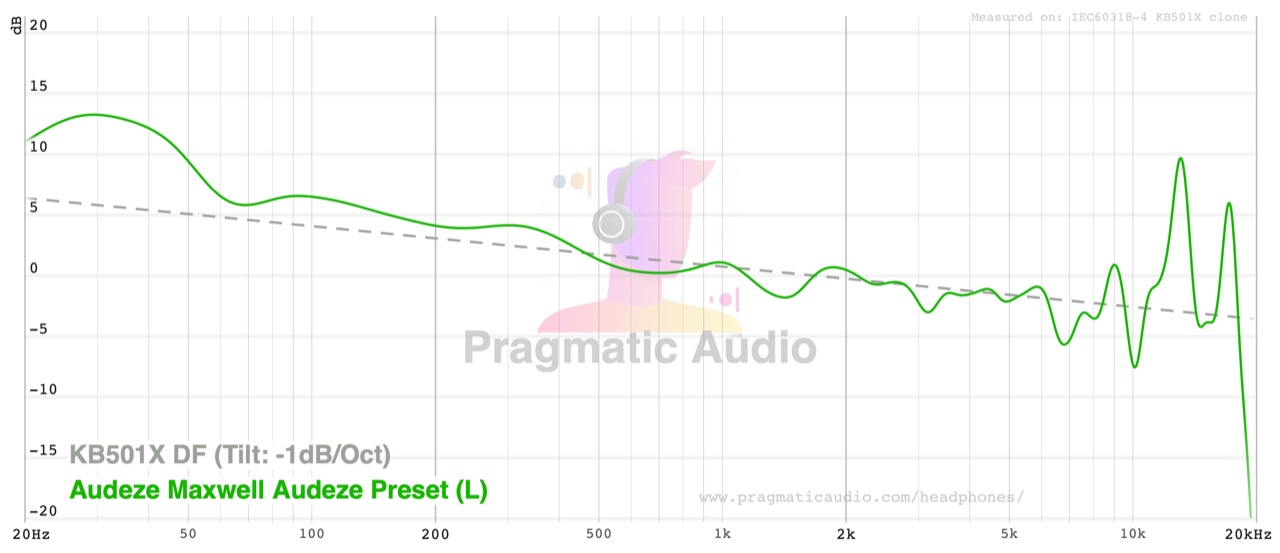
The bass is the first thing to notice, and it is substantial: about 11dB above the tilted target at 20Hz, peaking near 12.5dB around 30Hz, then falling to roughly 5dB by 70Hz with a small rise again near 95Hz. From there it descends smoothly, crossing below the target line around 500Hz and tracking it closely from 1kHz to 5kHz, which is the part of the curve that explains why the Maxwell reads as natural rather than coloured despite all that low-end weight. The sharp peaks at 12kHz and 15kHz are coupler and pinna resonances rather than anything you hear as tonality, and I would not read them.
That shape also settles the sub-bass question: the headphone I measured has a large, deliberate low-bass shelf, and the graph agrees with what I hear.
Against the Harman over-ear 2018 target on an absolute scale, the same trace tells a slightly different story:
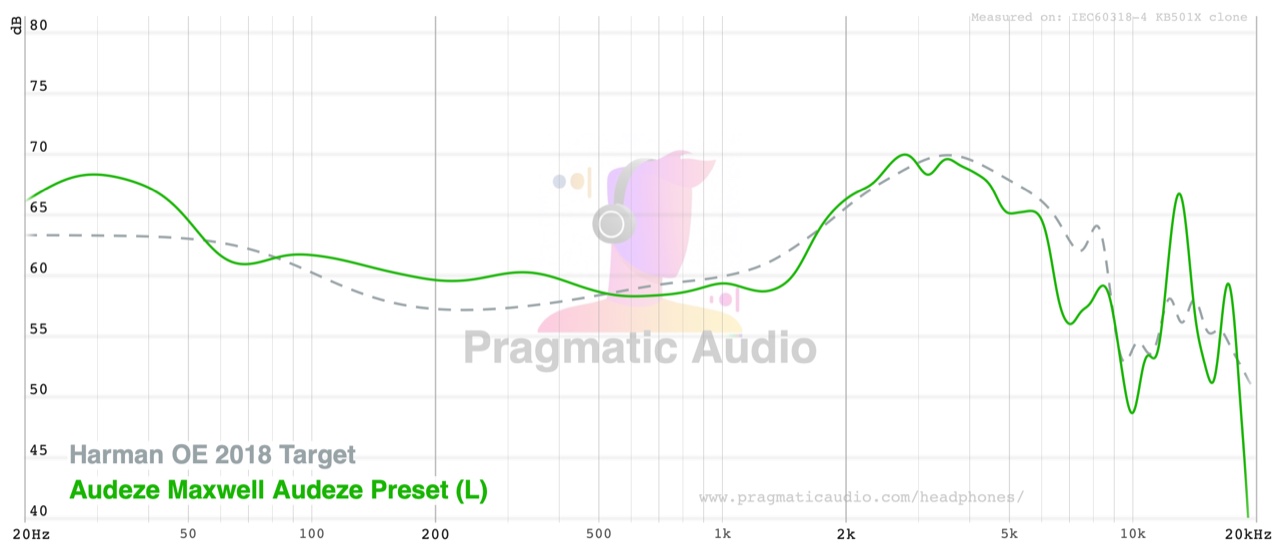
The bass sits about 4dB above Harman at 30Hz rather than the 11dB the tilted diffuse-field target suggests, which is a reminder that the target you choose decides how bassy a headphone looks. The more interesting departure is the ear-gain region: the Maxwell’s peak arrives near 2.7kHz where Harman’s plateau sits closer to 3.5kHz, so the presence region is pushed slightly lower in frequency than the target asks for.
The onboard presets are where a measurement earns its keep, because you can see exactly what each one does rather than guessing from its name. First the Audeze preset against Flat and Competitive:
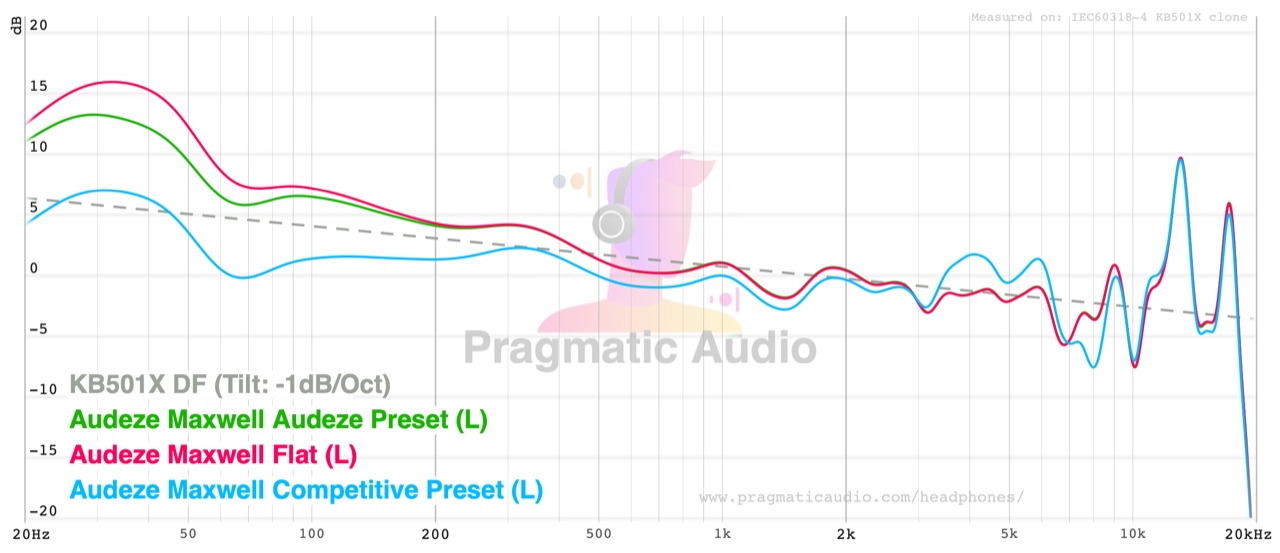
Flat is not flat. It carries the most bass of the three, about 15dB above the tilted target at 30Hz, some 2.5dB more than the Audeze preset, and the two are nearly identical above 1kHz. Competitive is the real departure: it strips the low end back to about 6.5dB at 30Hz and actually dips below the target around 70Hz, then adds a decibel or two through 3kHz to 5kHz. That is a deliberate trade of weight for positional cues, and it measures exactly as an esports preset should.
Then the Footsteps and Immersive presets, again against the Audeze default:
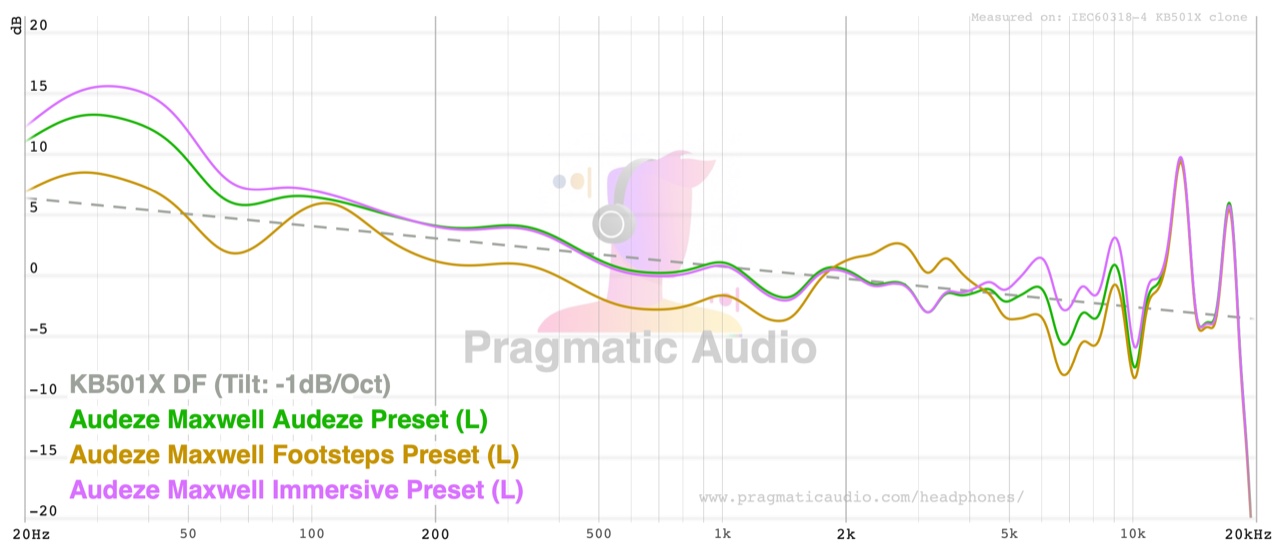
Immersive goes the other way from Competitive, adding bass to roughly 15dB at 30Hz and a little extra through the upper midrange. Footsteps is the most interesting of the set: it cuts the bass to about 8dB, then lifts a broad band through 1.5kHz to 2kHz where footstep and reload cues live, and reshapes the treble differently from every other preset. These are not cosmetic voicings, and the spread between Competitive and Immersive at 30Hz is around 8dB.
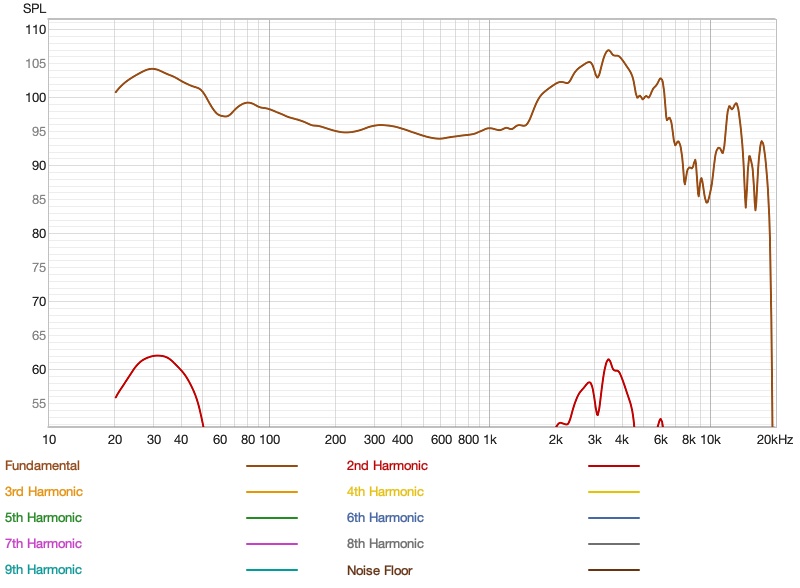
Distortion is a non-issue. Here it is as harmonics against the fundamental in SPL, and then as a percentage:
 |
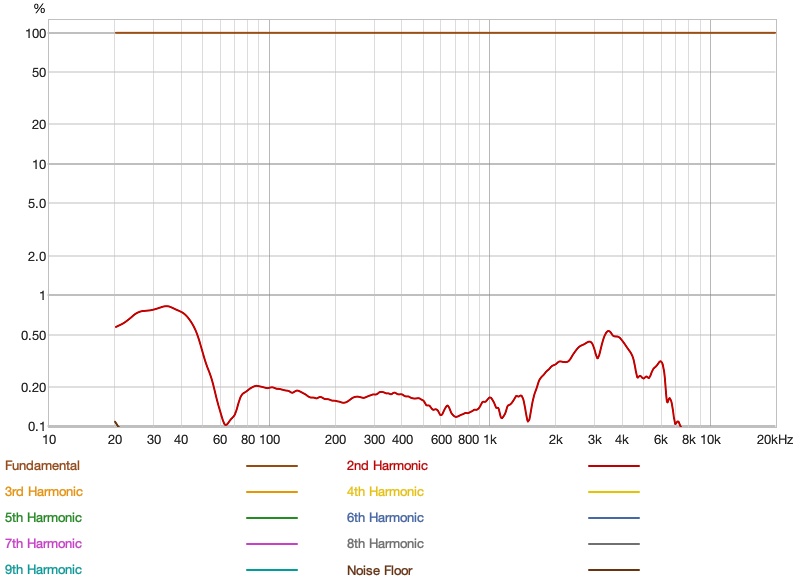 |
With the fundamental running between roughly 95dB and 107dB, the second harmonic is the only one that rises off the noise floor at all, and it stays 40dB or more below the fundamental. As a percentage that is around 0.6 to 0.85 percent in the lowest bass below 40Hz, falling to about 0.1 percent at 60Hz, sitting near 0.2 percent through most of the midrange, and rising to roughly 0.5 percent around 3kHz to 4kHz. For a planar asked to produce a 12dB bass shelf at this level, that is a clean result and there is nothing here to worry about.
Compared with headphones I have measured on the same rig
Because the measurement comparisons only make sense once you have seen the Maxwell’s own curve, they sit here rather than up in Comparisons. First against the Audeze MM-100, the wired Audeze whose headband the Maxwell borrows, both against Harman over-ear 2018:
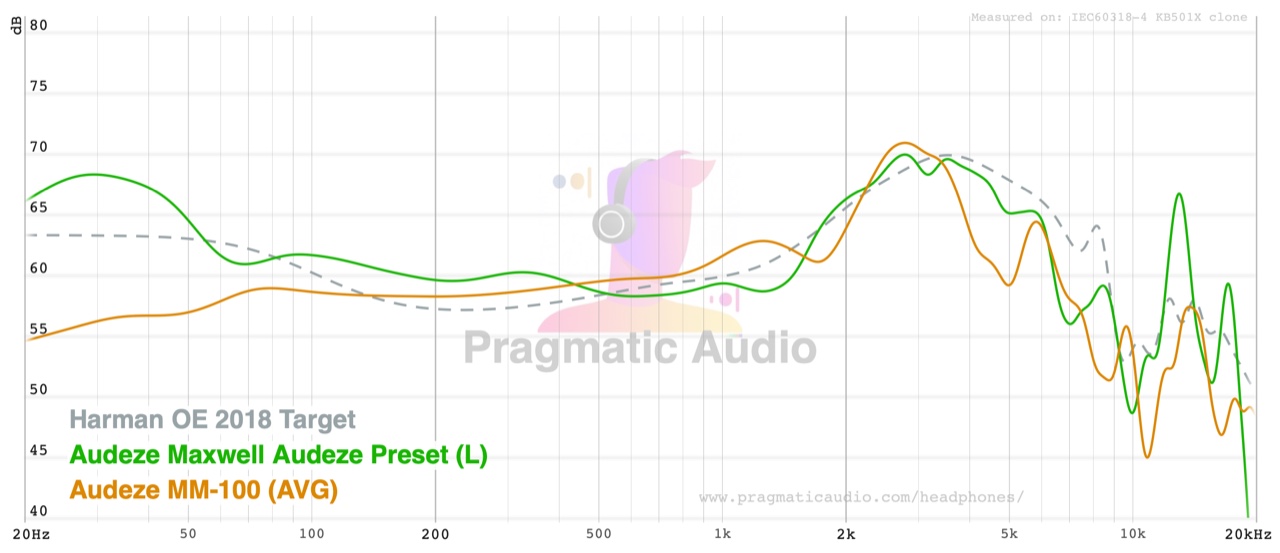
They are not the same tuning. The MM-100 is the flatter of the two below 200Hz, sitting close to Harman where the Maxwell rides 4 to 7dB above it, and it carries more energy through 1kHz to 2kHz. Their ear-gain peaks land in different places, the MM-100’s nearer 3kHz and the Maxwell’s nearer 2.7kHz, and the MM-100 holds a little more level from 3kHz to 5kHz. So the family resemblance is in the headband and the driver technology, not the voicing: the Maxwell is the warmer, weightier of the two by a clear margin, and if you know the MM-100 you should not assume you know how this sounds.
Then against two closed-backs I have measured recently, the Final DX4000 CL and the Aune SR7000:
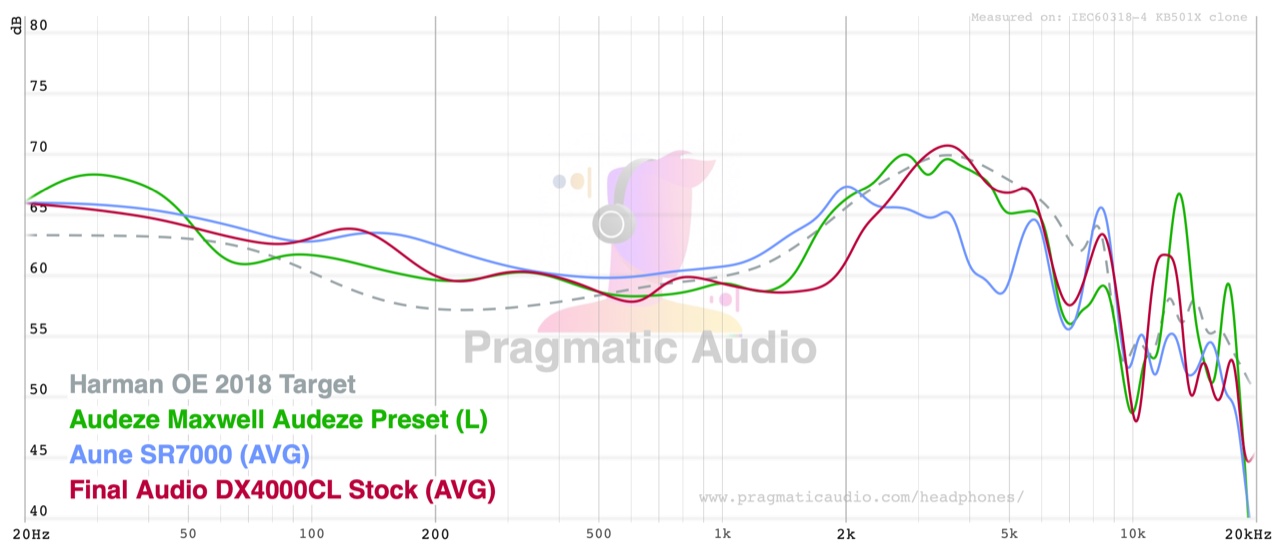
All three start from a similar place at 20Hz, and then diverge in a way that maps onto how they sound. The Maxwell keeps the most bass through 30Hz to 50Hz; the DX4000 CL holds a broad lift around 100Hz to 150Hz that neither of the others has; the SR7000 is the flattest of the three through the midrange and then the most forward from 3kHz to 5kHz, where the Maxwell and the DX4000 CL both sit lower. The Maxwell and the DX4000 CL actually track each other closely from 2kHz to 3kHz before parting company above it. What the graph says plainly is that the Maxwell is not a compromise tuning that happens to be wireless — it holds its own against wired closed-backs measured on the same fixture, and its bass emphasis is a choice rather than a limitation.
Rating Explanation
The Pragmatic Rating of 5 is because Maxwell uniquely combines accurate, engaging tonality with gaming‑grade latency, excellent mics, true PEQ, and multi‑platform support. You simply don’t see this blend of audio quality and features in closed, wireless headsets, and at $299 for the PlayStation version it is not asking a premium for the privilege — which is where the Price Rating of 5 comes from. The Features Rating of 5 follows from the same list: two radios that run at once, USB‑C audio, an analog fallback, two microphone systems, adjustable sidetone, spatial presets, and ten bands of parametric EQ stored on the headphone rather than in an app.
Who it suits is fairly specific. It is for audiophiles who need a closed, wireless headset without sacrificing sound, for gamers who want precise imaging and natural tuning, and for listeners who appreciate deep EQ tools to fine‑tune flavour without breaking the core of the tuning. If none of those describe you — if you sit at one desk with a wired chain and no need for a microphone — a lighter wired closed‑back like the HD 480 PRO is the more sensible purchase and I would say so.
The trade‑offs are physical rather than sonic, and there are three of them. It is heavy, and you feel it in very long sessions; 516 g is 182 g more than the Yamaha YH‑C3000 and more than double the HD 480 PRO. The headband adjustment is coarse — fine on my head, but the clips move between a handful of fixed points with no way to split the difference between two of them, where a Meze suspension headband or the newer Hifiman slider simply finds its own position. And the controls on the left cup are too easy to confuse by feel, which for me means periodically switching on sidetone when I meant to change volume. None of the three is a reason not to buy it, but all three are things I notice every week rather than once.
Conclusion
Audeze Maxwell is the most convincing “audiophile‑meets‑gaming” headset I’ve used, and after measuring it I am more comfortable saying so than I was before. The default tuning is excellent, the low‑bass shelf is real and visible in the graphs, and the preset set turns out to be genuinely engineered rather than cosmetic — Competitive and Immersive are about 8dB apart at 30Hz, and Footsteps lifts exactly the band where footsteps live. Add PEQ stored on the headphone, adjustable sidetone and distortion that never becomes a talking point, and the package is still the one to beat.
My two complaints are both things you hold rather than hear: 516 g that you feel after a couple of hours, and a cluster of controls on the left cup that I still mis‑hit often enough to surprise myself with my own voice. Neither changes the verdict. If you want a closed, wireless headset you can trust for music that also dominates in games and calls, the Maxwell is still the best audiophile gaming headphone I have used.