Sendy Audio Apollo Pro
Sendy Audio’s Apollo Pro — A Comfortable, Warm and Detailed Guilty Pleasure
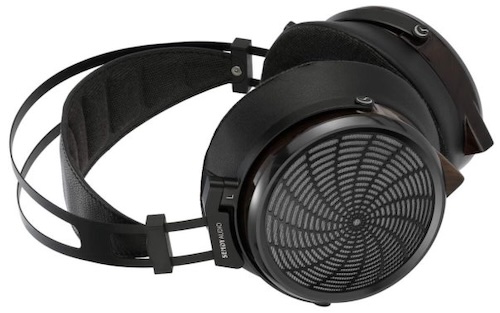
Sendy Audio is the audiophile-focused sister brand to Sivga, both from the same Dongguan-based company. My previous experience with Sendy Audio specifically was the excellent Egret, and while I have reviewed plenty of the sister brand’s headphones too — the Luan and the Robin SV021 Pro among them — I was genuinely excited to try the Apollo Pro.
I was particularly interested in the pads: they looked closer to the soft Sivga Luan pads than the sculpted pads on the Egret. Comfort turned out to be one of the Apollo Pro’s strengths.
The Apollo Pro is a substantial retune of the original Apollo, built around a 78mm planar magnetic driver. I have spent about three months with it, and this version has a warm tuning I enjoy; I have not included a direct original-Apollo comparison here.
I would like to thank Sendy Audio for providing the Apollo Pro for the purposes of this review.
If you are interested in finding more information about this product, you can find it at the official Sendy Audio product page.
The Sendy Audio Apollo Pro retails for €499 ($449 / £449).
That is much longer than I normally spend with a headphone before writing about it, and it left me with a much better sense of how the Apollo Pro works in everyday use rather than in a fortnight of concentrated listening. The short version: the comfort is amazing, the build is the high standard I have come to expect from this company, and the tuning, while it will not suit everyone, has a warmer tinge that reminded me of headphones from much further up the price ladder. But first, let’s take a look at what’s in the box.
Unboxing and Build Quality
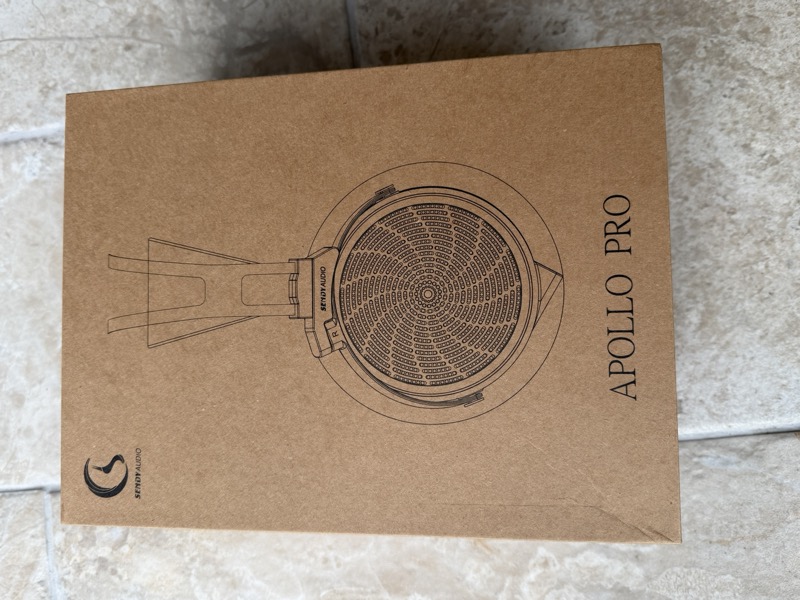
The Apollo Pro arrives in a plain kraft box with a line-drawing illustration of the headphone’s distinctive sunburst grille on the front:
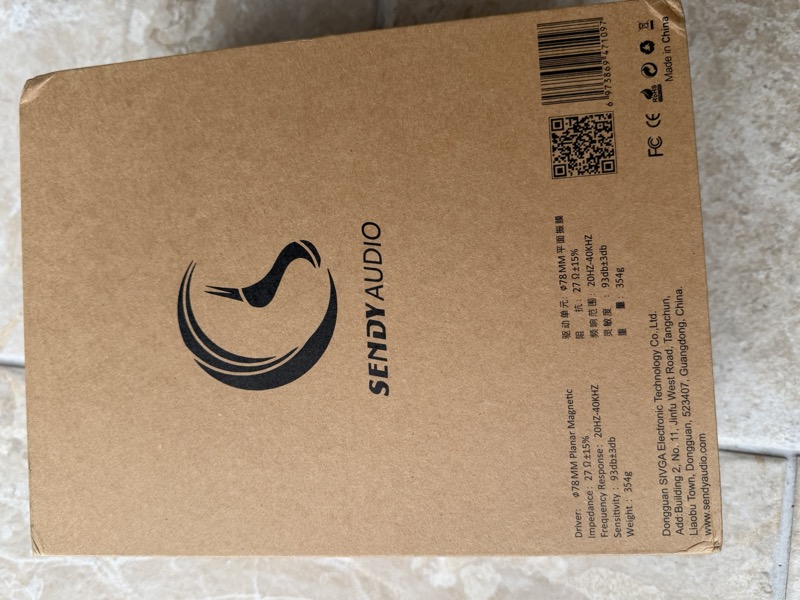
The back of the box prints the core specification in both English and Chinese, alongside the Sendy Audio logo:
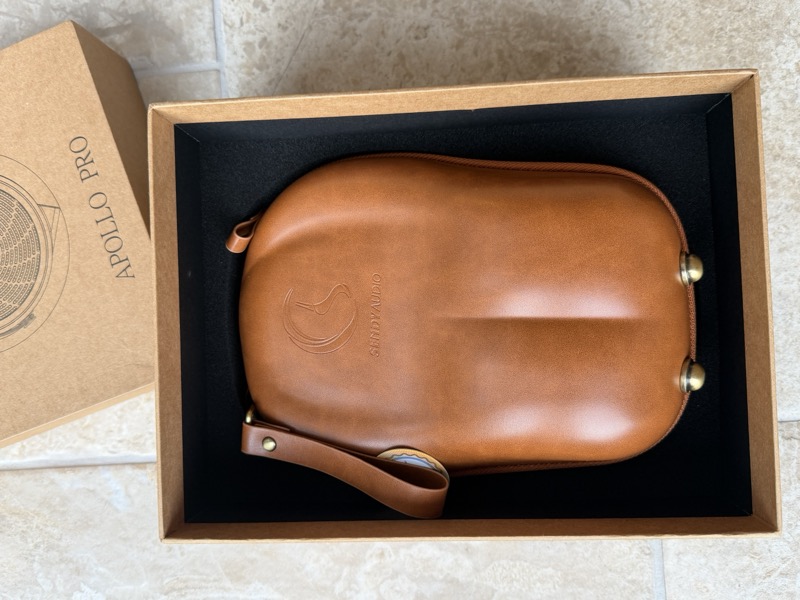
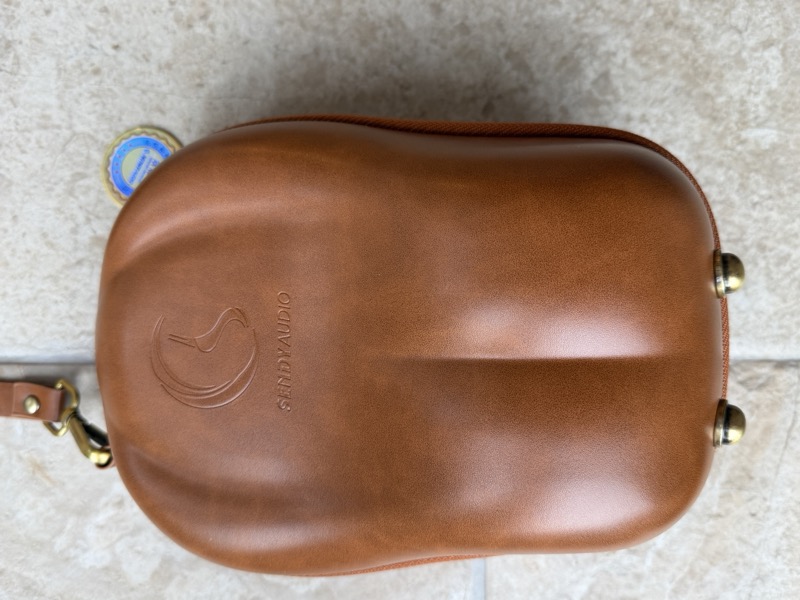
Inside sits a high quality leather carrying case, embossed with the Sendy Audio logo and finished with brass hardware — though like a lot of Sivga and Sendy Audio cases, it has a tendency to look a bit like a human posterior:
 |
 |
Inside the case, the headphone sits with a linen Sendy Audio drawstring bag tucked into the headband cavity:
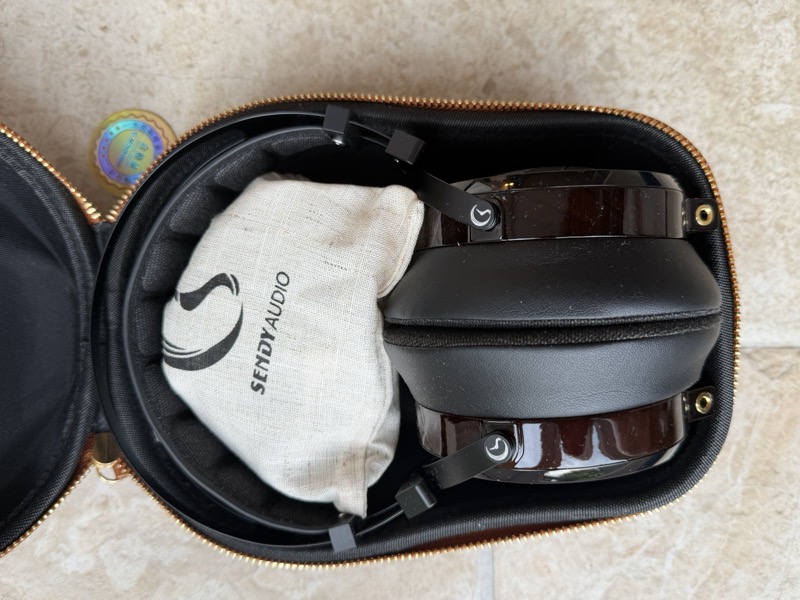
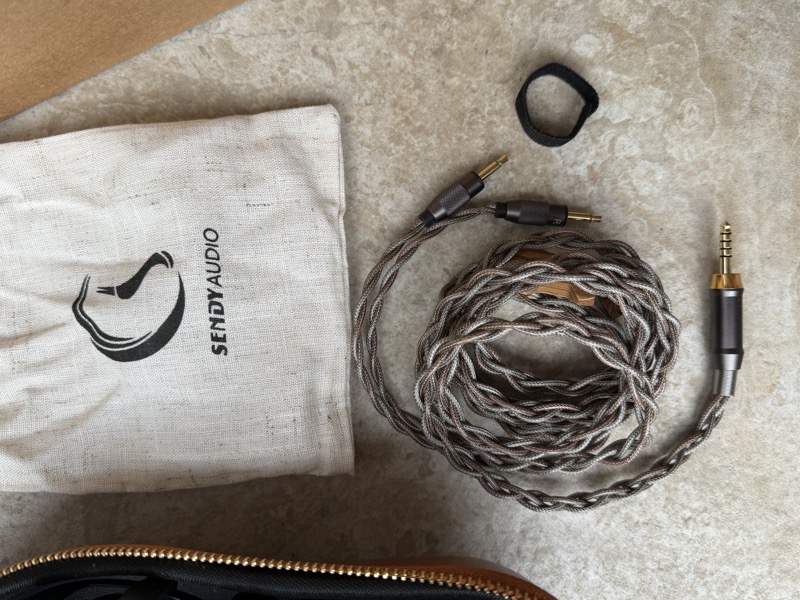
The box includes: the Apollo Pro headphone, the leather carrying case, a hemp accessory bag, a 4.4mm balanced cable, a 3.5mm-to-4.4mm adapter, and a 6.35mm-to-3.5mm adapter. The cable itself is a triple-composite build — Furukawa OFC, silver-plated, and gold-plated copper strands woven together with shielding according to Sendy Audio — coiled neatly with the adapters and a cable tie:
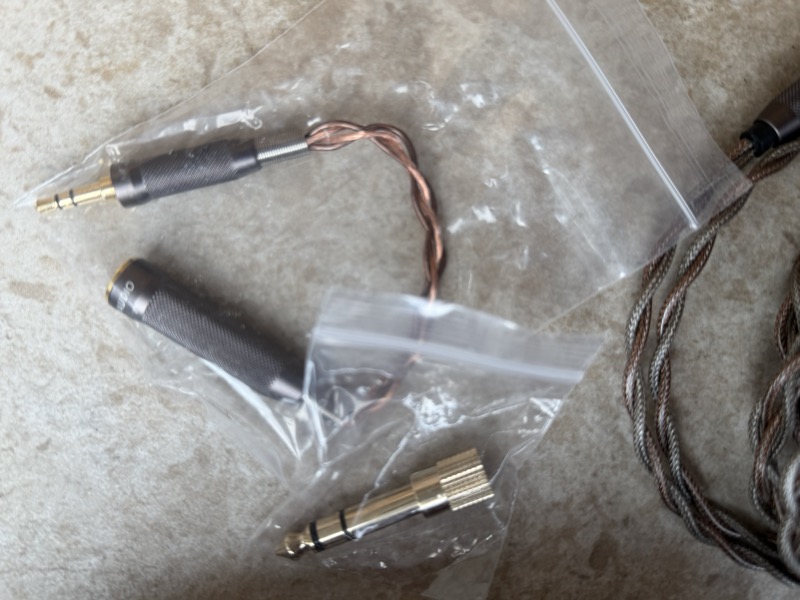
The two adapters ship individually bagged for protection:
The stock cable feels well made, though it is on the heavier side, so worth bearing in mind if you’d want something shorter for portable use. One thing to be aware of is that the earcup sockets are not compatible with every dual-3.5mm cable:
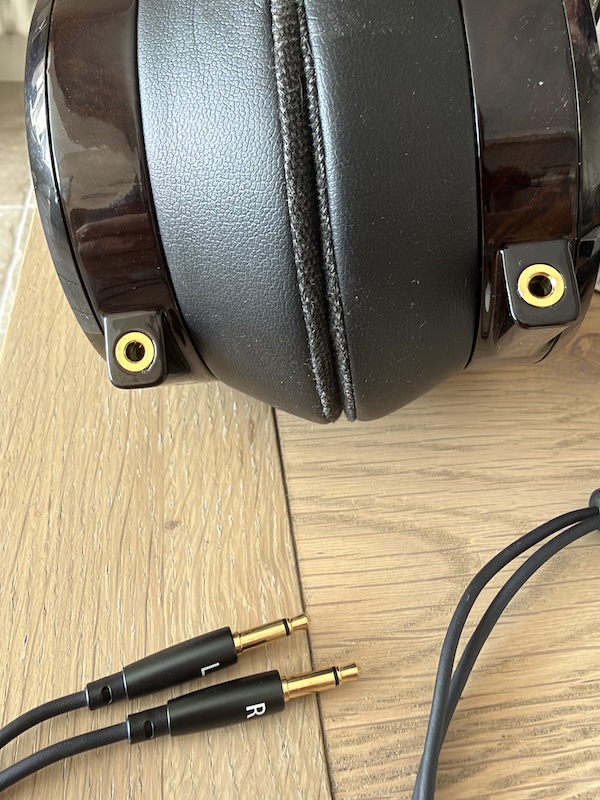
The sockets sit on the underside of each earcup and the plugs are marked L and R, so there is no ambiguity about which goes where. The difference that matters is the plug itself:
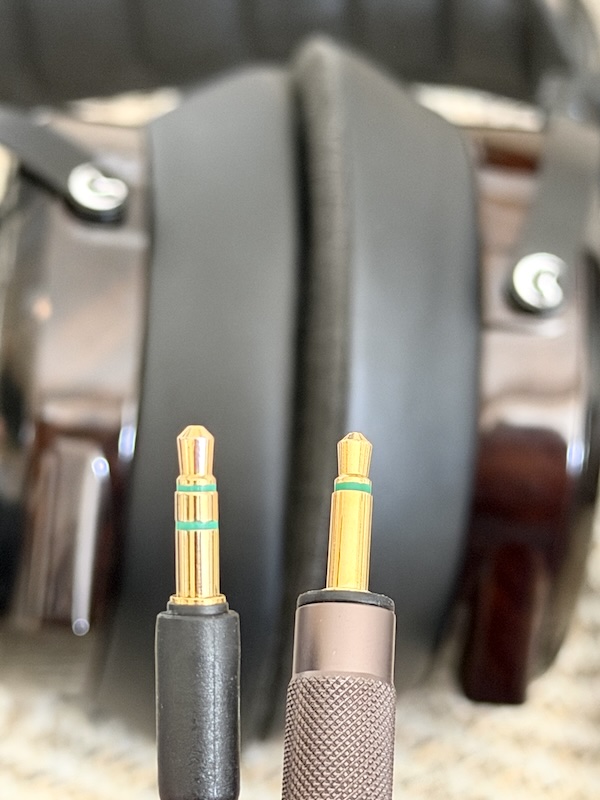
A HiFiMan cable I tried did not work. Sivga’s own single-ring cable did, including the one supplied with the Robin SV021 Pro V2, so make sure any replacement is a compatible one.
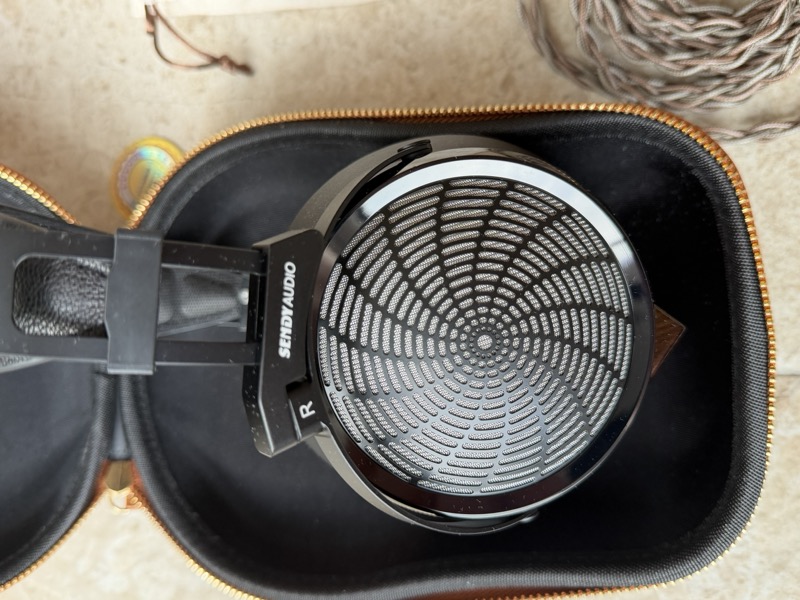
Build quality on the headphone itself is excellent for the price. The earcup grille uses a sunburst metal mesh pattern over the 78mm planar driver, set inside a CNC aviation-aluminium frame:
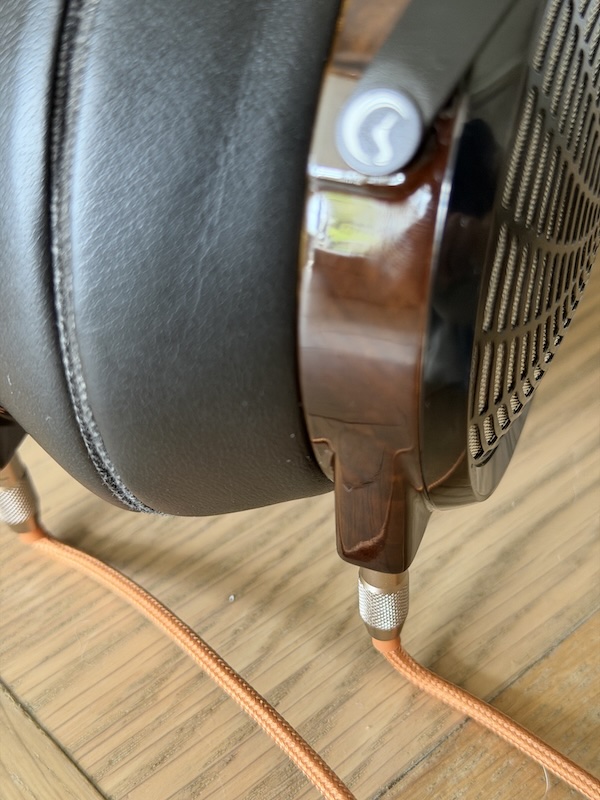
Sivga and Sendy Audio are well known for their gorgeous use of wood, and the zebrawood earcup here is worth a closer look on its own — the high-gloss finish catches the light nicely where the cup meets the CNC aluminium frame:
Fit and Comfort
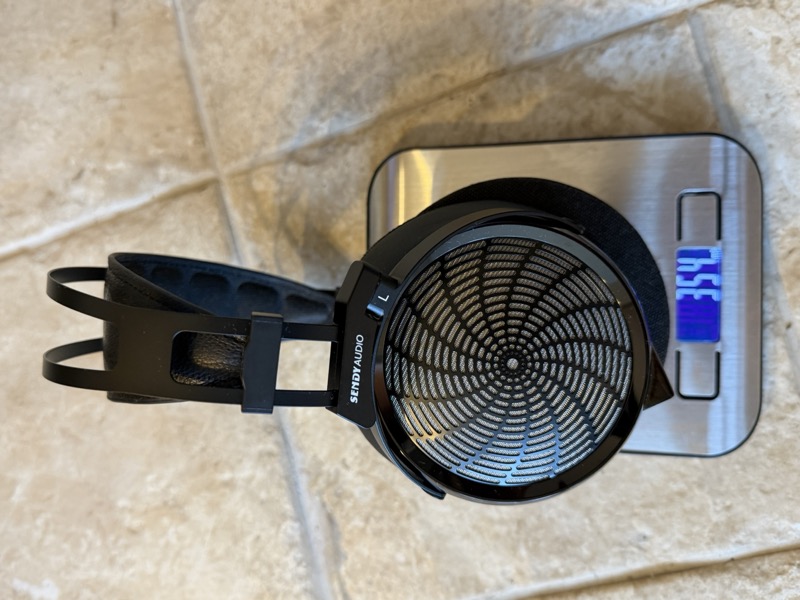
At 354g — confirmed on my own kitchen scale, matching Sendy Audio’s spec exactly — the Apollo Pro carries that weight well: it feels lighter on the head than the number suggests, even with its large earcups, and the comfort is genuinely excellent, arguably the best I’ve experienced from Sendy Audio or Sivga to date:
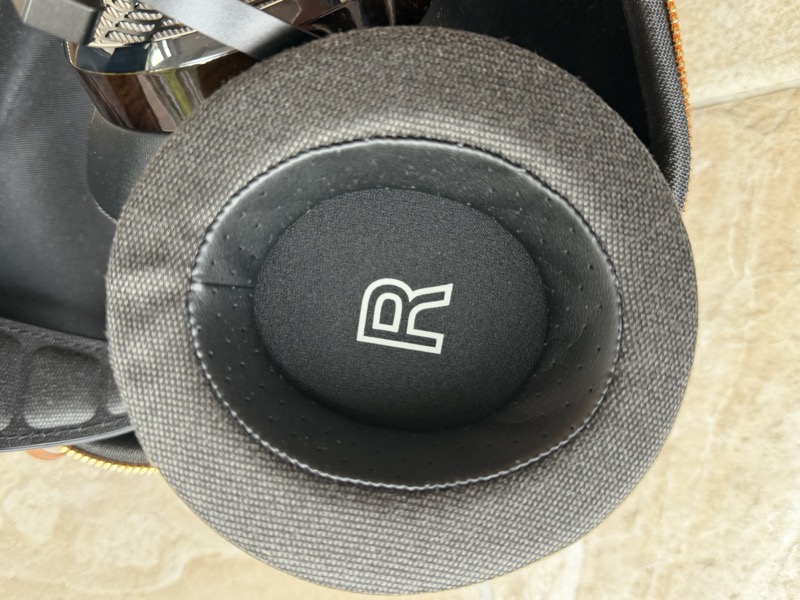
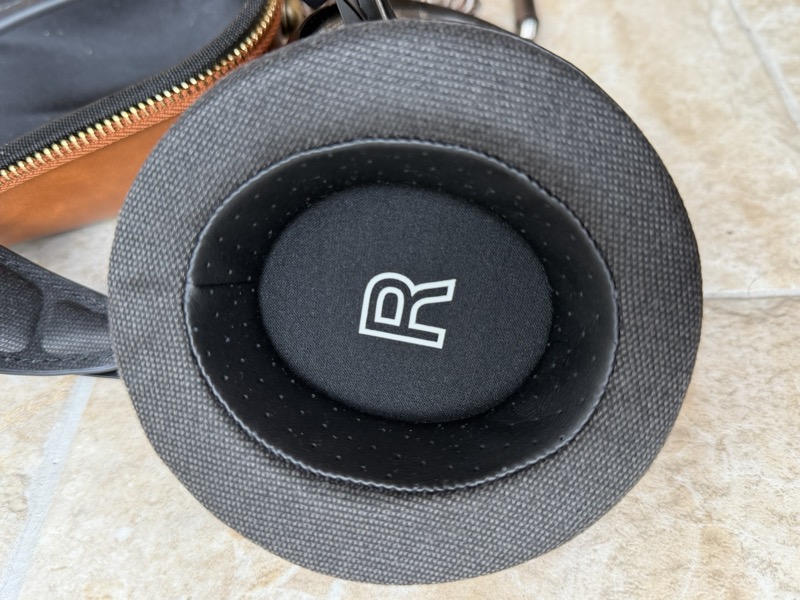
The earpads are breathable velvet with a soft lamb-leather headband, and the depth and softness of the pad cushioning is a real strength — I could happily wear glasses without it meaningfully affecting the bass response, which is not something I can say about most headphones that are this comfortable, where a high clamping pressure is usually needed to keep a good bass seal:
 |
 |
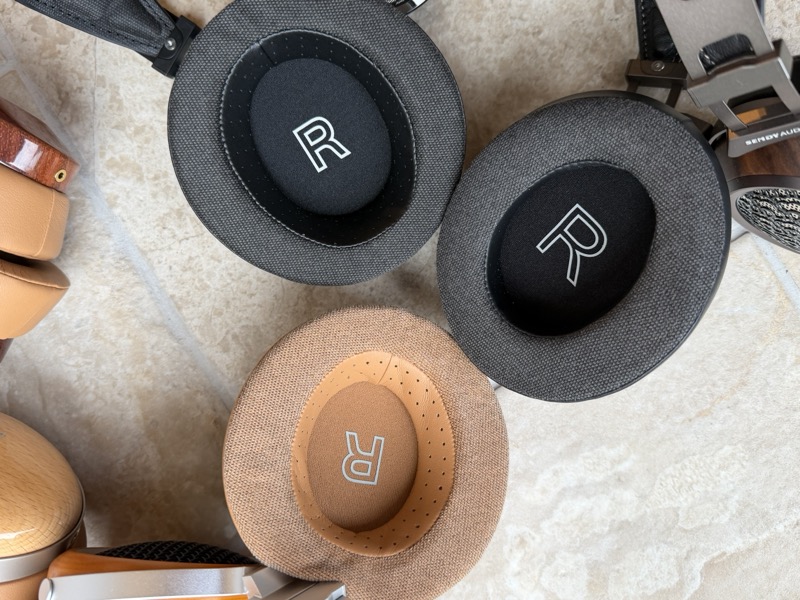
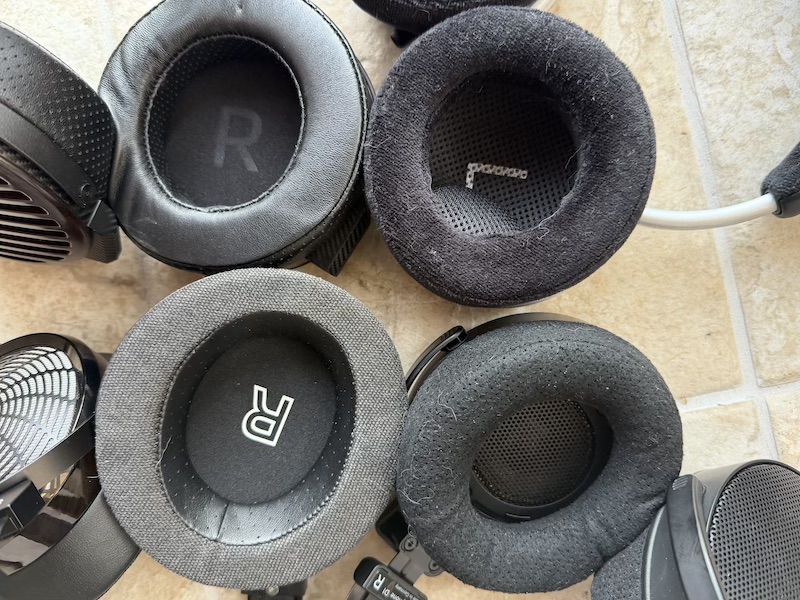
Compared against a few of the other Sivga and Sendy Audio earpads in the collection, you can see they’re similar to the Sivga pads but a little different from the sculpted earpads on the Egret, which are more prone to being affected by a broken seal:
The pad material itself is breathable velvet and does a good job of it, but the exceptionally hot summer we have been having in Europe turned up one caveat: on a genuinely hot day it can still get very warm inside these ultra-comfortable earpads. That is a function of size rather than material — they are large pads covering a lot of your ear and the surrounding side of your head, which is exactly what makes them so comfortable the rest of the year, and on a heatwave afternoon means they work rather like earmuffs. Worth factoring in if you listen for long stretches somewhere without air conditioning.
Sound Impressions
I listened to the Apollo Pro from both my work-from-home desktop setup with a Topping DX5 II, and using the Crinear Protocol Max connected directly to both my iPhone and my MacBook Pro, rotating it against several other planars and against the Egret. The overall character has a bit of that “high-end Meze” warmth to it, paired with a spicier top end than that comparison usually implies, and — thanks to the open design — a touch of that expansive Hifiman presentation. That warmth is really the key aspect of why this headphone might be a guilty pleasure to some, and won’t appeal to others — for me, though I like plenty of different sound signatures, I really liked it: it’s basically a pleasant colouration that should appeal to anyone who likes some of the warmer high-end headphones.
Everything described below is the stock tuning, which is how I listened for the first few weeks and enjoyed it. After that I switched to the three-filter PEQ set out in the measurements section, which trades the warm lower-midrange lift for a firmer bass shelf — and having lived with both, that is where I ended up staying. It is not a correction of a fault so much as a choice between two versions of the same headphone: the stock voicing is the more comfortably indulgent one, the EQ’d version the more even-handed, and which you prefer will come down to how much warmth you want on a long listen rather than which is more accurate.
Bass
The bass is warm without tipping into bloated or muddy territory — nicely controlled for an open-back planar, with enough weight to feel satisfying without ever overstaying its welcome in the mix. On “xanny” by Billie Eilish, the sub-bass has real presence and texture without smearing into the vocal, which sits just above it.
Midrange
The midrange carries that lovely warmth I mentioned, with a natural, inviting quality that never feels thin or clinical. It’s an engaging presentation rather than a strictly neutral one, and it suits vocal-forward material particularly well. On “Fade Into You” by Mazzy Star, the vocal has real body and warmth without ever feeling pushed forward artificially.
Treble
The treble is where the Apollo Pro breaks from that warmth with a genuinely spicy edge — well extended and detailed, but with real energy up top that’s the one area where I’d flag a caveat: some listeners may find it a little hotter than they’d like, particularly coming from a warmer, more relaxed-treble headphone. On “Chocolate Chip Trip” by Tool, the cymbal work and percussion have good detail and air, though on brighter recordings that extra energy is more noticeable.
Soundstage and Imaging
Soundstage is a genuine highlight — I hear a real sense of space, closer to what I’d expect from a Hifiman planar than from most other Sendy Audio or Sivga headphones I’ve used. On “Born, Never Asked” by Laurie Anderson, the instrumental layers spread out well beyond the earcups, with good separation between elements even in a fairly dense mix.
Comparisons
Within Sendy Audio’s own range, the Apollo Pro sits alongside the Egret as one of the two most complete tunings the brand has produced. The Egret leans toward authoritative planar bass and a composed midrange; the Apollo Pro trades a little of that bass authority for a more open, spacious presentation and a warmer overall character. Both are excellent, and the choice between them comes down to whether you prioritise the Egret’s bass weight or the Apollo Pro’s soundstage.
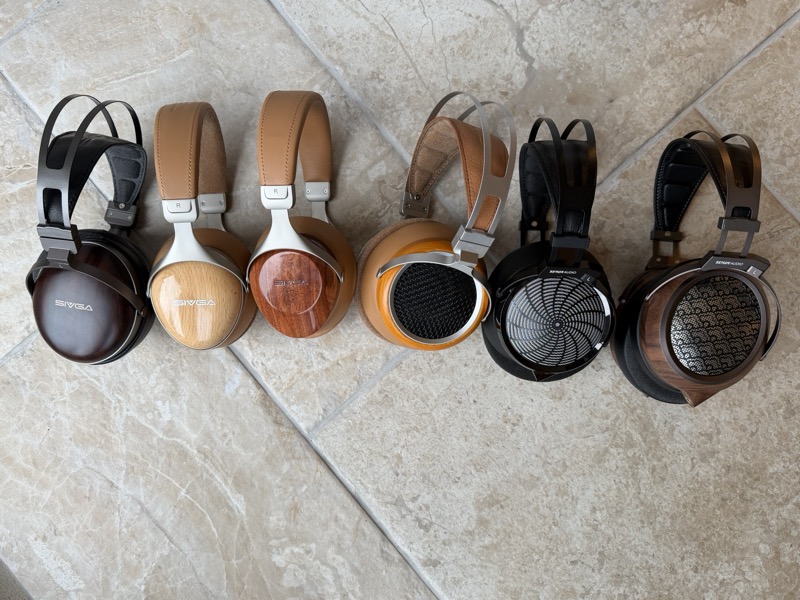
Against the Sivga Luan, the family resemblance in comfort philosophy is obvious — both prioritise exceptionally soft, breathable padding — but the driver technology and tuning are quite different. The Luan’s 50mm dynamic driver has a warm midrange with a brighter treble boost around 15kHz, while I hear a more spacious presentation from the Apollo Pro. I would not put that difference down to planar versus dynamic drivers alone. Pictured together with a wider selection of Sendy Audio and Sivga headphones, the family design language — wood, leather, and metal — is easy to spot across the range:
Against the Sivga Robin SV021 Pro, the comparison is really one of price tier and ambition. The Robin SV021 Pro is an impressive $200 closed-back once EQ’d, but its stock midrange needs that correction to sound its best. The Apollo Pro, at more than double the price, was enjoyable to me before EQ, with a substantially more spacious open-back presentation that I preferred for quiet-room listening.
Against the Sennheiser HD600, the Apollo Pro’s planar driver and warmer tuning make for an interesting contrast with the HD600’s more classically neutral, midrange-forward accuracy. The HD600 remains the more analytically “correct” of the two, but the Apollo Pro’s open, spacious presentation and warmer bass make it the more immediately engaging listen for a lot of music.
Against the Hifiman Edition XV, the comparison is closest in spirit — both are open-back planars in a similar price bracket with a relatively easygoing, non-fatiguing character. The Edition XV’s treble is more deliberately relaxed than the Apollo Pro’s, which makes it the safer choice for treble-sensitive listeners, while the Apollo Pro counters with a touch more warmth through the midrange and a comfort package — that leather case, those earpads — that goes well beyond what Hifiman includes at this price.
Specifications and Measurements
| Specification | Value |
|---|---|
| Style | Open-back, over-ear |
| Driver | 78mm planar magnetic, Nano-Scale composite diaphragm with EB evaporation deposition |
| Frequency response | 20Hz – 40kHz |
| Sensitivity | 93dB ±3dB |
| Impedance | 27Ω ±15% |
| Connector | 4.4mm balanced |
| Weight | 354g (spec); measured 354g |
| Earcups | Zebrawood with CNC aviation-aluminium frame |
| Cable | Triple-composite: Furukawa OFC, silver-plated and gold-plated copper |
| Earpads | Breathable velvet |
| Headband | Soft lamb leather |
| Price | €499 ($449 / £449) |
I had enough volume from the Topping DX5 II and CrinEar Protocol Max used for this review. Sendy Audio’s quoted 93dB sensitivity does not specify a power or voltage reference here, so that number alone cannot establish amplifier requirements.
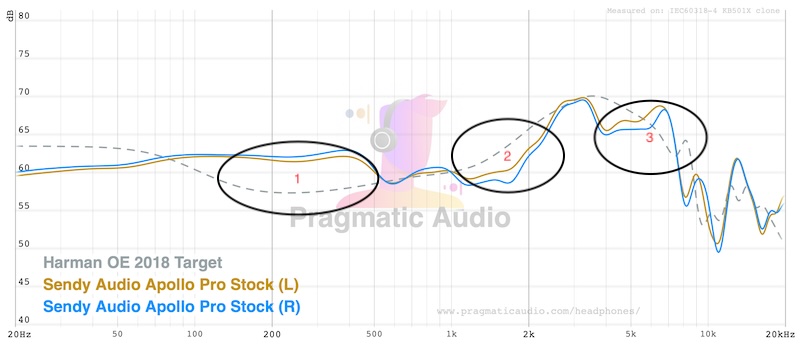
All measurements below were taken on my KB501X Soft Ear/Pinna with a 711 clone coupler. You can also pull the Apollo Pro up directly in the Pragmatic Audio headphone measurement database, where you can compare it against anything else I have measured and apply your own filters. Channel matching between left and right is close, and I’ve marked the three regions that line up with what I heard in listening: (1) the warm lower-midrange lift that’s behind the high-end warmth, (2) a small presence-region dip, and (3) the treble bump that gives the Apollo Pro its spicier top end:
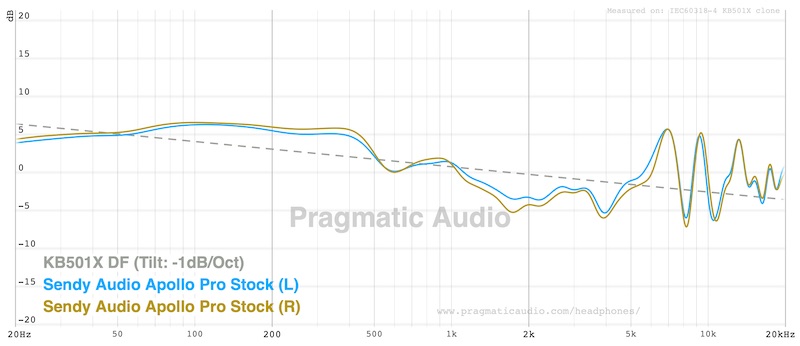
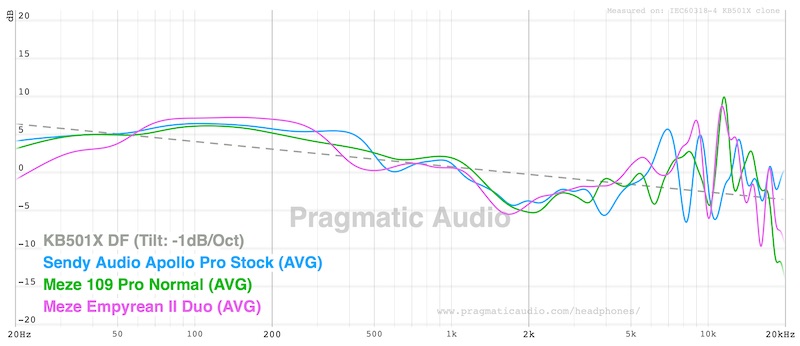
Here’s the same left/right channel data again, this time plotted against the flatter KB501X diffuse-field target rather than the Harman OE 2018 curve used above — useful if you prefer to judge against that reference instead:
How the Apollo Pro Measures Against Other Headphones
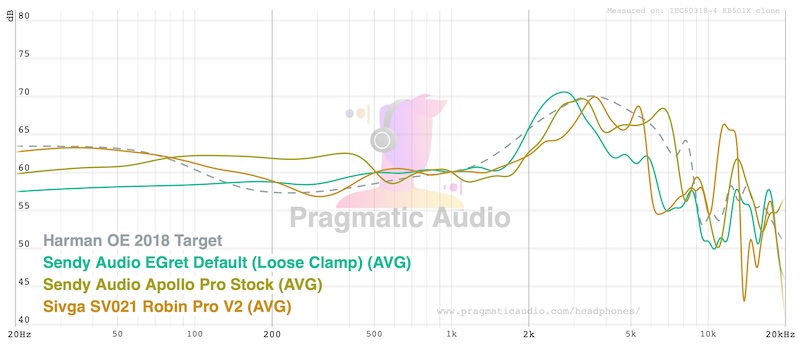
Against the Sendy Audio Egret measured with a loose clamp and the Sivga Robin SV021 Pro V2, the legend identifies the V2 rather than the original Pro. The Apollo Pro has the most energy through much of the lower midrange; the three do not share the same bass shape:
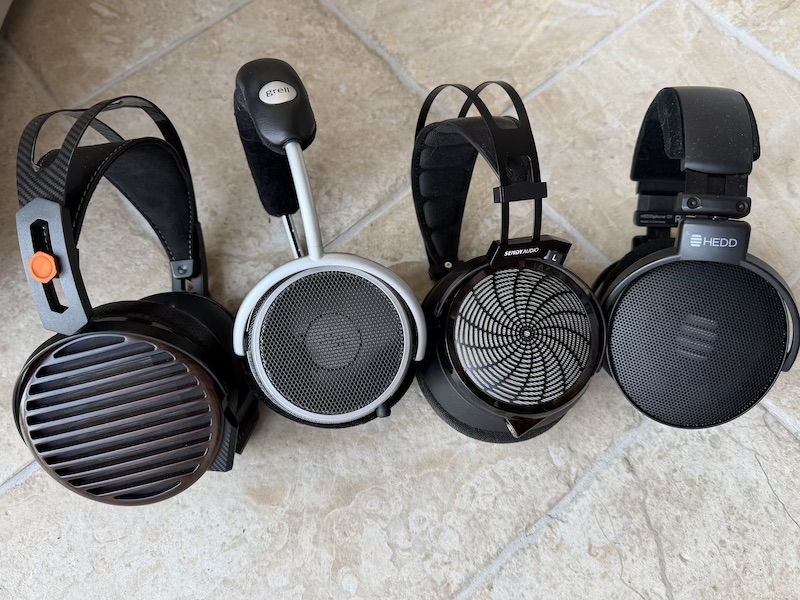
Beyond the Sendy Audio and Sivga family, I also measured the Apollo Pro against a few headphones I’ve reviewed with a similar lovely warmth through the midrange, to put a number on how warm it actually is. First, against the FiiO FT7, the Grell Audio OAE2, and the Hedd Audio HEDDphone D1, pictured here left to right along with the Apollo Pro itself:
 |
 |
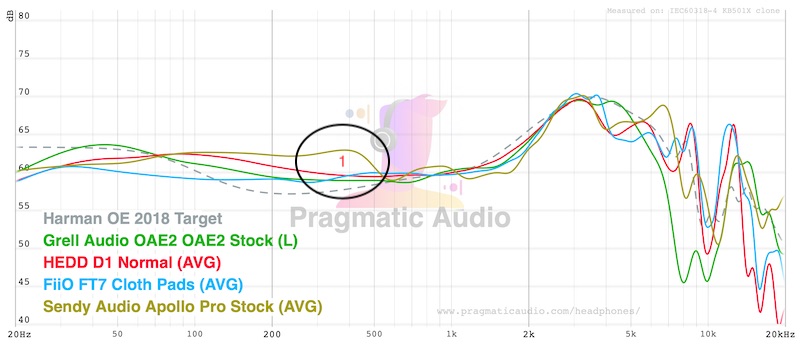
Region (1), marked on the graph, is where the Apollo Pro’s extra warmth actually lives: roughly 200Hz to 800Hz, the upper-bass and lower-midrange, where it sits above the Harman OE 2018 target and above all three of the other headphones here. That lift is what you hear as that high-end warmth.
The Grell Audio OAE2 is the more quality-over-quantity headphone of the two through the bass, and its midrange is the more neutrally balanced of the group — a real strength of that headphone, but it means the Apollo Pro reads noticeably warmer sitting next to it. The FiiO FT7 is the closest of the three in overall shape through this region, tracking the Apollo Pro’s lift for a good stretch before settling into its own excellent, more neutral balance in the pragmatic review of the FT7 — again leaving the Apollo Pro as the warmer of the pair. The HEDD Audio HEDDphone D1 is the outlier here: I’ve called the D1 class-leading for midrange transparency, and next to that reference-flat midrange the Apollo Pro’s warmth is easy to see and hear.
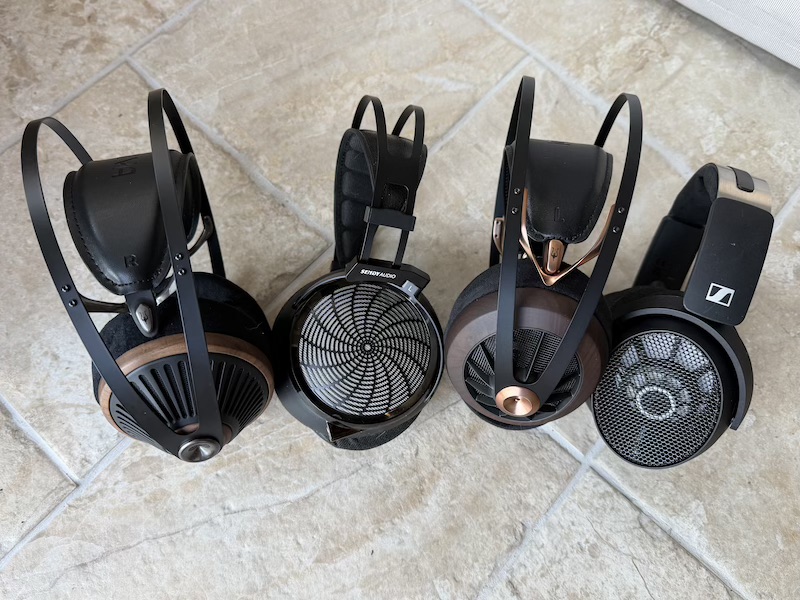
Here are the Meze 105 SILVA, Apollo Pro, Meze 109 Pro and Sennheiser HD490 Pro, from left to right. The graph below compares those models, with Producing pads on the HD490 Pro:
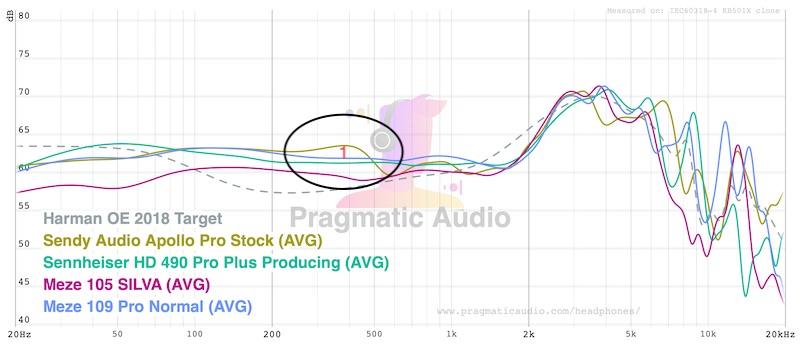
Region (1) marks the same 200Hz–800Hz band as the previous graph, and the Apollo Pro is again the highest line through it — this time against a group specifically chosen for that same lovely warmth, which makes it the clearest demonstration of how warm this headphone actually is.
The Apollo Pro consistently measures as the warmest of the group. The Sennheiser HD490 Pro on its Producing pads leans toward a deep, spacious sound rather than a heavy midbass lift, so it tracks the target more closely through this region than the Apollo Pro does. The Meze 105 SILVA carries some of that familiar Meze mid-bass richness, but doesn’t push it as far as the Apollo Pro does here. The Meze 109 Pro is probably the closest in spirit — Meze’s own description leans on a “full-bodied midbass” — but even there the Apollo Pro’s lift measures as the larger of the two.
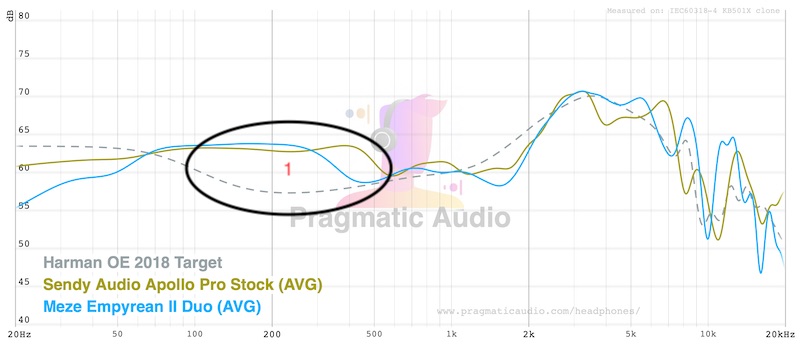
I no longer have a Meze Empyrean II with the Duo earpads to include in this round of measurements, but two earlier measurements are worth adding for reference. The Apollo Pro tracks close to the 109 Pro through that warm lower-midrange region, while the Empyrean II Duo pushes the same region further still:
 |
 |
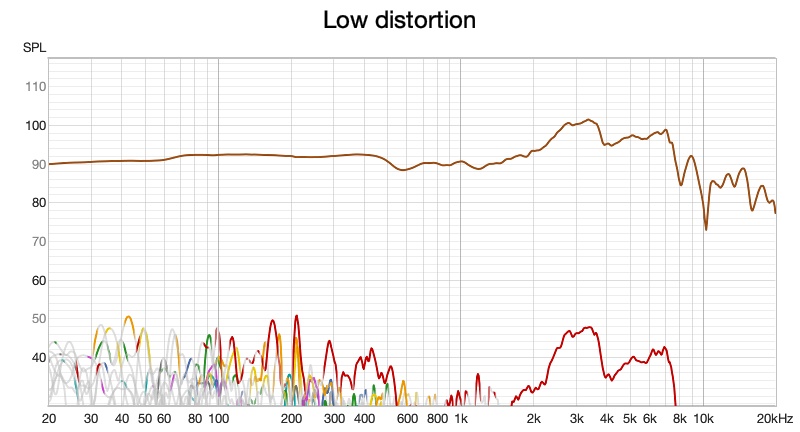
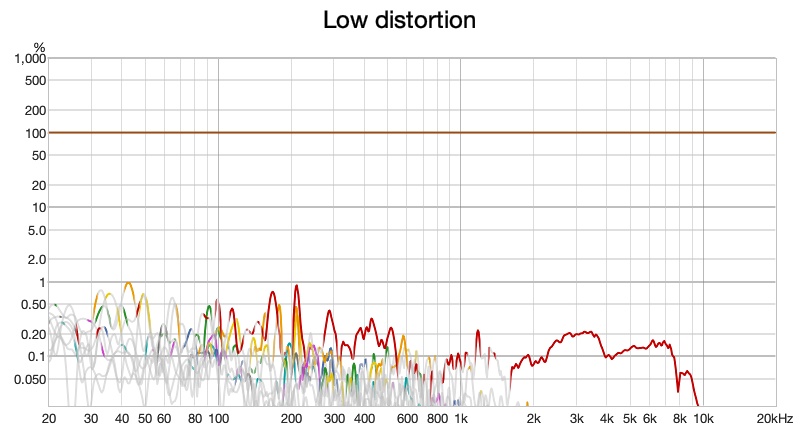
Most harmonic traces remain below 1% in this sweep, although a few narrow low-frequency spikes reach around that level. The fundamental is around 90dB SPL through much of the bass and midrange, rising in the treble:
 |
 |
Suggested PEQ — a firmer bass shelf, and the rest left broadly alone
The warm lower-midrange lift is the defining characteristic of this headphone, and if you like it there is nothing here you need to fix. But if you want the bass to behave more like a conventional Harman-style shelf — weight low down rather than warmth further up — while keeping the Apollo Pro recognisably itself, it turns out to be a small job. Here is the direction, stock in blue against the EQ’d result in green, plotted against Harman OE 2018:
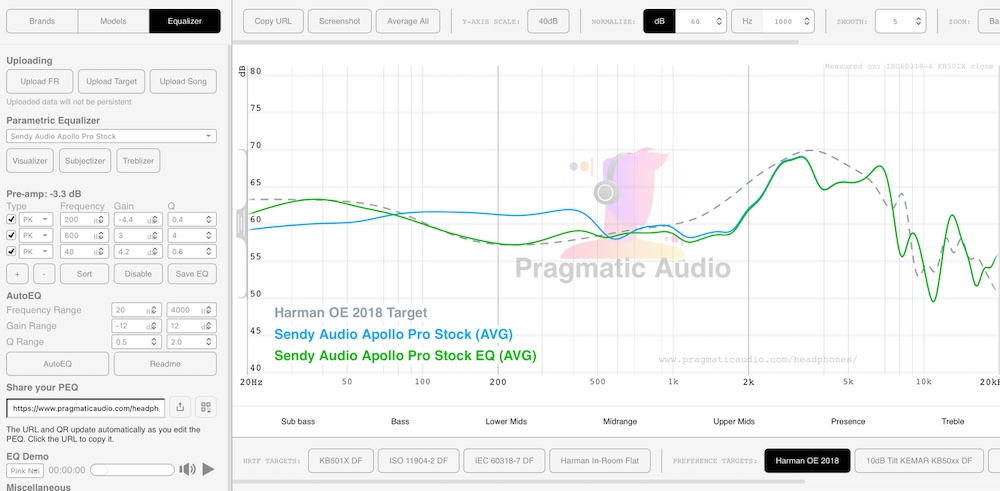
The wide cut at 200 Hz is doing the real work: it pulls down the broad lower-midrange bloom that gives the stock tuning its warmth, and once that comes down the bass reads as weight rather than thickness. The narrow lift at 600 Hz fills the small dip that opens up as a consequence. The third filter is a broad lift centred at 40 Hz, which puts the weight back where a Harman-style shelf wants it, low down, so the net effect is less thickness and more sub-bass rather than simply less bass. The presence region and the treble are left alone.
Three filters and a preamp, which you can apply directly to a supported DAC or dongle here:
A note on why there is no treble filter, because that is a deliberate choice rather than an oversight. It is tempting to point AutoEQ at the treble, since above roughly 5 kHz the measurement shows a series of sharp peaks and deep nulls that look like obvious targets — the null near 10 kHz in particular drops around 10 dB. I would not do it. That region is where a coupler measurement is least representative of what actually happens on a real head: those narrow features move in frequency and depth with pad seal, positioning and individual ear geometry, so a filter chain built to flatten them on this rig can easily make things worse on yours. If you do find the top end too spicy, a broad high shelf of a couple of dB is a more practical starting point than a set of notches — it is one control, it is less dependent on the exact location of a narrow peak, and you can set it by ear from there.
Rating Explanation
The Pragmatic Rating of 5 reflects how much I enjoyed the warm tuning and soft pads. It is a personal favourite alongside the Egret. The Price Rating of 5 also takes the carrying case, wood finish and supplied adapters into account. The caveats remain the bright treble, pad warmth in hot weather and replacement-cable compatibility; the high score does not make those disappear.
The Features Rating of 4 reflects an accessory package that is generous rather than exhaustive: you get one cable, terminated in 4.4mm balanced, and rely on the two supplied adapters for anything else, where some rivals at this level ship a second cable with a different termination. The Measurements Rating of 4 reflects a nicely controlled response that leans a little warmer than some listeners will prefer, without ever becoming bloated or muddy — a deliberate tuning choice rather than a flaw, but one that keeps this just short of a 5 for anyone chasing strict neutrality.
This one is for anyone who wants an open, spacious planar sound with exceptional comfort, and who doesn’t mind a distinctive look in exchange for one of the most complete packages Sendy Audio currently offers.
Conclusion
The Apollo Pro is probably my favourite Sendy Audio or Sivga headphone so far. The warm, bright tuning is not as linear as the Egret, but it is a fun, detailed, open sounding headphone that is incredibly comfortable. The optional EQ gives me a more even balance when I want it, and it suits quiet-room listening where isolation does not matter. If you dislike warmth or are sensitive to bright treble, audition it before buying.
If you want a high-end headphone at much less than high-end cost, the Apollo Pro should definitely be on your list to try. It has been an absolute pleasure to listen to over the past three months.