VE Monk GTR
Player One, Plug In
A USB-C flat-head earbud from Venture Electronics with the Odyssey Retro DAC built into the cable
The Monk GTR, short for “GT-Retro”, is the flat-head Monk from Venture Electronics (VE) aimed at retro handheld gaming. Many current handhelds have dropped the 3.5mm jack, so VE have put a USB DAC they call the “Odyssey Retro” in the earbud cable, and they pitch it with 90s nostalgia, though in practical terms it means the earbud plugs straight into a USB-C handheld (the USB-C version costs under $10).
I have reviewed VE’s Megatron DAC/amp and the Vanguard headphone before, and the GTR arrived together with its sibling the Monk GTS, which has the same shell and a different DAC. Hearing the two side by side was the main reason I wanted to review both.

I would like to thank Venture Electronics (VE) for providing the Monk GTR for the purposes of this review.
If you are interested in finding more information about this product, you can find it at VE’s official product page, and on VE’s AliExpress store.
As of 5 October 2026, the USB-C Monk GTR costs $9.98 on VE’s own store (before shipping) and €11.55 including VAT on VE’s AliExpress store. The 3.5mm version bundled with a separate Odyssey R DAC dongle costs $12.98 or €14.99. Both versions come in Aperture Black (a sparkle finish) or PS Silver. The unit reviewed here is the Aperture Black USB-C version.
The GTR is a Monk SL shell flat-head with a 14.8mm driver and a DAC/amp in the cable, and nothing more is needed to use it. It is the warm, bass-heavy one of the pair, because where the GTS is lean and controlled the GTR has real low-end weight, an exceptionally good midrange and a slightly restrained treble that never turned sibilant on me.
I wore it for a few days of work, plugged in from morning to evening, and mostly forgot it was there. The bass is sometimes more than I want, and the GTR’s DAC cannot be adjusted with DevicePEQ the way the GTS’s can, so the fix has to come from the source. But first, let’s take a look at what is in the pouch.
Unboxing and Build Quality
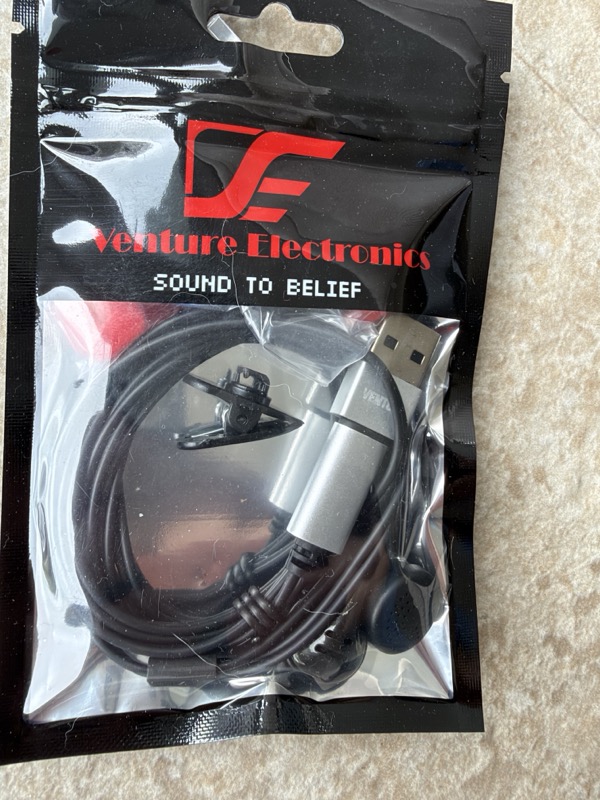
The GTR comes in the same resealable black foil pouch as other Monks, with a window showing the black cable, the USB plug and the shirt clip:
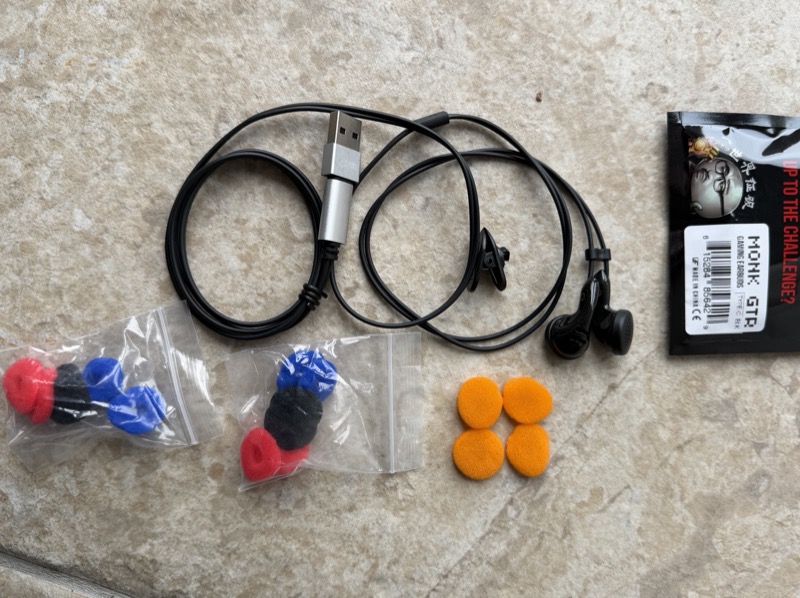
Here are the contents laid out next to the pouch (the label reads “MONK GTR GAMING EARBUDS”):
- Monk GTR earbuds with the fixed USB-C cable
- A USB-C to USB-A adapter, fitted to the plug
- Foam covers in several colours: donut foams in red, black and blue, plus four orange full-cover foams
- A shirt clip
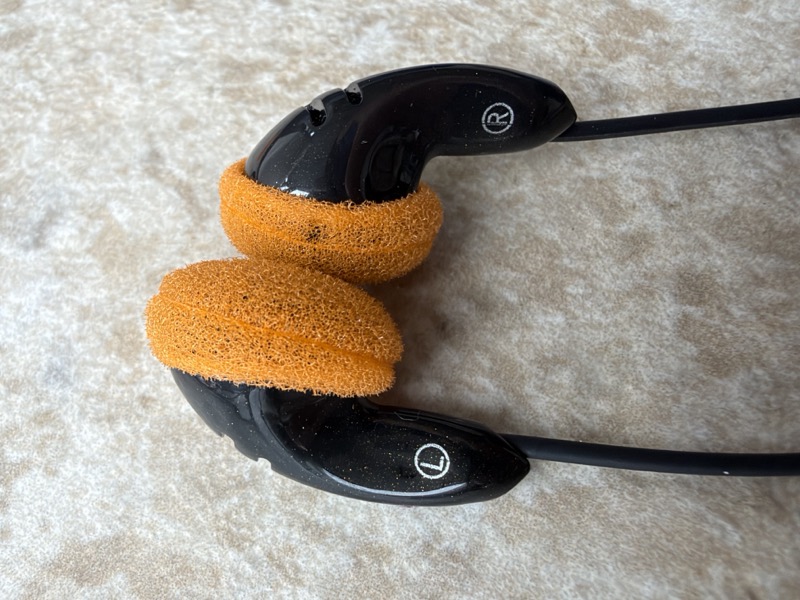
The orange foams are the full-cover type, which sits over the whole front of the shell:

The Aperture Black finish is glossy black plastic with gold sparkle flecks in it, and you can see them clearly up close:
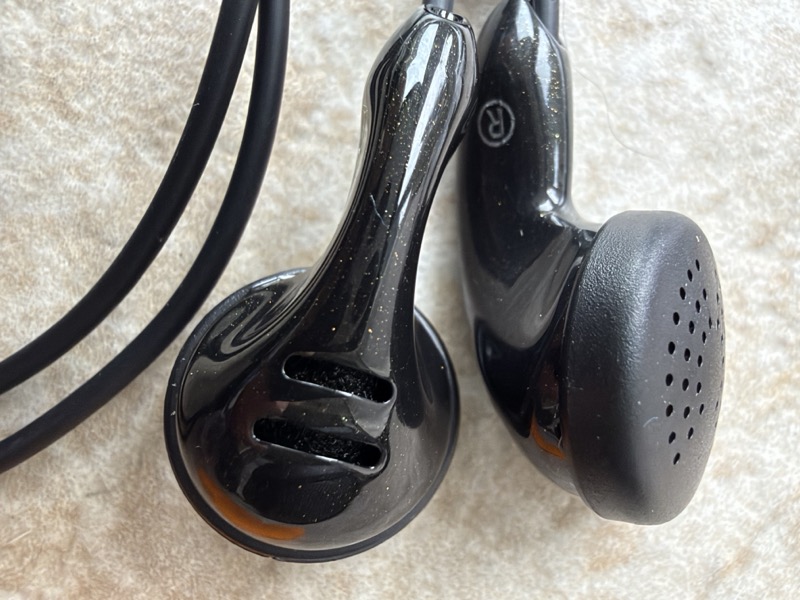
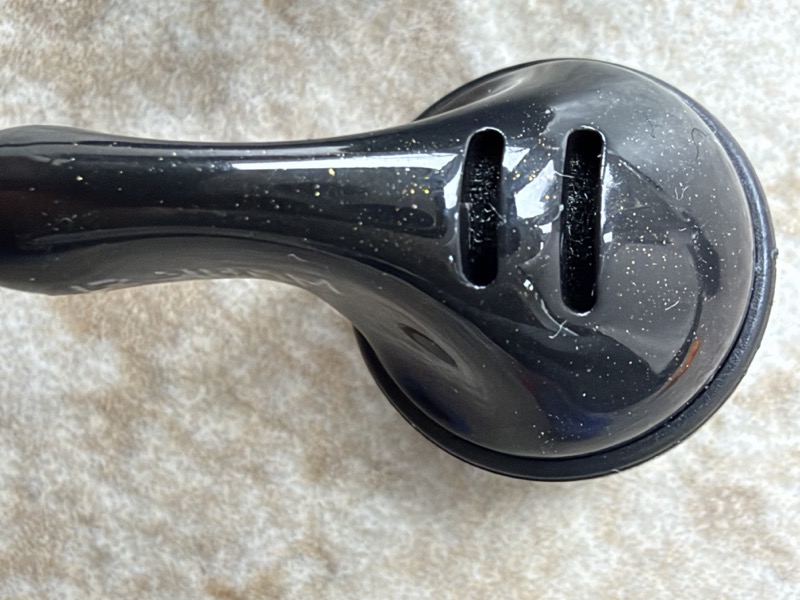
The two earbuds share the Monk SL shell, with “MONK SL” printed along the stem and twin vent slots on the rear:
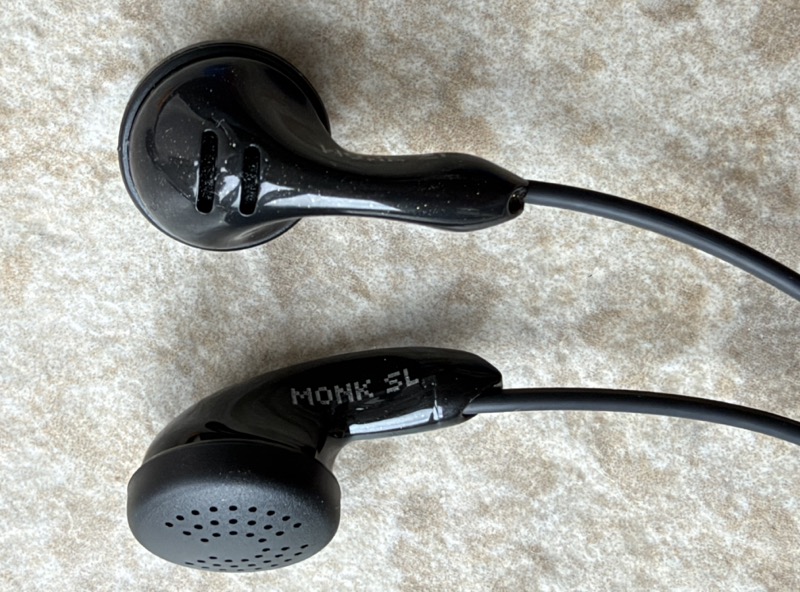
Here is one earbud from behind, showing the vent slots up close:
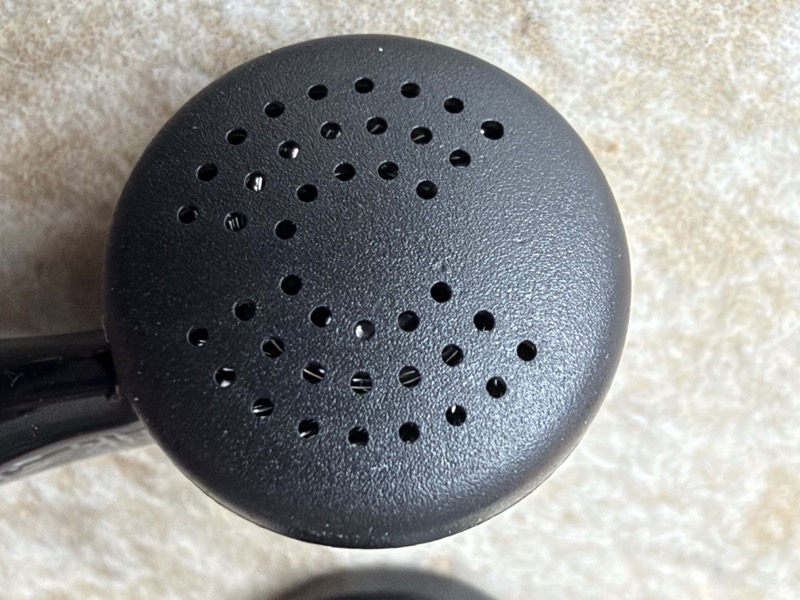
Without foam, the front is a matte black cover with a ring of small holes over the 14.8mm driver:
The L and R markings are printed in white circles on the outside of each stem, and here they are with the orange foams fitted:
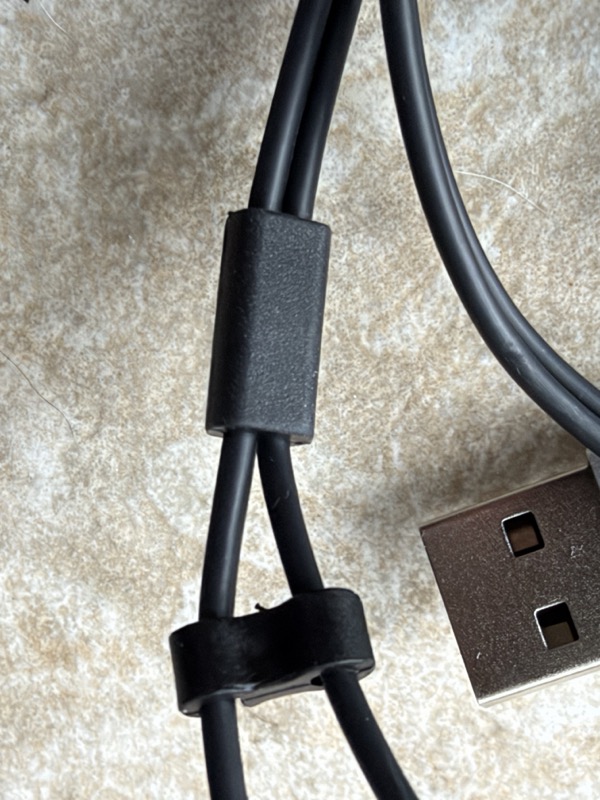
The cable is black TPE (VE call it an “imported A-TPE composite insulation jacket”), with a moulded Y-splitter and a cable slider, and the USB-A adapter is visible on the plug in this shot:
The DAC sits in a brushed aluminium USB-C plug, the same style of housing as on the GTS:
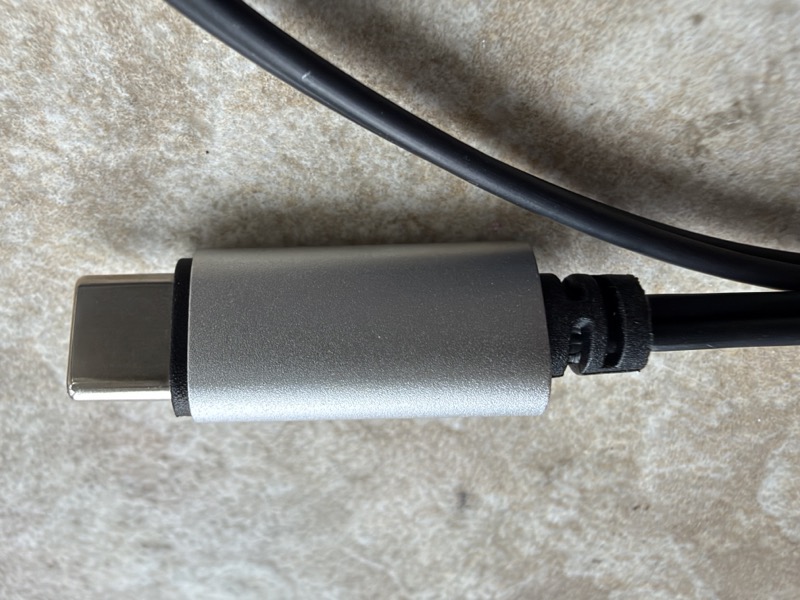
There is no inline microphone on this GTR. VE’s listings mention a mic version, but none of the editions currently on sale has one, so if you need a mic for voice chat the GTS is the one that has it.
Fit and Comfort
VE say the GTR has an “improved front cover mold for a smoother, more comfortable fit”, and I was interested to find out. Nothing presses into the ear canal, though isolation is close to none, and how well it fits depends on the shape of your outer ear since there are no tips to swap.
This is the best thing about earbuds for me. Once the GTR is in I forget I am wearing it, and I wore it through whole working days, with the cable staying out of the way (the one thing that usually spoils a long session with a wired earbud). The foams did not change the fit much, but they are what I would leave on, for a reason that belongs in the sound section.
Sound Impressions
My listening was a few days of work-day sessions with the GTR plugged straight in, with foams fitted. The foam colours do not sound different from each other, but having any foam on tames the treble a little, so I would use them.
The GTR is the warmer and bassier of VE’s two GT earbuds, and overall it is probably the better tuned of the two Monk open earbuds, mainly because you get a huge amount of bass. I think more people will like its sound than the GTS’s. A flat-head earbud rests in the outer ear without sealing, so how much bass you hear depends on how closely the shell sits against your ear, and the GTR has enough low end to make up for that, and then some.
Bass
There is a huge amount of bass here, and it is decent quality, with more low-end weight than most earbuds manage. On some tracks it becomes boomy though, and the warmth carries up into the lower midrange, which thickens the sound when a recording is already bass-heavy. Next to the GTS the GTR has too much where the GTS has too little, and neither is wrong, they are aimed at different listeners. The mid-bass is the part that is too much, which is an easy fix with PEQ, and even if you did not want to use PEQ that mid-bass warmth can be just what certain listeners want in their open earbuds. I prefer this tuning to the rolled-off sub-bass of the GTS, and it works especially well for certain genres of music like classic rock or the blues.
Midrange
The midrange is also pretty good on the GTR, but the boosted bass does mean you do not get a sense of balance from the overall tuning. It carries the warmth of VE’s “warm 90s analog tuning” line, and this is where the GTR sounded the more natural of the two earbuds to me.
Treble
The treble is a little restrained, but it is still enjoyable, with plenty of detail for most of my listening. More importantly it is not sibilant, which is the usual problem with earbuds, because depending on how a flat-head sits in your ear it can let through more treble than it should even with foams fitted, but the GTR never did that to me.
Soundstage and Imaging
This is the other thing I love about earbuds, how wide and open they sound. The GTR is not an HD800S, but because nothing seals your ear you still get a pleasant out-of-head presentation that IEMs rarely manage.
EQ
VE do not name the chip inside the GTR’s Odyssey Retro DAC and only say it is 16-bit. My DevicePEQ tool could detect and adjust the GTS’s DAC, but not the GTR’s, so the GTR’s tuning is fixed in the cable.
That matters because the GTR responds very well to a small EQ change. Pulling down the region from roughly 100Hz to 1kHz takes out the boom and the extra warmth, which restores the balance, and what is left is a very satisfying sound signature and an exceptional earbud with deep bass, a detailed sound and still no sibilance. Without hardware EQ you have to apply that cut on the source, in a player app or a system-wide EQ, which is easy on a PC or phone and often impossible on a handheld.
Comparisons
VE Monk GTS
The Monk GTS is the GTR’s sibling, with the same Monk SL shell, 14.8mm driver, 28 Ω impedance and 123 dB sensitivity but a different DAC in the cable, VE’s 32-bit Odo+ in place of the 16-bit Odyssey Retro. The GTS is sold only as USB-C, every edition has an inline mic, and it costs $13.98 or €15.68. Here are the two together, the GTR in black with orange foams and the GTS in white with blue foams:
 |
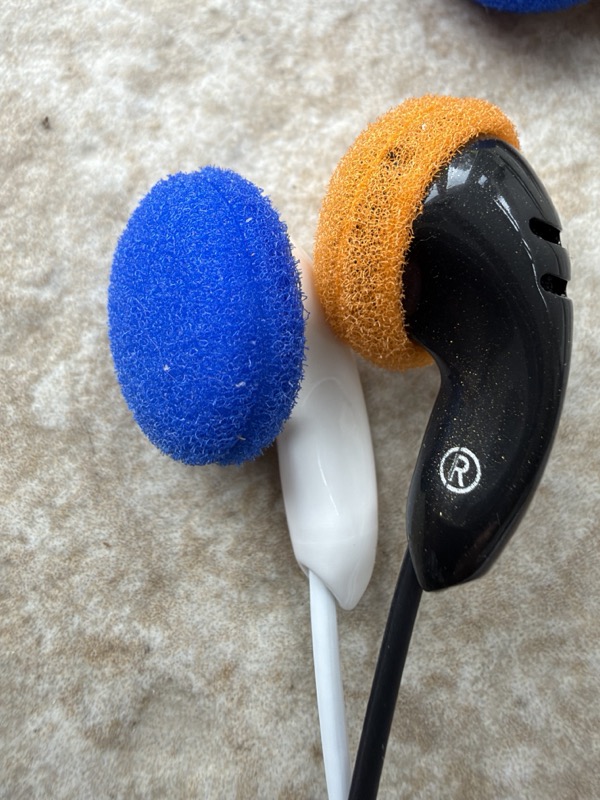 |
The difference between them is almost entirely in the bass and lower midrange. The GTR has more of both than I want on bass-heavy tracks and the GTS has less than it needs without EQ, while the midrange quality, treble and open, out-of-head presentation are close. The GTS has the inline mic and an EQ that DevicePEQ can reach, and the GTR is cheaper, sounds more natural to me out of the box, and is the only one VE sell as a plain 3.5mm earbud with a separate dongle. If I had to choose one without EQ I would pick the GTR, because I like some bass and it sounded the more natural of the two.
Sivga M260
The Sivga M260 is a flat-head with a USB-C option that costs much more. At $45 for the USB-C version you get machined metal shells, a detachable MMCX cable, a Realtek ALC5686 DAC in the plug and an inline remote, while the GTR costs less than a quarter of that, with plastic shells and a fixed cable. If money were no object I would pick the M260 and add some EQ to it, but for an earbud that lives in a bag or a handheld’s carry case the GTR’s price makes more sense.
Moondrop U-2
The Moondrop U-2 is a $34.99 flat-head with a 14.8mm driver, the same size as the GTR’s, and a 3.5mm single-ended plug, so it needs a source with a jack or a separate dongle. The GTR has its DAC built in and costs under a third as much.
Specifications and Measurements
| Specification | Value |
|---|---|
| Type | Flat-head (open) earbud, Monk SL plastic shell |
| Driver | 14.8mm dynamic |
| Shell diameter | 16.4mm |
| Impedance | 28 Ω |
| Sensitivity | 123 dB (1mW) |
| Frequency range | 20Hz to 20kHz (+/-10 dB) |
| Rated power | 1200 mW |
| Cable | Fixed, 1.2m (+/-2cm) |
| Connector | USB-C with built-in Odyssey Retro DAC, or 3.5mm single-ended plus an Odyssey R dongle |
| DAC chip | Not stated by VE (VE say 16-bit) |
| Compatibility (VE) | Switch, PS4, PS5, iOS, Android, macOS, Linux, Windows (standard USB audio) |
| Price | $9.98 / €11.55 (USB-C); $12.98 / €14.99 (3.5mm + Odyssey R) |
VE publish no frequency response or distortion measurements for the GTR, and no output or noise figures for the Odyssey Retro or Odyssey R DAC.
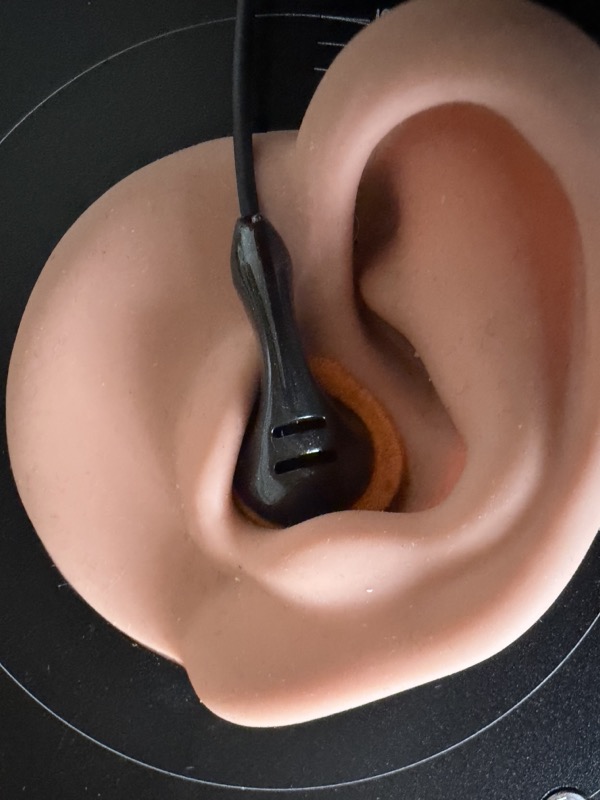
I measured the GTR on my KB501X Soft Ear/Pinna with a 711 clone coupler:
Here is the GTR (red) against the GTS (green), with the Harman target and the JM-1 target for reference:
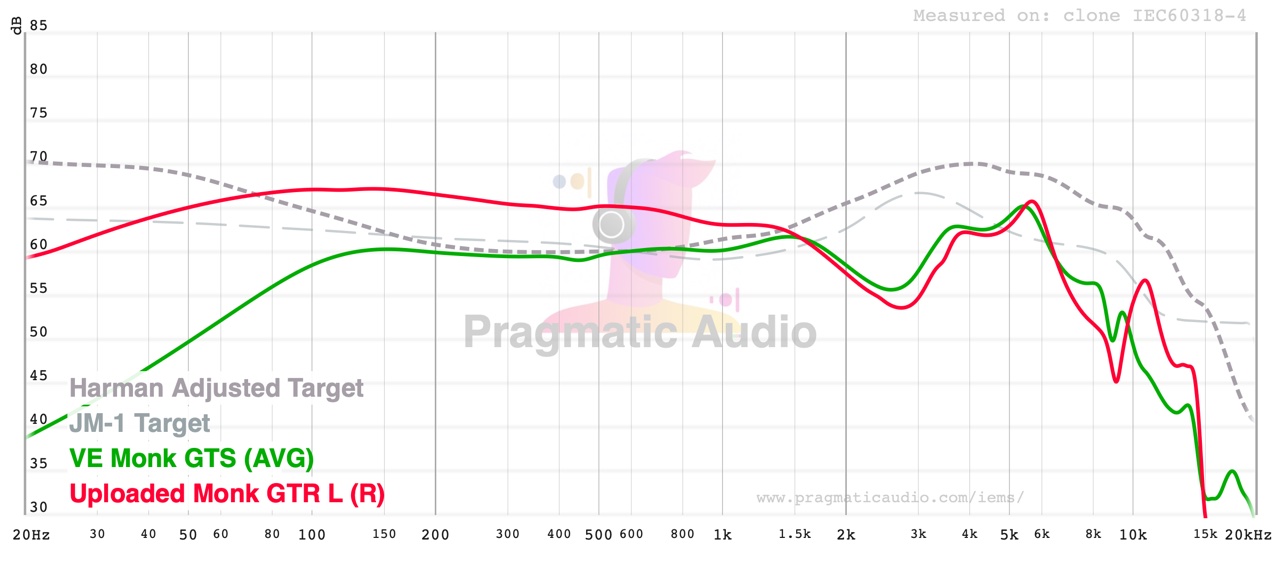
The graph explains what I heard. Below about 1kHz the GTR sits 3 to 7dB above the GTS, and it holds its bass down to around 50Hz where the GTS starts rolling off steeply below 150Hz, so that broad lift from 100Hz to 1kHz is the boom and the extra warmth, and exactly the region I would pull down with EQ. Above 1.5kHz the two are close, with both dipping around 2.5 to 3kHz (the GTR a little deeper, which is why its treble sounds restrained rather than sharp) and both peaking near 5.5kHz before falling away. Flat-head measurements depend heavily on how the shell sits on the pinna, so treat the treble detail as indicative rather than exact. The left and right channel measurements are in my IEM graph tool if you want to compare the GTR against other earbuds and IEMs.
The left (L) and right (R) channels of the GTR measured on the same coupler, with the Harman Adjusted and JM-1 targets for reference, are:
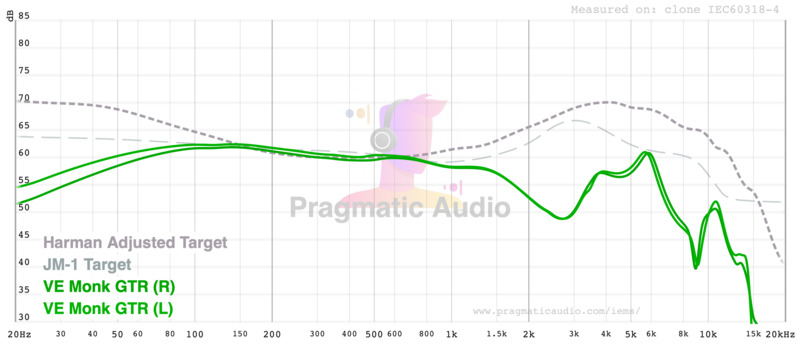
The two channels track each other closely through the midrange and treble, with the largest differences in the low bass, where one channel sits a few dB above the other below about 100Hz, and around 10 to 12kHz. Earbud measurements depend on how the shell sits on the pinna, so differences like this are not surprising.
The distortion graph with the fundamental and harmonics plotted in SPL (titled ‘No distortion worth worrying about’) is:
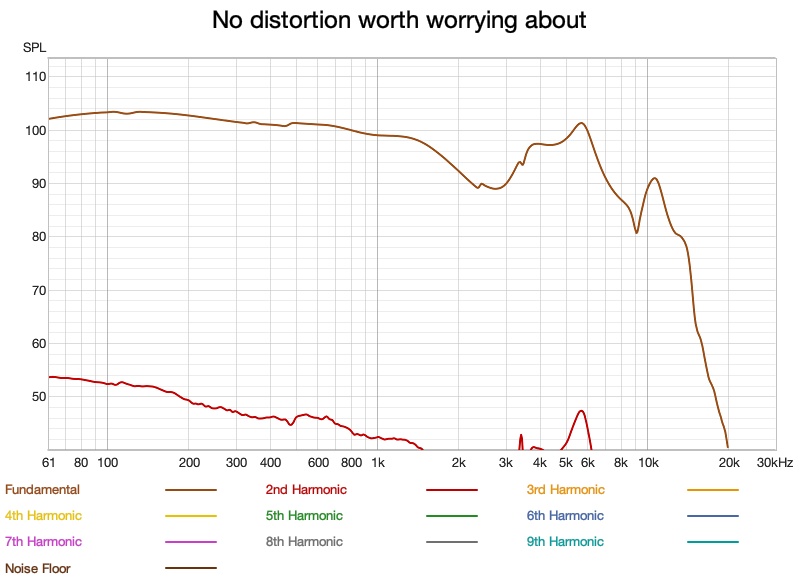
The 2nd harmonic is the only one that shows up. It is about 54dB at 60Hz where the fundamental is about 102dB, so roughly 48dB below it, and it falls to about 42dB around 1kHz, roughly 57dB below. It rises again to about 47dB near 5.5kHz.
The same measurement with the axis in percent is:
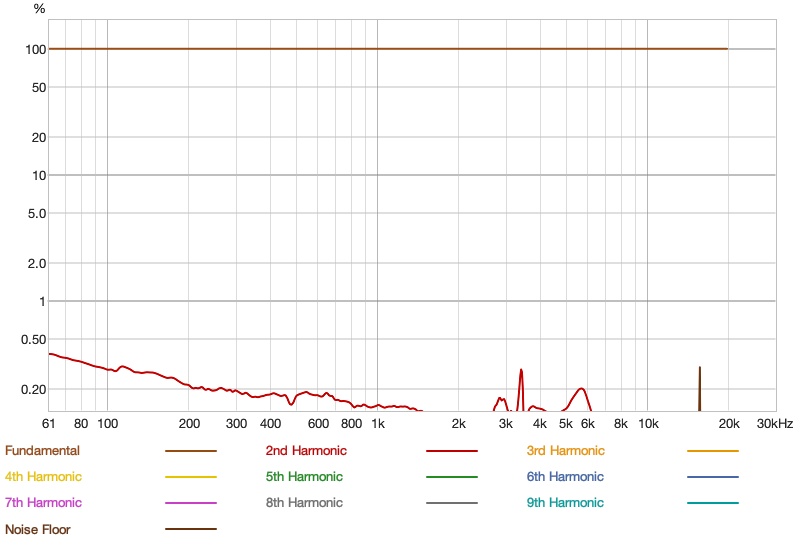
In percent that is about 0.4% at 61Hz, falling to about 0.15% by 1kHz, with small spikes of roughly 0.3% near 3.4kHz and 0.2% around 5 to 6kHz. All of it is well under 1%.
Rating Explanation
Five for pragmatic, even with the boomy bass, because for under $10 you get an earbud with an exceptionally good midrange, real bass, no sibilance and its own DAC, and it is comfortable enough to wear all day. Five for price, because that combination at $9.98 is hard to argue with. Four for features, as the DAC in the cable and the USB-A adapter are useful, but there is no inline mic and the DAC does not work with DevicePEQ, both of which the GTS has. Four for measurements, because the response is good for an earbud without being outstanding, and the extra 100Hz to 1kHz energy shows up clearly on the graph.
Buy it if you want a cheap, warm earbud to throw in a bag or plug into a USB-C device. Skip it if you are sensitive to boomy bass and cannot apply EQ on your source.
Conclusion
The GTR is the cheapest way into VE’s GT series, and you plug it into a USB-C device and it works, with no dongle to lose. It also sounds good for the money, with the midrange the highlight, the treble staying clean and the open presentation that makes earbuds so easy to live with all there.
The catch is the bass. There is a lot of it, and on bass-heavy tracks it gets boomy and spills into the lower midrange. A small EQ cut between 100Hz and 1kHz fixes that and turns the GTR into an exceptional earbud, but you have to do it on the source because, unlike the GTS, its DAC cannot be adjusted with DevicePEQ.
Between the two, the GTR is the one I would buy, as a cheap backup earbud for the bag, though I already have more audio gear than I need. If you want lean, controlled bass and EQ in the cable get the GTS instead, and if you want an earbud that sounds warm and full straight out of the pouch, the GTR is the one to get.