Kaiser Atelier Marvicon
A classic C-IEM from Kaiser Atelier
The Marvicon is the other CIEM from Kaiser Atelier. Compared to the newer ZenCarb it is a more ’traditional’ CIEM design, but it is still a very interesting product and one I have also been enjoying for the past few months. It was their first product, released in 2024, with a carbon fibre shell and one dynamic driver plus one electrostatic driver per side. Kaiser Atelier list it at 5,488 RMB, about US$800, against 20,000 RMB, about US$3,000, for the ZenCarb.
I was mainly reviewing and listening to the ZenCarb, but when Kaiser Atelier also offered to make the Marvicon for my specific ear mold, I thought this would be another exceptional opportunity to spend time with the more classic ‘old school’ CIEM design, which gives a lovely contrast with it. Since I also enjoyed it, I felt it deserves its own smaller review.
I would like to thank Kaiser Atelier for providing the Marvicon for the purposes of this review.
Kaiser Atelier does not have an international website yet, and their official website is still under construction. The Marvicon is sold through the Kaiser Atelier Taobao shop, which was always accessible when I checked but may not be accessible worldwide. According to Kaiser Atelier, a worldwide store will be available really soon. The price they give is 5,488 RMB, about US$800. They also post a lot of information on their Xiaohongshu (RED) profile.
I have been using the Marvicon for about 3 months, mainly as a contrast with the ZenCarb. Mine is the custom version, made from the same ear impressions I sent for the ZenCarb (the audiologist and the jaw position are covered in that review, so I won’t repeat them here).
Unboxing
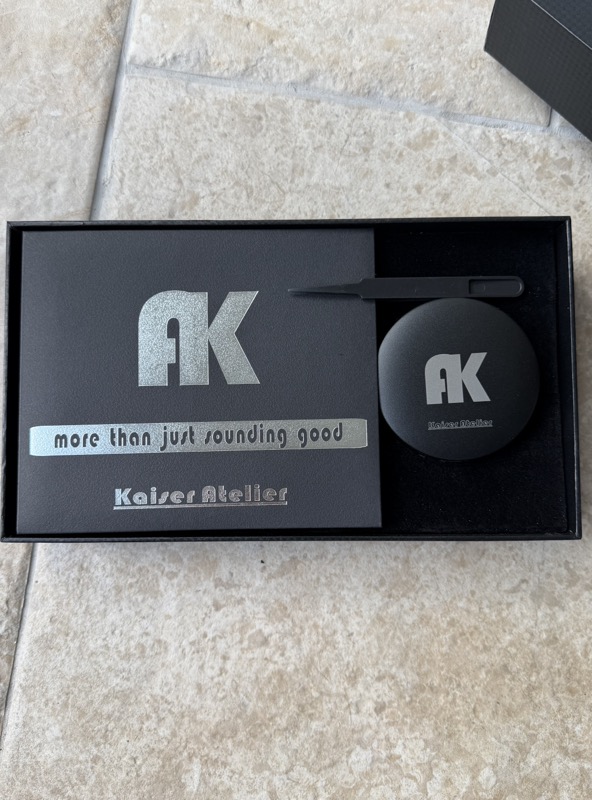
The box is a plain black slipcase with the AK monogram on the lid. Inside are the IEMs, a braided cable, a round machined metal case, a cleaning cloth, tweezers and a printed card:
 |
 |
Here are the IEMs, the cable and the carry case seated in the presentation box:
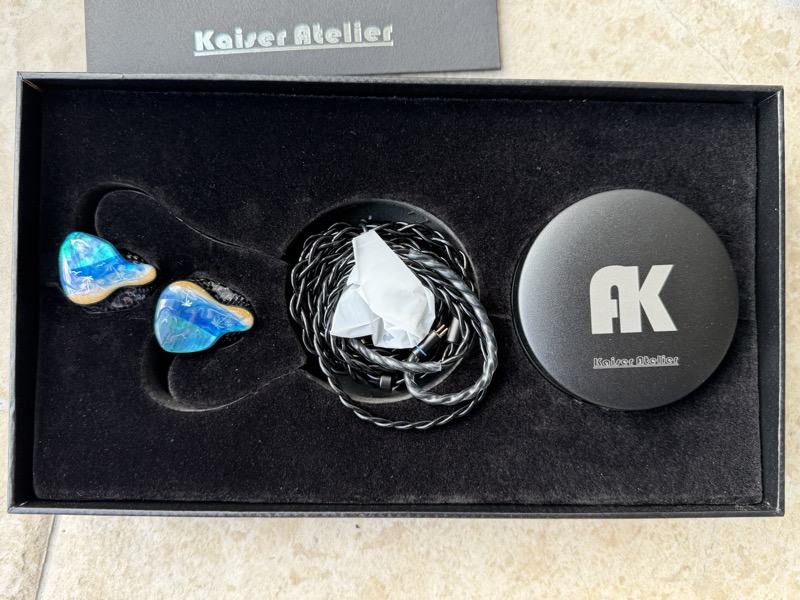
It is a decent box, very typical of an IEM in this price range, and the cable and carry case are decent too, but I feel what is special about the Marvicon is the quality of the CIEM build you get for this price.
Build and fit
The Marvicon is a ’traditional’ CIEM, with a rigid, custom-shaped shell that extends into the ear canal. No separate eartip is required, but while a custom shape can provide excellent isolation and repeatability, the seal can change with jaw movement, ear canal deformation and insertion depth.
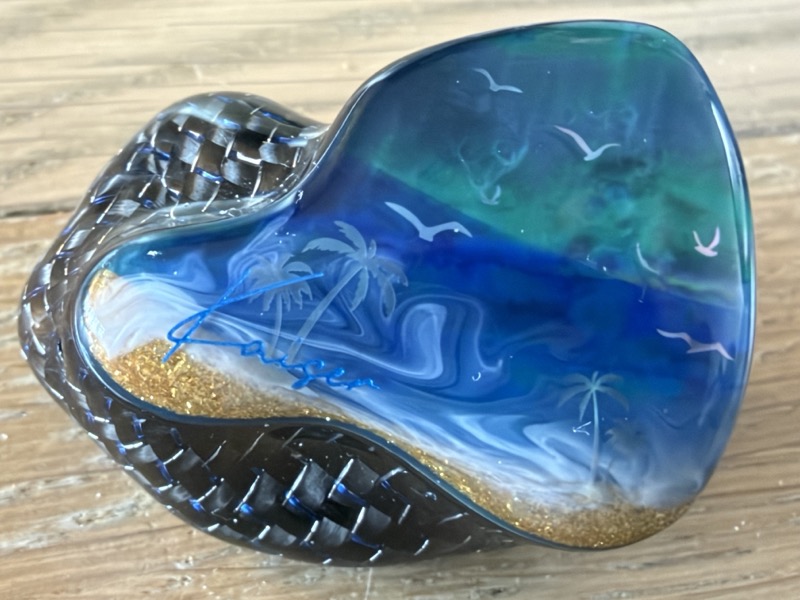
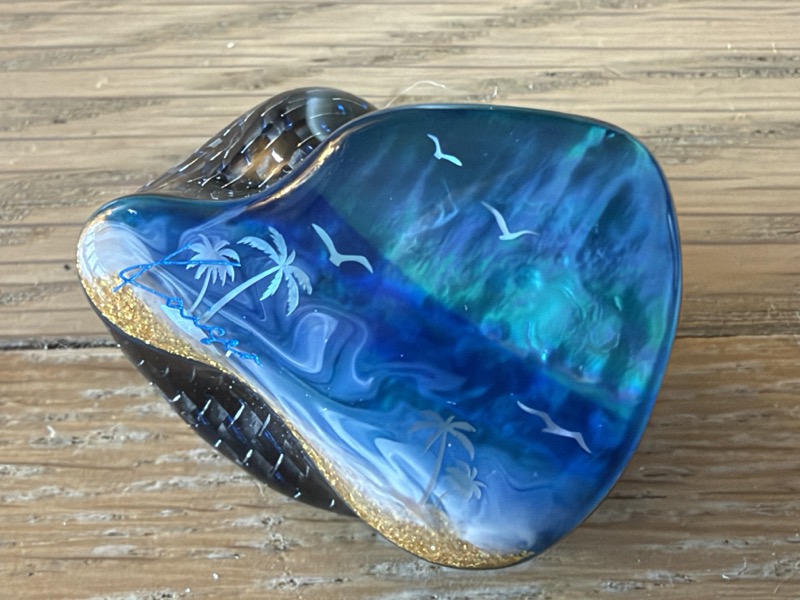
The shell is carbon fibre all the way through, with no silicone section, so this is the more traditional rigid design. Here is the faceplate from above, with the Kaiser signature and the gold glitter along the edge:
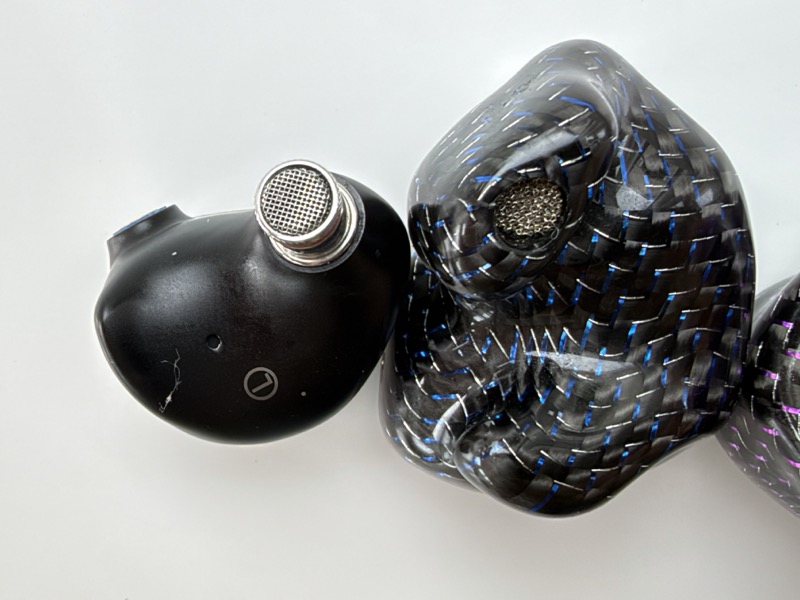
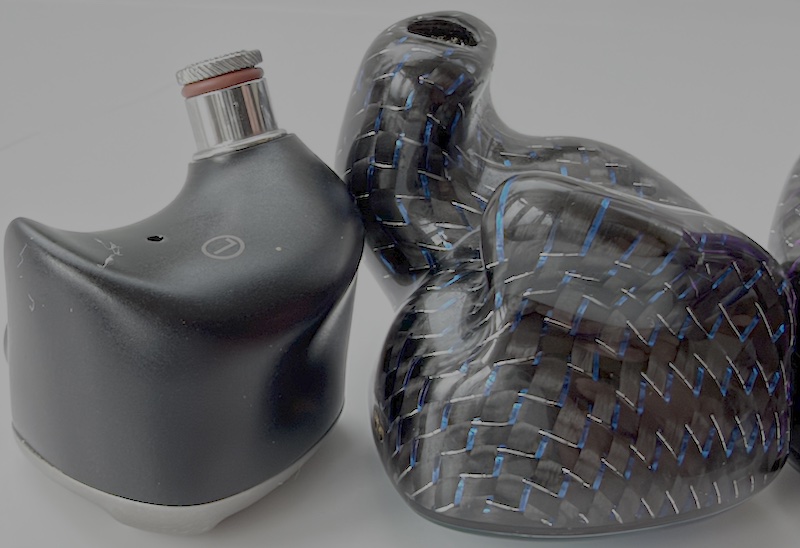
And here is the custom Marvicon shell next to a small universal IEM for size. Of course it is mainly this size due to my ear anatomy, but a CIEM will be larger in general than a universal shell. On the right it is next to the FiiO FH19, which is one of the largest universal IEMs that I have reviewed:
 |
 |
The right ear was a little ’tight’ for the first week and I was wondering if it would improve, but over the past weeks my ear has adjusted, and while it is still a very tight fit it is comfortable. The shell is rigid, so it is less flexible than the ZenCarb, and while I would not say I had discomfort, that more rigid fit makes it a little less comfortable. The ZenCarb ‘disappears’ when I wear it, while with the Marvicon (and I would guess most other CIEMs) you know you are wearing them. It also has a ’tighter’ fit and no custom eartips, which are really what set the ZenCarb apart from the competition.
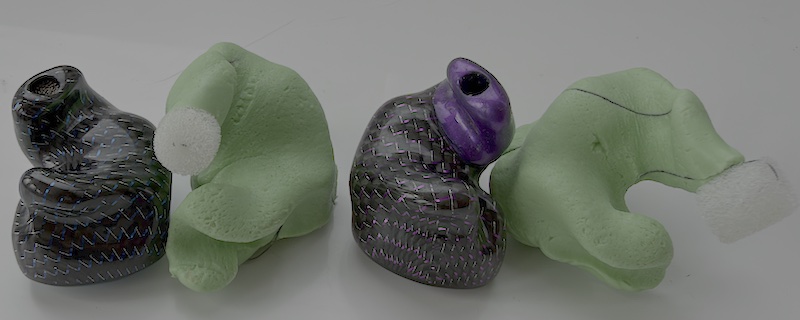
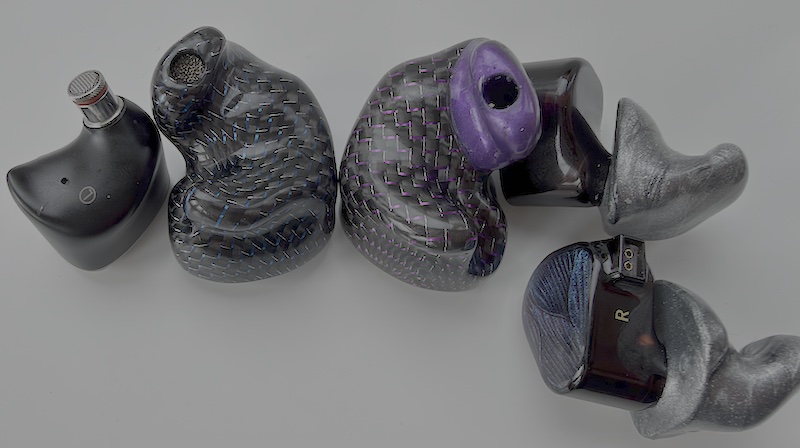
This shows the Marvicon (left) and the ZenCarb (right) compared to my other ear impression, the one I kept.
The tight fit means great isolation. It is the best I have had in any IEM, even better than the ZenCarb, and it gives me ANC level noise reduction without that weird ANC suction feeling. I even brought these on an airplane, where they almost completely blocked out the outside noise.
The cable is fine, but I would swap to a different one longer term, since we get standard 2-pin connectors. It is similar to the basic Truthear Gate cable, so it is perfectly respectable, just not at the ‘premium level’ of the ZenCarb cable.
Sound Impressions
Overall the tilt of this IEM is towards the bass and the midrange is somewhat recessed. That is more bass focused than my personal taste, which is one reason I scored the tuning a 4, but it still makes a very compelling listen.
Bass
The bass is probably the star of the show here. It is fairly deep but not bass head deep, and deeper than the graphs look. I think perceptually this might be because the midrange is a bit relaxed.
Limit to Your Love shows off the bass well. I think it is similar to maybe the Daybreak, but way more than the CrinEar Reference. Flight of the Cosmic Hippo is another good bass reference, because it sounds extraordinarily good with this tuning.
Mids
To be clear, the bass and midrange are both excellent, but the vocals seemed, at least with the fit I got, to be a little recessed. The midrange is more relaxed and a little recessed, but not in a muffled sense, just more so than on the ZenCarb when I swap between the two tunings. Some vocals still come forward depending on the recording. Fast Car is a good track to hear the recessed midrange on, and My Life by Dido is a great midrange reference where every aspect of the sound comes across beautifully.
I am all for having different sound signatures (it makes life interesting) and this is an excellent sounding IEM that prioritises the musicality of the recording over the vocals, which I felt was excellent with my Classical and Jazz test tracks, but less so with my folk and female vocal tracks. Summer Painter by Bill Callahan is one example, where his deep voice sounded immense (deep and meaningful) on that recording when listening on the Marvicon.
I did feel a little bit of EQ increasing the 1 to 4 kHz region would balance out the bass better and give this CIEM (at least in my ears) a more balanced sound signature.
Treble
The treble beyond the presence region was very good. The lower treble and presence region are slightly recessed, but the upper treble, powered by the single electrostatic driver, has some nice airy details. Tamacun by Rodrigo y Gabriela is a good track to hear that on, with the upper treble detail of the guitars coming through nicely. The treble is much ‘safer’ than on the ZenCarb. It is well handled and never sibilant, so I think this may be the better tuning for anyone susceptible to treble fatigue.
Soundstage and Imaging
The imaging accuracy was excellent, but the soundstage width was very typical of an IEM and mostly ‘within’ your head. Hotel California by the Eagles is a good track to hear both on.
Compared with the ZenCarb and Other IEMs
The two share a tuning direction, so for me the difference is mostly the balance. The ZenCarb has the more forward upper mids and the extra treble ‘air’ from its EST drivers, while the Marvicon has the stronger bass tilt, with a recessed midrange (though some vocals come forward depending on the recording) and a much safer treble.
Against the CrinEar Daybreak and Reference, I feel the bass is nearer the Daybreak this time, but the treble is probably below both, and the midrange is not nearly as good as on those two IEMs.
Custom Silicone Eartips
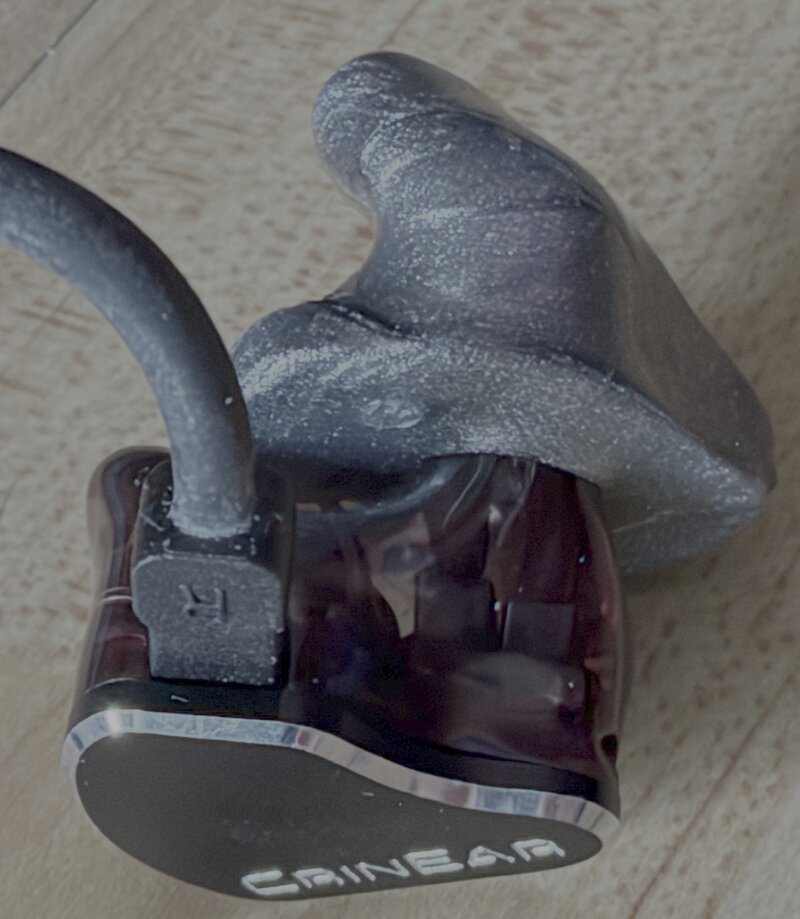
The photo shows the Marvicon and the ZenCarb next to two standard large universal IEMs that people might be familiar with, the Truthear Blue 2 and the CrinEar Daybreak. For both of those universals I have been using the custom large silicone eartip that Kaiser Atelier also provided. It was a custom request, because when I asked, they do not normally make these custom silicone ‘universal’ eartips. That custom eartip needs a larger nozzle to stay in my ear, which is why I have been using it with these IEMs. With these larger-nozzled IEMs the custom eartips have been stable and excellent, even when I am out running. That is normally the problem I have with standard eartips on these IEMs, as they are stable in the house but a less stable fit when I am out and about:
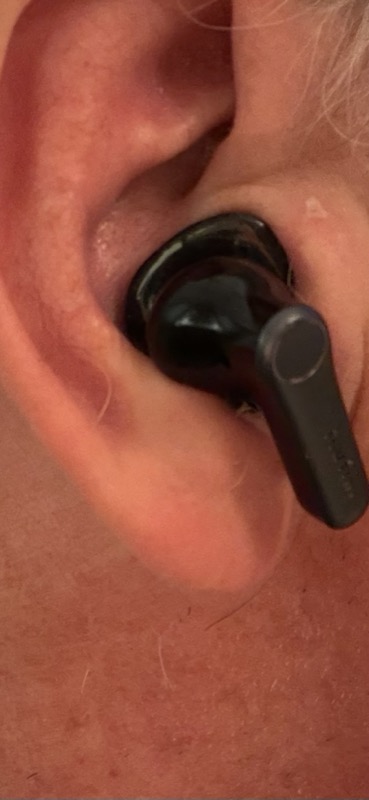
Here is the custom eartip fitted to the CrinEar Daybreak. It also works with the EarFun Air Pro 4 TWS earbuds, because their nozzle is large enough to keep the custom silicone eartip from Kaiser Atelier attached:
 |
 |
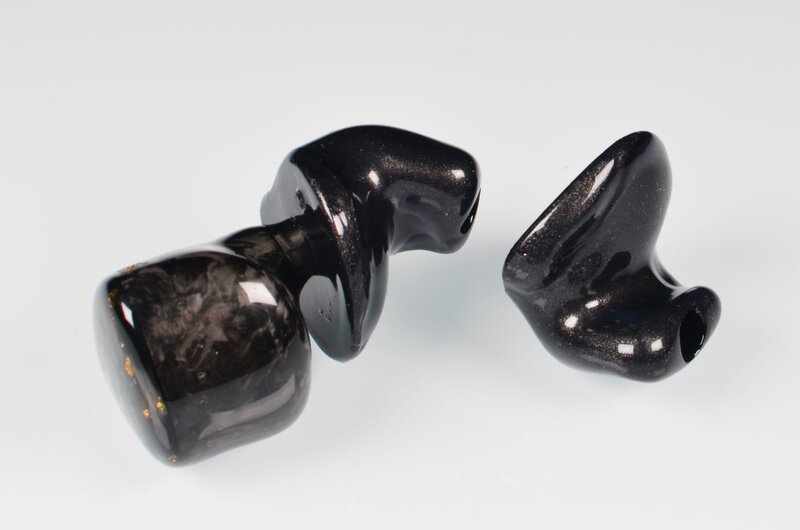
For reference, this is a ZenCarb shell with its custom silicone ear insert detached:
Specifications
Kaiser Atelier does not publish an English spec sheet, so this table comes from Chinese product coverage:
| Specification | Details |
|---|---|
| Product | Kaiser Atelier Marvicon |
| Released | 2024, the company’s first product |
| Drivers | One dynamic driver and one electrostatic driver per side |
| Housing | Carbon fibre shell, customisable faceplate |
| Fit options | Universal and carbon fibre custom |
| Price | 5,488 RMB, about US$800 (Kaiser Atelier’s figure) |
| Availability | Kaiser Atelier Taobao shop; worldwide store coming soon, according to Kaiser Atelier |
| Connector | 2-pin, standard |
| In the box | IEMs, braided cable, metal round case, cleaning cloth, tweezers, printed card |
Measurements
I did not measure the Marvicon. As a custom IEM (especially one as dramatically different from a KEMAR style pinna), it would never fit my KB501X, so there was no practical way of measuring it. For that reason I have mainly talked about my subjective opinions, but I did find one measurement of a Marvicon.
That is a frame from the Chinese reviewer YouTuji’s 2024 video, comparing the Marvicon (惊碳) with the Harman in-ear 2019 target on the left and a diffuse field target on the right:
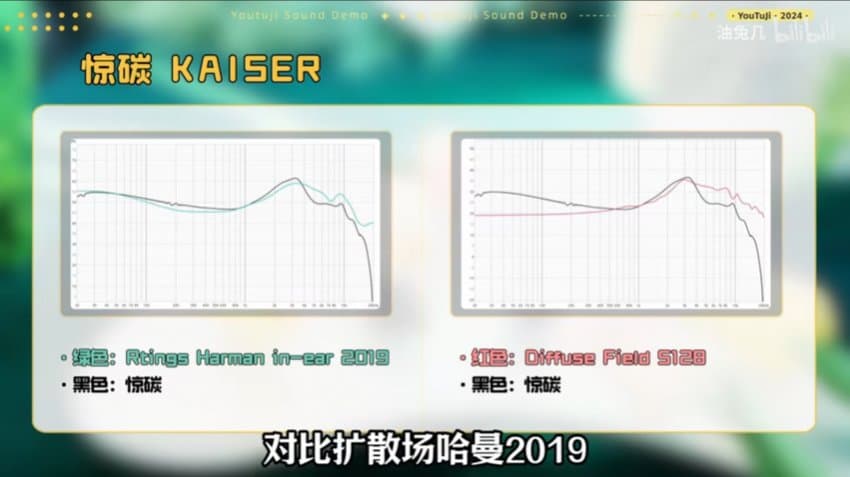
It is a low-resolution frame with no axis labels or stated coupler. I traced the Marvicon curve from this image (accurate to about 1.5 dB at best) and plotted it in my graph tool, against the JM-1 and Harman targets:
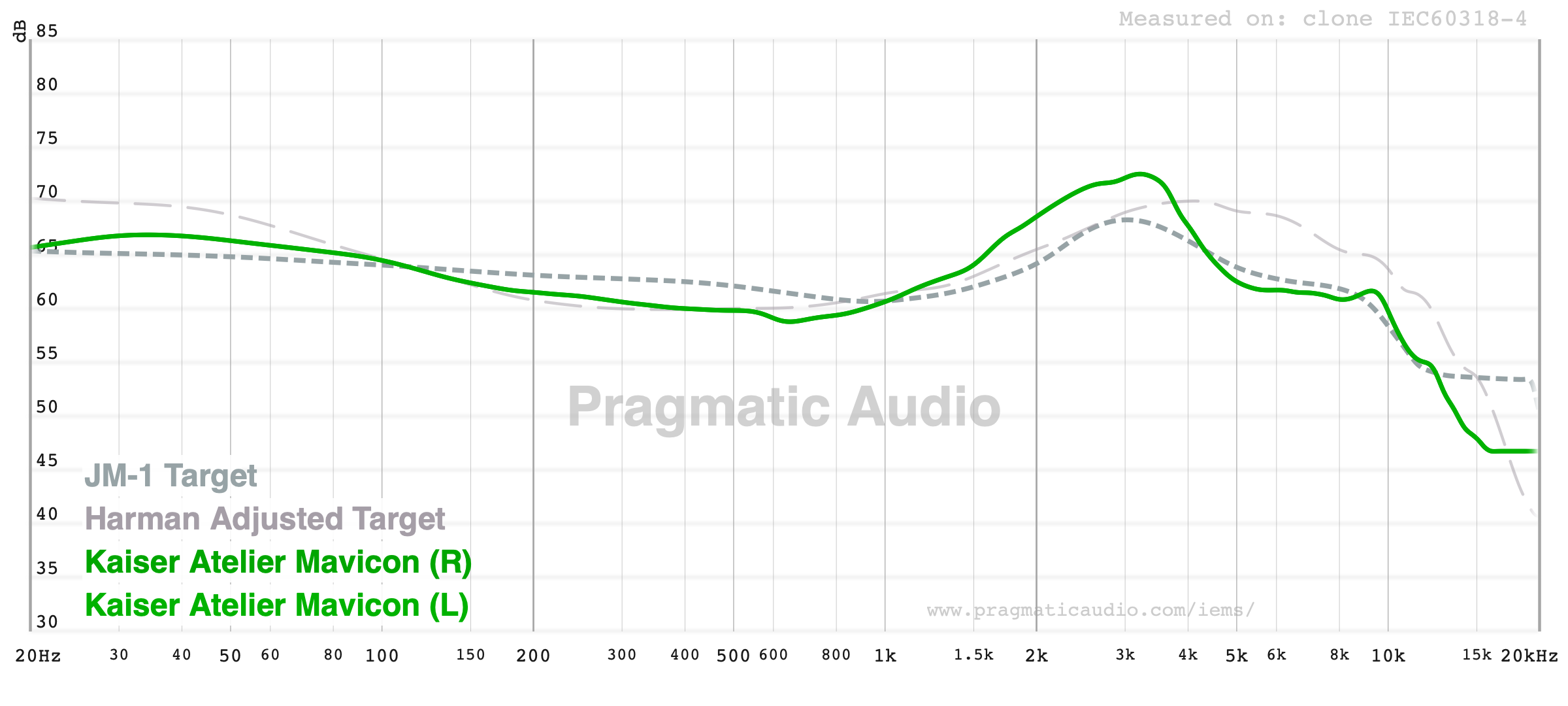
This graph is not a measurement from my 711 clone coupler, my KB501X or my own Marvicon. It is an extract from the YouTuji image above. The “Measured on: clone IEC60318-4” label and the left and right traces are just my graph tool’s defaults, and the left and right lines are the same trace. The coupler YouTuji used and the exact level are unknown, so treat the shape as indicative only, and don’t compare it directly with my own measurements of other IEMs.
With that caveat, it tracks the Harman target fairly closely in the bass, with a little extra around 30 to 40 Hz. It dips through the lower midrange and then peaks around 3 kHz, which puts the presence region more forward than I hear it. It then rolls off sharply in the upper treble, which is consistent with the safer treble I hear.
The measurement does look different from what I am hearing in places, which is understandable. In particular, I subjectively felt the presence region was recessed, but the one measurement I found shows that version with a more forward presence region. I am pretty sure this is related to the fit. This isn’t my Marvicon, and with a CIEM anything above about 4 kHz will probably be different from one ear and one unit to the next. The treble looks right to me though.
Rating explanation
I gave the Marvicon a 4 for the pragmatic rating, and a 4 for the measurement rating as well, because it has a good tuning, just not as good as the ZenCarb, and it is more bass focused than my personal taste. The features rating is a 4 because you don’t get a lot extra with it, but the price rating is a 5. CIEMs are never cheap, and I think the team has focused on delivering a lightweight CIEM experience at a very reasonable price.
Conclusion
The Marvicon is a very reasonably priced custom, with isolation better than any IEM I have used before, fairly deep bass, and a treble that is safe for anyone prone to treble fatigue. It is less exciting than the ZenCarb, with less air, and less comfortable, but I would still recommend it to anyone who wants to try a custom without the ZenCarb price. If Kaiser Atelier made a Marvicon 2 with a simpler driver configuration but with the custom eartips, I would love to see it.