Kiwi Ears Chorus
Kiwi Ears and B_Media Tune a Single-Dynamic in a Minor Key
Warm, dark and easy to live with: a budget IEM that chooses character over neutrality, in analogue or USB-C form.
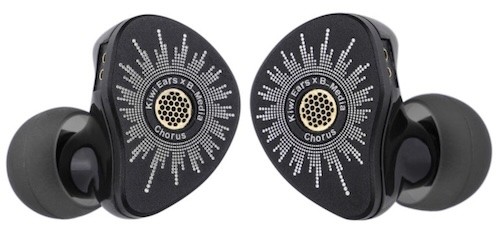
The Chorus is a collaboration between Kiwi Ears and B_Media, an audio reviewer involved in its tuning. Pairing that tuning sensibility with Kiwi Ears’ budget-IEM manufacturing, the Chorus is pitched as an engaging single-dynamic-driver IEM for everyday music lovers rather than a spec-chasing exercise.
It is a single dynamic driver, and the interesting part is what they have done with it. The tuning is V-shaped, which here means the bass is lifted and the top end has some extra bite, while the midrange between them sits lower than either — vocals end up slightly behind the bass rather than in front of it. A lot of the sub-$50 field is tuned toward Harman or something close to it; the Chorus deliberately is not, and that makes it a useful thing to have in a collection rather than another variation on the same theme.
It comes in two forms. The analogue version has a standard 3.5mm cable on 0.78mm 2-pin connectors, at $39.99, or $41.99 with an inline microphone. The USB-C version swaps that for a cable with a small DAC built into the plug, with a microphone and controls, at $44.99. The earpieces are the same in both. Kiwi Ears sent me the USB-C version, but the cable is detachable and I have listened and measured with a plain analogue cable as well, so most of what follows applies whichever one you buy. Where the two behave differently I say so, and I return to the choice between them at the end.
I would like to thank Kiwi Ears for providing the Chorus for the purposes of this review.
If you are interested in finding more information about this product, you can find it at the official Kiwi Ears product page.
The Kiwi Ears x B_Media Chorus retails for $39.99 with the analogue cable, $41.99 with an inline mic, or $44.99 with the USB-C cable. My sample is the USB-C version.
I have used the Chorus with a phone, over both the USB-C cable it came with and a plain analogue cable. The short version is that it is a likeable, slightly warm IEM that responds very well to a small amount of EQ, and that the two cables do not sound quite the same. But first, let’s take a look at what’s in the box.
Unboxing and Packaging
The Chorus arrives in Kiwi Ears’ tidy black-and-white packaging, with the IEMs and the driver billing on the front:
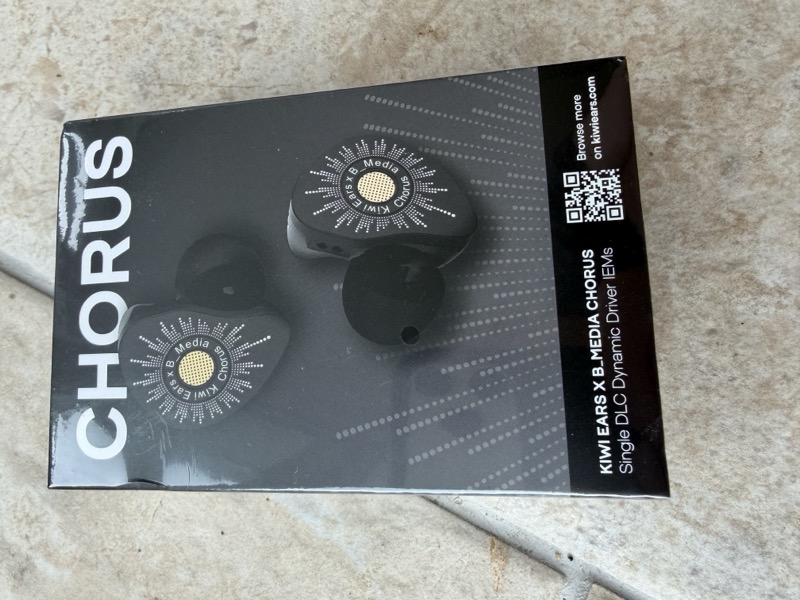 |
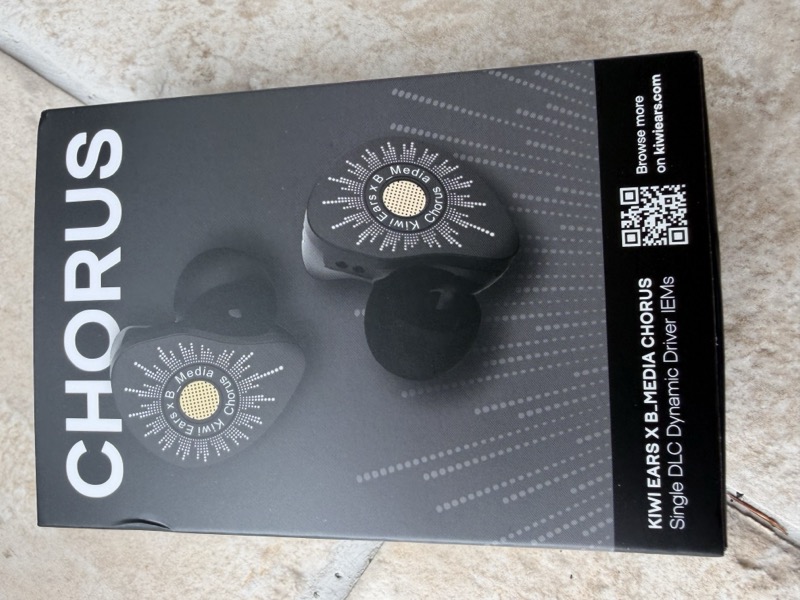 |
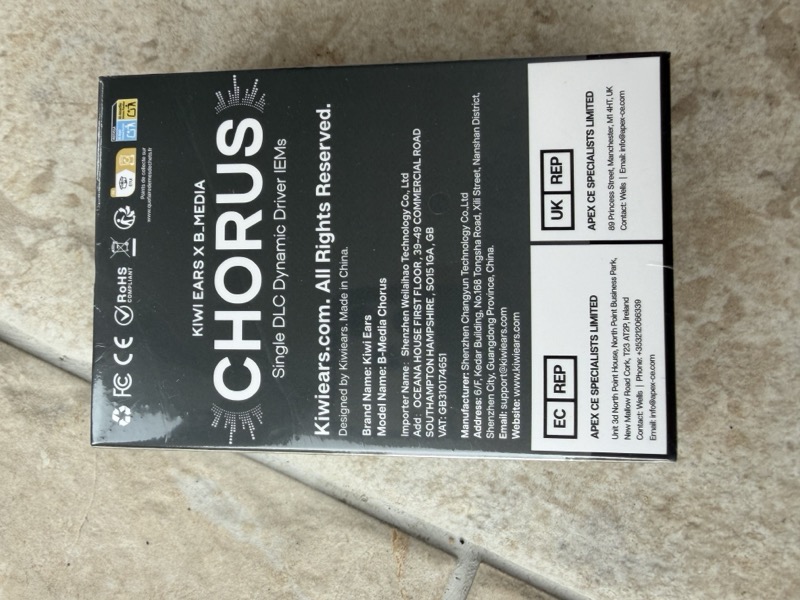
The side panel carries the specifications and the back the regulatory details:
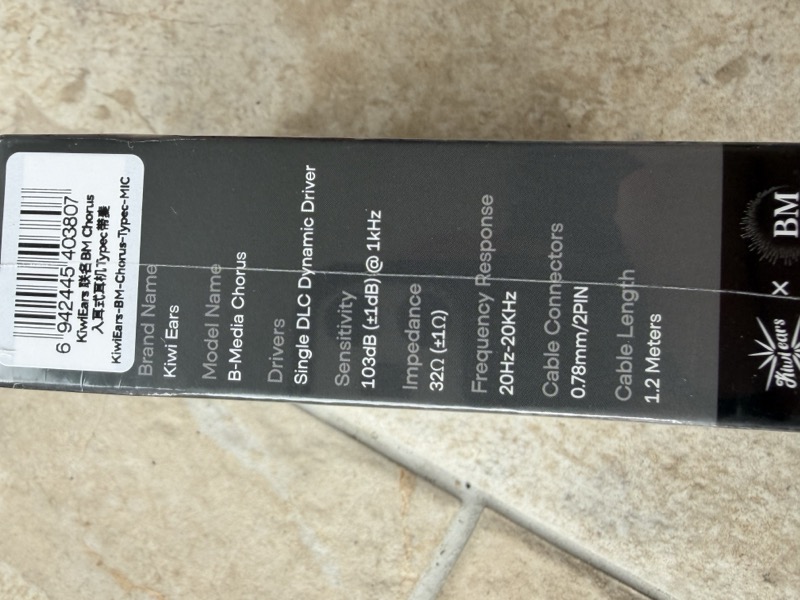 |
 |
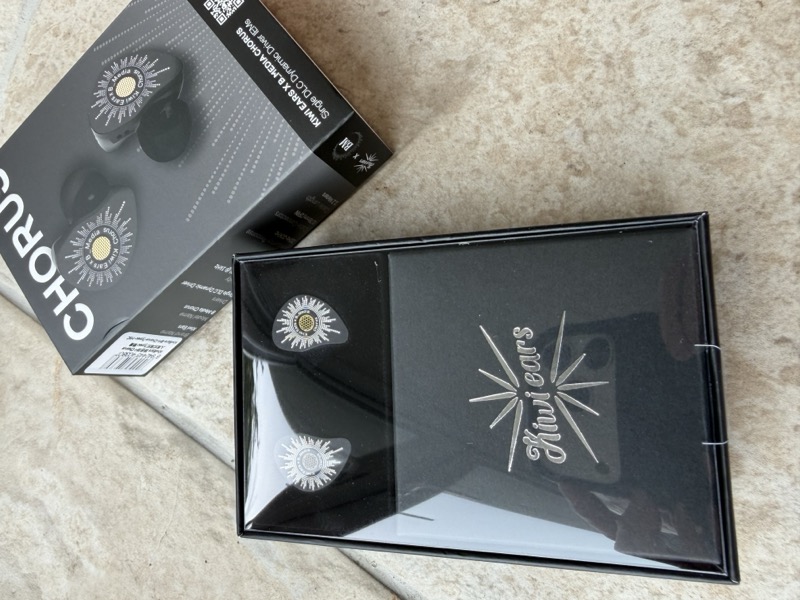
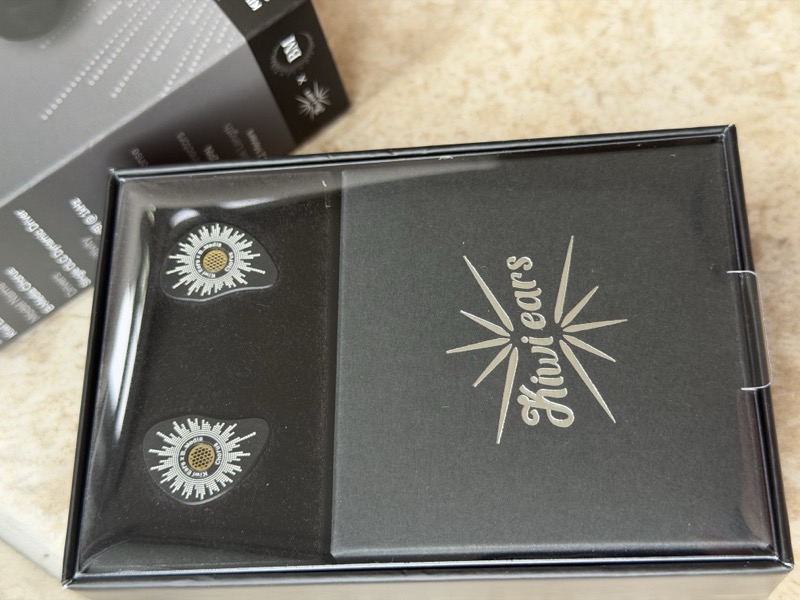
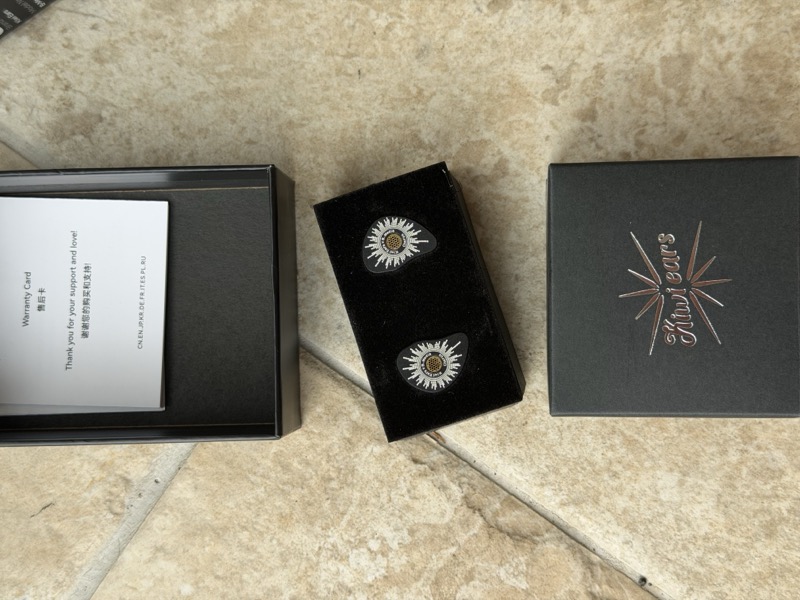
Inside, the IEMs sit in foam above a Kiwi Ears document folder. The presentation is tidy, but this is where the budget shows: there is no carrying case of any kind, which is the one omission I would call out at this price:
 |
 |
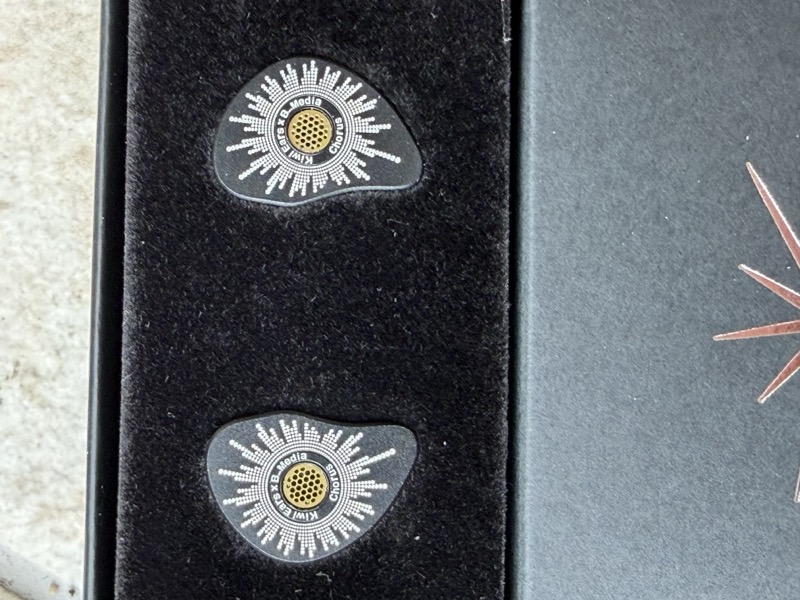
The faceplates are visible as soon as the lid comes off, which is clearly the intention:
The paperwork sits beneath the earpiece tray:
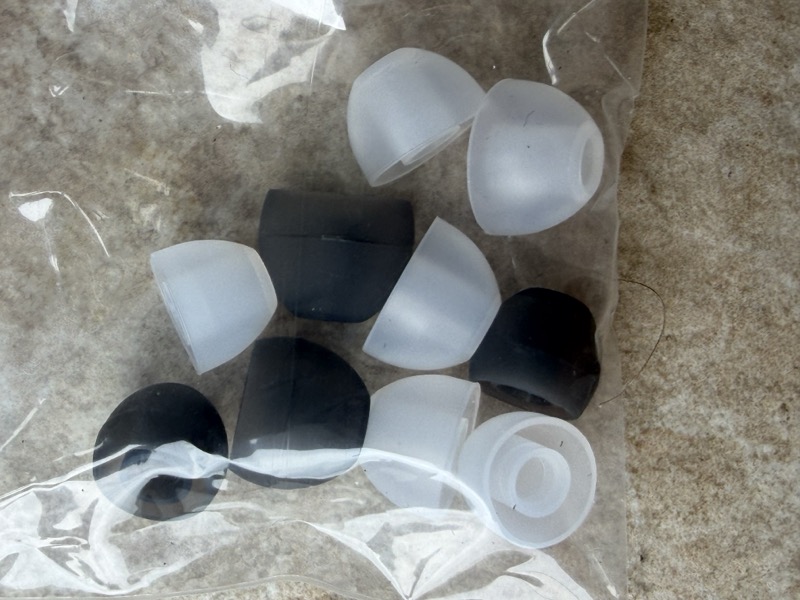
The supplied silicone tips, three pairs in S, M and L, are shown below. There is no foam option or carrying case:
Design and Build
In the hand the pair has a clean, symmetrical look with the sunburst faceplates facing out:
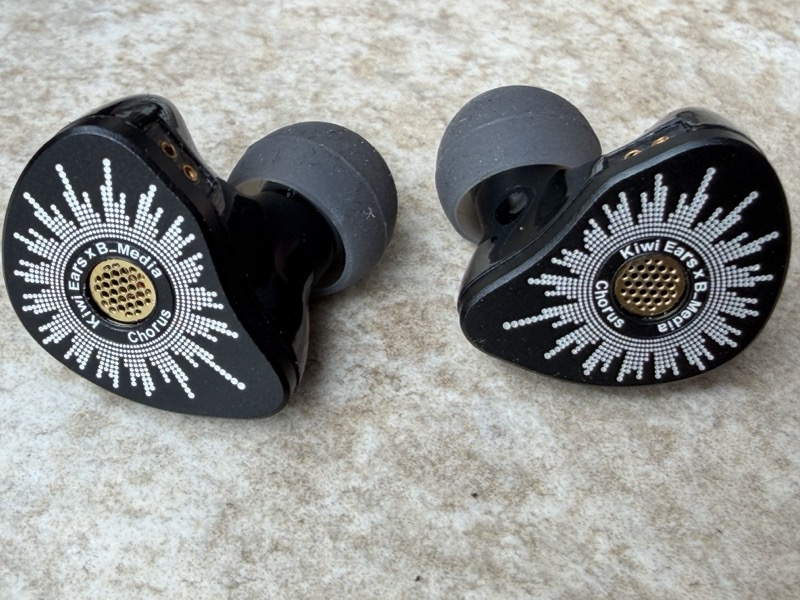
The shells are glossy black resin with a silver sunburst faceplate around a gold central vent. For a $45 IEM the finish is better than it needs to be — the sunburst catches light without looking cheap about it:
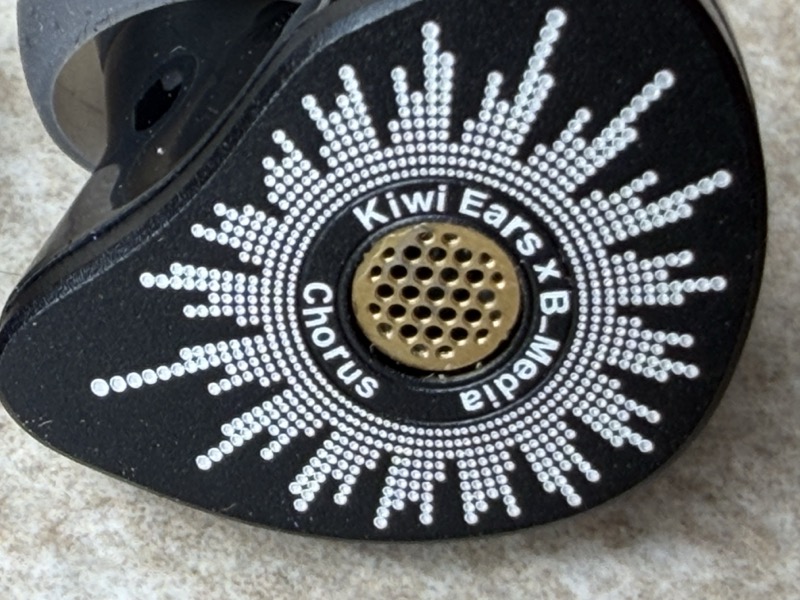
The nozzles use a gold mesh grille, and the shell is a comfortable, ergonomic shape that disappears in the ear over a long session:

Fit, Vent and Isolation
The shells are small and very light, which is most of why they are as comfortable as they are — these are among the easier IEMs to forget you are wearing. Two things are worth knowing before you buy, though.
The nozzle is on the wide side. That works in my favour for seal, but if you have narrow ear canals it is the thing most likely to cause a problem, and it is worth checking your experience with wide-nozzle IEMs before ordering. The shell also has some internal anatomical shaping, which is comfortable for me over long sessions but is the kind of thing that suits some ear shapes better than others.
That gold circle on the faceplate is a functional vent, not decoration, and it is a large one. Venting a dynamic driver can relieve pressure build-up — part of why the Chorus stays comfortable over hours — though the vent alone does not explain the soundstage. The trade-off is isolation: this does not block outside noise the way a sealed IEM does. It is fine for a desk, a walk or a quiet train, but it is not the thing to take on a plane. How much this bothers you will depend heavily on your seal and your choice of tips.
The Two Cables
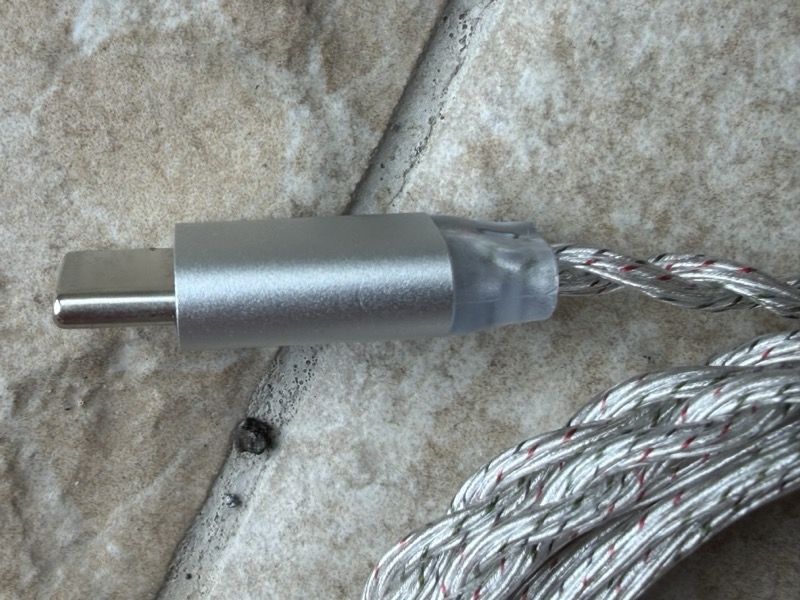
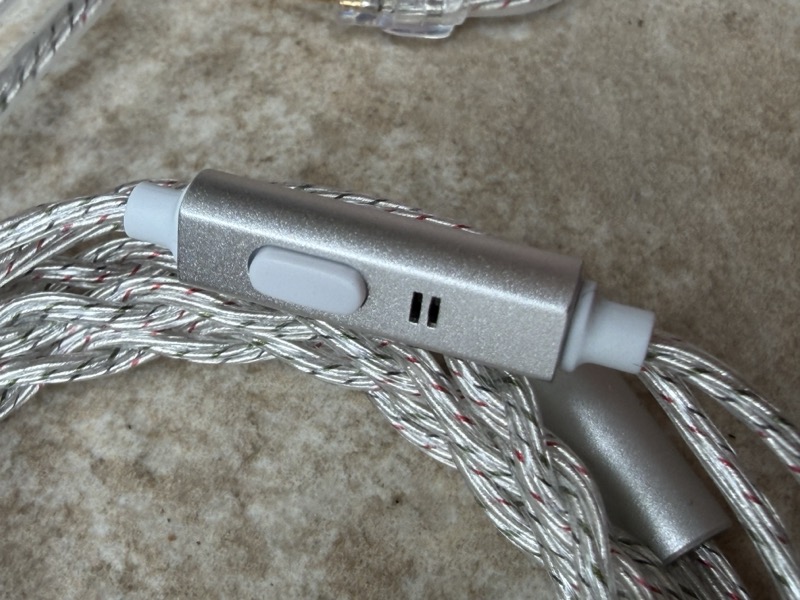
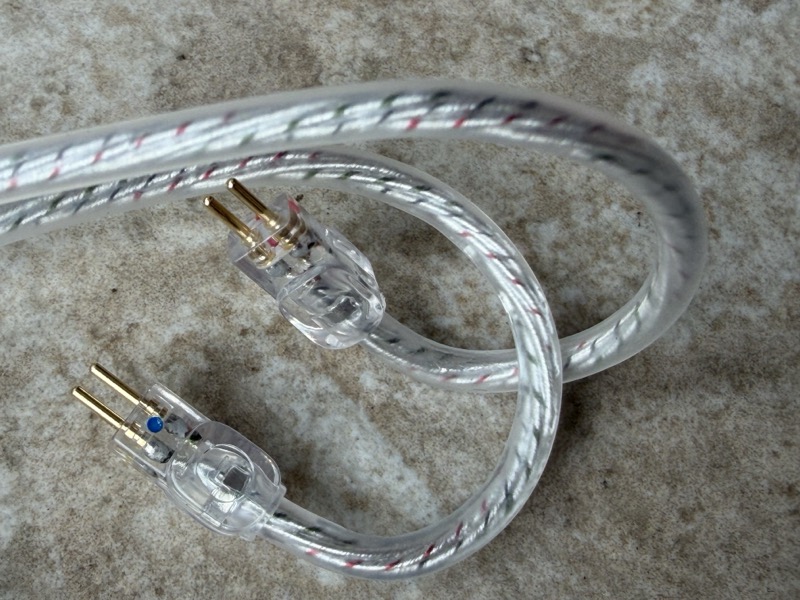
The analogue version ships with a standard 3.5mm cable, which is what most buyers at this price will have. The USB-C version, which is what I received, has a silver, lightly braided cable terminating in a USB-C plug with an inline microphone and controls, and the same 0.78mm 2-pin connectors at the IEM end:
 |
 |
The detachable earpiece connectors are shown here:
The USB-C plug is more than a connector. It carries the same DAC and DSP that Kiwi Ears use on their S-Link cable, and the DSP does two jobs. Out of the box it applies a tuning correction of its own, which is why the two cables measure and sound differently in the sections below. It can also store a parametric EQ of your choosing, set through Kiwi Ears’ web EQ editor. If you bought the analogue version none of this applies to you, and the rest of the review is written with that in mind.
Sound Impressions
I listened with both cables, and the descriptions below take the analogue cable as the baseline, since that is the Chorus as most people will buy it. The USB-C cable is not just a different connector: its DSP takes a little of the warmth out of the mid-bass and adds some energy back at the top, and the difference is easy to hear and visible in the graphs further down. It keeps the V-shaped character that gives the Chorus its personality; it just stops the bottom end leaning quite so heavily on everything else. Where that changes what I heard, each section says so.
Bass
The bass is the Chorus’s defining trait. There is real weight and a snappy, responsive quality to it, and on “Angel” by Massive Attack the low end is full and satisfying without ever losing its shape. Over the analogue cable there is a little too much of it — the mid-bass runs warm enough that the boundary between the bass and the lower midrange softens. The USB-C version pulls that back and the same track tightens up noticeably.
“Limit to Your Love” by James Blake is the track that finds the limit. The Chorus’s low end is a mid-bass lift rather than a sub-bass one — the measurement below shows it sitting slightly under target at 20Hz — so the famous sub-bass drops register as notes rather than as pressure you feel. That is a fair trade at $45, and it is worth knowing that the warmth you hear is coming from higher up than the very bottom.
Midrange
The midrange is not as recessed as the V-shaped description might lead you to expect. Measured against the target it sits roughly where it should — it is the bass lifted above it that makes it read as set back rather than any real scoop. Vocals stay present and keep their body, and on “Fast Car” by Tracy Chapman the vocal is clear and unforced, sitting in the mix rather than behind it.
This is the region the cable choice affects most. Over the analogue cable the lower midrange picks up some of the mid-bass warmth and “Sweet Jane” by the Cowboy Junkies loses a little of Margo Timmins' separation from the arrangement behind her. Over USB-C that clears up.
Treble
The treble is where the USB-C option earns its extra few dollars. Over the analogue cable it is safe — smooth, inoffensive, and a touch polite for a tuning with this much bass underneath it. The DSP adds energy back up top and the balance makes more sense for it.
On “Billie Jean” by Michael Jackson the hi-hats are clean and present without ever turning sharp, and over USB-C they have more presence in the mix rather than sitting politely behind everything. On “Chocolate Chip Trip” by Tool there is enough cymbal energy to follow the percussion work, though this is not an IEM that will impress anyone chasing the last word in air and sparkle — that is not what it is for.
Soundstage and Imaging
The stage is reasonable rather than expansive. “Hotel California” by the Eagles places instruments clearly enough to follow, though I find the imaging less precise than on the Halcyon. That is a listening comparison, not something price or a V-shaped response can establish on its own.
EQ suggestion
If you are on the analogue cable, the single most effective change is a small mid-bass cut to tighten up the bass-to-midrange transition:
Filter 1: PK Fc 150 Hz Gain -3 dB Q 1.0
One filter is enough to hear the improvement, and it works from any phone or player with a system EQ. On the USB-C cable much of this is already done for you by the onboard DSP, so start by listening to it stock before deciding whether you still want the cut.
Specifications and Measurements
Specifications
| Specification | Value |
|---|---|
| Brand | Kiwi Ears |
| Model | Chorus |
| Driver | Single dynamic driver, Diamond-Like Carbon (DLC) diaphragm |
| Sensitivity | <103dB (±1dB) @ 1kHz |
| Impedance | 32Ω (±1Ω) |
| Frequency response | 20Hz – 20kHz |
| THD | <0.1% @ 1kHz |
| Cable connectors | 0.78mm / 2-pin |
| Cable | 1.2m, two-core silver-plated |
| Variants | 3.5mm no mic ($39.99) · 3.5mm with mic ($41.99) · Type-C with mic ($44.99) |
The figures above are Kiwi Ears’ own published specification. Kiwi Ears rate the DLC diaphragm at less than 0.1% THD at 1kHz with a linear phase response; my own measurements follow below.
Frequency Response
All measurements were taken on my own clone IEC60318-4 coupler. First, the Chorus on the plain analogue cable, both channels, against the Harman Adjusted target:
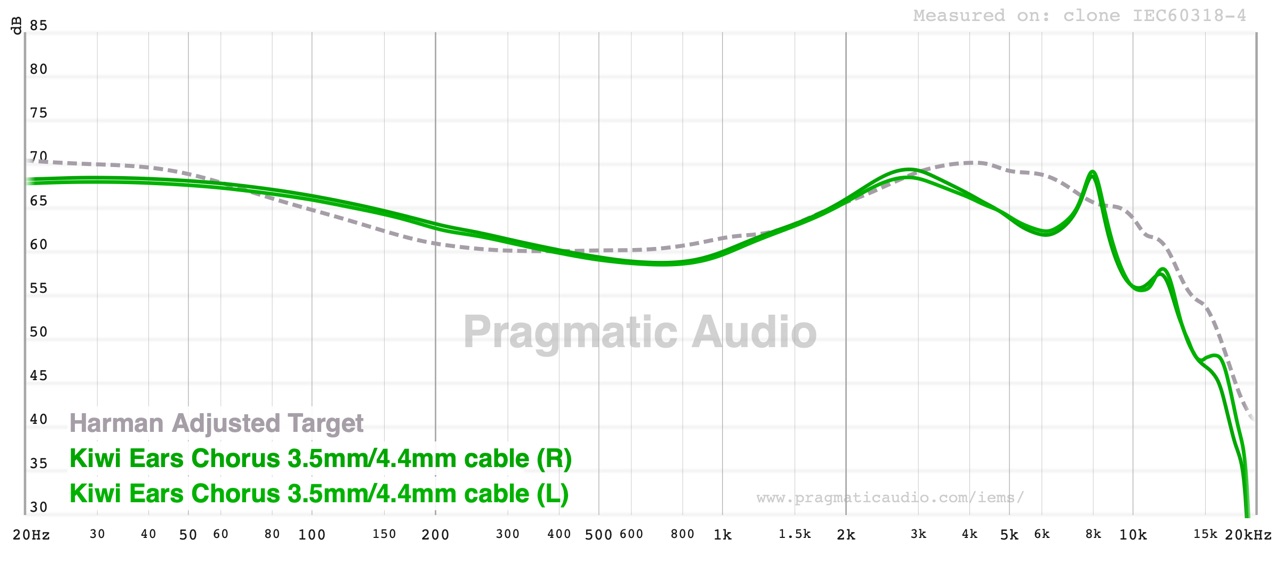
Channel matching is very good. The shape is the interesting part: the bass sits above the target from roughly 60Hz to 200Hz, which is the warmth you hear, while at 20Hz it is actually a little under Harman — so this is a mid-bass lift rather than a sub-bass one. Through the midrange it runs slightly below target, the pinna gain comes back up to meet Harman around 3kHz, and then 4kHz to 6.5kHz is recessed before a narrow peak at 8kHz. That combination — lifted mid-bass, dipped lower treble, spike above it — is what gives the Chorus its V-shaped character.
USB-C DSP vs the Analogue Cable
This is the graph worth looking at, because it shows what you are actually buying with the USB-C version:
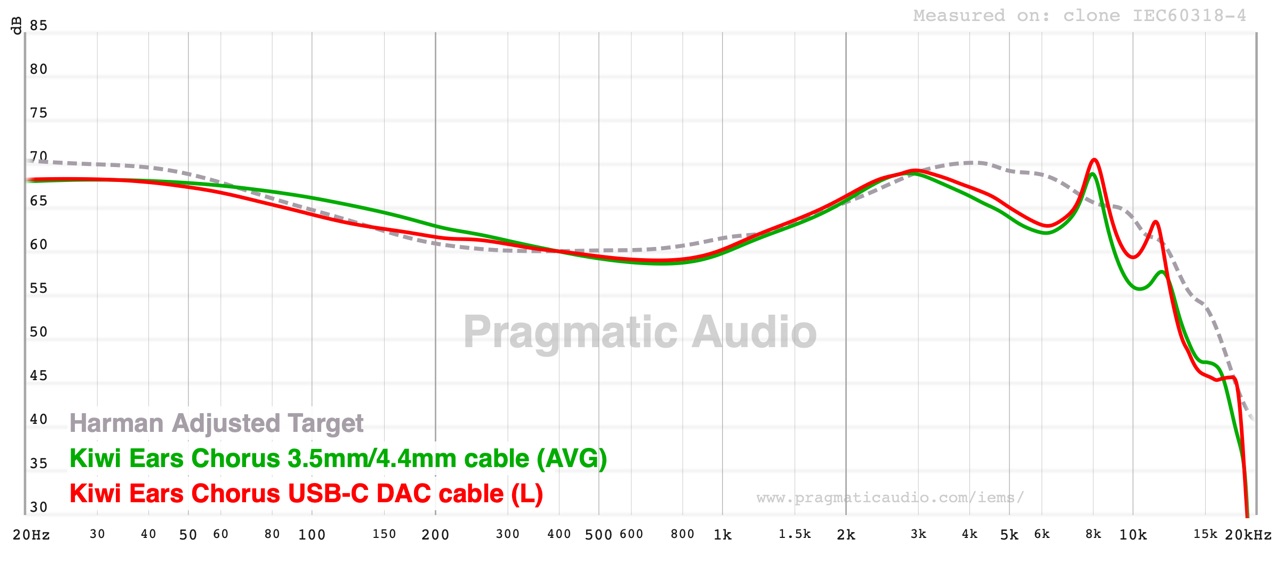
The DSP does two things. It takes about a decibel out of the 60Hz–400Hz region, which is exactly the warmth that makes the analogue version feel thick through the lower midrange. And it adds energy at the top — a little through 4–6kHz, more at the 8kHz peak, and a substantial lift through 9–12kHz where the analogue cable drops away.
That is a small change on paper and a clear one in practice. It does not turn the Chorus into a neutral IEM — the V-shape survives intact — it just stops the bottom end dominating and gives the top end enough presence to balance it.
Comparisons
Against two other Kiwi Ears models, the Airoso and the Belle:
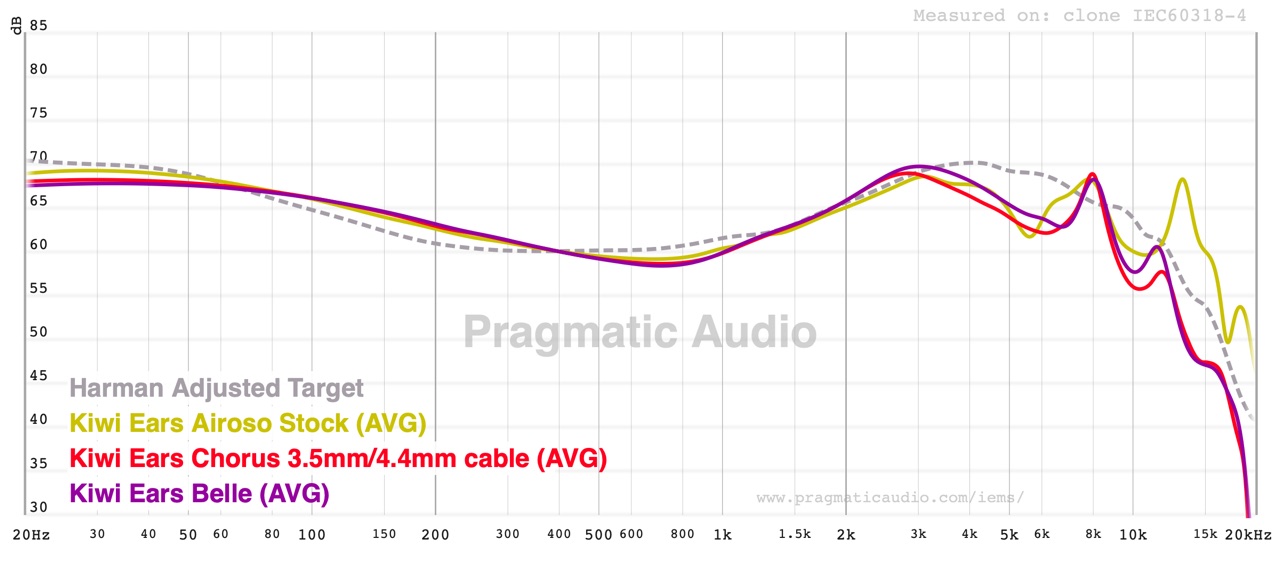
The Chorus and the Belle measure near-identically from the bass through to about 4kHz, which matches how they struck me — I heard these two as close relatives rather than different tunings.
It is worth being careful with that conclusion, though. Several reviewers have described the Chorus as clearly bassier and warmer than the Belle, and I can see why. Nozzle length, insertion angle and seal all shift a measurement more than people tend to assume, and two shells with different geometry can land differently in one coupler and differently again in somebody’s ear. My graph says one thing about my fit; it does not settle what the difference sounds like in yours.
The USB-C cable gives the Chorus a practical advantage over a fixed analogue setup: I can change its tuning and keep the filters on the cable. The measured differences at the very top still need the same insertion-depth caution as any IEM comparison.
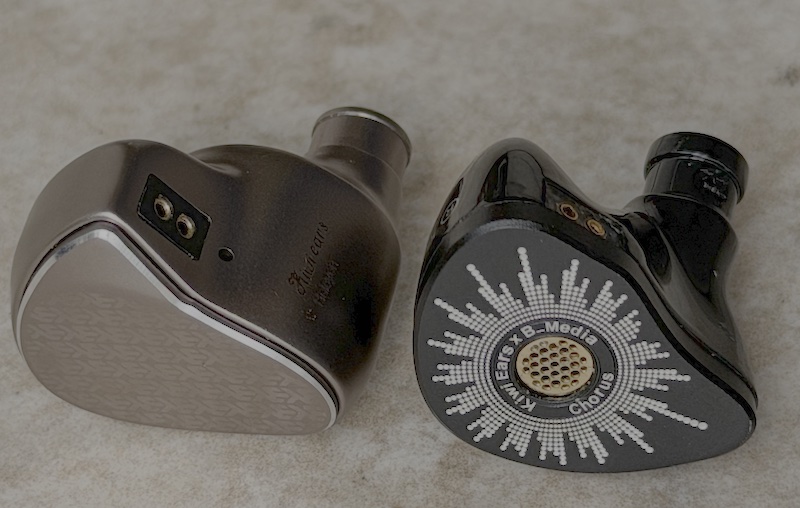
Worth a look alongside the Halcyon, which is the other Kiwi Ears I have been using recently — the Chorus on the right with its sunburst faceplate and gold vent, the metal-shelled Halcyon on the left:
 |
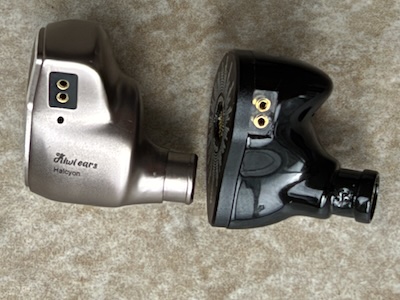 |
They are aimed at completely different buyers — one is a $45 warm-tuned single dynamic, the other a $259 tribrid — but the pair does show how much shell size the Chorus saves, and how visible that central vent is compared with the Halcyon’s smaller shell vents.
Since I have both on the same coupler, here they are measured against each other. This is the Chorus on the analogue cable, which is the fairer comparison — the USB-C DSP version is a different curve, as the graph further up shows:

I want to be straight about what this shows, because it would be easy to read the overlap through the midrange as the Chorus getting close. It does not. The Halcyon is the better tuning — to my ears it is arguably the best-tuned IEM Kiwi Ears make, in the same territory as the Astral, which is my favourite of theirs. The graph shows why.
In the bass the Halcyon has roughly 4–5dB more at 20Hz and holds it above the Chorus until they meet near 100Hz. That is real sub-bass against the Chorus’s mid-bass lift, and it is the difference between a low end that extends and one that is merely warm. The two remain close through much of the midrange, with smaller differences around 700–800Hz.
In the treble their peaks land in different places — the Halcyon’s around 7kHz, the Chorus’s around 8kHz — and above 10kHz the Halcyon keeps considerably more energy where the Chorus falls away steeply. That upper-treble difference needs caution: insertion depth and coupler resonances affect this region, and this graph does not isolate the MEMS driver.
I prefer the Halcyon’s tuning, particularly its stronger sub-bass. The Chorus makes sense if you want a warmer budget set with cable-based PEQ; the Halcyon makes sense if you share my tuning preference and can justify $259. The graph illustrates the tonal differences, rather than establishing an overall quality ranking.
Returning to the Airoso comparison above, its largest visible difference is in the upper treble. I would give more weight to listening and fit here than to the exact height of a peak above 10kHz.
Here the USB-C Chorus is plotted against the Juzear Nimbus, which sits a little above it in price:
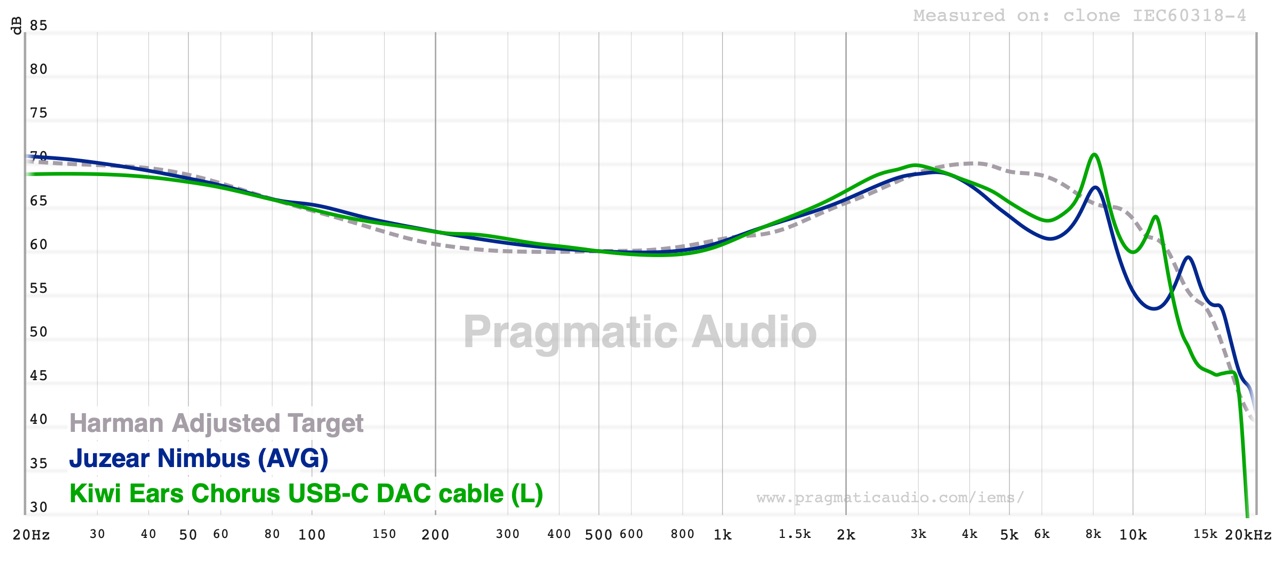
The Nimbus has a couple more decibels of genuine sub-bass at 20Hz, and the two are near enough identical from 100Hz to 1kHz. Above that the Chorus carries more through the presence region and has the more prominent 8kHz peak, while the Nimbus has more air at the very top.
Distortion
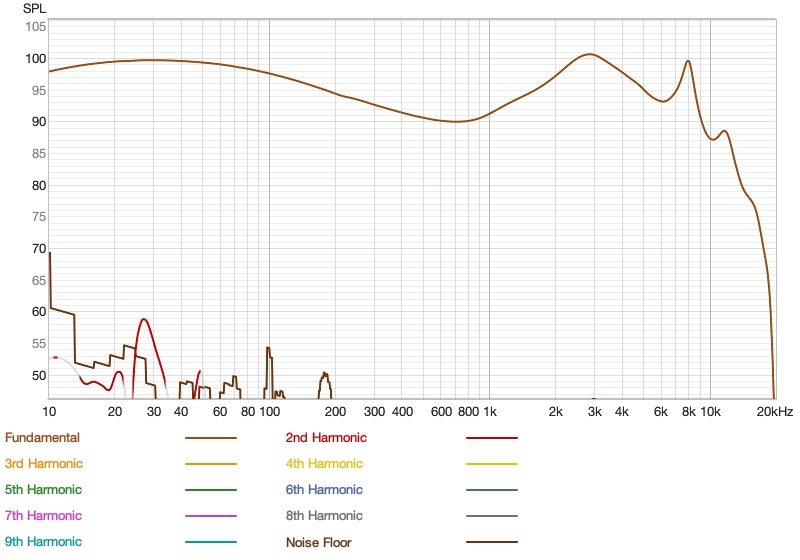
Here are the harmonic traces in SPL and as a percentage:
 |
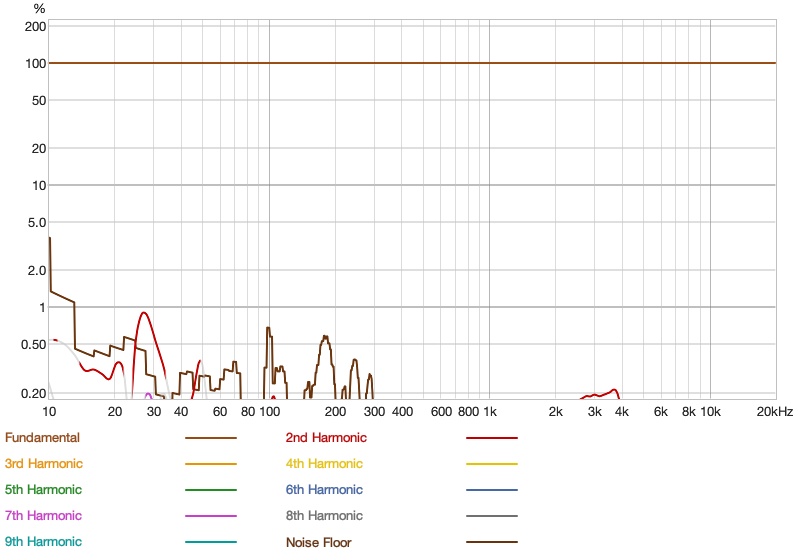 |
The distortion traces are low in this sweep, with most of the visible harmonic energy confined to the bass. The fundamental reaches roughly 100dB SPL in parts of the sweep. This is a result at that test level; it does not establish distortion at every listening level.
Rating Explanation
The Pragmatic Rating of 4 reflects an enjoyable budget IEM that does the fundamentals well. The DLC driver is snappy and low-distortion, the tuning is warm and easy to live with, and the build and comfort are good for the money. That rating applies to the earpieces, so it holds whichever cable you buy them with.
The caveats are that the stock analogue tuning is a little warm in the mid-bass and the treble is on the relaxed side, so it is not the last word in separation or air out of the box, though a single EQ filter addresses the first of those neatly. There is no case in the box, and the sub-$50 single-DD market is fiercely competitive, so the Chorus has to fight for attention.
The price rating of 5 is where the USB-C version comes in. For five dollars more than the analogue version you get a DAC, a microphone, a factory tuning correction that fixes the mid-bass, and a stored parametric EQ. That is an unusual combination at $44.99, and it is what lifts the Chorus from a decent budget IEM to a bargain.
Conclusion
The Chorus is a warm, comfortable budget IEM with a tuning that stands apart from the Harman-adjacent crowd at this price. If you have the analogue version, you have a good IEM: the mid-bass is the one thing I would reduce, a single filter in your phone’s EQ does it, and the wide nozzles and limited isolation are the two fit questions worth checking before you buy. Nothing in this review should make an analogue owner feel they bought the wrong thing.
But if you are still deciding, my recommendation after listening to both and measuring both is clear: buy the USB-C version. For five dollars more the cable’s DSP corrects the mid-bass at the factory, adds back the treble energy the analogue version lacks, gives you a DAC and microphone for a phone without a headphone jack, and lets you store your own parametric EQ on the cable itself. That is a very pragmatic bargain, and the performance it gets you is well above what $44.99 normally buys.