Kiwi Ears Halcyon
Kiwi Ears’ First MEMS Tribrid, Built for Composure Rather Than Fireworks
The MEMS driver gets the headlines. The tuning, the fit and the build are why it stays in my ears.
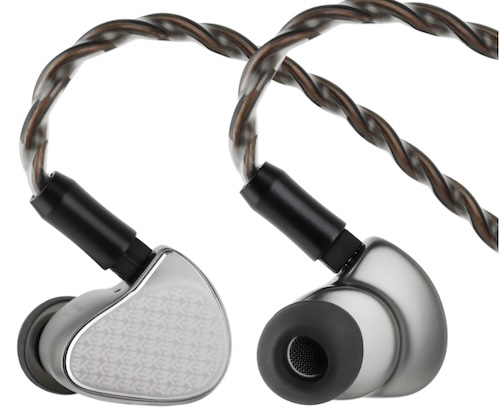
Kiwi Ears describes the Halcyon as one of the first in-ear monitors to build a tribrid around a solid-state MEMS driver. The more useful point for a buyer is that this driver combination is unusual at $259: a 10mm composite-diaphragm dynamic driver handles the bass, two customised DEK-series balanced armatures cover the midrange, a customised WBFK armature takes the treble, and the MEMS driver sits above that on the upper highs alone. The MEMS driver is the part Kiwi Ears puts in the spotlight, and it gets its own section below — though the dynamic driver and the two DEK armatures are doing real work of their own on bass and midrange, as the sound section covers.
It launched as a Kickstarter project, where backers paid $199; with that promotion now finished it retails for $259. Kiwi Ears describe the tuning as their house studio-monitor signature: a sub-bass shelf cut at 200Hz, neutral mids, and a 3kHz peak for pinna-gain compensation. My own measurements are further down, and they line up with that description closely.
I would like to thank Kiwi Ears for providing the Halcyon for the purposes of this review. My apologies to Kiwi Ears for how long this review has taken; the Halcyon has been in regular use the whole time, which I hope shows in what follows.
If you are interested in finding more information about this product, you can find it at the official Kiwi Ears product page, and on the Kickstarter campaign page.
The Kiwi Ears Halcyon retails for $259 (it was $199 during the now-finished Kickstarter campaign).
This is the best of the three Kiwi Ears products I have been using, and the one I was most curious about — a genuine tribrid with a driver type that is still rare in shipping products leading the treble. MEMS has existed for years in other applications; what is new is seeing it used as a driver in a finished IEM rather than a lab demo. But first, let’s take a look at what’s in the box.
Unboxing and Packaging
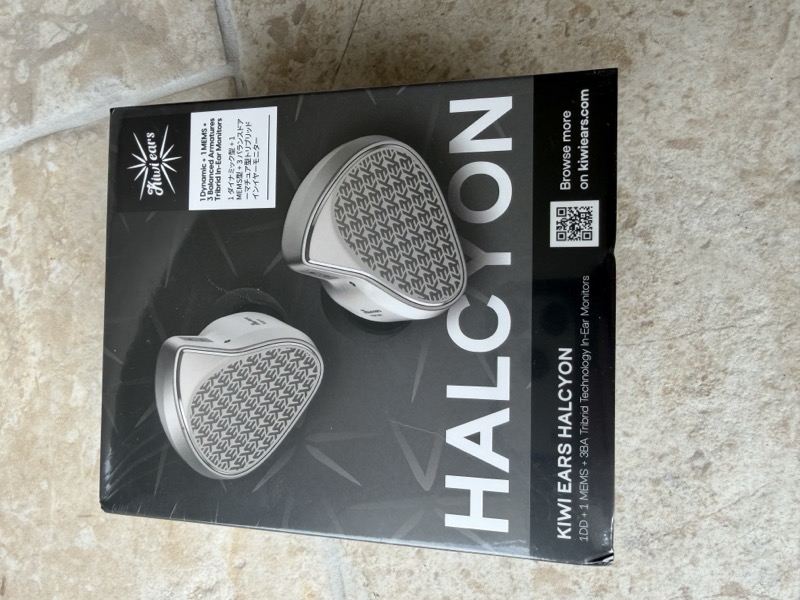
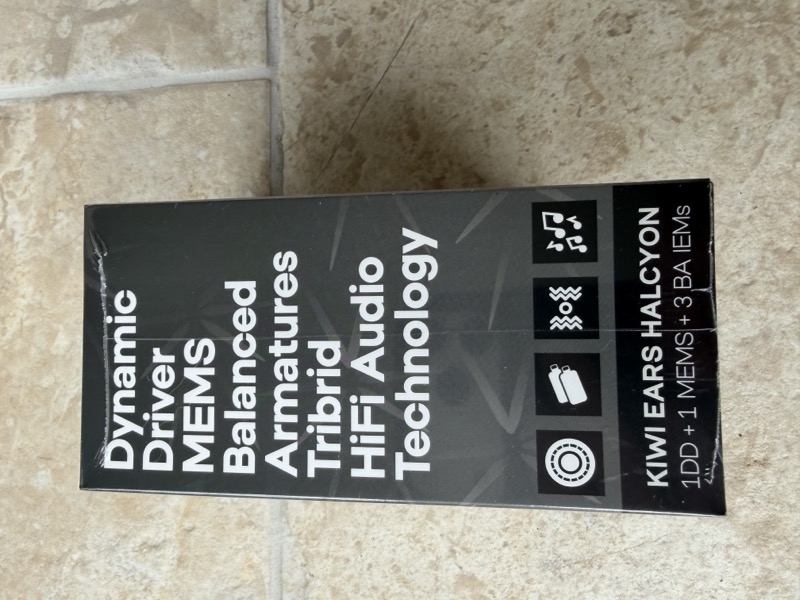
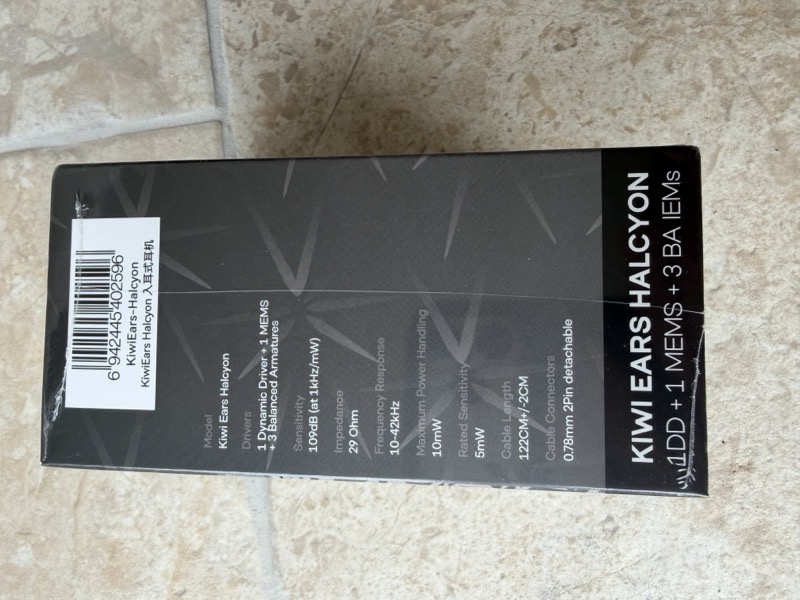
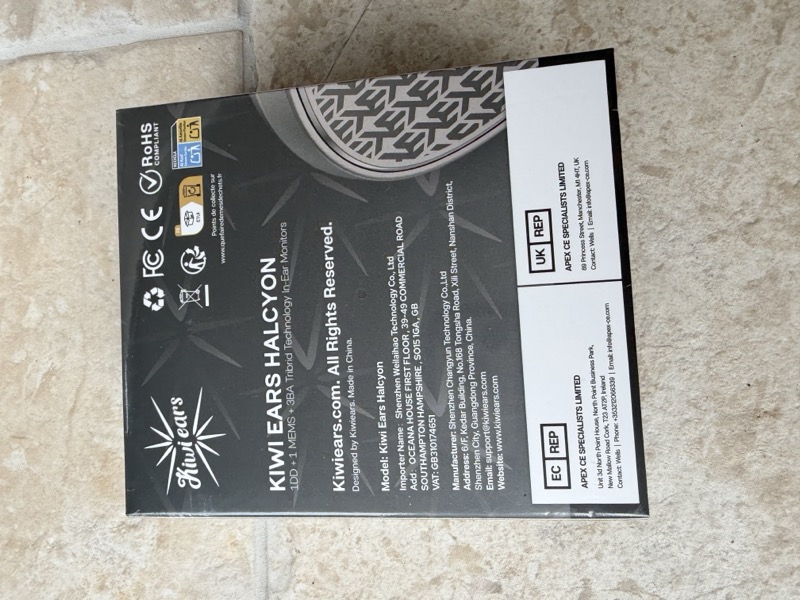
The Halcyon ships in a more premium presentation than the budget Kiwi Ears models. The front shows the chrome IEMs and bills it as a “1DD + 1 MEMS + 3 BA Tribrid”, with the side panels covering the specifications and the driver technology:
 |
 |
 |
 |
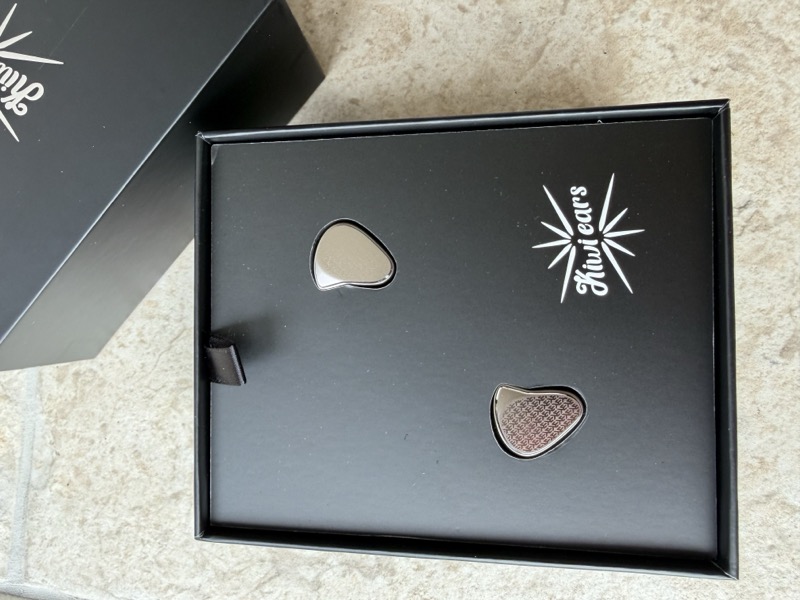
Lifting off the outer sleeve reveals a black Kiwi Ears inner box, with the IEMs presented in foam beneath:
 |
 |
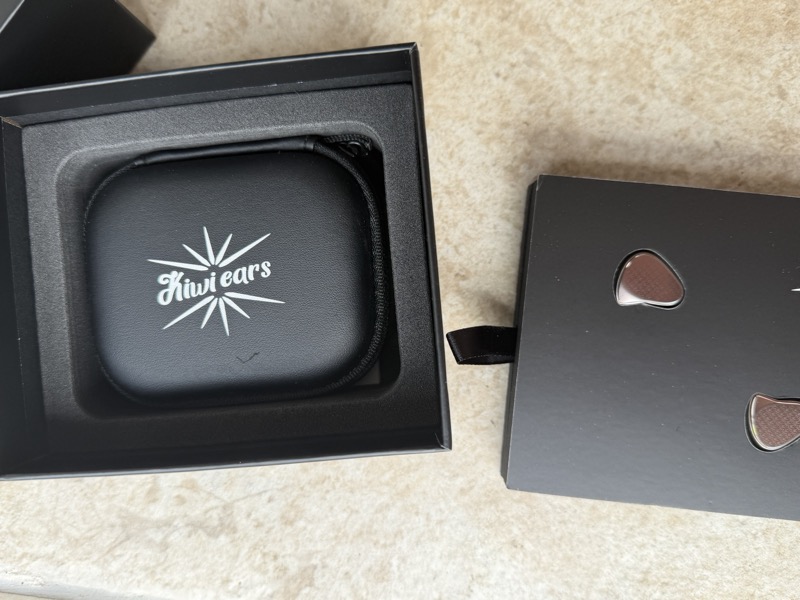
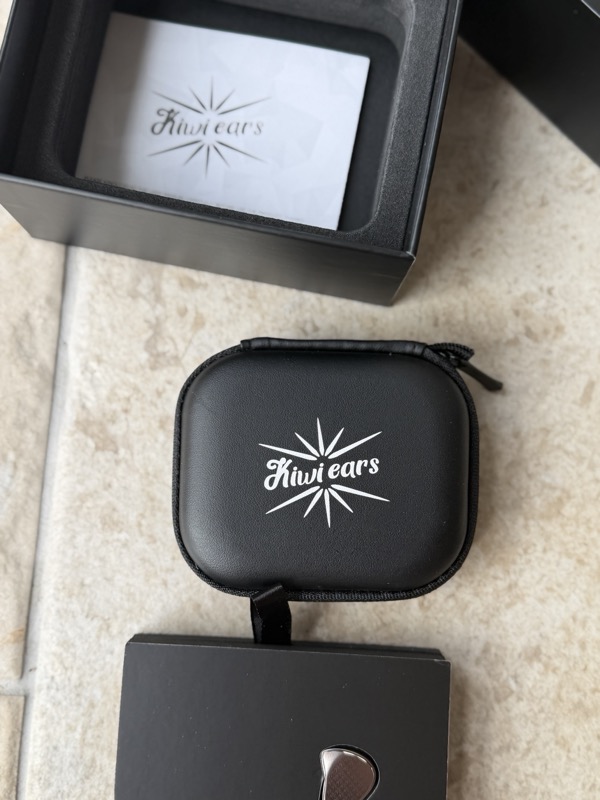
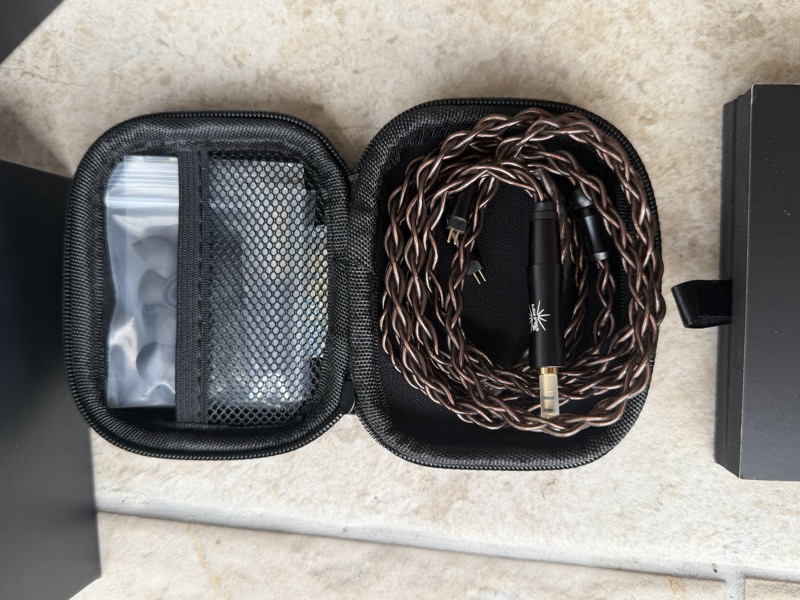
A zip-up hard carrying case is included, holding the cable and the tips:
 |
 |
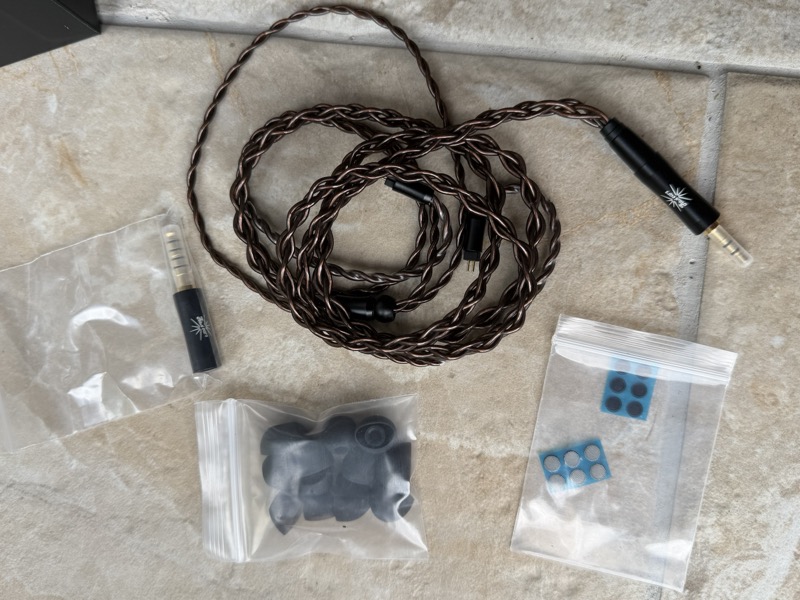
The box is well stocked:
- The Halcyon IEMs
- An interchangeable-plug cable
- 3.5mm SE and 4.4mm BAL adapters
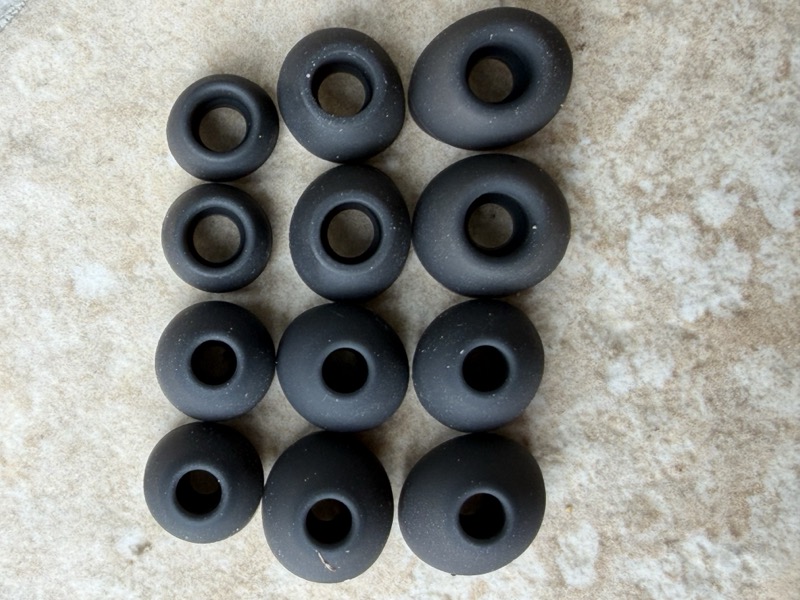
- Two styles of silicone ear tips (wide-bore and narrow-bore, three sizes each)
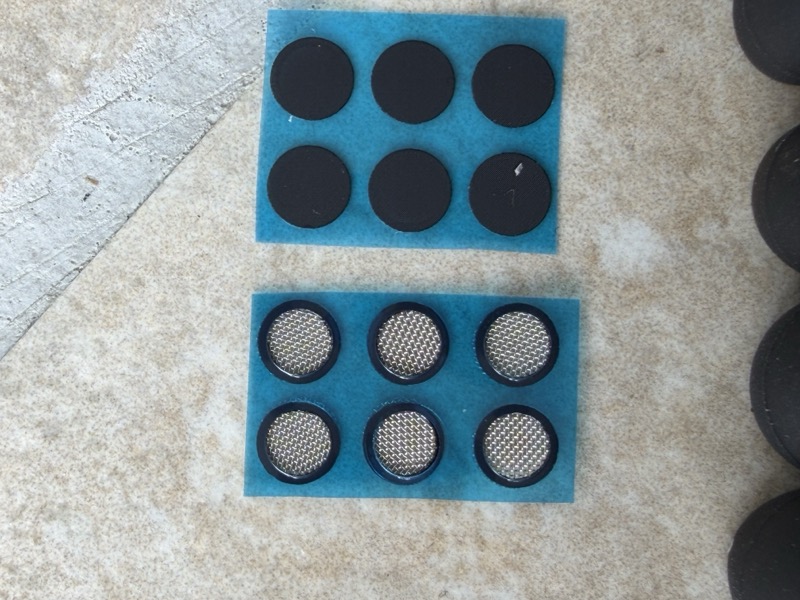
- Six replacement filters
- The hard case and documentation
Here’s everything laid out:
 |
 |
Two styles of silicone tips are included — wide-bore and narrow-bore, in three sizes each — which give you a first layer of tuning before considering EQ:
Design and Build Quality
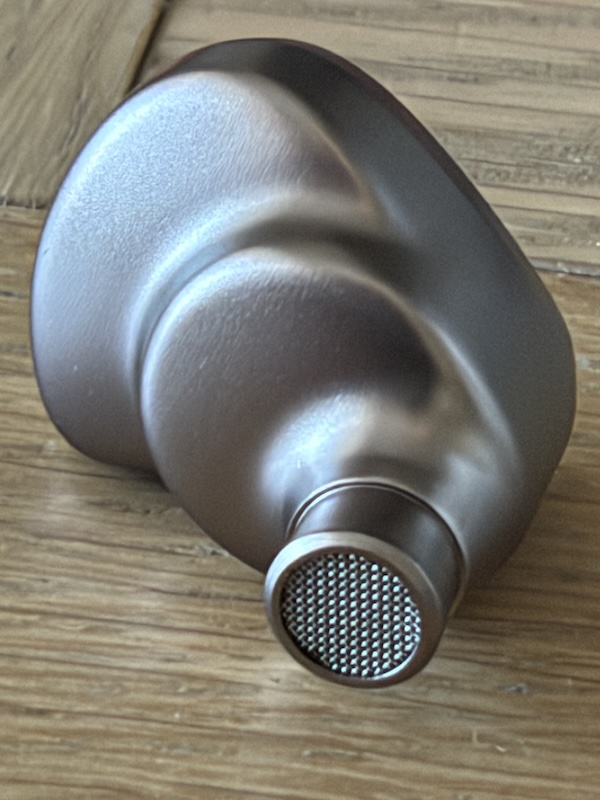
The Halcyon’s shells are CNC-machined aerospace-grade aluminium with a chrome-like finish, and at 5.99g each they are light for a metal-bodied tribrid:
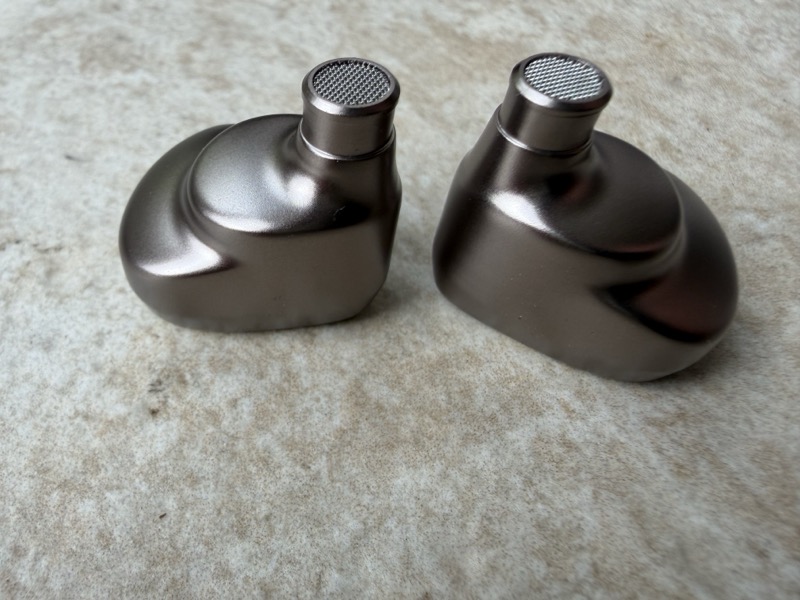
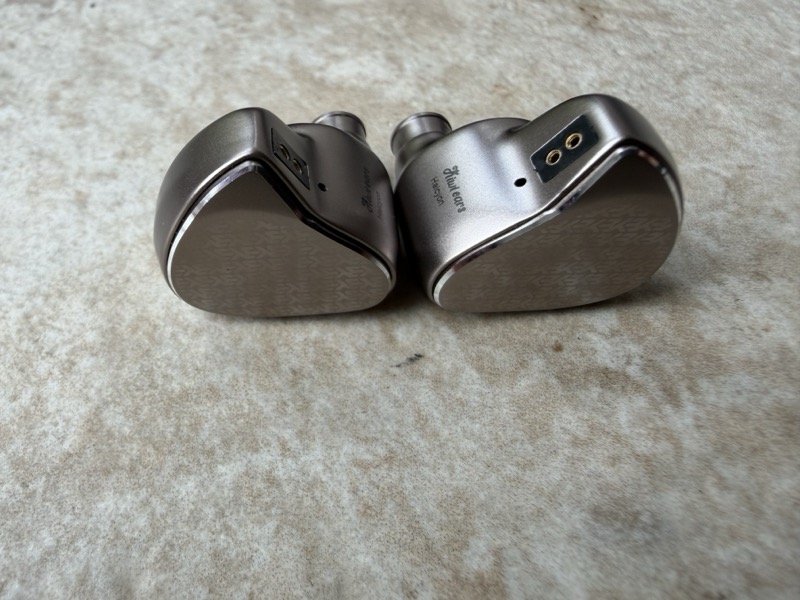
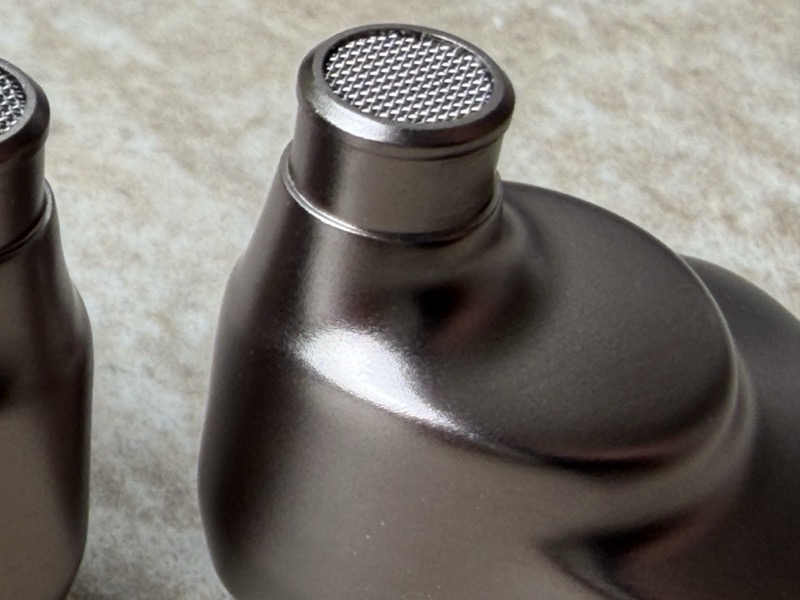
Seen from the inner side, the shape is ergonomic, with a 6.2mm nozzle topped by a mesh grille and the 2-pin socket set into the top edge:
 |
 |
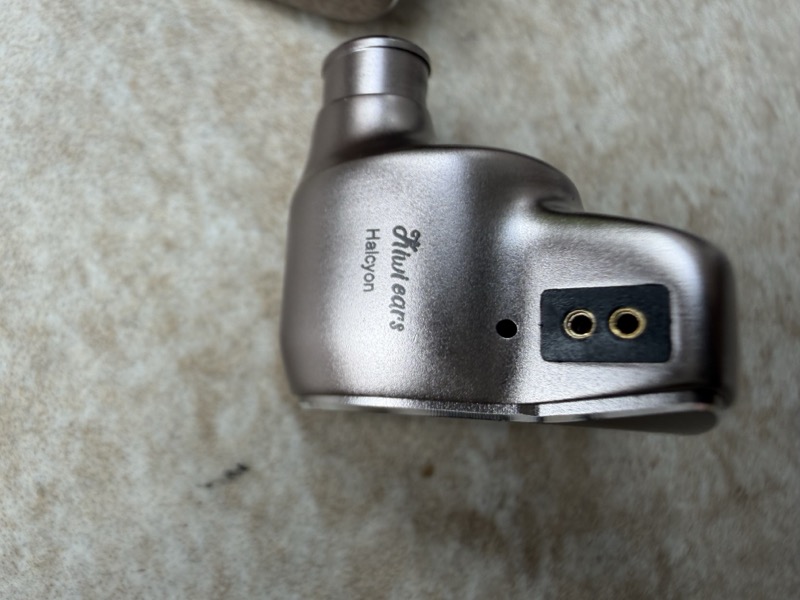
The inner side carries the “Kiwi ears Halcyon” engraving and a flush 0.78mm 2-pin socket, and the nozzle mesh is neatly finished:
 |
 |
The six replacement filters let you keep the nozzle mesh clean over time:
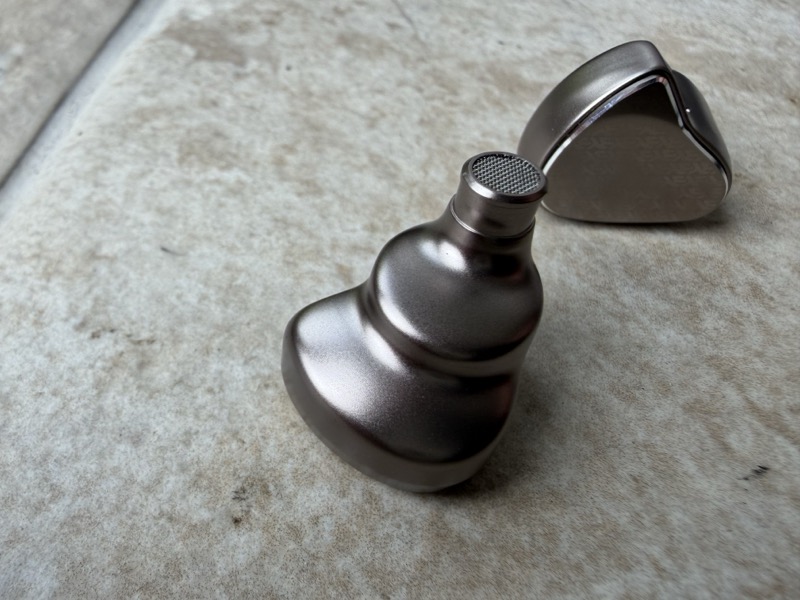
A closer look at a single shell on its own shows off that chrome-like machined finish and the mesh grille more clearly than the paired shots above:
 |
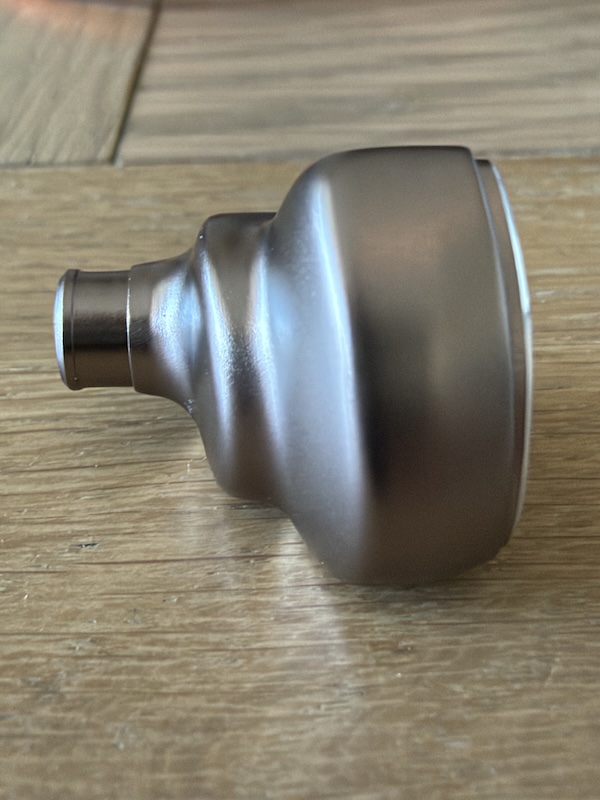 |
Set beside another IEM from the collection, the Halcyon’s shells are the rounder shape of the two, and compact with it — I think this is the smallest shell on any of the premium Kiwi Ears IEMs. Together with the 5.99g weight that makes it the most comfortable IEM I have worn for long sessions. The one thing to be aware of is that the rounded shape is slightly unusual, so not everyone will land a perfect seal first time — and on this IEM the seal is what the sub-bass depends on, so it is worth working through the eartip sizes rather than settling. Isolation was useful on a commute for me.
Here are the Halcyon shells beside a Tanchjim OLA II shell for a size comparison:
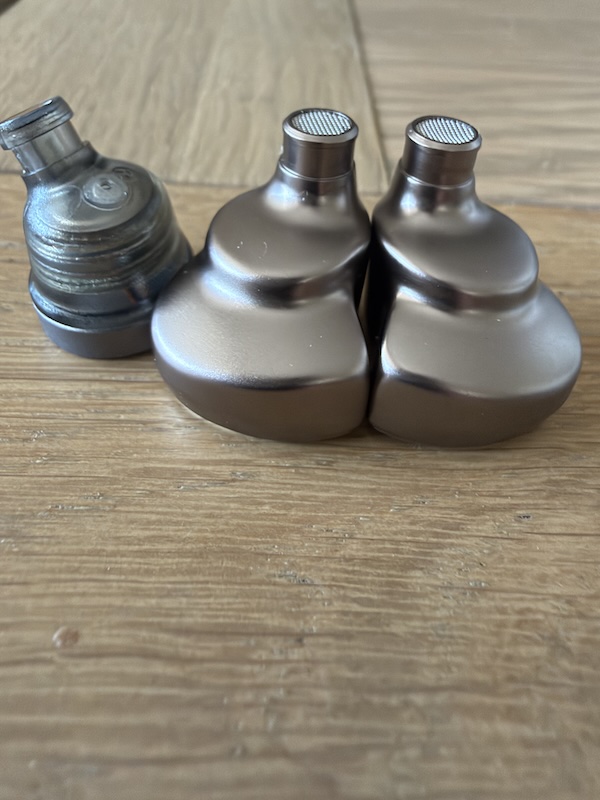
Seen from the inner side, the differences in shell profile and nozzle between these and the other IEMs I reach for most are clearer than any measurement of them:

Nozzle length and angle vary more between IEMs than people tend to assume, and that is worth keeping in mind whenever you see two of them overlaid on the same graph.
Cable and Connectivity
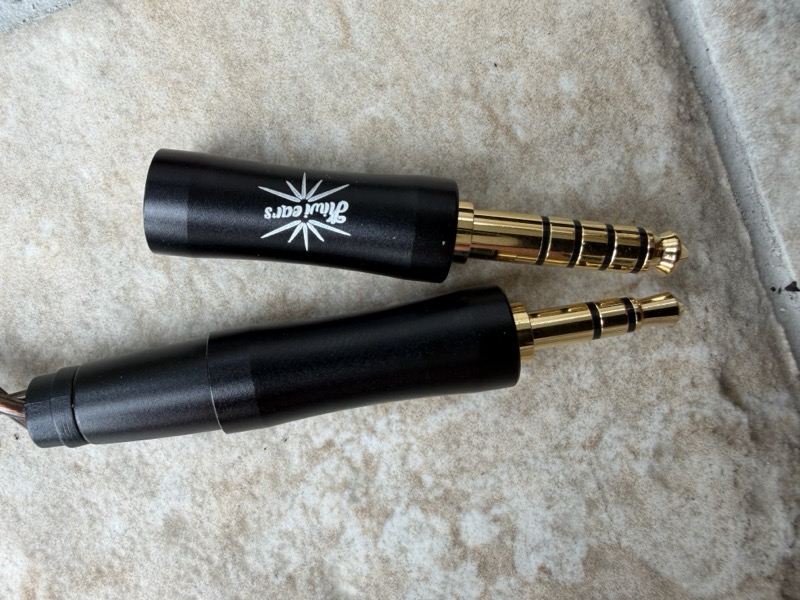
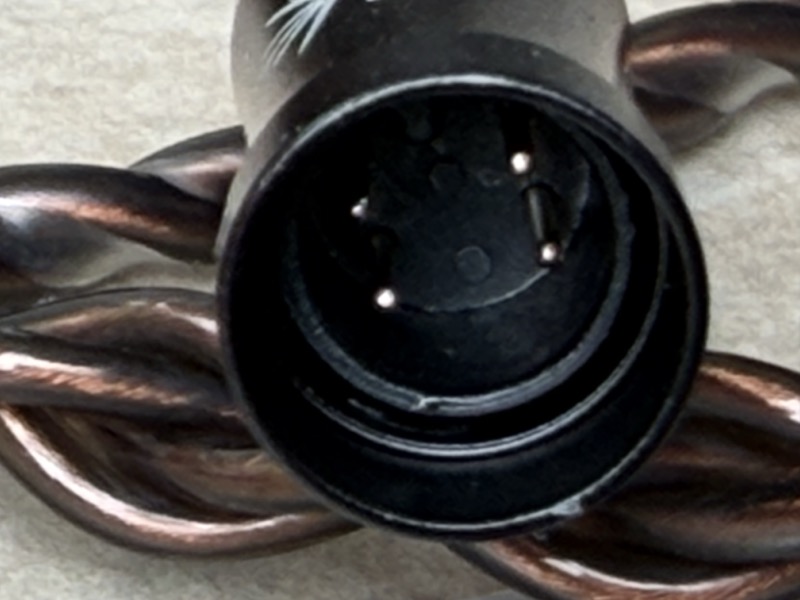
The supplied cable is a 4-core braided 4N single-crystal silver-plated copper, with a modular plug system — the connector unscrews so you can swap between the included 3.5mm single-ended and 4.4mm balanced adapters:
 |
 |
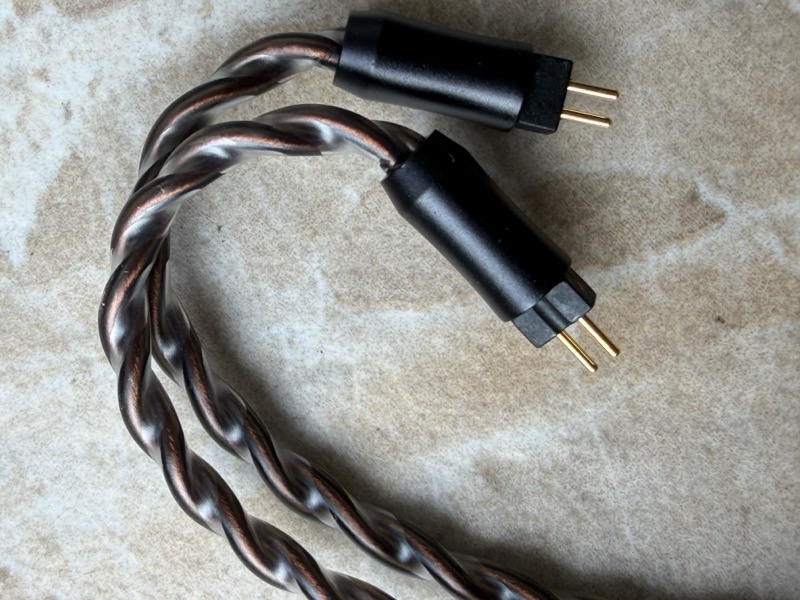
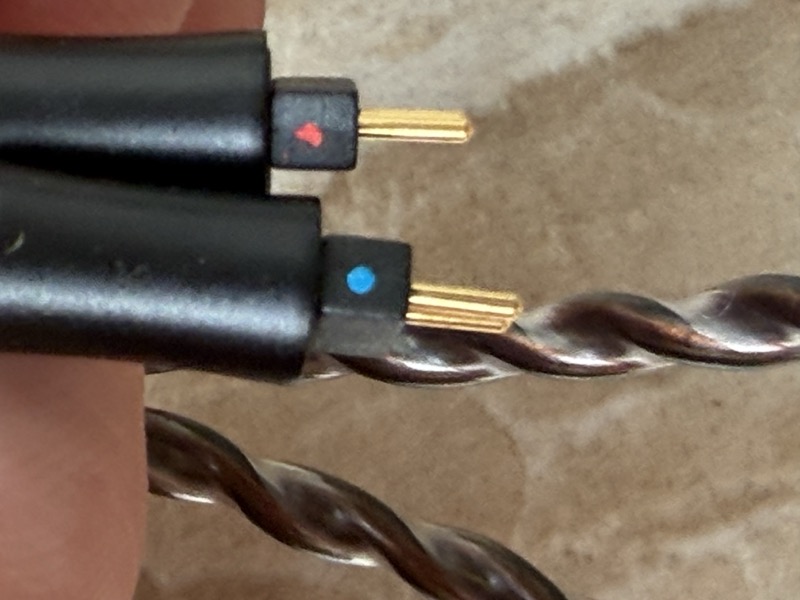
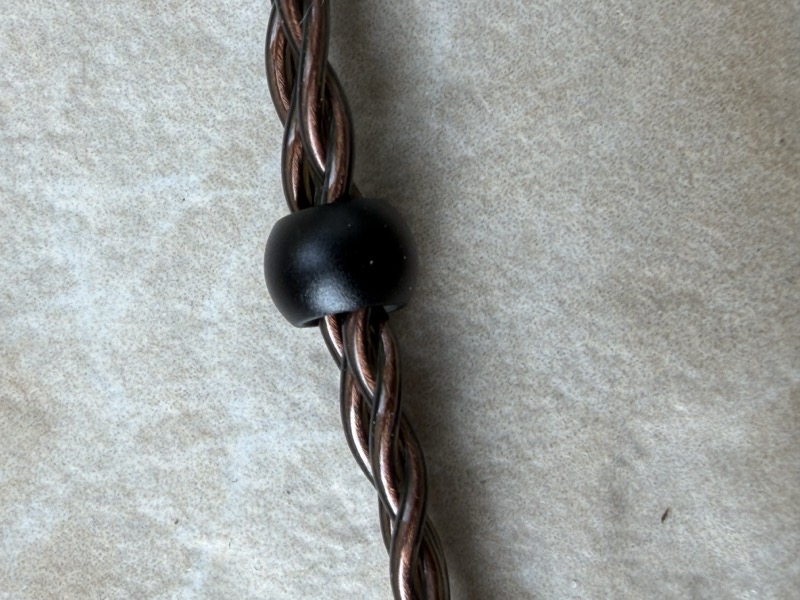
At the IEM end it uses standard 0.78mm 2-pin connectors with clear L/R polarity markers, and there is a chin slider on the cable:
 |
 |
Because the Halcyon uses a standard 2-pin system, it is also compatible with other cables — including Kiwi Ears’ optional USB-C cable with embedded DSP equalisation, which provides EQ through the editor supported by that cable, and an optional gaming boom-mic cable for calls and games. That makes it as flexible for gamers as it is for audiophiles, in the same vein as the S-Link cable. Both of those cables are sold separately — what is in the box is the modular 3.5mm/4.4mm cable and nothing else.
MEMS Driver Technology
MEMS stands for Micro-Electro-Mechanical Systems, and it is worth explaining because it is the reason this IEM exists in the form it does.
MEMS describes a manufacturing approach using microscopic electromechanical structures. Kiwi Ears describes this implementation as a silicon-based piezoelectric driver used alongside conventional dynamic and balanced-armature drivers. It still needs mechanical motion to produce sound; “solid-state” does not mean there are no moving parts.
The useful question is whether the complete IEM has a treble balance you like. MEMS, balanced-armature and electrostatic tweeters are different ways to address high frequencies, but the technology label alone does not establish resolution, speed or value.
Kiwi Ears’ claims for it are ultrasonic operating speed and near-zero phase distortion. Those are the manufacturer’s figures rather than anything I have verified — a coupler measurement cannot confirm either of them — so treat them as the design intent rather than as a result. What I can say is that MEMS drivers remain rare in shipping products, and the Halcyon is the first one I have had in a finished IEM rather than a demonstration.
One thing worth being clear about: MEMS microphones have been commonplace for years, in phones, laptops and the inline mics on plenty of budget earphones. A MEMS driver — the same technology used to produce sound rather than capture it — is the new part, and the two should not be confused.
Sound Impressions
I listened over the balanced cable from a desktop source, and also from a dongle to see whether it needed more than that. It does not. The Halcyon asks for a little more juice than a typical IEM, but nothing dramatic — the dongle I tried provided enough volume. You will just find yourself a few steps further up the volume control than usual.
The Halcyon follows Kiwi Ears’ studio-neutral house tuning, with the defining twist being the MEMS-driven top end.
Bass
There is proper sub-bass here, and it is the kind I like — it goes deep and it rumbles rather than thumping at you, and it stays where it belongs instead of smearing into everything above it. On “Limit to Your Love” by James Blake the low swells arrive as real physical weight while the rest of the track stays clean around them.
One thing matters more than usual on this IEM: get the fit right or you will not hear any of that. The Halcyon is sensitive to seal, and if you are even slightly off with the eartip size the bass is the first thing to go — it thins out and you end up wondering what the fuss is about. Work through the supplied sizes properly before you form a view on the low end. That is true of most IEMs, but it is more true of this one.
Midrange
The midrange is clean and well separated, and vocals stay clear and intelligible even with the bass doing as much as it does. Nothing is smeared and nothing is shouted at you. On “Fast Car” by Tracy Chapman the vocal sits where it should, with an even, honest presentation.
What you are hearing in the lower midrange is the Harman tuck rather than any thinness — it does not carry the extra warmth down there that has become common in the JM-1-inspired tunings a lot of makers have moved toward. Which you prefer is a matter of taste rather than one being correct; if you have been enjoying the warmer JM-1 house sound, this will read as the leaner of the two.
Treble
The treble is the part I keep coming back to, and it is where the Halcyon earns the MEMS driver. It is detailed and airy without ever being sharp — there is a real sense of space and extension up top, but it never tips into the hardness or splashiness that usually comes with chasing that kind of detail. On “Chocolate Chip Trip” by Tool the cymbal work has crispness and rapid decay while keeping its composure.
The shape of it is the part worth understanding. There is a recession in the lower treble — an approach that has become popular for good reason, because that is the region that turns fatiguing first — while the upper treble keeps real energy from the MEMS driver. You get the air and extension without the hardness that usually comes attached to it. If you want bite and sparkle pushed at you this is not that IEM, but if you are treble-sensitive I would still audition it rather than rule it out. The eartips give you room to move in either direction, as covered below.
Soundstage and Imaging
This is a strong area. There is genuine separation and layering, the stage is larger than I expect from an IEM at this size, and placing instruments within it is easy. On “Hotel California” by the Eagles the instruments sit clearly apart from each other with precise placement. The overall character is composed and unforced rather than explosive — it presents detail rather than throwing it at you.
Eartips
The Halcyon ships with two tip styles — wide-bore and narrow-bore, three sizes each — and swapping between them changes the treble subtly. That is worth knowing, because it means you have a way to adjust the top end without reaching for EQ at all. If you want a little more or less treble than the stock setup gives you, try the other tips before you touch a filter.
One minor observation while I am here. The selection is good, but having recently reviewed a few sub-$100 IEMs that ship with more generous tip sets, I was mildly surprised by what Kiwi Ears include at this price. It makes no difference to me personally — I use third-party tips on almost everything — but if you rely on the supplied set, it is worth knowing there is a little less choice here than the price might lead you to expect.
Comparisons
The overlays below come from my own coupler measurements; the full measurement set, and the caveats that go with it, follow in the next section.
The Kiwi Ears Astral is the obvious comparison, since it is the closest thing in the same house tuning:
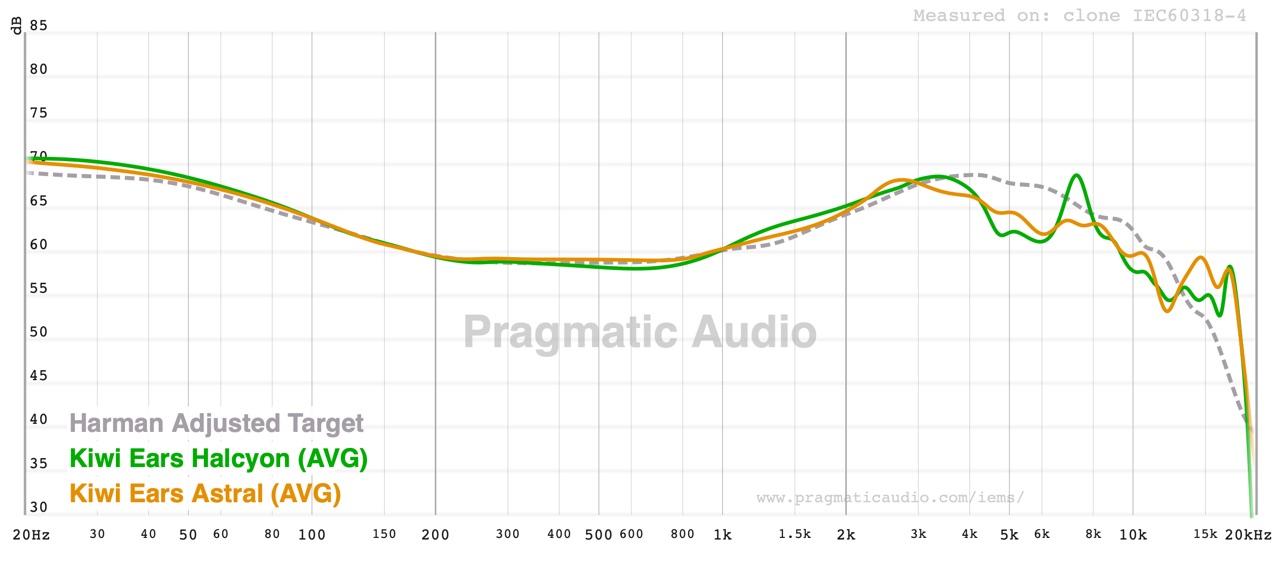
The bass and midrange of the Halcyon and Astral track closely in this overlay. The more obvious differences are in the treble, where I prefer the Halcyon’s balance. I would not attribute that preference to MEMS alone: the graph shows the combined output of all the drivers, and the highest-frequency features depend on insertion. Build is another difference — the Astral uses transparent resin and the Halcyon aluminium.
Against the Juzear Nimbus:
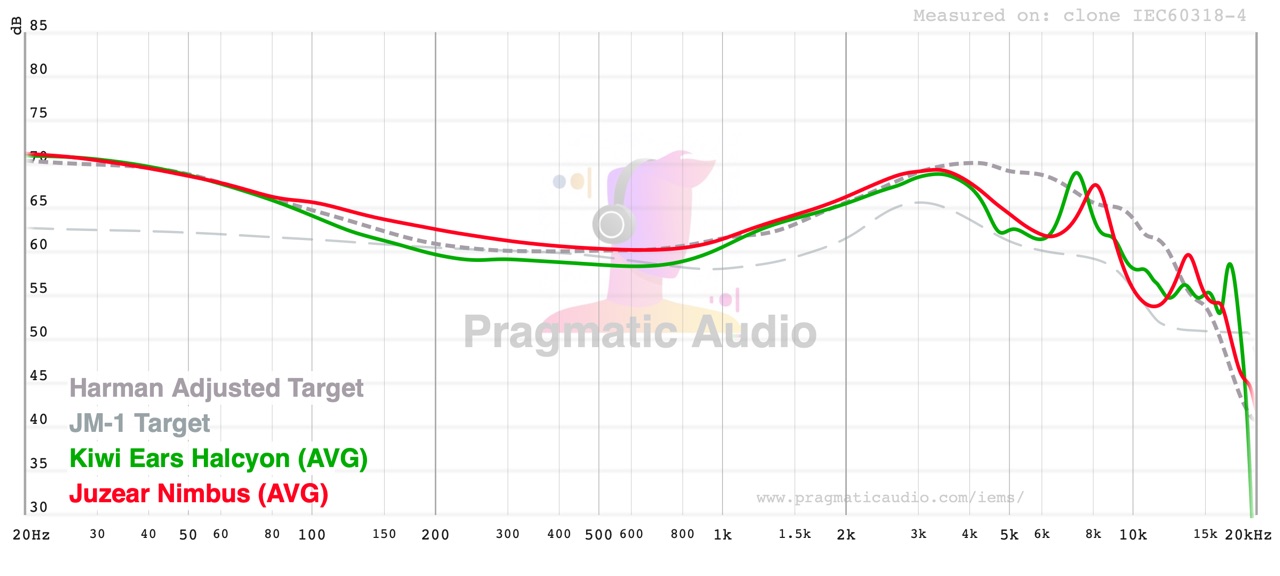
The Halcyon has more deep-bass output on this graph. The Nimbus carries more energy through parts of the lower midrange, so the two differ in both bass balance and vocal body.
Here they are together — the Daybreak on the left, the Halcyon top right and the Astral below it:
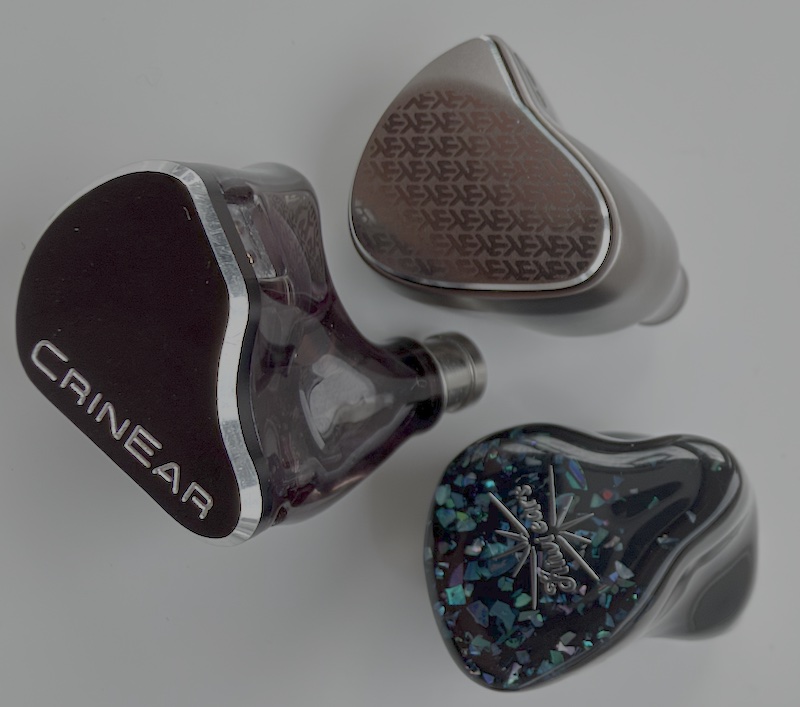
The size difference matters on its own: the Daybreak is a considerably larger shell than either Kiwi Ears, which is part of why it fits differently and, as noted above, why comparing measurements across shells of different geometry needs a little caution.
And against the CrinEar Daybreak:
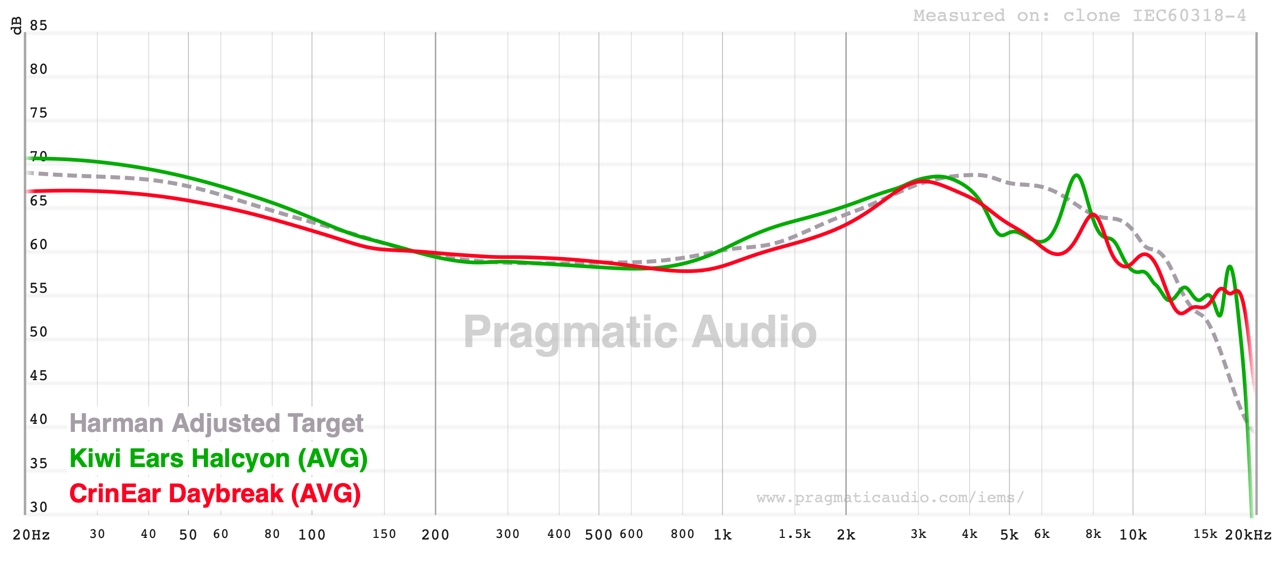
The Halcyon is the bassier of the two by a clear margin, and carries a little more presence-region energy through 1–2.5kHz. The pinna gain is almost identical.
Other Kiwi Ears alternatives
The current Kiwi Ears line-up, faceplates up:
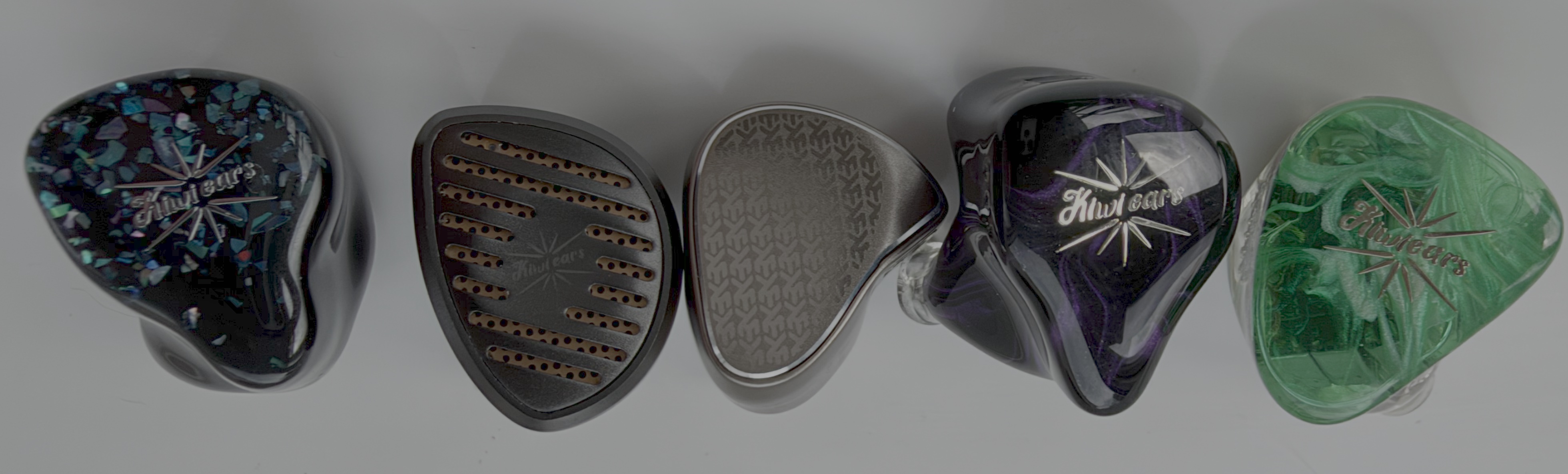
The family photo is useful for comparing shell shapes. For a purchase decision, the Septet and Orchestra II are also worth considering; the linked reviews provide the listening and measurement context.
Driver count does not decide that comparison. I would choose between them on tuning, fit and the accessories I actually need.
Specifications and Measurements
Specifications
| Specification | Value |
|---|---|
| Driver configuration | 1DD + 3BA + 1 MEMS tribrid |
| Bass driver | 1 × 10mm composite diaphragm dynamic |
| Midrange drivers | 2 × customised DEK-series balanced armature |
| Treble driver | 1 × customised WBFK-series balanced armature |
| Upper-treble driver | 1 × MEMS solid-state |
| Rated impedance | 29Ω |
| Sensitivity | 109dB/mW (at 1kHz, manufacturer specification) |
| Maximum power handling | 10mW |
| Frequency response | 10Hz – 42kHz |
| Distortion | <1% (at 1kHz) |
| L/R channel imbalance | <1.5dB |
| Connector | 2-pin, 0.78mm |
| Jack | Modular — 3.5mm single-ended and 4.4mm balanced |
| Cable material | 4N single-crystal silver-plated copper, 4-core braid |
| Cable length | 122cm (±2cm) |
| Nozzle size | 6.2mm |
| Weight | 5.99g (each) |
| Shell | Aerospace-grade aluminium |
| In the box | IEMs, interchangeable-plug cable, 3.5mm + 4.4mm adapters, 2 styles of silicone tips (3 sizes each), 6 replacement filters, hard case, warranty card, manual |
The figures above are Kiwi Ears’ own published specification. My own measurements follow below.
All the measurements below were taken on my own clone IEC60318-4 coupler. You can open them interactively, and overlay the Halcyon against anything else in the database, on the Pragmatic Audio measurement page.
Frequency Response
Here is the Halcyon against the Harman Adjusted and JM-1 targets, both channels shown:
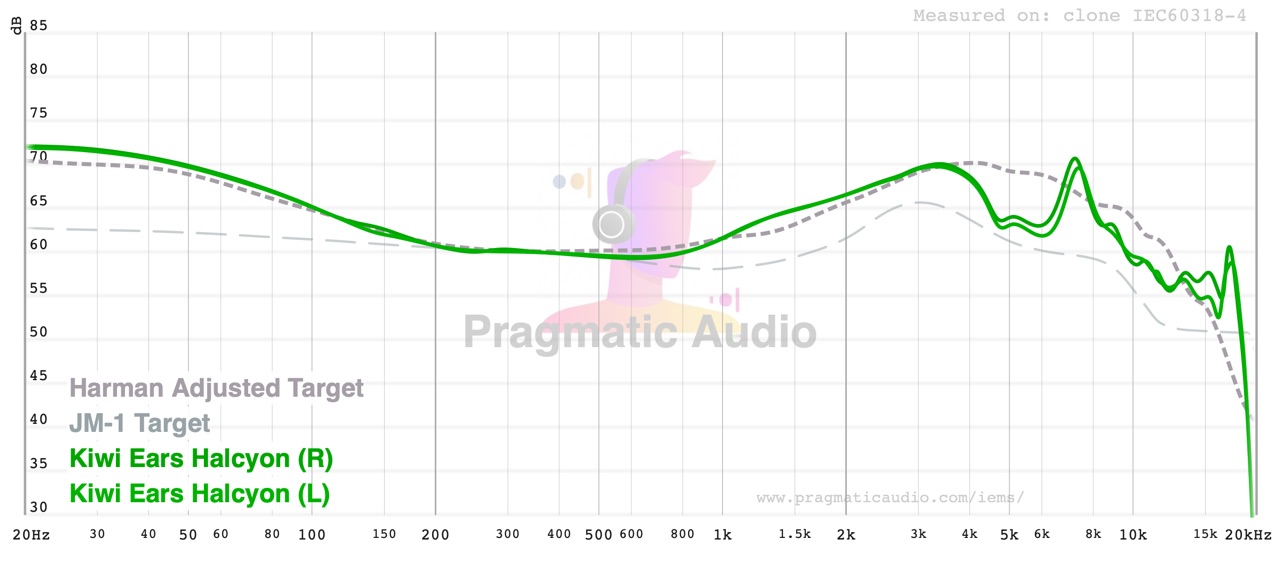
The bass tracks Harman closely, with that typical Harman “tuck” where the shelf returns to the target before it reaches the midrange. Channel matching is excellent — the two traces sit on top of each other. It is a very similar picture to my favourite recent Kiwi Ears, the Astral.
I prefer the Halcyon’s treble balance in listening. The dip through the lower treble is visible here. The narrow peak just above it, around 7.5kHz, is a typical measurement artefact rather than a feature of the tuning: peaks in the 7–8kHz region move with insertion depth and the coupler’s own resonance, and I did not hear anything corresponding to it. Measurements above roughly 10kHz are particularly uncertain on this rig, so they do not prove superior extension or MEMS resolution.
Distortion
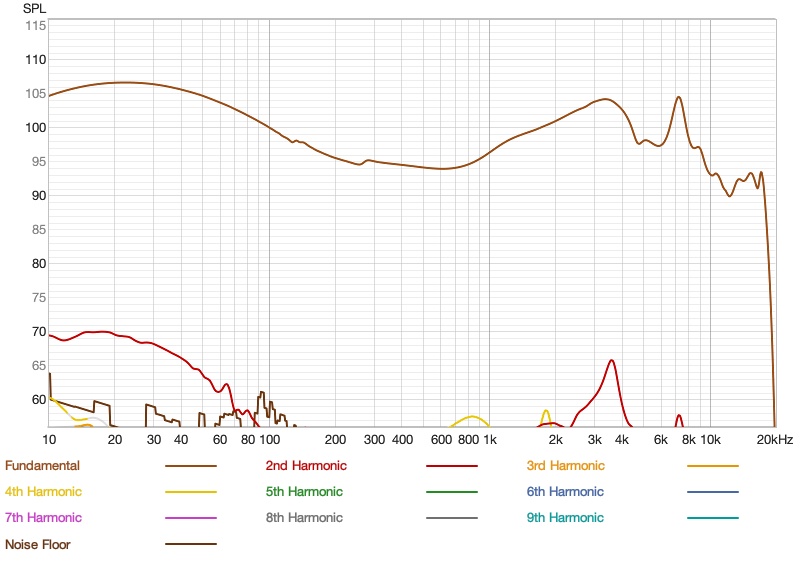
Distortion was measured at a deliberately high level — the fundamental sits between roughly 95dB and 105dB SPL across the sweep, which is louder than I would actually listen:
 |
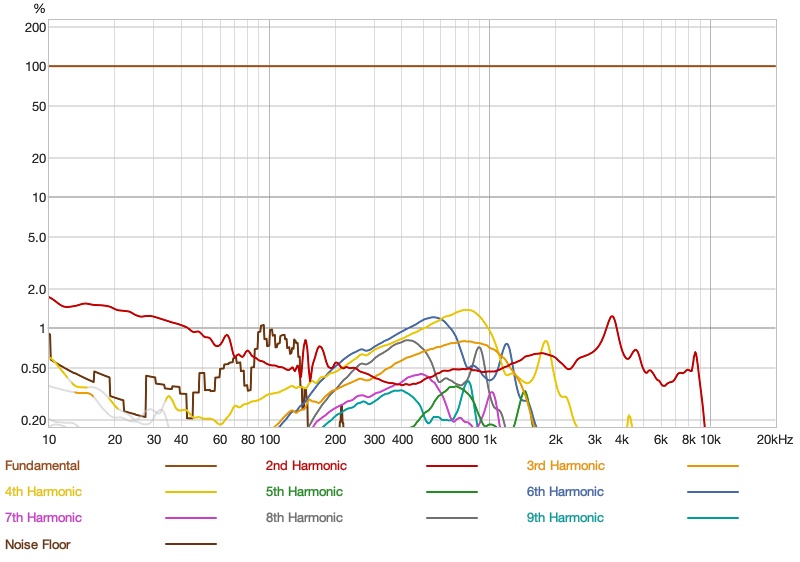 |
Read as a percentage, second-harmonic distortion sits around 1.5–1.8% in the lowest bass, falls to about 1% by 60–100Hz, and settles near 0.5% from 200Hz through 2kHz, with a rise to roughly 1.2% around 3kHz. Some higher-order traces rise above 1% in parts of the midrange, so this is not a uniformly sub-1% result.
The plotted harmonics at 1kHz appear below 1%, but this is not a direct verification of Kiwi Ears’ THD specification without matching its test conditions and summing the harmonics. The higher bass distortion was captured at a loud test level; I have not shown a level sweep here.
Rating Explanation
The Pragmatic Rating of 5 reflects a tribrid that backs up its ambitious technical premise with a coherent result rather than a driver count for its own sake. The treble resolved fine detail for me — cymbal texture and decay stayed separable — and I did not hear hardness on my sample. The 10mm dynamic gives a clean, weighty sub-bass shelf without muddying the mids, and I hear the midrange as natural: the studio-neutral tuning with its measured sub-bass boost is well judged. The aerospace-aluminium build is light and solid, the accessory set is generous, and the standard 2-pin system means it can become a gaming headset or a tunable EQ platform if you buy the optional USB-C DSP or boom-mic cable, and a straightforward balanced IEM if you do not.
At $259 it sits in a competitive mid-fi bracket, which is the main thing to weigh — this is no longer the $199 Kickstarter bargain. The measurement rating reflects what the graphs actually show: a bass shelf that extends fully to 20Hz and returns to target by 200Hz, and pinna gain that lands on Harman at 3kHz. It is held to four rather than five by the 4–6kHz recession, which is a deliberate voicing choice rather than a fault, but is the place the response departs most from the target.
This one is for the listener who wants a technically advanced, studio-neutral tribrid whose treble balance I particularly enjoy, and who values the flexibility to run it balanced, over USB-C with DSP EQ, or with a gaming mic.
Conclusion
The Halcyon is my favourite of the Kiwi Ears products discussed here. I like the sub-bass weight, clear midrange and airy treble, and its shell is especially comfortable for me. MEMS makes the design interesting, but it is the complete tuning and fit that justify the recommendation.
At $259, I would choose it if you share those tuning preferences and want the supplied modular cable. The optional DSP and microphone cables add flexibility, but cost extra. Seal sensitivity remains a reason to try it in your own ears before treating my enthusiasm as a guarantee.
The MEMS driver got the Halcyon noticed. Everything around it is what makes it worth keeping.