Chord Mojo 2
Four Spheres, Three Chords, Two Mojos and the Truth
A British portable DAC and headphone amp built on Chord’s own FPGA, with four-band tone control in the box — no app, no driver, no website.
Almost every portable DAC I have reviewed recently is built around a DAC chip you can look up — a CS43198, an ES9027PRO, an AK4493. The Mojo 2 is not. Chord Electronics design their own conversion in an FPGA, running a proprietary WTA (Watts Transient Aligned) interpolation filter, and the number they care about is tap length rather than SINAD. In the Mojo 2 that filter runs 40,960 taps across 40 DSP cores, up from 38,912 in the original Mojo. Teardown photos from Headphones.com show a Xilinx Artix-7 FPGA doing the oversampling and DSP and driving a discrete pulse-array converter, with an ATSAM3U1C microcontroller that is most likely the USB receiver. They also show a small analogue output stage between the headphone jacks. Despite a common belief to the contrary, Chord DACs do have an output stage; it is just kept as short as possible.
The other reason it is interesting is the onboard EQ. Chord call it UHD DSP and describe it as lossless — four shelving bands you can adjust from the device itself, with no app, no driver and no host software involved. That is an unusual thing to find in a portable at any price, and it is the feature I most wanted to put alongside the app-driven PEQ that cheap dongles now ship with.
I would like to thank Chord Electronics for providing the Mojo 2 for the purposes of this review.
If you are interested in finding more information about this product, you can find it at the official Chord Electronics product page.
Chord list the Mojo 2 in pounds, at £395. At the time of writing, US dealer Bloom Audio list it at $650, and European retail is around €499 (the price quoted by fairaudio when the 4.4 mm revision was announced in December 2025), with street prices from about €495. UK retailer Richer Sounds currently lists it at £395 — matching Chord’s own price — and at €479 in Europe, a little below the €499 quoted at launch (both checked September 2026). That is a rare direction for a product to move in: more inputs, more memory, a balanced connector option, and a lower European price than it launched at less than a year ago. The unit here is the revised 2025 version, which replaces one of the two 3.5 mm outputs with a 4.4 mm (pseudo-balanced) socket and enables the USB-C port for charging as well as data. It is sold in black only.
I have been curious about one specific thing since Chord announced this revision: is the Mojo 2 still a genuinely top-tier DAC in 2026, or has the last few years of cheap, capable dongles quietly caught up to it?
After two months with it, my answer turned out to be less about the DAC and more about how I use EQ. I started out assuming I always needed advanced PEQ. I now think the simplest route to the best sound is to buy a headphone that is already good, especially through the midrange — the Sennheiser HD600, the HEDD Audio HEDDphone D1 or the FiiO FT1 — and then tweak it with a tool like the Mojo 2. You end up with two quality products: a decent headphone, made to sound exceptional by a few small adjustments. First, though, the box.
Unboxing and Build Quality
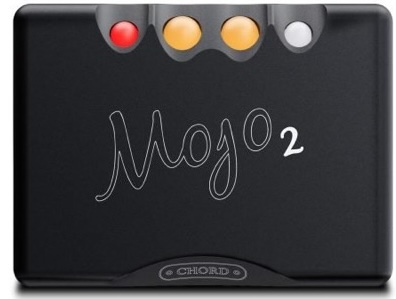
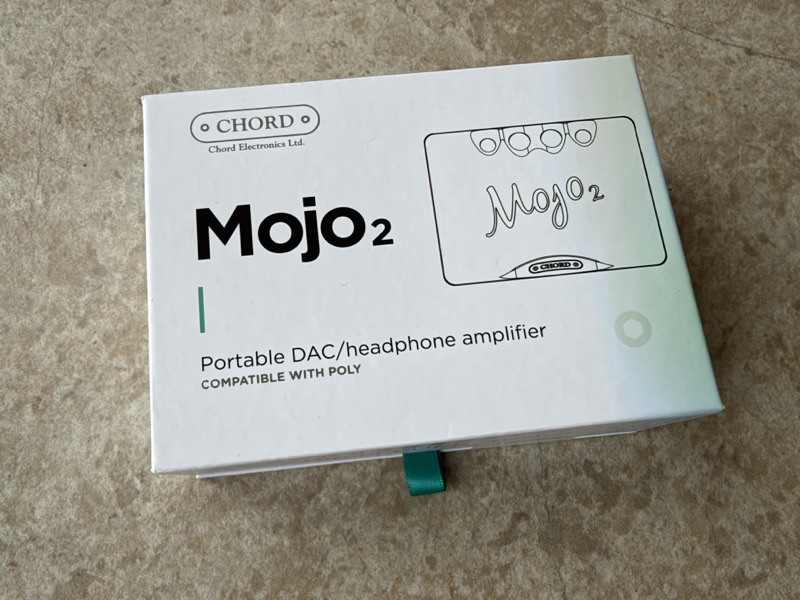
The packaging is plain white card with a green pull ribbon, and the only decoration on the lid is the Chord logo and a line drawing of the four control spheres:
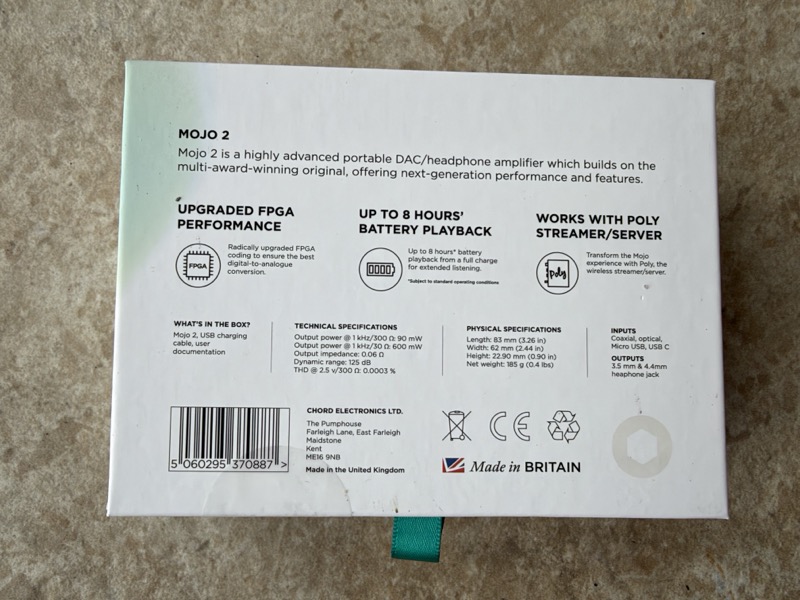
The rear of the box is the most useful surface on the whole package, because Chord print the specification there rather than making you find a PDF. It lists the upgraded FPGA, “up to 8 hours’ battery playback” with a footnote that this is subject to standard operating conditions, and Poly compatibility, alongside the power output, dynamic range and distortion figures:
The side of the sleeve carries the phrase Chord have used on this line for years:
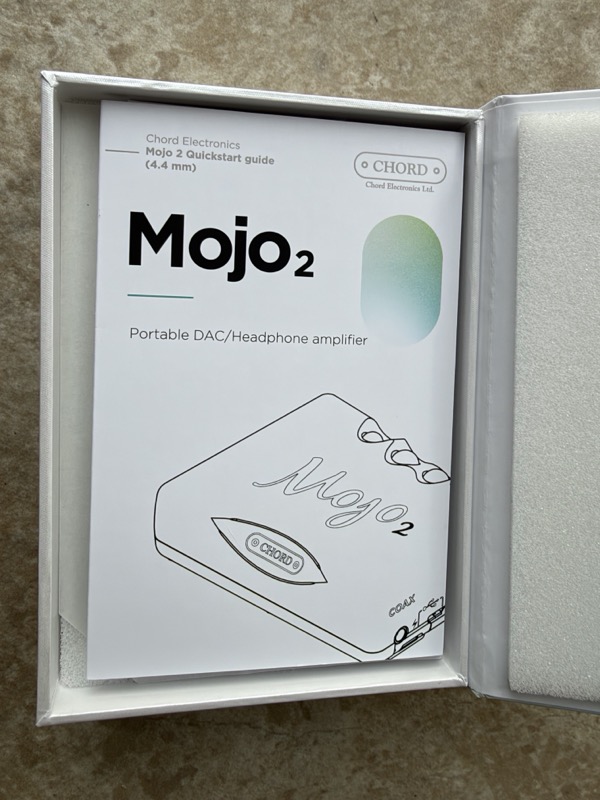
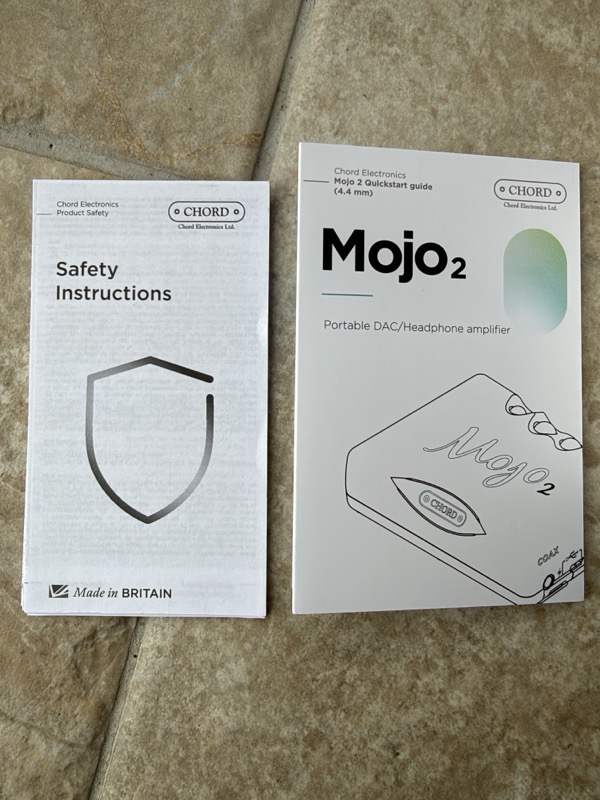
Lift the lid and the quickstart guide sits on top of the foam tray. The cover is titled “Mojo 2 Quickstart guide (4.4 mm)” — that bracketed suffix is how you tell the revised unit from an older one before you have even seen the sockets:
 |
 |
Under the paperwork the Mojo 2 sits in a moulded foam bed, top face up, with the four spheres recessed into the front edge:
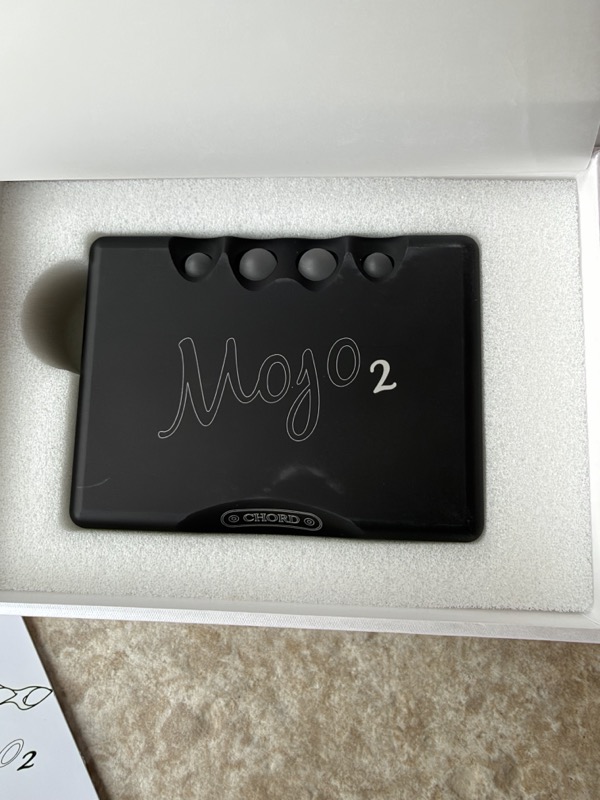
The box contents are exactly what Chord print on the back: the Mojo 2, a USB charging cable and the user documentation. That is it — no case, no adapters, no optical or coaxial lead. The supplied cable in this box is a short USB-A to micro-USB lead, so if you intend to charge over the USB-C port you will be using a cable you already own:
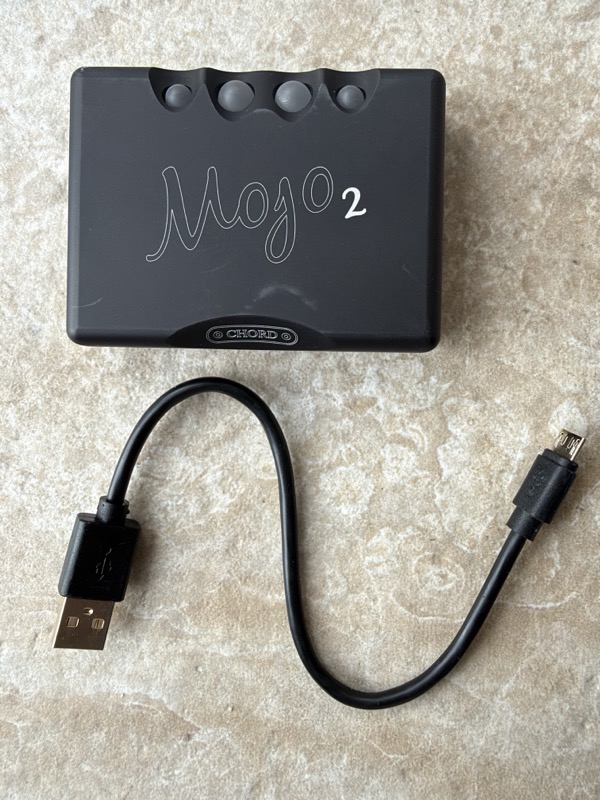
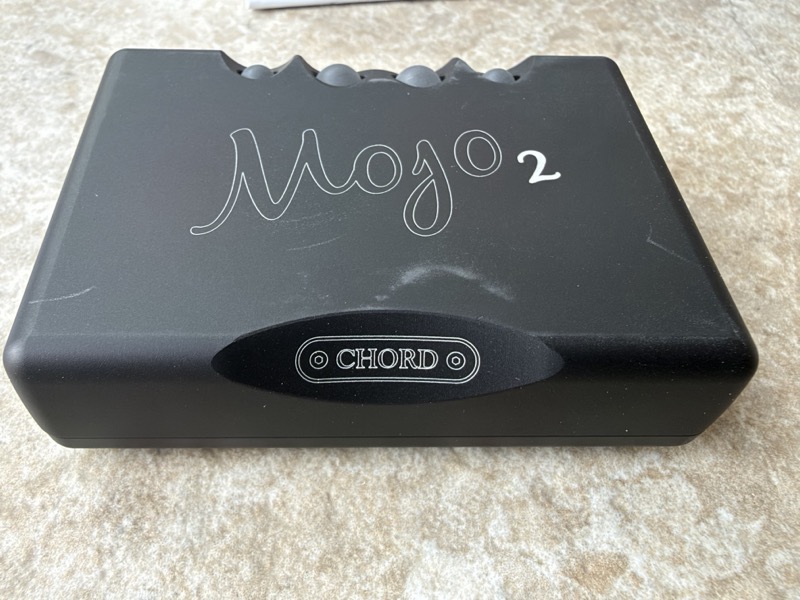
The chassis is machined aluminium and the finish is a fine matte black that shows fingerprints and light scuffing readily, and you can see both in these photographs. At 83 × 62 × 22.9 mm and 185 g it is a thick, dense slab: pocketable in a jacket, awkward in jeans, and heavy enough that strapping it to a phone makes the phone feel like an accessory rather than the other way round. The rounded corners and the moulded Chord badge on the front face are the same industrial design language as the original Mojo:
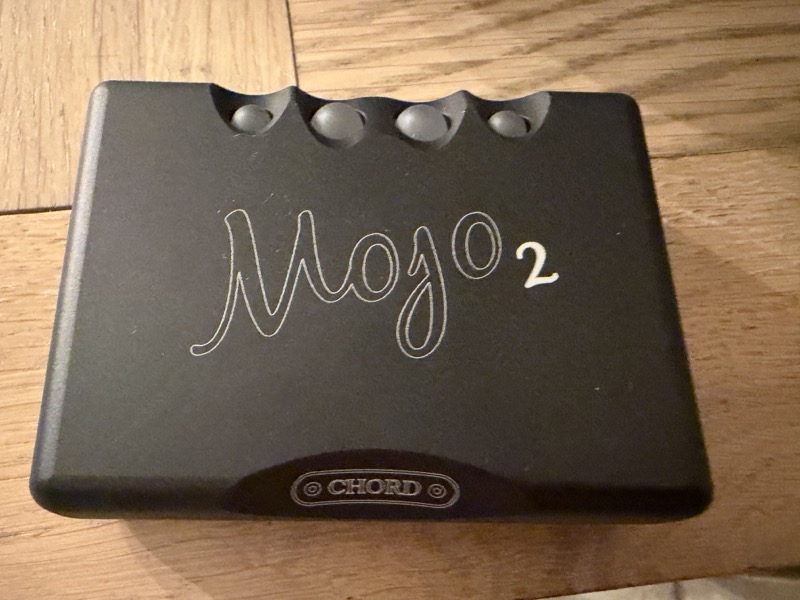
Away from the studio lighting, it looks exactly as at home on a desk as the marketing suggests — the matte black finish and rounded spheres read a little differently in daylight on a wood surface than they do under the earlier product shots:
Features and Performance
The Four Spheres
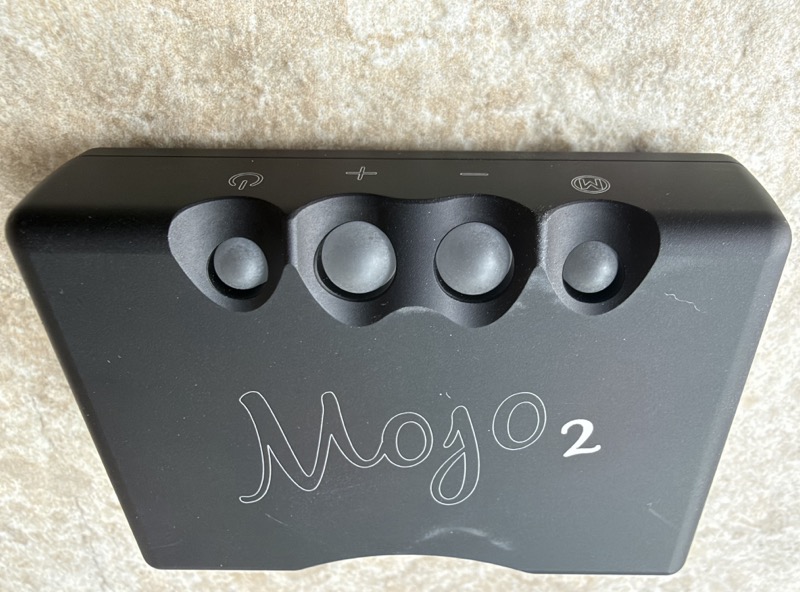
The control interface is the thing everyone forms an opinion about first. Four polycarbonate spheres sit in scallops along the front edge, marked from left to right with a power symbol, plus, minus, and an M for menu. The two centre balls are volume; the outer left is power and the sample-rate indicator; the outer right is the menu button added for the Mojo 2:
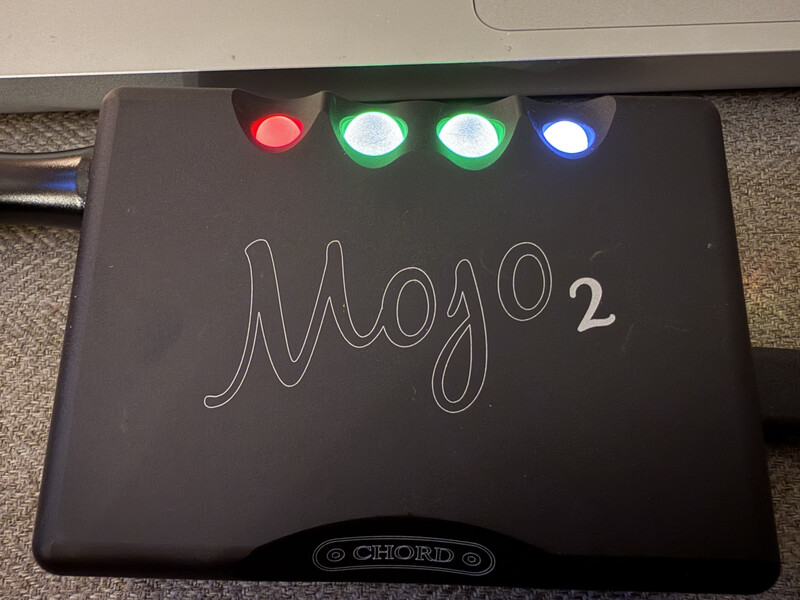
The spheres are also the display. There is no screen anywhere on the Mojo 2, so every piece of state is communicated by the colour the balls glow — the power sphere colour tells you the incoming sample rate, and the volume spheres change colour through the range to indicate level. The marketing image above shows this in action. Whether that is charming or maddening depends entirely on how well you remember a colour chart, and it is the single most divisive design decision in the product.
My verdict after two months: if you own several headphones, learning the colour codes is well worth the effort. Once I had read the guide, the menu sphere made the whole system much easier, because it always tells you which setting the plus and minus spheres are currently changing. If you only ever adjust volume, there is far less to learn.
This is what you are reading in practice — four spheres, four colours, no labels:
UHD DSP Tone Controls
The menu sphere is what makes the Mojo 2 different from the original Mojo. Each press steps through a menu that exposes four EQ bands, a crossfeed setting and the various configuration options. Chord’s documentation describes the EQ as shelving controls rather than parametric bands: a low shelf around 20 Hz, a second bass shelf at 125 Hz, a mid/upper-mid shelf at 3 kHz and a treble control up to 20 kHz, each adjustable ±9 dB in 1 dB steps. Chord describe the implementation as lossless, meaning the DSP is done at high internal precision inside the FPGA rather than by decimating the signal to make room for the gain.
Since the entire argument for this feature rests on how easy it is to reach, here is what adjusting it actually involves.
Press the menu sphere and it steps through the menu one item at a time, the sphere changing colour to tell you where you are. The four EQ bands sit in that cycle alongside crossfeed, button brightness and the lock setting. Land on the band you want, then use the same plus and minus spheres you use for volume to move it — each press is 1 dB, up to nine steps in either direction. There is no confirmation step and nothing to save: the setting is stored as you make it, and a band is flat when neither the plus nor the minus sphere shows a colour. When you are done, pressing through the rest of the cycle drops you back to normal operation and the volume buttons go back to being volume buttons.
That is the whole procedure. No host software, no menus on a screen, no pairing — and once you know which colour is which band, a two-decibel bass lift takes about four seconds without looking away from what you are doing.
The catch is in that clause. Because there is no screen, every step of this is communicated by colour, so the first while with the Mojo 2 involves the quickstart guide open beside you while you work out that yellow means the 125 Hz shelf. It is a real learning curve and it is the price of the no-screen design. Once it is muscle memory it is genuinely faster than any app.
Here is the cycle as Chord’s guide lays it out. It is the chart I would have liked printed on the underside of the unit:
| Menu sphere | What plus and minus do |
|---|---|
| Unlit | Volume, low gain |
| White | Volume, high gain |
| Dark blue | Minus cycles button brightness; plus cycles crossfeed (red minimum, green moderate, blue maximum, unlit off) |
| Red | 20 Hz shelf — deep bass |
| Yellow | 125 Hz shelf — mid-bass |
| Green | 3 kHz shelf — presence and lower treble |
| Light blue | 20 kHz shelf — upper treble and air |
| Purple | Press plus and minus together to lock every button |
In each of the four EQ bands, plus lifts and minus cuts, up to nine 1 dB steps either way. Gain is set from the volume control itself: press minus once more at zero volume for low gain, or plus once more at full volume for high gain, and turn the volume down before you swap headphones. Pressing plus and minus together mutes the output. The menu returns to volume on its own if you leave it alone for a while.
This chart shows the range each coloured band covers at its full ±9 dB, and it is the reason I call them shelves rather than bands:
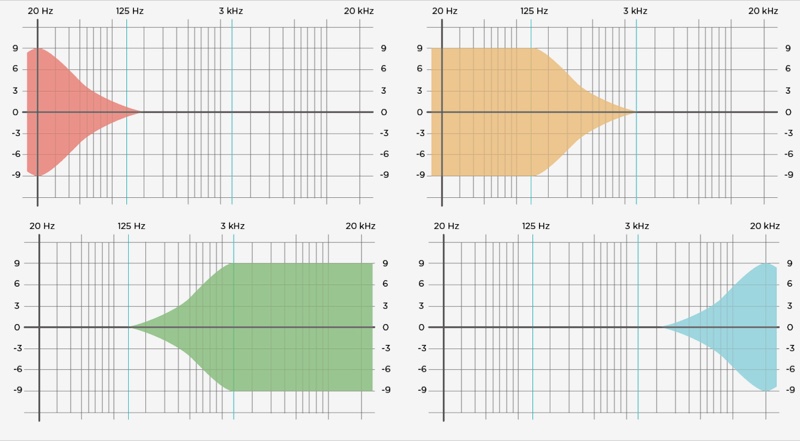
Red is a deep-bass control that is strongest at 20 Hz and has faded out by about 125 Hz. Yellow holds its full effect from 20 Hz up to 125 Hz and tapers off by 3 kHz, so it moves the whole bass region rather than just the bottom octave. Green mirrors it from the top, rising from 125 Hz to full effect from 3 kHz upwards. Light blue only starts above about 5 kHz and peaks at 20 kHz. In practice, red is the band for the kind of sub-bass lift I wanted on the HD600 and the ZenCarb, yellow is the broader “more or less bass” control, and green and light blue split the treble between the presence region and the air above it.
The practical consequence is that you get tone controls that travel with the device. Set them once and they apply to whatever source you plug in — a phone, a laptop, a CD transport over coax, an optical feed from a TV — with no app on the host and nothing to reinstall. That is a genuinely different proposition from dongle PEQ, which is configured by a host application and, on most dongles, is stored on the device but set up through Windows, Android or iOS software.
It is also a much blunter instrument. Four shelves are not ten parametric bands: you cannot put a 3 dB cut with a Q of 3 at 5.6 kHz to kill a specific peak, which is exactly the job people use PEQ for on headphones and IEMs. The Mojo 2’s EQ is for shaping a broad tonal balance, not for correcting a measured response toward a target.
I should declare an interest here, because it cuts against the conclusion I have come to. I wrote devicePEQ, the library a number of online PEQ platforms use to push filters onto dongles and DACs from the browser. I am about as invested as anyone in the idea that parametric EQ on cheap hardware is a good thing, and several dongles now costing a fifth of the Mojo 2’s price will happily take ten bands of PEQ.
And yet. Every one of those cheaper options requires something else to be true: an app installed on the host, or a specific PEQ website open in a supported browser, or a driver, or a phone that will talk to the device over the right protocol. Each of those is a small barrier, and small barriers are what stop people using EQ at all. The Mojo 2 has no app, no website and no host software. You press the menu sphere, then plus or minus, and the change is stored in the box and travels with it to every source you ever plug it into.
That matters more than the band count. The single biggest improvement most people could make to their headphones or IEMs is a couple of dB of EQ in the right place, and the thing standing between them and it is almost always friction rather than capability. Anything that removes the friction is a win, and the Mojo 2 removes essentially all of it. Four well-chosen shelves that get used beat ten parametric bands that never get configured.
The band centres help. A 20 Hz low shelf, a 125 Hz bass shelf, a 3 kHz mid shelf and a 20 kHz treble control land where most broad tonal complaints actually live — a little more weight underneath, or a couple of dB off a hot presence region. If you want to correct a specific measured peak, this is the wrong tool and a dongle running devicePEQ is the right one. If you want tone controls you will actually reach for, this is the best implementation I have used.
Crossfeed
The same menu also carries a three-level crossfeed — minimum, moderate and maximum — running through the same DSP. Crossfeed bleeds a little of each channel into the other to approximate what happens when you listen to speakers in a room rather than having two unrelated signals delivered straight to each ear. It is most useful on hard-panned recordings, which means a great deal of 1960s jazz and rock where the drums sit hard left and the bass hard right.
Most crossfeed implementations cost more in clarity than they return in comfort, which is why the feature is widely ignored. Chord’s runs at the same internal precision as the EQ, and the design intent is that engaging it should not smear the stereo image the way cruder implementations do.
Inputs, Outputs and Power
The revised unit has both a 3.5 mm and a 4.4 mm headphone output on the front edge, and Chord state that each socket keeps its own volume memory, so you can leave sensitive IEMs on one and a demanding pair of headphones on the other without a startup surprise:
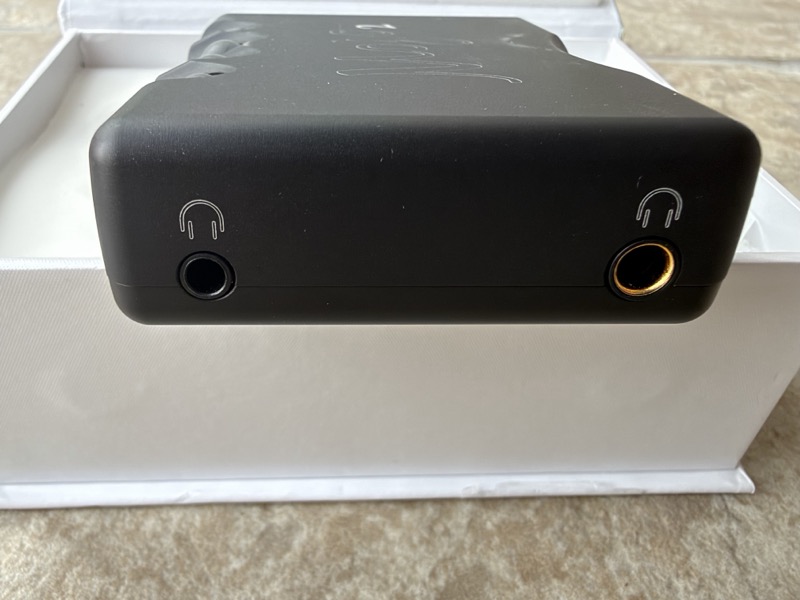
That 4.4 mm socket needs a caveat, because it is easy to read it as Chord adopting balanced operation. It is pseudo-balanced: a balanced connector on the outside, with the internal signal path still single-ended. Chord’s position on this has been consistent and public for years — their Pulse Array conversion is single-ended by nature, a fully balanced topology doubles the component count in the direct signal path, and differential operation reintroduces the noise-floor modulation the whole design sets out to eliminate. The company frames the 4.4 mm addition as answering demand for cable compatibility rather than as a change of engineering mind, and I have not seen anything from Chord suggesting otherwise. If you own 4.4 mm cables, this saves you an adapter. It does not give you balanced drive, and on this design that is deliberate rather than a shortfall.
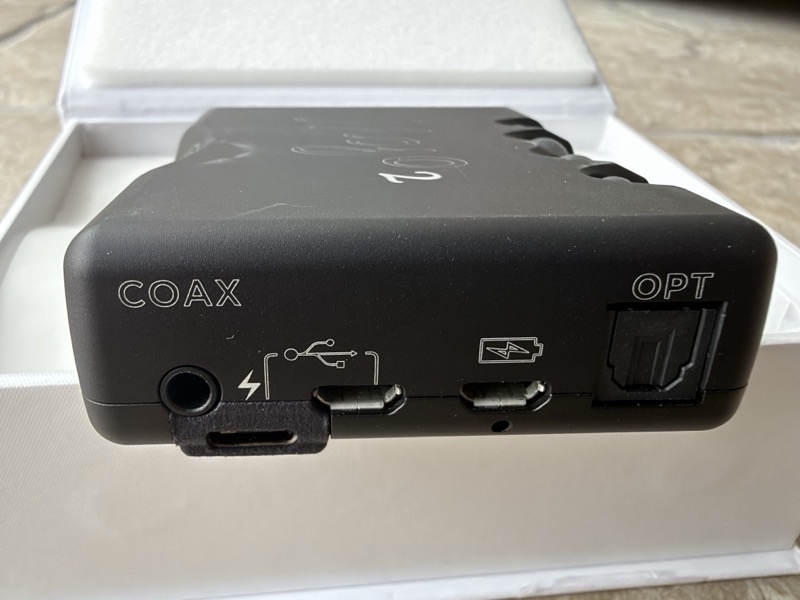
The rear panel is where the input flexibility lives, and it is more than most portables offer. From left to right there is a 3.5 mm coaxial input, a USB-C port carrying high-speed data and now charging, two micro-USB ports — one data, one charge, marked with the USB and battery icons — and an optical Toslink input at the right-hand end:
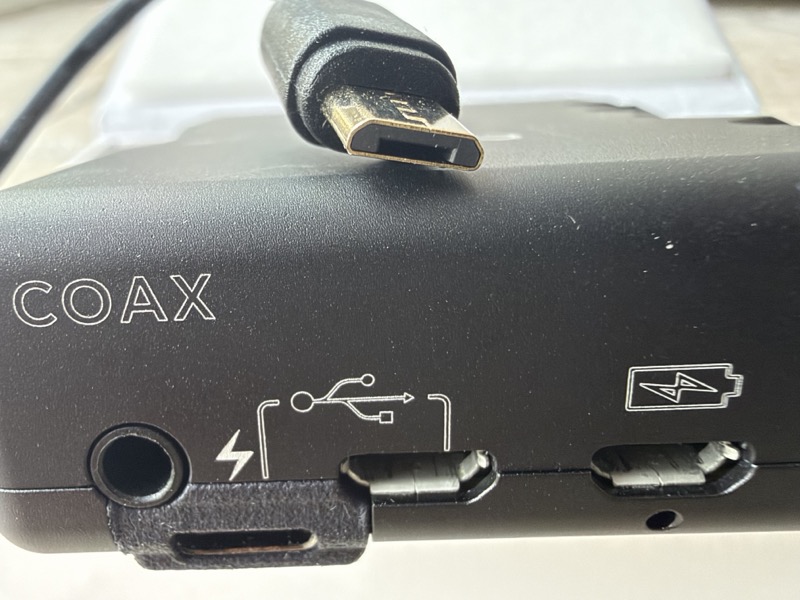
A closer look shows the labelling, and how tightly packed the sockets are — the USB-C port sits on the lower lip below the coax jack, which is not obvious until you have the unit in hand:
Chord quote 768 kHz over coaxial and micro-USB and 96 kHz over optical, with support up to 768 kHz PCM and DSD 256. Optical being capped at 96 kHz is a limitation of the interface rather than the Mojo 2, and matters only if you intended to feed it high-rate material from a device with no other output. Connect more than one input at once and the Mojo 2 auto-selects by priority — USB first, then coaxial, then optical. The Poly module, Chord’s wireless streamer/server that clips onto the Mojo, remains compatible.
Bit-perfect data is bit-perfect regardless of which socket carries it, so any difference between them is not about the data. Chord’s argument is that a source also injects radio-frequency noise and small correlated currents into the DAC alongside the music, and that galvanic isolation prevents both. On the Mojo 2 only the optical input is galvanically isolated; coax and USB are not. Whether that is audible depends entirely on how noisy your particular source is, which means there is no universal best input — a clean laptop over USB may well beat a noisy transport over optical. If you have a source that offers coax or optical, it costs nothing to try them.
On power, the numbers worth quoting are 90 mW into 300 Ω (5.2 V RMS) and 600 mW into 30 Ω (4.2 V RMS), with an output impedance of 0.06 Ω. Chord claim compatibility up to 800 Ω. The 5.2 V figure is the one that decides whether it will drive a high-impedance dynamic headphone properly, and it is a healthy amount of voltage for a battery device; the 0.06 Ω output impedance is low enough that it should not audibly alter the response of multi-driver IEMs.
Battery life is quoted as up to eight hours. Charging is slow by today’s standards but acceptable, and a full charge got me through a full day. Eight hours is the one specification that reads as a real constraint rather than a number — it is a working day if you are careful, and not a long-haul flight.
Charging itself is managed by the FPGA rather than a separate controller, which Chord say cuts charging power loss by around 75% and keeps the unit cooler while topping up. More usefully, the menu sphere reports charging quality as a colour when the unit is off: white for full-rate charging, through intermediate shades, down to red for a charger that is not supplying enough current. Chord recommend at least 2 A. That is a genuinely practical diagnostic — most devices leave you guessing why charging is slow, and this one tells you it is your charger.
Desktop Mode
The feature the original Mojo never had, and the one that quietly changes what the Mojo 2 is for, is Intelligent Desktop Mode. Leave it connected to mains power and, once charged, it transitions to a mode — signalled magenta — that effectively takes the battery out of circuit and regulates charging to protect the cells. You can leave it permanently plugged in as a desktop DAC without slowly destroying the battery, which is exactly what happens to portable devices pressed into fixed duty.
Chord also state that the power supply’s filtering and isolation were improved specifically so there is no sound quality penalty running from mains rather than battery. Taken together, these two things mean the Mojo 2 is not only a portable that can sit on a desk, but a reasonable desktop DAC that happens to be portable — a different and considerably more useful proposition.
In two months I never noticed a problem with battery life or heat, but I have not timed a full discharge, so the eight-hour figure is Chord’s rather than mine. Owners are more mixed on heat. On Pink Fish Media, one owner reports the Mojo 2 getting properly hot when it is driving IEMs and charging from a laptop at the same time, while others find it only slightly warm when charging with nothing playing and at room temperature when playing on battery. If you want to use it plugged in all day, Desktop Mode is the intended answer.
Sound Impressions
With the EQ flat and crossfeed off, the Mojo 2 sounds extremely neutral. Bass arrives with no added warmth or softness, the midrange contributes nothing of its own, and the treble stays composed and grain-free regardless of level. On “Angel” by Massive Attack the sub-bass extends and decays without ever turning thick or slow, and on “Billie Jean” by Michael Jackson the hi-hat stays crisp and unfatiguing at volumes that make lesser sources start to harden up. None of the three registers announces itself, which is what Chord’s quoted 125 dB dynamic range, 2.7 µV noise floor and 0.0003 % THD+N would predict: the headphones on the end of it set the sound. Neutral is only the starting point, though, because the Mojo 2’s main party trick is that you control the sound.
Imaging is good and clear. On “Private Investigations” by Dire Straits, the guitar and percussion sit in well-defined places across the stage. I would not credit that to anything mysterious in the filter. What a source contributes to imaging is mostly delivering the same level and power to the left and right channels, and the Mojo 2 does: in Cameron’s measurement at 4.3 V the two channels are within 0.002 V of each other. The rest comes from the headphone, and with the HD600 on the end it was impressive.
Crossfeed made its case most clearly on exactly the material Chord probably built it for: hard-panned recordings from the 1970s, mixed for two speakers spread apart rather than for headphones sitting directly on the ears. On Led Zeppelin’s “Whole Lotta Love” and Pink Floyd’s “Wish You Were Here,” both tracked with guitars and effects thrown hard to one side, engaging crossfeed pulled the two channels into a single coherent stage instead of two separate performances happening in each ear — and did it without the smeared, phasey quality that cheaper crossfeed implementations produce. Turn it off again and the hard panning snaps back, so the feature is clearly doing something real rather than adding a subtle blur. It is a lovely effect on these older recordings, and like the EQ, it is fantastic to have it one menu press away instead of inside a separate app.
Across bass, midrange and treble I struggled to find anything to complain about, and with crossfeed added on the right recording there is very little left on my list to ask for.
I heard no hiss with any of the headphones below, or with the ZenCarb custom IEMs. Some owners do hear it: on Head-Fi, users of very sensitive, low-impedance IEMs such as the Campfire Audio Fathom report audible hiss from the Mojo 2 that an iFi IEMatch adapter removed. If your IEMs are known to expose hiss, start in low gain and keep an adapter in mind.
Small Tone Changes on Sensibly Priced Headphones
Controlling the sound is how I used the Mojo 2 most, with good headphones that each needed one small change. The HD600 needs a modest sub-bass lift, adding low-end weight without trying to rebuild its tuning. The FiiO Jade Audio JT9, the Aune AR5000 MK2 and the FiiO FT13 need the opposite at the top end: all three benefit from a slight treble reduction, and cutting the light blue band attenuates their treble nicely. The Audeze MM100 goes the other way and wants a little more treble. These are broad tonal adjustments rather than attempts to correct every peak with narrow parametric filters, and on all four headphones they were enough. They are perfect examples of very nicely priced headphones that the Mojo 2 can make exceptional:
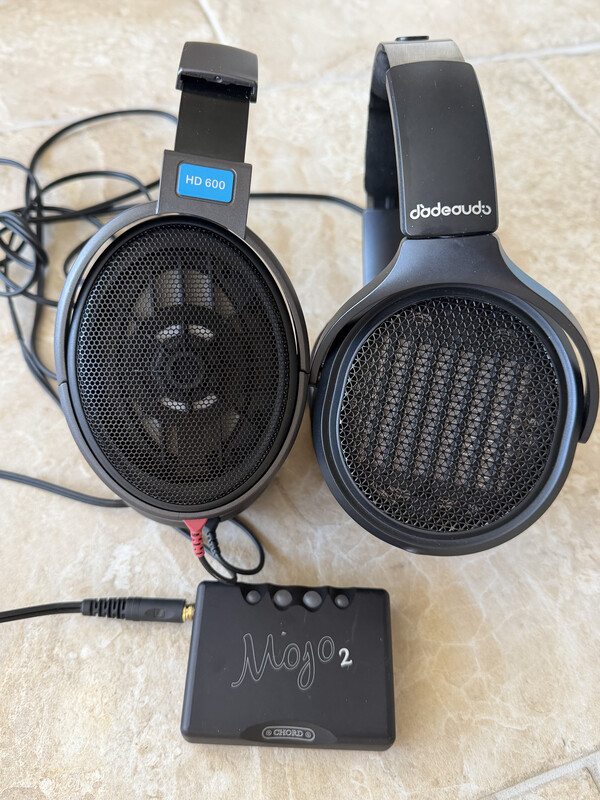 |
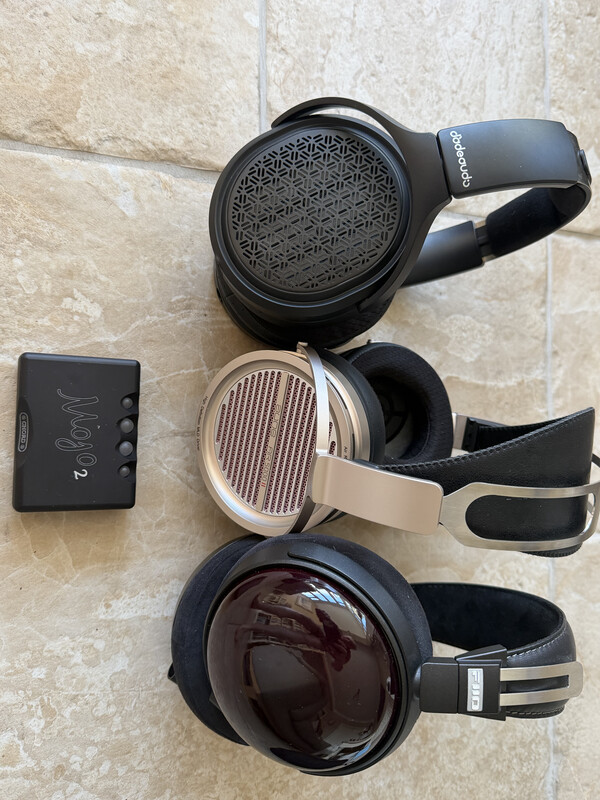 |
I also used it with the KAISER Atelier ZenCarb, an exceptionally good custom IEM with a neutral tuning, to add a little sub-bass.
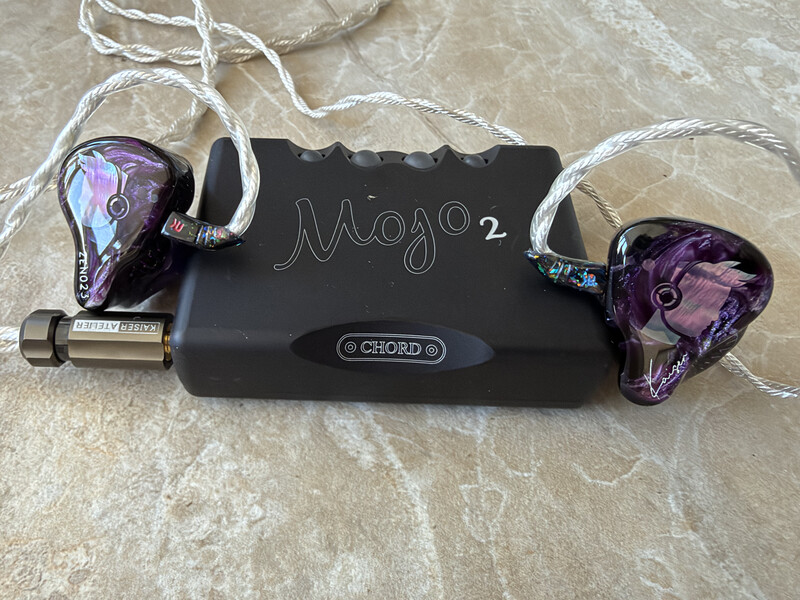
For me, these examples explain the Mojo 2’s continuing appeal. You can get incredibly clean audio and make the small changes that turn an already good headphone into an exceptional one, without opening a companion app or manipulating a complex PEQ curve. More adjustable filters remain useful when a headphone needs precise correction, but a headphone that is already close to my preference may only need a shelf or two. The simplicity becomes more useful as the headphones get better.
Comparisons
Against the Original Mojo, and the 2025 Revision
Three boxes wear the Mojo name and they share a backbone — FPGA Pulse Array conversion, Poly compatibility, the 0.06 Ω output — but the two steps between them are very unevenly sized.
| Original Mojo (2015) | Mojo 2 (2022) | Mojo 2 revision (2025) | |
|---|---|---|---|
| DSP / EQ | None | UHD DSP, four bands, plus crossfeed | Unchanged |
| WTA filter | 38,912 taps | 40,960 taps / 40 cores | Unchanged |
| Analogue coupling | Capacitor-coupled | DC-coupled, digital DC servo | Unchanged |
| Headphone outputs | 2 × 3.5 mm | 2 × 3.5 mm | 3.5 mm + 4.4 mm (pseudo-balanced) |
| Per-output memory | Shared | Shared | Each output stores its own volume and DSP |
| Digital inputs | Coax, optical, micro-USB | Adds USB-C data | Unchanged |
| Charging | Standard | Micro-USB, FPGA-managed | USB-C does data and charge, menu-switchable |
| Desktop mode | None | Intelligent Desktop Mode | Unchanged |
The first step is a real generation. The original has no EQ at all, so the UHD DSP is a capability rather than an improvement, and alongside it the Mojo 2 went DC-coupled — the coupling capacitors replaced by a digital DC servo. Chord attribute part of the original Mojo’s faintly warm voicing to those capacitors, so removing them buys neutrality and tighter bass. If you own an original Mojo and like its warmth, the Mojo 2 is not strictly an upgrade so much as a different and more neutral voicing with features attached.
The second step is close to a hardware refresh. Chord are candid that the FPGA, the DSP and the sonic architecture are untouched and state the sound is unchanged. What moved is the 4.4 mm socket, per-output memory, and USB-C finally doing both data and charging. If you own a 2022 Mojo 2 there is nothing sonic to chase here; if you are buying new and own 4.4 mm cables, take the revision.
Against Cheaper Alternatives
The comparison problem with the Mojo 2 is that the alternatives cost a fifth of the money, so the interesting question is not which sounds better but what the extra buys.
The closest thing I have reviewed in intent is the Tanchjim Space Pro at $119.99. It is a dual CS43198 portable DAC/amp with a ten-band parametric EQ, and that PEQ is the direct competitor to the Mojo 2’s UHD DSP. Ten parametric bands with adjustable frequency and Q can chase a measured target curve on a specific headphone; the Mojo 2’s four shelves cannot. What the Space Pro cannot do is take a coaxial or optical input, run from its own battery, or offer 5.2 V into 300 Ω. So the split is fairly clean: if what you want is headphone correction, the cheap dongle’s PEQ is the more capable tool, and if what you want is a self-powered box that will accept a CD transport or a TV’s optical output and drive a high-impedance headphone, the Mojo 2 is doing a job the dongle cannot attempt.
The FiiO QX13 at $219 is the nearest thing in category — a premium bus-powered DAC/amp with a display, PEQ, an ES9027SPRO DAC and up to 900 mW in desktop mode. It has the screen the Mojo 2 refuses to fit, which removes the entire colour-code learning curve, and it has app-driven PEQ. It is also roughly a third of the Mojo 2’s price. The case for the Chord over it is not the feature list, which the FiiO wins comfortably, but the FPGA conversion, the input flexibility and the British build.
At the bottom end, the ddHiFi TC44Pro E3 at around $105–120 is a useful reference point precisely because it has no PEQ at all. It shows how much of what people buy in this category is raw power in a small package — 510 mW balanced from something the size of a lighter — and how little of the Mojo 2’s price is explained by output power alone.
Having used all three, the difference that matters to me is not the band count. The PEQ on the Space Pro and the QX13 can do things the Mojo 2 cannot. The Mojo 2’s killer feature is that it needs no app at all, and once you have read the guide it is fairly intuitive to use it to improve headphones or IEMs that are already good.
Against the Qudelix 5K, Crinear Protocol Max and FiiO QX13
Four devices, four different ideas about where the money should go:
| Chord Mojo 2 | Qudelix 5K | Crinear Protocol Max | FiiO QX13 | |
|---|---|---|---|---|
| Price | £395 / €479 | $109 | $89.99 | $219 |
| Conversion | Chord FPGA, proprietary WTA filter | Dual ES9219C | Dual Cirrus Logic CS43198 | ES9027SPRO |
| Max output | 90 mW / 300 Ω, 600 mW / 30 Ω | 80 mW single-ended, 240 mW balanced (load not stated); 2.0 / 4.0 V RMS | Up to 600 mW / 16 Ω (balanced, boost) | Up to 900 mW (desktop mode) |
| Tone control | 4-band shelving EQ + 3-level crossfeed, no app | 20-band PEQ/GEQ plus crossfeed, via Qudelix’s own app | 10-band PEQ, via WalkPlay app or devicePEQ | Onboard PEQ, with display |
| Control method | Physical buttons on the device, no app or host software | Phone app or desktop browser app | App or browser-based devicePEQ | Onboard screen |
| Digital inputs | Coax, USB-C, micro-USB, optical | USB, Bluetooth (aptX Adaptive, LDAC, AAC, aptX HD) | USB-C only | USB-C |
| Battery | ~8 hours, Intelligent Desktop Mode | 6–20 hours (Bluetooth use) | None — bus-powered from the source | None — bus-powered from the source |
Each of the three cheaper devices wins clearly on the thing it was built around. The Protocol Max wins on price by a wide margin — under $90 for genuinely competent PEQ and real power into low-impedance loads is difficult to argue with, and it is the one I would point a budget-conscious buyer at first. The QX13 wins on raw power, with headroom the other three simply do not have once you are into genuinely hard-to-drive territory. The Qudelix 5K’s case is flexibility of a different kind: Bluetooth plus USB in one box, with by far the deepest EQ of the four on paper.
Where the Mojo 2 wins is the thing none of the other three can match at any price: adjust the EQ or the crossfeed level, on the device itself, with a button press, with nothing else in the loop. Every one of the other three requires an app, a browser tool, or a screen menu to get to the same place. That changes how often the feature actually gets used, and it is the reason the Mojo 2 still earns its place in this list despite costing roughly two to four times as much as everything beside it.
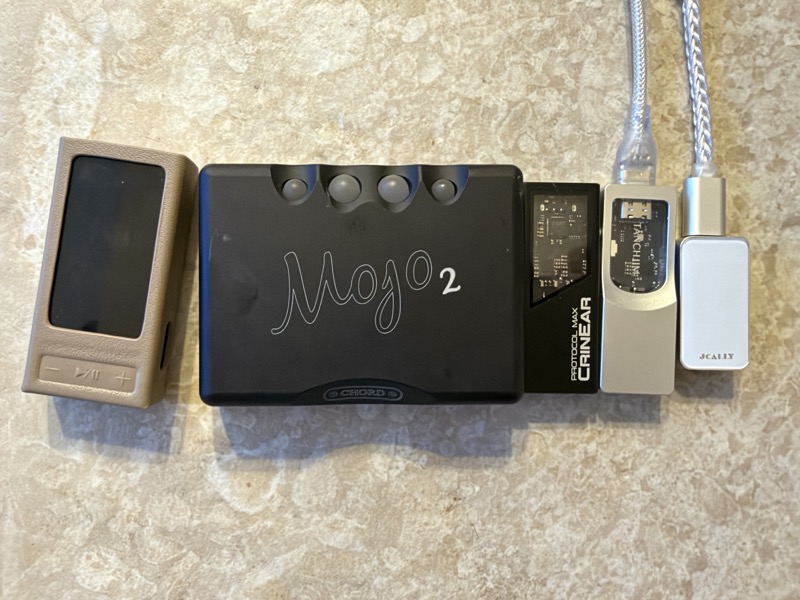
Here is the Mojo 2 with the FiiO QX13 in Titanium Gold on its left and the Crinear Protocol Max, the Tanchjim Space Pro and a JCALLY dongle on its right (the Qudelix 5K is not in the photo), which gives a fair sense of how much bigger and heavier it is than anything else in its category:
Specifications and Measurements
Specifications
The following are the manufacturer’s published specifications, taken from Chord’s product page and the figures printed on the retail box:
| Specification | Value |
|---|---|
| Conversion | Chord proprietary FPGA, WTA filter, 40,960 taps / 40 DSP cores |
| Dynamic range | 125 dB A-weighted |
| Noise floor | 2.7 µV A-weighted, no measurable noise floor modulation |
| THD+N | 0.0003 % at 2.5 V into 300 Ω |
| Signal-to-noise ratio | 123 dB A-weighted |
| Stereo separation | 118 dB at 1 kHz, 300 Ω, 2.5 V |
| Power output | 90 mW into 300 Ω (5.2 V RMS); 600 mW into 30 Ω (4.2 V RMS) |
| Output impedance | 0.06 Ω |
| Frequency response | 7 Hz – 20 kHz ±3 dB |
| Headphone outputs | 3.5 mm and 4.4 mm (pseudo-balanced), independent volume memory |
| Digital inputs | USB-C (data and charge), micro-USB 768 kHz, coaxial 768 kHz, optical 96 kHz |
| Formats | PCM up to 768 kHz, DSD 256 |
| EQ | UHD DSP, four shelving bands (20 Hz, 125 Hz, 3 kHz, 20 kHz), ±9 dB in 1 dB steps |
| Battery life | Up to 8 hours (Chord’s figure, “subject to standard operating conditions”) |
| Dimensions | 83 × 62 × 22.9 mm |
| Weight | 185 g |
| Made in | United Kingdom |
Manufacturer Measurements
Chord publish the numbers above but do not publish measurement dashboards or graphs to support them, so there is nothing here to reproduce as a manufacturer plot. The figures in that table are Chord’s own claims, not independent results.
Measurement discussion around Chord gets contested because Chord’s stated design objective is transient timing accuracy through very long interpolation filters — the tap-length argument — which is not the same objective as minimising harmonic distortion and noise to get a high SINAD number. Those two goals are not in direct opposition, but optimising for one does not automatically produce a leading result in the other, and Chord’s designs have historically been judged very differently depending on which of the two a reviewer treats as the point.
Independent Measurements
Both of the independent measurement sets below are of the 2022 Mojo 2, not the 2025 revision reviewed here — but per Chord’s own account and the comparison table above, the 2025 revision changes nothing about the FPGA, the DSP or the underlying sonic architecture, only the 4.4 mm socket, per-output memory and USB-C charging. So a 2022 measurement of the conversion and amplifier stage is still a measurement of the device sold today, four years on.
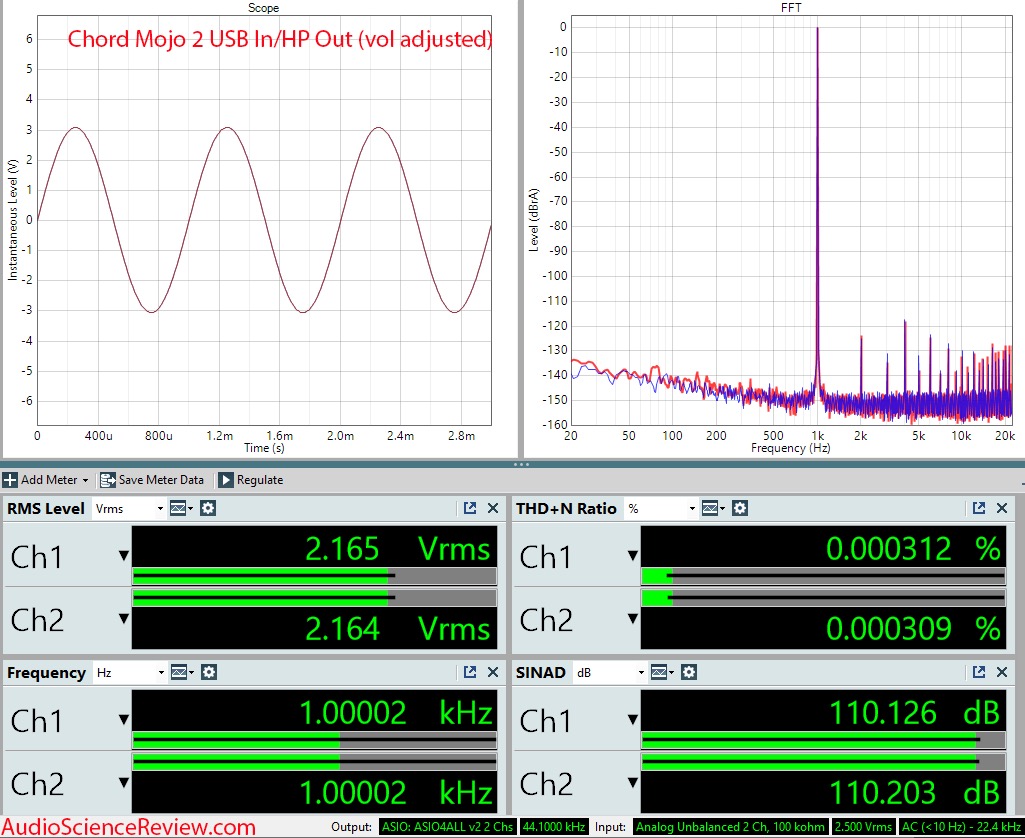
Amir Majidimehr at ASR measured the Mojo 2 as a DAC at a 2 V output level and recorded 110.1–110.2 dB SINAD with THD+N around 0.0003%, both channels closely matched:
Cameron (GoldenSound) at Headphones.com measured the Mojo 2 on two units, with matching results, using an Audio Precision APx555 at 4.3 V — the practical maximum before the Mojo 2 starts to clip — and recorded 112.6 and 113.4 dB SINAD across the two channels, with THD+N of 0.00022–0.00024%:
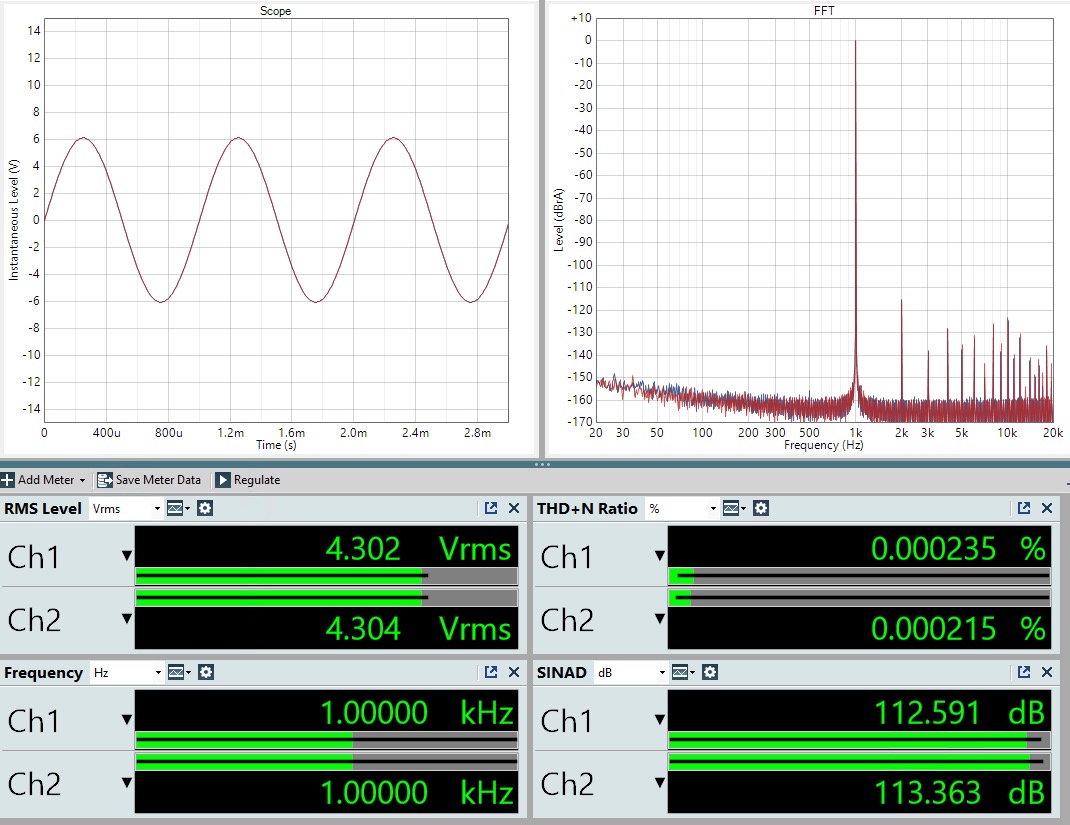
That is exceptionally low distortion. In the FFT on the right, the second harmonic sits around −115 dB below the 1 kHz tone and every other harmonic is below −125 dB, far beneath anything audible at any listening level.
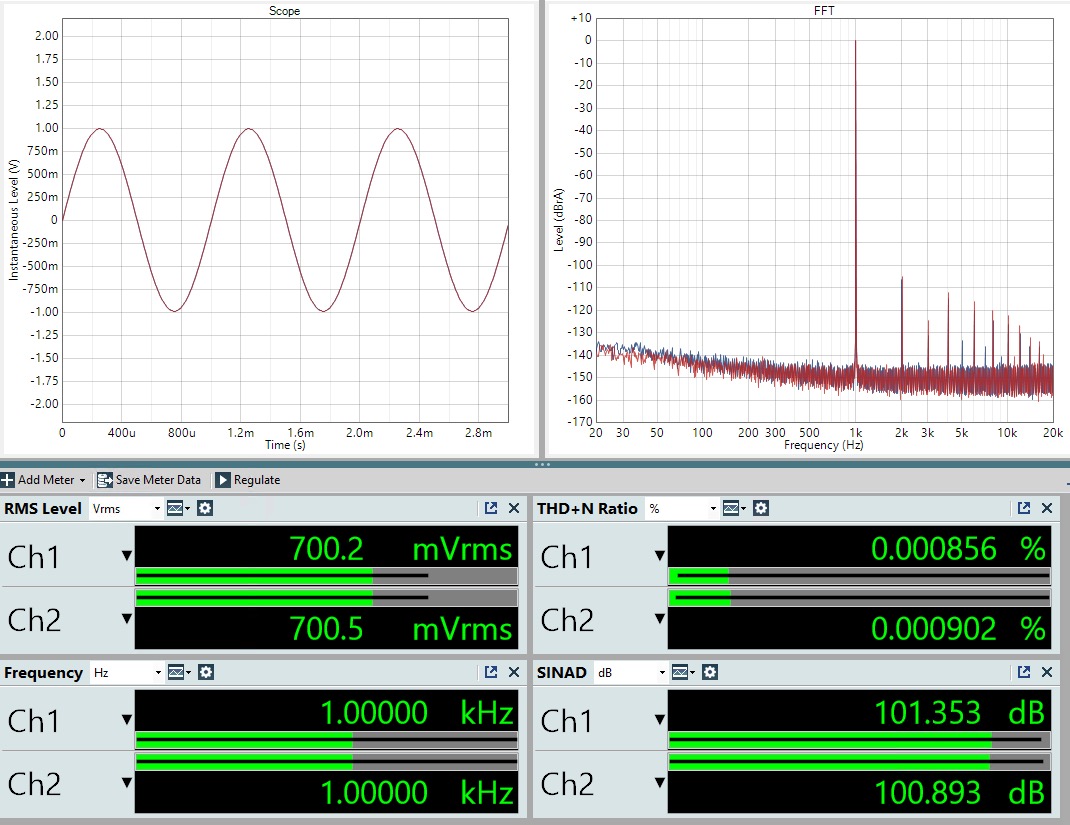
Headphones.com’s suite also includes a low-level output measurement, at 700 mV, where SINAD drops to around 101 dB — still a clean result, and the expected shape for any DAC measured well below its best operating point:
The rest of Cameron’s report fills in the picture: 117.3 dB dynamic range (AES17), 118.5 dB SNR, SMPTE intermodulation distortion of −95.7 dB, and a noise level of 5.1 µV RMS across 20 Hz–20 kHz. Because the volume control is entirely in the DSP, he measured at the 4.3 V maximum rather than at 2 V, which would only have given away 6 dB of dynamic range; the 2 V results are on his graphs at the −6 dB point.
Three details from his testing matter more to a buyer than the headline numbers. First, Desktop Mode costs nothing: he measured in Intelligent Desktop Mode and re-checked on battery, and the results were identical apart from 50 Hz and 150 Hz mains spurs below −140 dB that disappear on battery. Second, the source matters. Connected straight to a desktop PC without isolation, the Mojo 2 showed extra noise from about 7 kHz upwards, so he measured through an Intona USB isolator. A phone is a quiet, ungrounded source, so this is mainly a desk problem — if a PC sounds noisy through it, try another USB port or source before blaming the Mojo 2. Third, latency is 26.75 ms, which is the cost of the long WTA filter: irrelevant for music, but close to the point where lip-sync drift becomes noticeable if you watch video through it.
Cameron also notes that he could not reproduce some distortion artefacts in Amir’s ASR results on either of his two units. He suggests that Amir’s unit may have been faulty or affected by a noisy PC source, but neither of them has confirmed the cause. That is why the two sets of numbers above differ by a few dB. The full detail in both write-ups is worth reading directly if you want to go deeper than fits here.
What the data points above tell me is that Chord’s tap-length obsession did not come at the expense of a clean noise floor — this measures well by any conventional yardstick, on top of doing the timing-accuracy thing Chord actually designed it for.
I have not measured the Mojo 2 yet, so the electronics figures in this review are Chord’s, Amir’s and Cameron’s.
Rating Explanation
The Pragmatic rating of 5 reflects why I still find the Mojo 2 relevant. Good, sensibly priced headphones often need only minor changes to suit my taste: a bass boost for the HD600 or a small treble reduction for the JT9. The Mojo 2 combines clean output with onboard controls that make those changes easy to use. I do not always need a companion app and a full PEQ editor to get the result I want. Its four tone controls are limited compared with parametric EQ, but for broad adjustments that simplicity is the reason to choose it.
The features rating of 5 follows from the same place and adds the rest of it: four onboard shelving bands, three-level crossfeed clean enough to leave engaged, four digital inputs including coax and optical, per-output volume memory, a real desktop mode, and Poly compatibility. No dongle offers that list, and very few desktop units offer all of it either.
The price rating of 4 rather than 5 is the counterweight. This costs roughly five times a very good dongle, and a $119 dongle with ten-band PEQ will out-correct it on any specific headphone. You are paying for British manufacture, FPGA conversion, the input flexibility and the battery — all real, none of them cheap, and not all of them things every buyer needs.
Measurements get a 5. Cameron measured 112.6 and 113.4 dB SINAD at 4.3 V, 117.3 dB dynamic range and a 5.1 µV noise floor, with every harmonic at least 115 dB below the signal. That is distortion and noise far below audibility, from a battery-powered device, and Desktop Mode measures the same. Chord designed for timing accuracy through very long filters rather than for a SINAD number, and got an exceptionally low-distortion result anyway.
Where the compromises are is straightforward. There is no display, so all state is a colour code you have to learn. The supplied accessories are a single micro-USB cable and two booklets, which at this price is thin. The EQ is four shelves rather than parametric bands, so it shapes tone but does not correct a headphone toward a target. And the 185 g weight makes this a coat-pocket or desk device rather than something you clip to a phone.
Against that, it is one of very few portables that will take coaxial and optical input, run for a claimed eight hours off its own battery, put 5.2 V into a 300 Ω load, and apply tone controls without any software on the host. None of the cheap dongles offer them.
Conclusion
I went into this review wondering whether the Mojo 2 still served a useful purpose alongside today’s much cheaper dongles. I came away thinking that better headphones make its simplicity more relevant. When the HD600 needs a little more bass or the JT9 needs a little less treble, I want clean audio and an easy way to make that change. I do not necessarily want to open an app and work through a set of parametric filters. Small adjustments can turn an already good headphone into an exceptional one, and the Mojo 2 puts those adjustments on the device in my hand.
It still serves a vital need for listeners who want broad tone controls and crossfeed without companion software, with coaxial and optical inputs adding flexibility beyond a USB dongle. The price, size and colour-coded controls are real compromises, and precise correction of individual peaks is better served by PEQ. But when a headphone is already almost perfect for you, the Mojo 2’s simple controls can be all that is missing.