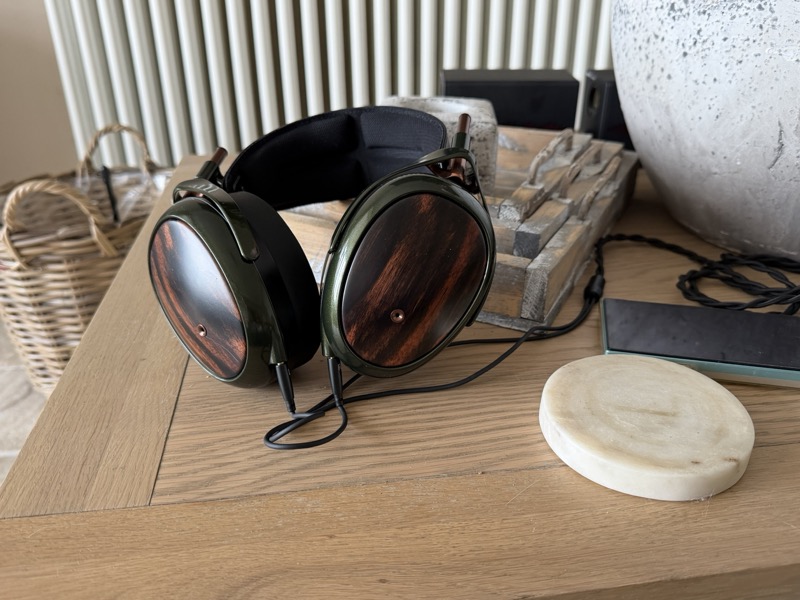
Meze Strada
A Closed-Back Dynamic Using a Retuned 109 Pro Driver
I have been through most of the Meze catalogue on this site by now, so the interesting thing about the Strada is not that it is another beautifully made Romanian headphone - it is where the driver came from. Meze say the 50 mm dynamic driver is derived from the one in the 109 Pro and retuned for a sealed cup, which is a genuinely awkward engineering job: the same motor and diaphragm behave very differently once you put a closed volume behind them.
The other thing to flag up front is the price. At $799 the Strada costs exactly what the 109 Pro costs, so Meze are not asking you to trade down to get a closed back. They are asking you to choose between open and closed at the same money, which makes this a more interesting review than a simple step in a product ladder.
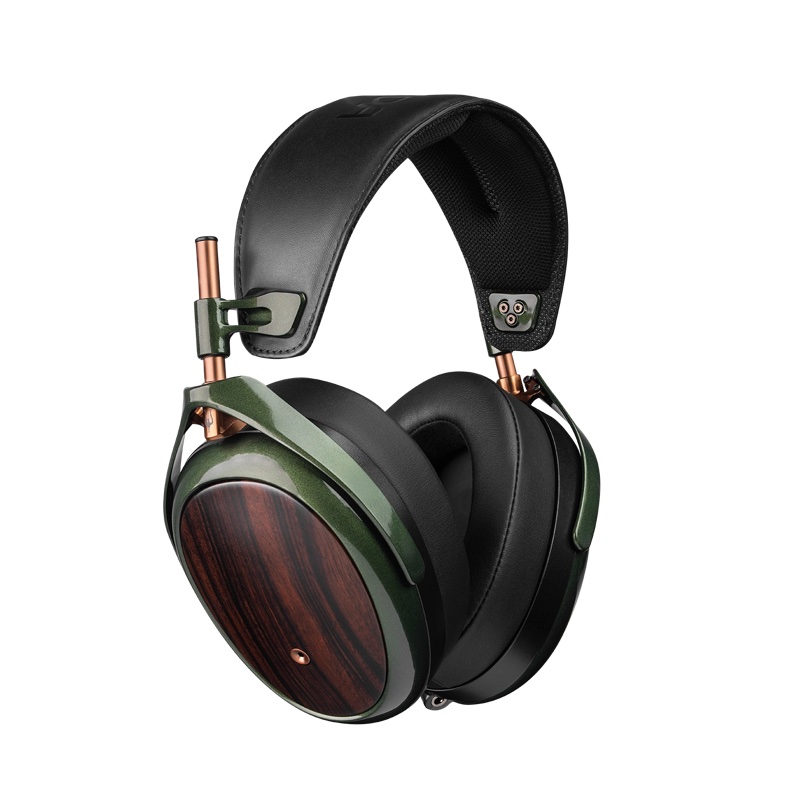
I would like to thank Meze Audio for providing the Strada for the purposes of this review.
If you are interested in finding more information about this product, you can find it at the official product page.
The Strada retails for $799 (and €799 in Europe, per Meze’s EU store, checked September 2026). It is sold in a single finish: a hand-painted deep green magnesium frame with Macassar ebony ear cup covers.
The Strada is one of those headphones that reinforces why I think people need a collection rather than one pair. Put my usual analytical tracks through it - the ones I reach for precisely because I know exactly what they should sound like - and it was different enough that my first reaction was genuinely “I am not sure about the Strada”. That reaction did not survive longer listening, and the gap between those two positions is the reason this review was worth writing.
Before any of the listening, let’s look at what arrives in the box, because Meze’s packaging is usually a good indicator of how seriously they take a product.
Unboxing and Packaging
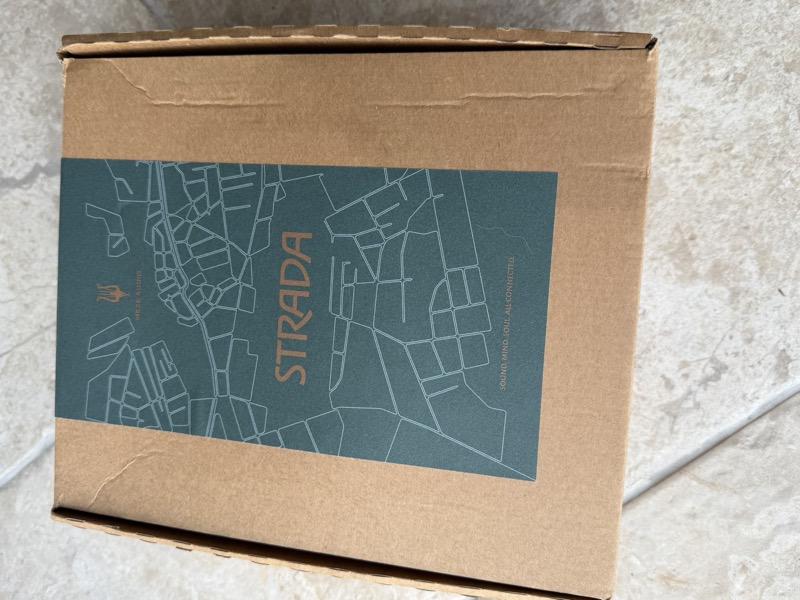
The outer carton is plain brown card with a dark green sleeve printed as a street map, which is the first hint at the name - the label on the reverse spells it out:
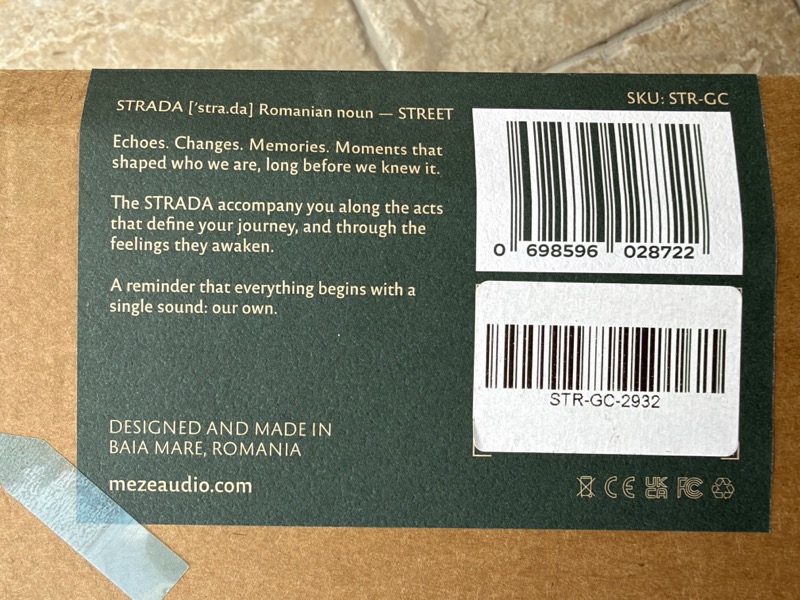
That reverse label is worth reading rather than skipping. It gives the pronunciation and the meaning - strada, the Romanian noun for street - and confirms the unit was designed and made in Baia Mare, along with the SKU and serial:
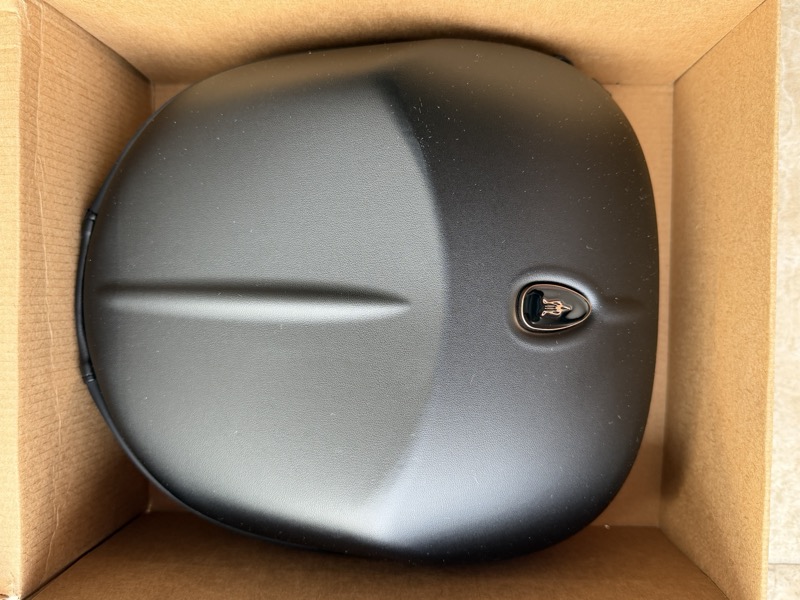
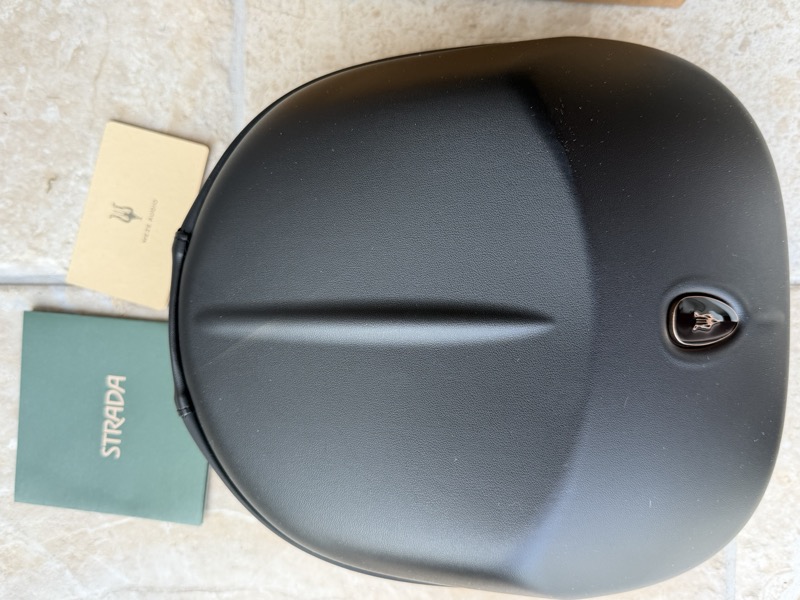
Inside there is no display tray or foam cradle, just the hard EVA carrying case sitting in the carton, with the printed documentation tucked alongside it:
 |
 |
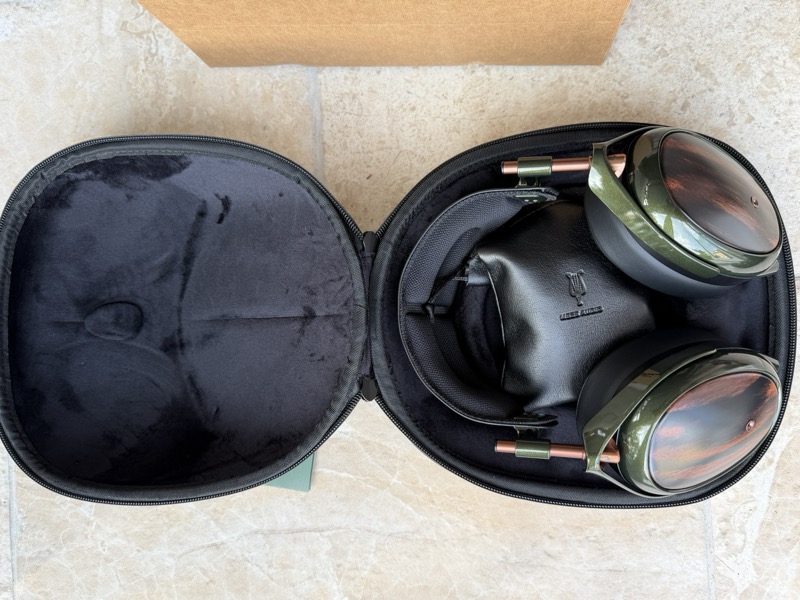
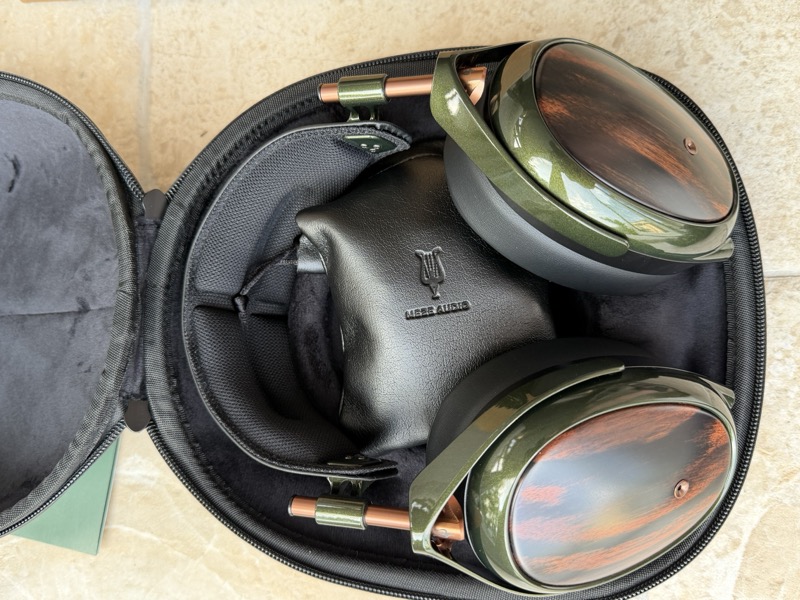
Open the case and the headphone is folded flat inside a moulded recess, with the leather cable pouch sitting in the middle where the two cups meet:
 |
 |
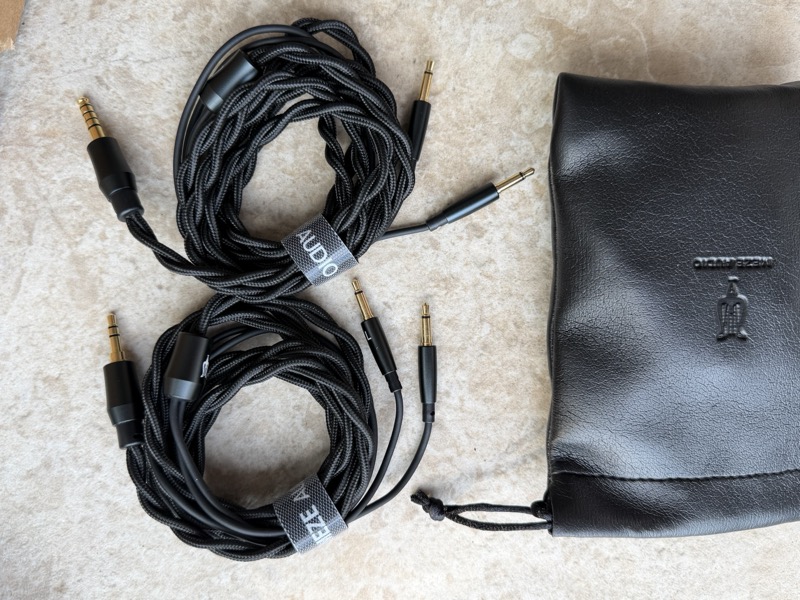
The accessory count is short and all of it is useful: a 1.8 m dual mono 3.5 mm to 3.5 mm cable, a 1.8 m dual mono 3.5 mm to 4.4 mm balanced cable, a 6.3 mm gold-plated adapter, the PU leather cable pouch and the hard EVA case. Two cables as standard rather than one plus an upsell is the right call at this price:
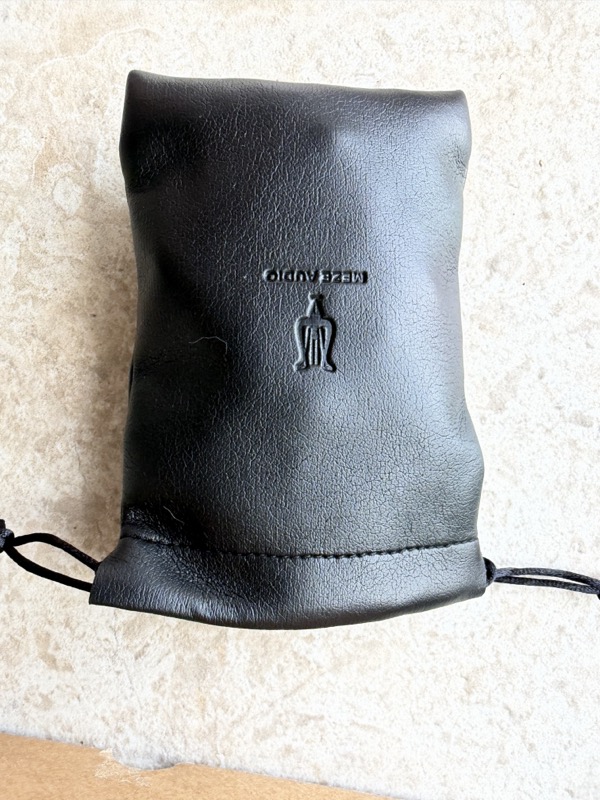
The pouch itself is PU leather with a drawstring and an embossed Meze lyre, and it is sized for exactly the cable you are not currently using:
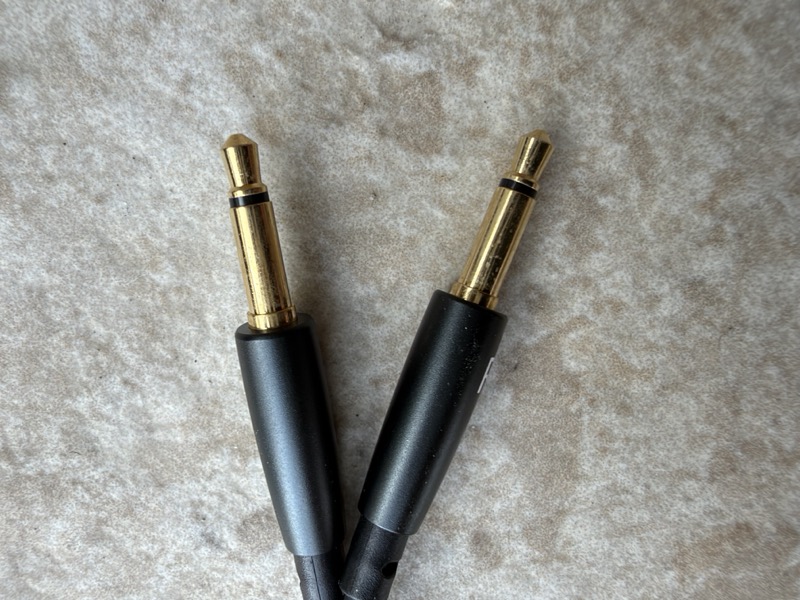
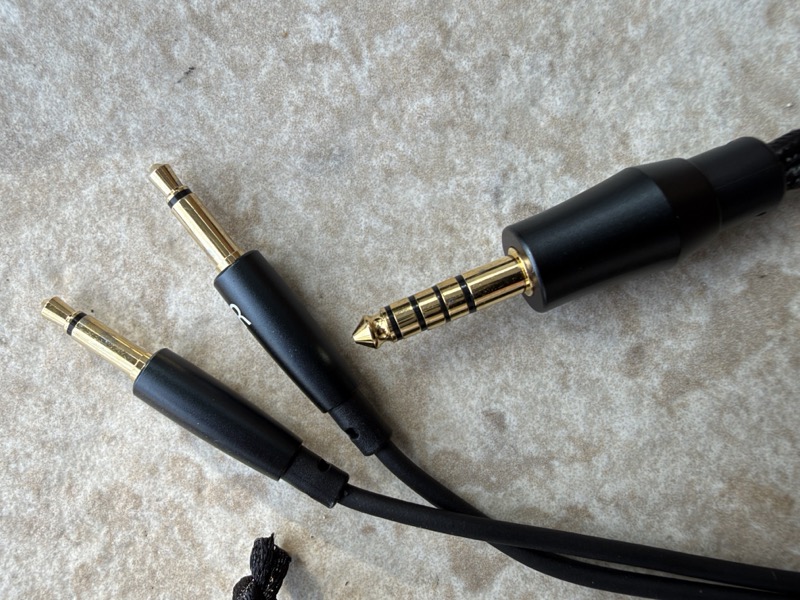
Both cables use the same dual 3.5 mm TS plugs at the headphone end, which is the connector Meze have standardised on across the 105 and 109 series - so if you already own another recent Meze, your cables carry over. Note that these are TS, not TRS: each plug carries one channel, so they are not interchangeable with a generic 3.5 mm stereo cable:
 |
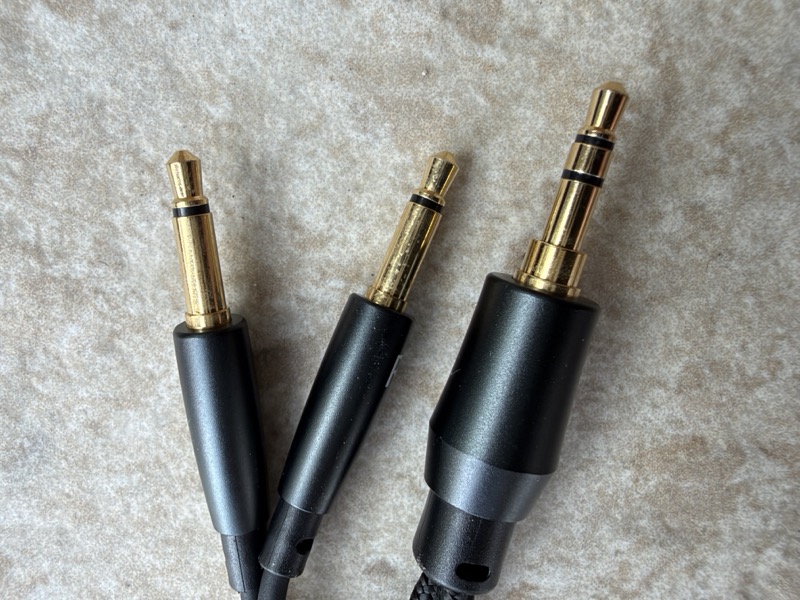 |
The source end of the single-ended cable is a straight 3.5 mm with the 6.3 mm adapter supplied separately, and the balanced cable terminates in 4.4 mm Pentaconn:
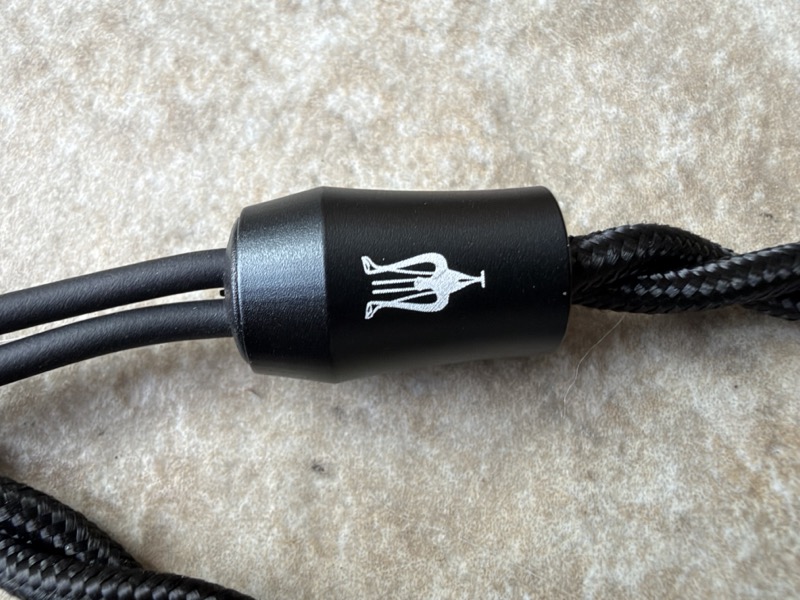
The Y-split is a small anodised aluminium barrel with the Meze lyre printed on it, and there is no chin slider - this is a home cable, not a portable one:
Design and Build
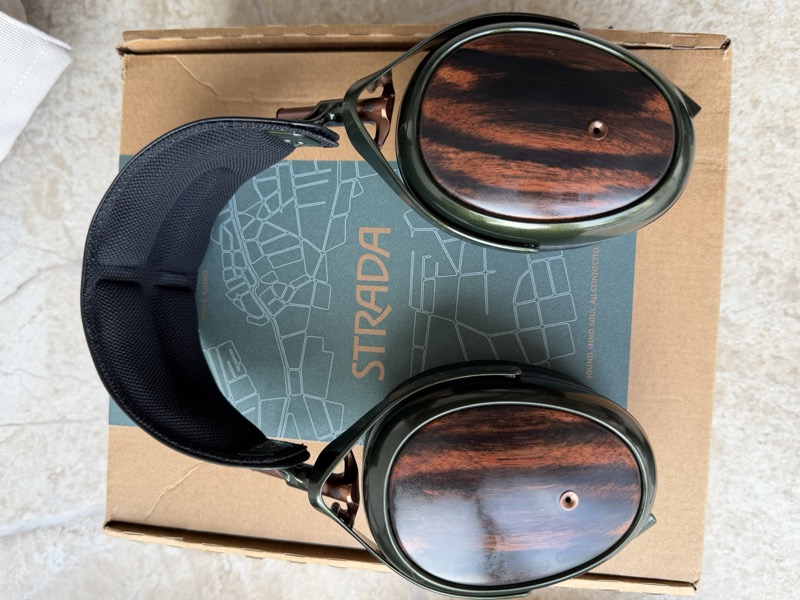
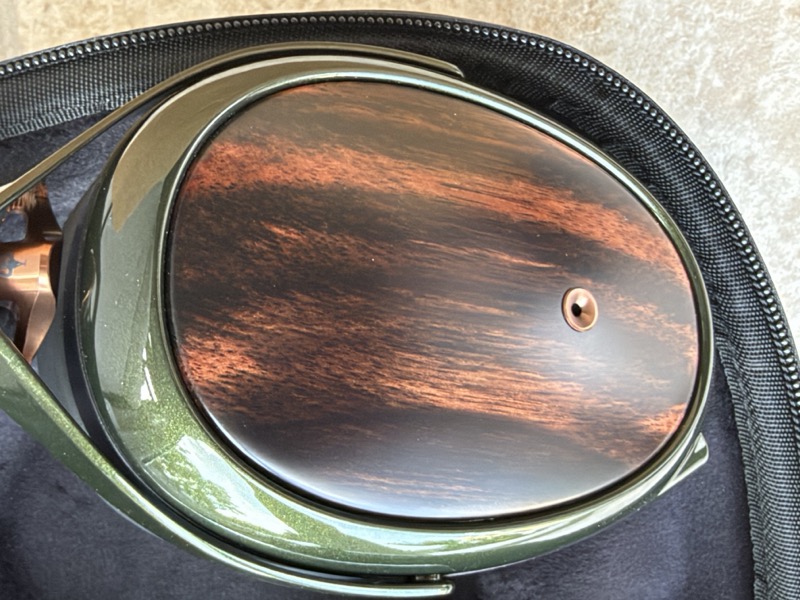
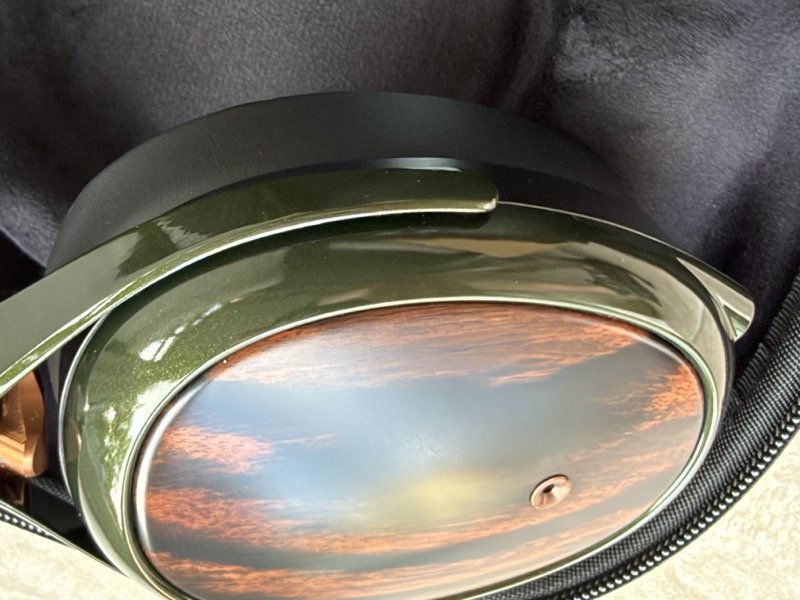
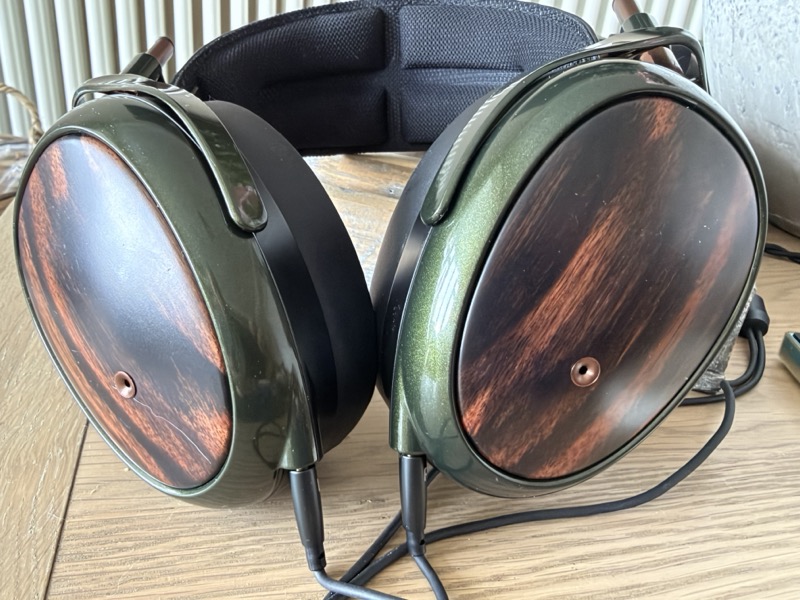
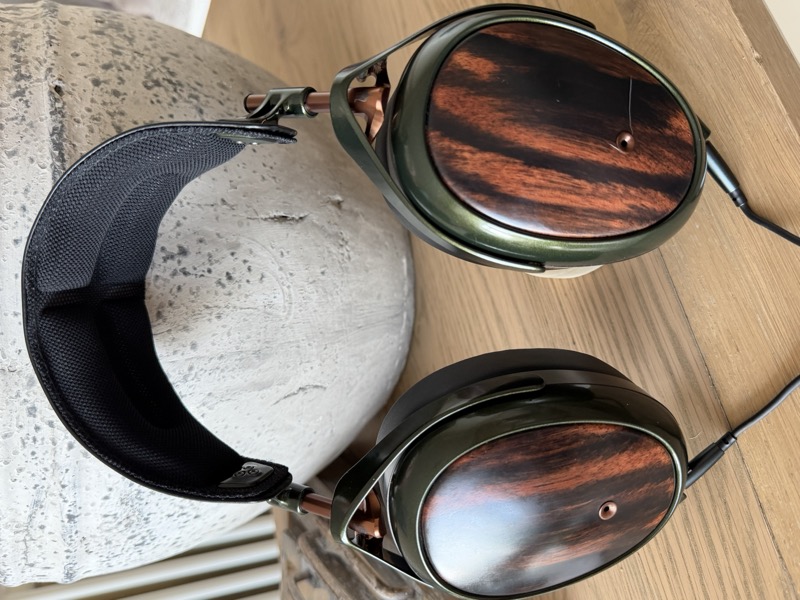
The construction is the part I can describe without any listening at all. The frame is magnesium, hand-painted in what Meze describe as four layers of a green finish with metallic particles suspended in it, and the ear cup covers are Macassar ebony. In natural light the green reads almost black until it catches the sun, at which point the metallic flake becomes obvious:
 |
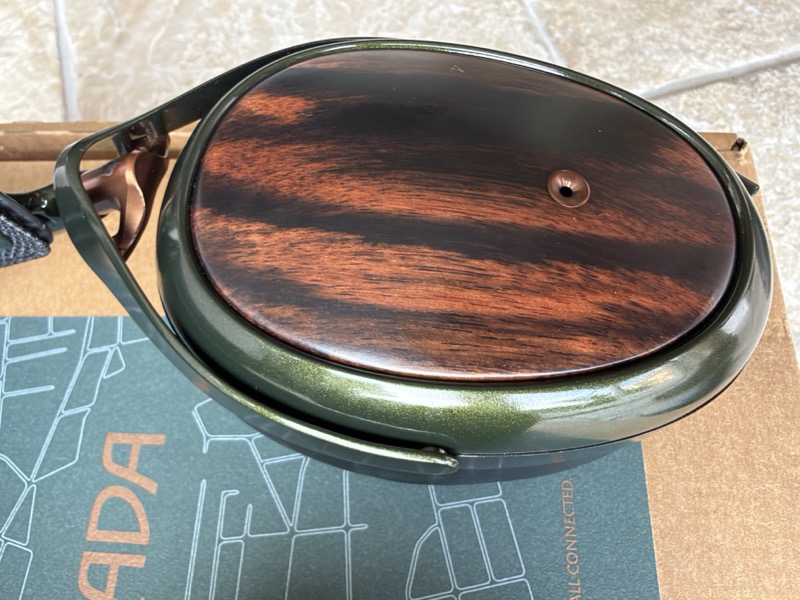 |
Macassar ebony is a striped wood rather than a uniformly dark one, and the two cups on this unit are visibly different from each other - one is dominated by broad dark bands, the other by finer reddish grain. Whether you consider that a feature or a mismatch is a matter of taste, but it is inherent to the material rather than a defect:
 |
 |
The gimbal is the detail that tells you where the money went. The cup pivots on a copper-coloured rod that passes through a painted magnesium block, and the whole assembly is held with visible Torx screws rather than glue or clips:
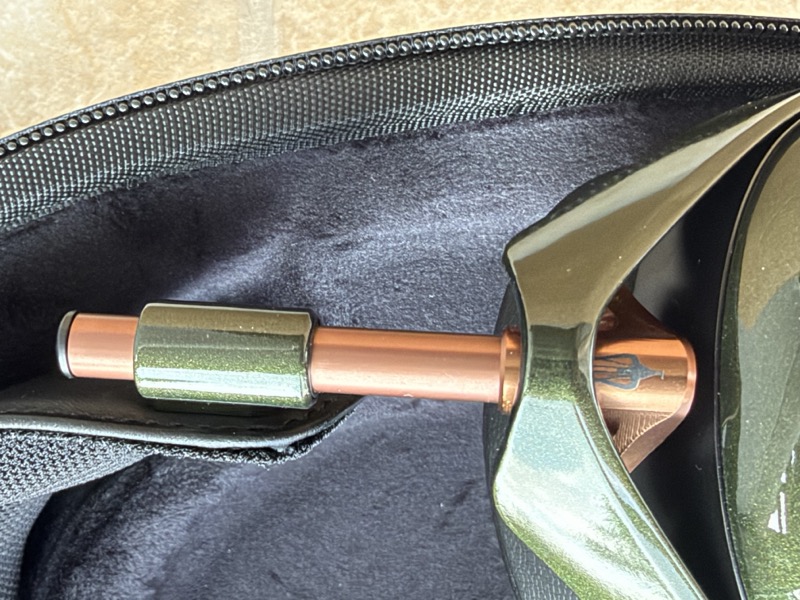
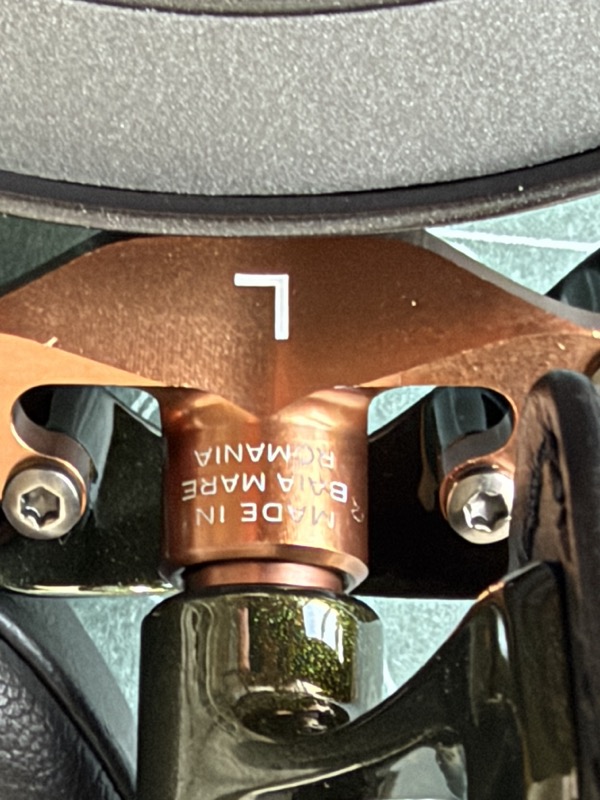
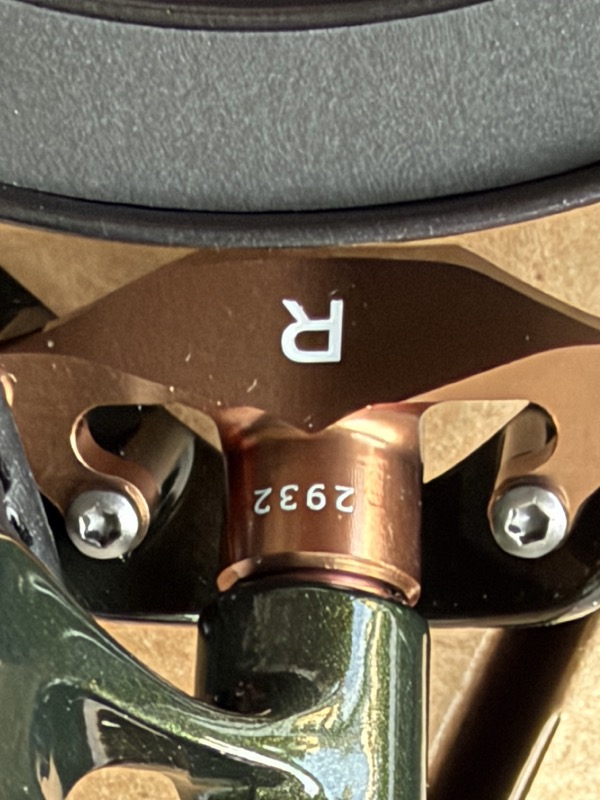
That same rod carries the engraving. One side is marked “MADE IN BAIA MARE ROMANIA”, the other carries the unit’s serial number, which matches the one printed on the box label - and the yoke plates are marked L and R in white:
 |
 |
Meze’s stated position is that the Strada is fully serviceable - every part replaceable, nothing bonded shut. The Torx-and-rod construction here supports that claim rather than just decorating it, and it is the same argument they have made for the 99 Classics V2 and the rest of the line. The practical consequence is that a cracked headband or a stripped pad ring is a spare part order, not a write-off:
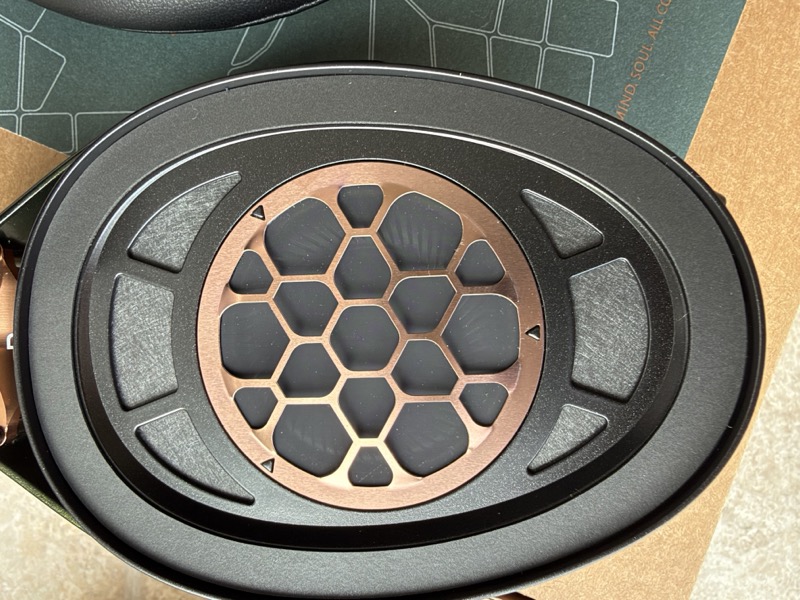
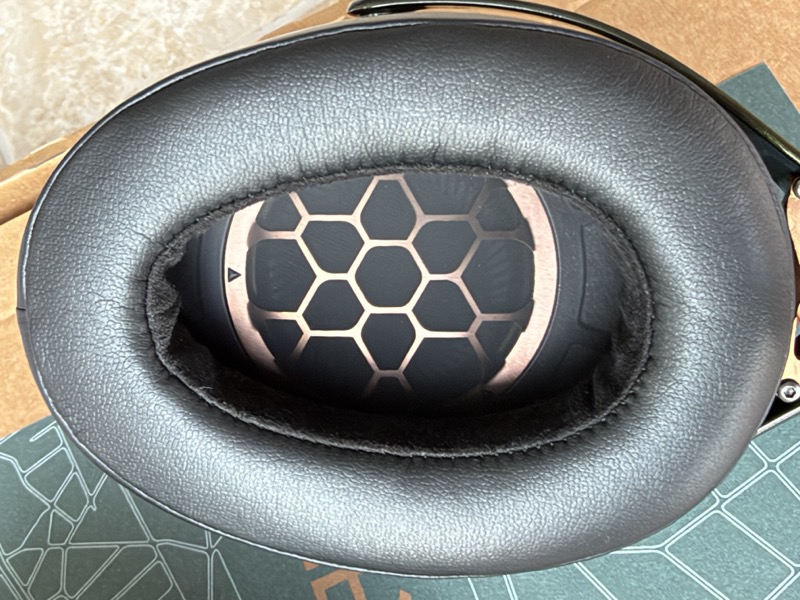
The ear pads are magnetic, which means you can pull them off without tools and see the driver side of the cup. What is behind them is a black baffle with a machined pattern and a copper honeycomb grille over the dome, with small triangular index marks for orientation:
 |
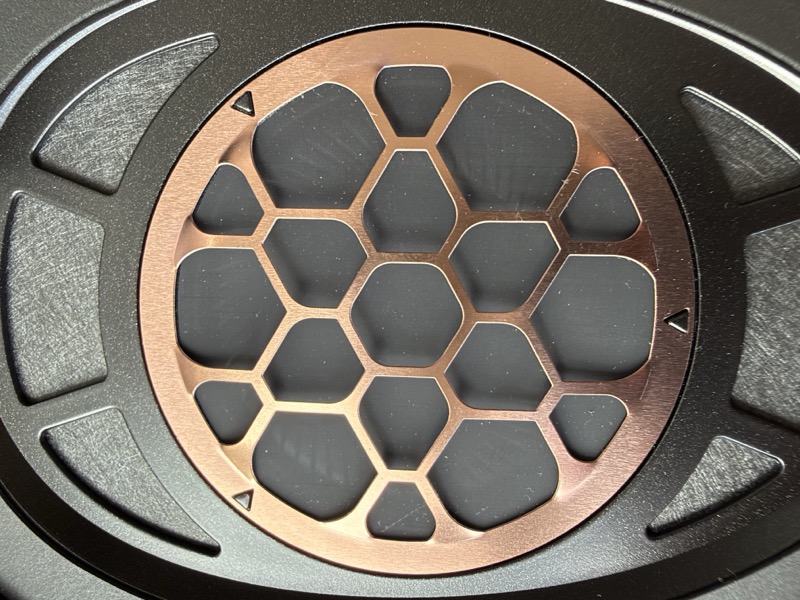 |
That gated copper grille is the same idea used on the 109 Pro rather than the plain acoustic mesh Meze used on the cheaper 105 AER, which is consistent with their claim that the Strada driver is from the 109 Pro family and not the budget one.
Fit and Comfort
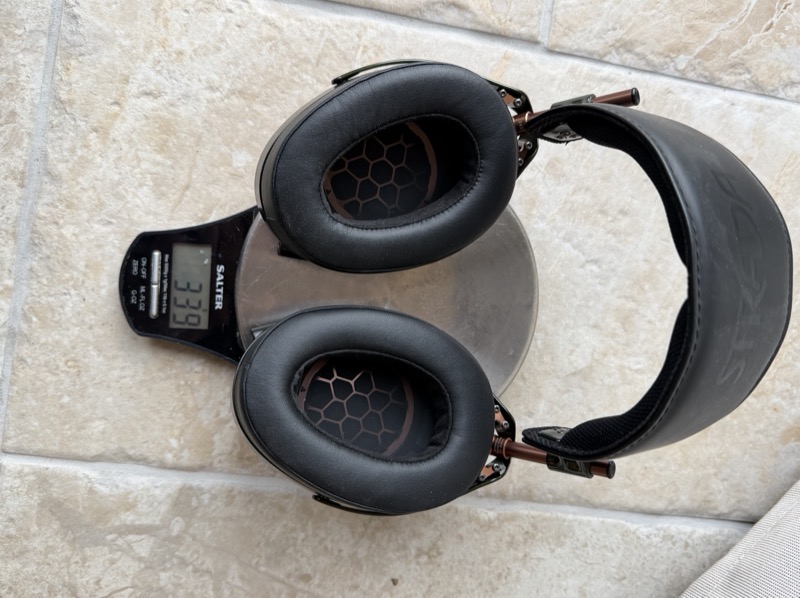
The published weight is 330 g without cable, which places the Strada between the 109 Pro at 375 g and the 99 Classics V2 at 298 g. Weight is carried by a breathable fabric strap under a leather outer band rather than by a padded headband, the same arrangement Meze use across the 105 and 109 series. On my scale it reads 339 g:
The pad opening is a tall oval and the pads are deep, so the driver grille sits well away from the ear - a real consideration on the 105 SILVA, where I noted that larger ears can touch the flatter driver:
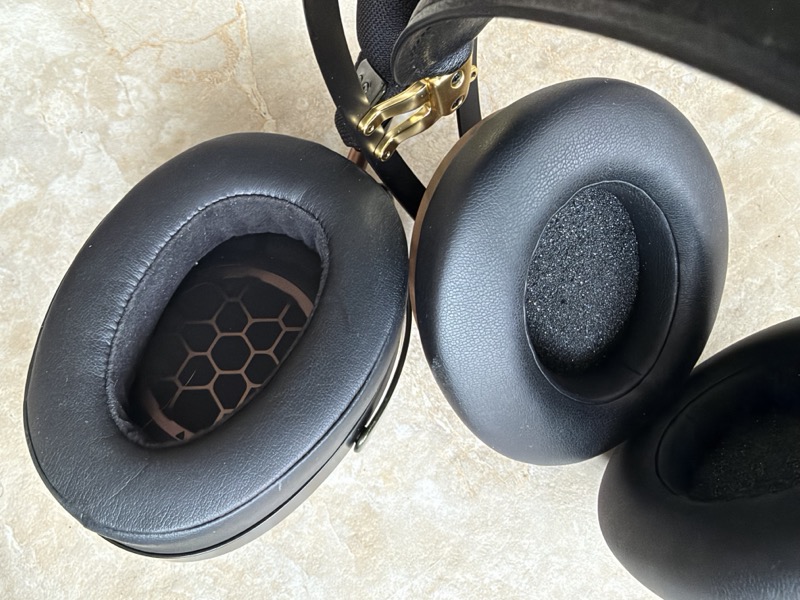
Comparing pad depth against the other closed-backs on my desk shows how much of that internal volume the Strada gives up to the pad rather than the cup:
Comfort is excellent, with the Strada more comfortable than the 99 Classics V2, and I love how light this is even though it uses very premium materials. My wife did try it though and she felt it wasn’t as comfortable as other Meze headphones on her smaller head, which I think was down to the size.
The isolation is fantastic. I have been working remotely in different offices and wearing this headphone gave me enough isolation ( and it is nice having some luxury ), though I did get lots of attention from my co-workers when I was wearing it. Mostly I think I ended up making a few new headphone fans, as my co-workers had never seen or tried a headphone as nice as this one. Compared to some other closed backs the isolation was better than the HD 480 Pro and the FT1. It is obviously not at the level of an ANC headphone, but this is ‘comfortable isolation’ compared to any ANC headphone.
Sound Impressions
It has a good soundstage for a closed back, and I will come back to that below.
On short sessions with familiar reference material, the Strada did not immediately convince me. The longer the sessions got, the more often I found myself thinking the opposite: that this is an extraordinary sounding closed back. With the right tracks and the right genre it stops being a headphone you evaluate and becomes one you listen through, and combined with the looks, the build and the comfort it left me wondering why it is not getting more attention than it is.
What it reminds me of is not the measurement, it is the lineage. This sounds to me like a classic Meze headphone, in the specific sense that the tuning seems to seek out what makes certain music work. If you listen to classic rock, folk, or anything vocal-forward, it pulls detail out of those recordings in a way that makes you want to go back through your whole library again. That is a different quality from accuracy and it is not one a frequency response graph predicts well, which is probably why my first impression and my hundredth were so far apart.
The source chain here is a desktop USB DAC and amplifier feeding the balanced 4.4 mm cable. At 40 Ω and 111 dB SPL/mW the Strada does not need much voltage, and the volume readout in this shot shows how little:
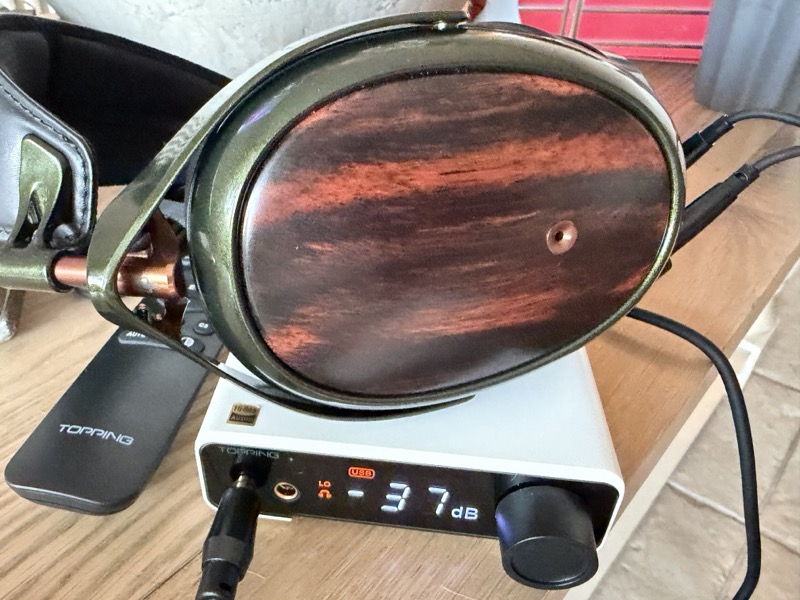
For me it is a more u-shaped sound signature, with some lower bass and upper treble but with a very decent midrange. The tuning is a little different to other Meze headphones, so don’t expect this to be a closed back 109 Pro.
Bass
The bass is mostly excellent for me, with some deep extension, and there is also a decent separation between the bass and the midrange which gives it some clarity ( though if you are a fan of a warmer bass then this might not be for you ). Basically it is a sort of unique bass presentation. Limit to Your Love by James Blake is a good one for hearing that deep extension.
Midrange
The midrange is excellent and well controlled for a closed back, one of the best closed backs for midrange. Fast Car by Tracy Chapman is a good one to check that with.
Treble
The treble was probably the weak point, and I feel the treble might be too much for some users. Similar to the bass, the treble tuning is a little different to other Meze headphones. Something like Billie Jean by Michael Jackson ( or anything else from Thriller ) had too much treble for me, so my advice would be some high shelf EQ, e.g. -3dB at 10kHz. That upper treble does also give you nice detail though, which I always find helps with some of the imaging ( precise instruments ).
Soundstage and Imaging
It has a good soundstage for a closed back. It isn’t as open or wide as a 109 Pro, but it is better than most closed backs in my collection, including the Sennheiser HD 480 Pro, the FiiO FT1 and the 99 Classics V2. It is not as wide as the Yamaha YH-C3000, but the Yamaha sacrifices tonality to get an open soundstage on a closed back, and the Strada doesn’t, it retains a nice midrange. Hotel California by the Eagles is a good track to check that with.
EQ
I did make some tweaks with PEQ, a small cut in the bass around 300 Hz and a gentle high shelf for the treble:
- Preamp: -0.1 dB
- Filter 1: Peak, 300 Hz, -3.0 dB, Q 1.0
- Filter 2: High shelf, 8000 Hz, -2.0 dB, Q 1.0
Comparisons
The most direct comparison is the 109 Pro, because the two cost the same $799 and share a driver lineage. On paper the differences are small - both 40 Ω, 112 dB against the Strada’s 111 dB, and 375 g against 330 g - so the choice is not about drivability or weight. It is about whether you need a sealed cup. Even though they share the same driver I feel they have a very different sound signature, with much more sub-bass on the Strada ( if you get the seal ) and an overall warmer but obviously more ‘open’ soundstage with the 109 Pro.
Against the 99 Classics V2 the gap is price rather than concept. The 99 Classics V2 is $349, closed, walnut, and 298 g, and I rated it highly - the tuning and build at that price were the point. The Strada asks for more than twice the money for a larger driver, a magnesium rather than plastic-and-wood frame, a second balanced cable in the box, and magnetic pads. The 99 Classics V2 is another excellent closed headphone from Meze, but it is not as premium as the Strada, and I find the Strada more comfortable.
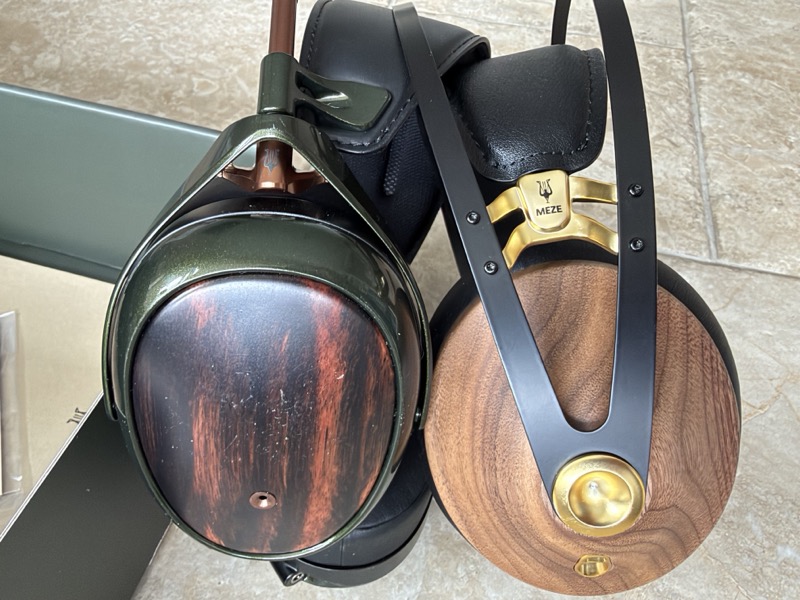
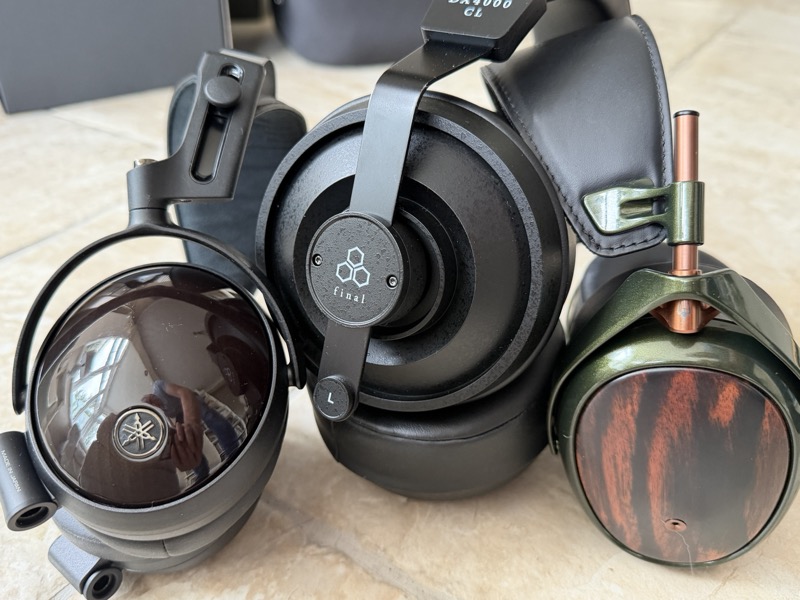
The 105 SILVA is the other useful reference point, at $499 with the same 50 mm platform in an open-back walnut shell, 42 Ω and 354 g. My reservation there was internal cup volume - the flatter driver means larger ears can make contact - and the Strada’s deep oval pads and set-back grille look like a direct answer to that. Here it is side by side with the walnut and gold 99 Classics V2:
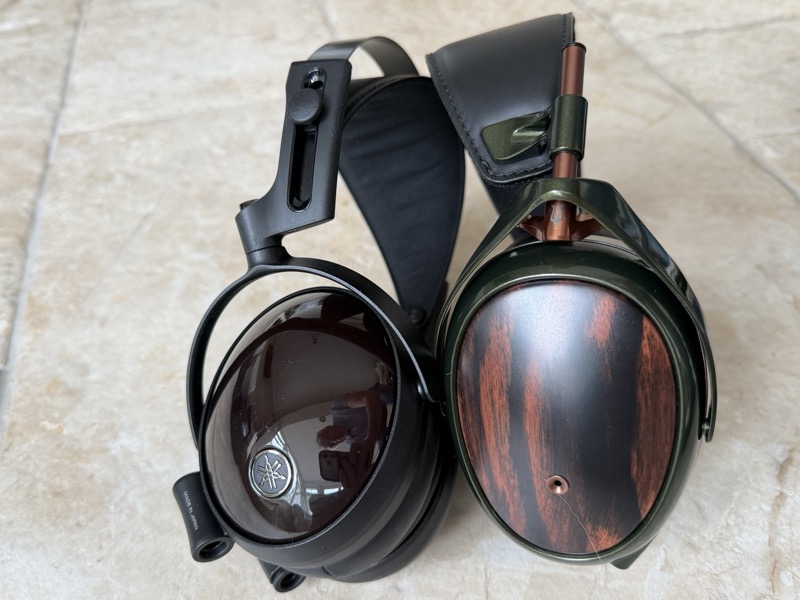
And next to the Yamaha YH-C3000, which has a very different cup shape, a shallow glossy dome instead of a deep oval:
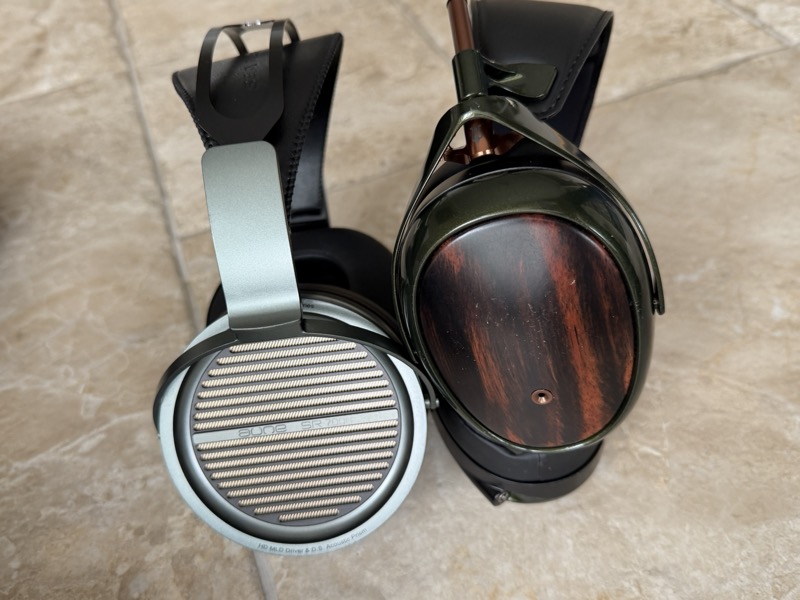
And with the Aune SR7000, another closed back:
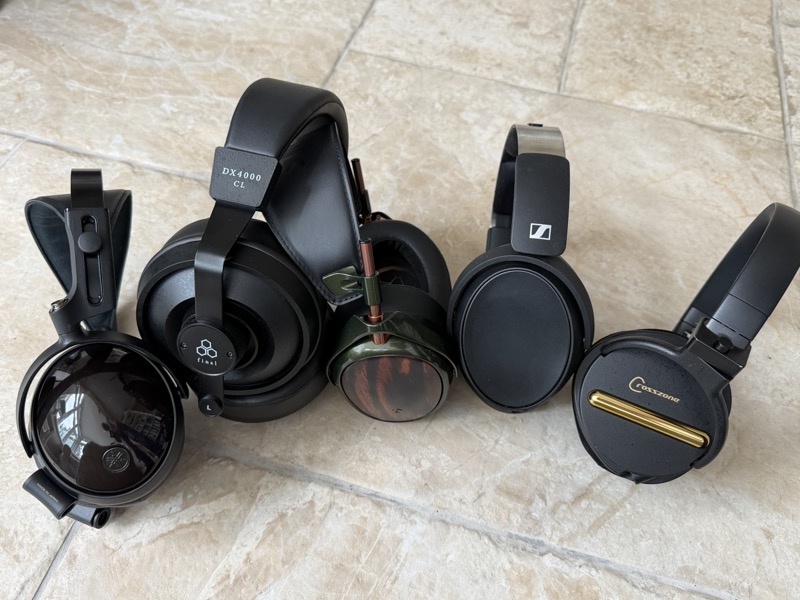
Seen in the wider group, the Strada is the smallest-looking of the lot despite having a 50 mm driver, which is a consequence of the oval cup rather than a compact driver:
 |
 |
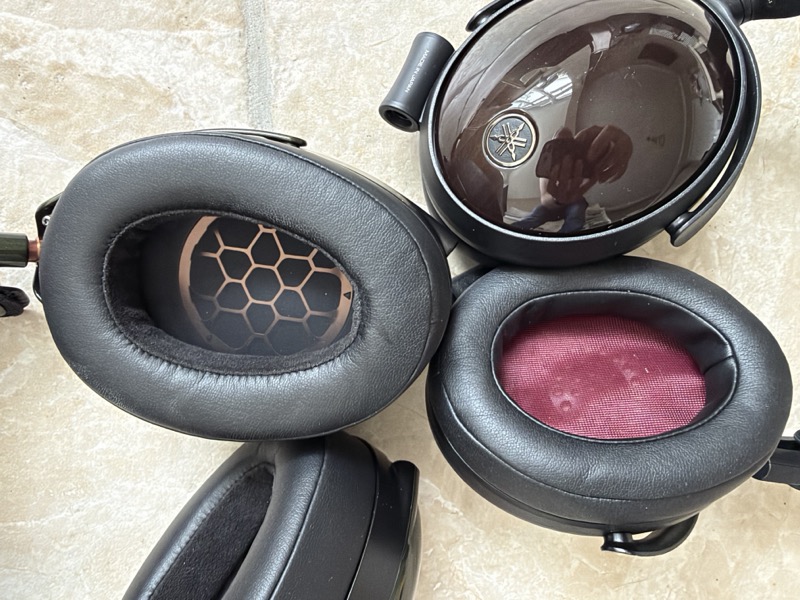
The pad comparison is the more informative one for anyone who has struggled with cup depth. From left to right the material and opening shape differ substantially, and the Strada’s is the deepest of the three:
Specifications and Measurements
Specifications
These are the manufacturer’s published specifications, taken from the Meze product page in September 2026. They are Meze’s claims, not independent measurements.
| Specification | Value |
|---|---|
| Type | Closed-back, over-ear |
| Driver | 50 mm dynamic |
| Diaphragm | Bio-cellulose composite dome, beryllium-coated torus |
| Impedance | 40 Ω |
| Sensitivity | 111 dB SPL/mW at 1 kHz |
| Frequency response | 5 Hz - 30 kHz |
| Total harmonic distortion | < 0.1% at 1 kHz |
| Weight | 330 g (11.64 oz), without cable; 339 g on my scale |
| Input connector | Dual 3.5 mm TS |
| Frame | Magnesium, hand-painted |
| Ear cup covers | Macassar ebony |
| Cables supplied | 1.8 m 3.5 mm and 1.8 m 4.4 mm, dual mono, fabric sleeved |
The two numbers that matter for buying decisions are the impedance and the sensitivity. At 40 Ω and 111 dB SPL/mW the Strada needs very little voltage to reach normal listening levels, which means a phone dongle will drive it loud enough. The quoted 5 Hz - 30 kHz response and < 0.1% THD are not useful for comparison - no bandwidth limits or measurement conditions are given, and every manufacturer quotes these the same flattering way.
Meze do not publish a frequency response curve or distortion plot for the Strada, so there is no manufacturer graph to present here.
Frequency Response
These are my own measurements, taken on a KB501X soft ear and pinna with a 711 clone coupler. Two plots appear below: one against the KB501X diffuse-field target with a −1 dB/octave tilt, and one against Harman OE 2018 on an absolute scale. Everything above roughly 7 kHz on this rig is coupler and pinna resonance rather than headphone, so the numbered annotations stop before it.
Starting with the two channels against the tilted diffuse-field target:
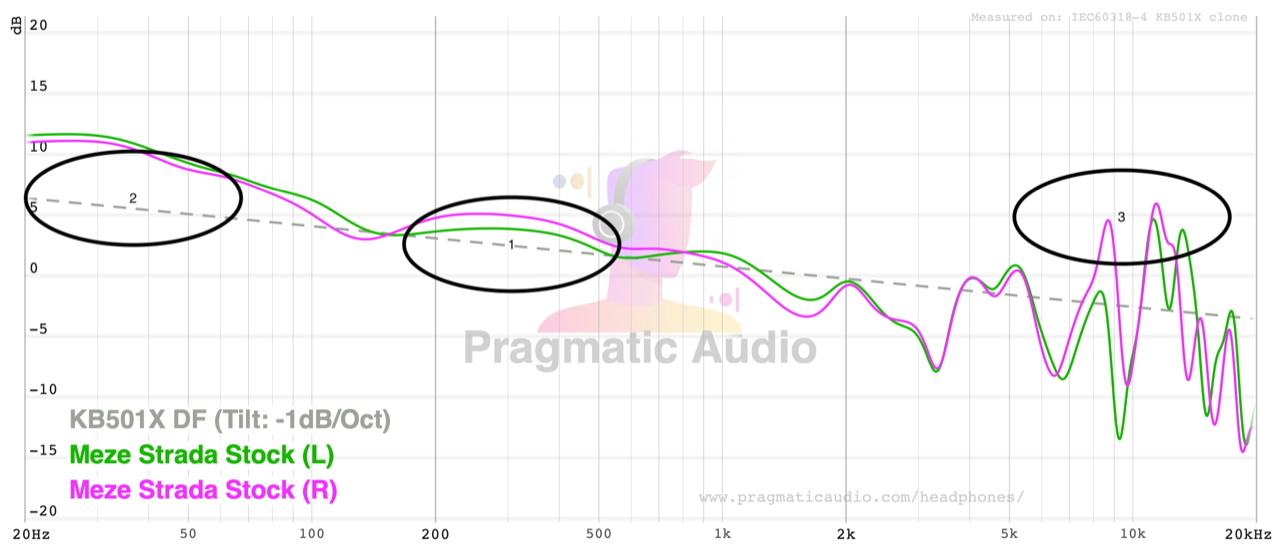
Annotation 1 is the whole review in one circle. Through roughly 200 Hz to 600 Hz the Strada sits about two decibels above the tilted target, and that is the lower midrange rather than the bass. Annotation 2 marks the bottom octave, where it runs three to four decibels above the target line and reaches 20 Hz without rolling away. Annotation 3 is the region I would not read anything into: above about 7 kHz the two channels diverge because the fixture does, not because the headphone does. Below that they track each other closely, which matters given how much of this headphone’s character lives in the midrange.
The same measurement against Harman OE 2018 on an absolute scale says the same thing from a different direction:
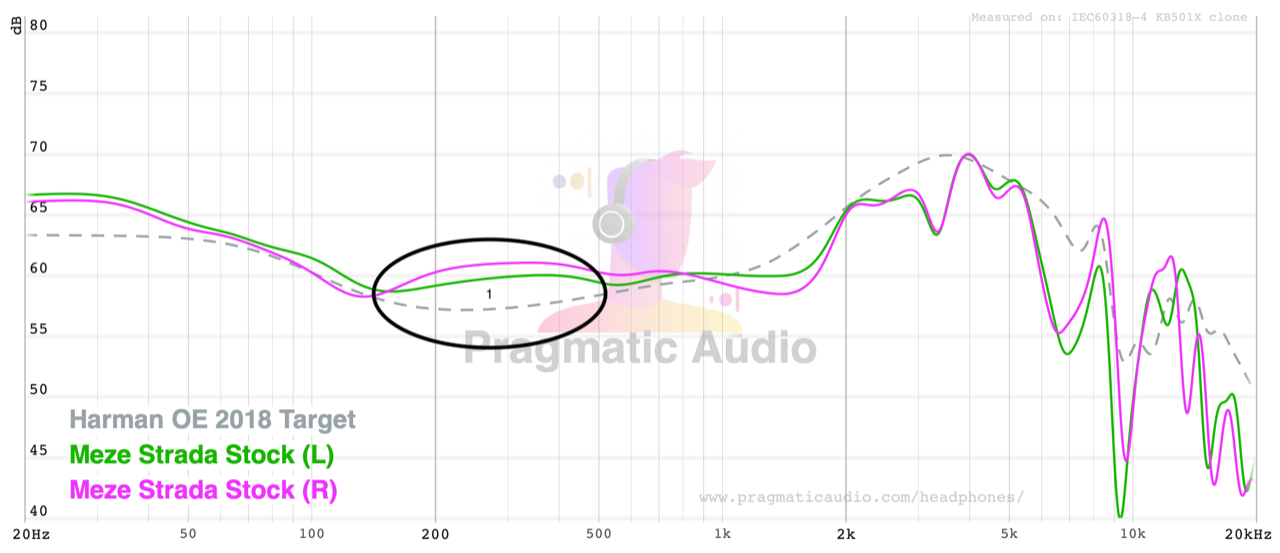
Annotation 1 again marks 150 Hz to 600 Hz, where the Strada runs two to three decibels above Harman. What the absolute plot adds is the region either side of it: from 1 kHz to 3 kHz the Strada sits noticeably below Harman’s ear-gain rise, by around five decibels at 2 kHz, before rejoining near 4 kHz. So the shape is not a simple warm tilt. It is a lift in the lower midrange combined with a dip through the presence region, and that combination is what gives voices body without giving them edge.
Against the Meze Poet, the house resemblance is less than you would expect:
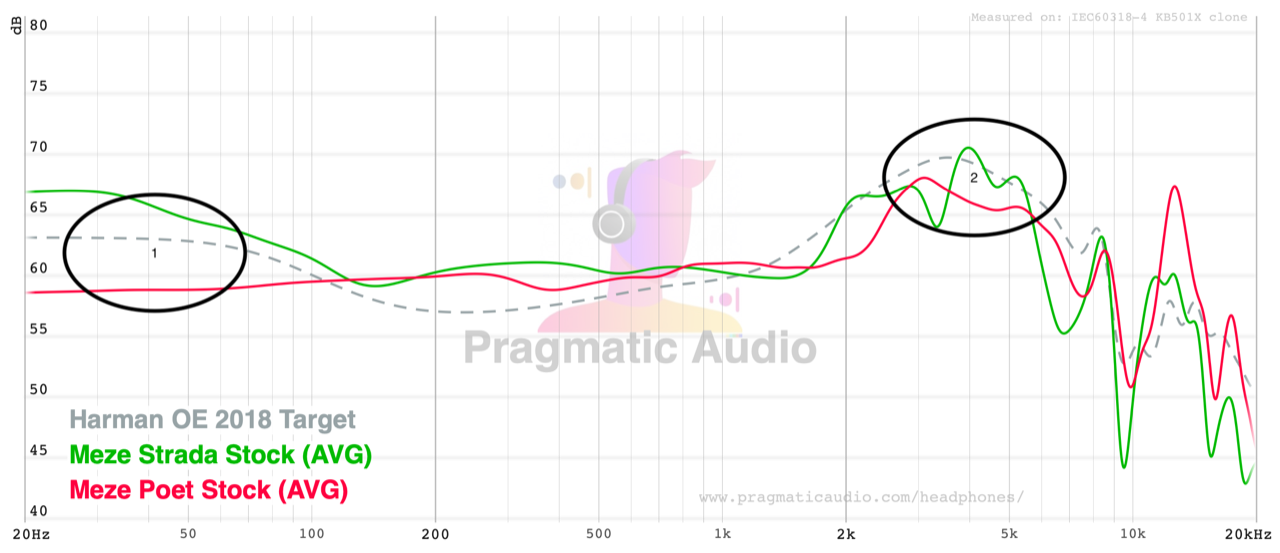
Annotation 1 is the bottom octave, where the sealed Strada has roughly eight decibels more output at 20 Hz than the open-backed Poet - exactly the difference you would predict from the cup and not an interesting finding on its own. Annotation 2 is the interesting one: through 2.5 kHz to 5 kHz the Strada carries more energy and a sharper peak near 4 kHz where the Poet stays smoother and flatter. The Strada is the more vivid of the two in the presence region, not the more relaxed.
Against the 99 Classics V2, the difference is where the warmth comes from, and this is the comparison I would point anyone at who wants to understand the Strada:
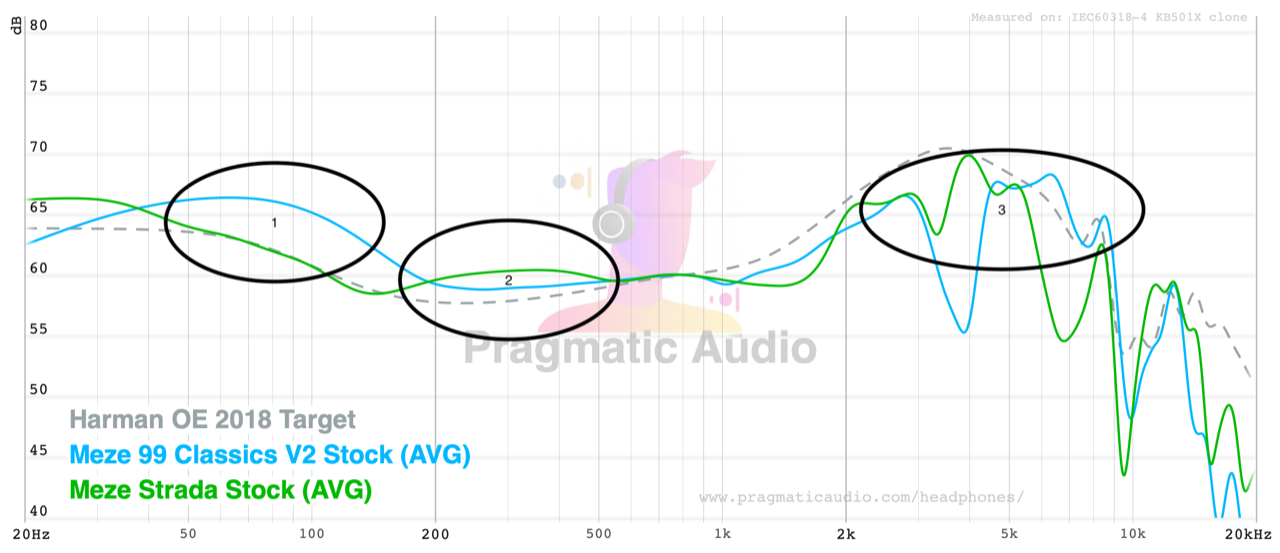
Annotation 1 covers 50 Hz to 150 Hz, and here the 99 Classics V2 is the fuller of the two by three or four decibels - that is the classic mid-bass hump, and the Strada does not have it. Annotation 2 covers 200 Hz to 500 Hz, and the order reverses: the Strada is the one sitting above both the 99 Classics and the target. Annotation 3 covers 2 kHz to 6 kHz, where the Strada’s 4 kHz peak stands against a deep notch on the 99 Classics near 4.5 kHz. Two Meze headphones, two completely different routes to warmth: one adds weight below 150 Hz, the other adds body above 200 Hz. The second route is much less common and much more forgiving of dense bass.
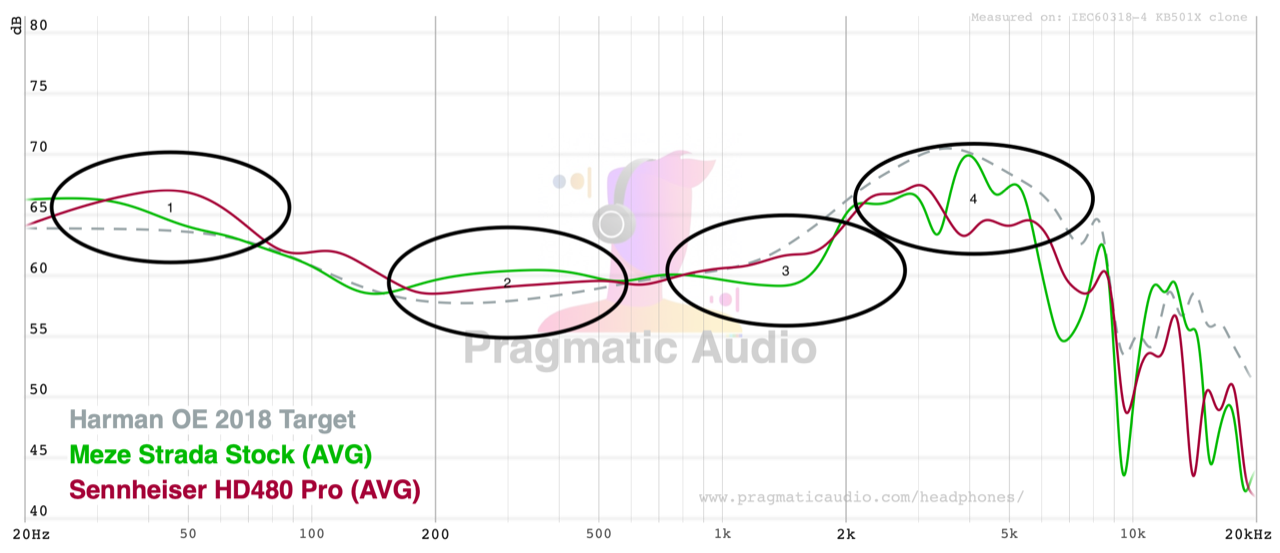
The Sennheiser HD 480 Pro is the studio reference in this group, and the pair of plots below is the clearest statement of what the Strada does differently:
 |
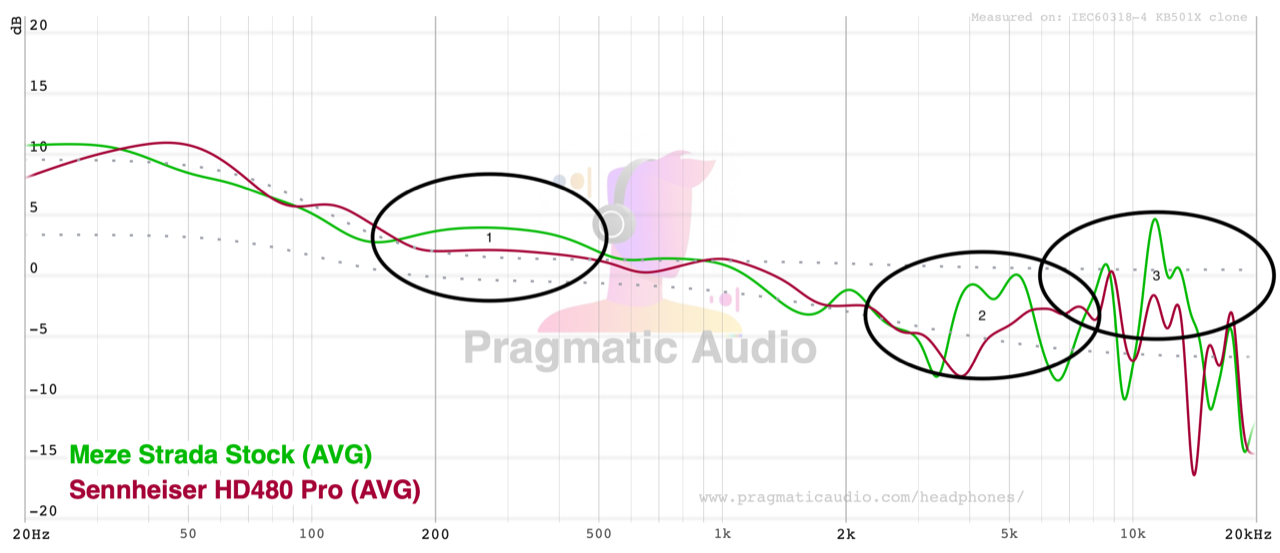 |
On the Harman plot, annotation 1 shows the two within a decibel in the bottom octave, so this is not a bass comparison. Annotation 2 is the lower midrange again, the Strada around a decibel and a half above. Annotation 3 is the one that matters: from 700 Hz to 2 kHz the HD 480 Pro is the more forward of the two, which is exactly what you want from a monitoring headphone and exactly what makes it unflattering. Annotation 4 shows the Strada’s 4 kHz lift against the HD 480 Pro’s flatter run through the same region. The tilted-target plot beside it marks the same lower-midrange lift as annotation 1 and the shared presence dip as annotation 2, with annotation 3 covering the fixture region above 7 kHz.
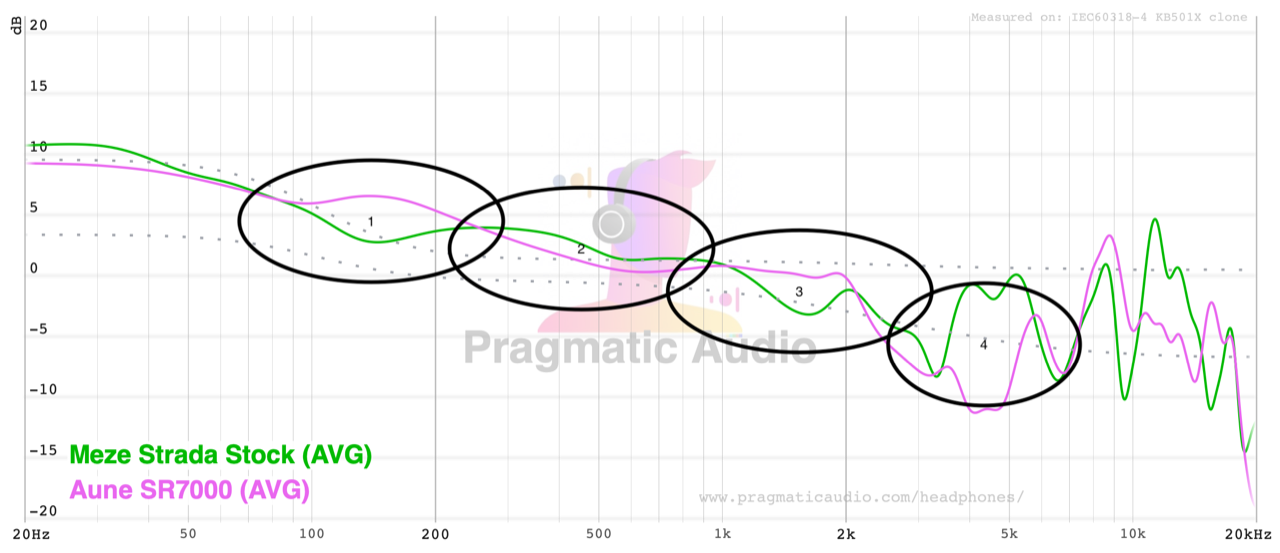
The last two comparisons make the pattern hard to dismiss. Against the Aune SR7000 and the FiiO FT1, both closed backs:
 |
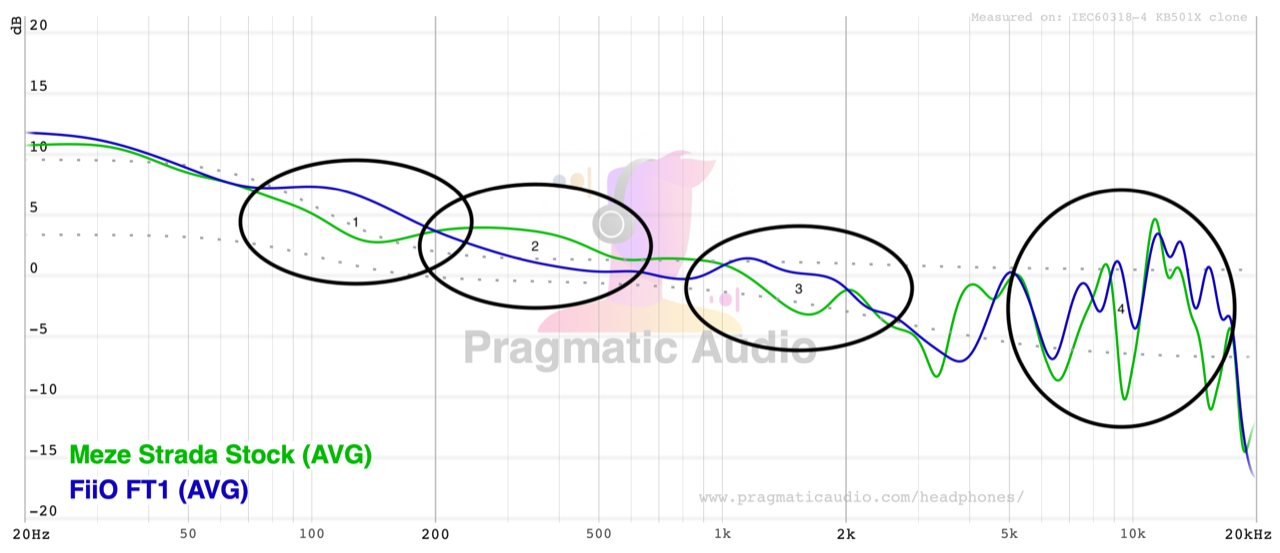 |
Annotation 1 on both is 70 Hz to 250 Hz, and on both the Strada is the leaner headphone - the SR7000 by three or four decibels, the FT1 by around three. Annotation 2 on both is 250 Hz to 700 Hz, and on both the order flips and the Strada comes out on top. Annotation 3 on both covers 800 Hz to 2.5 kHz, where the Strada is the more recessed. Annotation 4 marks the presence dip and the fixture region respectively.
Four different comparison headphones, and the same signature every time: less mid-bass than its peers, more lower midrange, less upper midrange. That is an unusual place to put warmth, and it is not what most tuning conventions ask for. It is also, I think, the explanation for everything in the listening section above - why my analytical tracks sounded tonally shifted and why acoustic and vocal material sounded so good. Body in the 200 Hz to 600 Hz region is where the chest of a male voice, the box of an acoustic guitar and the body of a cello live. Lift that region and hold the mid-bass back and you get warmth without thickness, which is a rare and specific trick.
Positional Variation Measurements
One more measurement, because on this headphone it turned out to matter. These come from my Headphone Positional Capture tool, which measures the headphone at a centred seating and at deliberate forward, back, up and down offsets on the fixture and overlays the family of curves. Everything is normalised at 1 kHz:
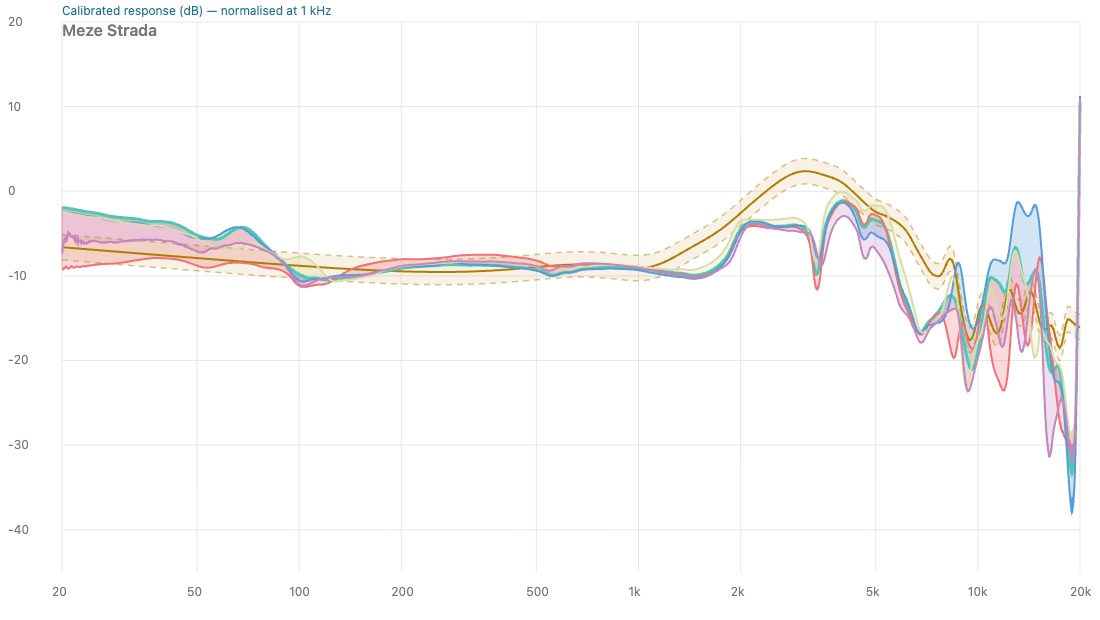
Two findings, pointing in opposite directions. Below 100 Hz the traces spread by six or seven decibels depending on where the cup sits, which is seal dependence and a real caution: on a sealed cup the bass is only as good as the seal, and if you wear glasses you should assume you are hearing the lower of those traces. Through 2 kHz to 5 kHz, by contrast, the curves stay bunched within about a decibel, so the presence region and the lower treble are stable wherever the headphone lands. The part of the tuning that gives the Strada its character is the part that does not move.
I ran the same measurement on the Grell Audio OAE2 and got almost exactly the inverse - tight in the bass, spread across the presence region - which is what you would expect from a steeply angled driver against a conventional one. The comparison is discussed in that review.
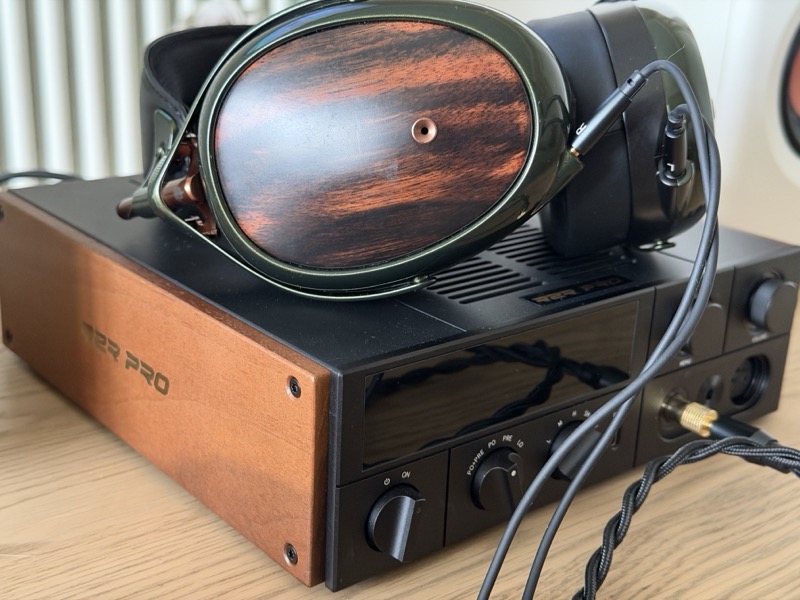
Most of my listening was from the FiiO K17 R2R, which is more amplifier than this headphone needs and which happens to match it rather well:
Why that makes it a collection headphone
This is the point where I want to stop describing the graph and say what I think it means, because the Strada is the clearest example I have measured of a headphone that is not trying to be the only one you own.
Floyd Toole’s “circle of confusion” is the useful frame. There is no standard for how music is mixed and mastered: recordings are made on monitors that do not agree with each other, in rooms that do not agree with each other, and then played back on transducers that do not agree either. Every link in that chain is calibrated against the others by ear rather than to a reference, so the loop never closes. A single “correct” headphone cannot exist while the source material itself has no standard - and while it would be good to have one, we do not.
What follows from that is not despair, it is the argument for a collection. Classic studios had their own sounds and their own monitoring, and a great deal of the music people love most was made inside those specific conventions. A headphone whose emphasis happens to align with the conventions a particular record was made under will make that record sound extraordinary, and the same headphone will make a record made under different conventions sound slightly off. That is not a fault in the headphone. It is the circle of confusion showing through, and it is why owning several transducers with genuinely different emphases is a luxury worth having rather than an indulgence.
The Strada is a very good argument for that position. The measurements above say precisely where its emphasis sits, and that emphasis is genuinely different from everything else in this comparison group. On the right material it is stunning, and on the wrong material it is tonally shifted in a way you can hear and now, having read this far, explain.
Distortion
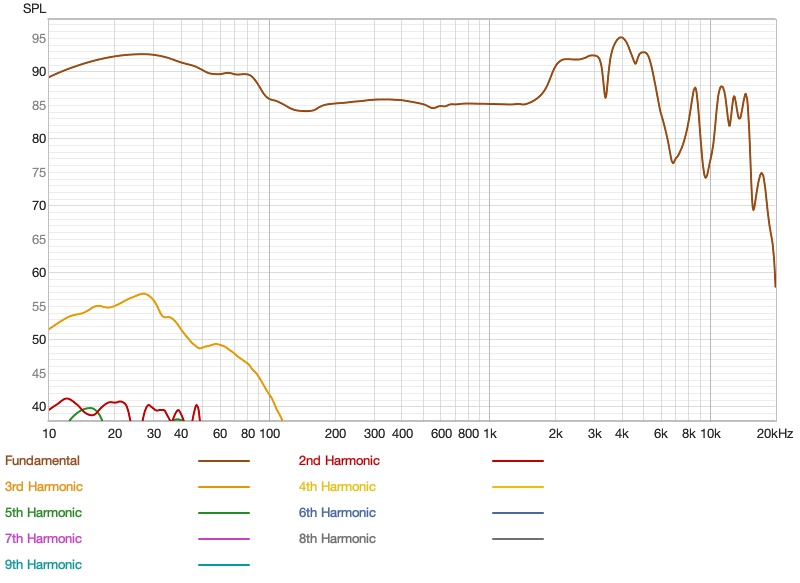
The distortion sweep was run at ordinary listening levels - the fundamental sits between 85 and 93 dB across the band, peaking near 95 dB at 4 kHz:
As a percentage of the fundamental, the picture is unusual in one respect:
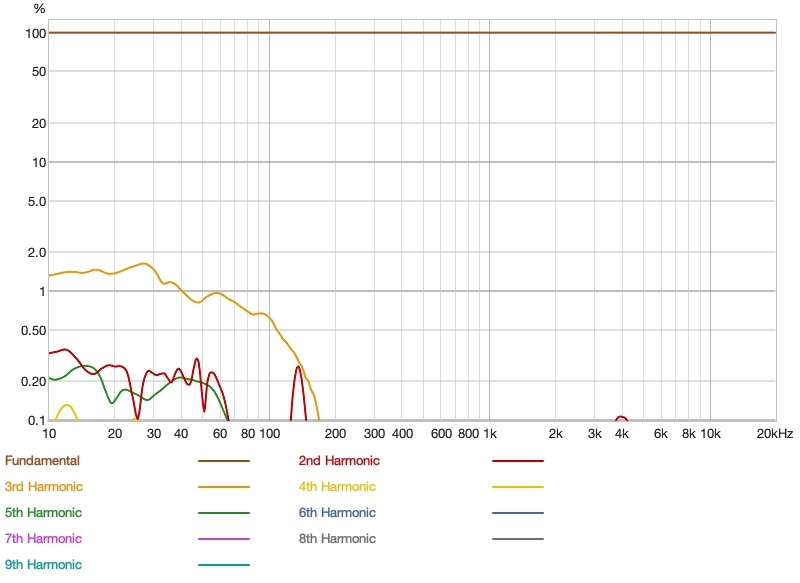
Third harmonic distortion is the dominant component in the bass, peaking at about 1.5% around 25 to 30 Hz and falling below 0.5% by 80 Hz. Second harmonic stays under about 0.3% throughout. Above 200 Hz there is essentially nothing to report, which is the important part: across the entire midrange and treble, where this headphone’s character lives, distortion is below the level at which it is a consideration. Third-order distortion dominating second is less common than the reverse and is the more audible of the two, but 1.5% at 30 Hz at 92 dB is a modest figure and not one I would expect anyone to hear on music.
Rating Explanation
I rate the Strada 5 overall, 5 for price, 5 for features and 4 for measurements. For the price it is a premium build with a generally good detailed sound signature, and this has been a great year for headphones, with the Strada one of those excellent closed backs like the HD 480 Pro and the Final Audio DX4000 CL (and of course the cheaper 99 Classics V2). It is not cheap, but this is basically a high end Meze with a more standard dynamic driver, so I gave it a 5 for price. Features get a 5 because I just love how comfortable it is, and the slightly quirky green with the wood finish.
Conclusion
The Strada is a $799 closed-back with a 50 mm driver derived from the 109 Pro, in a 330 g hand-painted magnesium frame with Macassar ebony covers. My first impression, on the analytical tracks I use precisely because I know them too well, was uncertainty, and it took extended listening to work out that on the right material this is an extraordinary sounding closed back. If your listening leans towards classic rock, folk or vocals, the Strada is likely to send you back through your library. If you are a fan of a warmer bass it might not be for you, and the treble may be too much for some people without a little EQ.
My experience bringing it on a few trips and showing some of my remote co-workers what a premium headphone is like was a lovely feeling, and in the run up to Christmas this could be an exceptional present for someone.