Grell Audio OAE2: An Excellent Headphone on Most Heads, Exceptional on the Right Head
An Open-Back That Is Very Good for Everyone, and Exceptional When Its Angled Driver Meets the Right Ear
The second coming of Axel Grell. Spacious, open and superbly comfortable — and how spacious depends on how the angled driver sits against your ear, which this review sets out to measure rather than argue about.
I reviewed the Grell Audio OAE1 last year and came away fascinated by it — Axel Grell’s free-field tuning, the extreme angled driver, and a deliberately tilted bass shelf. The OAE1 was not the most comfortable headphone I have used, but it was okay for me. The OAE2 is much better in this respect. It keeps the same bio-cellulose driver technology and design philosophy, but Grell have clearly used what they learned from the OAE1 to improve the parts that mattered.
This review is about two months later than it should have been, and the delay was not idleness. I could not work out how to measure this headphone in a way that explained what I was hearing. Reviews of the OAE2 disagree about the presence region and the lower treble: some hear it as recessed, and I hear it as one of the best things about the headphone and the basis of the spacious presentation it shares with the OAE1. Both readings cannot be right about the same object, which usually means the object is not behaving the same way for everyone. My theory is that the steeply angled driver is the reason, and that the response in that region is unusually sensitive to exactly how the cup sits against the ear. So I spent part of that two months building a tool to measure it, trying to uncover a little of what the head-related transfer function does to headphones that aim sound at your ear from an angle. It will be useful on other angled designs too, the recent Aune headphones among them, though nothing I have measured is angled as steeply as the OAE1 and OAE2.
At €499/$499, the OAE2 is more expensive than the OAE1 was available for after Drop reduced the original’s price. I first heard the retail-ready unit at Grell’s booth at Vienna High End, where it immediately impressed me enough that I wanted my own sample for a proper long-term listen once it shipped.
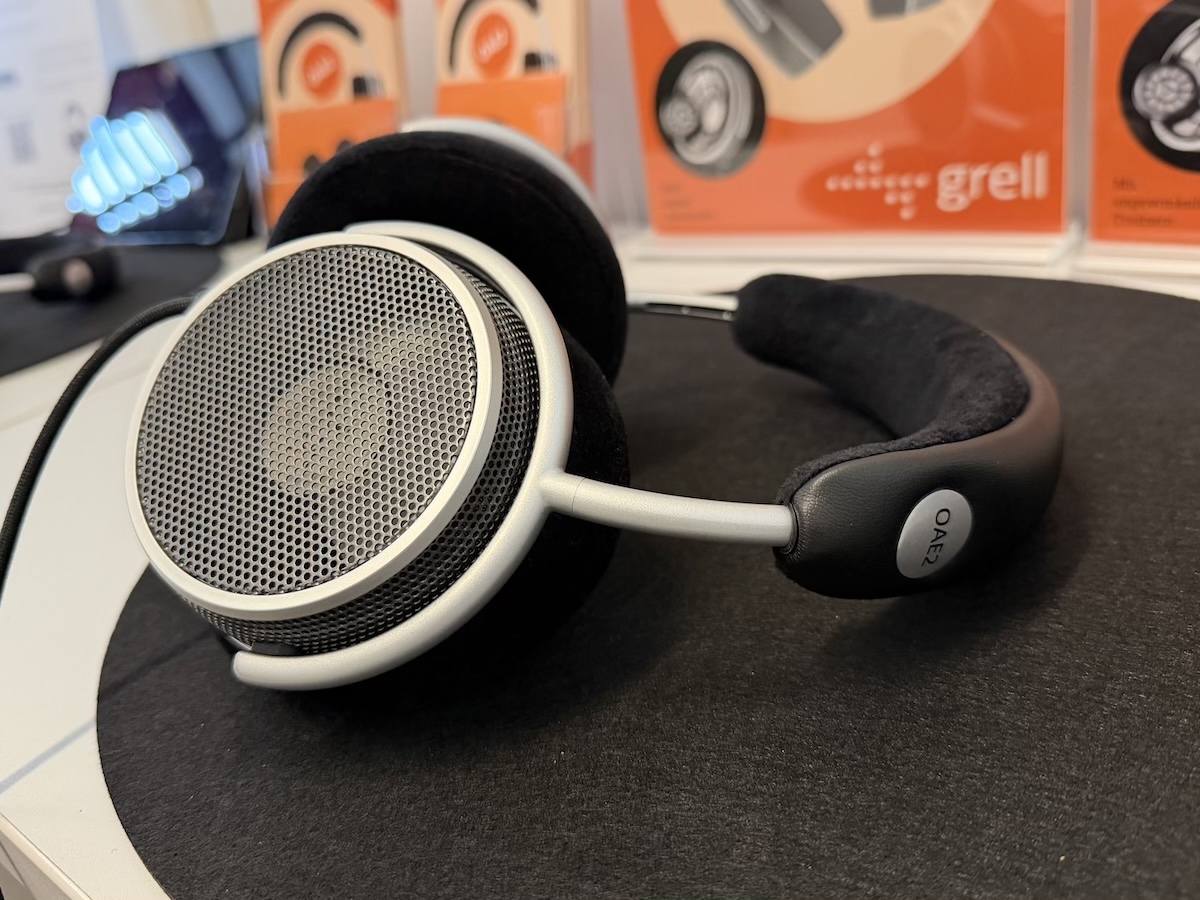
I would like to thank Grell Audio for providing the OAE2 for the purposes of this review.
If you are interested in finding more information about this product, you can find it at the official Grell Audio product page.
The Grell Audio OAE2 retails for €499 ($499). It is worth remembering that the OAE1 was available for less through Drop, so the OAE2’s value needs to be judged against the current market rather than only the original launch price.
I have had the OAE2 for five weeks now and have been enjoying every bit of it. The short version, which the rest of this review backs up: it looks almost identical to the OAE1 online, but it is a better headphone in the ways that matter most — noticeably more comfortable, and with bass that trades quantity for real quality. But first, let’s take a look at what’s in the box.
Unboxing and Build Quality
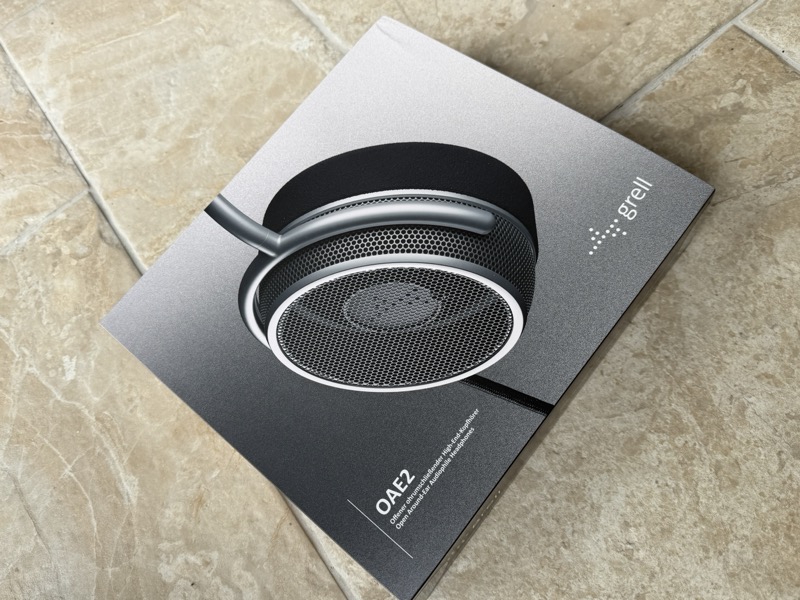
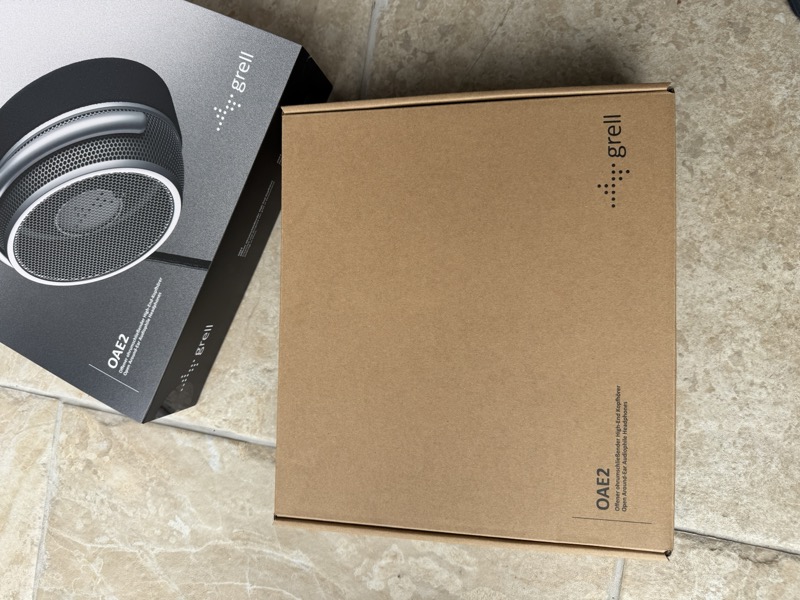
The OAE2 arrives in a glossy black outer sleeve with a life-size photo of the headphone on the front, sitting over a plainer kraft shipping box underneath:
 |
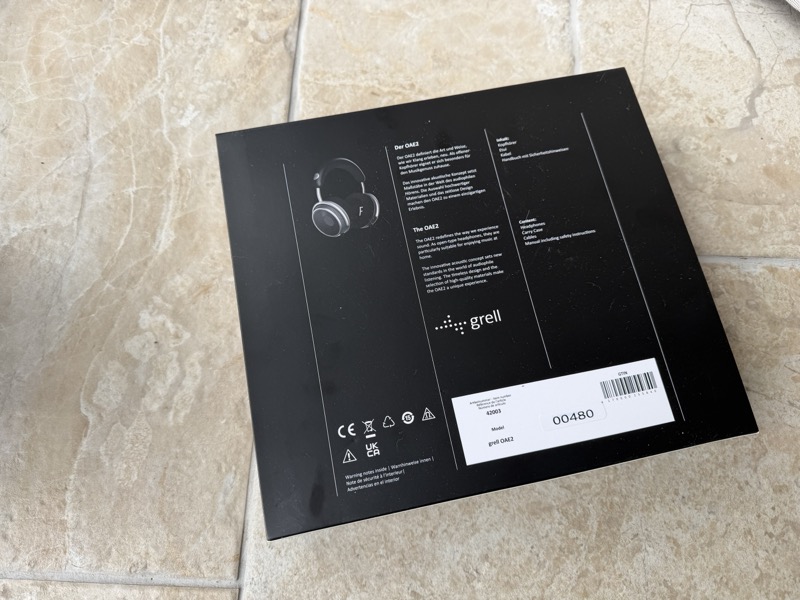 |
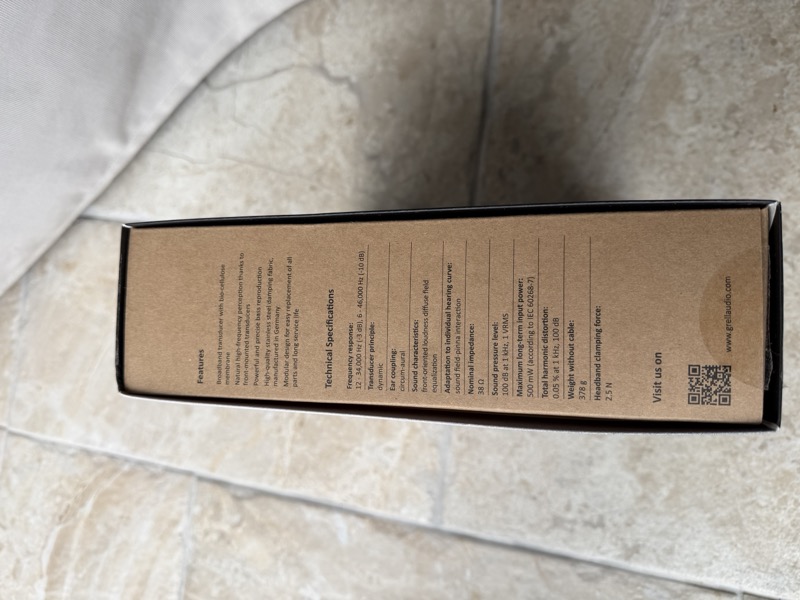
The back of the box carries the model number and regulatory information, while one side panel prints the full feature list and technical specification table — useful to have to hand before you have even opened the case:
 |
 |
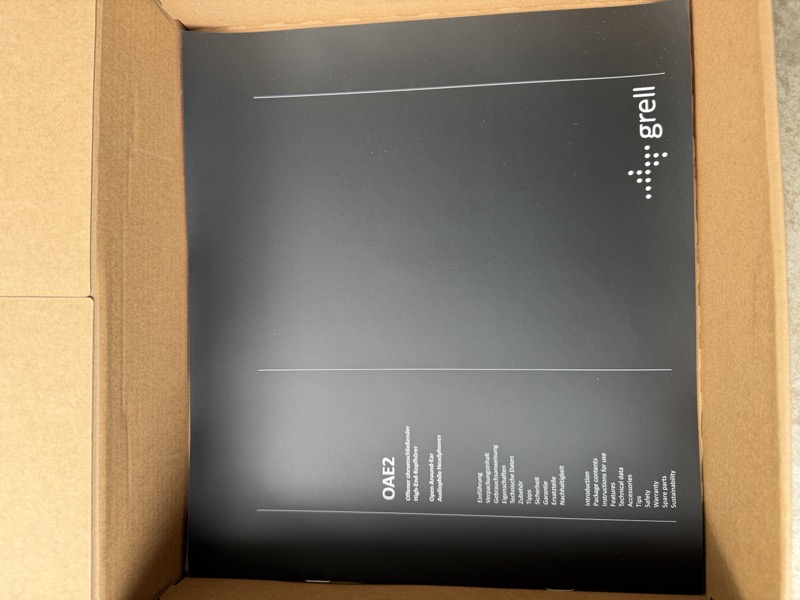
Inside, a fold-out manual cover sits on top, printed in the same dark, minimal style as the rest of the packaging:
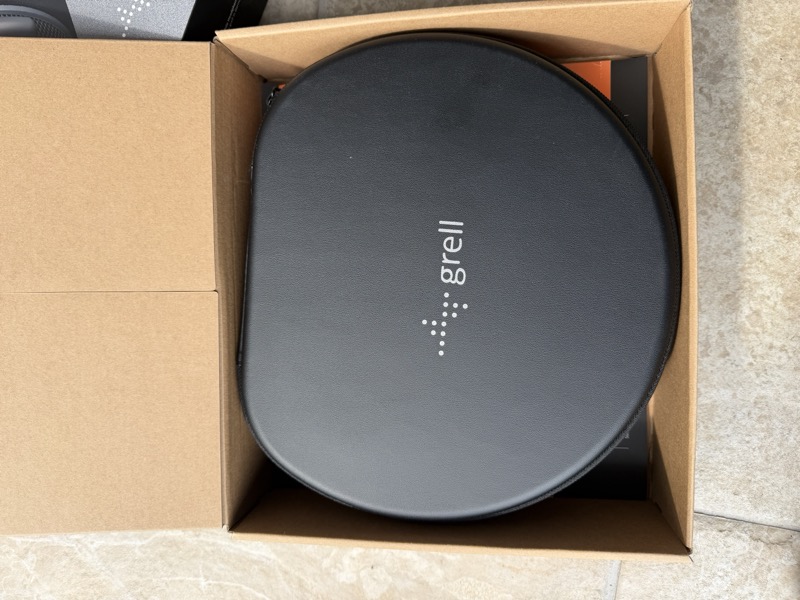
Underneath that is the carrying case itself, a slim, flat clamshell with the Grell logo on the lid — a much slimmer profile than the bulbous case you get with a lot of headphones at this price, and one that will actually fit in a drawer or a bag pocket:
Open the case and the headphones sit with the earcups swivelled flat, one of Grell’s two cables coiled neatly beside them, along with a card insert:
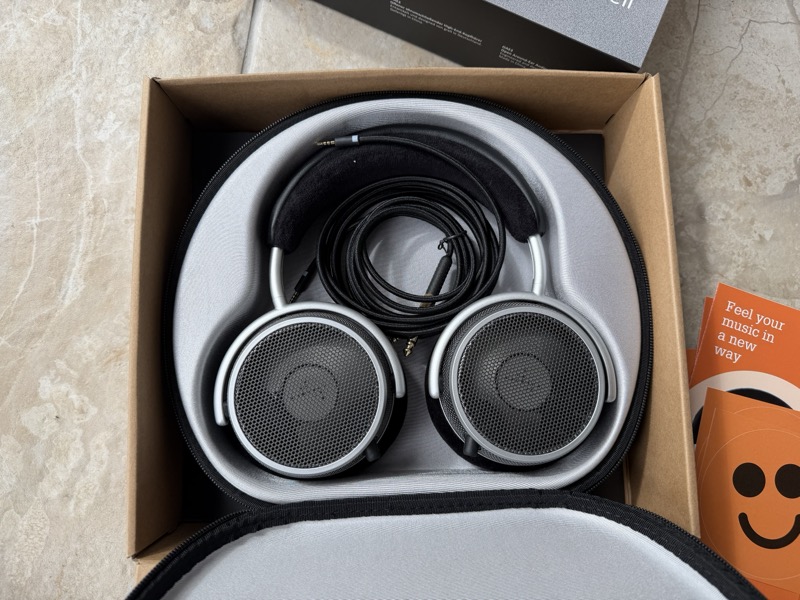
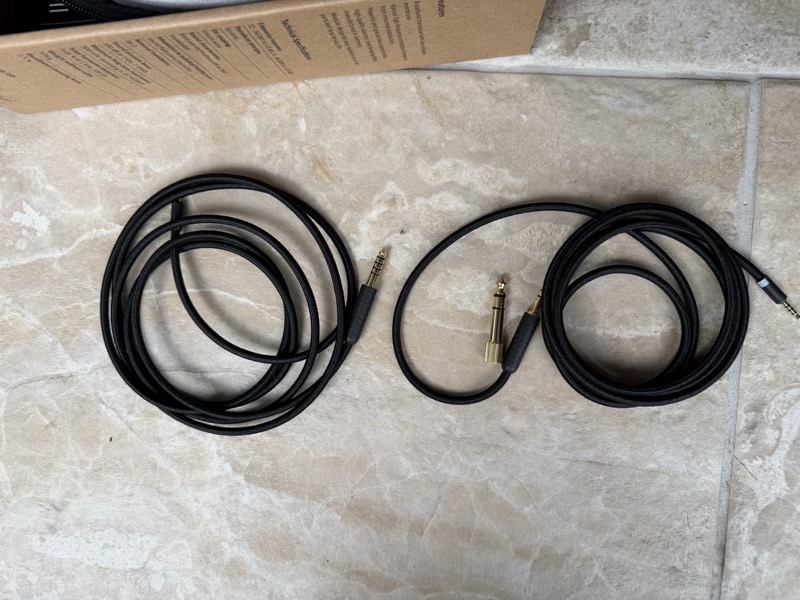
You get two cables in the box: a 1.8m balanced lead terminated in 4.4mm, and a second 1.8m single-ended lead terminated in 3.5mm with a screw-on 6.35mm adapter — between the two, that covers most of the DAPs, dongles and desktop amps you would plausibly want to pair this with:
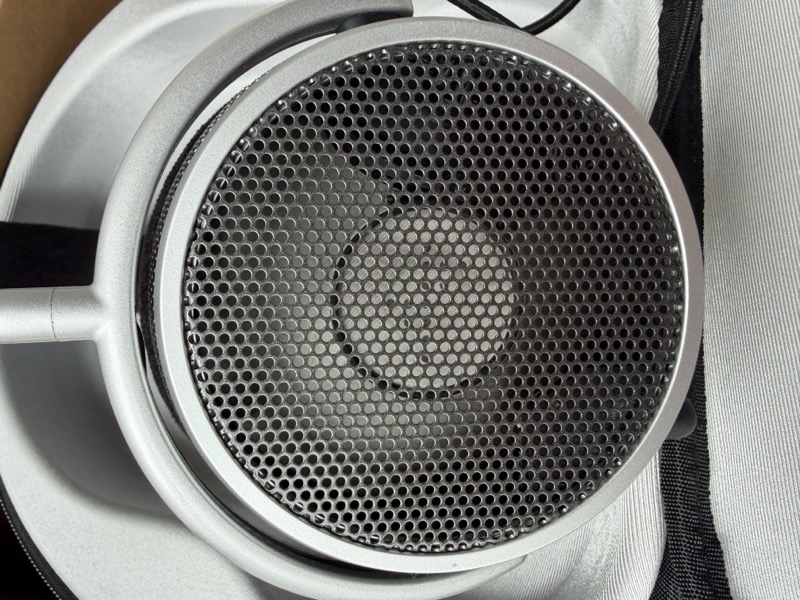
Build quality is a clear step up from what photos suggest — like a lot of gear, the OAE2 looks better in person than in the marketing shots. The earcup grille is a fine stainless-steel damping mesh made in Germany, held in a silver-finish ring, and it photographs cleanly straight-on:
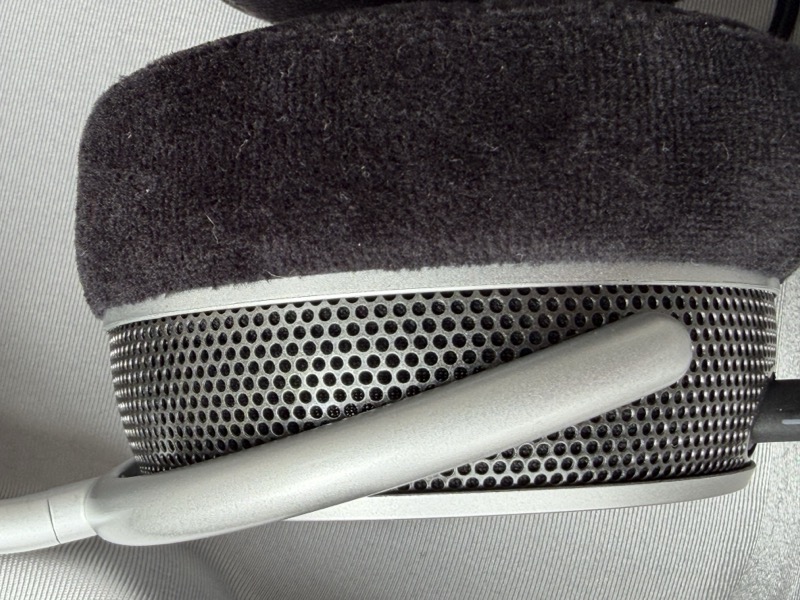
Seen from the side, you can make out the depth of the grille assembly against the dark velour earpad — the driver sits well back from the mesh, which is part of how Grell get the angled, front-oriented driver placement their FSFM tuning depends on:
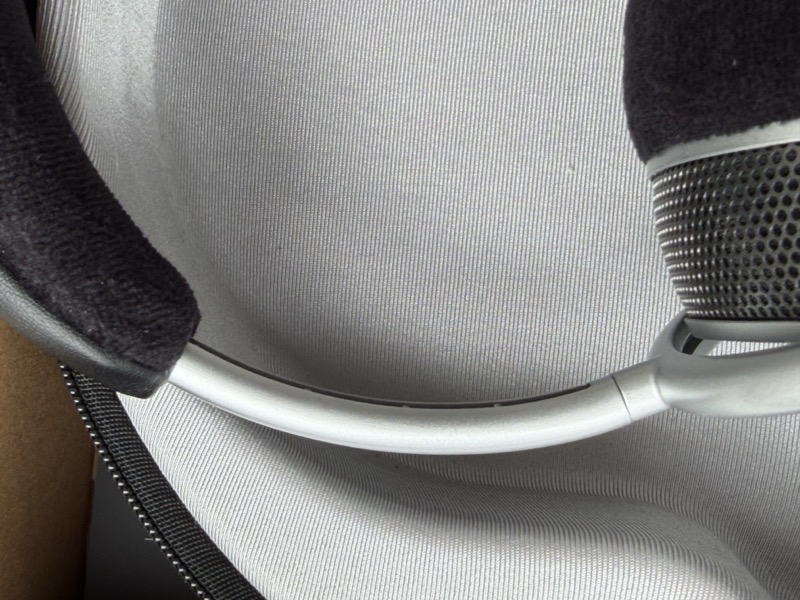
The headband yoke and slider mechanism is solid metal, with the leather-and-velour headband strap visible where it meets the frame:
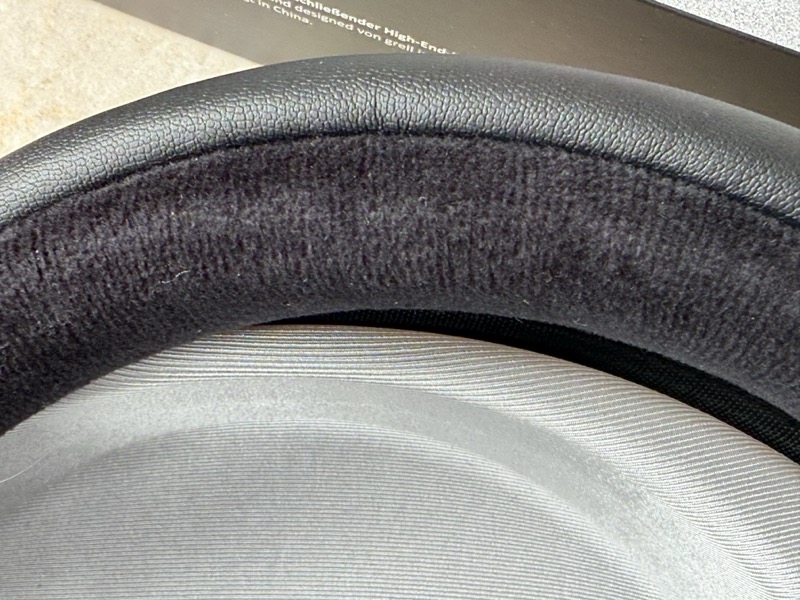
Looking at the slider and headband arch on its own, the finish and fit feel considered rather than cost-cut — nothing about the adjustment mechanism feels loose or cheap:
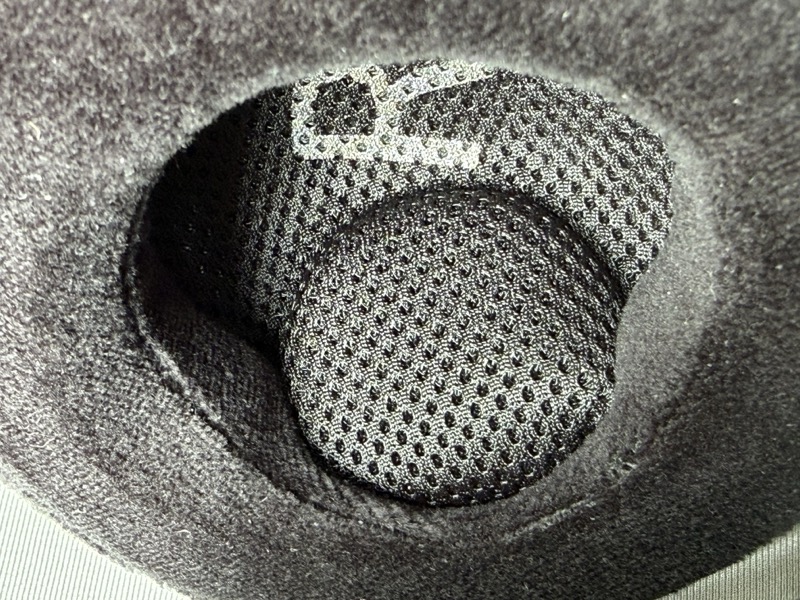
Inside the earpad itself, the driver sits behind a fine acoustic mesh, with a clear “R” marking so there is no ambiguity about orientation — worth paying attention to, since the angled driver placement means you cannot swap the pads or cups side to side without hurting the sound:
One thing worth flagging up front, because it is one of my few real criticisms: the cable connects to only one earcup via a 2.5mm TRRS plug, with the signal for the other driver routed internally through the headband. It is a sensible enough engineering choice, but it is the same design decision I disliked on the OAE1, and it means the aftermarket cable market — which is enormous for standard dual 3.5mm connections — is effectively closed off to you here. The stock cables are fine, but I would still have preferred the simpler, more swappable dual-entry approach.
Fit and Comfort
This is where the OAE2 makes its biggest improvement over the OAE1, and it is not a subtle one. At 378g without cable it is not a light headphone, and the fixed headband clamping force is rated at 2.5N — on paper, nothing here suggests an obviously more comfortable headphone. But the OAE1’s problem was never really weight or clamp force; it was the headband material itself, and that is exactly what Grell changed. Pictured directly against the OAE1’s headband, the OAE2’s padding is noticeably softer to the touch:
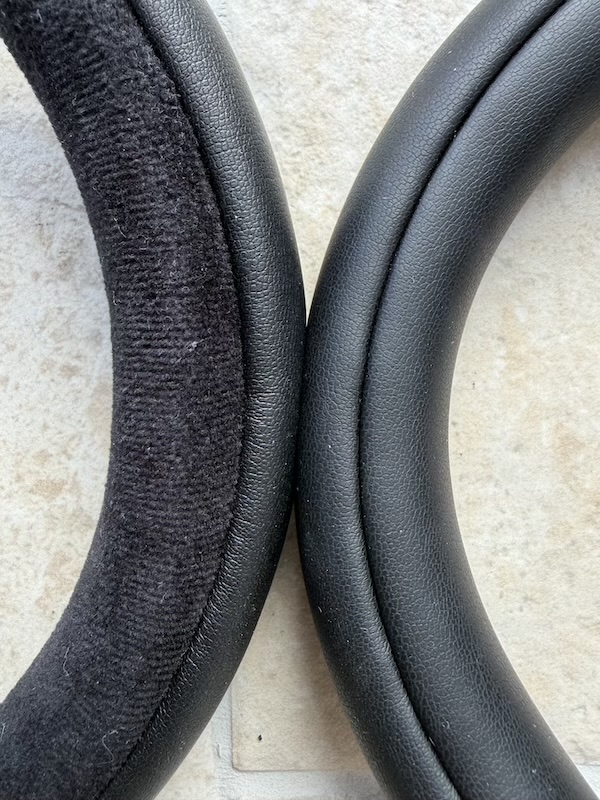
For me, that one change makes a real difference over long sessions — I would call the OAE2 genuinely comfortable, and clearly more comfortable than the OAE1. The original was okay for me but never one of my most comfortable headphones. I’ll note that this puts me somewhat at odds with a chunk of the wider community discussion around the OAE2, where headband pressure hotspots come up repeatedly as the headphone’s biggest weakness; head shape clearly varies a lot here, and my own experience over five weeks has simply not matched those reports.
The earpads themselves are large, deep, and fully surround the ear without resting on it, which is consistent with the angled, front-firing driver design carried over from the OAE1. Between the improved headband and the same generously sized pads, this is a headphone I can comfortably wear for a long listening session, and it is a clear step up from its predecessor.
Sound Impressions
I have spent five weeks listening to the OAE2 across a desktop chain, and the short version of my impression is that Grell have moved the tuning from “make you feel the bass” toward “get the balance right” — and the whole headphone is better for it.
Before the detail, the plain statement: listening to this headphone is an absolute joy, and I am genuinely confused that it has not had more love. Grell have toned the bass down to what I think is exactly the right level, and the result is very likely to be my open-back headphone of the year.
Bass
The bass on the OAE2 is a genuine quality-over-quantity story compared to the OAE1. There is less sheer low-end lift, but what is there is tighter, better controlled, and more textured — this is a headphone that gives you good, clean bass rather than a bass shelf designed to impress on first listen. On “Way Down Deep” by Jennifer Warnes the low end has real weight and definition without ever feeling like it is reaching for drama it does not need, and the mid-bass stays out of the way of the vocal rather than crowding it.
Midrange
The midrange is carefully balanced, and it is where the OAE2 does its most convincing work. Vocals and acoustic instruments come through with a natural, unforced quality — nothing pushed forward for effect, nothing recessed either. On “Sweet Jane” by Cowboy Junkies the vocal sits with real presence and body, and the surrounding instrumentation stays clearly layered around it rather than competing for space.
Treble
Treble is spacious without tipping into fatigue, which given the OAE1’s more relaxed, free-field-influenced top end is a meaningful shift rather than a small tweak. There is enough air and extension to keep cymbals and detail present, but nothing sharp enough to wear you down over a long session. On “Roads” by Portishead the treble has room to breathe without ever turning splashy or hot, which suits the spacious character of the rest of the tuning.
Soundstage and Imaging
The angled, front-oriented driver placement that defined the OAE1 carries over here, and the payoff is the same speaker-like sense of space, now sitting on top of a more coherent overall balance. Imaging is accurate and the presentation opens up beyond the earcups rather than sitting inside your head. On “Private Investigations” by Dire Straits the spacious presentation and the precise placement of the guitar and percussion work together convincingly, giving a real sense of depth without ever feeling artificially inflated.
Comparisons
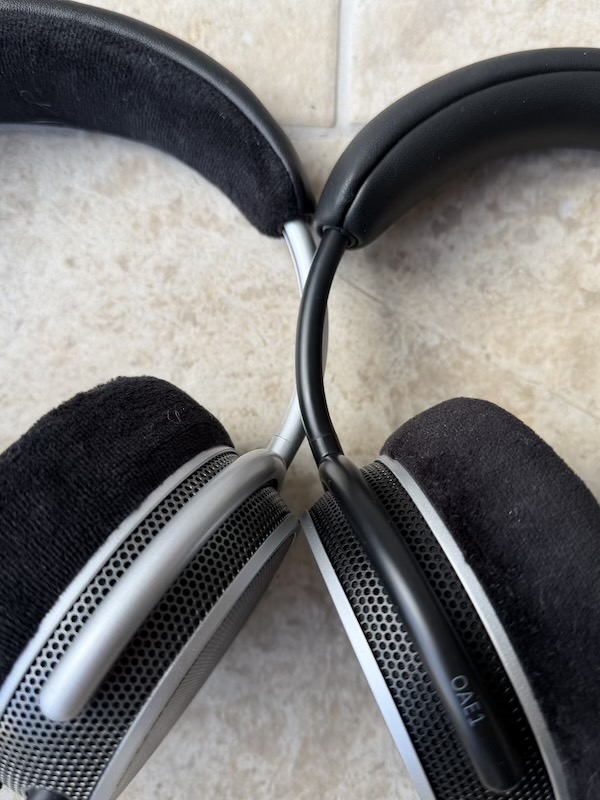
The most relevant comparison is obviously the OAE1, since the two share a driver and a design philosophy while landing in noticeably different places. Looking at the two side by side, the family resemblance is clear from the earcup grille and driver placement, but the detail differences are where the story is — the OAE2’s headband frame finish differs from the OAE1’s, and it is a small but telling sign of how much Grell iterated on the details between generations:
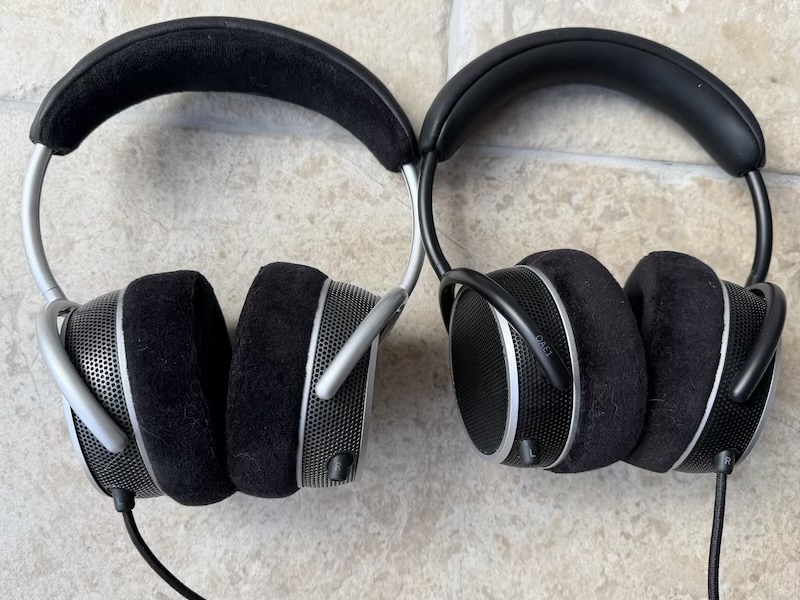
Looking at the two from the top, you can see how similar the overall silhouette remains — this is very much an evolution of the same design rather than a ground-up rework:
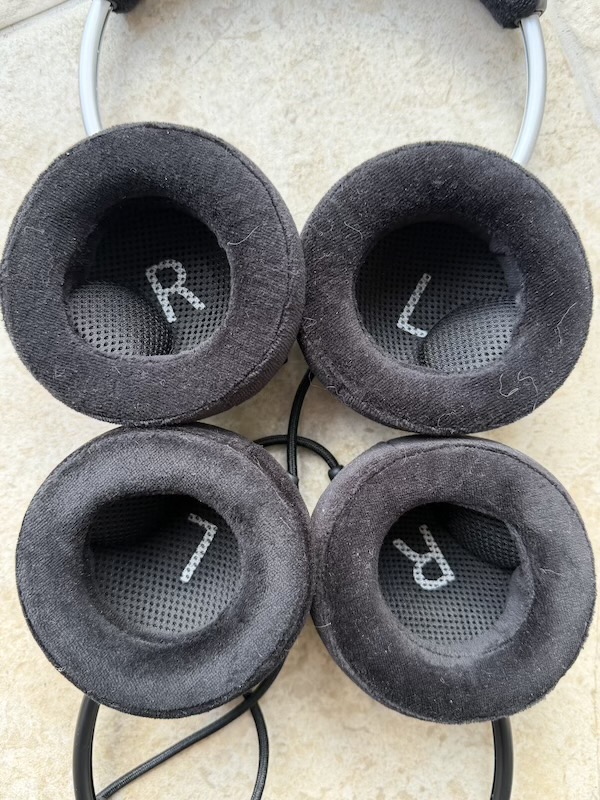
The earpads tell a similar story of careful refinement rather than reinvention — both are generously sized velour pads, but placed side by side you can see the OAE2’s shaping is subtly different:
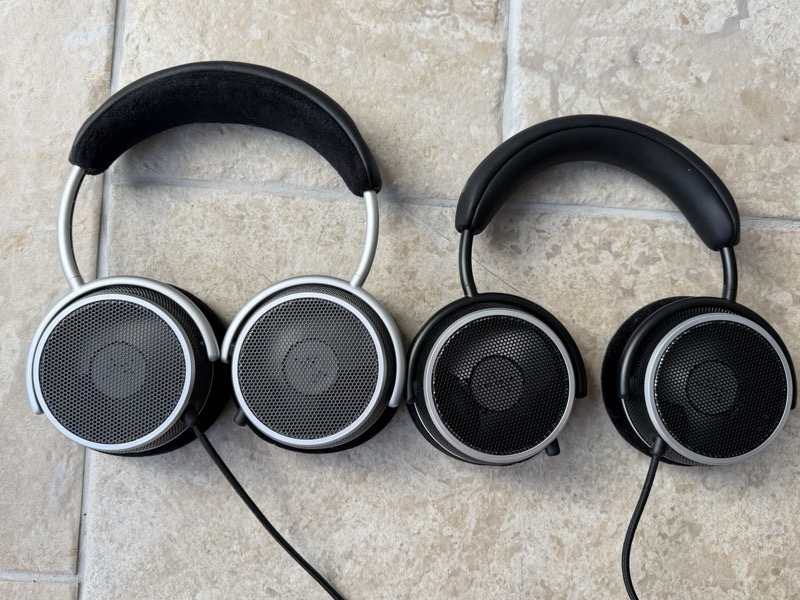
And the driver grilles — silver-ringed on one, differently finished on the other — make for an easy visual way to tell the two apart at a glance if you ever have both in front of you:
Sonically, the two are close relatives rather than twins: the OAE1’s tilted, elevated bass and more relaxed presence region give way on the OAE2 to a more controlled low end and a fuller midrange, while both retain that distinctive front-oriented soundstage. If you found the OAE1 interesting but wanted something more universally easy to enjoy day to day, the OAE2 is the more complete headphone.
Beyond the OAE1, four headphones from the wider collection are the most useful reference points for the OAE2: the Sennheiser HD600, the Hifiman HE600, the FiiO FT7, and the HEDD Audio HEDDphone D1.
Against the HD600, the comparison is really a study in two different definitions of “accurate.” The HD600 remains my benchmark for pure midrange and treble tonality — beautifully balanced, if narrower in soundstage — but its bass is deliberately restrained, more about precision than presence. The OAE2 gives you more low-end body and, thanks to its front-oriented driver placement, a noticeably more open, out-of-the-head presentation than the HD600’s more traditional, in-head imaging. Neither makes the other redundant; they simply chase different goals well.
Against the HE600, the OAE2 trades the Hifiman’s planar-driver bass extension and treble energy for a warmer, more organic overall character. The HE600 is more linear and technically extended in the bass, and its treble carries more sparkle and micro-detail — exciting on the right recording, but also the more fatigue-prone of the two on hot masters. The OAE2’s spaciousness comes from a completely different mechanism than the HE600’s planar-driven width, and where the HE600 sounds more analytical, the OAE2 sounds more relaxed and inviting over a long session.
Against the FT7, the comparison is the closest in philosophy of the four. FiiO’s flagship planar also prioritises bass accuracy over quantity and pairs it with a spacious soundstage, which is exactly the OAE2’s own pitch. Where they part ways is in character: the FT7 is the more neutral, reference-leaning of the two, while the OAE2’s bio-cellulose driver and front-oriented tuning give it a more distinctive, speaker-like personality. If you want the most “correct” sound, the FT7 edges it; if you want the more interesting listen, the OAE2 does.
Against the HEDD D1, the OAE2 meets its closest rival in ambition, if not in underlying technology. The D1’s Thin-Ply Carbon Diaphragm gives it a midrange that is genuinely class-leading, with a wider, more three-dimensional soundstage than the HD600 and bass that is tight and honest rather than elevated — much the same “quality over quantity” bass philosophy the OAE2 is going for. The OAE2’s midrange is very good but does not quite match the D1’s exceptional tonal density, though the OAE2’s front-oriented driver placement gives it a different, arguably more directly speaker-like spatial presentation than the D1’s more conventional driver geometry achieves. Both are headphones built around a novel diaphragm technology, which makes them an unusually interesting pair to own side by side.
I will be adding measured frequency-response overlays against all four of these comparison headphones once I have measured the OAE2 myself.
Specifications and Measurements
| Specification | Value |
|---|---|
| Driver | Dynamic, bio-cellulose membrane, front-oriented (FSFM) |
| Ear coupling | Circumaural |
| Frequency response | 12–34,000 Hz (–3dB), 6–46,000 Hz (–10dB) |
| Nominal impedance | 38Ω |
| Sound pressure level | 100dB at 1kHz, 1Vrms |
| Max long-term input power | 500mW (IEC 60268-7) |
| THD | 0.05% at 1kHz, 100dB |
| Weight | 378g (without cable) |
| Headband clamping force | 2.5N |
| Headphone connector | 2.5mm TRRS (single-sided) |
| Cables | 2× 1.8m silver-plated OFC — 4.4mm balanced, 3.5mm + 6.35mm adapter |
| Price | €499 ($499) |
Grell’s own spec sheet, printed on the side of the retail box, is unusually detailed about the sound-shaping philosophy behind the FSFM driver placement and the stainless-steel damping fabric — see the packaging photo above for the full text.
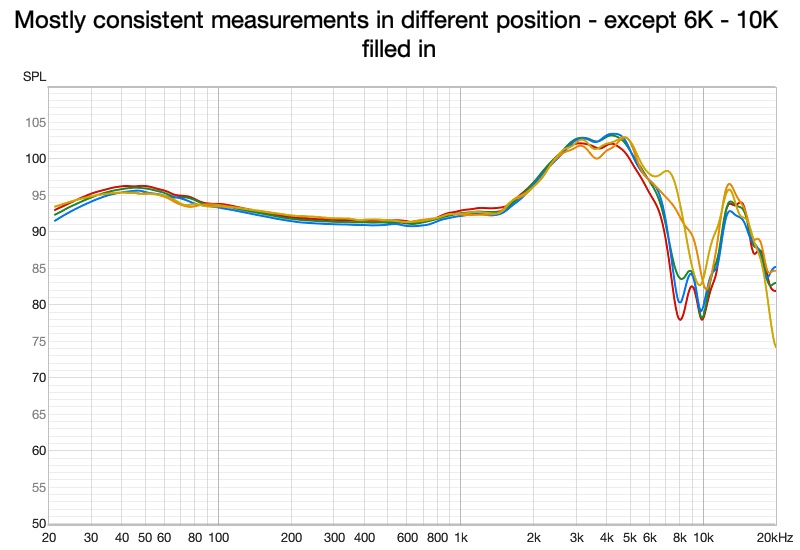
I have started measuring the OAE2 myself. Before settling on a single reference curve, I ran repeat measurements across several refits and positions to check how consistent the seal and placement were — the overlay below shows those runs together, and they track closely except for a region between 6kHz and 10kHz that needed a couple of extra passes to fill in properly:
Here is the reference curve I settled on, a stock left-channel capture plotted inside the preference bounds:
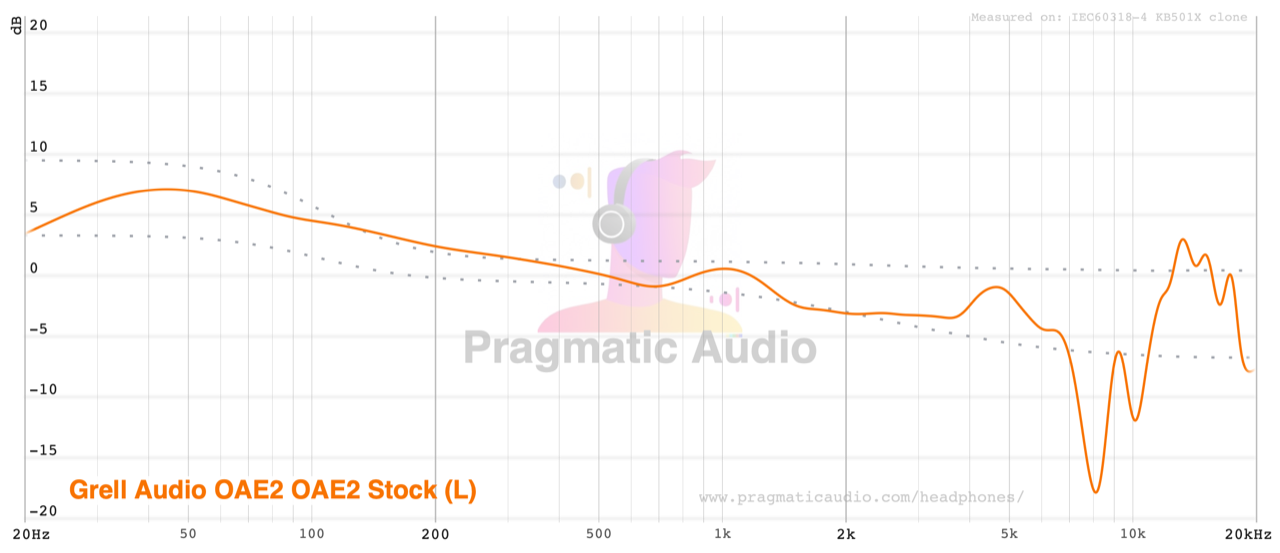
Read on its own this is a well-behaved open back: a gentle lift through 40–60 Hz, a smooth downward slope through the midrange, and a broadly even run from 1 kHz to 5 kHz that stays inside the bounds for most of its length. Nothing in that curve looks like a headphone anyone would call badly recessed in the treble. Hold that thought, because the next section is about why some people do.
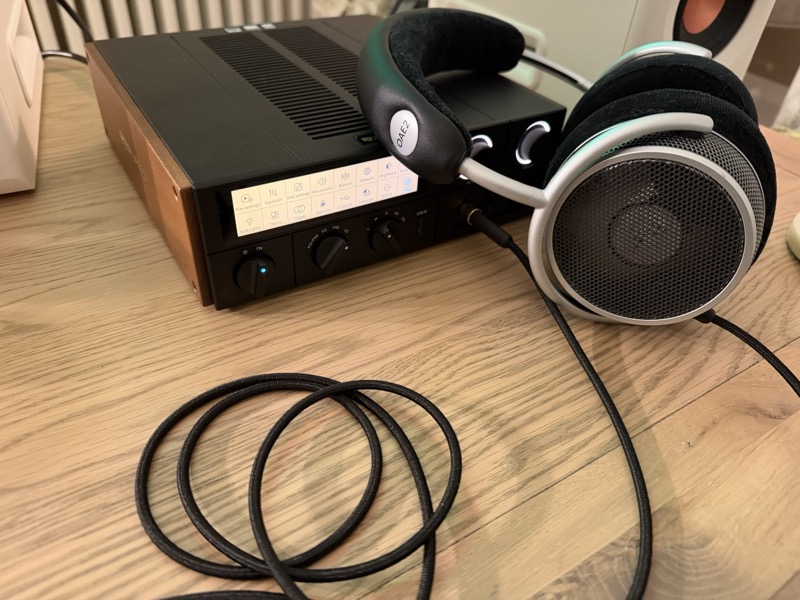
Most of the listening for this review was done from the FiiO K17 R2R, which has more than enough voltage for an open back of this sensitivity and takes the amplifier out of the argument:
Positional Variation Measurements
That repeatability overlay was the first hint, and it is what sent me off to build a better instrument. The measurements below come from a tool I wrote for the purpose, the Headphone Positional Capture. The idea behind it is deliberately narrow: make it simple to take a centred measurement plus a forward and a backward one, plot them together against the target and its preference bounds, and see what actually moves. The point is never any single curve. The point is how far apart the family is, and where.
The specific question I built it to answer on this headphone was whether shifting the cup forward or back fills in the treble region. Here is the answer, normalised at 500 Hz:
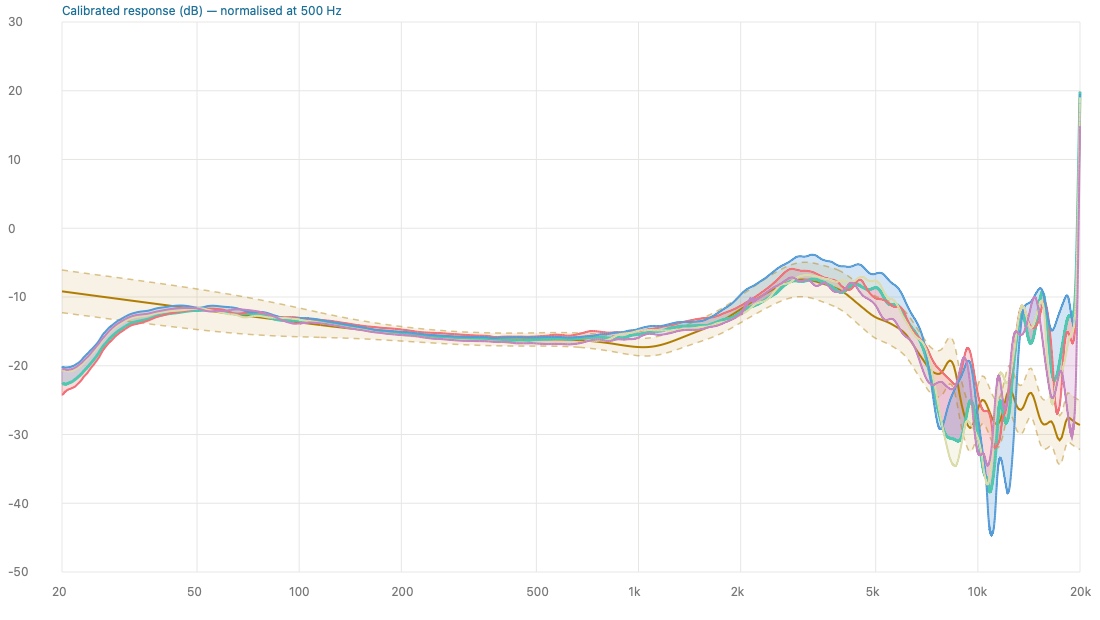
It does. From 20 Hz to about 1.5 kHz the traces sit almost on top of each other, within a decibel or two — this headphone’s bass does not care where it sits on your head. Then from 2 kHz upward they separate, and the widest spread lands squarely on the ear-gain peak around 3 kHz and the region above it out to 6 kHz, where the family covers roughly three decibels. Move the cup and that region fills in or empties out.
That is the whole argument of this review in one graph, and it resolves something I could not explain any other way. Reviews of the OAE2 disagree about the treble to a degree that is unusual even for this hobby: some describe it as massively recessed and conclude the tonality is simply wrong, while others, me included, find the tonality exceptional. Both camps are reporting honestly. They are measuring, by ear, different positions of the same headphone. Three decibels across the presence region is not a subtlety — it is the difference between a presentation that reads as open and one that reads as withdrawn, and on a driver angled as steeply as this one, a centimetre of seating is enough to move between them.
To show that this is a property of this headphone rather than of my fixture or my technique, here is the same measurement run on the Meze Strada, a conventional open-back with a driver that is not steeply angled:
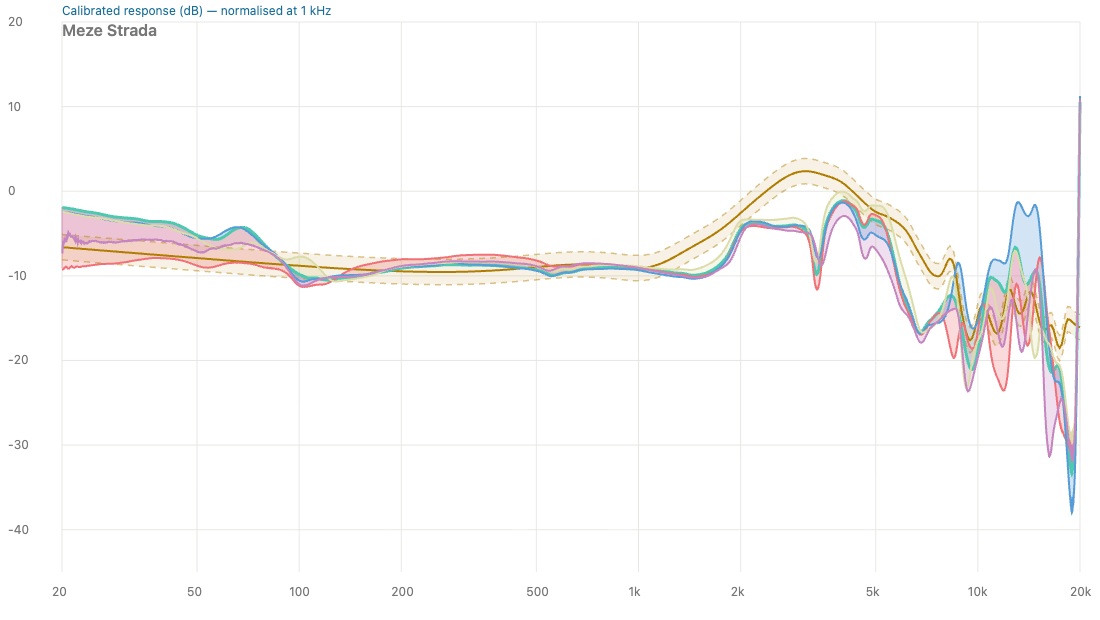
The Strada shows the opposite pattern, and a more serious problem of its own. Below 100 Hz its traces spread by six or seven decibels, which is a seal issue and a real one — this headphone’s bass depends heavily on how well it seats. But through 2 to 5 kHz, the region where the OAE2 moves around, the Strada’s curves stay bunched within about a decibel. Two headphones, two opposite signatures. The Strada’s variation is where a seal problem puts it; the OAE2’s is where an angled driver puts it.
One honest caveat about reading these plots. The two are normalised at different frequencies, 500 Hz for the OAE2 and 1 kHz for the Strada, and a family of curves is always tightest near its normalisation point by construction. That explains some of the OAE2’s tightness around 500 Hz and some of the Strada’s around 1 kHz. It does not explain the OAE2 holding together from 20 Hz to 1.5 kHz, and it does not explain the Strada spreading by six decibels at 20 Hz while staying inside a decibel at 3 kHz. The patterns survive the caveat.
It is worth seeing the two headphones’ actual responses side by side as well, because the positional behaviour is not the only thing that separates them:
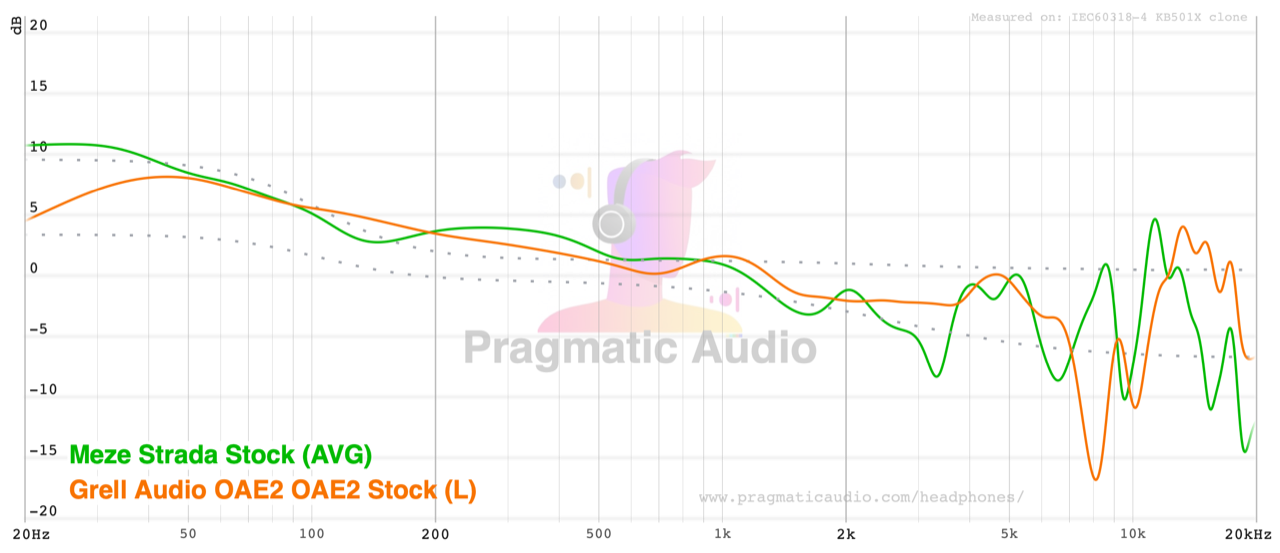
Below 100 Hz the sealed Strada has the greater lift, which is what a closed cup buys. From 200 Hz to 1 kHz the Strada carries more energy, which is the lower-midrange warmth that defines it. Through 2 kHz to 5 kHz the OAE2 holds the steadier line while the Strada dips further. Two good headphones with genuinely different emphases, and an argument for owning both rather than choosing.
The usual limits apply as well: this is a KB501X soft ear and pinna with a 711 clone coupler, not your head. Positional results are rig-dependent, and everything above 8 kHz on this fixture is coupler and pinna resonance rather than headphone. What these measurements show is a mechanism, not a prediction for any one listener. But the mechanism is enough to explain the disagreement. If the OAE2’s presence region moves three decibels with a centimetre of seating, then reviewers are not contradicting each other — they are each describing a different sample of the same headphone’s behaviour, and so am I. On my head, and on the seating my fixture reproduces, it lands on the good side of that range. On someone else’s it may not, and that is a real caution rather than a disclaimer.
I’ll be adding a single reference frequency response curve and distortion graphs to this review once I’ve finished that process, rather than publish placeholder charts or lean on anyone else’s numbers as if they were mine. In the meantime, I don’t want to leave anyone who wants a PEQ recommendation without one, so my thanks to oratory1990 for measuring the OAE2 and publishing both a raw response and a corrected one against the Harman AE/DE 2018 target:
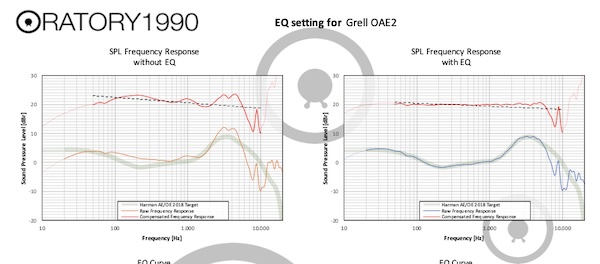
Worth being clear about my own take here: I have been genuinely happy listening to the OAE2 with no EQ at all, and nothing in oratory1990’s raw curve struck me as something I felt needed fixing during five weeks of regular listening. But preference is exactly that — a preference — and if you want a sensible, measurement-derived starting point rather than trusting your ears cold, oratory1990’s PEQ is a good one. You can find the full PEQ settings here.
Based on the spec sheet’s THD figure of 0.05% at 1kHz and 100dB, and on how composed the OAE2 sounds even at higher listening levels, I would expect my own measurements to show a clean, well-controlled distortion profile once I’ve measured it — but that is a listening impression, not a measurement, and I want to be clear about that distinction until I can back it up with real data.
Distortion
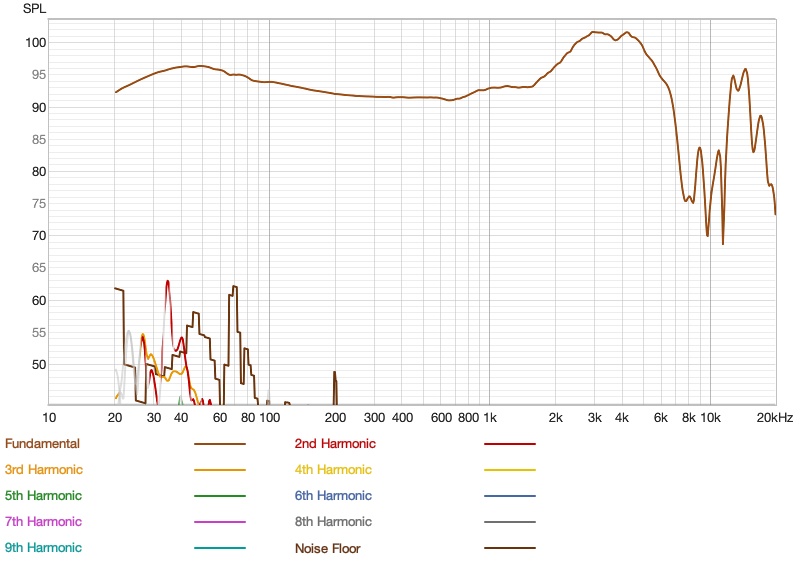
I ran a harmonic distortion sweep on the same rig, with the fundamental sitting between 91 and 101 dB SPL across the band — louder than I listen, and comfortably above the level where any of this matters:
 |
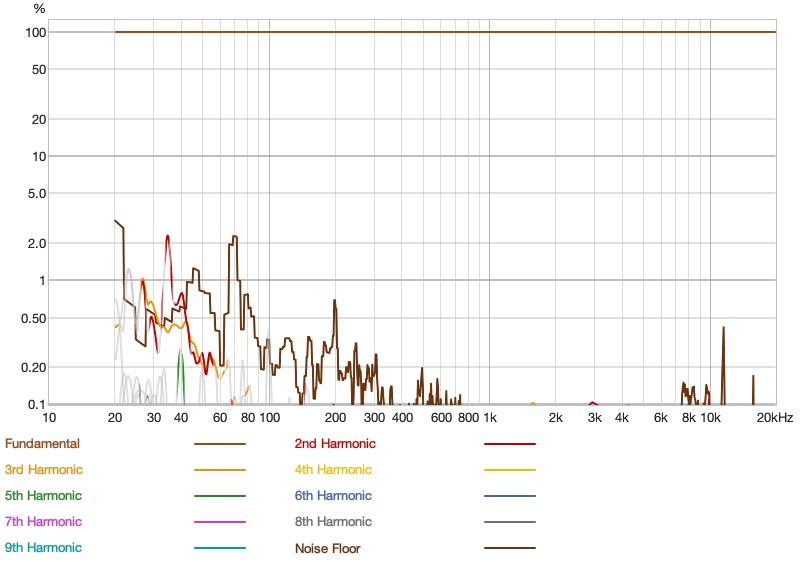 |
The result is fine. At over 100 dB SPL nothing in these measurements is going to be audible on music, so there is nothing to be concerned about here.
Rating Explanation
The Pragmatic Rating of 5 reflects a headphone that took what was interesting but flawed about the OAE1 and improved the parts that mattered. The bass moved from “make a statement” to well-judged, the midrange is a real strength, the treble is spacious without being fatiguing, and — for me at least — the OAE2’s comfort is a clear improvement over the OAE1 through a softer headband material rather than a cosmetic tweak. The Measurements score of 5 reflects what I believe Axel Grell was always aiming for with this driver and tuning approach — I’ll confirm that properly once I’ve measured it myself, but everything I hear points the same way.
The Features score of 4 comes with one real caveat: the single-sided 2.5mm TRRS cable connection is a sensible engineering choice but a genuine practical limitation, since it locks you out of the huge aftermarket dual 3.5mm cable market that a lot of headphones at this price can freely use. The Price score of 4 is not really a knock on the OAE2 itself — at €499 it remains a strong proposition — but the OAE1 spoiled all of us on what Grell Audio could do at this price point, and that context is hard to fully shake off even when, as here, the newer headphone is simply better.
This one is for anyone who found the OAE1 interesting but wanted something easier to live with day to day, and for anyone starting fresh who wants a distinctive, front-oriented open-back with good bass quality and a comfortable long-term fit — though given how much comfort opinions seem to vary head to head with this design, an in-person try before buying is a sensible precaution.
Conclusion
The Grell Audio OAE2 is everything I had hoped for from Grell Audio’s second headphone: it looks similar to the OAE1 at a glance, but it is a better headphone once you actually live with it. The bass swaps quantity for quality, the midrange and treble are spacious without tipping into fatigue, and — for me — the comfort is a clear step up from the OAE1.
Five weeks in, I am still reaching for the OAE2 regularly, which is the simplest evidence I can offer that Grell got the important things right this time. At €499/$499 it remains a compelling price for what you get, and I think it is my open-back headphone of the year.
I know that will be controversial, so let me put the claim precisely rather than loosely. This is not the headphone that shows up on a typical high-end recommendation list, and I am not claiming it is the most resolving or the most technically accomplished open back at any price. What I am claiming is narrower and, I think, harder to argue with once you have heard it: from the sub-bass through to the upper midrange, this is the best open-back tonality I have heard in any headphone. That is the region where the measurements are repeatable, where the positional variation barely moves anything, and where Grell’s tuning decisions are simply better judged than almost everything I can compare them against.
The claim comes with one condition attached, and it is not a small one: you have to listen to it. The region from roughly 5 kHz to 10 kHz is strongly position-dependent on this headphone, as the measurements above show, and that is exactly the region a graph will not tell you about on your own head. Anyone recommending or dismissing the OAE2 from a published curve alone is describing one seating of it. Put it on, move it around, and find out which version of this headphone you own.
There is a comparison I keep coming back to, and it is worth setting out because it cuts both ways. I think the Sennheiser HD 480 PRO is the greater achievement of the two. Closed backs are genuinely hard to tame, and Sennheiser tamed that one while giving it exceptional treble, which is why it is my headphone of the year overall. But achievement and preference are not the same thing. Put both on a table, let the house go quiet in the evening, and nine times out of ten I reach for the OAE2. That openness combined with this tonality trumps even the best-tuned closed back, at least for me and at least for the way I listen when there is nobody else to consider.
That is not a criticism of the Sennheiser and it is not a ranking. It is the honest answer to the only question that matters when you already own both, and if you are choosing between an exceptional closed back and this, it is worth knowing which one actually gets picked up.