Douk Audio H5
A Tube Preamp that does everything you should expect and more
The Douk Audio H5 is a small tube preamplifier that also carries a moving-magnet phono stage, bass and treble controls, a switchable 20Hz high-pass filter, two RCA output pairs and a low-pass-filtered subwoofer output. Douk Audio have been making inexpensive tube buffers, phono stages and small amplifiers for years, mostly sold direct and through Amazon, and the H5 is their attempt at putting the lot into one box.
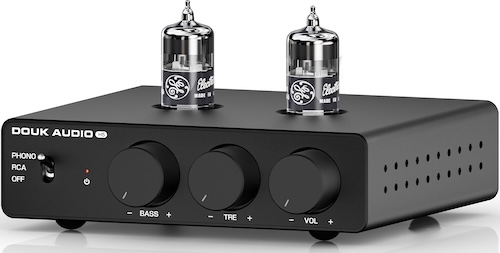
The H5 product page is on Douk Audio’s site, and it is typically $89.99 on Amazon, frequently discounted below that.
I bought the H5 myself from Amazon.de, specifically because I wanted something interesting to use as a phono preamp with the turntables I have collected over the past few months.
I have been listening to it for a few weeks, both as a line-level preamp and as a phono preamp, and I have been extremely impressed with what is here. As you will see through this review, you get an awful lot for your money.
I do have one small niggle, which I will come to later, but it is cosmetic and it has nothing to do with how the H5 sounds.
Unboxing and What You Get
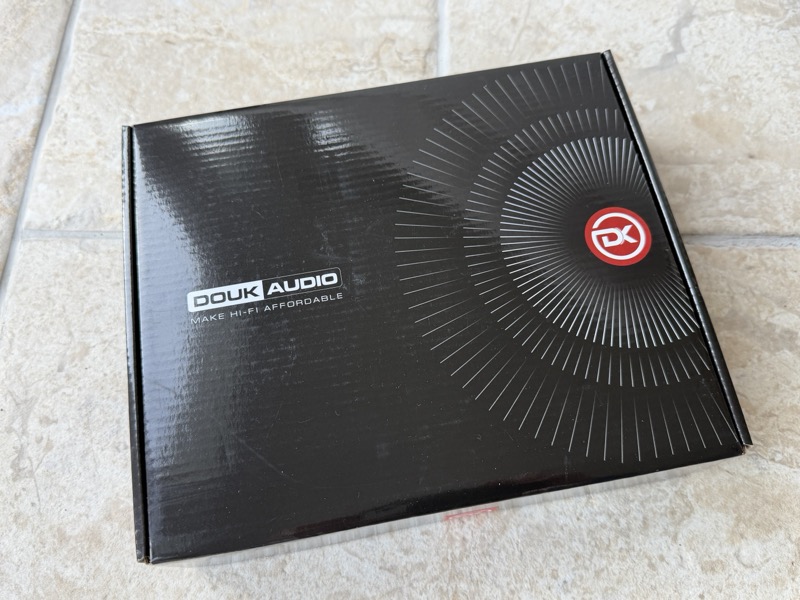
The retail box is plain and functional, which is what I expect at this price:
 |
 |
Inside, the unit is bagged, the two tubes are in their own foam cutouts, and there is a manual and a small brochure:
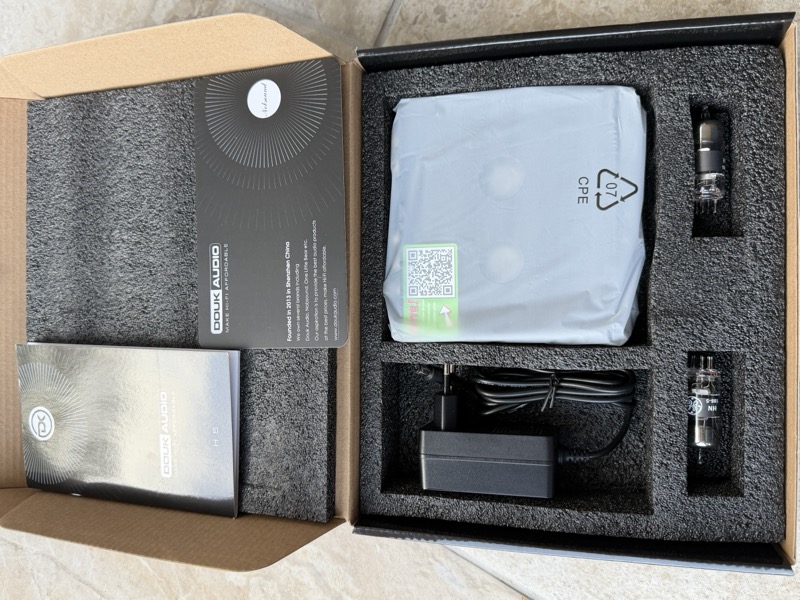
In the box:
- Douk Audio H5 preamplifier
- Two GE-4BZ6 tubes (packed separately, you install them)
- 12V DC power supply
- Manual and brochure
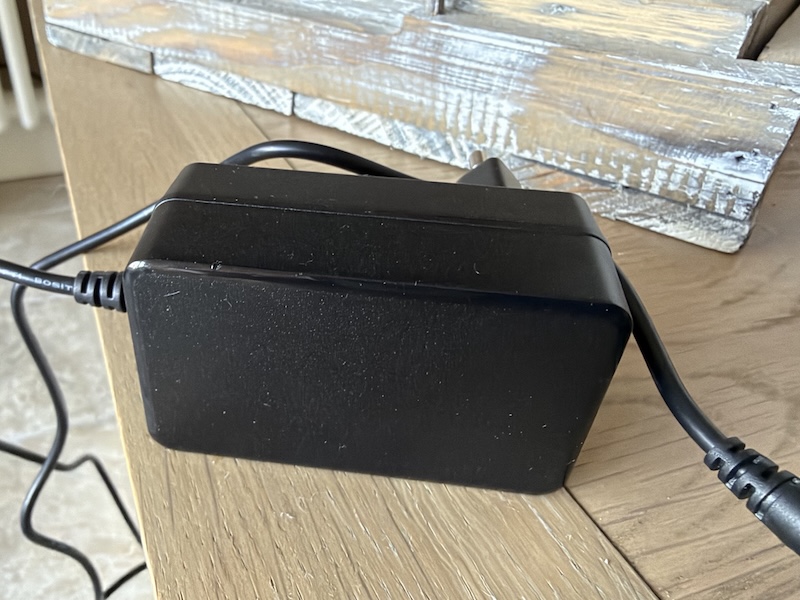
The power supply is a basic 12V wall-wart, nothing elaborate:
 |
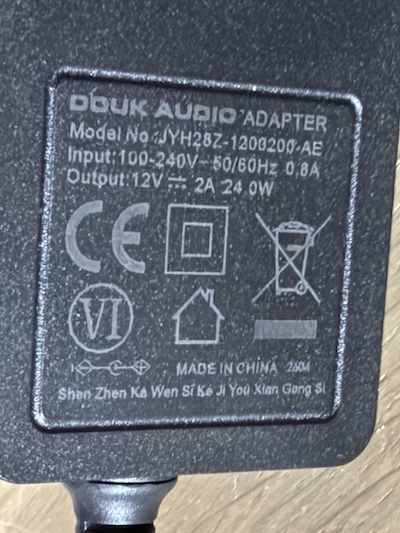 |
It is a 12V, 1.5A minimum, 5.5×2.1mm barrel supply. Nothing about it is remarkable, but it is the same spec as almost every other small desktop preamp I own, so if you already have a decent linear supply in that format you have an easy experiment available.
Design and Build Quality
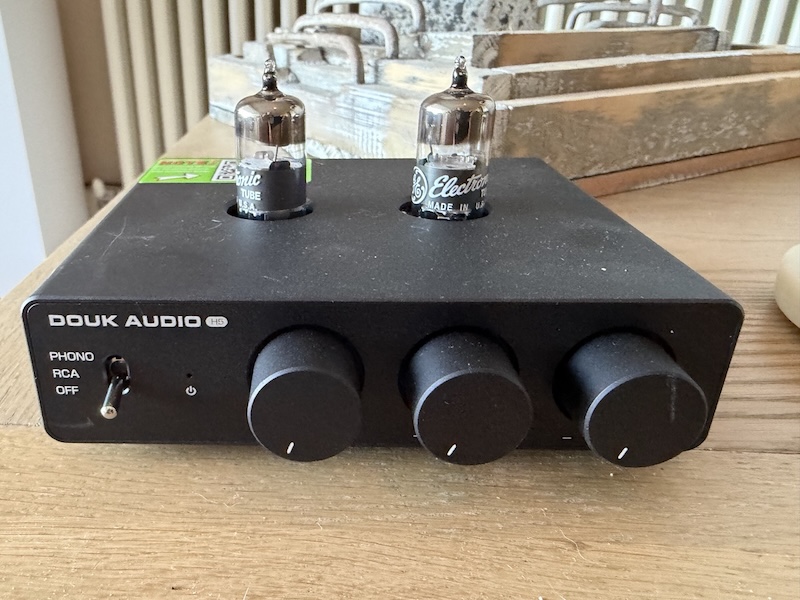
The front panel is about as simple as it gets: a three-position PHONO / RCA / OFF slide switch, a power indicator, and three knobs for bass, treble and volume.
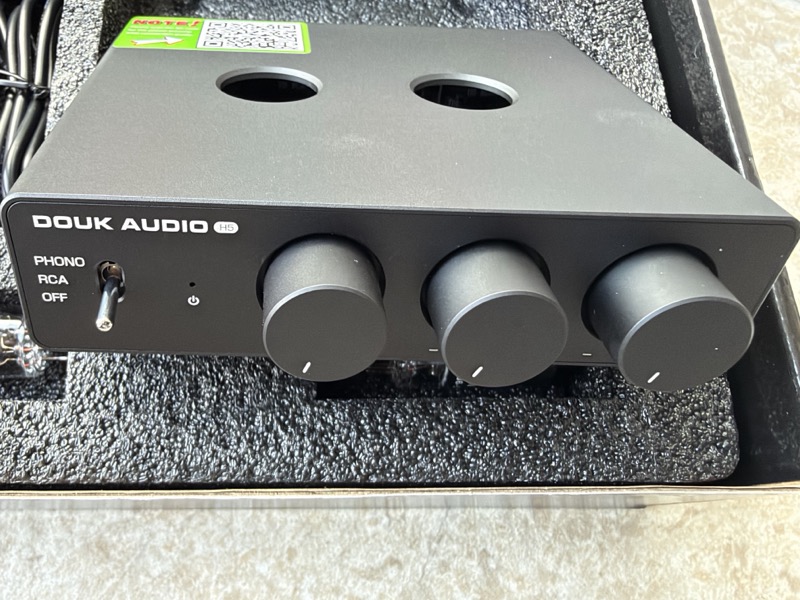
Look at where those bass and treble knobs are sitting, because that is exactly how the H5 arrives. Out of the box they are turned down into the negative position rather than centred. Plug it in without touching them and you are hearing a rolled-off top and bottom, and you will conclude it sounds dull — I suspect this has caught a few people out and coloured their first impression. Turn both to the centre detent, listen there, and only then start adjusting.
The tactile side of this is better than I expected. The bass and treble knobs have a defined centre detent — Douk call it a “defeat” position — so you can find flat by feel without looking, and the volume knob has a fine click as you turn it that makes small adjustments repeatable instead of approximate. That sounds like a small thing. On a box where tone control is the whole point, being able to return to a known-flat reference by touch is what makes A/B comparison possible at all.
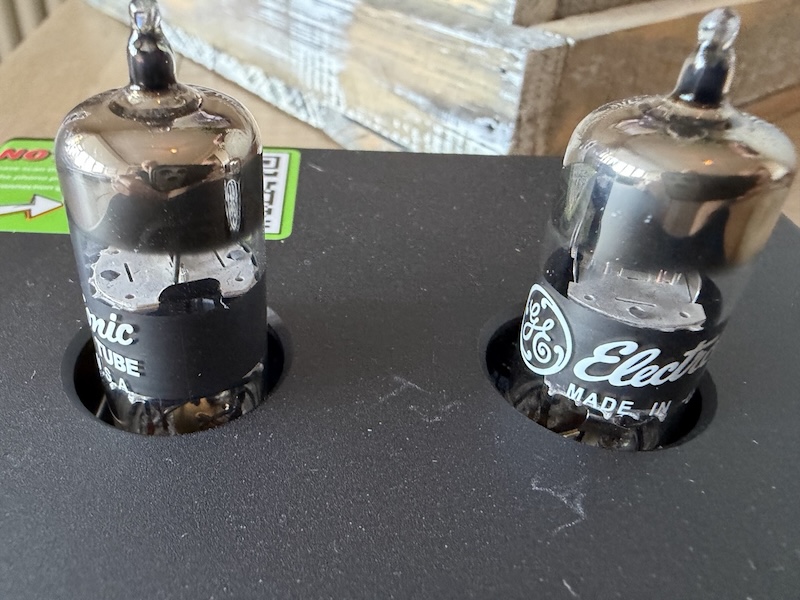
The tubes sit in two recessed holes on the top plate:
 |
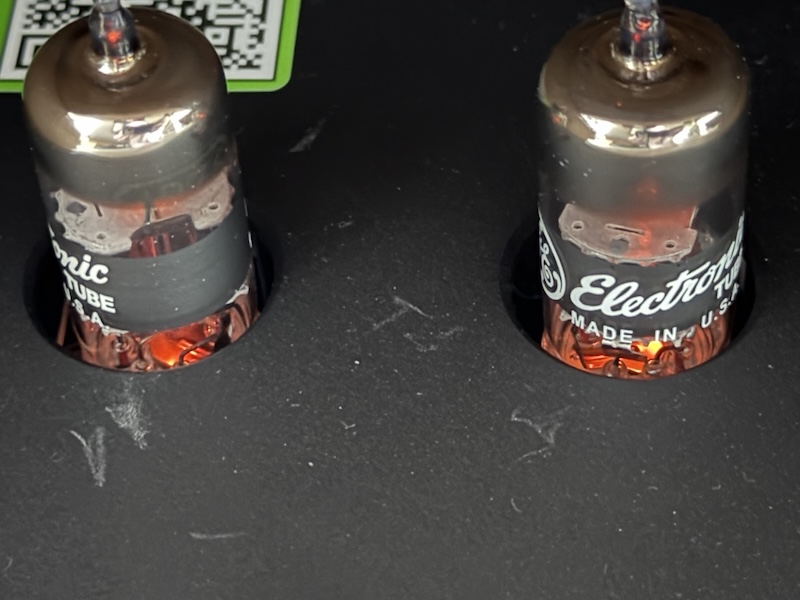 |
And here is my one purely cosmetic complaint, visible in the left-hand photo with the unit off: the printed lettering on the two tubes does not line up. One reads across the front, the other is rotated. Only somebody who looks at their gear as much as I do would ever notice, and it has no bearing on anything, but I said I would mention my niggles and that is one of them.
With power applied, the glow is subtle — a soft orange from the heaters themselves. I like it for being understated, and it suits late-night listening with the room lights down.
The chassis has ventilation slots along the side, which matters on a unit that runs a 250V boost rail to feed a 180V tube stage in a case this small:
 |
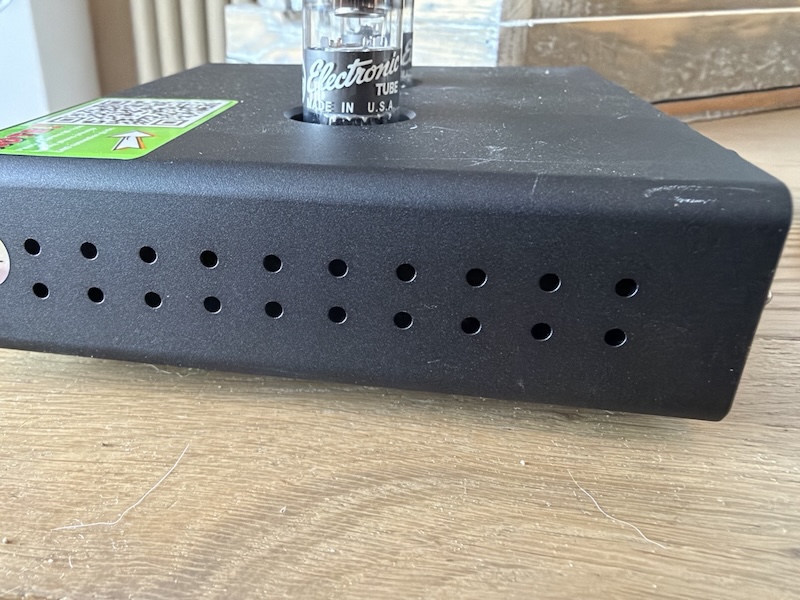 |
In my listening the H5 did get a little warm — nothing dramatic, and never uncomfortable to touch, but worth mentioning if you were thinking of shutting it inside a cabinet.
Connectivity
The rear panel is where the H5 justifies itself:
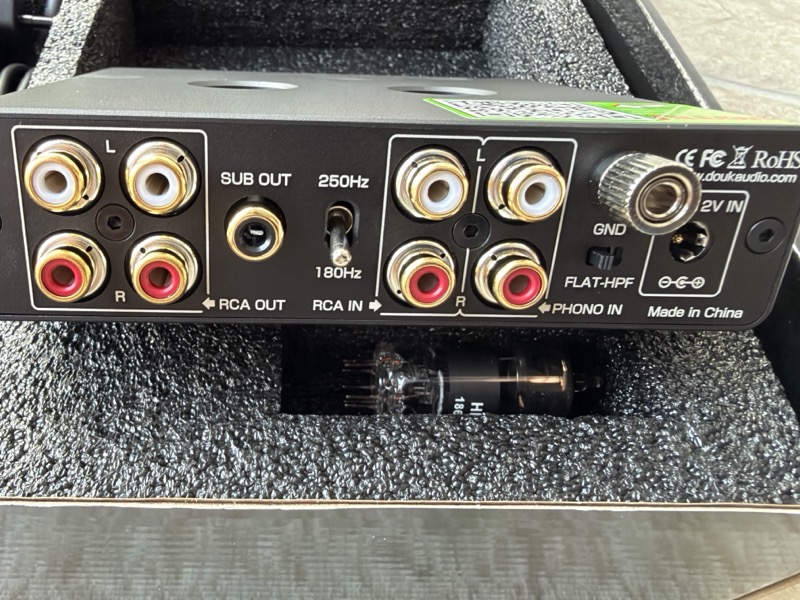
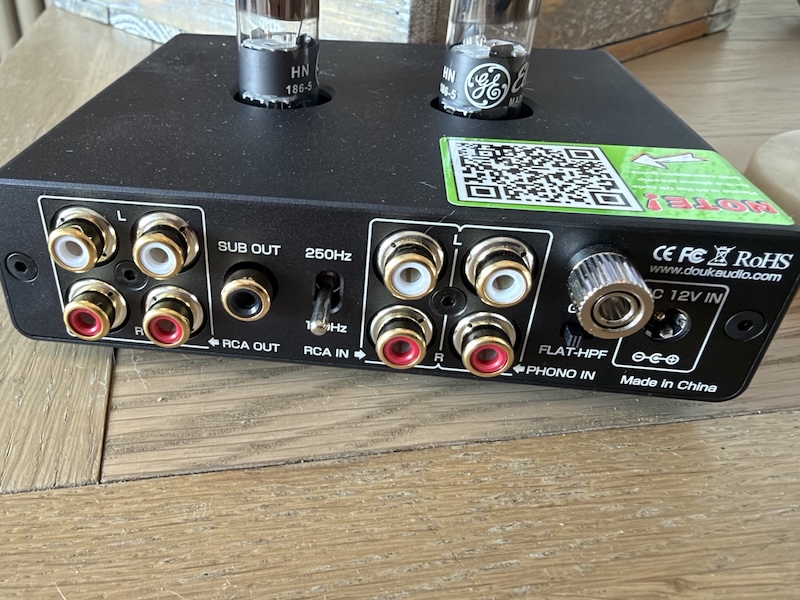
From left to right that is a stereo RCA output pair, a SUB OUT with a 180Hz / 250Hz low-pass slide switch, a stereo RCA input pair, a stereo PHONO input pair with a FLAT / HPF slide switch, a knurled ground post, and the 12V DC input.
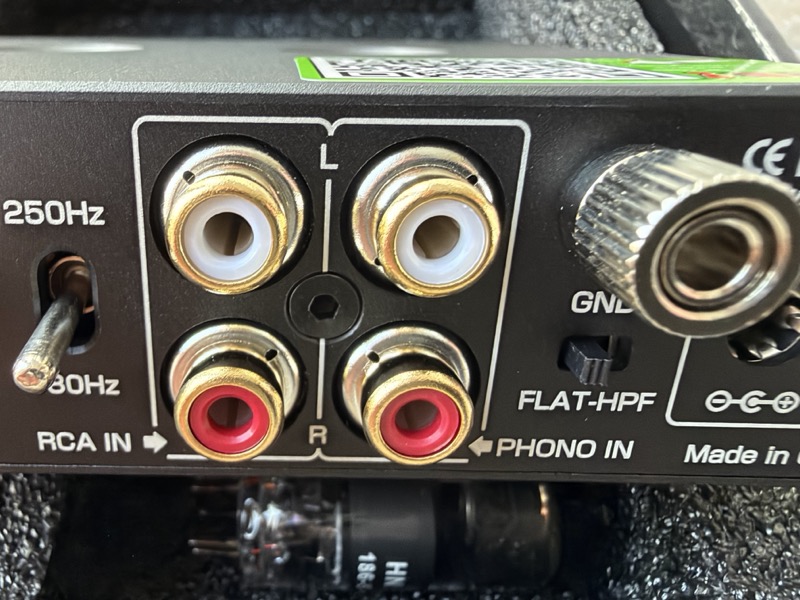 |
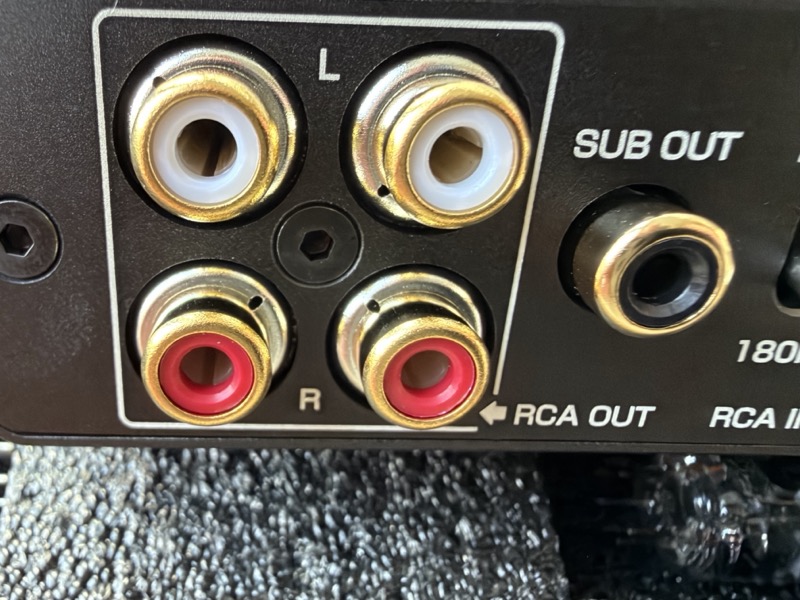 |
The ground post and DC input sit together at the right-hand end:
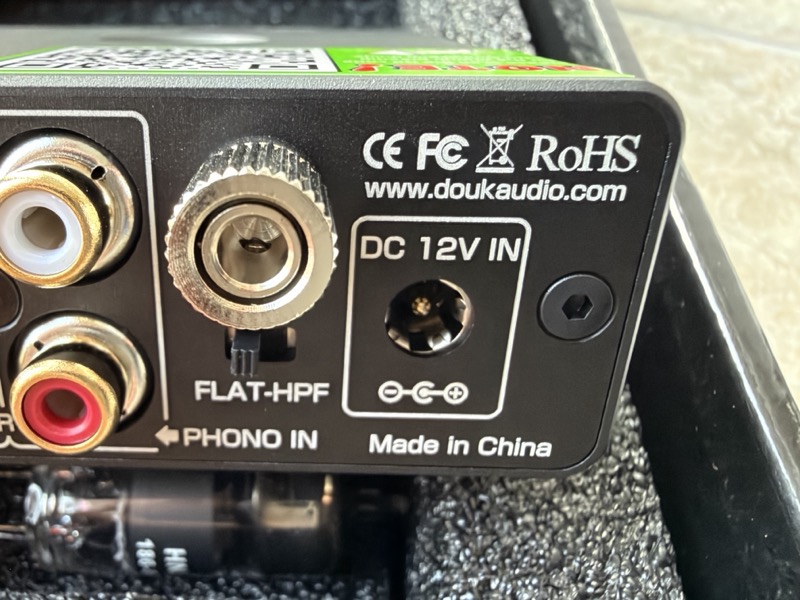
Two things there matter more than the panel suggests. First, there are two RCA output sockets, not one, so you can feed two amplifiers or two pairs of active speakers simultaneously without a splitter. Second, the SUB OUT is a filtered output, not a full-range tap — more on that below.
Setup — Follow the Sticker
There is a large green sticker on the top plate with a QR code on it, and it is worth scanning rather than peeling off:
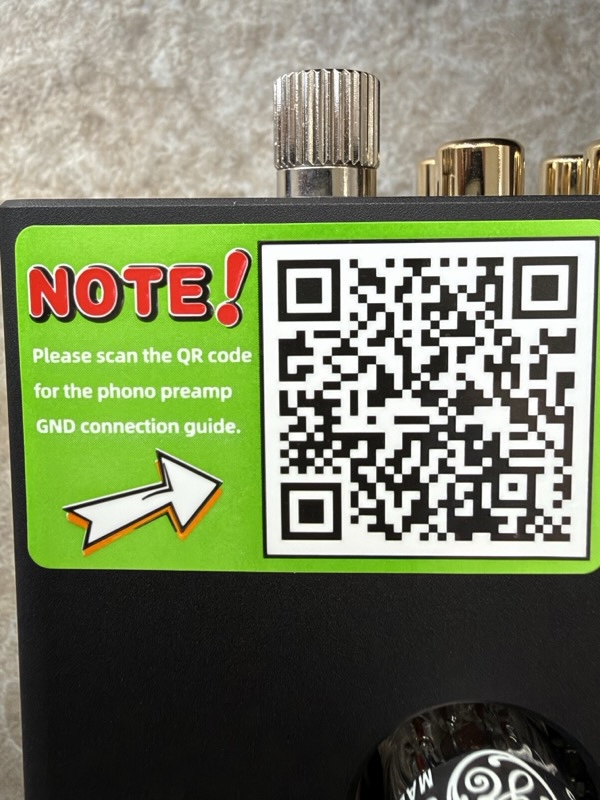
That code points at a Douk Audio YouTube video covering the phono preamp ground connection, and it is genuinely useful — getting the grounding right is the difference between a quiet phono stage and a buzzing one. Putting it on a sticker where you cannot miss it is a better decision than burying it in a manual nobody opens.
Features and Tuning Options
Douk publish an internal block diagram, and it is worth a look because it shows what each input actually passes through:
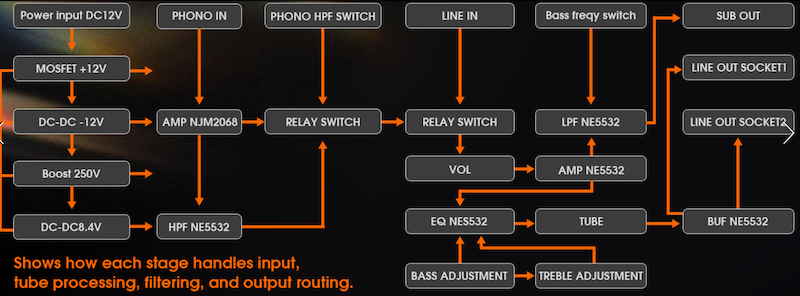
The phono input goes through an NJM2068 gain stage and then, if you want it, the NE5532 high-pass filter. The line input goes straight to its own relay. From there both share the same path: volume control, the NE5532 EQ stage that the bass and treble knobs act on, the tube stage, and an NE5532 buffer feeding the two line outputs. The subwoofer output is tapped off separately through its own low-pass stage.
The order matters. The tube stage sits after the EQ and before the output buffer, so whatever you dial in on the tone controls gets the tube treatment on the way out — which is the right way round for what this box is trying to do. The op-amps are socketed if you want to roll them, though I have left the stock parts in place.
Plenty of boxes at this price will add warmth. What makes the H5 interesting is how many ways it lets you shape what happens around that warmth.
The Phono Stage and Bass Boost
I have five turntables, and I did most of my H5 testing with two of them — one at either end of the price scale — to see what the H5 could do for the sound coming off each.
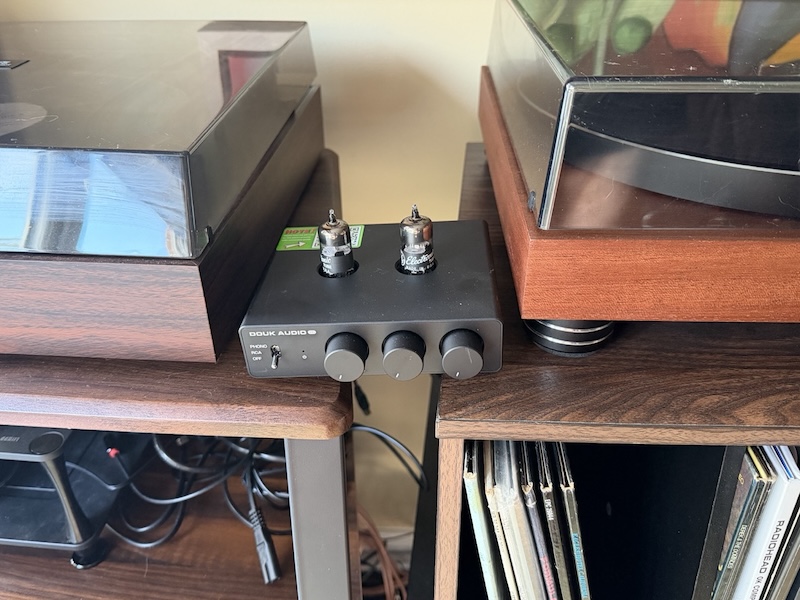
On the left is the FiiO TT11, a $179 fully-automatic belt-drive with a built-in phono preamp. On the right is the Argon Audio TT-4 MK2, an $800 turntable with an Ortofon cartridge and a considerably better built-in phono stage. The H5 is the box sitting between them.
Against the TT11, the H5’s own MM phono stage was clearly the better of the two — more space, less congestion in the midrange, and a firmer grip on bass notes. But it was also where I wanted the bass control. The TT11 through the H5 sounded a little lean at the bottom to my ears, and a couple of notches of bass boost was exactly what it needed. That is not a criticism of either unit so much as it is the point of having a tone control at all: a cartridge, a phono stage and a pair of speakers in a real room do not add up to flat, and a knob that adds up to +6dB at the bottom lets you fix that in ten seconds without reaching for software EQ.
The Argon was a different situation. Its own phono stage is more linear than the H5’s, which is part of what you are paying the extra $600 for on a higher-end turntable. But linearity is not the only question. Running the Argon’s line output into the H5’s RCA input and adding a small amount of tube warmth produced something I subjectively preferred to the Argon on its own — the turntable is the more transparent-sounding of the two, and the H5 filled in a bit of body and harmonic texture that I liked.
That is a preference rather than an improvement, and I would not argue it any harder than that. It is a good option to have, it costs $90 to have it, and one switch takes it out of the path again.
The 20Hz High-Pass Filter
The FLAT / HPF switch on the phono input engages a 20Hz high-pass filter. Douk illustrate what it does:
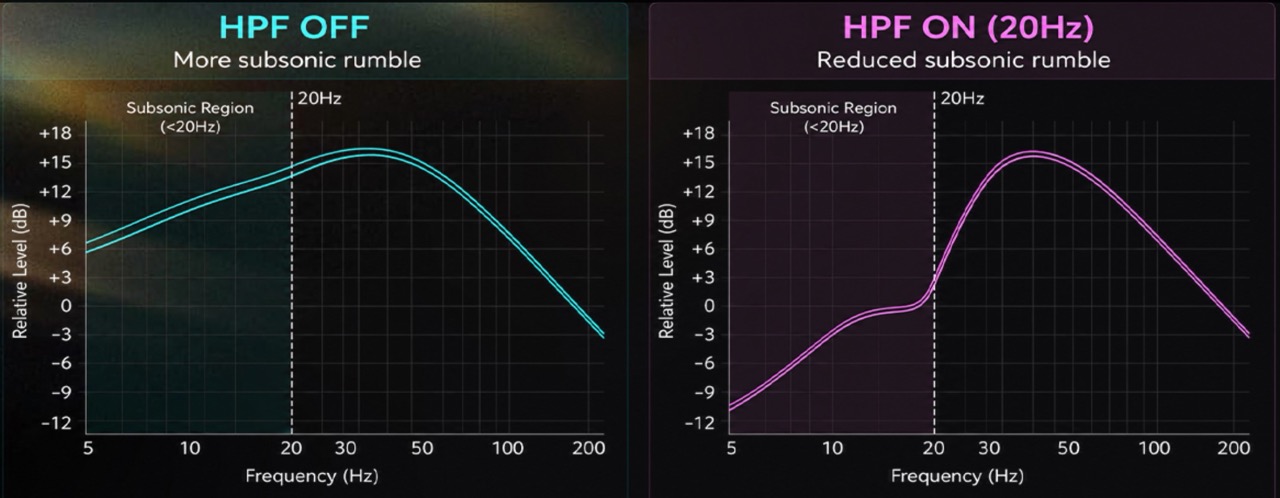
The left graph is the filter off; the right is it engaged. Everything below about 20Hz — warp, footfall, motor rumble, acoustic feedback from your speakers into the plinth — gets rolled away, while the audible bass region above 20Hz is left essentially intact.
This matters more than it sounds like it should, and it matters specifically in combination with the bass control. If you add a couple of notches of bass boost, you are also boosting the subsonic junk that a turntable produces, and that junk eats amplifier headroom and woofer excursion without producing anything you can hear. Engaging the HPF and then adding bass boost gave me the tailored low end I wanted without the woolliness that boost alone produced. The two controls are better together than either is alone, and that combination is probably the best single thing about the H5’s feature set.
The Subwoofer Output and Low-Pass Filter
The SUB OUT has its own 180Hz / 250Hz low-pass switch, so the H5 can act as a rudimentary crossover instead of just a full-range Y-splitter. Douk’s spec sheet gives 3.2V maximum output at the 180Hz setting and 5.5V at 250Hz.
I tried this briefly with my KEF Kube8 subwoofer and it worked exactly as described — the sub got a filtered feed instead of a full-range one, which stops the bottom two octaves being reproduced twice and keeps the sub from muddying the region where the main speakers are already working.
In honesty, I did not use it for long beyond a basic test, because I have better subwoofer management options in my WiiM Ultra — adjustable crossover frequency, level, phase and room correction, which a two-position switch cannot match. But it is still a nice option to have, especially for someone starting out: if you are running a simple stereo pair plus a sub off a turntable and an integrated amp with no crossover of its own, a filtered sub output on the back of a $90 box is a genuinely useful thing to find, and 180Hz versus 250Hz covers most small-to-medium bookshelf speakers reasonably well.
Two Outputs
The pair of RCA output sockets is the least glamorous feature here and possibly the most quietly useful. Two active speaker pairs, or an amplifier plus a headphone amp, or a main system plus a recording input, all without a splitter degrading the signal. Neither the T1 Pro nor the Fosi T20 offers that.
Sound Impressions
The stock GE-4BZ6 tubes run on a 180V rail, and the character is what I would call gentle — this is a box that stays out of the way until you ask it not to. With the tone controls in their centre detents and the line input selected, the difference between H5 in the chain and H5 out of the chain is a small addition of body through the lower midrange and a slightly softer, rounder edge to transients. It is the sort of change you notice more on switching back than on switching in.
Midrange and Vocals
The lower midrange is where the tube stage does most of its work, and it is where I like it most. Voices gain a little weight and a little more of a sense of being in a physical space. On Sweet Jane by Cowboy Junkies, Margo Timmins' voice through the H5 sits slightly forward and fuller-bodied compared with the same track direct — listen to the way the vocal sustains at the end of phrases, where the tube stage adds a touch of decay that the direct path does not have. Whether that is more accurate is a different question from whether it is more enjoyable, and on this kind of recording I found it more enjoyable.
Bass
With the tone controls flat, the bottom end is neither boosted nor loose. With the bass control up two or three notches and the HPF engaged, it firms up in a way I liked on vinyl. Flight of the Cosmic Hippo by Béla Fleck and the Flecktones is the track I kept going back to here, because the bass line on it goes low enough to show up any subsonic-region problems: with the HPF engaged the fundamental stays defined instead of smearing into the notes around it, and you can hear the string, not just the note.
Treble
The treble control gives ±6dB and the tube stage itself is very slightly soft up top instead of bright. Billie Jean by Michael Jackson is the clearest illustration I found, because the whole track hangs off the attack of the hi-hat and snare: through the H5 both are still distinct, but each strike starts a fraction less sharply than it does direct. If you like your treble crisp, that is a reason to listen carefully before committing. If you find modern remasters fatiguing up top, it is a reason to buy.
Genre Fit — Where the Warmth Belongs
I like options in audio, and part of having options is admitting that they are not always the right ones. For older jazz in particular, tube warmth and the small amount of added harmonic content that comes with it feel right to me — my honest sense is that a lot of that material was recorded expecting to be played back on equipment with exactly this character, and playing it back dead flat can leave it sounding thinner than it was ever meant to. That is a feeling and not a measurement, and I will not pretend otherwise, but it is a consistent one.
The clearest test of that was away from vinyl entirely. My WiiM Ultra has a very linear default output, which makes it a useful reference: I ran it into an amplifier with the H5 in the chain and then straight through, and switched between the two on the same material. On older recordings — the ones made when warmer tube amplification was simply what music got played back on — the H5 in the path gave a more realistic, more nostalgic result to my ears, closer to what I think those records were meant to sound like.
Modern recordings went the other way. They are generally mastered flatter and cleaner to start with, and on those I preferred the Ultra’s more linear output direct. The H5’s contribution there is much closer to “adds a bit of fun” than “fixes anything” — on No Surprises by Radiohead it is a pleasant difference and not a better one. Which is the point about having options: a slide switch decides it, record by record, instead of you picking one sound and living with it.
Comparisons
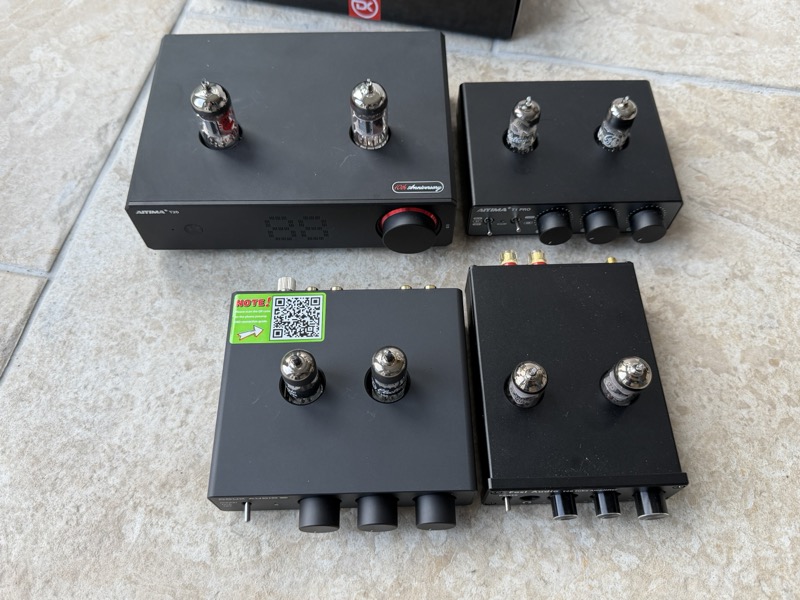
I have been buying small tube “buffer” preamps for years, for the same reason each time: I want the option of a little warmth and some harmonic distortion in front of an otherwise clean system, and I want to be able to take it out again when the music does not suit it. That distortion is not a side effect you tolerate — it is the reason you buy one of these. Over time that has meant an Aiyima T1 Pro, a Fosi Audio T20 — that one a tube integrated, not a preamp — and more recently the much fancier Aiyima T20. I still have all three.
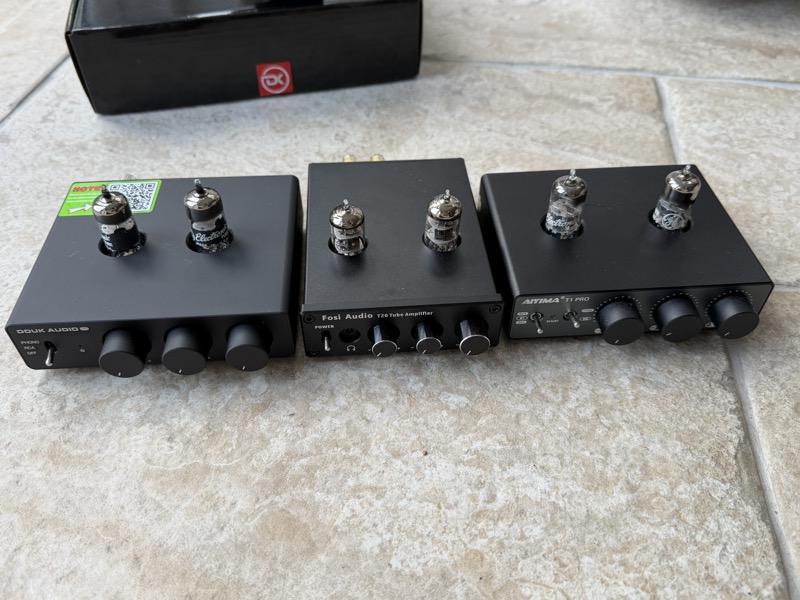
Here are the four together — the Aiyima T20 at the top left with its display and single large knob, the T1 Pro at the top right, the H5 at the bottom left with Douk’s green sticker still on it, and the Fosi Audio T20 at the bottom right:
 |
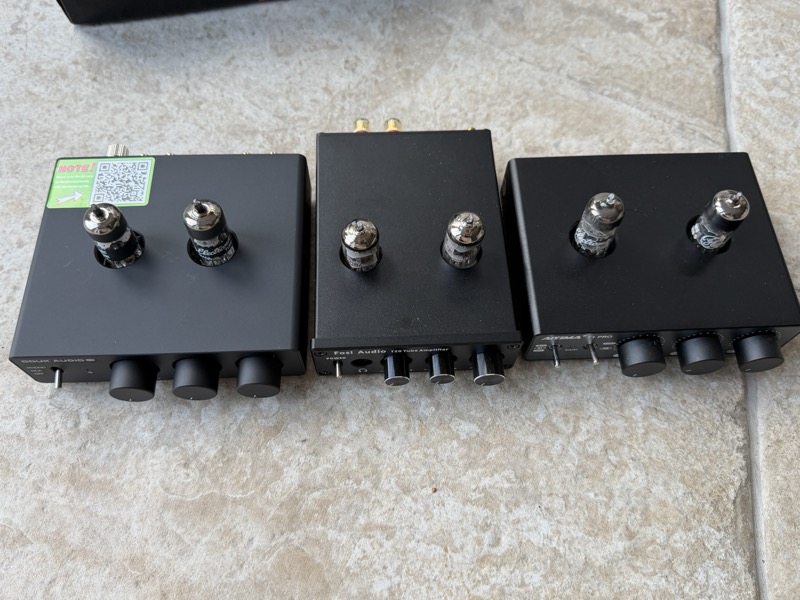 |
The H5, the Fosi Audio T20 and the Aiyima T1 Pro are close enough in size and format that they look like the same product from three brands, and from the top view you would struggle to tell them apart. They are not quite the same class of device, though: the Fosi T20 is a tube integrated amplifier with a TPA3116 power stage and a headphone output, so it drives speakers directly, while the T1 Pro and the H5 are line-level preamps that need an amplifier after them. Where they overlap is the part I care about here, which is putting a tube stage into the signal path of a system that would otherwise be clean.
The difference is what happens once you want to do anything else with that signal. Neither the T1 Pro nor the Fosi T20 has a phono stage, so a turntable needs a separate preamp in front of either one. Neither has a subsonic filter. Neither has a filtered subwoofer output. Neither gives you two output pairs. The T1 Pro’s answer to versatility is Bluetooth and a 3.5mm aux input, which is a different kind of useful — it is aimed at being a small hub for a desktop, not at tailoring an analogue front end. As a simple tube buffer for a system with a turntable in it, the H5 is the better of the three and it is not particularly close.
The Aiyima T20 is a different proposition and a more expensive one. It has balanced XLR in and out, a remote, a display with a tube warm-up countdown, 12V triggers, and measurements good enough that it may be the first tube preamp Amir has recommended at AudioScienceReview. It is a better-engineered and better-measuring device, and if you want tube character in a balanced system with clean measurements, that is the one to buy. But it is not a phono preamp, it has no subsonic filter and no subwoofer crossover, and it costs roughly twice as much. The T20 and the H5 are solving different problems, and I would not describe either as replacing the other. What I would say is that if your front end is a turntable, the H5 does more of what you need.
Specifications and Measurements
| Specification | Details |
|---|---|
| Vacuum Tube Type | GE-4BZ6 × 2 |
| Tube Supply Rail | 180V |
| Op-Amp | NE5532 (socketed, user-replaceable) |
| Audio Inputs | MM Phono, RCA line |
| Audio Outputs | 2 × RCA line, 1 × SUB |
| Frequency Response | Phono: RIAA; RCA: 20Hz–20kHz (±0.3dB) |
| THD+N | Phono: 0.15%; RCA: 0.5% |
| SNR | Phono: ≥78dB; RCA: ≥104dB |
| Input Sensitivity | Phono: 5mV; RCA: 1V |
| Max Output | Phono: 500mV; RCA: 2V |
| SUB Max Output | 3.2V @ 180Hz; 5.5V @ 250Hz |
| High-Pass Filter | 20Hz (switchable, phono input) |
| Low-Pass Filter | 180Hz / 250Hz (switchable, SUB output) |
| Bass / Treble | ±6dB, with centre defeat detent |
| Power | DC 12V, ≥1.5A, 5.5×2.1mm barrel |
| Package Size | 265 × 240 × 65mm (10.43 × 9.45 × 2.56in) |
| Package Weight | 0.8kg (1.76lb) |
I have not measured the H5 myself, and I am not aware of any independent measurements of it, so everything in that table is Douk’s own specification rather than verified performance.
Worth reading the numbers honestly, though, because they tell you what kind of device this is. An RCA THD+N figure of 0.5% and a phono figure of 0.15% are not transparency numbers — they are orders of magnitude worse than any competent solid-state preamp. BUT that harmonic distortion is the product. It is what people mean when they say tube warmth, and if your goal is a preamp that adds nothing to the signal, this is not it and you should not buy it. The ≥104dB RCA SNR is the more reassuring figure: it suggests the noise floor should stay out of the way in normal listening even if the harmonic content does not. The phono SNR of ≥78dB is unremarkable for a budget MM stage and matches my listening experience, where the H5’s phono input was quiet enough not to intrude but not silent in the way the Argon’s is.
Rating Explanation
The H5 gets five stars on the pragmatic rating, five on price and five on features, with a 4 for measurements.
The price and features scores are the easy ones. For $89.99 you are getting a tube preamp, an MM phono stage, a switchable subsonic filter, ±6dB of bass and treble with detented centres, two line outputs and a low-pass-filtered subwoofer output with two crossover choices.
The pragmatic five stars follow from that. The word I keep coming back to is options. The H5 adds warmth, and then it also lets you decide how much, decide where in the frequency range, take it out entirely with a switch, clean up turntable rumble on the way through, and split the low end off to a subwoofer. That combination is what let me get a result I preferred out of an $800 turntable, which is not a sentence I expected to write about a $90 box.
The measurement 4 needs a word, because anyone buying a tube preamp should expect it to measure poorly — that is what the topology does, and scoring it as though it were trying and failing to be transparent would miss the point. What lifts it back up is that the H5 hands you the tools to work with its own colouration instead of just presenting it as a fait accompli: flat tone controls with detented centres, a switchable subsonic filter, and a switch that takes the whole thing out of the path. The point off is for the phono stage’s ≥78dB SNR, which is the one place I could actually hear the difference against the Argon.
The only real niggle is the misaligned tube lettering, which is cosmetic and which almost nobody will notice. The knobs shipping in the negative position is worth knowing before you listen, but it takes two seconds to fix.
Conclusion
Once it is set up — tone controls moved to their centre detents, ground connection made the way the video shows, HPF engaged if there is a turntable involved — the H5 is a flexible-sounding preamp that I have enjoyed more than any of the other tube buffers I own.
It is at its best in front of vinyl. The phono stage on its own beat the built-in stage in the FiiO TT11 comfortably, and while it did not beat the Argon TT-4 MK2’s own stage, the H5’s tuning options let me get a result out of that much more expensive turntable that I liked better than the turntable alone. Being able to boost the bass and filter the subsonics in the same signal path, by feel, without opening an app, turns out to be worth a lot on a format that genuinely benefits from both.
It is also more useful than I expected in front of a clean digital system. Feeding a WiiM into the H5 and out to an amplifier gives you a way to put some harmonic texture back into a deliberately linear chain, and to remove it again when the recording does not want it. That is a preference and I will keep saying so — but at $90 it is an inexpensive preference to try, and for older jazz in particular it is one I keep choosing.
If you want the most tuning options per dollar that I have seen on a tube preamp, and particularly if there is a turntable in your system, I would recommend the H5.