EarFun Wave Pro X
A Quality ANC Headphone with a Real 10-Band Parametric EQ Built In
I reviewed the EarFun Wave Pro back in 2024 and it is still an easy recommendation for an ANC headphones under $100. The one thing I asked for at the end of that review was a proper PEQ editor instead of a 10-band graphic EQ, because the areas that need fixing on a closed ANC headphone almost always fall between the fixed bands.
The Wave Pro X is EarFun’s answer to that question and much more, and as a first attempt at a flagship-level headphone rather than a budget one — Qualcomm QCC3095, Bluetooth 6.0, aptX Adaptive Lossless, eight microphones, a dual-coaxial driver, and a Professional EQ screen with ten fully parametric filters.
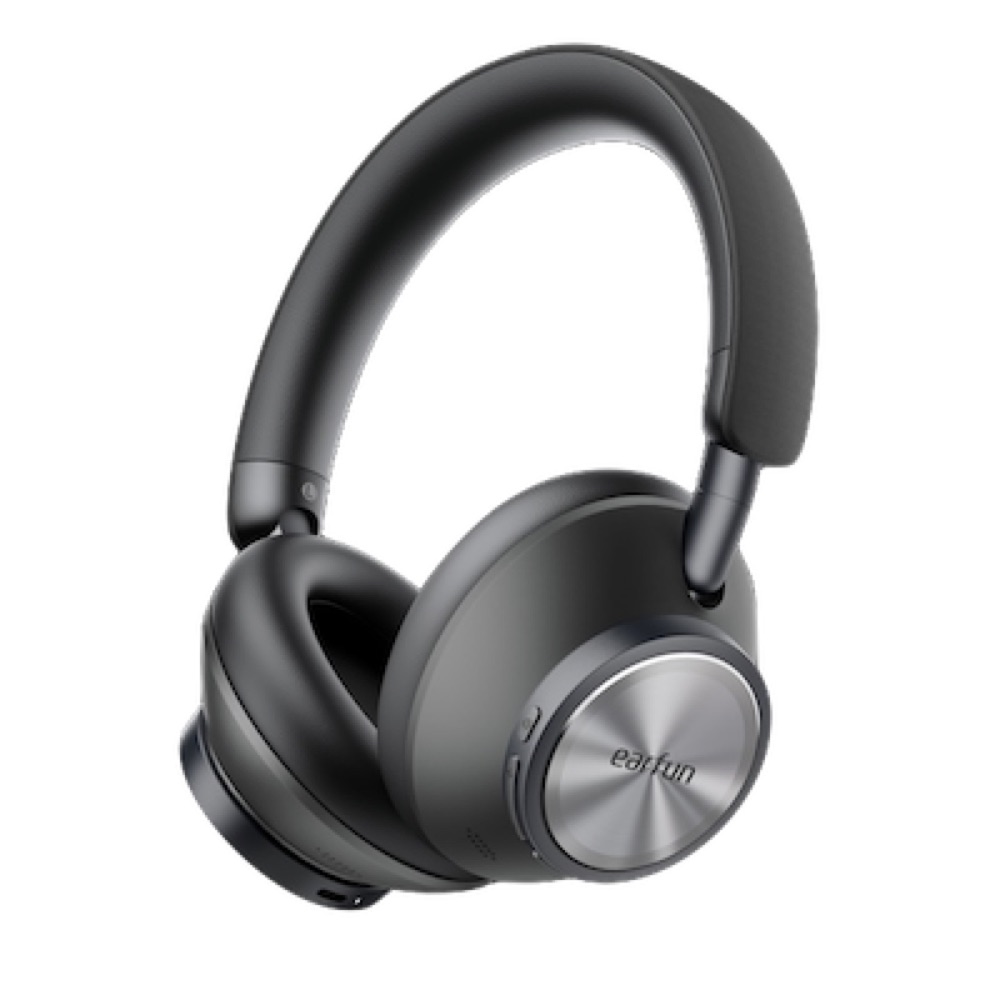
I would like to thank EarFun for providing the Wave Pro X for the purposes of this review.
If you are interested in finding more information about this product, you can find it on the official product page, on Amazon US and on Amazon UK.
The Wave Pro X retails for $129.99 / £119.99 / €149.99 and is available in Black and White. The unit reviewed here is the Black variant.
So, after listening to this for a few weeks, I have been very impressed with both the hardware and software updates that EarFun have provided. There is a long list of features that are now standard across their range, and I am not going to re-cover all of them here — the Wave Pro and Tune Pro reviews go through the app in even more detail and most of it carries over unchanged. This review mostly concentrates on what is actually new.
The most interesting feature came along about a week ago, once the Professional EQ screen became available and I could really drill into tweaking the (already good) stock tuning into something closer to an audiophile reference target with a −1dB/octave tilt and this IMO brought this headphone to another level.
But before I get into the new Equaliser capabiltiies, let’s take a look at what’s in the box.
Unboxing and What’s in the Box
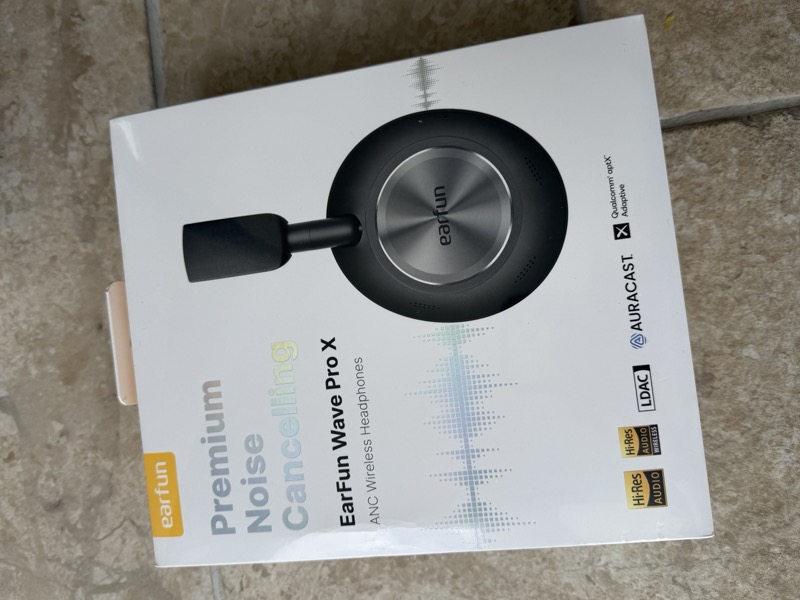
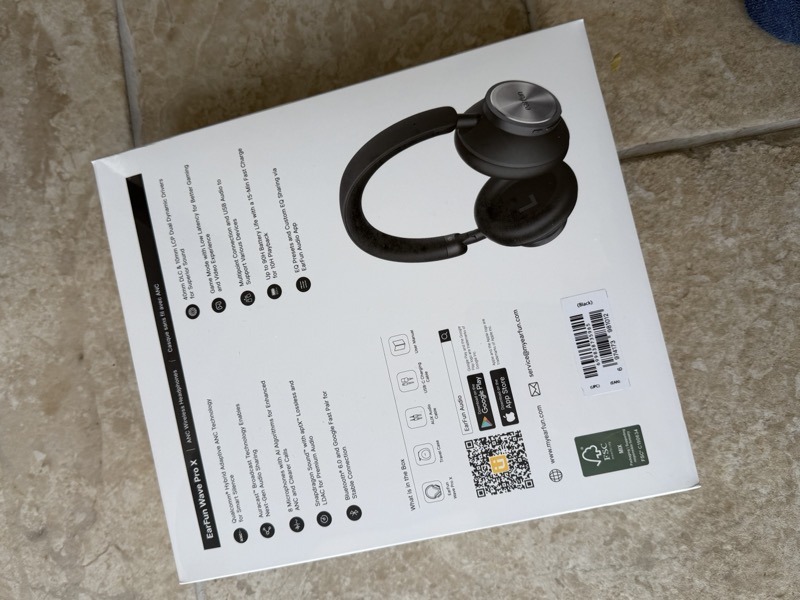
The retail packaging is the same tidy, unfussy presentation EarFun have used for a while, with the headphone photographed on the front and the feature list on the back:
 |
 |
Inside the outer sleeve the inner box carries EarFun’s “Better Sound, Better Life” line:
The travel case sits directly under that, and the user manual is tucked underneath the case rather than on top of it:
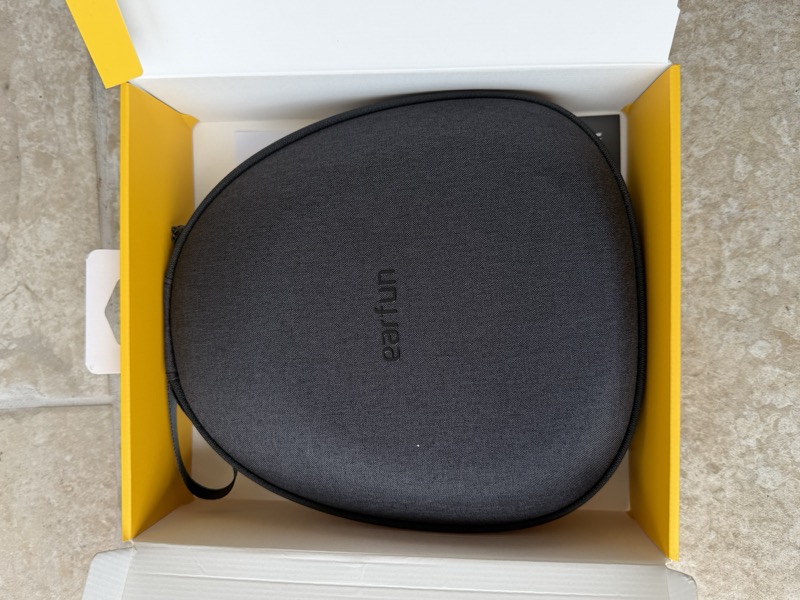 |
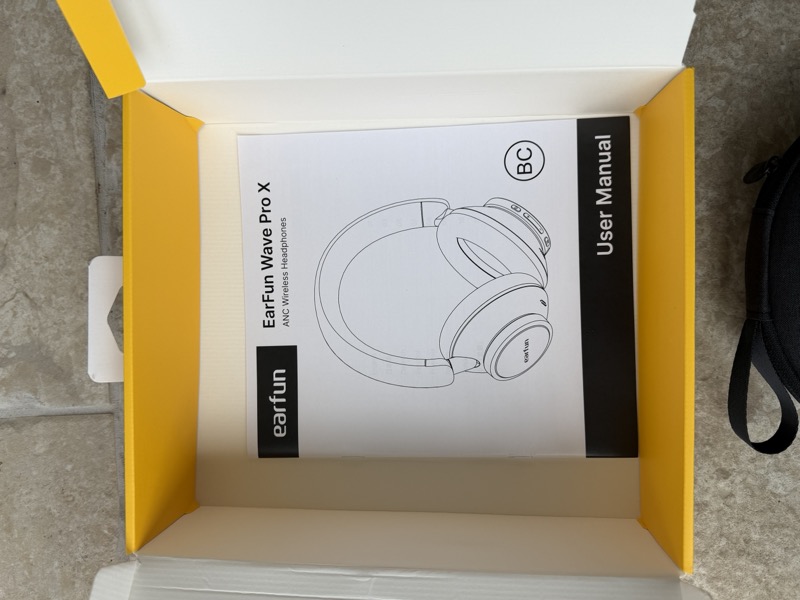 |
The case is a hard zip-up shell with a sculpted interior, and the folding mechanism does both things — the cups lie flat, and they also fold inwards, so the headphone packs down properly rather than only lying flat:
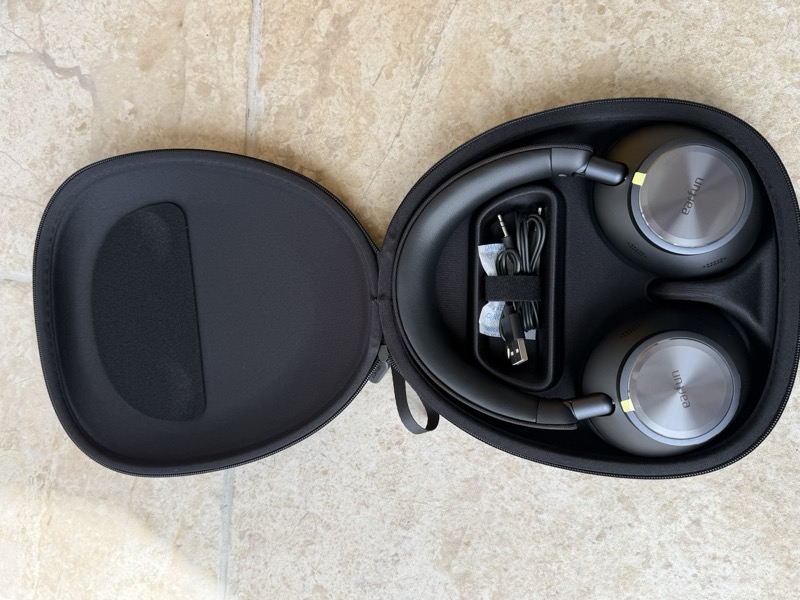
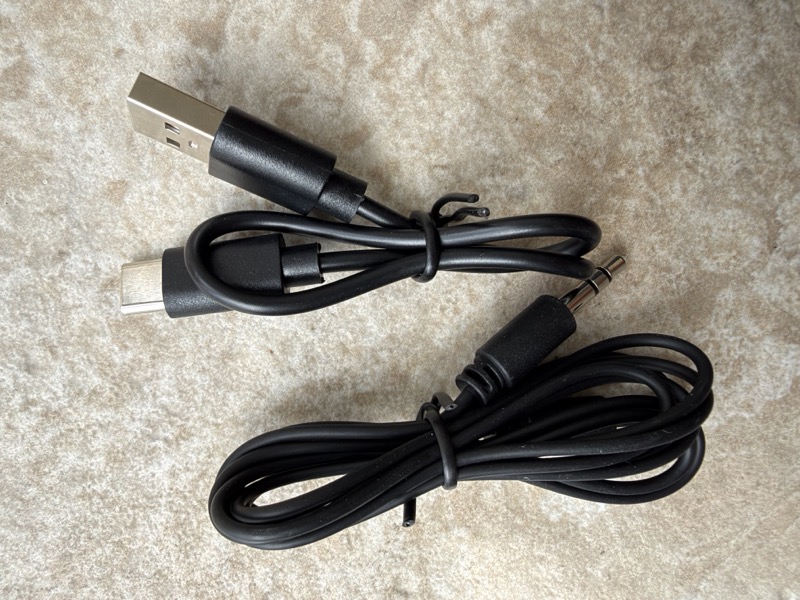
In the box you get the Wave Pro X, the hard travel case, a USB-C charging cable and a 3.5mm analogue cable, with the two cables held in an elasticated loop in the case lid:
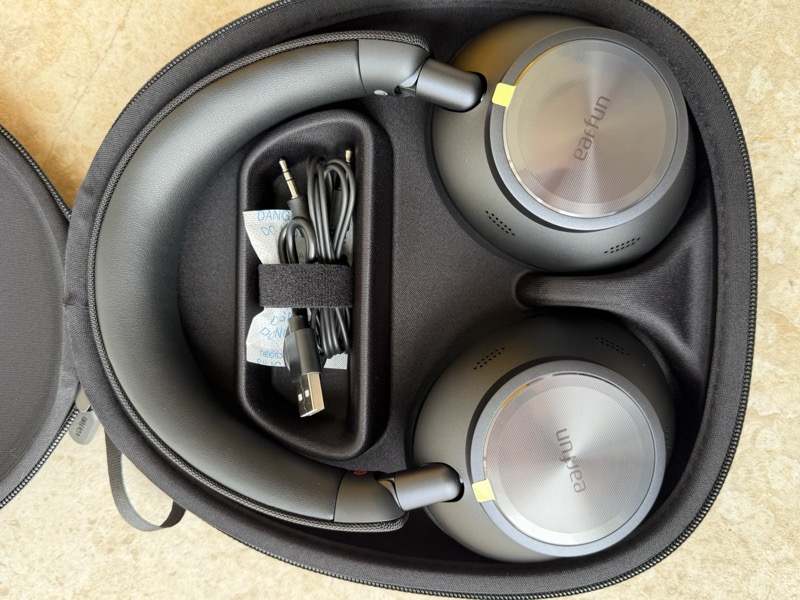
Here are the two cables out of the case — the analogue cable matters more than it looks, because it lets you use the headphone on an aircraft entertainment system or after the battery dies:
Build Quality and Comfort
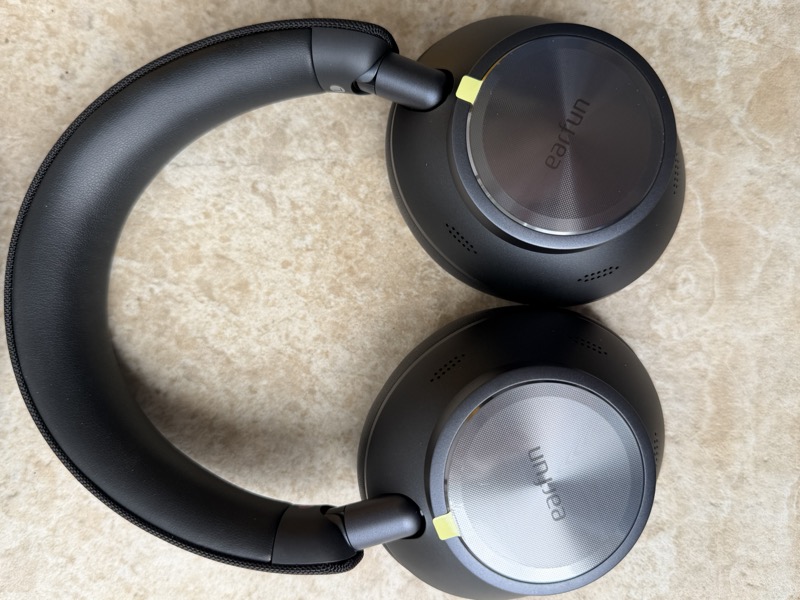
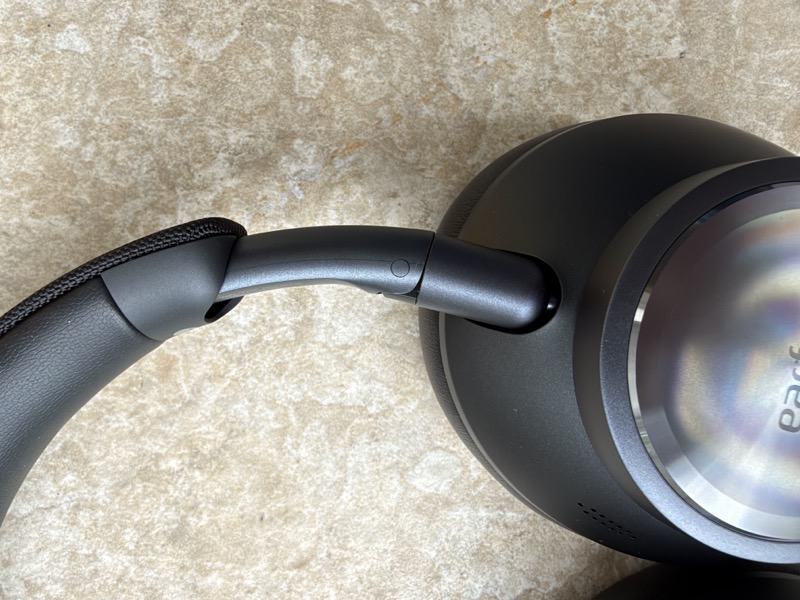
The Wave Pro X is a clear visual step up from the Wave Pro. The earcup housings are aluminium alloy rather than plastic, finished in a matte dark grey with a machined disc carrying the EarFun logo, and the yokes are metal rather than the plastic arms on the original:
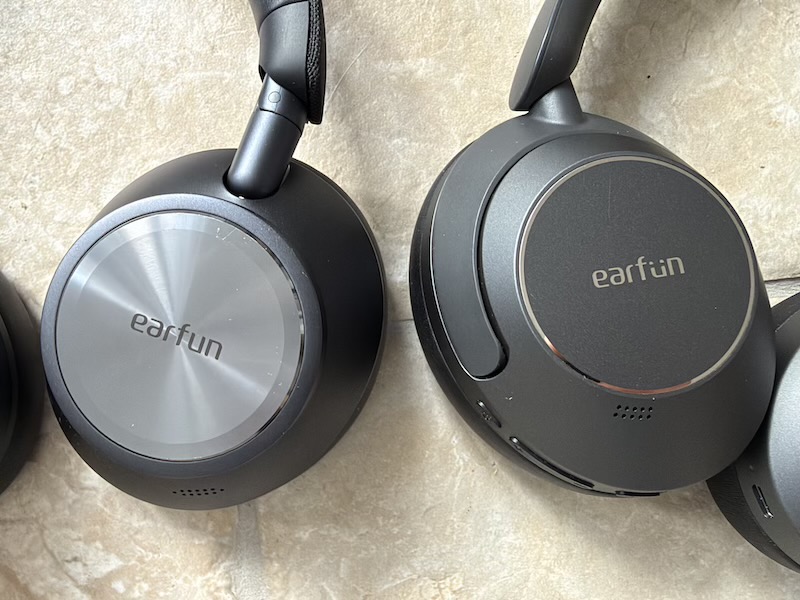
Put the two side by side and the difference in finish is obvious — the Wave Pro X is on the left, with the brushed metal cap and a cleaner seam line, while the Wave Pro on the right uses a plastic disc and has its buttons and microphone ports cut into the cup edge:
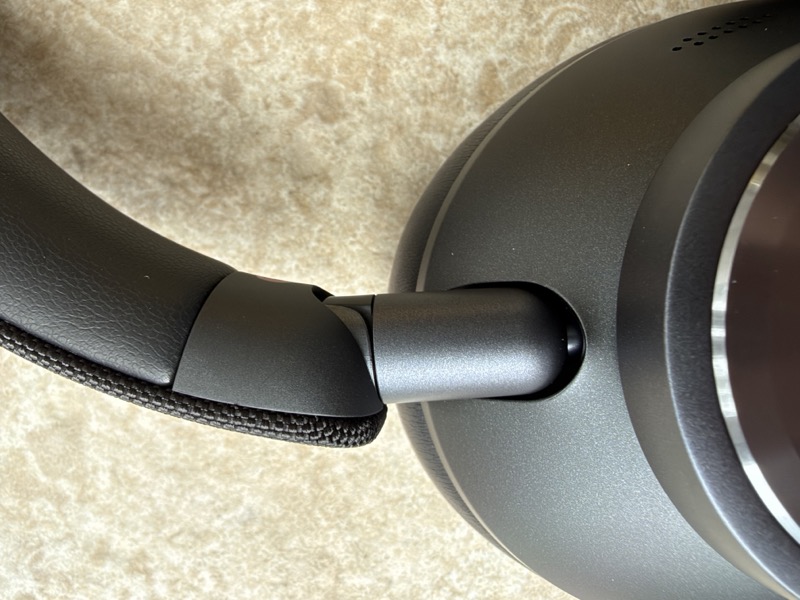
There is decent headband extension, so even much larger heads should be fine:
 |
 |
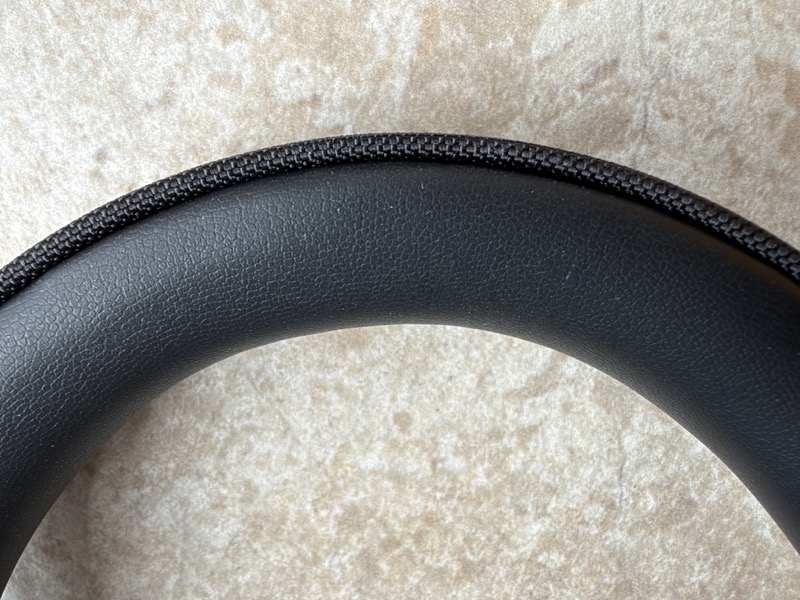
The headband padding is generous and covered in the same synthetic leather as the pads, with a fabric-wrapped outer edge:
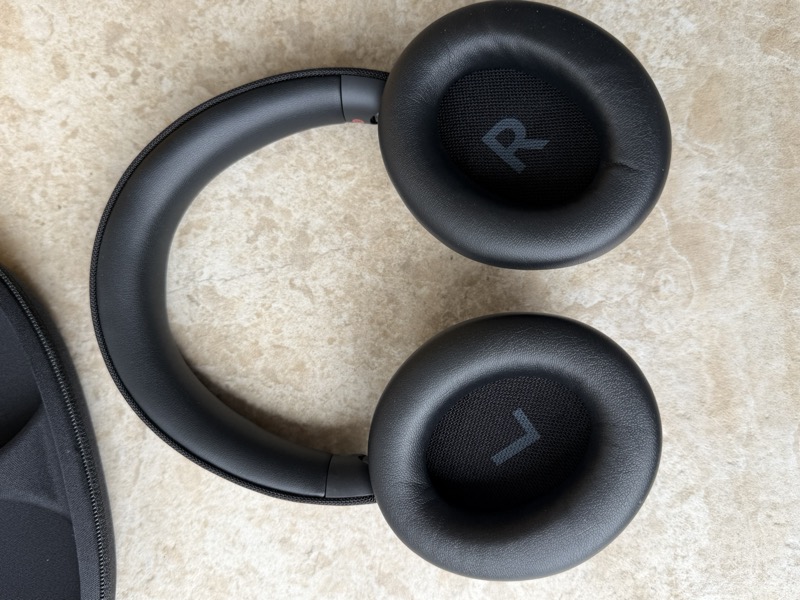
Comfort is the strongest non-audio thing about this headphone. At 259g it is light for a metal-yoked closed back, the clamping force is moderate rather than tight, and the pads are deep enough and angled that my ears do not touch the driver grille:
 |
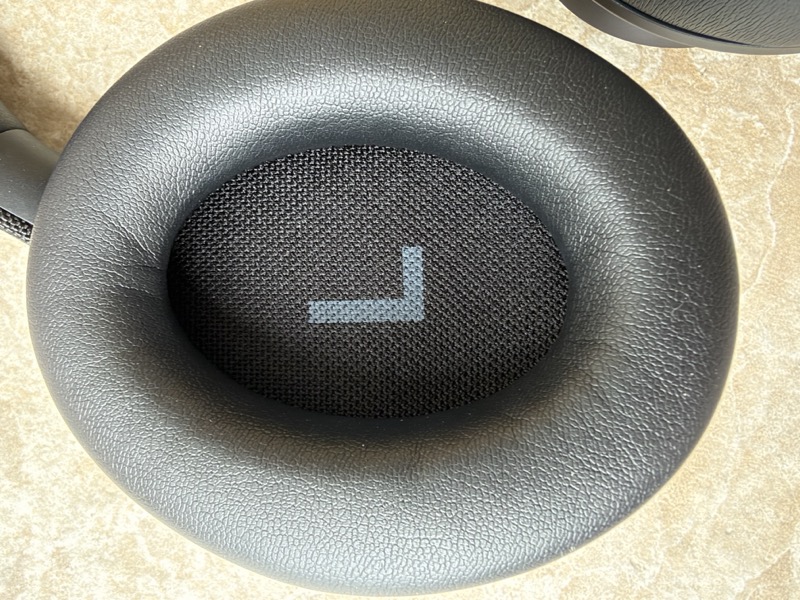 |
The pad opening is much the same as the original’s, which is no bad thing — the Wave Pro was already comfortable:
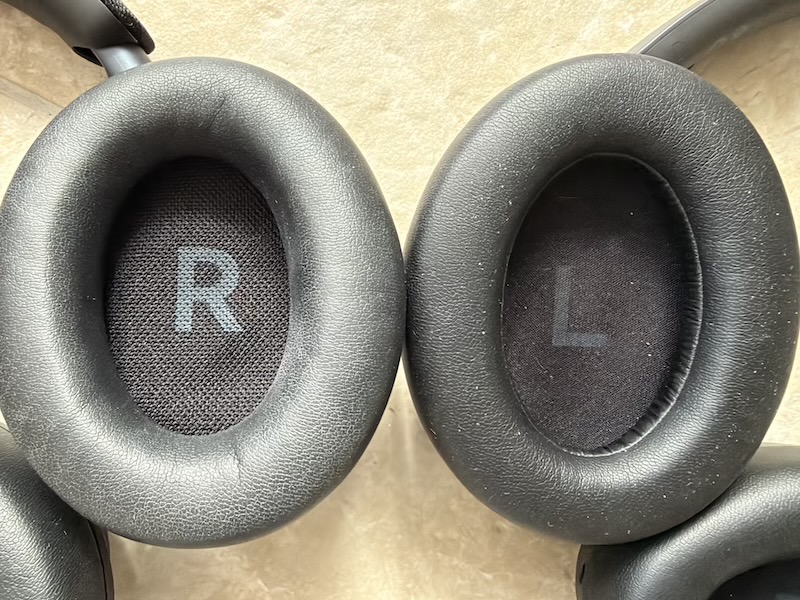
But, I should keep that in proportion, though. It is comfortable enough for my larger-than-average ears, but both EarFuns look small next to a typical full-size audiophile, here is the size of FiiO FT7 compared:
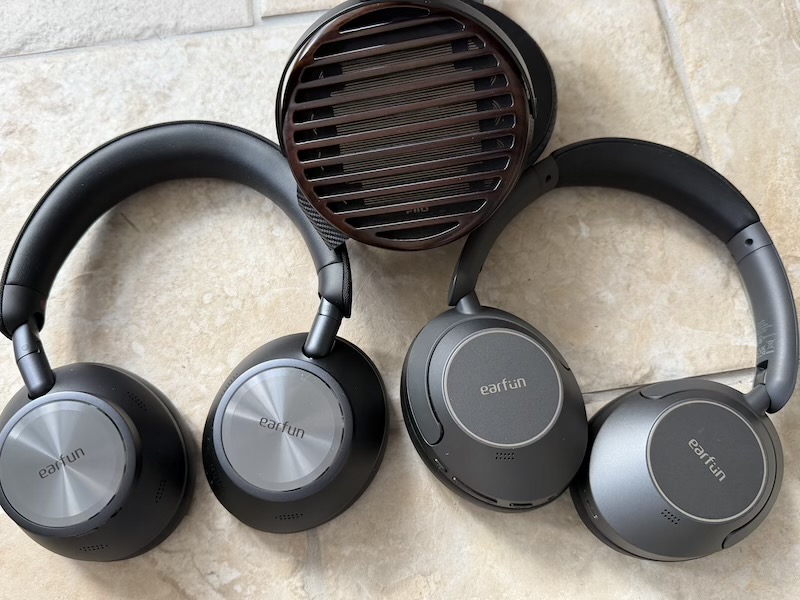
Nothing in the ANC category comes close to that, and closed ANC headphones have good reasons to stay small — but if you are coming from something open like the FT7, calibrate your expectations. The Wave Pro X is comfortable by ANC standards, not by open-back audiophile standards.
And here is the group I did most of my comparison listening with — the Wave Pro X, the Wave Pro, my Sony WH-1000XM5 and the Tanchjim Rita:
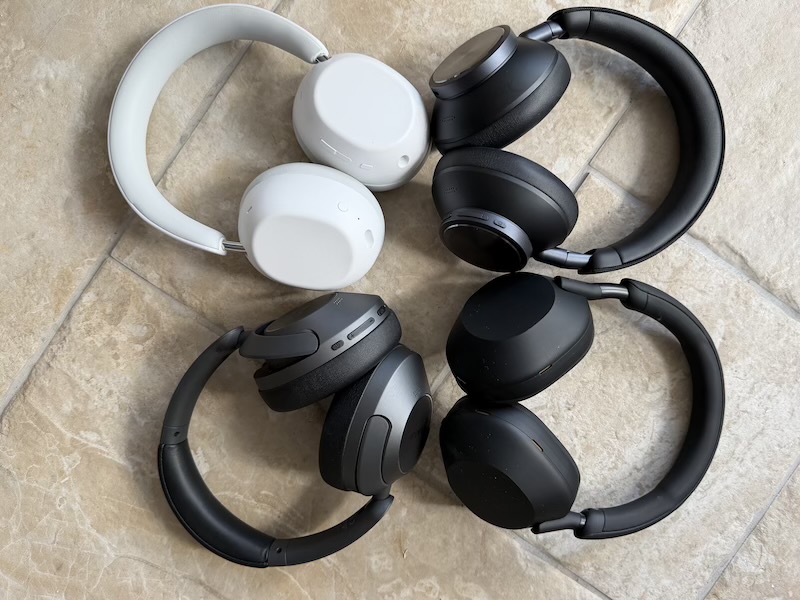
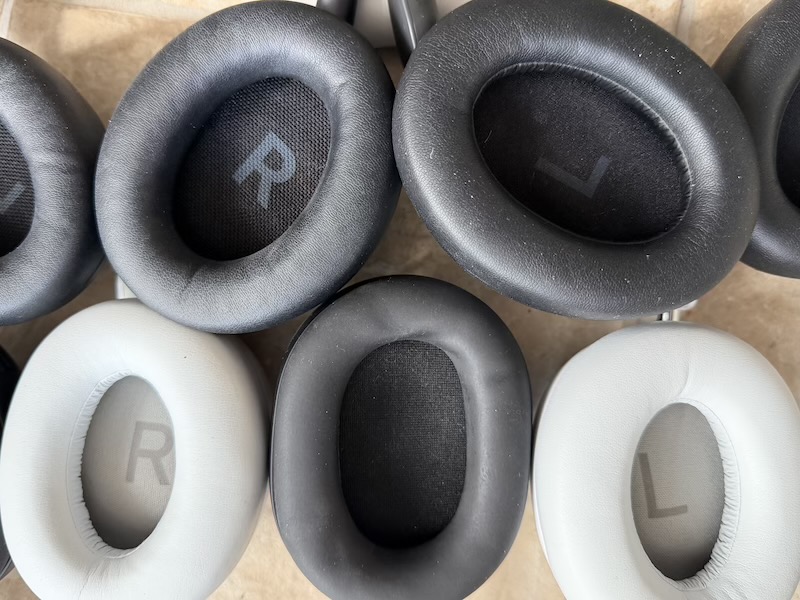
The pad comparison is the more useful photo of the four. The Rita’s opening is noticeably smaller than the other three, and that is the reason I could not wear it for as long as the Wave Pro X even though I do like how the Rita sounds by default:
The swivel range is the same as the Wave Pro’s and it is judged correctly: enough rotation that the cups sit flat against your chest when you drop the headphone around your neck, which is what you actually do a dozen times a day when someone talks to you. Given there is no wear detection to pause the music for you, getting this right matters more on the Wave Pro X than it would on a headphone that pauses itself.
Features
Drivers and Acoustic Architecture
EarFun call the driver arrangement DCAA, for Dual-Coaxial Acoustic Architecture: a 40mm DLC composite driver with a 10mm LCP driver sitting coaxially in front of it, with the Qualcomm QCC3095 board behind both. Their exploded view makes the layout clear:
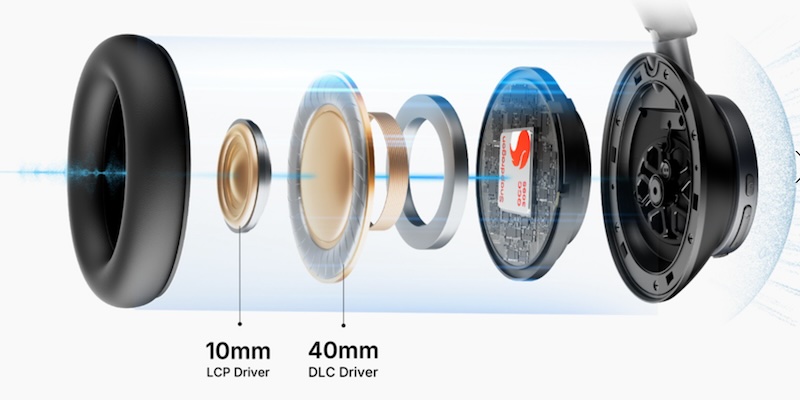
I am not convinced any of this was necessary. Plenty of well-tuned closed-back audiophile headphones manage with a single dynamic driver, and adding a second one brings a crossover and an integration problem that a single driver simply does not have. The interesting part is the geometry rather than the driver count. Putting the small driver on the same axis as the large one, at its acoustic centre, is the same idea KEF have used for years with Uni-Q — the two sources radiate from effectively one point, so you avoid the lobing and phase mess you get when two drivers sit side by side and their path lengths to your ear differ.
Whether it was needed or not, EarFun have executed it properly. The two drivers are well integrated, with no discontinuity or phase oddity around the crossover region in either the measurements or the listening, and that is more than can be said for a lot of multi-driver designs. Treat it as a marketing headline that happens to have been done correctly, rather than as the reason to buy the headphone.
ANC and Transparency
The ANC is hybrid, driven by eight microphones and Qualcomm’s QCC3095, and it is genuinely good for the price — not the token attenuation you get on most sub-$100 headphones, and without the pressure sensation those cheaper implementations tend to produce. EarFun call the implementation QuietSmart 3.5 and describe it as Adaptive Hybrid ANC with four adjustable cancellation levels. Those two things live in different places, which is worth being clear about: the ANC button on the earcup only cycles three states — Noise Cancelling, Ambient Sound and Normal — and the four strength levels are the app’s manual slider, alongside the AI Environment Adaptive ANC option:
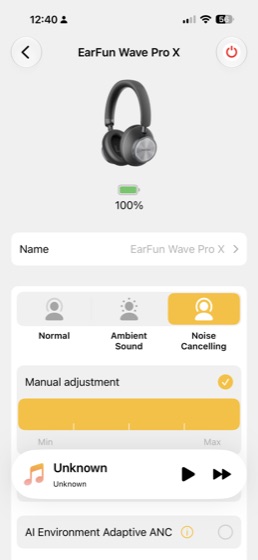
The four levels are spaced sensibly — the jumps between them are large enough to be worth making, which is not always true of a strength slider, and I did not find myself wishing for a step in between. The adaptive option is genuinely useful too, and I say that having previously turned adaptive ANC off on cheaper headphones because it kept switching modes audibly mid-journey. Wind noise cancellation has improved over the Wave Pro as well, which I would expect given three extra microphones, though it is still not at flagship level.
It is not, however, at the level of a Sony WH-1000XM5, a Bose QC Ultra or an AirPods Max, and I do not think it is close on raw attenuation.
EarFun’s own comparison sheet points at the likely reason — eight microphones against Sony’s twelve and Bose’s ten, and I would rate the ANC to be a similar level to the Sennheiser Momentum 5, which also employs eight microphones, but the key thing is to note what you get for the price:
| EarFun Wave Pro X | Sony WH-1000XM6 | Bose QC Ultra (2nd Gen) | Sennheiser Momentum 5 | |
|---|---|---|---|---|
| Price | $129.99 / €149.99 / £119.99 | $449.99 | $449.00 | $399.95 |
| Battery life | 90 h | 40 h | 30 h | 57 h |
| Bluetooth | 6.0 | 5.3 | 5.4 | 5.4 |
| Qualcomm chipset | QCC3095 | ✗ | ✗ | ✓ |
| Driver unit | DCAA dual-coaxial (40mm DLC + 10mm LCP) | 30mm dynamic | Dynamic | 42mm dynamic |
| Auracast | ✓ | ✓ | ✗ | ✗ |
| Codecs | LC3, LDAC, aptX, aptX Adaptive, aptX Lossless, SBC, AAC | LC3, LDAC, SBC, AAC | aptX Adaptive, SBC, AAC | AAC, aptX Lossless, aptX Adaptive |
| ANC technology | Hybrid | Hybrid | Hybrid | Hybrid |
| Microphones | 8-mic with AI algorithm | 12-mic | 10-mic | 8-mic |
| Hi-Res certification | ✓ | ✓ | ✓ | ✓ |
| USB audio | ✓ | ✗ | ✓ | ✓ |
| Google Fast Pair | ✓ | ✓ | ✓ | ✓ |
| Customised EQ and app | ✓ | ✓ | ✓ | ✓ |
| Multipoint | ✓ | ✓ | ✓ | ✓ |
| Carrying case included | ✓ | ✓ | ✓ | ✓ |
| Launch date | September 2026 | May 2025 | October 2025 | June 2026 |
What I can say from comparing them is that there is still a gap, but it is getting smaller every release and with the Wave Pro X it was small enough that I stopped noticing it after a few journeys, and the Wave Pro X is doing this at roughly a third of the price of those flagships.
One detail that is easy to miss and genuinely useful: the Hybrid ANC works in both wired modes, over USB audio and over the analogue cable. Most ANC headphones that accept an analogue cable either disable cancellation when you plug in, or require the headphone to be running in Bluetooth mode anyway. Being able to plug into an aircraft entertainment system and still get the noise cancelling is exactly the situation where you want it most. Though with the analog cable connected, you do need to separately switch on the headphone to hear audio via the analog cable ( so you still need the headphone charged even on the analog cable).
Transparency works well, and again I think the updated microphone array helps, it sounds natural rather than hissy. One little complaint is the same one I had with the Wave Pro: there is no quick gesture to switch to it. Every switch to Ambient Sound goes through the physical button cycle, whereas the Sony and the AirPods Max let you cup an earcup or press and hold a touch surface. If you take your headphones off to talk to people a lot, this will annoy you.
Codecs, Connectivity and Battery
The codec support is the most complete I have seen at this price: SBC, AAC, LDAC, aptX, aptX HD, aptX Adaptive and aptX Adaptive Lossless, plus LC3 and Auracast over Bluetooth 6.0, with Qualcomm Snapdragon Sound certification and Hi-Res Audio certification for both the wireless and the wired path. Most of my listening was over AAC from an iPhone, which is the codec that matters on iOS and which I think sounds better on Apple hardware than AAC does on Android. I also used LDAC and aptX when paired with my FiiO DAP, and the connection held a high bitrate reliably in both cases (at least reported by the DAP). The practical point is that you get a good path on whatever you own rather than having to match the headphone to the phone, and USB audio is there if you would rather run it wired from a laptop. Multipoint is supported, so a phone and a laptop can stay connected at the same time, Google Fast Pair handles the initial pairing on Android, and there is a low-latency Game Mode for video and gaming. Voice assistant access is available from the buttons or the app.
Battery life is one of the genuinely strong points and the one place where the Wave Pro X beats every flagship in the comparison table outright. An 800mAh cell gives a quoted 90 hours with ANC off and 50 with ANC on, against 40 for the Sony and 30 for the Bose. I have not run a controlled battery test, so those remain manufacturer figures, but I have never come close to flattening these in normal use and I stopped thinking about charging them within the first week. A 15-minute charge claiming 10 hours also means a forgotten charge is not a ruined commute, in fact just testing the usb-c audio for while meant the headphone battery was back at full again after listening to my test tracks again.
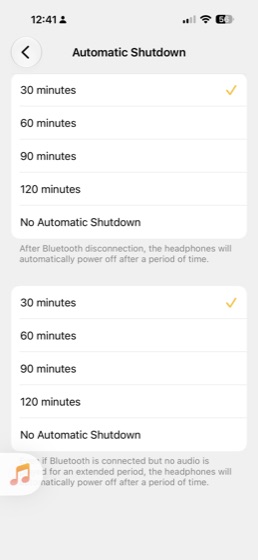
There is an automatic shutdown setting with separate timers for “disconnected” and “connected but idle”, both defaulting to 30 minutes, which is more thought than most companion apps put into it:
Controls are physical buttons rather than touch surfaces — a multifunction button, volume up and down, and a separate ANC control. These are the defaults from the manual:
| Function | Button | Action |
|---|---|---|
| Play / pause | MFB | Press once |
| Next track | + | Press and hold 2s |
| Previous track | − | Press and hold 2s |
| Volume up / down | + / − | Press once |
| Cycle Noise Cancelling / Ambient Sound / Normal | ANC | Press once |
| Answer / end call | MFB | Press once |
| Reject call | MFB | Press and hold 2s |
| Answer and transfer between two calls | MFB | Press twice |
| Voice assistant | MFB | Press twice |
| Power on / off | MFB | Press and hold 2s |
| Enter multipoint pairing | ANC | Press and hold 2s |
| Factory reset | MFB | Press and hold 10s, LED turns pink |
Having a dedicated ANC button rather than a buried gesture is the right call, and the volume rocker doubling as track skip on a long press is the convention most people already know. The one wrinkle is that a double press of the MFB means both “voice assistant” and “answer and transfer between two calls” — the headphone works out which from context, but if you use multipoint heavily you will occasionally get the wrong one. Game Mode is not on a button at all; it has to be enabled in the app. Much of this is reassignable anyway:
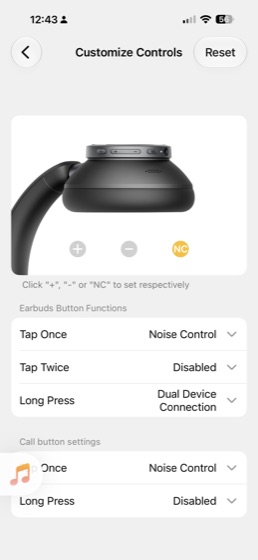
I prefer physical buttons on an ANC headphone — they work with gloves and in the rain — but you do give up the earcup touch gestures that the Sony and the CMF Headphone Pro have, and there is no wear detection, so the Wave Pro X will not pause when you take it off.
Microphones and Call Quality
The eight-microphone array is one of the three genuine upgrades over the Wave Pro, which had five. EarFun split it six and two: six microphones feed the Hybrid ANC system, and two dedicated AI cVc microphones handle voice pickup on calls. That split is worth knowing, because it means the call microphones are not being asked to do two jobs at once, and call quality is clearly better than the original — voice pickup outdoors was the Wave Pro’s weakest feature and it is no longer a reason to avoid taking a call. The same array is what feeds the ANC, so the microphone upgrade and the ANC upgrade are really one piece of engineering rather than two separate bullet points on the box.
AI Translation
The EarFun app includes an AI translation feature, which I have not used on the Wave Pro X and so cannot report on here. I have used it on earlier EarFun models, including during a trip to Japan earlier this year, and it was more useful than I expected for short exchanges — enough that I would treat it as a real feature rather than a specification-sheet entry. Whether the implementation on the Wave Pro X behaves the same way, I have not checked.
The App: Firmware, Personalized Sound and Professional EQ
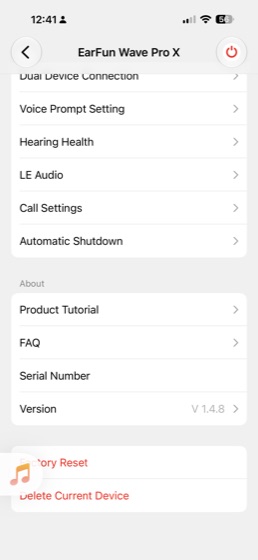
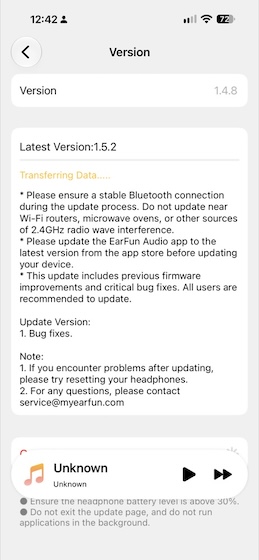
Firmware updates are handled in-app and the unit shipped to me on 1.4.8 with 1.5.2 available:
 |
 |
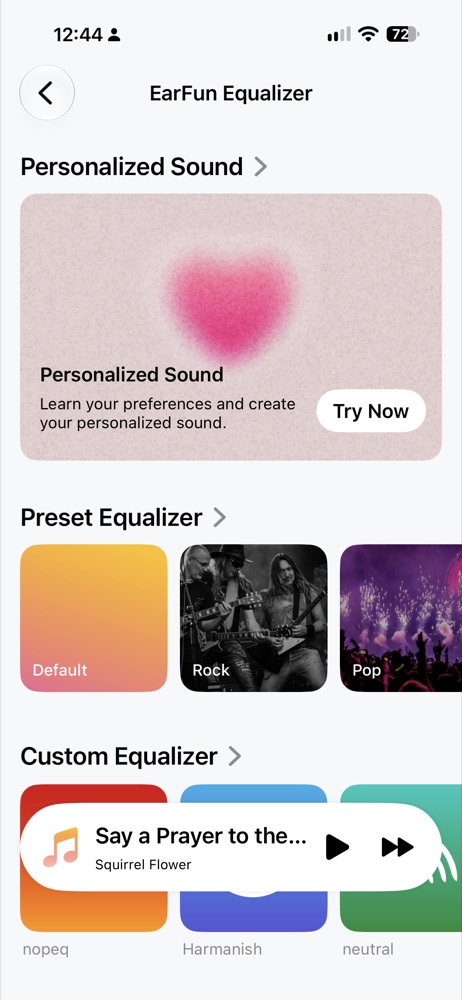
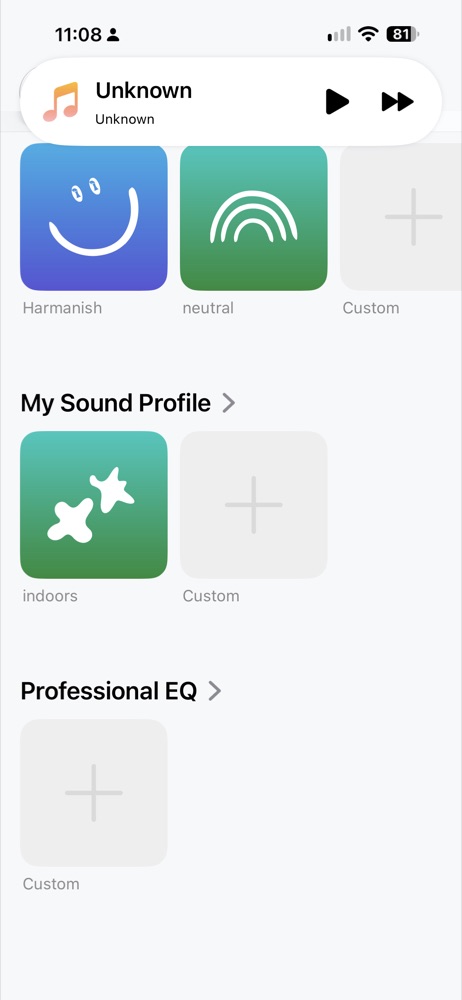
The EQ section now has three tiers: preset EQs, a Personalized Sound wizard, and the new Professional EQ. The equalizer landing screen shows all three:
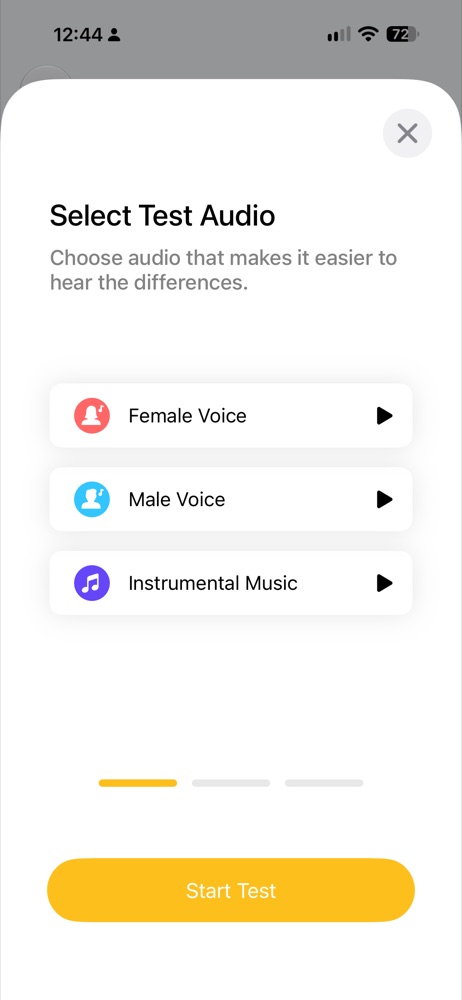
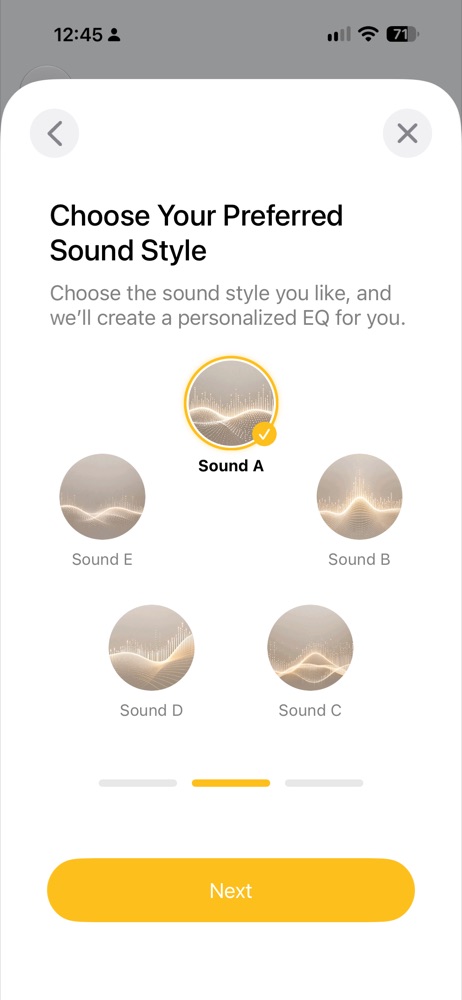
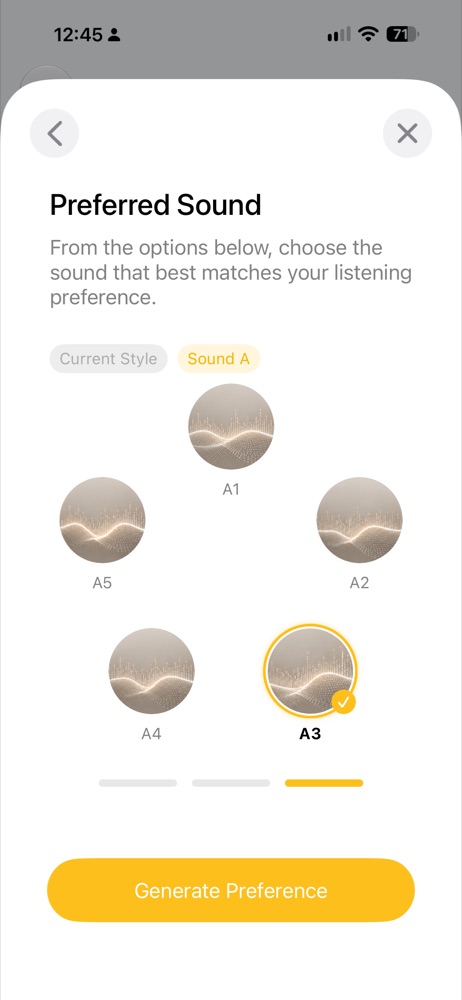
The Personalized Sound wizard is the second of the three upgrades over the Wave Pro. It starts by asking which kind of test material you want to use, then walks you through two rounds of A/B choices between generated sound styles before generating a profile:
 |
 |
 |
 |
This is a preference-matching exercise rather than a hearing test, so it is not the same thing as an audiogram-based personalisation — it finds a curve you like the sound of, not one that compensates for your hearing. It is a reasonable starting point, but it is not where I ended up.
Before the Professional EQ arrived I was using the 10-band graphic EQ, and this is the curve I had settled on — a big +10dB at 4kHz to fill the lower-treble dip, with a −10dB notch at 8kHz to pull down the peak above it:
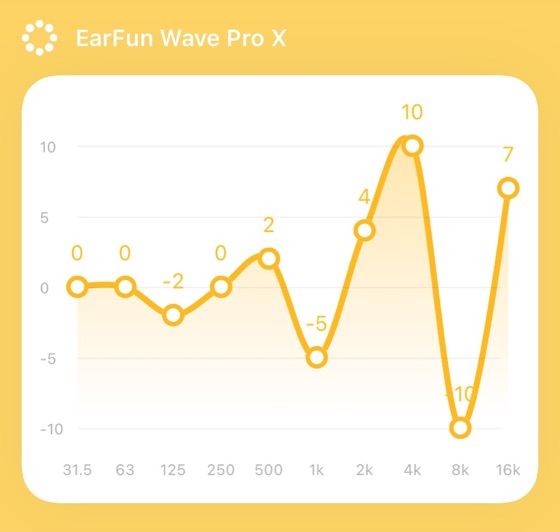
That curve tells you exactly why a graphic EQ is the wrong tool here. To lift 4kHz I also had to swing 2kHz and 16kHz around, because the fixed bands are an octave apart and the features I was trying to fix are much narrower than that. It got me closer, but it was a compromise every time.
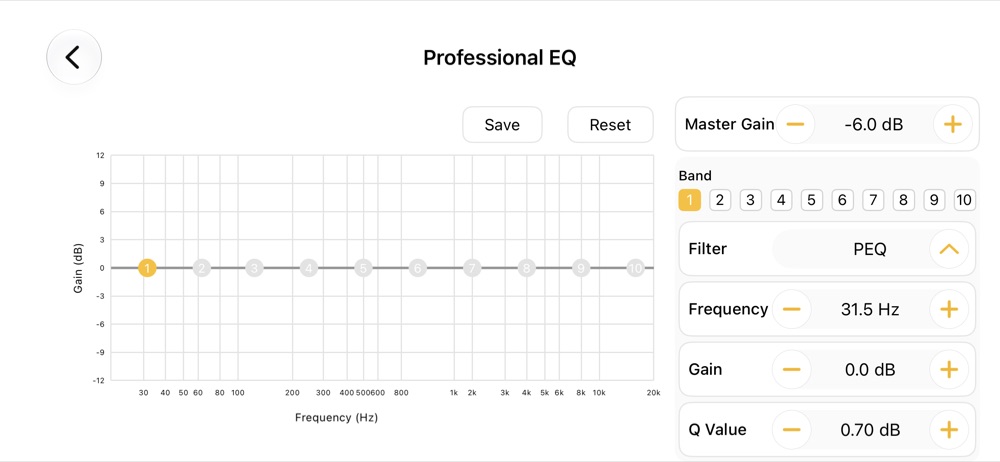
The Professional EQ is the third upgrade, and it is the reason I would buy this headphone. You get ten bands, each with a selectable filter type, its own centre frequency, gain and Q, plus a master gain control for headroom:
Here it is with a working curve loaded, showing band 2 set to a PEQ at 1500Hz, −3dB, Q 4, and master gain at −6dB to leave room for the boosts:
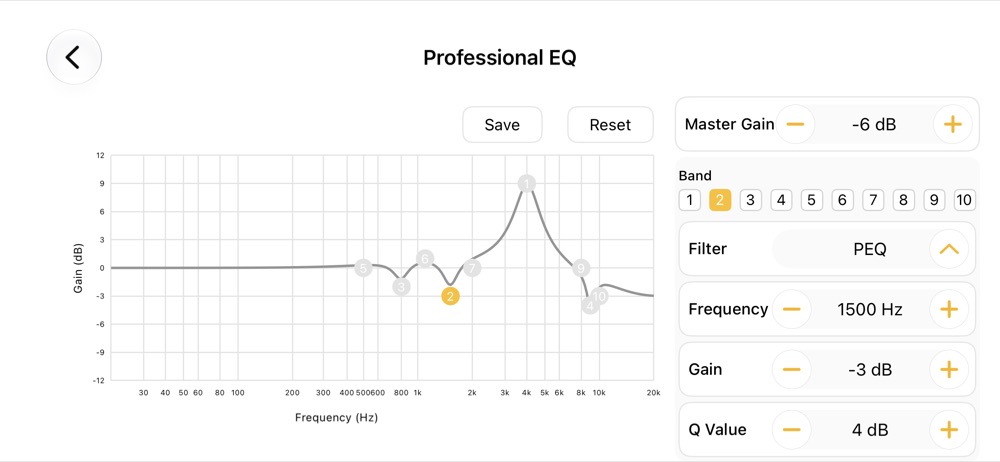
Two practical notes. The Q field is labelled in dB, which is a straightforward UI bug — it is a Q value and the units are wrong. And you have to set the master gain negative yourself before you start boosting, or the boosted bands will clip. Neither is a real obstacle, and I would still call this the best PEQ implementation currently shipping on a Bluetooth headphone — not on band count, since the Tanchjim Rita has twelve and the FiiO EH13 also has ten, but on what each band lets you do. Selectable filter types and an explicit master gain control are what make it practical to correct the tonal balance and notch out two treble resonances in the same profile, and the filters sit on top of the shipped tuning rather than replacing it. I compare the four properly later in this review.
Since I am asking for things, here is where I would take it next. Entering filter values numerically is clean and simple, and I would rather have that than a fiddly editor — the Tanchjim app works the same way and I said in that review that I preferred it to a drag-and-drop interface that makes exact values hard to hit. But the two are not mutually exclusive. What I would really like is to drag each filter around the response graph with a finger and watch the curve move, with the numeric fields still there to nail down the final value once you are close. Moondrop’s app is the more visual of the ones I have used; EarFun’s is the more precise. Someone should do both.
The bigger omission is that a profile you have spent an evening building cannot leave the app. There is no export, no import, and no way to hand it to anyone else. That matters more here than on most headphones, because ten parametric bands is enough that a good profile represents real work — and because a correction below 4kHz transfers between listeners, as I argue in the measurements section. Being able to export a profile as text, import someone else’s, and share a link to it would turn each user’s tuning work into something the next buyer benefits from instead of repeating. That is the feature I would ask for after visual editing.
Sound Impressions
Everything below was listened to with ANC enabled, which is the mode I think an ANC headphone spends its life in. I listened to the default tuning for the first stretch, moved to the 10-band curve above, and have spent the last week on the Professional EQ approximating a diffuse-field target with a −1dB/octave tilt. Where the default and the PEQ profile differ materially I have said so.
One thing to keep in mind while reading this section: the Wave Pro X’s default response measures close enough to the Apple AirPods Max and the Nothing Headphone (1) that the subjective description below largely applies to those two as well. Where I say something about the default tuning rather than about this specific headphone, assume it travels — that is the point of the measurement comparisons further down.
Bass
The default bass is well judged and, importantly, restrained by ANC-headphone standards. There is real sub-bass extension — the low synth line in “Angel” by Massive Attack arrives with weight rather than as a suggestion — but there is no mid-bass bloom smearing into the lower midrange, and no boom. My Sony WH-1000XM5 has considerably more low-end lift out of the box, and next to the Wave Pro X it sounds thick. The AirPods Max and the Nothing Headphone (1) both carry a little more sub-bass than this too, though the difference is smaller and more a matter of taste than the Sony’s. Bass texture and control are good; decay is clean enough that fast bass lines stay separated. This is one area the DF-tilted PEQ barely changed, and the small lift my own filters leave in is deliberate rather than a correction.
Midrange
The midrange is the part of the default tuning that works. Timbre is convincing, note weight is about right, and vocals sit forward enough to be intelligible without being shouty. Tracy Chapman’s voice in “Fast Car” has proper chest weight and the guitar behind it stays distinct rather than blending in. Instrumental separation through the mids is better than I expected at this price, and it holds up as arrangements get busier. This is also where the Wave Pro X pulls ahead of the CMF Headphone Pro, which starts pulling its response down from around 700Hz and recesses the upper midrange as a result — a much harder thing to live with than a dip further up.
Treble
This is the weak point of the default tuning, and it is a specific problem rather than a general one. The lower treble is recessed, and the audible consequence is that both male and female vocals sit further back in the mix than they should — you hear the arrangement first and the singer second. Above that there is some mid-treble unevenness: cymbals in “Chocolate Chip Trip” by Tool have a hard edge on certain strikes while the decay behind them is under-represented. This is not a Wave Pro X failing so much as a house style — the AirPods Max and the Nothing Headphone (1) do the same thing in the same place, and if you have heard either of those you already know what this sounds like. What separates the Wave Pro X is that you can undo it. With the DF-tilted PEQ the recession is gone and the tonal balance becomes very good, but the two narrow peaks are still there — they are resonances, not tuning, so a broad tilt does not touch them. A tone sweep to locate them followed by two narrow cuts is what actually fixes it, and having ten bands is what makes that practical.
Soundstage and Imaging
Soundstage is the limitation, and the default treble makes it worse — with the lower treble pulled down, the presentation is closed-in and mostly stays between the ears. Imaging within that space is good: instrument placement in “Hotel California” is stable and the separation between the two guitars is clear. Restoring the lower treble with PEQ opens things up somewhat and improves the sense of depth, but this is still a closed-back ANC headphone and it does not compete with an open back for width. The same caveat applies to the AirPods Max and the Nothing Headphone (1) for the same reason — a recessed lower treble closes the presentation in, and all three sound more open once it is restored. If soundstage is your priority, this is not the category to shop in.
Specifications and Measurements
| Specification | Detail |
|---|---|
| Driver | DCAA dual-coaxial dynamic — 40mm DLC + 10mm LCP |
| Impedance | 35Ω |
| Chipset | Qualcomm QCC3095, Snapdragon Sound certified |
| Bluetooth | 6.0, with LE Audio and Auracast |
| BT profiles | A2DP, AVRCP, HFP |
| BT frequency | 2.402–2.480 GHz, <7 dBm (EU) |
| Wireless range | 15 m without obstacles |
| Codecs | SBC, AAC, LDAC, aptX, aptX HD, aptX Adaptive, aptX Adaptive Lossless, LC3 |
| Microphones | 8 — six for hybrid ANC, two AI cVc for calls |
| ANC | QuietSmart 3.5 hybrid, adaptive, four strength levels; works wired too |
| Controls | Physical buttons; Google Assistant and Siri |
| Multipoint | Supported |
| Battery | 800mAh |
| Battery ANC off | Up to 90 hours |
| Battery ANC on | Up to 50 hours |
| Charging input | 5V ⎓ 1A |
| Charging time | 2 hours; 15 minutes gives 10 hours |
| Other inputs | 3.5mm analogue (ANC still works), USB audio |
| Enclosure | Aluminium alloy, plastic and synthetic leather |
| Dimensions | 188 x 168.3 x 86.7mm |
| Weight | 259g |
| Warranty | 18 months |
EarFun’s user manual is worth a look if you want the LED codes and reset procedure — white for one second on power up, red for one second on power down, flashing white while pairing, and pink for three seconds after a factory reset.
Against the original Wave Pro, the differences are worth setting out directly:
| EarFun Wave Pro X | EarFun Wave Pro | |
|---|---|---|
| Colours | Black, White | Black, Oat White |
| Bluetooth | 6.0 | 5.3 |
| Codecs | SBC, AAC, LDAC, aptX Adaptive Lossless, LC3 | SBC, AAC, LDAC |
| Microphones | 8 | 5 |
| Driver | DCAA dual-coaxial dynamic (40mm DLC + 10mm LCP) | 40mm dynamic, DLC and PET composite diaphragm |
| Control | Physical buttons | Physical buttons |
| Fast charging | 15 mins = 10 hours | 10 mins = 10 hours |
| Multipoint | Supported | Supported |
| Charging time | 2 hours | 2 hours |
| Playtime | 90 h ANC off / 50 h ANC on | 80 h ANC off / 55 h ANC on |
| Dimensions | 188 x 168.3 x 86.7mm | 210.8 x 159.7 x 82.4mm |
| Weight | 259g | 268g |
Both tables above are EarFun’s own figures. The changes worth paying for are the codec list, the microphone count and the chipset — the driver change and the extra battery hours matter less in daily use than those three.
All measurements below were taken on my KB501X Soft Ear/Pinna with a 711 clone coupler, and are compensated against the KB501X diffuse-field target with a −1dB/octave tilt.
Frequency Response
Here are the raw sweeps with ANC on across nine repositionings, left and right, with the RMS averages:
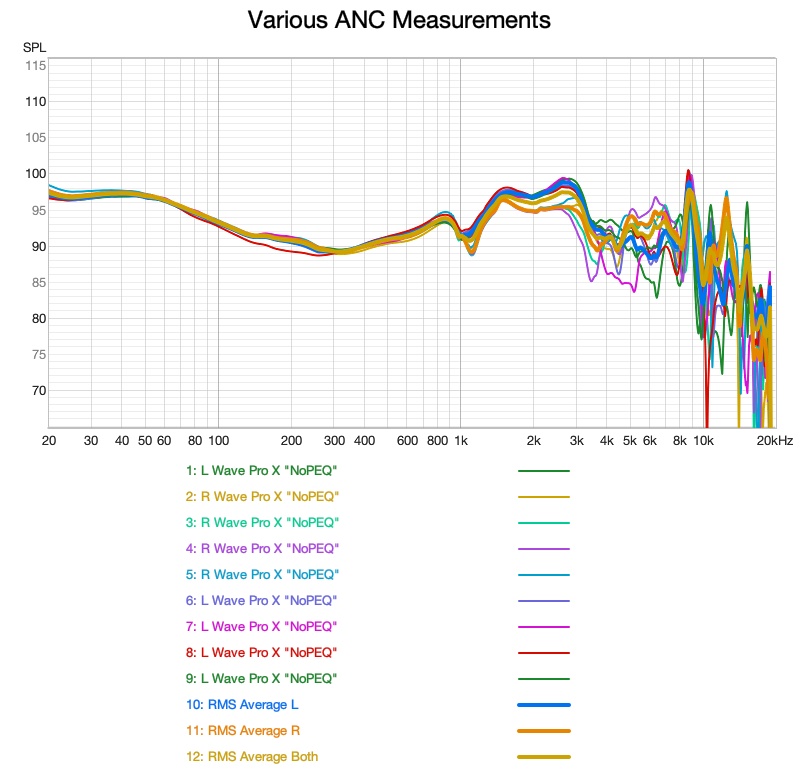
Below about 3kHz the seating variation is negligible, which tells you the seal is easy to achieve and that the bass you measure is the bass you will actually get. Above 4kHz the spread widens, which is normal pinna and coupler behaviour and is the reason I would not treat any single point above 8kHz as a hard number, basically my EQ recommendation is always to manually tune beyond 4kHz.
Compensated and averaged, this is what the default ANC tuning looks like against the target:
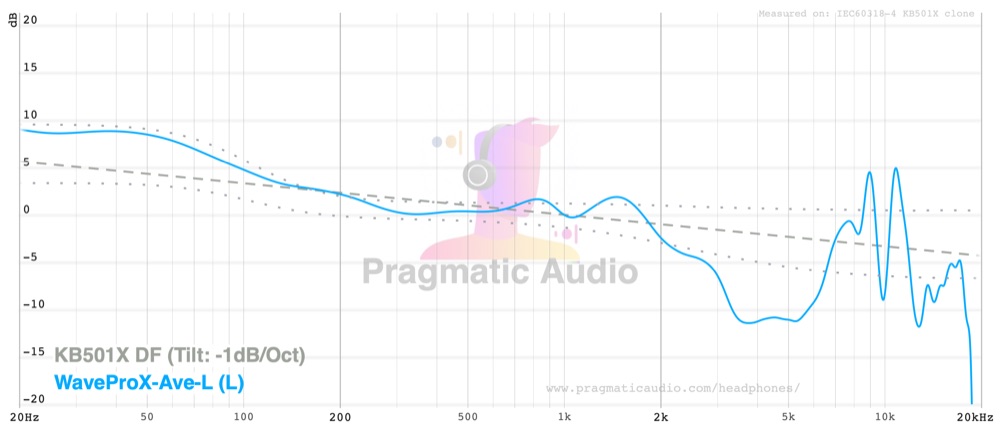
From 20Hz to about 1kHz this tracks the preference ranges within the tilted diffuse-field line closely, sitting only a few dB above it in the sub-bass — that is the well-judged, non-boomy bass I described above, and is a welcome restraint for an ANC headphone ( even my Sony WH1000XM5 have horrible boomy bass). From 2kHz the response falls away from the target into a broad depression centred around 3.5–5kHz that sits roughly 6–8dB low, then recovers with two narrow peaks near 8kHz and 10kHz. That single shape explains both listening complaints: the depression is the recessed lower treble that pushes vocals back, and the peaks are the hard cymbal edge.
Zooming in on the treble makes the two problems easier to separate — the broad dip marked 1 and the narrow peak marked 2:
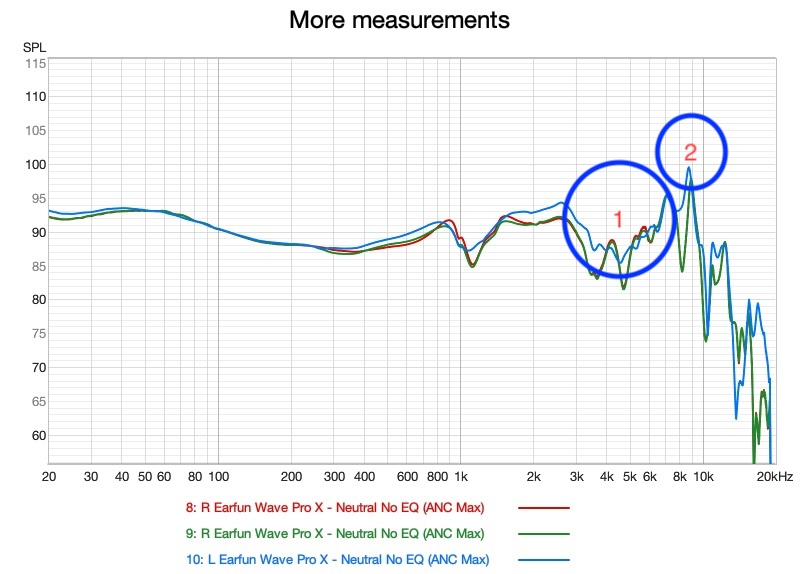
The dip is a tuning decision and PEQ fixes it with a wide, gentle boost. The peak is a resonance, roughly 8dB above its surroundings and narrow, and it needs its own notch filter. This is precisely the distinction that a 10-band graphic EQ cannot make.
Turning ANC off changes the tuning, and not subtly and this is probably my only major complaint about the tuning:
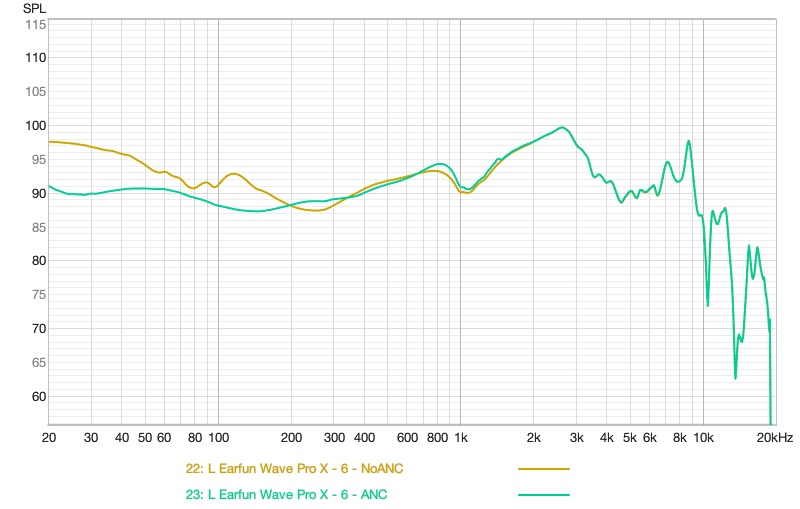
With ANC off there is roughly 6dB more output below 150Hz, while everything above 300Hz is essentially unchanged. That is worth knowing if you switch modes often, because your EQ profile is only correct for one of them. I did all of my listening and all of my EQ work with ANC on, since that is the mode an ANC headphone spends its life in.
Distortion
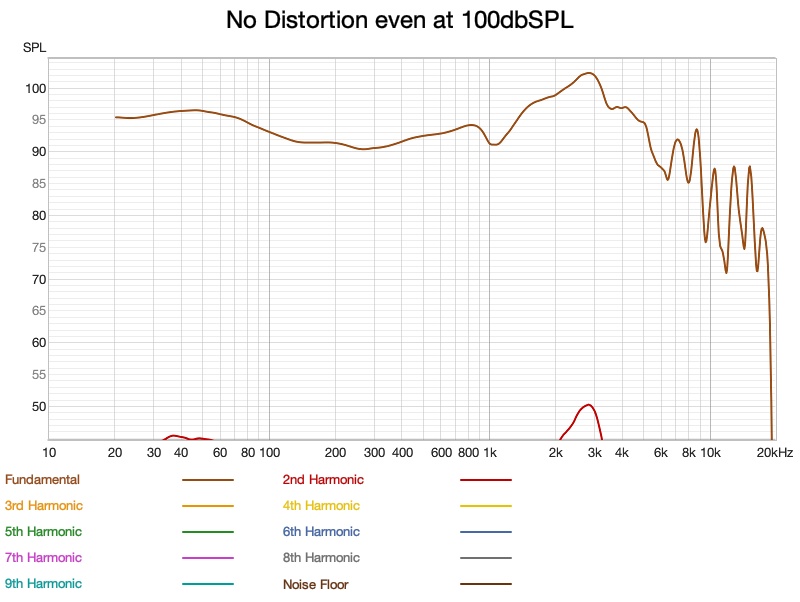
Distortion is a non-issue. Driven to 100dB SPL, the second harmonic stays around 45–50dB below the fundamental and everything above the second harmonic is buried in the noise floor:
 |
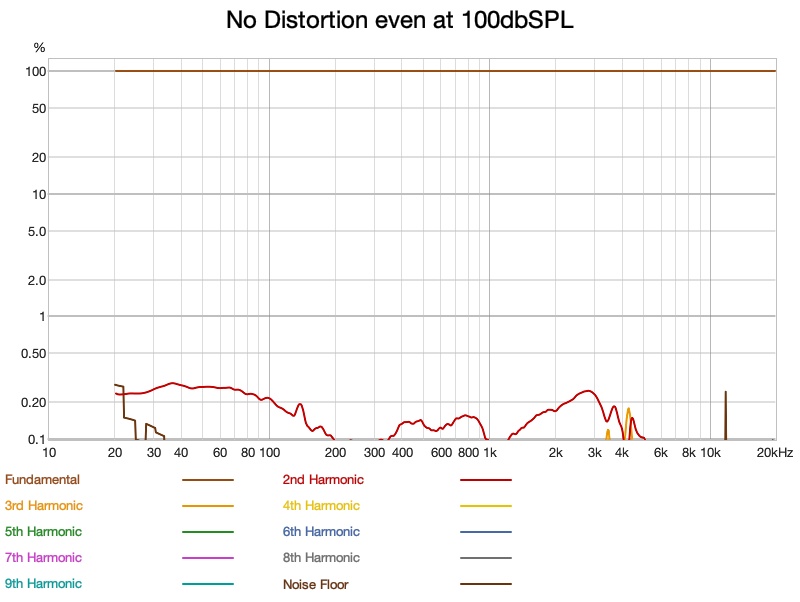 |
Expressed as a percentage that is under 0.25% across the entire range and mostly at or below 0.2%. The practical consequence is that you can apply the EQ boosts described below without worrying about running the driver out of its comfortable range — and it means the frequency response, not the driver’s linearity, is what limits this headphone. If there is one advantage where I would agree with Earfun choose of dual driver configuration it is probably the benefit it provides here.
What the Professional EQ can provide
This is the default average against my DF-tilted Professional EQ profile:
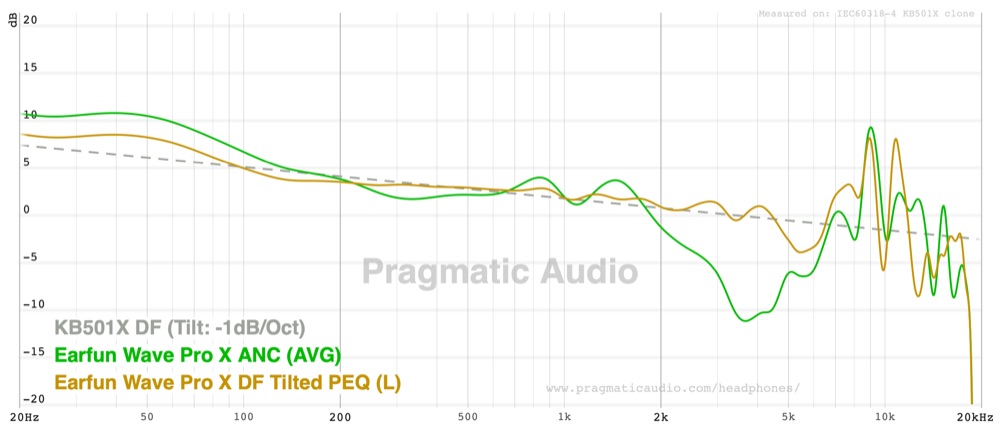
The 3–6kHz depression is filled back in to within a couple of dB of the target, the sub-bass comes down slightly ( this is much more a personal preference), and the result tracks the tilted diffuse-field line from 20Hz to around 6kHz. That is a very good response for a closed ANC headphone and it is what I have been listening to for the past week.
Here is the same pair on a tighter vertical scale, which makes the residual deviations easier to read:
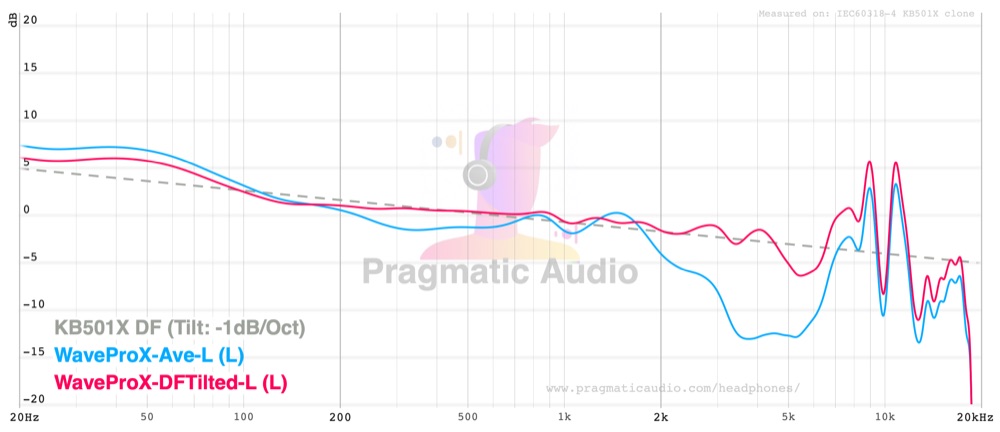
That measurement is from before I went any further with the treble, which I then did entirely by ear using sine sweeps. Note what the tilt does not fix: the 8kHz and 10kHz peaks are still there, and in places the PEQ profile makes them slightly more prominent because the surrounding region has been raised.
This is where I would argue against using the graph at all. I do not think measurements should be trusted above about 4kHz, because every headphone couples differently to every head up there — the raw repositioning sweeps earlier in this section show that spread on a single fixture, and a real pinna is worse. What my coupler says is an 8kHz peak may sit at 7kHz or 9kHz on your head, or barely exist. So the honest instruction is: run a sine sweep, listen for where it actually stings on your head, and put a narrow cut there. Do not copy my numbers for that region, and do not hand it to AutoEQ — an automated fit will confidently correct a resonance that is an artefact of my fixture rather than a feature of your listening. Below 4kHz the measurement is worth trusting and worth correcting to; above it, your ears are the better instrument.
Spend two of your ten bands on that, and you still have plenty left for tonal balance, which is more than any other headphone in this price range gives you.
EQ Recommendation
These are the six filters I have been using. They get the Wave Pro X close to diffuse field while deliberately leaving a little extra bass in — on an ANC headphone used in a genuinely noisy environment, some of the low end is masked by whatever the ANC has not removed, and I find the small lift makes up for it. Set the master gain to −10dB before you enter these, or the 3800Hz boost will clip:
Preamp: -10.0 dB
Filter 1: ON PK Fc 44 Hz    Gain -2.9 dB  Q 0.600
Filter 2: ON PK Fc 300 Hz   Gain  1.9 dB  Q 0.900
Filter 3: ON PK Fc 840 Hz   Gain -2.4 dB  Q 3.400
Filter 4: ON PK Fc 1500 Hz  Gain -3.6 dB  Q 3.100
Filter 5: ON PK Fc 2200 Hz  Gain  1.1 dB  Q 4.000
Filter 6: ON PK Fc 3800 Hz  Gain 10.0 dB  Q 1.700
Filter 6 is doing the real work — a wide 10dB lift centred at 3800Hz to fill the lower-treble depression. Filters 3 to 5 tidy up the narrow deviations either side of 1kHz, and filters 1 and 2 shape the bass.
I have only used six of the ten bands. The remaining four are yours: spend two on the treble resonances once a sine sweep has told you where they actually sit for you, and the last two on whatever you want to adjust to taste. Copy filters 2 to 6 verbatim (use Filter 1 for bass preference), then do the top end by ear. No other headphone at this price leaves you that much room to work in.
I did not measure the app’s EQ presets — Bass Boost and the rest — this time round. I expect they behave the same way relative to the default response as the equivalent presets on the Wave Pro, which I did measure, so that review is the place to look if you want to know what each preset does.
Comparisons
Against the EarFun Wave Pro and Tune Pro
The family comparison is instructive, because the Wave Pro X is not simply a better-tuned Wave Pro:
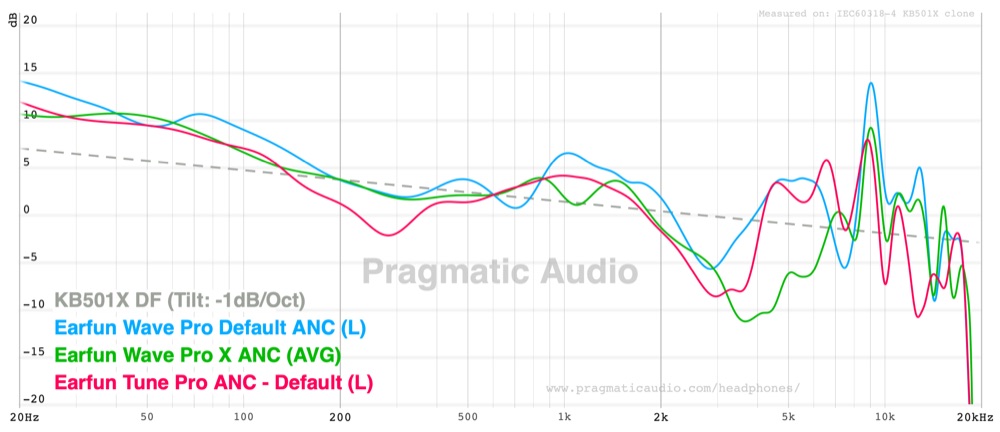
The Wave Pro has noticeably more sub-bass and a small bump around 1kHz, and it is actually less recessed through 2.5–5kHz than the Wave Pro X. Out of the box, the original is the safer tuning. The Tune Pro sits between them, with a similar dip that recovers earlier. What the Wave Pro X buys you is not a better default curve — it is a better driver with lower distortion, better ANC, better microphones, and the PEQ needed to put the curve wherever you want it. If you are not going to use the PEQ and your budget is under $100, the Wave Pro is still the sensible purchase.
Against the Apple AirPods Max and Nothing Headphone (1)
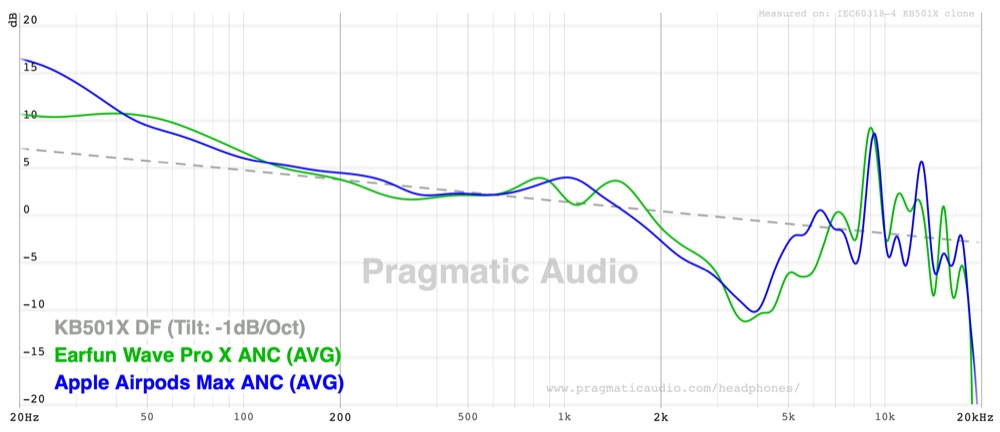
The Wave Pro X default tuning is not arbitrary. Put it next to an AirPods Max and the family resemblance is obvious:
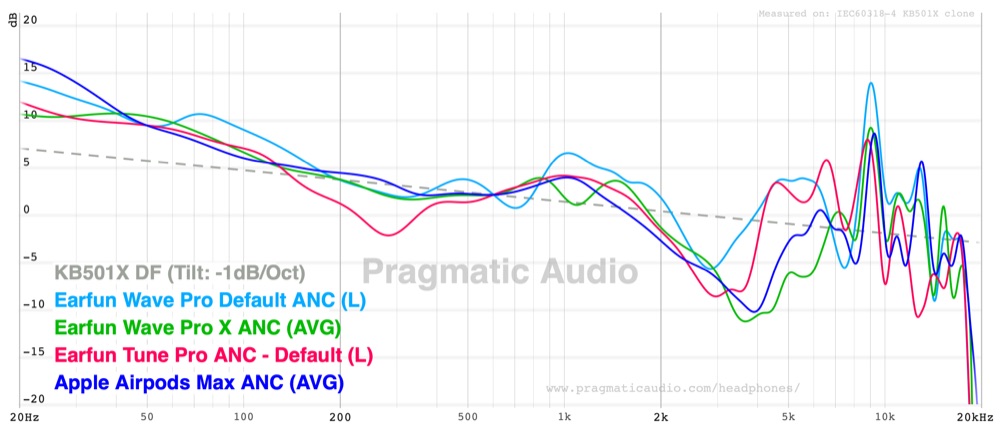
Isolated, the two curves are close enough that I would call the Wave Pro X’s default a deliberate imitation of the AirPods Max house sound — similar bass shelf, similar broad depression through the lower treble:
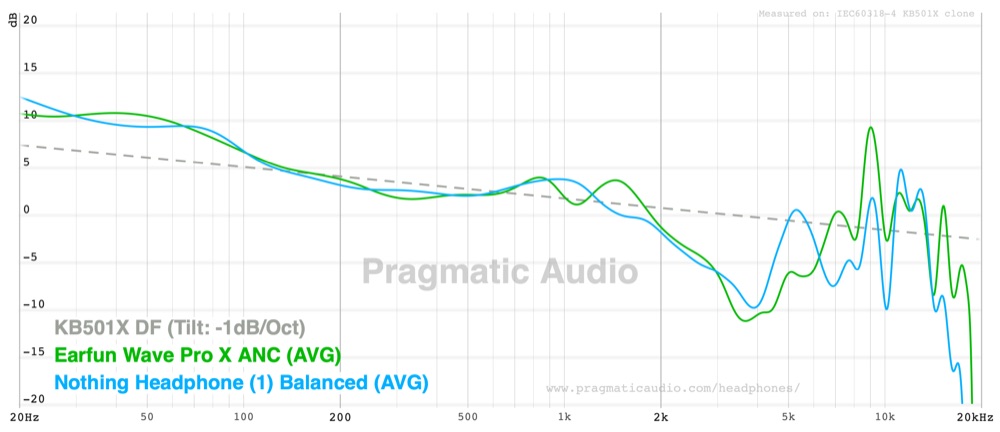
The same is true of the Nothing Headphone (1) in its Balanced setting, which tracks the Wave Pro X almost exactly from 20Hz to 2.5kHz and shares the same lower-treble dip:
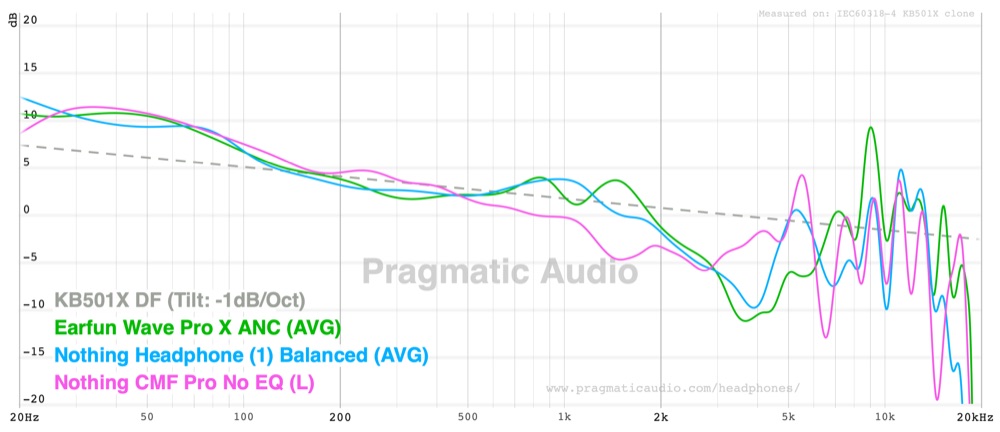
Add the CMF Headphone Pro and the Final UX3000 and the picture fills out. The CMF starts pulling down earlier, from around 700Hz, which recesses the upper midrange as well as the lower treble — a harder problem to live with than the Wave Pro X’s, and harder to fix with the EQ the CMF gives you:
 |
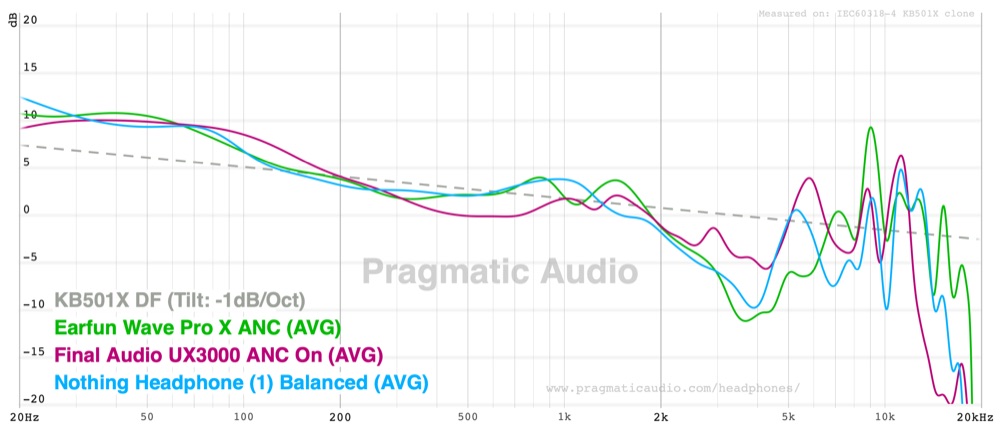 |
So the honest framing is this: a lower-treble depression is the current default across a lot of consumer ANC headphones, including a $549 one. The Wave Pro X is not worse than its peers here — it is the only one of them that hands you the tools to correct it properly ( though the Nothing Headphone (1) does have limited PEQ ).
Adding my DF-tilted profile to that AirPods Max comparison shows what “correcting it properly” means in practice:
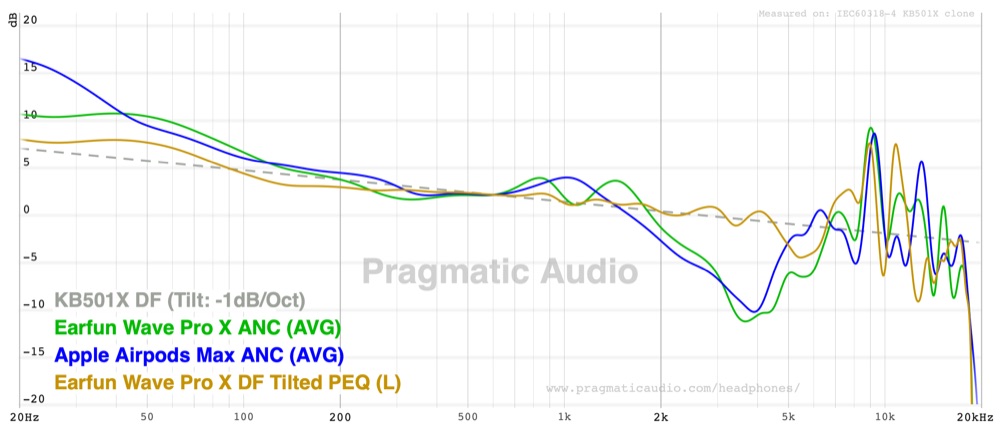
There is one thing the flagships in this comparison do that the Wave Pro X does not, and it is the feature I would most like EarFun to add next. The AirPods Max — and the Bose, and Apple’s newer AirPods Max 2 — implement some form of Adaptive EQ: the headphone listens to what is actually arriving at your ear through its own microphones and corrects for the seal it is getting, in real time. The practical benefit is a consistent bass response regardless of how the headphone happens to be sitting, whether you wear glasses, or how much hair is in the way. It is a different kind of correction from anything in this review: my PEQ profile fixes the tuning, but it assumes a seal, and it cannot do anything about the seal changing while you walk.
That matters more than it sounds. The repositioning sweeps earlier in this review showed very little variation below 3kHz — but that is a measurement fixture, clamped consistently, with no glasses and no hair. A real head is a harder problem, and the low end is exactly where a broken seal costs you the most.
So this is the gap I would point EarFun at. They have already built the harder half: eight microphones that are clearly good enough to drive competent ANC, and the DSP to run a ten-band parametric filter set. Adaptive seal correction uses the same microphones and the same DSP. Combine real-time seal compensation with a user-definable 10-band PEQ and you would have something neither Apple nor Bose currently offers — Apple gives you the adaptive correction but no meaningful user EQ, and EarFun gives you the EQ but no adaptive correction. Whoever ships both first has the killer feature in this category, and EarFun are closer to it than Apple are.
Against the Sony WH-1000XM5, Sonos Ace and Moondrop Edge
Moving up and sideways in price:
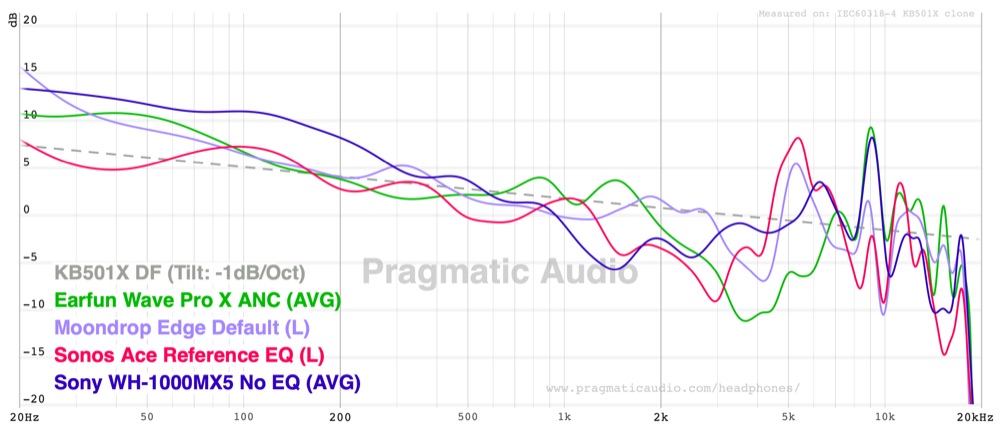
My Sony WH-1000XM5 with no EQ carries considerably more energy from the sub-bass through the lower midrange, which is the thickness I hear when I switch to it — a warmer, heavier presentation that works well on a plane and less well for acoustic material. The Moondrop Edge has a large sub-bass lift and a suckout through 1–2kHz, which is a worse place to have a hole than 4kHz. The Sonos Ace with its Reference EQ tracks the target well and is the closest of the three to a neutral default, at roughly three times the price.
Against the Tanchjim Rita, FiiO EH13 and UGreen Max5C
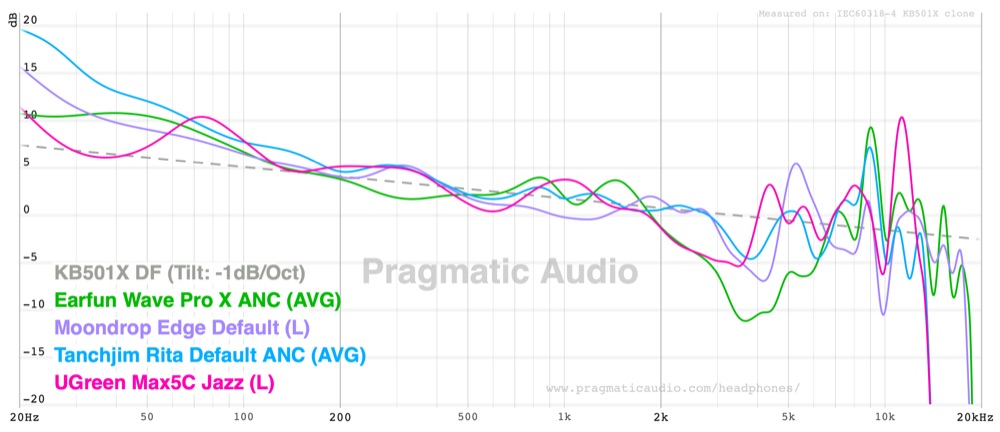
This is the group the Wave Pro X actually competes with on price:
 |
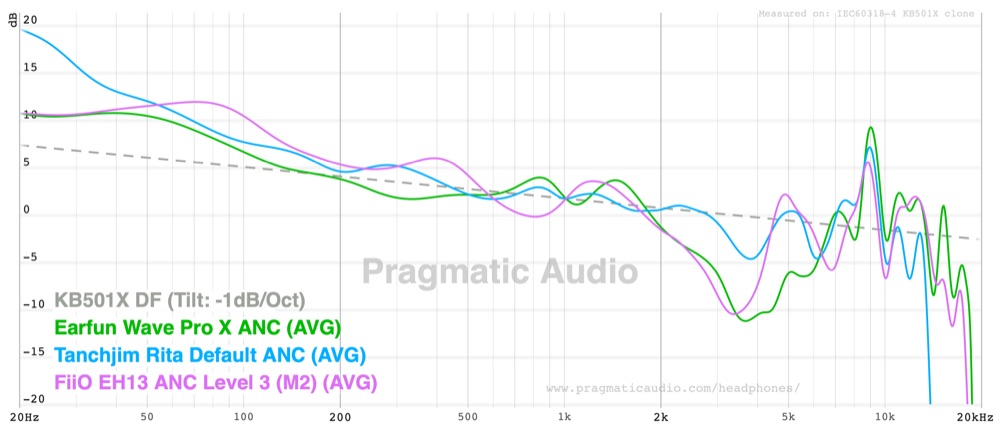 |
The Tanchjim Rita is the one honourable exception in this price bracket: its default ANC tuning tracks the tilted diffuse-field line closely all the way up, including through the 3–5kHz region where everything else falls over. If you want a near-reference response with no EQ work at all, the Rita is the one to buy. The reason I still reach for the Wave Pro X is comfort — as the earpad photo above shows, the Rita’s cups are small enough that I cannot wear them for as long, and comfort decides which headphone actually gets used.
The FiiO EH13 has a mid-bass hump through 80–400Hz that makes it warmer than either, and its own 2.5–5kHz dip of similar depth to the Wave Pro X’s, without a comparable EQ to fix it. The UGreen Max5C in Jazz mode is closer to the target than the EH13 but has its own narrow peaks in the same treble region.
The PEQ Cohort Compared
The Rita, the Edge and the EH13 are the headphones that matter most here, because they are the other ANC headphones with on-device parametric EQ — the feature that decides what any of them can be made to sound like. Everything below is drawn from my own reviews of each:
| EarFun Wave Pro X | Tanchjim Rita | Moondrop Edge | FiiO EH13 | |
|---|---|---|---|---|
| Price | $129.99 | $89.99 | $89.99 | ~$50 |
| Parametric EQ | 10-band, selectable filter types | 12-band | 5-band | 10-band, replaces the default tuning |
| Other EQ | 10-band graphic, presets, preference wizard | Presets | Presets, community profiles | Presets |
| Bluetooth | 6.0 | 6.0 | 5.4 | 6.0 |
| Codecs | SBC, AAC, LDAC, aptX family, LC3 | SBC, AAC, LDAC | SBC, AAC, LDAC | SBC, LDAC |
| ANC | Hybrid, adaptive, four levels | Hybrid, strongest of the sub-$100 group | Hybrid, weak in the midrange | Hybrid, up to −42dB, three levels |
| Wind noise mode | Yes | — | — | None |
| Battery ANC on / off | 50 h / 90 h | 51.5 h / 92 h | — | 45 h / 75 h |
| Wired input | 3.5mm and USB, ANC works on both | 3.5mm, passive when flat | 3.5mm | 3.5mm |
| Travel case | Yes | Yes | No | No |
| devicePEQ support | App only at the time of writing | Yes | Yes | Yes |
The first thing that stands out is that band count is not the story. The Rita has twelve, the Wave Pro X and the EH13 both have ten, and the EH13 costs $50 — so if raw band count were the deciding feature, the cheapest headphone here would already be good enough and the Rita would win outright. Only the Edge is genuinely short-handed at five, which is enough for broad tonal shaping but not enough in my opinion to also chase treble resonances.
But I feel with the Wave Pro X it is the other flagship level features that make it stand out, with the widest codec support of the four, a wind mode, ANC that works over both wired inputs, a case, and the best comfort.
Features the Wave Pro X Does Not Have
But there are a few features it loses to the larger group of ANC headphones I compared it to above. There is no wear detection, so it will not pause when you take it off — the Sony, the AirPods Max, the Sonos Ace and the Sennheiser Accentum Plus all do this. And there is no quick-transparency gesture; every mode change goes through the button. And there are no touch controls on the earcups which, to be honest, I feel is a feature as they can be very annoying.
Rating Explanation
The pragmatic rating is 5 because, for $129.99, this is the best sub-$200 ANC headphone I have used. The comfort is better than everything else I compared it against below $200, the ANC is genuinely useful rather than a checkbox, the codec support is complete on both Android and iOS, distortion is low enough to take EQ boosts without complaint, and the Professional EQ turns a merely competent default tuning into effectively any target response you might want. The features rating is 5 for the same reason: ten parametric bands with selectable filter types and a master gain control is the most usable PEQ implementation shipping on a headphone right now, Auracast, LE Audio, multipoint, USB audio, analogue in, an ANC wind Mode and 50 hours with ANC on, is there as well.
The price rating is 5 because the nearest competitors on feature count cost three times as much.
The measurement rating is 4 rather than 5, and that is entirely about the default tuning. EarFun have aimed at the same target as Apple and Nothing rather than at an audiophile one, and I understand why — that is where the volume is in this market. It will not appeal to anyone who wants a reference response out of the box, and the broad depression through 3.5–5kHz pushes vocals back in the mix while the narrow peaks near 8kHz and 10kHz add a hard edge to cymbals. With the Professional EQ this becomes a 5 — but the rating has to reflect what comes out of the box, and what comes out of the box needs some work I feel. The saving grace is that the audiophile is precisely the buyer best equipped to fix it, and has been handed the tools to do so.
The other genuine measurement limitation is the ANC to non ANC differences in FR.
Conclusion
I feel EarFun have done a very nice job with the Wave Pro X, and they have put full PEQ on a headphone that is comfortable enough to wear all day, quiet enough to work in, and cheap enough that the decision is easy.
The default tuning will not win an audiophile over on first listen, and it is not trying to — it aims at the same place the AirPods Max and the Nothing Headphone (1) aim, which is where most of the consumer buyers are. What should win an audiophile over is everything sitting behind that default. The EQ is where EarFun have spent their effort, the ANC has moved up a tier, and both of those change what you hear in a way that wear detection and touch panels never will. Out of the box the Wave Pro X is already better than the Moondrop Edge, the FiiO EH13, the Nothing Headphone (1), the CMF Headphone Pro and the Sennheiser Accentum Plus, and better built and more comfortable than any of them.
Spend 10 minutes with the Professional EQ and a tone sweep, and it becomes an exceptionally well tuned headphone that properly shows off everything you should want in an ANC headphone, this is my new easy recommendation for an ANC headphone under $200.